
Mimsy Review: A Fifteenth Century Cookry Boke
Around the net
Review of A Fifteenth Century Cookry Boke•, with a recipe for Prymerose.
| Author | John L. Anderson |
|---|---|
| Publisher | Charles Scribner’s Sons |
| Year | 1962 |
| Length | 92 pages |
| Book Rating | 5 |
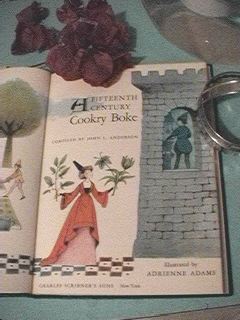
This is not really a cook book. That is, you aren’t expected to get any useful recipes out of it. Printed in 1962, before the beginning of the “historical re-enactment” craze, it actually reprints fifteenth century recipes verbatim. They were compiled by John L. Anderson•, taken from various fifteenth century (1400s) texts from museums around England. A glossary in the back explains what some of the words mean, and you need it. A few of the recipes are almost readable:
Take percely, and grynde hit wiþ vynegre & a litel brede and salt, and strayne it þurgħ a straynour, and serue it forþe.
The ‘thorn’, which shows up often, is generally pronounced ‘th’. So this reads:
Take parsely, and grind it with vinegar and a little bread and salt, and strain it through a strainer, and serve immediately.
The ‘u’ and ‘v’ are often pronounced ‘v’ and ‘u’, respectively. Those wacky ancients! But it was fairly easy to figure out that one. Now, try:
Nym Rys, an bray hem wyl, & temper hem with Almaunde mylke, & boyle it; & take Applys, & pare hem, an smal screde hem in mossellys; þrow on sugre y-now, & coloure it with Safroun, & caste þ-to gode pouder, & serue forth.
According to the dictionary, “Nym” is “take”. But “Rys” isn’t in there: the closest is “Ryse; Raise”. Take raise, and grind them well? No. Leigh Clayton wrote me and relieved my confusion: “Rys” is rice. The “y” is long. So take your rice and bray hem wyl. The book has the following sections:
- Fleysshe (Meat)
- Fysshe (Fish)
- Byrdys (Poultry)
- Mete Pyes & Tartes (sound it out)
- Daryoles & Other Tartes & Frittours (Meat Tarts and Fritters)
- Mylke, Eyroun & Notys (Milk, Eggs, and Nuts)
- Frutes & Flowres
- Potages Dyuers (Varous Soups—remember, ‘u’ is often ‘v’)
- Sauces pur Diuerse Viaundes (Sauce for Various Meats)
- Cakys, Bredes & Amydon (Cakes, Breads, and apparently some kind of sourdough; the dictionary is coquettish on what it means; in fact, it doesn’t give a definition at all, except to see the recipe, which is of course clear as mud but seems to involve leaving wet wheat out for nine days)
- Swetes
Most intriguing is the number of flower recipes. That “Fruit and Flower” chapter is not a bastardization of “Flour”, it means cooking with Primrose and Hawthorn flowers and something called “Flower of Rys” which might explain our recipe above.
If you’re keeping score, the recipes come verbatim from the Harleian manuscripts 279 and 4010 (about 1430 and 1450, respectively), the Ashmole manuscript 1429, the Laud manuscript 553, and the Douce manuscript 55 (about 1450) from the British Museum and the Bodleian Library, courtesy the Early English Text Society.
A Fifteenth Century Cookry Boke• is intriguing for occasionally flipping through—you aren’t going to read it straight without going bonkers in the process—but you aren’t going to get much in the way of usable recipes from it. Unless, of course, you understand fifteenth century English, in which case, serue hem forth!
Prymerose
- Take oþer half-pound of Flowre of Rys, .iij. pound of Almaundys, half an vnce of hony & Safroune.
- Take þe flowre of þe Prymerose, & grynd hem, and temper hem vppe with Mylke of þe Almaundys.
- Do pouder Gyngere þer-on.
- Boyle it.
- Plante þin skluce with Rosys.
- Serue forth.
If you enjoyed A Fifteenth Century Cookry Boke…
For more about cookbooks, you might also be interested in A Concise Encyclopedia of Gastronomy, Bull Cook Historical Recipes, Cavalier Cooking, Classic Chinese Cuisine, Cooking the Bahamian Way, Country Commune Cooking, Life, Loves, and Meat Loaf, The Art of Korean Cooking, The Casserole Cookbook, The Complete Book of Oriental Cooking, The Complete Bread Cookbook, The Frugal Gourmet Celebrates Christmas, The Healthy Cuisine of India, The New Larousse Gastronomique, A Decade of Jell-O Joys: 1963-1973, Saucepans and the Single Girl, The Northwest Cartoon Cookery, Good Food From Mexico, Laurel’s Kitchen, The Cooking of Vienna’s Empire, James Beard’s Fireside Cook Book, French Bistro Cooking, Crockery Cookery, Southern Cooking, The Frugal Gourmet Keeps the Feast, The Fannie Farmer Cookbook, French Cooking Simplified With a Food Processor, In Good Taste, Heritage of America Cookbook, Our Favorite Hometown Recipes Vol. II, The Indian Spice Kitchen, Japanese Country Cookbook, La Cuisine Française, Larousse Treasury of Country Cooking, The Natural Foods Cookbook, A Russian Jew Cooks in Peru, Soul Food Cook Book, The Tassajara Trilogy, Pains Spéciaux & Viennoiseries, Whole Earth Cookbook, The Wok: a chinese cook book, Southern Living Cookbook for Two, Lebanese Cuisine, The Art of Syrian Cookery, Popular Greek Recipes, In a Persian Kitchen, The Art of Pennsylvania Dutch Cooking, The Southern Living Cookbook Library, The Donna Rathmell German Bread Machine Cookbook collection, The missing indexes, St. Mary’s Altar Society Cookbooks, The Deplorable Index, My year in food: 2022, My Year in Food: 2023, My Year in Food: 2024, My Year in Food: 2025, Franklin Golden Syrup Recipes, Promotional cookbook archive, Finding vintage cookbook downloads, Chiquita Banana’s Recipe Book, A golden harvest of sunflower seeds, A 1950 recipe calendar for 2023, Hope Lutheran 1950 Lenten fish au gratin, Tempt Them with Tastier Foods: Second Printing, Mrs. Winslow’s Domestic Receipt Book for 1876, Stoy Soy Flour: Miracle Protein for World War II, A Traveling Man’s Cookery Book, Rumford Recipes Sliding Cookbooks, Using ingredients to guess cookbook years, Four New Ices and an Ice Cream Cookery, Ice Cream Cookery, Second Printing, A Bicentennial Meal for the Sestercentennial, Padgett Sunday Supper Club Sestercentennial Cookery, Refrigerator Revolution Revisited: 1928 Frigidaire, Refrigerator Revolution Revisited: 1942 Cold Cooking, Refrigerator Revolution Revisited: 1937 Kitchen-Proved, Padgett Sunday Supper Club, Club recipe archive, Promotional Cookbook Archive, Cookbook publication year estimates I have made, and Club Padgett Cookery Errata.
- A Fifteenth Century Cookry Boke•: John L. Anderson (hardcover)
- Nicely odd book for your shelf, either your kitchen shelf or your gaming shelf!