


To the ends of the earth

Over on the MIT Technology Review, Nick Bostrom writes about the Great Filter (hat tip to Hit & Run). The Great Filter is one side of possibly the most important question for humanity. The problem is that some of us are violent creatures who want to cause mass destruction. And some of us are short-sighted creatures who do so by mistake. The means of causing mass destruction always get easier, never more difficult. The amount of mass destruction we know how to create always grows.
Presumably, we don’t want this to happen, but how to stop it? Prohibition laws don’t work. Whether it’s marijuana or nuclear weapons or a deadly supervirus, anyone with the wherewithal to acquire it and the desire to acquire it can and probably will acquire it. For nuclear and other population-destroying weapons, the wherewithal barrier is still fairly high. But it gets smaller every year. Someday it will be easy for terrorists to acquire nuclear weapons; soon afterwards it will be easy for other criminals to acquire them. At some point it will be easy for any depressed individual on your block to get or make something or buy something that will destroy millions or billions of people.
Laws have failure rates. Usually fairly large ones or, catch-22, they wouldn’t need to be laws. Unless the failure rate is under one in ten billion, they don’t matter to the Great Filter. Because, like the Internet, with these kinds of technology, it only takes one person to get past the laws and destroy humanity.
Laws will not stop them. We need to make sure that by the time the wherewithal barrier gets that low, the desire barrier has risen to the point that nobody wants to breach it. We need to ensure that nobody wants to use these kinds of destructive technologies, and we need to do so before it becomes so easy to make them that anybody who wants them can have them.
- March 25, 2020: Media Scare Machine: The Sky is Falling
-
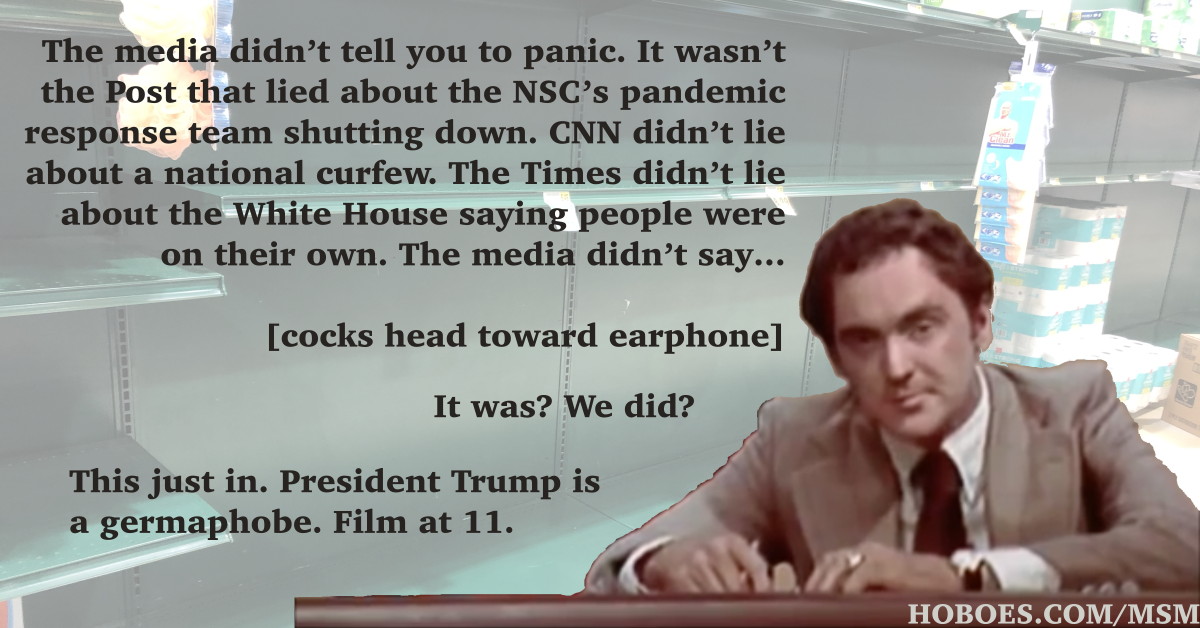
… the man who never looks into a newspaper is better informed than he who reads them, inasmuch as he who knows nothing is nearer to truth than he whose mind is filled with falsehoods and errors. — Thomas Jefferson (Letter to John Norvell, June 14, 1807)
I was in a cab, these blog posts always start, but in this case it was a Lyft rideshare from downtown Raleigh to RDU airport two weeks ago on Friday the 13th. The driver started talking about how people were panicking and hoarding things that shouldn’t, objectively, matter, and I made the point that people shouldn’t have to be experts on the biology of obscure Chinese diseases. That’s what a healthy news media is for. But we don’t have a healthy news media. We have a sick media and so we have runs on toilet paper for no apparent reason.
This got the driver going off about how horribly the press, in general, was acting during this pandemic. How they seem to have no idea how biology works, or statistics, and how they pass on lies that deliberately create panic.
She was right. If you heard that the United States no longer has a response team for pandemics, as the Washington Post incorrectly reported, you might reasonably panic about needing to load up on medical supplies. If you heard that there was going to be a national curfew, as CNN incorrectly reported, you might decide to stock up on essentials. If you heard that Trump told the states they were on their own, as the New York Times incorrectly reported, you might very reasonably decide that hoarding the essentials is necessary.
And when I say “incorrectly reported”, I mean lied. There was nothing ambiguous about what they reported on. They took statements from the White House confirming that federal response teams had the states’ backs, and reported the opposite. They took a common-sense reorganization that strengthened our ability to respond to pandemics, and lied that it removed our ability to respond. And they completely made up the curfew rumor, as far as I can tell.
All to deliberately cause a panic to sell papers and feed their hatred of the President.
- August 14, 2019: The media’s Trump hatred causes mass murder
-
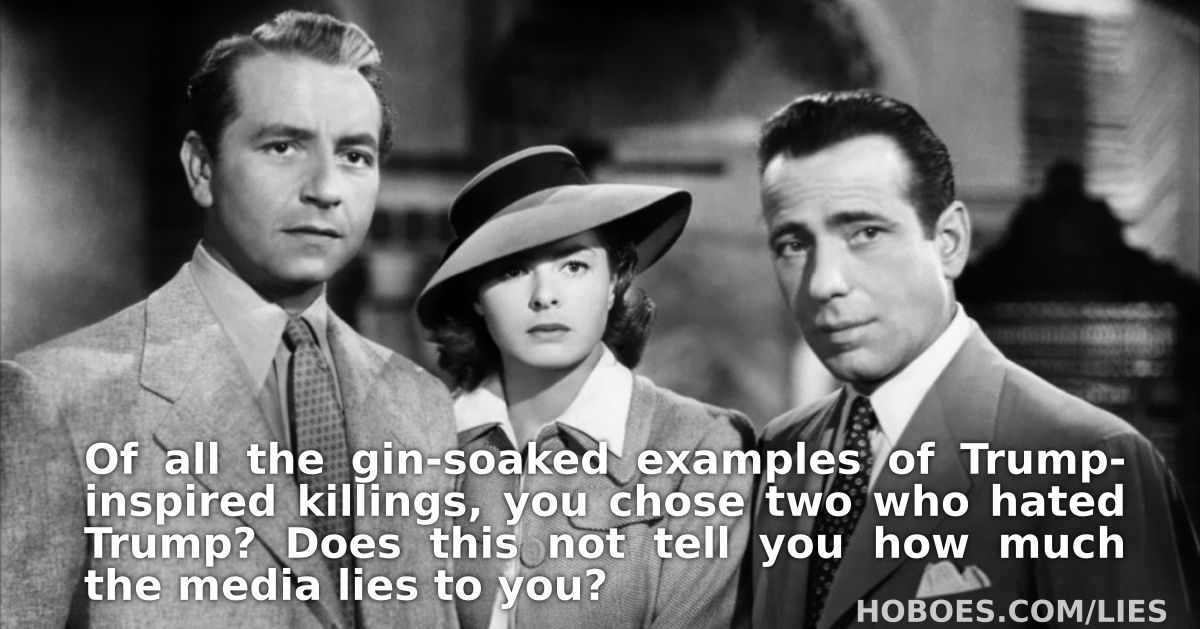
Why are the actions of a deranged environmentalist, worried that too many people harm the Earth—the El Paso killer—blamed on President Trump? The “current climate of hate legitimized by the MAGA ethic” is so much a part of the religion of the left that asking for examples is an insult to intelligence. Here’s what one person in my Facebook feed said when someone else questioned the left’s religion by pointing out that “Trump has outwardly, formally, and officially on several occasions announced his stand against all hate groups. Burning a church does not help to Make America Great Again, so no, it was not a MAGA inspired event.”
I have a very informed opinion about what is going on in this country. The flames of bigotry and hate are being fueled and condoned by Trump. I won’t insult your intelligence by citing the numerous documented instances. Bottom line for me; You as a minority supporting this man is akin to a victim of child abuse listening to MJ.
This is extreme condescension, and emblematic of the way the left infantilizes anyone who disagrees with them. The attempt to shame a minority into returning to the left’s plantation. Disagreement among the groups they feel they own is especially appalling to the white left; when they lose control over their subject identity groups it’s like a child abuser losing access to their victims. They lash out.
But there’s also the dig about insulting your intelligence. Realizing that just about every “numerous documented instance” turned out to be a hoax, I asked for an example. He posted two.
The anti-Trump (at best) New Zealand Christchurch killer. And the anti-Trump synagogue shooter here in the United States.1
Those are two very good examples of how blind hatred of Trump is at best self-defeating and at worst is fueling the deadly hatred the left claims to oppose. Blaming Trump for fueling those killings is coming out unequivocally in favor of hatred. The only way Trump or any political leader could have adjusted their speech to appease the synagogue shooter or the New Zealand shooter would have been to engage in hate.
- July 11, 2018: Showboat media and showboat killers
-

I’m not sure how you would design a cover to play more to the narcissism of showboat killers.
This is a near-perfect example of how difficult it is to stop incentivizing showboat killers. This is why they plan and perform their over-the-top crimes: because it works. There are a handful of people right now, thinking about this Time-Life cover, seriously planning out how to top one of the pictured assassins, to get their face and name on the cover of the next special to succumb to the showboat killers’ gambit.
As I wrote earlier, inciting killers in this manner shouldn’t be illegal. It ought to be beyond the boundaries of what any sane editor would publish. Much of our problems today are not something that better laws can fix; they require more introspection on the part of the media and politicians.
It’s another example of how the Topper mentality (to steal from Dilbert) absent any sense of responsibility is not just indirectly dangerous to the public discourse, but also directly dangerous. Time-Life didn’t put out this cover and special because it’s in the public interest; they designed it specifically to be more edgy, more offensive, to break more boundaries than their past offerings. This special did not need to be presented this way to report news nor to explain history, not even news or history on this topic—they could, after all, have focused on the results rather than on the perpetrators. They wrote this special and led with this cover for the same reason showboat killers keep trying to top each other: they did it to become news.
The only thing worse than being talked about for having incited a showboat killer is not being talked about at all.
And of course it works, because unlike showboat killings, there’s no way to talk about how this cover works to create more showboat killings without talking about the cover itself. The egregiousness of this cover can’t be explained in words as well as it can be seen, in its blood-red cover and glamorizing head shots. It seems designed specifically to play to the narcissism of potential showboat killers.
- March 14, 2018: Civil rights vs. showboat killers
-
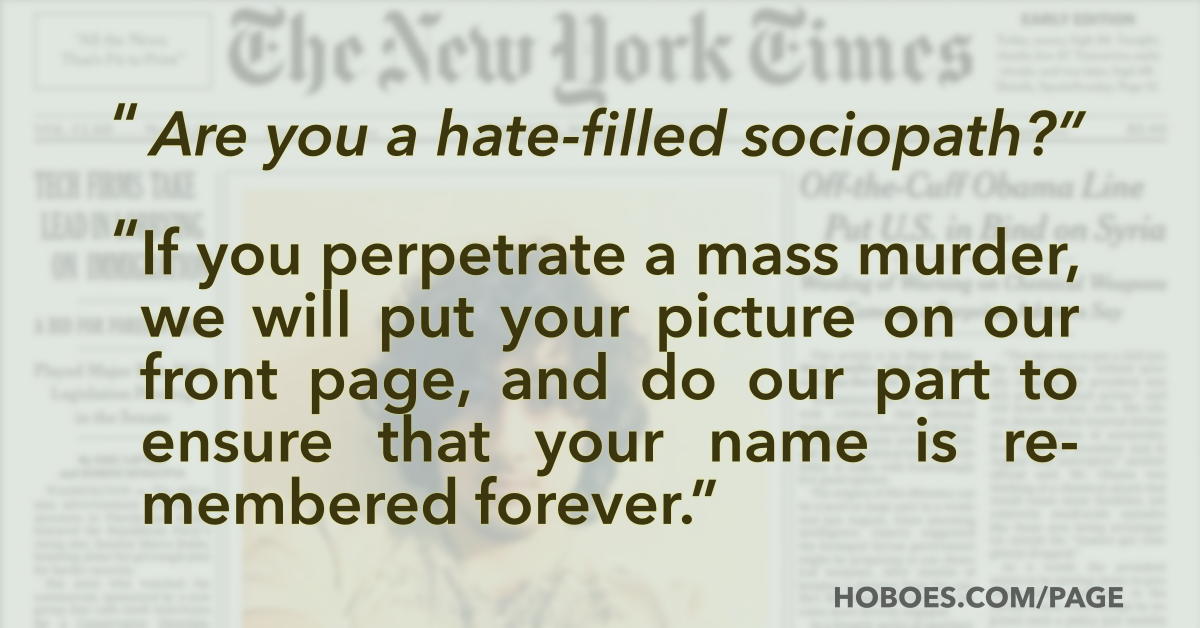
“The above paragraph is not the formal policy of… much of the mainstream media, but it amounts to the de facto policy.”—Dave Kopel
Most of the gun laws continually recycled after a mass shooting require the insane belief that criminals would suddenly start obeying this law, even though they’re willing to commit mass murder. They make no sense. If anything, such laws would increase the numbers of mass murders by creating more areas where only criminals are allowed to carry firearms. Such laws would tear at the self-defense rights of the law-abiding, and do nothing to protect them.
Even the people who propose these gun bans eventually admit, if you press them, that their proposals wouldn’t have stopped the mass murder they’re using as justification.
But what if there were a civil right we could infringe on that would stop such mass murderers? What if there were a law we could force the law-abiding to follow that would mean no more Parklands?
It does exist. Psychologists and commentators across the political spectrum recognize that these particular kinds of mass murders are done because the killer wants recognition. They know they’re going to get media attention, and lots of it, if they (a) use a gun, and (b) kill lots of people.
That’s why the vast majority of these killings take place in places where only criminals are allowed to carry firearms, even though such places are a tiny minority of places where people gather in the United States. Because the killers don’t want to be stopped before they kill enough people to make the news, and they know that if they’re stopped because one of their potential victims has a self-defense weapon, they either won’t make the news or their fame will be brief.
Columbine was meant to be spectacular, and it has beckoned mass shooters ever since as an example, a template, and a challenge. They study it, and they try to top it in terms of either body count or showmanship. From suicidal ideation grows the delusion of grandeur; from the desire to kill yourself grows the desire to kill as many people as possible, with immortality on the line.
- February 28, 2018: Flying blind in Broward County
-
We are beginning to see what went wrong in Parkland, and how badly. It is looking ugly, and incomprehensible, just how badly local and federal law enforcement screwed up. Last week I wrote about the parent who said:
It seems inconceivable that he was allowed to legally buy the gun and that he was able to get access to the school.
And it does seem inconceivable. We have a National Instant Criminal Background Check System specifically to stop exactly this kind of killer. The school had a deputy on campus specifically to keep this kind of killer off of school grounds. It seems even more inconceivable that Broward County had a program in place that specifically helped the killer bypass the NICS.
In Florida, one of the nation’s largest school districts has overhauled its discipline policies with a single purpose in mind — to reduce the number of children going into the juvenile justice system.
It’s a move away from so-called “zero tolerance” policies that require schools to refer even minor misdemeanors to the police. Critics call it a “school to prison pipeline.”
Civil rights and education activists say the policy can be a model for the nation.
Under a new program adopted by the Broward County School District, non-violent misdemeanors—even those that involve alcohol, marijuana or drug paraphernalia—will now be handled by the schools instead of the police.
The problem with this is that, of course, if the local police don’t know about it—or, more likely, know about it but let the school deal with it—other police in other locales can’t know about it; and since the crimes are never prosecuted, they are never entered into the NICS. The other problem is system creep. It seemed to rapidly evolve to keep even violent crimes hidden, to the point that the deputy on campus apparently not only didn’t stop the killer but refused to share information that would have put the killer in the NICS.
- February 21, 2018: The Vicious Cycle of Mass Murders
-

It’s as if the Facebook ghouls are praying for mass murder.
Last week there was another mass shooting in an area where only criminals are allowed to carry firearms.1 Immediately, Facebook began filling up with attacks on the people who didn’t do it. This is a standard cycle, now. It’s so obvious that the Facebook ghouls who take part in it have tried to turn it around on people who offer sympathy to the victims while waiting for the facts about the murders. A few days after the Parkland murders, I saw a meme with these steps on it:
- Mass shooting
- Thoughts and prayers
- Facebook debates
- Everyone forgets
- Congress does nothing
- Crickets chirping
But of course, everyone doesn’t forget. After the facts come out, it turns out that there are real solutions that would have solved these crimes, but those solutions aren’t gun control so it’s only the Facebook ghouls who forget—or, worse, blame the people trying to pass real solutions.
The real cycle looks more like this:
- There’s a mass murder in an area where only criminals are allowed to carry firearms.
- Before they could possibly know what actually happened, an army of Facebook ghouls calls for disarming the people who didn’t do it, and blaming NRA members.2 They try to capitalize on mass murders so rapidly that they will call for more gun bans even when the murders weren’t committed with guns.
- Other people wait for the facts to come in, and offer prayers and sympathy to those hurt by the murderer. The Facebook ghouls berate them both for waiting for the facts and for offering prayers and sympathy.
- When the facts come in, it turns out the government wasn’t doing its job enforcing the laws we already have. More gun bans wouldn’t have made a difference when the government isn’t enforcing current laws.
This is what happened in Sutherland Springs, when it turned out the federal government wasn’t doing its job—the killer should have been in the NICS. First, the left called for banning all guns3 and then they went silent when it turned out the real solution was to make the federal government do its job—and especially that the laws they reflexively called for would have resulted in more murders in Sutherland Springs.
This is what happened at the Pulse in Florida, when it turned out that the federal government wasn’t doing its job—the killer had been investigated by the FBI, who verified that he had threatened a mass shooting, and then they took him off of the list that would have notified law enforcement when he went to buy any firearm at all.
This is what happened at Fort Hood in 2009, at Washington Navy Yard in 2013, and Fort Bragg last year.
- October 6, 2017: How do we keep this from happening again?
-
Imagine this: you’re a police chief or an FBI district chief, and you get a notice from the automated warning system: a man who has twice been investigated because he threatened a terrorist attack has just bought a couple of firearms.
Do you investigate? Of course you do. And when you investigate, you find out that he also tried to buy body armor.
There is no question that you will act immediately to stop this terrorist attack before it happens.
This is the way that the Pulse nightclub attack should have been stopped. In the immediate aftermath, the left tried to turn the attack into a call for more gun control, but when the facts came out it turned out the terrorist would not have been affected by more gun control. He didn’t want to commit a gun crime. He wanted to kill people at a gay bar.
But also when the facts came out, we discovered that law enforcement should have been warned about him ahead of time. The terrorist had twice been investigated for threatening terrorism. The investigation came up inconclusive, with, according to the authorities, not enough evidence to put him in jail or even put him on the no-fly list. But it certainly seemed that there was enough to keep him on the lesser watch list that notifies law enforcement whenever there’s further suspicious activity.
Unfortunately, he was removed from that list.1 So law enforcement was never notified. Conservatives suggested fixing that; the NRA suggested fixing that; the people who had been calling for more gun control moved on to something else. If this has been fixed, I’m unaware of it; FBI Director Comey publicly stated that he didn’t think anything needed to be fixed, once it came out that it was the FBI that had removed the terrorist from the notification list.
- April 6, 2016: Europe, the West, and the graphs of destruction
-
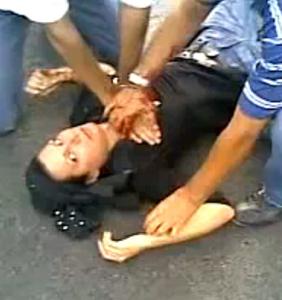
Her children will never speak against tyranny in Iran.
The significance of the graphs of destruction is that they empower individuals and small groups to cause mass destruction. Only one line on that graph is subject to alteration. The march of progress in medicine, biology, technology, physics, chemistry, and mathematics ensures that the technological line will always move down—it will always be getting easier for individuals to cause mayhem. Even improvements in our ability to travel quickly also improve the ability of people who want to kill to move to where they want to kill.
Our only hope is that people—our euphemistic “non-state actors”—don’t want to use new and easier technology for destruction when it becomes available.
We have, for the last eight years at least, been going about it wrong, 180 degrees from what we should be doing to affect the graph’s line of desire. It isn’t Iran that we have to worry about in the long run. It’s Iranians. Not Syria, but Syrians. Not China, but the Chinese. If we want to affect that line positively, we need to support the Green Revolutions, not their oppressors. The librarians of Cuba, not the Castros. The people of Iraq who voted Maliki out, and not Maliki. The people of impoverished countries and not their corrupt governments.
It is the children of the Green movement in Iran who will grow up abandoned by the United States who will cross the graphs of destruction. The children of Cubans who we threw to the Castros in favor of improving state relations.
Almost every aspect of our top-down foreign policy is wrong, from charitable organizations that put charity in the hands of corrupt governments to diplomats who prefer appealing to dictators rather than to the people the dictators oppress.
- January 2, 2012: California arson and the Great Filter
-
Two graphs converging: ability and desire. Over the last several days, an arsonist or group of arsonists has started thirty-nine fires in the Los Angeles area.
“Whoever is doing this is really messing with people’s lives,” said Los Angeles Fire Capt. Jamie Moore.
That’s an understatement.
What’s surprising isn’t that it’s happened, it’s that it doesn’t happen more often. I am amazed every time I go driving just how orderly people act in public. Watch the people driving on the other side of the road. Any one of them—all it takes is one—could cause massive death and destruction simply by swerving a few feet to the left.
Fires are incredibly easy to start, and if done randomly the culprit would probably never be found. If this arsonist had stopped at one, two, or even three, they’d probably never be caught. (Thirty-nine, I’m guessing they will. There’s too much opportunity for them to be seen.)
But not as quickly as they should have been. Listen to this from CNN:
Police are asking residents in the area to bring forward any surveillance video from their properties that might show suspicious activity. Residents are also being encouraged to follow the “see something, say something” motto and report suspicious behavior to authorities.
The police shouldn’t have to ask. Unfortunately, we’ve created a culture, especially in the cities but spreading to rural areas as well, that believes keeping order is something best left to the police, that there is no reason to get involved.
There is no way for the police to stop people who want to commit random acts of attempted murder like this before the attempt happens. Even the biggest police state can’t forbid or track all flammable materials. Cameras on every street corner still need people on every street corner to watch them; at best, computer heuristics could be reactive, making it easier to catch someone who has already started a fire, but even that assumes that the cameras themselves don’t become targets.
The only people who can stop a crime are people who are already there, either by stopping it or by immediately reporting it.
Random killers commit their crimes because they can, and because they want to, and because the repercussions of criminality are lower than their desire to be criminals. We can’t take away their ability to start fires; technology passed that point centuries ago. What we can do is slow down the increased population whose desire to start fires—or commit other forms of mass murder—exceeds the social barriers in place against starting fires.
- September 11, 2011: The graphs of destruction
-
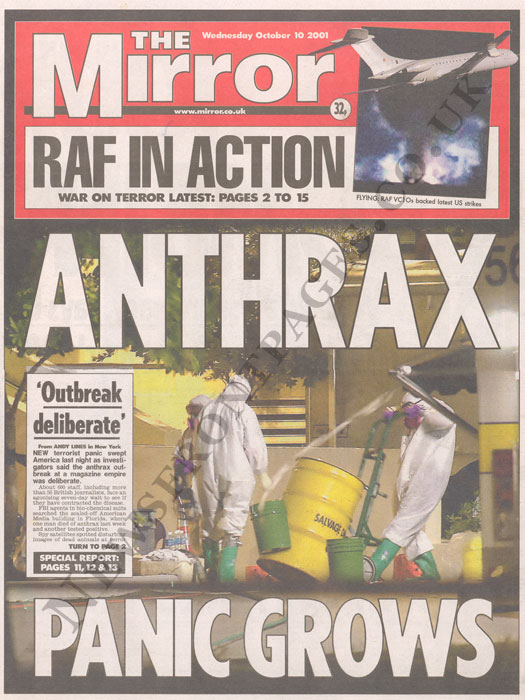
This looks like a science fiction magazine from the fifties.
Over on the Ace of Spades HQ, ArthurK mentions the technological singularity in passing as a way to talk about the social singularity on 9/11. He posts a newspaper front page from a month after 9/11 that would, to some pre-9/11 coma victim, look like a science fiction magazine.
The technological singularity is, basically, technology that advances so rapidly that we can’t recognize what’s on the other side. The technological singularity intersects with Arthur’s social singularity. Every year it is easier to kill more people: every year it is easier to make more advanced and powerful things—including things that can be used for attacks that will kill millions.
Imagine a graph along the years with two lines on it: “the resources necessary to kill millions” and “the resources of people who want to kill millions”. The lines haven’t normally crossed. The kind of person who wants to commit attacks of mass destruction doesn’t have much in the way of resources1.
The problem is that the line for “resources necessary” is dropping. It will eventually drop below the “resources of” line, at which point we’re screwed, and bad. In some cases the line is already dangerously close. We have to watch it not just in areas like “resources necessary to build a nuclear weapon” or “resources necessary to create a supervirus” but also in areas we don’t even foresee as killing areas. It isn’t just that it’s easier to make nuclear weapons or biological weapons. The cheapness of computers made flight simulators cheap, which increased the availability of flight training. It became cheaper to learn to fly airliners, and class sizes became large enough that instructors didn’t necessarily know every student.
- Homesickness
- Homesickness, an image designed for the water-themed Internet Ray-Tracing Competition.
- Where Are They?: Nick Bostrom
- “The more disconcerting hypothesis is that the Great Filter consists in some destructive tendency common to virtually all sufficiently advanced technological civilizations.”
- No ETs Is Good News for Humanity’s Future?: Ronald Bailey
- “So far the Search for Extraterrestrial Intelligence (SETI) has been a dud. Bostrom argues that there may be two explanations for this.”
More great filter
- The Vicious Cycle of Mass Murders
- We now know what went wrong. Let’s ignore the ghouls on Facebook and fix it.
- Europe, the West, and the graphs of destruction
- The solution to the graphs of destruction is the graph of freedom.
- California arson and the Great Filter
- The California arsonist is the wave of the future, unless we return to a society of “laws, not men.”
- The graphs of destruction
- Imagine a graph with two lines charted against the years: the resources needed to cause mass destruction, and the resources available to those who want to cause mass destruction. Those lines are dangerously close today.
More technology changing society
- Revolution: Home Refrigeration
- Nasty, brutish, and short. Unreliable power is unreliable civilization. When advocates of unreliable energy say that Americans must learn to do without, they rarely say what we’re supposed to do without.
- Future Snark
- Why does the past get the future wrong? More specifically, why do expert predictions always seem to be “hand your lives over to technocrats or we’ll all die?”
- The lost tradition of unannounced visits
- Once upon a time, if you were in the area of a friend, and you had extra time, you’d just drop in for a visit. You wouldn’t call first—phone calls were expensive. You wouldn’t text—there were no texts. You’d just show up. And you’d be even more likely to do this on holidays.
- Cell phones: threat to public safety
- Cell phones are a part of the decentralization of our society; they are a severe threat to those who prefer centralization and restricted channels of access.
- iPods and the future of social interaction
- The iPod--as part of the decentralization of media control--allows us to carve our own spaces, rather than having the “crass commercialization of public space” force us into marketing spaces of someone else’s design.