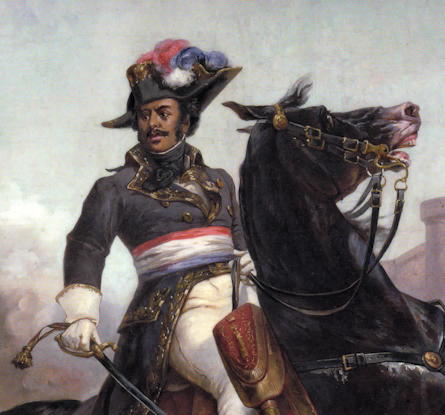
Anne of Austria
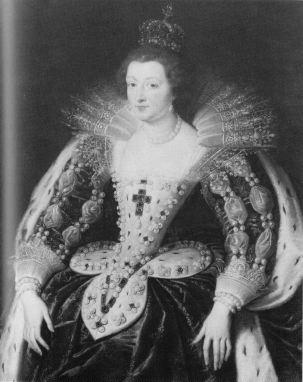
The Queen in The Three Musketeers, and the Queen Mother in Le Vicomte de Bragelonne, Anne of Austria had never been in Austria (Kleinman, ix). Her mother was Austrian, her father (Phillip III) was Spanish, as was she. Her full name was Doña Ana Maria Mauricia. She had been born September 22, 1601, putting her at 24 in The Three Musketeers.
As mentioned in The Three Musketeers, Anne’s Spanish attendants, starting in 1617 with Louis XIII’s ascendance, were dismissed by the king. Yes, that’s the right year: their marriage was finalized November 25, 1615, and consummated that night. (Kleinman, 26) They were perhaps quite young for their responsibilities. While Kleinman claims that most likely Louis successfully consummated their marriage, Moote (84-85) claims that he did not.
Far from being brash on his marriage night, he lost his nerve and did not recover it for four long years. He continued his habit of sleeping alone, visiting his wife ritualistically during the day and for a brief goodnight parting… Six months passed before the newlyweds ate a meal together. (Moote, 85)
For “fun-loving”, “rosy-cheeked” Anne, this must have seemed especially cold.
Anne played only a background role in opposition to Richelieu. However, “she listened approvingly to criticism of Richelieu and obstinately kept up relationships with people who were his enemies—not just because they were his enemies but because she felt they were her friends. This was unfortunate for her because Louis regarded opposition to Richelieu as opposition to his own will.” (Kleinman, 72)
Was Louis XIII the father of her children? There were rumors that the true father was Richelieu or Mazarin, but these were purely political: Anne loathed Richelieu, and Mazarin was not in Paris in 1637. No one seriously questioned the paternity of their first child. (Kleinman, 105)
Louis XIII
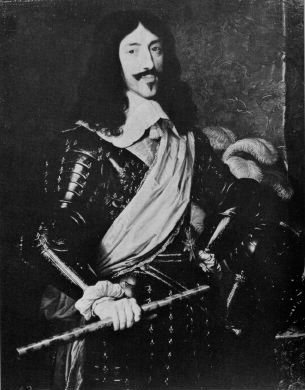
Born on September 27, 1601, five days after his future queen, he was in fact reminded that she would be his wife for most of his young life. While their marriage was never certain, it was fairly well counted on by the royal houses of both countries. (Kleinman, Ch. 1) His father was assassinated on May 14, 1610, and his mother became regent until his majority in 1614; for many years after his mother still retained political power. (Kleinman, 10). He took power in 1617, with the assassination of Concini, marshall of d’Ancre, and the exile to Blois of his mother.
As in The Three Musketeers, and as complained about by the falconer at the end of The Man in the Iron Mask, Louis XIII was fond of hunting, and fond of falconry especially.
Was he weak-willed, as in The Three Musketeers? Kleinman writes:
Most of Louis’s personal relationships were double-faced, combining passionate attachment or even dependence with distrust and hostility. In almost every case, ultimately the distrust and hostility became predominant. This happened with his mother; with his first great favorite Luynes and Luynes’s widow, Madame de Chevreuse; with all his later favorites; and at times it seemed to be happening with Richelieu. (Kleinman, 88)
Despite his Spanish marriage, Louis XIII generally disliked the Spanish, first as his father’s enemies, and later as his own. In an incident foreshadowing his fear of his Queen’s possible spying, he rebuked his Jesuit confessor soon after his father died: “refusing to tell his confessor why he was lost in thought, ‘because you will immediately write it to Spain.’” (Moote, 49)
“They do not call me Louis the Just for nothing,” said the King in The Three Musketeers. He first gained his “reputation for justice” in his minority, as he and his mother went out to Brittany to end a pending rebellion led by his half-brother. “Louis felt most comfortable with its strictest rendition: justice meant punishment of wrongdoing… Louis noted this sobriquet, commenting wryly that he wanted people to call him Louis the Just and not Louis the Stammerer.” (Moote, 56)
Louis came into his majority at the age of 13. While he continued to defer to his mother for a number of years, all state acts required his validation from that point on.
Louis XIV
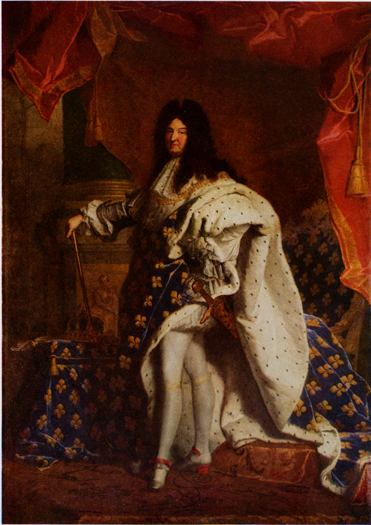
Did Louis XIV have many open affairs? According to Kleinman, he was certainly given to believe that he married solely for reasons of state: he was at the time of his marriage strongly in love with one of Mazarin’s nieces, far below him in class, and had to be continually dissuaded from marrying her instead. His marriage to Maria Teresa of Spain brought peace with Spain as well, after twenty-four years of war. (Kleinman, 266-267)
At the end of The Man in the Iron Mask, a conversation between Louis XIV and Henrietta takes place, Henrietta’s husband being “Monsieur” (Henrietta herself was often called “Madame”). That would be Louis XIV’s brother, Philippe. Henrietta was Charles II’s sister, but also the daughter of Louis XIII’s sister Henrietta, married to Charles I of England. The younger Henrietta had grown up in France, her mother in exile during Cromwell’s reign. And, more to the point in our discussion of Dumas’ works, after she was married to Philippe, and while Queen Maria Teresa was pregnant with their first child, Louis XIV flirted heavily with his brother’s wife. The Queen-Mother asked Henrietta to curtail such flirtations, but the only concession she could get was:
As a blind, however, she and Louis agreed that he would seem to be paying attention to one of her maids of honor, Mademoiselle de La Vallière, a stratagem that would explain Louis’s constant presence in Madame’s company. (Kleinman, 279)
Fans of the Iron Mask will of course recognize that maid of honor as Raoul’s lost love. These flirtations ended, however, at the end of the Queen’s pregnancy, during which he stayed by her side “as though his flirtations of the summer had never happened.” (Kleinman, 280) But later on, he continued pursuing the “blind”, Mademoiselle de La Vallière, as well as others.
Cardinal Richelieu
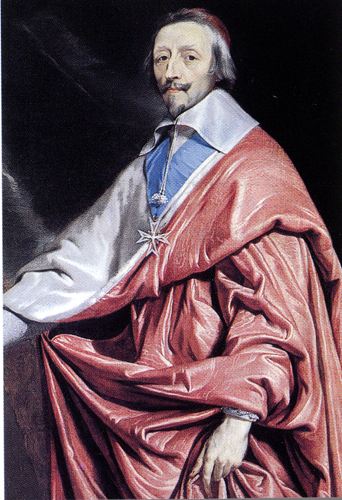
Jean Armand Duplessis de Richelieu was Louis XIII’s mother’s “most trusted advisor” (Kleinman, 52), and it was possibly at her urgings that Louis XIII successfully obtained the cardinalship for him from Rome. Within months of his appointment to the royal council, “he rose to first place in Louis’s council and dominated policy decisions.” (Kleinman, 62)
As Richelieu gained in power, opposition to him grew stronger. Mostly his opponents gathered around the Queen-Mother, Marie de Medici, and Louis’s brother, Gaston d’Orleans.
Was Richelieu in love with the Queen?
People whispered at the time that he was in love with the queen, that he had been jealous of Buckingham and could not forgive Anne for having scorned his own feelings. Madame de Motteville later reported she had heard the queen recollect that Richelieu had once come to her with the air of a suitor and had made her a very passionate speech to which she was about to reply in anger and disdain when the king entered the room, and later she never had dared to resume her interrupted reply lest she give Richelieu the satisfaction of knowing that she remembered the incident at all.
Did she remember the matter correctly, or did she misunderstand Richelieu? Certainly the Cardinal would have taken a great risk to become her lover: this was one thing that the king would certainly not stand, and he wrote in his memoirs that he feared a plot to lure him into a compromising position with respect to the queen. (Kleinman, 73)
In Chapter 39 of The Three Musketeers, D’Artagnan sees Richelieu writing, or re-writing, the play Mirame. Mirame was actually written by Desmarets de Saint-Sorlin, but:
Desmarets was one of Richelieu’s literary protégés, even in some sense his collaborator, for Desmaret’s’s plays were generally believed to have been inspired by the cardinal himself… Mirame was a princess of Bithynia loved by two heroes; one hero was besieging her father’s city while the other was its defender. She herself loved the attacker and spurned the defender, though apparently in vain, for her preferred lover suffered defeat at the hands of his unsuccessful rival. Scandalmongers at the time took the play as a roman à clef, reading the list of characters as Anne of Austria, the duke of Buckingham, and Richelieu himself, and they saw the allusion as a public mockery of the queen.
Richelieu made his “political debut” at the close of the Estates General in 1615, when he was still the bishop of Luçon. “Luçon knew how to touch on every reform proposal and please everyone—including the queen mother—while still challenging the young ruler to greater things.” It was a plea for royal firmness, and marked Richelieu’s desire to see a strong “royal dignity”. (Moote, 71-72)
Duke of Buckingham
His seductions and love affairs were legendary, and it was his good fortune to have a loving and tolerant wife who turned a blind eye to all of them.
According to Kleinman, the plot was hatched by Madame de Chevreuse, and willingly accepted by Buckingham. Buckingham first saw Anne in a play in Paris, when he and Charles, prince of Wales, were traveling incognito through France on their way to Spain. They did not make their presence known. However, Charles was to marry the King’s sister Madame Henrietta Maria (whose daughter appears in The Man in the Iron Mask). Madame de Chevreuse was having an affair with Lord Holland, the English ambassador to Paris, and friend of Buckingham. Through him, she set up Buckingham and Anne to meet in Paris, when Buckingham came to bring Henrietta to England. The Queen’s reaction to Buckingham in Paris was overly cordial, and the King hastened Henrietta’s departure. But the custom in France was that royal daughters who were married abroad should be accompanied by their female kin to the border, which included Anne. Not only that, but the duke and duchess of Chevreuse also accompanied the train. Louis XIII gave “strict orders that on no account was Buckingham ever to see Anne alone during the journey.”
When it finally came time to part, Buckingham “tried to declare his feelings”.
Though she did not encourage him, she showed enough emotion so that her companion, the princess of Conti, declared she could vouch to the king for the queen’s virtue from the waist down but would not be answerable for the part from the waist up.
From this point on, the French saw everything Buckingham did, for the next three years, as “designed to force the French government to let him come back for negotiations”. This included the English promise of aid to the Huguenots.
More likely, “political imperatives were compatible with Buckingham’s romantic ambitions”. As time went on and he continued to be refused entry into France, “Buckingham had ample reason to adopt an increasingly hostile attitude toward France. Buckingham in fact began to contribute to plots that were hatching in France against the authority of Richelieu and of the king himself, plots to which he was introduced by Madame de Chevreuse.”
Now, what about those diamond studs that D’Artagnan went to England to retrieve?
Many years later, the duke of La Rochefoucauld wrote in his memoirs that the French queen had given Buckingham as a farewell present a set of diamond points for laces that had been a gift to her from Louis. One of Richelieu’s informants, a mistress whom Buckingham had discarded, saw him wearing the points in London and managed to cut off two, which she sent to the cardinal. According to La Rochefoucauld, Richelieu, seeing an opportunity to ruin the queen whom he distrusted, suggested that Louis ask her to wear the diamonds he had recently presented to her. Buckingham, meanwhile, having noticed the loss of two of the jewels, had the ports of England closed while a jeweler made exact copies. Then Buckingham reopened the ports and sent the jewelry back to Anne, who promptly showed it to Louis and thereby checkmated the cardinal. La Rochefoucauld was twelve years old and not at court when all this supposedly happened. It was a dramatic story and inspired Alexandre Dumas to write The Three Musketeers. There is no evidence to support it, however, and no other writer of the time ever mentioned it. La Rochefoucauld moreover seems to have assumed that as early as 1625 Richelieu felt a settled hostility toward Anne. This was not the case. On the other hand, thanks in large part to her friend Madame de Chevreuse, Anne was becoming involved in much more serious matters than purloined jewelry or romantic dreams.
(Kleinman, Chapter 5; Tapié, p. 148)
Madame de Chevreuse
In The Three Musketeers, Madame de Chevreuse was used to ferry letters between the Queen and various extranational powers, such as Buckingham and Spain, as well as with Aramis. By the time of The Man in the Iron Mask, Madame de Chevreuse has been disgraced and the queen no longer speaks with her. In real life?
I do not wish the queen to write any more to Madame de Chevreuse, chiefly because this pretext has served to cover all the letters she has sent elsewhere.
This was a memorandum from King Louis XIII on August 17, 1637 (Kleinman, 103). Following this, Madame de Chevreuse fled to Spain. This was all engineered by Cardinal Richelieau, who had intercepted many of those letters.
Not as obvious in Dumas’ books, it was Madame de Chevreuse who introduced Buckingham and the Queen, with the purpose being romance. It was also Madame de Chevreuse, according to Kleinman, who fed Anne’s dislike of the cardinal:
Since her return to France, Madame de Chevreuse had been feeding Anne’s sense of grievance and giving it a focus. She never saw herself at fault in having led the queen to indulge in the Buckingham romance. Instead she blamed all the humiliation Anne had suffered in consequence on Cardinal Richelieu. She and Anne began to cultivate their dislike of the cardinal and to indulge in hopes and sometimes plans for his fall. (Kleinman, 69)
She used her network of friends to “facilitate an alliance between Lorraine, England, and the French Huguenot nobles,” the purpose being military action against Louis to discredit Richelieu, forcing his dismissal. However, the matter focussed on the siege at La Rochelle, and a few months after Buckingham’s assassination in August of 1628, that city capitulated. Peace with England came only a few months later, and Madame de Chevreuse, while allowed to return to France, was to remain at Dampierre.
She didn’t change much when Anne took power. Shortly before the death of Louis XIII, Richelieu also died, and Louis XIII appointed his successor as Mazarin, at Richelieu’s recommendation. While Anne brought many of her favorites back to court, including Chevreuse, she trusted Mazarin’s advice on statecraft highly. Madame de Chevreuse, with the Duke of Beaufort, “organized a conspiracy to assassinate Mazarin”. Anne finally ordered the arrest of Beaufort, and exiled the rest, including Madame de Chevreuse, from Paris. When Madame de Chevreuse continued her intrigues, she was ordered into confinement in a royal castle, but instead fled to Spanish Netherlands. (Kleinman, 168-169)
Colbert
At the end of The Man in the Iron Mask, d’Artagnan and Aramis are told, to their astonishment, of the plans for a great French fleet by Colbert.
The ships and men which constituted the French Fleet at the time were a beggarly assortment not even capable of protecting the French coast from pirate raids. Louis XIV’s ministers were aware of the need to build a new fleet and Colbert especially was convinced of the enormous political and economic advantages to be had from a major investment in sea-power (Noone, 62)