
Negative Space Presents:
The Other Superhero Role-Playing Game
by Jerry Stratton
3rd Edition, 2nd Printing
2026
https://www.menandsupermen.com/
Men & Supermen™ ©1993, 1994, 1997, 1998, 1999 Jerry Stratton.
Men & Supermen™ and Negative Space™ are trademarks of Jerry Stratton
Men & Supermen, in some form or other, has been around since 1980. I couldn’t have done it without the many playtesters. Their heroes survived the early days of the world’s creation and the fundamental changes in the laws of physics which followed. Their names shall forever be etched in the Chronicle of Heroes, on the Life Stone in the Caverns at the End of Time.
 And again there shall be wonder,
as the singer draws the pen,
And legends fill the story
as the eagle learns its ken,
As heroes fight for freedom
on the planet, end to end,
They shall strive a fight for justice—
Men, and Supermen.
—The First Circle of Earth
Special thanks go to Rory Keating and Thor Brickman, who spent many hours arguing with me over various rules and the game as a whole. This book is dedicated to Jerry Siegel and Joe Schuster, creators of Superman™ and to E. Gary Gygax and Dave Arneson, creators of the Dungeons and Dragons™ role playing game. If it weren’t for them I’d spend all my free time reading romance novels and playing bridge.
Jerry Stratton, https://www.menandsupermen.com/
Agent Aura “Kincaid” Ange (Darryl DeLeeuw)
Agent Bobo (Russ Nelson)
Ape (Thor Brickman)
Black Cat (Rory Keating)
Blue Disc (Darryl DeLeeuw)
Brat (Rory Keating)
Brinn X’Halikso (Rick Turner)
Bob (Rory Keating)
Daklin (Chris Eitniear)
Dark Horse (Thor Brickman)
Elektra (Irish McWhorter)
Eric Exploso (James Stratton)
Ian McKellan (Vince Kimball)
JC-9 (Vince Kimball)
Lightwave (Rob Reed)
The Lugnuts/New Wave Heroes
(Rob, Rory, Vince, Thor, Linc)
the Lurking Grue (Rory Keating)
Pale Destroyer (Ron Watkins)
Pulsar (Kevin McMinn)
Rayzon (Rex Bowers)
Razz (Andee Kunza)
Roach (Virginia Walker)
Shaman (Thor Brickman)
Tween (Rory Keating)
Role-playing is getting together with friends to write a story. It’s joining around a campfire or a dining room to spin tall tales. Role-playing is being creative and having fun.
Role-playing games have rules to help players play certain kinds of stories. Men & Supermen helps you play stories about superheroes.
In most role-playing games, one person is the referee, who can be thought of as the Editor of the story. The Editor will, with input from you describe a world—a setting. You and your friends, as Players, will take a character in this world, a protagonist, and you will guide your character through the story that you and your friends create.
Each player takes a different character, and each character interacts with the other characters. Role-playing is a lot like acting. You imagine what the Editor describes. You imagine your character’s response to the situation, and describe that response to the Editor and the other Players. They each do the same with their characters, and the story unfolds.
In most games—board games, card games, and gambling—there is a clear way to win and a clear way to lose, and winning is the goal of the game. In role-playing games—much like life itself—the very concepts of winning and losing do not have to exist. Your goal as a Player is to help create a story and to have fun. You may give your character other goals, but your character’s success at these goals has no bearing on your winning or losing the game. As the cliché goes, it’s not so much whether you win or lose, its how you play the game.
That’s all well and good, you say, but what actually goes on? What do these characters do?
Characters have adventures, like the main characters in novels, comics, television shows, and movies. What these adventures consist of—whether it be chasing a supervillain, saving a world, or baking a pie—is up to you.
Cecil Adams (author of The Straight Dope) said with regards to role-playing games: “a lifetime of Parcheesi does not adequately prepare you for this.” There are no ‘moves’ in role-playing games. You make choices for your character as creatively as if you were writing a book.
People used to board games can find this difficult, and fall into two ‘rules-lawyer’ traps. Games have rules that explain what happens when, for example, your character is attacked by a dragon, or what happens when two space vessels race to the same destination. These rules are almost always there as guidelines. They describe what normally should happen, not what always must happen. The first rules-lawyer trap is insisting on following the rules, even when there’s an obvious discrepancy between how the Players and Editor want the game to proceed, and how a game rule says an event should turn out. The overall game should be more important than any specific rules.
Many times, games will not have a rule to cover an odd situation. The second rules-lawyer trap is believing that every situation must have its own rule. In this case, you waste time and interrupt the flow of the story by searching through the rule-book for rules that aren’t there.
It is easy to develop an adversarial relationship with your Editor. Why? Because you are playing the ‘hero’ and the Editor will be portraying all of the ‘villains’ that the hero meets. Players must remember that this is not a competition between the Players and the Editor. The goal is to have fun, creatively, together.
A related trap is to consider the Editor an omnipotent being in relation to the game, and to consider the game world to be the Editor’s world alone. The game must be for all the Players. The Editor is, however, the final arbiter of game disputes and questions. There’s no need to waste time arguing when you could be playing!
1. Don’t Panic! A cool head is the most important piece of equipment any superhero owns.
2. Never allow an innocent bystander to come to harm, even at the expense of your own or a fellow hero’s well-being. Avoid attacks which, if inaccurate, could endanger the lives of those you are protecting. Move fights away from inhabited areas.
3. Don’t forget that your character also has a non-superhero life that can be role-played. Life isn’t all busting supervillains.
4. Never attack anyone who hasn’t either committed a crime, or attacked you. The law is on your side, but assault is assault, whether the victim is a super villain or not and even if the accused merely ‘created a reasonable apprehension of assault’ in the mind of the victim.
5. Never use more force than is necessary to subdue a villain. Never kill a villain unless it is necessary to protect the life of someone else. And, never attack an unconscious villain. Your status as a crime fighter is extremely precarious. Take care not to wind up a villain yourself. As a private citizen you are not subject to the restrictions of the police, but neither are you covered by the legal protections society gives it’s official protectors.
6. Never attack any villain who is more powerful than you without a darn good plan. A dead hero cannot protect anybody.
1. Don’t Panic! Do not allow the complexity of modern game mastering to overcome you. Follow the next rule and keep cool.
2. Be Prepared. Know thyself and know thy non-player characters. Villains seldom act without a plan. Know it. Be prepared for heroes who will try both orthodox and unorthodox ways of interfering and halting this plan. Be prepared to use your imagination when players think of something you didn’t.
3. Take full charge of your dramatic license. If the adventure absolutely requires that something happens (or if it would merely be fun for that to happen) ignore the results of the dice and allow it to flow. Vary the adventure style between combat, mystery, suspense, thriller, comic, and any other genre you can think of. Don’t modify rolls you make for characters, but only rolls you make as the world—weather, random events, etc.
4. Don’t stifle humor. Humor is an integral part of comic-book adventuring.
5. When in doubt, allow it. If you’re not sure whether to allow a player to use power X to do action Y, and can’t decide, then allow it. If you’re not sure whether to give the player a 50% or a 60% chance of success for an action give a 60% chance. And remember—this rule works for non-player characters also.
6. When creating adventures, give everyone a part—from the most to the least powerful. And don’t forget about the other side of superheroing—the characters’ personal lives.
7. When creating adventures, err on the side of toughness. Heroes are known for being able to take on even the impossible. However, you must at least attempt to accurately judge how tough an adventure should be.
8. Do not hide reality from the players. There is hunger, disease, and bigotry in the real world, and combating these villains is a rewarding part of being a Hero.
Men & Supermen was designed to allow variable power between heroes. In comics, it is perfectly possible for a god to fight alongside an average human. The game system of Men & Supermen allows for this, without losing the differences between powerful and less powerful heroes.
Running the Game: Besides the Eight Commandments on the previous page, some more general hints are in order. On the first game, an Editor who is not used to dealing with characters of differing power may want to limit the number of extra power rolls to one or even none, thus gaining experience running slightly different characters before running highly different characters.
If a player evinces interest in playing a Wizard, this character should be created before the other players arrive. Have that player arrive a half hour before the others.
When in doubt about whether a character can do something, assign either a general percentage or an ability to determine the chance that the character can succeed. For example, if a character has fallen into a pit, and wants to grab the side of the pit so as to not fall in, you could instruct the player to save on a 2d10 vs. Agility. That is, the player must roll a 2d10 and get a number less than or equal to the character’s Agility. If there were a bar or flagpole sticking out, there might well be a bonus of 1, 2, 3, or 4 to the bonus pool. Saving throws can be made against any ability. General percentages are useful when the character has no control over the outcome. For example, if a character wants to hail a cab, you might assign a 25% chance that a cab is nearby. That is, you (or the player) must roll d100 and get 25 or less for there to be a cab in the area.
The game is modular in design. Parts can easily be added or deleted without losing that elusive element called ‘game balance.’ Almost all of the rules beyond the basic rules can be dropped or replaced at the Editor’s option.
Abilities: Abilities are variable aspects of characters. Abilities are strength, agility, constitution, charisma, and learning.
Action Rolls: Action rolls determine whether or not an action, such as an attack, is successful. Action rolls are almost always made on 2d10.
Attacker: Attacker in these rules refers to the person(s) directing the attack in question.
Attributes: Attributes are generally invariable aspects of characters. Newoen, Sight, Hearing, Height, Build, and Beauty are attributes.
Character: The term character refers to people within the game, both Player Characters and Non-Player Characters.
Defender: Defender in these rules refers to the character(s) against whom an attack is directed.
Dice: Dice in this game are important—they determine outcomes when outcomes are random. This game requires six dice: d4, d6, d8, d10, d12, d20. The d4 is the four-sided die, the d6 the six-sided, etc. The notation ndx means this: roll the x-sided die n times and add each roll to the previous. For example, 4d10 means roll the ten sided die four times and add these rolls together, for a result from 4 (minimum) to 40 (maximum).
| d2 | roll d6; 1, 2, & 3 are 1; 4, 5, & 6 are 2. |
| d3 | roll d6; 1 & 2 are 1; 3 & 4 are 2; 5 & 6 are 3 |
| d5 | roll d10; divide the result by 2; round up. |
| d32 | roll d4; subtract 1; multiply by 8; add d8. |
| d100 | roll d10; but a “ten” means “zero”; multiply by ten, and roll d10 again. If two zeros are rolled, this is really 100. |
| d1000 | roll d10 and multiply by 100; add d100; if greater than 1000, subtract 1000. “Tens” mean “0” unless all three come up zero, which is 1,000. |
| d% | roll d100; this roll is used to generate a percentage. If told to multiply by d%, divide the roll by 100 first, then multiply. |
| ndx X dx | roll the first set of dice; then roll the second die that many times. |
The most common dice used are 2d10 and d100. Each uses two ten-sided dice. When rolling d100, roll one of the dice. That is the tens. Roll the next die. That is the ones. If a 0 and a 5 is rolled, the result is 5. If a 3 and a 9 is rolled, the result is 39. If two zeroes are rolled, the result is 100.
For 2d10, roll the two dice and add them together. Zeroes are considered to be 10. So, if a 0 and a 5 is rolled, the result is 15. If a 3 and a 9 is rolled, the result is 12. And if two zeroes are rolled, the result is 20. Usually, when a Special Character rolls 2d10 and a 1 is rolled, that die can be rolled again and its result subtracted from the previous total. So, if a 1 and a 9 is rolled, that is a 10. Re-roll the 1 and subtract that from 10. If both dice come up 1, both dice will be re-rolled, and their total subtracted from 2. Dice are only re-rolled once.
Distance: The basic unit of distance is the meter. The meter is divided up into ten decimeters, one hundred centimeters, and one thousand millimeters. One thousand meters equals one kilometer. For conversion to feet, multiply meters by .3048. For conversion to miles, divide kilometers by 1.6.
Editor: The Editor is the player who is creating the adventures and interpreting the rules.
Knowledge: Knowledge is measured in Knowledge Scores, and is a measure of what characters know.
Miniatures: If miniature figures and hex (or 8 square) sheets are used, let one hex (or square) be one or two meters during combat, depending on the total area covered and personal preference.
Non-Player Character (NPC): Non-player characters are characters controlled by the Editor.
Normal Character: Normal characters are characters who are not the main characters of the story. Most innocent bystanders are Normal. No player characters are Normal.
Percent Chance of Success: When a Chance of Success or a Percent Chance is requested by the rules, roll d100. If the result is less than or equal to the chance of success, the roll is successful. Otherwise, the roll fails.
Percent Control (%Control): Percent Control measures the amount of control a character has over a given power, ability, skill, or knowledge. It is usually only applied to powers, however.
Player: The term Player in these rules generally refers to the people playing the game, that is, the people who roll the dice and control the player characters.
Player Character (PC): Player Characters are the characters that players create and play.
Power Roll: Power Rolls are measures of the strength a character has in a specific power. Power Rolls are usually treated the same as the Quality of an Action Roll.
Quality: When an Action Roll is made on 2d10, the dice total is subtracted from the Action Roll needed, and the result is the Quality of the Action Roll. The lower the dice, the higher the Quality.
Roll Until Missed: If the rules say to “roll this chance until missed,” roll once. If the roll is made, the character has whatever was rolled for, and the player can roll again, for another one. The player can keep rolling until the chance is not made—“the roll is missed”.
Saving Throws: A Saving Throw (or Save) requires that the player roll a d100 or 2d10 (depending on the instructions) and get a number less than or equal to the number, score, or ability given, in order to succeed at a task or survive a danger. Saving Throws vs. an ability or skill are usually made on a 2d10, and saves vs. Willpower and Perception are usually made on a d100.
Saving Throws vs. Mind Control, or Illusion type powers and spells are made as soon as the power or spell takes effect, and any time afterwards when the target has decent reason to believe that it is an illusion, or is controlled into doing something far against the character’s principles.
Certain Saving Throws (especially against illusions and mind control) allow for a bonus of up to the character’s Newoen or Willpower. For a character to get the full bonus of Newoen/Willpower, the character must truly know what is going on. In the case of an illusion, belief must be so much that the character would be willing to ignore the effect—for example, not run from or fight the monster, or walk right through the fire.
Skills: Skills are abilities that characters can learn. The amount of skill a character has in a skill is measured with Skill Levels. The higher the level, the more skilled the character is.
Special Characters: Special characters are characters who are important to the story. All player characters are Special, and most non-player character superheroes and supervillains are Special.
Target: In these rules, targets refer to a person, place, or thing against which an effect/attack is aimed.
Abilities describe what the character can do, and how well the character can do it. Basic abilities are those abilities that all characters have because the abilities are inherent to being alive. The basic abilities are Charisma, Constitution, Agility, Hearing, Learning, Sight, and Strength.
Agility: Agility is a measure of bodily dexterity and natural skill. Agility measures the character’s fluidity and physical speed. Agile characters can run faster than non-agile characters, and they are better at “fine” movements such as dancing, sewing, and spellcasting.
Charisma: This is a measure of the character’s force of personality: how well the character gets along with others, how the character is viewed by others, and the character’s self-esteem. Each character has two Charisma scores. The first charisma is Active Charisma. This is the character’s charisma in action/adventure oriented situations. Usually, this will apply in a character’s superhero identity. The second charisma is Normal Charisma. This applies to normal situations—the everyday, bland existence, usually in the character’s secret identity. It will also usually apply to the superhero identity when the character is involved with close friends who know of that identity. A character can be very charismatic as a hero and uncharismatic normally, or vice versa. The player is allowed to choose, before playing the character, which charisma goes with which identity.
When charisma is involved in a Figured Statistic, the choice of charisma to use is up to the Editor, and should be chosen according to the situation.
Characters with high charisma can charm or enthrall other characters. The character makes an Action Roll vs. Charisma, with a penalty equal to the target’s charisma. If the roll is successful, the target is allowed a save vs. Willpower. If the Willpower saving throw is failed, the target can attempt additional saving throws later: Subtract half the target’s Newoen from 0, and look this up on the Action Chart, from Result to Doubles, for the number of months (assume a month is 30 days if needed). Each time an additional save is attempted, add 1 to this number. An average person (14 Newoen, -7 on the Chart) will make a second save after 3 hours (.004 times 30 days). Their next save will be about 6 hours later (.008 times 30), and their next 12 hours after that (.18 times 30).
The standard Performance Time for Charm is 5 minutes. The Quality of the Action Roll can be applied to reducing the Performance Time (by halves, as normal), reducing the target’s saving throw (a penalty of 3 for each point of Q), or increasing the amount of time between saving throws (up 1 row).
Charmed targets will want to help the charmer. They may feel a close tie of friendship, or they may be in awe of the charmer, depending on the situation. Charmed targets are nearly unquestioning followers.
Characters with charismas less than 0 are not charming. These characters are usually evil. They can attempt to cause fear, rather than charm. The Action Roll is the same (as if the character’s charisma were positive), as is the target’s saving throw. The result is that the target is either scared into following the orders of the villain, or simply paralyzed with fear, depending on the situation.
Once a save vs. charm or fear succeeds, that target is immune to further charm/fear attacks by that attacker for the duration of the adventure. Also, the target of a Charm or Fear attempt may have a bonus of up to Willpower on the saving throw, depending on the situation.
If a charisma of less than zero is averaged with learning (for determining certain Learning Times, for example), make the charisma positive for purposes of averaging. Also, when losing charisma, there is no charisma between 1 and -1: If a character with a charisma of 1.2 loses .8 charisma points, that character now has a charisma of -1.6. The 1.2 dropped .2 points, and then the remaining .6 brought it ‘up’ from -1. If a character wishes to change charisma from negative to positive or vice versa, it costs Editing Points equal to the charisma score.
Constitution: Constitution is a measure of health, endurance, and the ability to stand up to punishment. Female characters have 1 added to their rolled constitution.
Learning: Learning measures how much memory the character has, how fast the character can think, and how fast the character learns. The learning modifier for learning is given below. Generally, multiply the time it takes to learn something by the modifier.
| Learning | Learning Modifier |
| 3 | 3 |
| 4-6 | 2 |
| 7 | 1.5 |
| 8-9 | 1.25 |
| 10-11 | 1 |
| 12-13 | 1/1.25 |
| 14 | 1/1.5 |
| 15 | 1/2 |
| 16 | 1/3 |
| 17 | 1/4 |
| 18 | 1/5 |
For Learning greater than 18, divide learning time by Learning minus 13.
Characters with a high learning may have photographic memory (total recall). Total recall does not mean something is understood, just that it is remembered. Photographic memory must be applied. It is not automatic. At least one action must be used. The chance for a character to have photographic memory is learning minus 16, times 3. If the character later increases in learning, there is a 2% chance per point of increase of gaining photographic memory.
Characters with an extremely high learning will have picked up a lot of miscellaneous information, and as such the player has a chance of being able to ask the Editor questions. This chance is the character’s learning minus 20. Even if the character does know something about whatever is asked about, a roll must be made under willpower, to simulate making the connection between what the character is doing and the immense amounts of random information at the character’s disposal. This roll may be made once every 2 turns (2 rounds in combat if the information pertains to the present situation).
Animals generally have a learning of 1 or 2. Plants and inanimate objects will have a learning of 0.
Strength: Strength is the power of the character’s muscles. It and mass are the main determinants of how much damage can be done in hand-to-hand combat and how much the character can lift.
Strength also determines how loudly the character can talk. See Hearing. If the character really wants to yell, others in range can become deaf. Divide the strength of the yell by 10, round up, and roll d6 this many times for the number of segments of deafness. Subtract 10 times the distance in meters to each target, for how long that target is deaf. Targets are allowed a perception roll to avoid deafness, at a penalty equal to the number of dice done and a bonus equal to the number of meters from the yelling character. Hearing is applied as a modifier also, but as a penalty.
The attributes are Beauty, Build, Hearing, Height, Newoen, and Sight. Attributes cannot be changed with training, although Build and Beauty can be changed with Experience.
Beauty (4d6) measures how pleasing the character appears physically. Beauty modifies reaction rolls only the first couple of times the character meets someone. After that it’s all Charisma and actions.
Beauty can act as a bonus or penalty depending on the circumstances. The non-player character in love with FireBlade might resent a handsome hero, but will feel no jealousy towards an ugly one.
A character with high Beauty will often charm, similar to the Charisma charm. Charming generally only works on the opposite sex. The Charm Roll is half the character’s Beauty. Standard Performance Time for Charm is 12 minutes. The target is allowed a saving throw vs. Willpower, with a bonus of Beauty (Sphere). If the saving throw is failed, additional saving throws can be made later: Subtract half the target’s Newoen from 0, and look this up on the Action Chart, from Result to Sphere, for the number of months (30 days). Each time an additional save is attempted, add 1 to this number. An average person (14 Newoen, -7 on the Chart) will make a second save after 3 days (.10 times 30 days). Their next save will be about 4 days later (.13 times 30), and their next 5 and a half days after that (.18 times 30).
Q from the Action Roll can be applied in three ways. It can reduce Performance Time (as normal—3 points reduce time by half). The Charmer can apply a penalty to the target’s saving throw (a penalty of 3 per Q point applied), or the Charmer can move the save progression up 1 point on the Result side.
Characters with low Beauty may horrify others. The Horror Roll is the negative of the Horror’s Beauty. Targets are allowed a save vs. their willpower, with a penalty equal to Beauty (Sphere). The Weirdness Bonus modifies this save as well. A horrified character will be inactive (paralyzed by disgust, possibly even retching—Editor’s option, depending on the circumstances) at least 1d6 segments. Q points from the Horror roll can increase this: look up the Q points applied on the Sphere Chart, and the result is the additional d6 segments. Q can instead apply a penalty to the target’s saving: a penalty of 3 to all targets, per Q point applied.
Each time a save vs. horrification is successful, add 2 to the character’s Weirdness Bonus. Each time a save vs. horrification is unsuccessful, subtract 1 from the Weirdness Bonus.
Targets of a Charm or a Horrify attempt may have a bonus of up to Willpower on the saving throw, depending on the situation.
If Beauty is less than 0, see Terror, using the negative of the Beauty for the number of Terror Points.
Example of Horrification: Seraph and the Nightgaunt
Cerest-Ranon, Seraph, and Gremlin come across a Nightgaunt with a Beauty of -4. The Editor rolls 1 for the Horror Roll. Cerest-Ranon’s Beauty is 16 and her Willpower is 72. Her save is vs. 62. Seraph has a Beauty of 31 and Willpower of 80. He saves vs. 68. Gremlin’s Beauty is 6 and her Willpower is 60, so she saves vs. 54.
Half of the Q (round up) of 1 is applied as a penalty to his Willpower, so each has a penalty of 6. Half of the Q (round down) is applied to the time paralyzed, so that’s an extra 1d6 segments, for 2d6. Cerest-Ranon’s player rolls 45, so she’s not horrified. Seraph’s player rolls 78, so he is. Gremlin’s player rolls 9, so she isn’t. The Editor rolls 9 on 2d6 for Seraph, so Seraph is paralyzed with horror for 9 segments.
Once a character has successfully saved against a specific person’s or thing’s Beauty charm, horrify, or terrify power, that character is immune to further attempts by that person or thing, barring significant changes in Beauty. Both Horror and Charm may be used against multiple targets at added cost: There is a penalty to the Action Pool equal to the number of targets. (Terror occurs automatically, and is not under control of the player, barring a paper bag.)
If the character’s Beauty is greater than 20 or less than -20, it may be used to Charm or Horrify involuntarily. Roll less than or equal to Beauty minus 20 on d100. If successful, the character makes an involuntary Charm/Horror roll. The player may still control how excess Q is used.
Build (4d6) measures the character’s body size. Female characters have 10 added to their build, and males have 11 added to build.
Hearing (4d6) measures a character’s ability to hear. To determine if a character can hear something, add the strength at which it was said (a person can talk at a strength up to the character’s own strength, but normal speaking is at a strength of from 2 to 3) to the character’s hearing score, and subtract the distance, in meters (Sphere Chart), the source is from the listener. The character must roll less than or equal to this on 2d10. If a character gains the power, Hearing Power, divide the true distance something is from the character by the power for the distance it seems to the character. The Hearing Power can reduce the penalties for being unable to see. This table corresponds hearing powers to: a multiplier for the penalty for being unable to see.
| Hearing Power | Multiply Penalty By: |
| 10-20 | 5/6 |
| 20-40 | 4/6 |
| 40-80 | 3/6 |
| 80-160 | 2/6 |
| 160 and up | 1/6 |
Round the penalty to the most negative.
Characters can have different kinds of hearing, such as Microwave, Ultrasonic, and Radio Frequencies. Normally, the original Hearing Score is used for each type, but players have the option of re-rolling hearing for each type of hearing.
Height is the character’s height in meters.
Newoen measures the metaphysical side and the character of the character. It determines how well a character can evade magical and psychic attacks. High newoen characters can discern good from evil.
Newoen can never be changed, through training or otherwise. If newoen changes, the character is, literally, a new person.
Animals have a newoen of 1 to 3. Plants and most unliving objects have a newoen of 0.
Sight measures the character’s sight ability. If a character with below average sight wears glasses or contact lenses, average the character’s sight with for the character’s apparent sight while wearing the glasses/contacts. For example, a 5 sight character wearing glasses would have a 10 sight—5 +14, divided by 2, is 10. Round up.
The player must roll 2d10 less than or equal to Sight, in order to read/identify a target. This can be rolled once per round. Subtract the distance in meters the target is (Sphere Chart), add the height in millimeters (Sphere Chart), and subtract the character’s height in meters (Sphere Chart). There is a bonus if the character is shorter than a meter tall or the target is closer than a meter away from the character, and a penalty for things smaller than a millimeter.
For objects that are within a number of meters equal to the height of the character, add the Close sight adjustment to the roll. Otherwise, add the adjustment to Ranged combat for sight. In addition, Nearsighted characters have a penalty of 1 to the roll for things further away than their height. Farsighted characters have a penalty of 1 to the roll for things nearer than their height.
The following table gives the modifiers to the Attack Score in Close and Ranged Combat. The bonus or penalty for Ranged Combat will not be greater than the number of Range Sets to the target, plus the Close Combat bonus/penalty.
| Sight | Close/Ranged Combat Modifier | Defense Modifier |
|---|---|---|
| -5/-9 | (-2 to Defense) | |
| 1 | -4/-8 | (-1 to Defense) |
| 2 | -3/-7 | (-1 to Defense) |
| 3 | -2/-6 | |
| 4 | -1/-5 | |
| 5 | -1/-4 | |
| 6 | 0/-3 | |
| 7 | 0/-2 | |
| 8 | 0/-1 | |
| 9-16 | 0/0 | |
| 17 | 0/+1 | |
| 18 | +1/+1 | |
| 19 | +1/+2 | |
| 20 | +1/+2 | |
| 21 | +1/+3 | |
| 22 | +2/+3 | |
| 23 | +2/+4 | |
| 24 | +3/+5 | |
| +1 | +1 Every 10/+1 every 5 (at 29, 34, 39, etc.) |
Farsighted characters can’t have microscopic sight. Nearsighted characters can’t have telescopic sight. Players whose characters have a Sight of less than 14 should choose either Farsighted or Nearsighted.
If a character has a Sight Power, divide the distance something is from the character by the sight power for the distance it seems to be. This reduced distance will apply to Short Ranges and Range Sets, but not to Maximum Range.
Fog, dust, and darkness can decrease vision. If such conditions exist, modify the sight die roll by a number from 0 (normal visibility) to infinity (zero visibility). Heavy fog will be about 10. Light fog will be about 5. A few feet underwater, the modifier will be 3.
Characters can have different kinds of sight (infrared, ultraviolet, normal). Usually the same sight score is used for each kind. However, the player has the option of re-rolling sight for each type of sight.
These are all derived from the Basic Abilities, Attributes, Powers, and Skills. If there is a common abbreviation for the derived ability, this is given in parentheses after the full name.
Mass: Subtract 10 from Strength, and look this up on the Sphere Chart. Divide by 10. Add Build to this, and Constitution divided by 10. Multiply this total by the cube of the character’s height (height times square root of height if height is less than one) and divide by 2.2. This is the character’s mass in kilograms. If the character’s Mass is less than 50, the character has a penalty to Skin Temper, and the character’s opponents in combat have a bonus to Skin Temper, equal to Mass divided by 100, on the Doubles Chart. This number also applies as a penalty to Martial Throw and similar rolls.
Damage Points (DP): This is the amount of actual physical abuse a character can take. To compute Damage Points, divide Build by 5. Look up the character’s Mass, if greater than 50, on the Square Chart, and subtract 7. Add this in for the total DP. Round up.
This DP score is Body DP, the amount the body has. In the case of the certain attacks, the character must know how much DP specific parts of the body have. Multiply normal DP by 3/5 for Head DP, 1/2 for Neck DP, 2/3 for each arm, and 3/4 for legs. Round each of these scores up.
Resist Death: Add the character’s Maximum Body DP and Newoen together, and subtract 14. Look this up on the Doubles Chart. The character’s Resist Death is added to Injury rolls.
Virtual Damage Points (VP): This is the amount of cumulative physical damage the character can ignore before losing DP—the player subtracts the damage from VP instead of DP. This damage is dodged, rolled with, or otherwise bypassed. VP is figured by adding agility to strength, adding one third of learning, and one third of newoen, and dropping fractions.
If the character’s Active Charisma is greater than learning, it may be substituted for learning in the above calculation.
Endurance Points (EP): These measure how long a person can work without resting. Each character starts with twice constitution plus half strength and half body DP Endurance Points, ignoring fractions.
Skin Temper: This measures the toughness of the character’s skin. Damage done to the character is multiplied by the character’s Skin Temper. The base Skin Temper is 1 (Row 0). Divide Strength by 50, and Constitution by 25, and add these together. Look it up on the Doubles Action Chart. Move Skin Temper up this many Rows on the chart below.
In Mind Combat, Skin Temper is normally 1. For newoens greater than 20, subtract 20 from newoen for the number of rows to move up. For charismas higher than 20, subtract 20 and divide by 10 for the rows to move. Use the appropriate charisma.
| Row | Skin Temper |
|---|---|
| 1 | |
| 1 | 9/10 |
| 2 | 4/5 |
| 3 | 2/3 |
| 4 | 1/2 |
| 5 | 2/5 |
| 6 | 1/3 |
| 7 | 1/3 |
| 8 | 1/4 |
| 9 | 1/4 |
| 10 | 1/5 |
| 11 | 1/5 |
| +1 | 1/+1 (repeated) |
If Skin Temper is modified (either by low Mass or by weapons which gain a bonus vs. Skin Temper), each bonus of 1 vs. Skin Temper moves the Skin Temper down 1 line. So, 1/5 goes to 1/4, 1/3 goes to 2/5, 4/5 goes to 9/10, and 9/10 to 1. Normally, a weapon cannot reduce Skin Temper below 1. However, Skin Temper modifications for low DP or for certain powers (such as Vibratory Power) can. For these, once Skin Temper has been reduced to 1, start going back up the list, but reverse the numbers. So, 1 becomes 10/9, then 5/4, then 3/2, etc.
Skin Temper is applied after Ignore Damage.
Willpower: This is the ability of the character to withstand psychic, magical or other similar attacks. Willpower starts at newoen times 4.
Perception: The base perception is newoen divided by 2 plus learning divided by 4, round up.
When using perception, use these modifications for senses, if the sense is applicable to the situation:
| If applicable | Then add: |
| hearing | hearing, and four times the number of digits in the character’s hearing multiplier. |
| sight | sight, and four times the number of digits in the character’s sight multiplier. |
| touch | Supersensitive Touch PR |
| smell/taste | Smell PR |
A power such as magnetism or electricity can aid in searching for another such power/power source: Add the PR to the Perception roll.
There is a penalty of 1 for each other character attempting the same roll (Sphere Chart).
Weirdness Bonus: This is ten minus the character’s Beauty, if Beauty is less than 10. Otherwise, this is 0.
Special Abilities: If some basic abilities or attributes are very high or low, special abilities are gained. See the basic ability or attribute for a description of the special ability.
| Learning: | If Learning is greater than 16, there is a chance for photographic memory. If Learning is greater than 20, there is a special Chance to Ask. |
| Charisma: | If charisma is greater than 19, there is a chance to charm. If charisma is less than 0, there is a chance to horrify. |
| Beauty: | High Beauties can charm. Low Beauties can horrify and terrify. |
Experience: This starts out at zero. The player adds all editing points ever used here. If 1 editing point is used to increase Evade Attacks from level 0 to level 1, 1 point is added to Experience. Training points gained from practicing (see Training Points) are not added to Experience.
Editing Points: The character starts the game with 4 Editing Points. These Editing Points cannot be used for training until the first game session is completed. They can be used to modify Action Rolls during the first game.
If the character is experienced, multiply the editing points gained from adventures by the Editing Point Multiplier, before recording them here. See Editing Points, under Metarules, as well as the Hero’s Guide.
Ignore Damage: This score is zero for most people. It is increased by certain powers—such as Ignore Damage.
Fate Points: Characters start the game with 2 Fate Points. Characters gain 1 Fate Point for every 10 issues (game sessions) they appear in. Non-player character Specials (and Pets) start the game with 0 Fate Points, but gain them at the normal rate.
Forgotten Knowledge: Your character knows more than you think. Add your character’s true age to your character’s learning. You can put this many points into Knowledge Scores when needed. Immortals tend to have quite a bit of forgotten knowledge.
This measures knowledge that you forgot your character knew. You have to come up with a reason for the knowledge at the same time you use the points. If you can’t remember how you got the knowledge, you don’t remember that you have the knowledge. You can only make the increase (or gain the ‘new’ knowledge) when the increase is necessary.
%Recognition: This is the percentage of the normal population that recognizes your character. For most characters, this starts at zero. However, consult your Editor if you know of any reason it should be different for your character.
| What can be done with Perception? | |
|---|---|
| Detect Danger: | Any time a character is about to be ambushed or step into a trap, a roll against perception is allowed. Add 2 to perception for each person about to surprise. Subtract 40 from perception if the character is asleep. If those about to surprise are not trying to be quiet, add 50 to the chance. Detecting Danger is automatic, and requires no action on the part of the character using it. Supersensitive Touch and Hearing will usually modify Detect Danger. Usually, the amount the roll is successful by is the number of meters away the danger is. |
| Detect Hidden Objects: | Subtract 5 for each time the character has already used this power on the same area. It takes 1 action to Detect Hidden Objects, and the character can cover a 2 by 2 by 2 meter volume of space. |
| Detect Lies: | Subtract the target’s willpower from perception for this action. Hearing and sight can modify this score. Infrared vision adds 10, and smell adds PR times 5. |
| Avoid Blindness, choking, or disorientation: | Roll vs. Perception plus agility to avoid blindness from a light attack, to take a deep breath before air is cut off, or to avoid becoming disoriented by a surprising action. |
Action Rolls use 2d10. If the 2d10 result is less than or equal to the Action Roll in question, the Action is successful. The Quality of the success is found by subtracting the die roll from the target number (the Action Roll). When a 1 shows up on one of the dice, that die can be re-rolled, and its second result subtracted from the first. Example: a player rolls 2d10, for 1 and 7, this totals to 8, but the 1 is rolled again; the next die comes up 6, which is subtracted from 8, for a total of 2.
Many rolls will have a Bonus Pool also. Look up the Bonus Pool on the Sphere Chart, for the bonus/penalty to the Action Roll.
Only one action can be initiated on any segment. No action (except passive actions) can be initiated while another action is in progress. Initiating a passive action moves all pending actions back one segment.
Q can usually be used to reduce the Performance Time. Three points are required to half the Performance Time. (One point can reduce by 10%, 2 points by 20%.) For example, a character with an Action Roll of 15 is deciphering a cipher, and taking 12 hours to do it. The character rolls 7, for 8 Q points. Three points of Q bring this time to 6 hours. If the character applies Six Q points, it will only take 3 hours to solve the cipher.
The player can transfer quality from one action to the next on a two-for-one basis. The next action must be started immediately after the first action is finished, and it must be the same kind of action. For every two quality points ‘saved’, one is added to the next action’s bonus pool.
Once an Action Roll is made, the player can continue to use that roll, as long as the action is continuous. The player can also choose to re-roll the Action Roll (with the same performance time) to rearrange the Q distribution. If the action is not continuous (such as a Combat Roll or a Throw Roll), an Action Roll must be made for each performance of the action.
If Q can be applied to more than one thing for continuous actions, Q can be redistributed each segment.
There is no problem dropping most sustained actions once the performance time has been completed. Dropping an action during its performance time is a little trickier. Dropping an action is itself a passive action that takes 10 segments. It requires a roll vs. Learning (Sphere) plus Agility (Sphere). There is a bonus equal to the Q of the action being dropped, and a penalty equal to the number of actions in progress (including the action to be dropped and the drop an action). The roll automatically reduces Defense by 1, although the player can apply Q to bring it back up (but not by more than 1).
If the roll is failed, the character’s Defense is reduced by the failed amount until the next non-Passive action, and the failure amount is applied to all Action Rolls that follow, as for surprise (see Combat). Dropping an Action starts at row 6 for EP use. On a failure, the character can either choose to try again, or pay extra EP equal to the amount missed by (the Defense and Action Roll penalties will still apply).
Many Action Rolls use EP. If the action is a sustained action (such as lifting an object), the EP cost is per round. If the action is a single action (such as throwing an object) the EP cost is per attempt. An action normally has an EP cost of 5 EP (Row 9 on the EP Use Chart). The Quality of the Action Roll can usually decrease EP cost, with each Quality Point reducing the EP Use Row by 1.
| EP Use Row | EP Cost |
| no EP cost | |
| 1 | 1/day |
| 2 | 1/hour |
| 3 | 1/ten minutes |
| 4 | 1/minute |
| 5 | 1/round |
| 6 | 2/round |
| 7 | 3/round |
| 8 | 4/round |
| 9 | 5/round |
| 10 | 6/round |
| +1 | +1/round |
Often, a player will want to re-roll a sustained Action Roll in order to reduce EP cost (or, in the case of the Move Roll, to increase speed). The character doesn’t pay the EP cost for these re-rolls, unless the EP cost is greater than what the character has already paid since starting the action (or the last Payment Segment, whichever was closest). If the EP cost is greater, only the difference is paid. So, if a character starts an action at 3 EP/round on segment: 15, and makes another roll on segment: 35, which results in an EP cost of 4/round, only 1 EP is paid.
Passive actions (such as Running) can be started while the character is still within the Performance Time of another action. The character must wait at least one tenth the Performance Time of the previous Action, rounded up, before starting the passive action. For example, Maria begins firing her rifle on Segment 39. Her Performance Time is 15. She can’t start a Passive action until 2 segments later, or Segment 41.
Starting an Action during the Performance Time of another action (or actions) adds 1 to the Performance Time of the action or actions in progress (adds 1 to the Pushback—see Combat).
Magic Rolls (Casting Spells) are passive, and wizards can start casting new spell(s) before the old spell(s) is completed. For example, if Cerest-Ranon casts a spell that takes 50 segments, she can start casting another spell 5 segments later. If she starts casting fly on segment 23, she might start casting night vision on segment 28.
Action Rolls based on Abilities cannot usually be increased by spending more time doing them. This requires skill.
Ability Rolls only need to be rolled when in a stressful situation (such as combat, or extra effort). Otherwise, a die roll of 7 can be assumed.
The character can make an Extra Effort when making an Ability Roll. The character can increase any ability after the roll is made, in order to increase the Quality and to succeed at the roll. The ability that was increased is immediately decreased by the same amount it was increased. If a character with a 17 strength makes a Lift Roll, and increases strength to 24 (8 point increase), strength drops immediately to 9 (17-8). These lost ability points return per hour when resting.
Abilities cannot be increased so far that the ability will drop to less than 0.
Combat Roll: Look up twice Agility on the Sphere Chart for the character’s Combat Roll. Combat Q can be applied to Attack, Defense, Speed, or Damage. The Combat Roll costs 1 EP (it starts at Row 5).
| Attack: | One point of Q adds 1 point to Attack. |
| Defense: | Two points of Q add 1 point to Defense. |
| Speed: | Three points of Q divide Performance Time by 2. One point reduces Performance Time by 10%, 2 points by 20%. |
| Damage: | Q applied adds that many points (Doubles Chart) to damage. |
The character’s Attack must be greater than or equal to the opponent’s Defense. If the Combat Roll fails, apply the negative Q evenly to Attack, then Damage, then Defense. It’s possible, if unlikely, that the target has a negative Defense, so a negative Attack can still hit. Note that the miss goes directly to Damage, not to the Doubling Chart. Defense Q is still divided by 2 and rounded towards 0.
Sight bonuses/penalties to Combat, Size Difference modifiers, and learning divided by 10, round down, are all added together, along with any other modifiers, for the Bonus Pool to the Combat Roll.
Attack and Defense only apply to one opponent. If the character wants extra opponents, each extra opponent counts as a penalty of 1 to the Combat Roll’s Bonus Pool. The character’s Defense counts against all opponents. The player must apply Attack separately for each opponent. In order to attack multiple opponents, they must all be in front of the character, and the character must be able to attack them in a ‘sweeping’ manner, such as with a telephone pole, a beam power, or a semi-automatic weapon. Each attack takes place on successive segments (except for automatic firearms). Whether or not a multiple attack can be performed must be handled on a case-by-case basis.
Discernment Roll: The Discernment Roll is vs. half Newoen, rounded down. This is the ability to know what is the right, true, and good course of action. If successful, the character knows what the good or evil action is in that situation. The Discernment Roll doesn’t use EP, and has a Performance Time of 6.
Hand Damage: This is the damage done by a character when attacking unarmed, and the damage added to a weapon which depends on strength. Look up mass divided by 10 on the Doubles Chart, and add strength divided by 4 (round down). If Strength is greater than Mass, add Mass/4 instead of Strength/4.
Hand Damage is not normally rolled. A character with a Mass of 100 kg and a strength of 14 will do 7 points of hand damage on a successful fist attack.
Hand Damage starts at row 7 on the EP use chart. When characters use their maximum Hand Damage, it costs 3 EP (that heal per round). The EP cost can be reduced by doing less damage. Use the standard EP cost progression, but start at 3 EP (Row 7). A character who can do 9 points Hand Damage who decides to do 7 will use 1 EP. If the character does 6, it only costs 1 EP for every 5 attacks. Note that Hand Damage costs EP whether or not the attack is successful.
Healing Roll: The Healing Roll is an automatic roll. It costs no EP and cannot be increased via Extra Effort. The roll is vs. Constitution (Sphere Chart). The character’s current Body DP is added to the Bonus Pool.
If the roll is for mental healing, there is a bonus equal to newoen divided by 4, round down, to the Pool.
Physical Healing Roll Q is automatically applied to healing DP, strength, agility, constitution, and EP, in that order. The Healing Roll is made each hour (for Bludgeoning DP, for abilities that heal per hour, and EP that heals per hour of sleep). It is made each day (for Penetrating Damage), and each month, for Injury Damage.
Mental Healing Roll Q is automatically applied to healing EP (Astral Form), charisma, and learning, in that order. It is made each hour (for abilities that heal per hour, and for EP that heals per hour of sleep).
VP and EP (things that heal per round) are handled slightly differently. Take the Healing Roll and add the Bonus Pool (Sphere Chart, of course). Half this (round up) for the VP that is restored each round. The same amount of EP (round down) are restored each round. The character must be resting to regain lost VP and EP.
There is no penalty applied to Healing Rolls because of low EP or low DP.
Hold Breath Roll: This is vs. Constitution plus half Strength, with a bonus equal to current Body DP. There is a penalty to the Quality equal to the elapsed time, in rounds, on the Sphere Chart. The Quality reduces EP cost. The roll is only made once for any specific attempt, and the elapsed time penalty builds as time passes, thus increasing the EP cost. When Quality becomes less than 0, EP cost moves beyond Row 9. At Q of -1, the EP cost is 6 per round (Row 10).
For every 5 points of EP lost in one round, 1 point of DP (bludgeoning) is lost, to the head.
The Performance Time for Hold Breath is 10. If the character hasn’t completed Holding Breath before the necessary time, the character is affected by whatever gas was being avoided. If the character was simply trying to hold breath before air was lost (due to a vacuum), there is a penalty to the roll equal to the number of segments remaining for the Performance Time. If a character starts to Hold Breath at segment 34, and all air is sucked away at segment 36, the penalty is 8.
Jump Roll: The Jump Roll is vs. agility plus strength. There is a bonus equal to twice height (on the Square Chart). The Quality can be applied to reducing the EP cost and to the height of the jump. Look up the Q applied for the height on the Result column, and read to the Square Chart, for the height in centimeters.
The amount of time (in segments) the character is in the air is found by looking up four times the height jumped (in meters) on the Square Chart.
The distance a character jumps horizontally depends on speed at the time of jumping, and the amount of time the character was in the air. Take the character’s speed in meters/segment and multiply by the number of segments the character was in the air for the horizontal jump distance.
For purposes of grabbing something, characters can add up to their height to either the height jumped or the length jumped. A Combat Roll (close combat) is required to actually grab something in a jump.
Jumping, like movement, is a passive action, and has a Performance Time of 6. It can be started on the same segment as Move is started.
On a failure, the character still jumps, but not as high.
If the character’s density is extremely low, multiply the time in the air by the atmospheric density plus the character’s density, and divide by the character’s density. Movement should be multiplied by the same amount.
Lift Roll: The Lift roll is vs. Strength minus 9, plus the character’s Mass on the Sphere Chart. The Quality must be the object’s mass (Sphere Chart). Quality can also reduce the EP cost and Performance Time. A failure costs 1 EP. The Performance Time for a Lift is 10 segments.
For powers, the Performance Time is 20 segments. For powers that can lift at a distance, look up the distance to the object, in meters, on the Sphere Chart for the Q required for distance.
Inanimate objects (ropes, webs) do not normally need to roll the Lift Roll. Their Lift Q is the Roll plus the Pool (Sphere Chart, of course).
| Pushing and Pulling: | You can push or pull just about anything, depending on the amount of friction that must be overcome. Make the Lift Roll as normal, but if the roll is missed, double the Performance Time for every point the roll was missed by. Friction is applied as a penalty directly to the Roll. Very low friction (such as most wheeled vehicles or between a floating object and water) is 1. Pushing a box up a dirt road will have a friction of 5. A friction of 20 is impossible to overcome. If the roll is missed by more than 20 minus the friction number, the object cannot be pushed/pulled. |
| Overhead Lift: | Weight lifted overhead counts as twice its weight. |
| Worn: | Weight that is worn counts as half its weight. |
Move Roll: The Move roll is vs. Agility plus half Strength (round up), plus the character’s Height on the Square Chart. The Quality can be applied to increasing or decreasing the character’s current speed, to turning, or to reducing the current EP cost for movement. EP cost for movement (at the end of each round) is always the cost of the last Move Roll.
The character’s current speed is the total Q so far applied to speed, on the Sphere Chart (a Q of 0 and 1 are practically the same—.9 vs. 1). There is a penalty to the Move Roll pool equal to the total Q so far applied to speed. If negative Q is allowed for movement (using the fractional results on the Sphere Chart), this does count as a bonus.
If the roll is missed by more than 5, subtract the amount the roll was missed by from the current movement Q total. Also, add 1 to the EP cost row for every 5 points the roll was missed by. This extra EP cost will last until the player makes a successful move roll or stops moving.
When attempting to decrease speed, the character can automatically decrease the movement Q total by the current movement Q, on the Sphere Chart. A Move Roll is required, however, and if the Move Roll is failed, reduce the decrease by half the failure.
In order to turn, the character must use 1 Q point per 45 degree turn.
Speed is in .1 meters per segment (decimeters/ segment). Each .1 meter/segment is equal to 5 meters per round, 25 meters per minute, and 1.5 kilometers per hour.
Always round Movement to 2 digits, unless you want to make a complex rule really tough. If a player wants to, Movement Q can also be applied to Defense, with 2 points of Q adding 1 point to Defense (against all enemies). In this case, the same amount that is added to Defense is subtracted from Attack, if the character is attacking. The Defense Q must be re-applied every time a new Move Roll is made.
Movement is passive with a Performance Time of 6.
You don’t need to handle movement on a segment by segment basis. Determine how far a character has moved only on the character’s action, or when the character is being attacked. Editors and players can always call for a movement update for everyone, in order to plan an upcoming action or area-effect attack.
| Maneuverability for Vehicles: | The 45° mentioned above is the Maneuverability of humans. Vehicles usually have a lower Maneuverability. A vehicle’s maneuverability is simply the number of degrees the vehicle will turn using one Q point. |
Throwback Roll: Characters who are punched, blasted, or otherwise attacked, may be thrown by the force of the blow. The Throwback Roll is the character’s Mass, on the Sphere Chart. The Throwback Roll has no bonus pool. There is a penalty to the roll of the damage done before skill, Skin Temper, or Ignore Damage modified it. If the character was only hit for VP, there is a bonus of the highest of agility or strength (Sphere Chart). If the character took DP from the attack, the bonus must be strength.
For a character to be thrown back when only VP was lost, the character must have been surprised. If the character lost DP in a surprise attack, the bonus due to strength is halved.
If the Throwback Roll is failed, make the negative Q positive, and look this up from the Result Column of the Action Chart to the Sphere Column, for the speed in meters/segment and the distance in meters that the character is thrown. Half this for attacks that do mainly penetrating damage. Half again for small projectile weapons, such as handguns and rifles.
(For more precision, assume that the character is at a height equal to half the character’s height. Multiply this by 4, that is, multiply character height by 2, and look this up on the Square Column for the number of segments in the air. For most characters, this is 1, making the speed equal the distance.)
The Throwback penalty Q is added to Pushback.
Under certain circumstances, you may want to apply throwback for positive Q (making it negative), thus resulting in fractional throwback, but this should be rare, as it is quite tedious.
Throw Roll: The Throw roll is for throwing things. It is vs. Strength minus 9. There is a bonus equal to the character’s Mass (Sphere Chart). The Q is used for the object’s mass (Sphere Chart). It can also be used to reduce the EP cost or to increase the distance the object is thrown. Look up the Q applied to distance on the Result column of the Action Chart, and read to the Sphere Column, for the distance in meters. A Combat Roll must still be made to hit a specific distance or location.
If the Throw Roll fails, the object is still thrown a small distance. The EP Cost is 5, and the negative Q is looked up from the Result column to the Sphere Column, just as before.
The speed of the object will be the same as the distance, in meters/segment.
| Lobbing and Tall/Short Folks: | For more precision, assume the object is at a height equal to half the character’s height. Look up this times 4 (character height times 2) on the Square Chart, for the number of segments in the air, and the Q is applied to speed. Multiply the number of segments by the speed for the distance. If you use this calculation, you can allow characters to lob the object. For each point of Q applied to lobbing, add the character’s height to the effective height the object starts at. Thus, 1 point of Q here means that height times 6 is looked up on the Square Chart for segments in the air. Two points means height times 8, three points height times 10, etc. That much height must be free for the length of the Throw. |
| Attacking with a Thrown Object: | When throwing something as an attack, an Attack Roll must still be made. The Maximum Range is the speed. The Short Range is equal to the Q used for speed, and the Range Set is half this. Performance Time for a Throw is 15. |
Example of Movement
Seraph starts running. He has a strength of 11, an agility of 22, and a height of 1.791. His Move Roll is 22 (agility) plus 5 (half of strength), plus 1 (height on the square chart), or 28. He rolls a 5 and a 1, for 6. The 1 is re-rolled, getting a 4, bringing the result to 2. The Quality of the Move Roll is 28-2, or 26.
Seraph puts 9 of the Q points towards reducing the EP cost to 0. This leaves 17 Q points. He applies all 17 points to Speed, for a speed of 10 dm/segment, or 1 meter/segment. Later (segment: 81) he decides to try and increase his speed. He rolls again, but since he’s got 17 Q in speed already, he has a penalty of 17 to his Bonus Pool, for a total penalty of 10. He rolls 18, plus 10, or 28, for a Q of 0. He cannot increase his speed, and his EP cost just went to 5 EP/round (so he pays 5 EP). He tries again on segment: 87, rolling a 14, for 24 and a Q of 4. He uses 1 point to bring his speed Q to 18 (or 11 dm/segment) and uses the other 3 to reduce the EP cost to 2 EP/round (using 2 EP). He’s not satisfied with that EP cost, however, so on segment: 93, he makes another roll. His Bonus Pool is now -18 (for a penalty of 11). This time, he gets 17, for a Q of 0. EP is back up to 5 EP/round, and he uses 5 EP. He tries again on segment: 99, getting 13, (+11 gives 24) for a Q of 4. He uses this to reduce the EP cost to 1 EP/round (paying 1 EP now, and again on segment: 100, a Payment Segment). He tries one more time on segment: 105. This time he’s more successful. He rolls 5 (+11 gives 16) for a Q of 12. He uses 9 points to bring the EP cost down to 0, and puts the other 3 on Speed Q. This brings the speed Q up to 21, but since 21 and 18 are the same on the Sphere chart, his actual speed doesn’t increase.
Skill Rolls can be modified to increase the chance of success, or to decrease the performance time.
Increase Action Roll: To increase the chance of success, characters can spend more time attempting a skill. For each doubling of the time spent on the attempt to use the skill, add 2 to the character’s Action Roll. The character cannot increase the Action Roll by more than twice the character’s Skill Level.
Decrease Performance Time: To decrease the amount of time spent on an attempt at using a skill, a character can hurry. For each penalty of 2 to the Action Roll, divide Performance Time by 2, and round down (though an action can never take less than 1 segment).
Quality (or Q) can be used to increase Defense or to decrease Performance Time. Each skill will usually have other uses for the Quality of the roll as well.
Defense: Characters can use 2 Q points to add 1 to their Defense for the duration of the action. If this is a Passive Action, the character’s Attack will almost always be reduced by the same amount Defense is increased. A character who is zigzagging (Movement), and firing a gun at the same time might use 4 Movement Q to increase Defense by 2. This will reduce the character’s Attack with the gun by 2 as well.
Performance Time: It takes 3 points of Q to half Performance Time.
Setting Aside An Action: Some actions must be finished completely in one sitting. Others can be set aside and worked on periodically. Those that can be set aside must be completed within a number of days equal to the Performance Time in hours. In other words, if an action will take 5 hours to complete, the character must actually find time to spend 5 hours on the task before five days is up. Otherwise, the character has lost track of what they were doing.
Power Rolls are not random. The Quality of the Power Roll is the character’s Power Roll with the Power. Most powers have a Performance Time of 20. A combat roll is required to attack with the power, and the combat roll Q can be used to decrease the performance time. The Power Roll can also be used to reduce the Performance Time.
Power Roll PR can be used to reduce EP Cost and to increase any of the power’s Effects the same as Quality for skills. A character can use a power for as many passive actions as desired (as well as one active action). For each specific action, the total of the Q for the action’s effects cannot be greater than the character’s PR. Each action uses EP separately.
Most defensive aspects of a power, such as setting up a power shield, are passive actions. Most mind-based powers (such as telepathy) are also passive. Performance Time for passive power actions are usually halved (which will usually mean a Performance Time of 10).
Maintaining an Attack: Most blast/ray attack powers can be maintained. The Performance Time is divided by 4 (usually meaning 5 segments), and the same Attack is used. There is a penalty of 2 to the Attack for each successive action (that is, -2, -4, -6, etc.), and a penalty of 1 to the EP use row for the blast.
Power Example: Sun-Ruler has a PR of 12 in Fire Coat. He enters combat with Seraph. On segment 1 he starts firing up to increase his Skin Temper. That’s a passive action, so it only has a Performance Time of 10. He’ll be done on Segment 11. He uses 8 PR for that (increasing Skin Temper by 4 rows), using 1 EP per round. Now, on segment 6, he initiates a fire blast, using all 12 PR. He rolls 17, missing (he needed 13 or less: 12 plus his pool of 1). He uses 5 EP for this attack.
Extra Effort: It’s up to the Editor and Player whether a specific character can use Extra Effort (see Ability Rolls) with a specific power, and whether the power returns its PR with the physical healing roll or the mental healing roll.
Knowledge can affect Skill Rolls. Knowledges with the same name as a Skill give a bonus equal to the Knowledge Score divided by 10 to the Bonus Pool.
Knowledge Rolls use d100. Ones do not reduce the die roll for Knowledge Rolls.
Knowledge scores range from 0 (no knowledge) to anything. There is no upper limit on knowledge scores. The knowledge score is useful in determining what a character knows in that field. If a player wants to know if the character knows something in a field, give that possibility a modifier, depending on how likely it is that the character knows it. This modifier is a multiplier. A character with Chemistry, for example, will have a multiplier of about 20 for knowing the symbol for an element, making this knowledge nearly automatic. Knowing the formula for an obscure substance found on the planet Regorius ½ might have a multiplier of 1/4, depending on the circumstances.
A Knowledge Score of 15-20 indicates competence in a field. A brilliant chemist with a Ph.D. might have a chemical knowledge of 50, while someone with only high school chemistry will have a 1 to 5. A score of 5 indicates good general knowledge.
If you need to compare two different Knowledge Rolls, compare the difference between the target number and the roll. If a character with American History (75) rolls 50, that’s 25. If another character with History (90, but halved for American History, to 45) rolls 40, that’s 5. The character with the 25 knows much more about the subject at hand than the character with the 5.
Skills can modify Knowledge Rolls. Usually, a Skill with the same name as a Knowledge will give the character a bonus to that Knowledge equal to the Skill Level. A character with Sailing 7 (Skill) and Sailing 52 (Knowledge) will have a bonus of 7 to Sailing Knowledge Rolls. This is even the case when the character has no knowledge score at all in the area. So, a person with a Skill of 7 in Magic Tricks Skill and no Knowledge Score of Magic Tricks will have, effectively, a Score of 7 in Magic Tricks Knowledge.
Everything in the world is not a rock waiting to be lifted. Some rocks fight back. If you’re competing with someone, and your goal is as much to keep your opponent from succeeding as it is to succeed yourself, that’s an Opposed Action. Obvious examples are arm wrestling and tug of war—in those cases, only one person can win.
Here’s an example of arm wrestling. Arm wrestling is likely to be based on Lift, so two people arm wrestling each make a Lift Roll, as if lifting no weight. If one fails, then that person loses. If both fail, they use maximum EP (5) and try again. If both succeed, they can use the Q to reduce the EP used, as normal, and Q can also be used to reduce the opponent’s Q, at a 2 to 1 ratio. It takes 2 points to reduce the opponent’s Q by 1 point. If a person’s Q is reduced to less than 0, that person loses.
If you follow these character creation ‘rules’ you will get a good superhero character. These rules, however, are only for people who don’t already know what kind of hero they want to play. If you know what you want, you can create your character without rolling any dice at all, simply by writing down your abilities, powers, and background.
Your final character is subject to approval by the Editor and possibly the rest of the players, whether you created it with dice or not.
Copy the following box onto some scrap paper, or use the Character Creation Worksheet:
| 1 | 2 | 3 | |
| Strength (3d6) | |||
| Agility (3d6) | |||
| Constitution (3d6) | |||
| Active Charisma (3d6) | |||
| Normal Charisma (3d6) | |||
| Learning (3d6) | |||
| Newoen (4d6) | |||
| Hearing (4d6) | |||
| Sight (4d6) |
Now, roll three sets of these. Roll 3d6 for the first 6 (abilities), and 4d6 for the last 3 (attributes). You do not have to choose which of the three sets you will use until later. When you do so choose, you are allowed to switch active and normal charisma.
Decide what Hero Type you want. For information on creating heroes of each type, read the appropriate description under Hero Types.
Class Powers and Special Powers have no ability requirements. Package Heroes do have ability requirements.
I. Class Powers
1. Animalistic Powers
1. Bear
2. Bird
3. Cat
4. Dog
5. Huge Animal
6. Snake
7. Spider
8. Sting
9. Water Animal
10. Rodent
2. Cosmic Powers
3. Psychic Powers
4. Superhuman Powers
II. Special Powers
III. Package Heroes
1. Civilian
2. Intelligent Robot
3. Combat Skills
1. Archer
2. Boxer
3. Marksman
4. Martial Artist
5. Weaponmaster
4. Mad Scientist/Eccentric Professor (for this package all listed attributes except learning are maximums)
5. Magician
6. Special Agent
7. Wizard
Package Hero Ability Requirements
| strength | agility | constitution | learning | newoen | hearing | sight | |
| Civilian | 3 | 3 | 3 | 3 | 3 | 4 | 4 |
| Intelligent Robot | 3 | 3 | 3 | 3 | 3 | 4 | 4 |
| Archer | 12 | 15 | 9 | 9 | 11 | 12 | 18 |
| Boxer | 14 | 14 | 10 | 8 | 12 | 15 | 15 |
| Marksman | 8 | 13 | 7 | 12 | 10 | 11 | 17 |
| Martial Artist | 14 | 16 | 12 | 10 | 15 | 14 | 14 |
| Weaponmaster | 15 | 10 | 12 | 8 | 8 | 14 | 14 |
| Mad Scientist/Eccentric Professor | 9 | 13 | 10 | 16 | 12 | 16 | 11 |
| Magician | 7 | 14 | 3 | 13 | 4 | 12 | 13 |
| Special Agent | 9 | 9 | 10 | 10 | 11 | 11 | 11 |
| Wizard | 3 | 10 | 3 | 13 | 14 | 7 | 8 |
There is a chance that you will be able to roll on another Hero Type table. The chance of doing so depends on what you chose as your first Hero Type and by what extra Hero Type you want. You must choose which of the following chances you wish to take before you roll the dice:
| First hero type | Extra Special Power chance | Extra Class Powers chance |
| Class Power | 35% | 15% |
| Intelligent Robot | 30% | 10% |
| Special Power (See below) | 35% | 15% |
| Mad Scientists, Civilian | 5% | 1% |
| Everybody Else | 10% | 4% |
The first time that a player whose first Hero Type was a Special Power rolls for an extra Special Power, this chance is increased to to 45%. Any later rolls for an extra Special Power are at 35%.
Roll for extra powers until the chance is missed.
Now you must choose which set—I, II, or III—you wish to use for your character. Then, decide whether or not you want to switch your active and normal charismas in this set. If your character is going to be female, add 1 to her Constitution.
Roll Power Rolls for each power you have. Normally, Power Rolls are found by rolling 3d6.
Roll %Control for each applicable power. %Control is found by rolling 4d6 and adding the result to 76. %Control does not apply to skills, attributes, abilities, or certain totally automatic powers such as Luck and Magic Resistance. Intelligent Robots do not require %Control for any of their powers. Whenever a power with %Control is used, a roll must be made on d100 less than or equal to the %Control for that power. For power uses that last a period of time (such as flying) the roll must be made once per Panel (once per round in combat). If the roll is missed, the power in question failed to operate. EP is not used for the power the round or Panel it failed. %Control can be increased later, by training in it. One Training Point increases %Control by 10 points.
The remaining attributes are height, beauty, and build.
Height: Roll d100 and consult the following chart to determine your character’s base height. To this, add 2d100 millimeters (2d100 divided by 1000 meters).
| d100 Roll | Male Base Height | Female Base Height |
| 01 | 1.217 meters | 1.166 meters |
| 02-03 | 1.336 meters | 1.290 meters |
| 04-06 | 1.455 meters | 1.414 meters |
| 07-10 | 1.574 meters | 1.539 meters |
| 11-90 | 1.693 meters | 1.663 meters |
| 91-94 | 1.829 meters | 1.794 meters |
| 95-97 | 1.965 meters | 1.925 meters |
| 98-99 | 2.102 meters | 2.057 meters |
| 00 | 2.239 meters | 2.188 meters |
Build and Beauty: These are determined by rolling 4d6. Female humans add 10 to build. Males add 11.
Use the optional rules that you wish to use or that your Editor requires you to use.
Roll 3d6 to determine your character’s age. If your character is a Special Agent add 2 to that roll. If it is a Mad Scientist/Eccentric Professor, add 4. Intelligent Robots have a 70% chance of having an age of 0. Otherwise, subtract 2 from their 3d6 roll. Look up the roll on the following chart for the character’s base age, and add d10.
| 3d6 | Base Age | 3d6 | Base Age |
|---|---|---|---|
| 1-3 | -1 | 17 | 29 |
| 4 | 9 | 18 | 34 |
| 5-8 | 14 | 19 | 36 |
| 9-14 | 19 | 20 | 40 |
| 15-16 | 24 | 21 | 50 |
| 22 | 60 |
If you roll up an age less than 16 (and your character is not an Intelligent Robot or Wizard) that age is the age your character received any powers he, she or it has. Your character will start the game at 15 plus d4 years (plus 0 to 11 months, depending on your character’s birthday)—the age the character physically matures. If you roll up an age that is greater than your character’s age of deterioration (see Old Age) then go through the rolls for Old Age, starting from the age of deterioration and ending at your present age, ignoring any result which calls for your character’s death. Any character who starts playing at an age other than that rolled will have increased %Control. Subtract the age rolled from the age the character starts at. Add the result to any %Control scores your character has, remembering that %Control cannot increase above 100.
Birth Date: Roll d12 for the month and d32 for the date (until a date that exists is gained). To determine the year, check this date against the present date. If this date has already passed, subtract the character’s age from the current year. Otherwise, subtract it from the last year, for the year the character was born.
Most characters have a 1% chance of being mutated. Aliens have an 85% chance, Intelligent Robots have a 20% chance, and Normals have a one in one million chance. If a character is mutated, use the Mutated Appearance tables. Otherwise, use the Normal Appearance tables.
Skin Color (there is a 15% chance of rolling this more than once, thus getting mixed ancestry): (d10)
| 1) | Red | 2-3) | Black |
| 4-7) | White | 8) | Yellow |
| 9-10) | Brown |
Hair: The player rolls, first, for hair type—curly, wavy, or bald—and then for hair color. The intensity of the color must also be rolled for. See lower.
Hair Type: (d10)
| 1-3) | Curly | 4-6) | Straight |
| 7-9) | Wavy | 10) | Bald |
Hair Color: (d10)
| 1-2) | Red | 3) | White |
| 4-6) | Brown | 7-8) | Black |
| 9-10) | Blond |
Eye Color: (d10)
| 1-2) | Green | 3-5) | Blue |
| 6-9) | Brown | 10) | Violet |
Intensity of Skin, Hair, and Eye Color: (d6)
| 1) | Light/Dull/Pale |
| 2-5) | Normal |
| 6) | Dark/Bright/Swarthy |
Blood Type: Roll d1000 (Robots and Aliens must roll on the Mutated Appearance Table for this):
| Roll | Type | Roll | Type |
| 001-384) | O Positive | 850-943) | B Positive |
| 385-461) | O Negative | 944-960) | B Negative |
| 462-784) | A Positive | 961-992) | AB Positive |
| 785-849) | A Negative | 993-999) | AB Negative |
| 000) | Mutated Blood (see Mutations, below) |
Any player whose character has mutated looks must roll up a mutation% first. If the character is an alien, roll a d4. If the roll is 1, the alien’s mutation% is d100, otherwise it is 100. Robots have a mutation% of 40+d60. Normals who are mutated have a mutation% of d80. Other characters have a mutation% of d100. See Mutants, under Special Rules for more effects of being a mutant.
Use the mutation% to find out what visible parts of a character’s body are mutated. For each aspect here, roll d100. If this roll is less than or equal to half the mutation%, roll on the table for that aspect. Otherwise, use the Normal table, above.
Eye/Hair/Skin Color (d20, roll each separately)
| 1-2) | White | 3-4) | Red |
| 5-7) | Brown | 8-9) | Black |
| 10-11) | Blue | 12-13) | Yellow |
| 14-15) | Green | 16-17) | Purple |
| 18-19) | Orange | ||
| 20) | Roll 2-4 more times and use the pattern chart below. |
Multiple Color Pattern Chart: If the character gained multiple colors on the above chart, use this to determine the color pattern. (d4)
| 1) | Kaleidoscope | 2) | Banded |
| 3) | Dotted | 4) | Striped |
Intensity of Skin, Hair, and Eye Color: (d3)
| 1) | Light/Pale | 2) | Average |
| 3) | Dark/Bright |
Sex: (d100)
| 01-90) | male or female. Alien races have two sexes. |
| 91-95) | asexual. Alien races have d6 sexes. |
| 96-00) | hermaphroditic (players of aliens roll again, to determine the number of sexes in the race; the character is two of them; if this result is rolled twice, the character is three of them, if more than two sexes exist) |
Skin Characteristics: (d12)
| 1) | Hairy | 2) | Scaly |
| 3) | Leathery | 4) | Feathers |
| 5) | Slimy | 7-12) | Normal |
| 6) | Combination—roll d6 twice more |
Fingers/Toes: Most races have the same number of fingers as toes, so only roll once for both: (d24)
| 1) | no arms/legs— 2+twice d3 tentacles |
| 2-7) | 4 fingers and toes |
| 8-14) | 5 fingers and toes |
| 15-20) | 6 fingers and toes |
| 21) | 3 fingers and toes |
| 22) | 2d4+3 fingers and toes |
| 23) | 2 fingers and toes |
| 24) | roll for number of fingers and toes separately— once for each |
Blood Type: Robots always have odd blood, even if without a Mutation Percentage. So do some humans. (d100)
| Roll | Color | Roll | Color |
| 01-25) | Red | 56-60) | White |
| 26-35) | Green | 61-65) | Black |
| 36-45) | Blue | 66-70) | Purple |
| 46-50) | Orange | 71-75) | Yellow |
| 51-55) | Brown | 76-00) | Special |
The Special result means that the player must make up something that goes with the character’s powers or origin. A fire controlling hero, for example, might have veins of fire.
Unusual Feature: This must be rolled until missed, at half the character’s mutation%. For each unusual feature the character rolls up, a specific unusual feature must be chosen. Examples include horns, a tail, strange shaped head, strange shaped hair (flame hair, for instance), wings on feet, cosmic eyes.
Handedness: Intelligent Robots have a 40% chance of being ambidextrous. Otherwise, roll d100 to see which hand your character favors. Ambidextrous characters gain +1 to the Combat Pool if using hands, and suffer no penalty for using the incorrect hand.
| d100 Roll | Handedness |
| 01-70 | Right-Handed |
| 71-98 | Left-Handed |
| 99-00 | Ambidextrous |
Roll d20 to determine where your character was born. Aliens may use this to determine where they landed, or may ignore it (as can anyone, as stated earlier).
| 1-10 | North America | 11 | South America |
| 12-13 | Europe | 14-15 | Great Britain |
| 16 | Asia | 17 | Africa |
| 18 | Australia | 19 | Greenland |
| 20 | Island |
Population Density: Roll d20 to determine the population density where your character was born:
| 1 | Isolated Area | 2-3 | Rural Area |
| 4-6 | Town | 7-10 | Suburban Area |
| 11-15 | City | 16-20 | Metropolis |
Siblings: Roll d100 and consult the following chart for the number of siblings your character has:
| Roll | Number | Age Difference |
|---|---|---|
| 01-22 | no brothers/sisters | |
| 23-50 | 1 sibling | d3 X d3 |
| 51-63 | 2 siblings | d3 X d3 |
| 64-75 | 3 siblings | d3 X d2 |
| 76-84 | 4 siblings | d2 X d2 |
| 85-89 | 5 siblings | d2 X d2 |
| 90-93 | 6 siblings | d3 |
| 94-96 | 7 siblings | d3 |
| 97-98 | 8 siblings | d2 |
| 99 | 9 siblings | d2 |
| 00 | Roll twice and add | d4 (1-3 = 1 year, 4=2 years) |
To determine order of birth, roll d100 for each sibling, including your character. The highest roll is the oldest sibling, the next highest is the next oldest, on down to the lowest roll, which denotes the youngest sibling. If any two siblings roll the same number, either they are twins (80%), or one is adopted (20%), give each sibling an even chance of being adopted, and age difference is plus or minus d6 months). There is an 80% chance that twins are true look-alike (zygotic) twins. Otherwise, twins are fraternal twins. Fraternal twins do not have the same genetic code, and do not usually look alike.
To determine the age of each sibling, roll the dice given on the table used to determine number of siblings, from the column Age Difference. Add the result to your character’s age. This is the age of your character’s nearest older sibling. If there is an even older sibling, roll again, and add to this age. Continue to do this until there are no more older siblings. For younger siblings, do the same thing, but subtract the result from each preceding age.
Parents’ Age: To determine the age of your character’s parents, use their oldest child’s age. For the father, add 14. Then roll d3, add 1, and roll d6 this many times. Add this in for your dad’s age. For the mother, add 12. Then, roll d3, add 1, and roll d6 that many times. Add this for your mom’s age.
Death or Disappearance in the Family: Each sibling has a 5% chance of having died or disappeared (Player’s option). The chance for each parent is 15%. If both parents are gone, there is a 60% chance this occurred at the same time. For each parent who is gone, there is a 20% chance that this occurred near when your character was born. Otherwise, roll d% and multiply by your character’s age to determine when loss occurred.
If only one parent was lost, there is a 30% chance, plus your character’s age minus the age your character was when the parent disappeared, that the remaining parent remarried. If you have any younger siblings born after the loss, the remaining parent has a 90% chance of having remarried.
If both parents died/disappeared, and this occurred before your character was 18, there is a chance your character was adopted immediately. This chance is 18, minus your character’s age when the parents disappeared, times 5. If not adopted immediately, divide that chance by 5 for the chance your character was eventually adopted. If your parents disappeared at your birth, and you have younger siblings, then you were adopted, either (1-4 at birth, 5-6 later).
For remarriages, subtract the remaining parent’s age at the time of the loss from the parent’s present age. For late adoptions, subtract your character’s age at the time of death/disappearance from 18. Multiply that number by d% for the number of years it took for remarriage or adoption.
Ask your Editor how detailed you character’s economic status should be. Some Editors will require that you only determine Economic Level. Others will also ask you to determine Net Worth, and possibly Disposable Income.
| Hero | Villain | Economic Level |
| 01 | 01-02 | Destitute |
| 02-09 | 03-25 | Poor |
| 10-94 | 26-90 | Middle Class |
| 95-99 | 91-98 | Rich |
| 00 | 99-00 | Ultra-Rich |
Net Worth is how much something will reasonably sell for. Net Worth includes the character’s car, home, wardrobe, etc. It can include debt as well. Remember that Economic Level takes precedence over Net Worth. A rich character with a negative net worth still lives a rich lifestyle.
| Economic Level | Net Worth ($) | Disposable Monthly Income ($) |
|---|---|---|
| Destitute: | ||
| Poor: | 2d100x200 | 3d100-100 |
| *Middle Class: | 2d100x2,000 | (2d10-6)x100 |
| *Rich: | 2d10+11 (doubles) | Net Worth Roll minus d10 (Sphere) x 100 |
| *Ultra-Rich: | 2d10+20 (doubles) | Net Worth Roll minus 2d10 (Sphere) x 100 |
| *Villains have a 70% chance of reducing the Income Roll by 10. |
Disposable Monthly Income is the amount of money left over after taxes, food, and upkeep on Net Worth. If negative, the character must acquire the overrun or reduce Net Worth by it, each month.
Modify Worth and Income by the character’s Learning and Age: If the dollar amount is positive, multiply by (half Learning on the Sphere Chart, plus Age on the Doubles Chart) and divide by 10.
If the dollar amount is negative, multiply by (Age on the Doubles Chart plus 10) and divide by (half Learning on the Sphere Chart plus 10).
If the character is a minor, the Net Worth and Disposable Monthly Income rolled is for the parents. You’ll need to roll their Learning. If there are two parents, average their Learning and Age. The character’s Weekly Allowance is the parents’ Disposable Monthly Income, divided by 10, divided by d4, and divided by the number of kids. Modify this as normal for your Age and Learning. Of course, you could get a job.
All Possible Knowledge: Well, maybe not everything. Area lists possible areas which the knowledge could fall under. The player can choose which area applies. The Hours listed is for learning this area after the game starts.
| Knowledge | Study Time | Area | Knowledge | Study Time | Area | ||
|---|---|---|---|---|---|---|---|
| 1 | Acoustics | 5 hours | Mechanical | 47 | Hunting (hobby) | 2 hours | Empathic/Action |
| 2 | Acting | 5 hours | Acting | 48 | Journalism | 5 hours | Empathic/Writing |
| 3 | Aeronautics | 16 hours | Mechanical | 49 | Language | 8 hours | Classification/Empathic |
| 4 | Amateur Radio (hobby) | 5 hours | Technical | 50 | Law | 18 hours | Bureaucratic |
| 5 | Animal Training | 8 hours | Empathic | 51 | Linguistics | 14 hours | Classification |
| 6 | Anthropology | 18 hours | Classification | 52 | Literature | 13 hours | Classification |
| 7 | Archaeology | 16 hours | Classification | 53 | Magic Tricks (hobby) | 4 hours | Empathic |
| 8 | Architecture | 16 hours | Mechanical | 54 | Mathematics | 18 hours | Technical |
| 9 | Artwork (hobby) | 4 hours | Artwork | 55 | Mechanics | 9 hours | Mechanical |
| 10 | Astrology | 12 hours | Technical | 56 | Medical | 18 hours | Life |
| 11 | Astronomy | 20 hours | Technical | 57 | Memorized Words | 2 hours | Classification |
| 12 | Ballistics | 6 hours | Technical/Mechanical | 58 | Meteorology | 12 hours | Technical |
| 13 | Biology | 20 hours | Life | 59 | Metal Worker | 8 hours | Mechanical |
| 14 | Booby Traps | 5 hours | Mechanical | 60 | Navigation | 7 hours | Technical/Bureaucratic |
| 15 | Botany | 18 hours | Life | 61 | Occult | 6 hours | Classification |
| 16 | Brickworker | 4 hours | Mechanical | 62 | Operate Lie Detector | 7 hours | Empathic/Classification |
| 17 | Broadcasting | 6 hours | Empathic/Bureaucratic | 63 | Parachuting (hobby) | 2 hours | Action |
| 18 | Business | 10 hours | Bureaucratic | 64 | Parapsychology | 8 hours | Life/Classification |
| 19 | Carpentry | 8 hours | Mechanical | 65 | Partying (hobby) | 1 hours | Action |
| 20 | Chemistry | 20 hours | Technical | 66 | Philosophy | 10 hours | Classification |
| 21 | Citizen’s Band (hobby) | 1 hour | Action | 67 | Photography (hobby) | 6 hours | Empathic |
| 22 | Climbing (hobby) | 3 hours | Action | 68 | Physics | 20 hours | Technical |
| 23 | Computers | 14 hours | Technical | 69 | Play Instrument (hobby) | 3 hrs | Playing an Instrument |
| 24 | Construction | 12 hours | Mechanical | 70 | Psychiatry | 16 hours | Empathic/Classification |
| 25 | Culinary (hobby) | 8 hours | Empathic | 71 | Psychology | 18 hours | Life |
| 26 | Dance (hobby) | 4 hours | Dance | 72 | Public Speaking | 6 hours | Empathic/Writing |
| 27 | Deskwork | 7 hours | Bureaucratic | 73 | Religion | 12 hours | Classification |
| 28 | Diplomacy | 10 hours | Bureaucratic/Empathic | 74 | Robotics | 18 hours | Technical/Mechanical |
| 29 | Directing | 5 hours | Empathic | 75 | Science | 18 hours | Technical/Classification |
| 30 | Diving (hobby) | 6 hours | Action | 76 | Singing (hobby) | 4 hours | Singing |
| 31 | Economics | 12 hours | Bureaucratic | 77 | Sculpting (hobby) | 5 hours | Sculpting |
| 32 | Electronic Surveillance | 3 hours | Bureaucratic | 78 | Sociology | 14 hours | Life/Bureaucratic |
| 33 | Electronics | 16 hours | Technical | 79 | Space Aeronautics | 18 hours | Mechanical |
| 34 | Engineering | 17 hours | Technical | 80 | Speed Reading (hobby) | 2 hrs | Classification |
| 35 | Explosives | 4 hours | Mechanical | 81 | Sport, Physical (hobby) | 2 hrs | Action |
| 36 | Farming | 12 hours | Classification | 82 | Stereo (hobby) | 2 hours | Empathic/Action |
| 37 | Fingerprinting | 2 hours | Mechanical | 83 | Survival (hobby) | 2 hours | Empathic/Action |
| 38 | First Aid (hobby) | 1 hour | Life | 84 | Tactics | 6 hours | Bureaucratic/Action |
| 39 | Fishing (hobby) | 1 hour | Empathic | 85 | Tailor | 8 hours | Mechanical |
| 40 | Forestry | 2 hours | Empathic | 86 | Teaching | 12 hours | Empathic/Classification |
| 41 | Game, Mental/Luck (hobby) | ? | Most any area | 87 | Vehicles (hobby) | 6 hours | Mechanical |
| 42 | Geography | 14 hours | Classification | 88 | Veterinary | 15 hours | Life |
| 43 | Geology | 16 hours | Mechanical/Technical | 89 | Visual Surveillance | 2 hours | Bureaucratic |
| 44 | Glass Worker | 8 hours | Mechanical | 90 | Weapons | 8 hours | Mechanical |
| 45 | Governments | 14 hours | Bureaucratic | 91 | Wizardry | 21 hours | Magic/Empathic |
| 46 | History | 15 hours | Classification | 92 | Writing (hobby) | 6 hours | Writing |
Language: Your character will know one language with a Knowledge Score of five times learning.
General Knowledge: You have a number of points to be used in determining what knowledge your character has at the start of the game. The base number of points is your character’s learning. If your character’s learning has changed since you rolled it up, use the original learning, unless your character is an Intelligent Robot, you changed learning under the Civilian rules, or you roll d100 less than or equal to four times your character’s newoen.
The base number of points is modified as follows:
Intelligent Robots divide the number of points by 10, then multiply by (2d6 minus 2), round down.
For any character, subtract twenty from the character’s age (zero if the character is a robot) and look this up on the Doubles Chart. Multiply this number by 2. Add this to the character’s knowledge score in (General) History, and add the same amount to the score in the History of the character’s area of birth. Also, add this to the number of points the character has.
No character can have more points than age times newoen divided by 20, read to the sphere chart. A four year old with a ten newoen can’t have more than two points; a ten year old with a fourteen newoen can’t have more than seven points, and a 20 year old with a fourteen newoen can’t have more than 43 points.
Each point your character finally has can be used to increase any Knowledge Score by d20. Or, a point can be used to gain 2 Training Points. These Training Points do not apply to Experience, and cannot be saved beyond character creation.
You must use at least one point in each of the following areas: Mathematics, Science, and Language/Literature. If your character doesn’t have three points to use, the requirement does not apply.
Hobbies: You may also have a number of points which must be used entirely for hobbies. Divide your character’s Normal Charisma by 4, round up, and make this positive. Your character has this many hobby points. Hobbies are marked on the Knowledge List. Hobby points are like general knowledge points, except that the d20 roll cannot be greater than the character’s newoen.
Driving: Most characters will have a driving level of d3 plus 1. Characters who are not from Great Britain or North America, or who are under 16 years of age, have a 70% chance of having to divide that score by 6 and then multiply it by (d6-1). Intelligent Robots and Mad Scientists/Eccentric Professors divide their level by 2. Round each of these up.
Combat Skills: Most characters start at level two in each of these skills: fist fighting, clubs, and thrown clubs. Mad Scientists/Eccentric Professors and Intelligent Robots start at level 1. Most characters start at level 1 in Firearms.
Power Use: Characters start at level 2 in Power Use for each power. Mad Scientists/Eccentric Professors start at level 1, if they have a power.
Other Skills: You have a 20% chance of being able to choose an extra skill. This can be rolled until it is missed. The skill’s level is rolled for with the Starting Dice.
Other Skills: You have a 20% chance of being able to choose an extra skill. This can be rolled until it is missed. The skill’s level is rolled for with the Starting Dice.
| Skill | Starting Dice | Skill | Starting Dice | Skill | Starting Dice |
|---|---|---|---|---|---|
| 1 | Acrobatics | 3d6 | 2 | Armor Use | 3d6 |
| 3 | Astral Combat | d4 | 4 | Awareness | 3d6 |
| 5 | Body Hold | d4 | 6 | Body Smash | d4 |
| 7 | Body Throw | d4 | 8 | Ciphers/Codes | 3d6 |
| 9 | Combat Skills | d4 | 10 | Confidence Art | 3d6 |
| 11 | Contacts | 3d6 | 12 | Counterfeiting | 3d6 |
| 13 | Create Optical Illusions | 3d6 | 14 | Detection | 3d6 |
| 15 | Discipline | 3d6 | 16 | Disguise | 3d6 |
| 17 | Double Action | Special | 18 | Driving | 2d6 |
| 19 | Endurance | 3d6 | 20 | Escape Artistry | 3d6 |
| 21 | Evasion | 2d4 | 22 | Evading Pursuers | 3d6 |
| 23 | Falling | 2d4 | 24 | Forgery | 3d6 |
| 25 | Gesticulation | 3d6 | 26 | Hide Objects in Plain Sight | 3d6 |
| 27 | Hide Objects on Body | 3d6 | 28 | Hold Breath | 3d6 |
| 29 | Hypnosis | 3d6 | 30 | Ignore Damage | d4+3 |
| 31 | Intensive Spells | 3d6 | 32 | Interrogation | 3d6 |
| 33 | Inventing | 3d6 | 34 | Jumping | 3d6 |
| 35 | Loquacity | 3d6 | 36 | Magic Tricks | 3d6 |
| 37 | Maneuverability | 3d6 | 38 | Martial Kick | d4 |
| 39 | Martial Punch | d4 | 40 | Martial Throw | d4 |
| 41 | Mass Hypnosis | 3d6 | 42 | Memory Training | 3d6 |
| 43 | Mind Combat | 2d4 | 44 | Nerve Pinch | 2d4 |
| 45 | Opening Locks | 3d6 | 46 | Picking Pockets | 3d6 |
| 47 | Power Use | d4 | 48 | Quick Change | 3d6 |
| 49 | Quick Draw | 3d6 | 50 | Read People | 3d6 |
| 51 | Remote Attack | d4 | 52 | Rolling With Attacks | 3d6 |
| 53 | Running | 3d6 | 54 | Scaling | 3d6 |
| 55 | Searching | 3d6 | 56 | Sex Appeal | 3d6 |
| 57 | Sneak | 3d6 | 58 | Special Use | Special |
| 59 | Teamwork | 3d6 | 60 | Tracking | 3d6 |
| 61 | Trailing | 3d6 | 62 | Using Incorrect Hand | Special |
| 63 | Combat Skill | d4 | 64 | Weight | 3d6 |
| 65 | Weightlifting | 3d6 | 66 | Wizard Block | 3d6 |
| 67 | Wrestling | d4 |

Your character has a base 1% chance of having a special headquarters. Add 1% to this for each 6 points of learning, 1% for every 4 points of the character’s highest charisma, and 1% for every 8 points of newoen. Different Hero Types have different modifications to the chance (if your character has more than one Type, choose the least modification).
| Combat Skills: | -6% | Special Agent: | -7% |
| Magician: | -7% | Wizard: | -6% |
| Civilian: | -8% | Intelligent Robot: | -3% |
| Cosmic Powers: | -7% | Animalistic Powers: | -6% |
| Special Powers: | -3% | ||
| Mad Scientist/Eccentric Professor: | No Chance |
Position of Base: If a character has a base, the player must decide where it will be. It must be in an accessible position, and in a spot which is consistent with the character’s powers and origin.
Fittings: The player rolls 2d6 times on the table below for what is in the character’s base. (d100)
| 01-16 | Computer (type 3 + 4d12, see following table) |
| 17-31 | Radio Communications |
| 32-34 | Satellite Communications |
| 35-37 | Air Conditioned: Oxygen Field PR d6 |
| 38-42 | All air is filtered for impurities |
| 43-50 | Backup Power Supply (lasts d1000/d6 days) |
| 51-53 | Internally Generated Power |
| 54 | Building can be Invisible, PR 2d6 |
| 55-65 | Radar, scans up to 5d100 kilometers |
| 66 | Force Field capability around the base; |
| 2d6 ST, 2d10 Ignore Damage | |
| 67-69 | All air checked within base for impurities |
| 70-72 | Servants (d4 of them) |
| 73-75 | Radio Telescope |
| 76-77 | Gasoline Supply (2d20 thousand liters) |
| 78-81 | Secret Doors: 2d8 doors, penalty of d20 to |
| Perception rolls to detect one. | |
| 82-87 | Secret Tunnels to the city and surrounding area d100x1000,xd10xd10 cubic meters of tunnel; |
| 88-90 | Place can be made airtight |
| 91-00 | Think up something positively brilliant. |
If the base has a computer, roll for type divided by 3 special abilities. Where applicable, the computer has a Knowledge Score of 20+d100 in areas rolled here. (d20)
| 1 | map of city |
| 2 | maps of world |
| 3 | connection to FBI files |
| 4 | connection to CIA files |
| 5 | fingerprint correlation ability |
| 6 | visual recognition |
| 7 | voice recognition |
| 8 | monitors police communications |
| 9 | History File |
| 10 | Geology File (of mapped area or nearby area) |
| 11 | Chemical Analysis capability |
| 12 | Biological Analysis capability |
| 13 | Monitors all frequencies for strange activity |
| 14 | Advanced Math programming |
| 15 | Astronomy Files |
| 16 | Advanced Programming Language (can program itself under command of the user) |
| 17 | Medical Analysis capability |
| 18 | Psychological Analysis capability |
| 19 | Runs Worker Robots (d20 of them) |
| 20 | Think up something brilliant. |
Defenses: Roll on the following chart for defenses:
| 01-25 | No Defenses |
| 26-75 | Sleep Gas, Type 2d4 |
| 76-90 | Stun Guns, Type 2d4 |
| 91-98 | Lasers, Type d8 |
| 99 | Computer controlled. The computer attacks at level d6+2. Roll again for defense type. |
| 00 | Roll twice more. |
Main Wall Material: The base’s outer walls will be able to ignore 2d10 points damage, have a maximum ST of 4+d4, and a maximum DP of 10 + d60. The player must keep this in mind when designing the base.
Rooms: If the character has a headquarters, the player should choose 3d8+6 of these special rooms for it.
Laboratory: Electrical, Chemical, Physics, Biological, Psychological, Photographic, Medical, Botanical, or Observatory.
Standard Rooms: Infirmary, Recreation, Room, Kitchen, Dining Room, Sleeping Quarters, Gymnasium, Library, Garage (vehicle storage), Trophy Room, Conference Room, or Projection Room
Working Areas: Woodworking, Metalworking, Vehicle Workshop, Recording Studio, Landing Bay/Hanger, Super-Criminal, or Holding Facilities.
If your character has a base, consult your Editor for clarification.
Your character has a 2% chance of having a pet. If your character has a pet, consult your Editor. You can use the following rules to create your pet.
First, choose an animal that fits with the character’s origin and powers. All pets have a bonus of 1 to both Learning and Newoen.
Pets will generally have powers and abilities based on the powers and abilities of the player character. If they don’t, use the Generic Pet table. Pets have a 12% chance of having extra powers, and this can be rolled until it is missed. For extra rolls, roll d8 on the Generic Pet table, rather than d10.
Intelligent Robots’ Pets: There is a 90% chance that a robot’s pet is also a robot, in which case it will have to be created on the Intelligent Robot chart. Otherwise, use the Generic Pet chart below.
Special Agents’ and Combat Skilled Heroes’ Pets: There is an 80% chance that a Special Agent’s or Combat Skilled Hero’s pet is a trained fighting animal. Add 2d4 to its Weapons Ability in unarmed combat (fighting with its ‘fists’). Also, add 2d4 to either its agility or its strength. If the pet isn’t a trained fighting animal, roll on the Generic Pet chart below.
Wizards’ and Magicians’ Pets: A wizard’s or magician’s pet has an 80% chance of having a magic spell (Roll on the power, Magic Spell). If so, it has a 50% chance of having another one, and this 50% chance can be rolled until it is missed. Half the chance for Minor Spells for the pet, however. If the wizard’s pet does not have spells, roll on the Generic Pet Table.
Special Powered Characters’ Pets: Pets of characters whose main power is a Special Power have a 40% chance of having the same power, but not the same Power Roll. Otherwise, use the Generic Pet Table.
Everybody Else’s Pets: For any other character’s pet, there is a 60% chance that it will roll up powers or determine its skills, etc., in the same place that the player did. Otherwise, use the Generic Pet Table.
The Generic Pet Table (roll d10)
| 1 | Animalistic Powers (roll on Animalistic Powers table) |
| 2 | Cosmic Powers |
| 3 | Psychic Powers |
| 4 | Superhuman Powers |
| 5 | Special Power |
| 6 | Intelligent Robot |
| 7 | Trained Fighting Animal (see Special Agent/Combat Skilled pets, above) |
| 8 | Magic Spell (roll as the power, Magic Spell) |
| 9-10 | Add 2d6 to its learning. It has a 50% chance of being able to roll again on this Table, but the roll is made on a d8 instead of a d10. It has a 4d6 newoen. |
Animalistic Powers (roll d20)
| 1-10) | The pet’s own area |
| 11) | Bear |
| 12) | Bird |
| 13) | Cat |
| 14) | Dog |
| 15) | Huge |
| 16) | Snake |
| 17) | Spider |
| 18) | Sting |
| 19) | Water |
| 20) | Rodent |
Your character has a chance of having a Handicap or Weakness. Add half the number of Class Powers your character has to the number of Special Powers, add 2, and then subtract half the number of weaknesses already rolled up. Square this. This must be rolled until missed. Two or more weaknesses can be combined into a single, more debilitating weakness (which will still counts as 2 in the formula above). If you do roll up a weakness, consult your Editor. You and your Editor must take into account the character’s abilities and powers to determining the exact weakness or handicap.
For example, Pulsar’s player rolls up Power Related Physical Weakness, and then rolls up Affects Another Ability/Power. Pulsar has the power Gravity Control. Every time he initiates this power at a level which uses one or more EP per round, his strength becomes 13 minus the number of EP being used per round. These lost points return at Pulsar’s healing rate per hour when not using Gravity Control. Pulsar’s normal strength is 13, so this is an effective weakness. If Pulsar’s normal strength were 47, a small reduction of 1-5 wouldn’t much affect Pulsar at all. In that case, Pulsar might have to lose strength equal to two or three times the EP used, or simply interpret the weakness in another way.
For more examples of weaknesses, see the Rainbow Wizard, in the Starter Kit, and Prism and Shale, in the adventure A Taste of Jasmine (also in the Starter Kit).
To determine type of handicap/weakness, roll a d10 on the following chart. If the result is impossible (Power Weakness for a Civilian) use the next result up.
| 1-4 | Power Weakness |
| 5 | Power Related Physical Weakness |
| 6 | Origin Related Physical Weakness |
| 7 | Physical Handicap |
| 8 | Origin Related Mental Weakness |
| 9 | Power Related Mental Weakness |
| 10 | Mental Handicap |
Power Weakness: This affects one or more of the character’s powers.
Power Related Physical Weakness: This is related to/affected by one or more of the character’s powers.
Origin Related Physical Weakness: This was gained at the same time the character’s powers were gained, and relate to that origin.
Physical Handicap: Although this handicap is not related to anything, it should still fit the character.
Origin Related Mental Weakness: Something happened to the character’s mind in the formation of the character’s powers.
Power Related Mental Weakness: One or more of the character’s powers affect or are affected by a mental problem.
Mental Handicap: Like Physical Handicap, this is a problem unrelated to powers or origin, yet it should still fit the character.
To determine the exact weakness, roll d100, and cross-reference the result on the Weakness table.
Some weaknesses, mainly mental ones, may be violated by choice of the player under dire circumstances. Some (such as Phobia) will require a saving throw of some sort if the character wishes to violate it, depending on what the player and Editor have already worked out for the weakness. Others (such as Conviction) can be broken at the player’s option, but the character will gain no training points from the adventure in which the character broke the restriction, and characters in the same adventure with that character multiply training points gained by 8 and divide by 10.
| Power Weakness | Power Related Physical Weakness | Origin Related Physical Weakness | Handicap | Origin Related Mental Weakness | Power Related Mental Weakness | Mental Handicap | |
|---|---|---|---|---|---|---|---|
| Affects Another Ability/Power | 01-04 | 01-10 | 01-05 | — | — | — | — |
| Attracts Attacks | — | 11-13 | — | — | — | — | — |
| Bad Luck | — | — | 06-07 | — | — | — | — |
| Blind | — | — | 08-13 | 01-11 | — | — | 01-04 |
| Conviction | — | — | — | — | 01-05 | 01-06 | 05-11 |
| Deaf | — | — | 14-19 | 12-21 | — | — | 12-15 |
| Drug Required | — | 14-16 | 20-26 | 22-32 | 06-09 | 07-11 | 16-22 |
| Fainting Spells | — | 17-21 | — | 33-40 | 10-16 | 12-18 | 23-29 |
| Focus | 05-18 | — | — | — | 17-21 | 19-24 | — |
| Fugue States | — | — | — | — | 22-25 | 25-30 | 30-36 |
| Immunological Deficiency | — | — | — | 41-42 | — | — | — |
| Increased Cost | 19-22 | 22-28 | 27-29 | — | — | — | — |
| Induced Reaction | — | — | — | — | 26-28 | 31-34 | — |
| Limited Use | 23-31 | — | — | — | — | — | — |
| Loss of Use of Legs | — | — | 30-31 | 43-51 | — | — | 37-39 |
| Lost Aspect | 32-37 | — | 32-41 | — | 29-35 | 35-42 | 40-42 |
| Low Self-Control | — | — | — | — | 36-40 | — | 43-47 |
| Manic-Depressive | — | — | — | — | — | 43-46 | 48-51 |
| Monomania | — | — | — | — | 41-47 | — | 52-67 |
| Mute | — | 29-30 | — | 52-65 | — | — | 68-70 |
| No Effect | 38-50 | — | 42-51 | — | — | — | — |
| Non human Form | 51-53 | — | 52-53 | — | — | — | — |
| Non-Linear Logic | — | — | — | — | 48-51 | — | 71-75 |
| Permanent Change | 54-55 | 31-37 | — | — | 52-56 | — | — |
| Phobia | — | — | — | — | 57-64 | 47-54 | 76-82 |
| Reaction Formation | — | — | — | — | 65-66 | 55-60 | — |
| Restricted Change | 56-64 | — | — | — | 67-71 | — | — |
| Restricted Healing | — | 38-50 | 54-60 | — | — | — | — |
| Restricted Recharge | 65-71 | — | 61-66 | — | — | — | — |
| Restricted Use | 72-81 | 51-53 | 67-76 | — | 72-74 | 61-66 | — |
| Slow Death | — | 54-58 | — | 66-68 | — | — | — |
| Slow Healing | — | — | — | 69-80 | — | — | — |
| Slow Reaction Time | — | 59-60 | — | — | 75-78 | 67-72 | — |
| Split Personality | — | 59-60 | — | — | 79-83 | 73-78 | 83-84 |
| Tires Easily | — | — | — | 81-90 | — | — | — |
| Uncontrolled Effect | 82-84 | — | — | — | 84-87 | 79-83 | 85-86 |
| Uncontrolled Use | 85-88 | — | — | — | 88-90 | 84-90 | 87-88 |
| Vulnerability | 89-90 | 61-90 | 77-90 | — | — | — | — |
| Wrong Choice | — | — | — | — | — | — | 89-90 |
| Be Original | 91-00 | 91-00 | 91-00 | 91-00 | 91-00 | 91-00 | 91-00 |
See Carol Channing, Prism, Shale, John Koll, and the above description of Pulsar’s weakness. Here, also, are some other weaknesses pulled from some of the author’s adventures.
Armadillo: Mental Handicap, Low Self-Control. Armadillo must make a saving throw vs. his learning plus his willpower minus VP/DP lost, on d100, or go berserk—attack until his opponent is down or Armadillo himself is unconscious. He is allowed another saving throw under certain circumstances, if friends try to calm him down, or he actively tries to throw off the berserker state. For an example of a normal saving throw, if he took 10 points damage he would have to save vs. 48 on d100 or go berserk.
Black Violet: Power Weakness, Limited Use, two weaknesses combined. If deprived of ultraviolet light, Black Violet’s electric whip will not function, and his powers disappear at 10% of the maximum PR per minute, disappearing completely in 10 minutes.
Brinn X’Halikso: Power Weakness, Limited Use. If Brinn uses his Slide Molecules power for a period of time greater than twice his PR rounds, he begins to lose control of his molecules. He loses 1 DP, penetrating, per round that he continues to slide molecules.
Diamondback: Handicap, Mute. Diamondback is physically unable to speak. Diamondback also has the Handicap, Tires Easily. After 4 rounds using 1 EP or more per minute, he has -1 to his Combat Pool. Every 2 rounds after that, he gets another penalty of 1 to his Combat Pool, due to his fatigue. These penalties disappear at 1 point per minute when resting.
Jake Kotter, the Man with the Cosmic Guitar: Power Weakness, Focus. Jake cannot use his Transducer (cosmic energy to sound energy) without his Cosmic Guitar—the guitar which was with him when he gained his powers.
Leviathon: Power Related Physical Weakness, Be Original. While using his Get Tall power, Leviathon becomes completely deaf.
Prototron, Android: Origin Related Physical Weakness, Vulnerability. Prototron is based on positive electricity/electrical flow. Negative electrical attacks do 3 times normal damage to him. Negative electrical fields reduce his EP and all senses by a percentage equal to the square root of the potential difference from ground. 100 volts of negatively charged field reduces his EP and senses by 10%. 400 volts by 20%, and 10000 volts by 100%—shutting him down.
Spiro Poseidon: Power Weakness, Limited Use. Spiro’s magical trident (normally getting +3 to Combat Close, +1 to Combat Ranged, and returns to the thrower) must spend 8 hours out of every 24 in the ocean. After 16 hours, for every half hour it spends out of the ocean it loses 1 plus, and after two hours it loses its ability to return to the thrower.
Star Knights: Origin Related Physical Weakness, Restricted Healing. When not subject to starlight, the 5 Star Knights cannot heal EP or DP.
8-Ball: Handicap, Tires Easily. 8-Ball uses twice normal EP for any action requiring EP, and regains EP at half the normal rate.
Latent Powers are powers which haven’t yet shown up. Each character has a chance of having latent powers. Since the character will not know about these, the Editor should check for them, so that the player doesn’t know, either. The base chance is 4% for Civilians, Mad Scientists/Eccentric Professors, 1% for Special Agents, Combat Skill Heroes, and Wizards, and 10% for everybody else (If a character falls under more than one category, choose the one that gives the lowest base chance). Subtract one from this for each Class power and Special power the character has. If the character has a latent power, roll d8 for the kind of power, and then roll for the power on the appropriate table.
| 1) | Special Power, Extra Power List |
| 2) | Special Power, First Power List |
| 3) | Animalistic Power |
| 4) | Cosmic Power |
| 5) | Superhuman Power |
| 6) | Psychic Power |
| 7-8) | A Power or Skill from some area where the character first gained powers or skills. |
The Power Roll is made as normal. The power will require a triggering event before it shows up. At that time, the character will be level 1 in Power Use for the power, and %Control must be rolled normally, then halved, if %Control is applicable.
Intelligent Robots have Psychic Immunity on a d10 roll from 2 to 10. Other characters have Psychic Immunity on a roll of 100 on d100. Normals have it on a roll of 10000 on d10000. Psychic Immunity makes characters nearly impervious to psychic and magical mind probing or mind attacks (such as psychic illusion). The player rolls 2d100 for the amount of Psychic Immunity. Normals only get d100. Also, there is a chance equal to newoen, rolled until missed, that another d100 can be added to the characters Psychic Immunity score. The Psychic Immunity score is added to any saving throw vs. mind probing or mind attacks. Half this is added to saves vs. mind control (such as possession). If there is no saving throw, the Psychic Immunity score is the chance of ignoring the attack.
Now, calculate your character’s Figured Abilities. You will also need a name, identity, and costume for your character, as well as a personality and background.
As an example, the following section details the creation of Seraph. For other examples, see the Rainbow Wizard, Viking, and everyone else in the Brand X Starter Kit.
First, Biff rolls three sets of abilities, getting:
| Strength (3d6) | I | II | III |
| Agility (3d6) | 12 | 11 | 9 |
| Constitution (3d6) | 9 | 11 | 9 |
| Active Charisma (3d6) | 16 | 15 | 10 |
| Normal Charisma (3d6) | 9 | 11 | 4 |
| Learning (3d6) | 7 | 12 | 15 |
| Newoen (4d6) | 14 | 11 | 10 |
| Hearing (4d6) | 12 | 20 | 17 |
| Sight (4d6) | 13 | 10 | 13 |
Hero Type: Second, he decides he wants to roll for a Special Power as his first Hero Type. Using the Special Powers table under Hero Types, he rolls d100 as instructed, getting a 36. On the Hero Type table, this is Electricity.
Extra Powers: Third, he determines his extra powers. He decides to roll for extra powers on the Superhuman table. This is a Class Power, so his chance of doing so is 15%. He rolls d100 and gets 15, just making it. Going to Hero Types, Class Powers, he rolls for the number of powers and finds he has 4. Using the Superhuman table, he rolls d100 four times.
His first roll is 87, Skin Temper + d5/5 or Ignore 2d5 points damage.
His second roll is 18, Agility + 3d8.
His third roll is 38, Constitution + 3d8.
His fourth and final roll is 45, Beauty + 3d6.
He rolls again for extra powers, this time deciding to use his increased chance of getting an extra Special Power. His chance is 45%. He rolls d100 and gets 17, succeeding. Returning to the Special Powers table, using the Extra Power column, he rolls 47 on d100. This is Healing.
For his next extra power, he decides to try for another Special Power. This time his chance is normal, 35%. He rolls 36, just missing it. He has no more extra powers.
Choosing Ability Set/Charismas: Fourth, he chooses which group of abilities he wants to use. He decides to use group II. In this group his active charisma is 11 and his normal charisma is 12. He could switch them, but he decides not to.
Power Rolls and Percent Control: Fifth, he rolls his Power Rolls (Power Rolls) for each power, and %Control for each applicable power.
Electricity: He rolls 4 times for this one, since it was his first Special Power and he rolled for his first power on the Special Powers table. He rolls 5, 10, 12, and 17 on 3d6. His PR is 17. Rolling %Control, he gets 93 %Control.
Skin Temper +d5/5 or Ignore 2d5 points damage: He chooses a Skin Temper increase, and rolls 4 on d5, for a bonus of .8 to his Skin Temper. It is only partial protection, and protects 42% of the time.
Agility + 3d8: He gets +11, for a agility of 22.
Constitution + 3d8: He gets +17, for a constitution of 32.
Beauty + 3d6: He gets a bonus of 13.
Healing: He gets PR 7 on 3d6, and 92 %Control.
Attributes: Sixth, Biff rolls for his attributes. He rolls 57 on d100 for his height, so his base height is 1.693. On 2d100 he gets 98, so his total height is 1.791 meters.
He rolls 20 for his build, plus 11 (he’s male) gives him a 31 build. He rolls 18 for his physical beauty, and adds 13 because that’s one of his powers, for a physical beauty of 31.
Age: For base age, he rolls 4, so his base age is 9. He rolls 5 on d10, so his age is 14. He determines that his age of maturity is 18. He gets to add 4 to his %Controls, for a %Control in Electricity of 97% and in Healing of 96%. Biff’s character was born on 11-16, November 16th. As I write this, it is May 13, 1986. November 16th hasn’t passed yet, so Biff’s character was born in 1985 minus 18, or 1967.
Appearance: Biff is not mutated. He rolls on the Normal Looks table, getting light white skin, wavy brown hair, bright blue eyes, and blood type A Positive.
Handedness: Biff rolls for handedness and is left handed.
Birthplace: For his Continent of Birth, Biff rolls 3 on d20. He was born in North America. For the relative population density he rolls 12. He was born in a city. He chooses Fort Vermilion, Alberta, Canada.
Family: Biff rolls a 55 on the Siblings chart. He has two siblings. Rolling d2 for sex (1 means female, 2 means male), he determines that he has 1 brother and 1 sister. He rolls d100 for each for order of birth and rolls 31 for himself, 25 for his brother, and 93 for his sister. He has one younger brother and one older sister. For age differences, he rolls d3 X d3. For his sister, he rolls 2 on the first d3, and then rolls 2d3 for 5. She is five years older than him. For his brother, he rolls 1, so rolls 1d3, getting 3. His brother is three years younger than him.
He determines his mother’s age. Her oldest child is 23. Adding 12 gives 35. He rolls 2 on d3, so adds 3d6, or 10, to that, for an age of 45. His mother is 45 years old. For his father, the base age is 14 plus 23, or 37. He rolls 2 on d3 again, so adds another 3d6, this time 8. His father is 44 years old.
He rolls for Death/Disappearance, and determines that his original father has disappeared. Rolling for when, he determines that this happened when his character was born. Since Biff’s character has a younger brother, his mother has a 90% chance of having remarried. He rolls 95, so she hasn’t.
Economic Status: Biff rolls 23, Middle Class. For his Net Worth, he rolls 11, for $22,000. For his Disposable Monthly Income, he rolls (2,6) 8, minus 6 is $200.
Biff’s Learning is 11. His Age is 18. He multiplies the above dollar amounts by 5 (half Learning on the Sphere Chart) plus 5 (Age on the Doubles Chart), or 10, and divides by 10. This is 1, so it won’t change the above numbers.
Knowledge: He chooses to know English as his native language. He has a Knowledge Score in English of five times his learning, or 55. For general knowledge, he has 11 points. He first rolls d20 once in each of the four mandatory areas. This gives him a mathematics score of 17, a Canadian history score of 8, a chemistry score of 1, and a French language score of 4. He has used up four points, so he has 7 points left. He uses half a point to gain the hobby Hunting, and gets a score of 15 for that. He uses another half point to get another hobby, this time Survival, getting a score of 19 there. This leaves him with six points. He uses another half point to raise his Hunting score, getting an additional 10 on the d20 roll, bringing his Hunting score to 25. He uses another half point to gain First Aid, and rolls a score of 4. He now has five points left. He decides to take up Forestry, using one point to roll a score of 7. Considering this too low, he uses another point, increasing it by 11 to 18. Wanting a still higher score, he uses another point and increases his score in Forestry to 36. He has 2 points left. He uses one for Fishing, rolling a 1 on d20, and decides to use his last point to increase this again. He rolls 18, and has a Fishing score of 19.
For hobbies, he has a normal charisma of 12. This gives him three hobby rolls. His newoen is 20, so he doesn’t have to worry about rolling ‘too high’. He decides to use his hobby points on Climbing (rolling 8), First Aid (rolling 4, increasing his First Aid to 16), and Climbing again (rolling 12, increasing his Climbing to 20).
Skills: Biff rolls level 3 in driving. He misses the chance for extra skills.
Base and Pet: Biff has a 1% plus 1% (learning) plus 3% (normal charisma) plus 2% (newoen) minus 4% (Special Powers), or 3% chance of having a base. He rolls 12, so he hasn’t got one. He also misses the pet roll.
Weakness: His chance of having a weakness is half of 4 (the number of Class Powers he has) plus 2 (the number of Special Powers he has) plus 2, or 6, squared, or 36. He rolls 38, so he hasn’t got a Handicap or Weakness. (See Carol Channing, the Rainbow Wizard, for an example of someone who does.)
Psychic Immunity: He also misses the roll for Psychic Immunity, with a roll of 56.
Latent Powers: His Editor rolls to see if Biff’s character has a latent power. His chance is a base 10 minus 6 (he has 6 powers) or 4%. The Editor rolls 3, so Biff’s character does have a latent power. The Editor rolls 6 on the table, so it is a latent Psychic power. Going to the Psychic Power Table, the Editor rolls 95, or Psychic Invisibility, and then rolls a PR of 9. When Carl discovers this power, Biff will have to roll %Control and half it.
Name: Biff’s character has now been created. He chooses to call his hero Seraph, secret identity Carl Friedman. Look at his Character Record Sheet at the end of this book.
The rules provided here (Creating a Character, Hero Types, and Lists and Tables) are guidelines. They are designed to create a hero or villain falling into relatively specific, common areas. They are not, however, rules.
If you have an idea for a hero, talk with your Editor. Be specific about your idea, and have it written up as well as possible. You can use the rules here to flesh out the areas you haven’t thought about. Once you and your Editor have worked out an acceptable (by the campaign’s standards) character, do not worry about forcing it to conform to these guidelines.
The only limit to what you play should be your own imagination and experience as a role-player. You may have to resort to Special Immunity, Power Enhancement, or the Magic Spell power to create the character’s powers, or create a power yourself, but these rules were designed to allow any conceivable hero from the most powerful to the least.
That said, do not completely ignore these guidelines. Creating random characters often produces results that you would never have come up with yourself. I have found that the characters I most enjoy playing are those that surprise me in some way, those that manage to diverge from any preconceived notions of what I thought the character would be like—characters who have lives that take over from me.
Unless you have definite ideas about your character, it is usually easier to mold the random creation into something you want, rather than start from scratch and build a character up on your own.
I also recommend that first time players create their characters completely at random, so that they can more fully appreciate the scope of superhero roleplaying. The superhero genre encompasses variety, and this variety can be hard to grasp at first, even for role-players experienced in other forms of role-playing.
Here are a few tips on how to have more fun playing this, or any, role-playing game.
1) Be Organized: It is too easy to believe that you can remember everything of importance. You should make a practice of writing down often used pieces of game information (weapon statistics, spell effects, etc.) and keeping this information handy during play. It will greatly speed up the flow of the game. Also, don’t expect the Editor to fill you in on everything that your character noticed last week. Your Editor can only tell you what he or she thinks you thought was important, not what you actually thought was important.
2) Show up on Time: If you cannot show up for a scheduled game, try to contact your Editor about this, so she or he can plan accordingly. When games are scheduled, make sure that you really can make it at the agreed upon time. It’s better to schedule a game for 7 PM and show up at 6:30 than to schedule for 6:30 and show up at 7.
Those of you who are familiar with classes, professions, and occupations in other games might be inclined to interpret Men & Supermen classes and packages similarly. However, the Class Powers, Special Powers, and Package Heroes are simply guidelines to help you create a character who fits in a superhero world. Players are in no way confined to using any of these guidelines.
Some of these types of heroes carry some pretty strange pieces of equipment. The tables in this section will sometimes ask you to roll on the Normal Equipment table or the Advanced Equipment table. Here they are, along with the related equipment tables for special kinds of equipment.
| 01-05 | Boomerang, roll on Special Weapon table |
| 06-12 | Shield, roll on Special Weapon table |
| 13-23 | Sword, roll on Special Weapon table |
| 24 | Roll item on Magic Equipment table (p. cite) and roll power on Special Power table |
| 25-29 | Choose from the Mad Scientist laboratory list, using 2d12 points. |
| 30-32 | Choose from real world, using (d1000 times d100 divided by d10)+100 dollars |
| 33-40 | Gun, roll on Special Weapon table |
| 41-44 | Lasso (of rope type d4+1) and roll on Special Weapon table |
| 45-46 | Glider Wings |
| 47-48 | Tracer |
| 49-64 | Knife, roll on Special Weapon table |
| 65-70 | Bow/Arrow, roll on Special Weapon table |
| 71-75 | Grappling Hook, shoots, retractable rope is of type d10, and (d3+1) times d20 meters long |
| 76-80 | Belt, Pouch, or other small equipment holder (roll on Belt table) |
| 81-84 | Whip (of rope type d4+2, roll on Special Weapon table) |
| 85 | Roll once on the Magic Equipment table (p. cite) |
| 86-94 | Choose a Hand to hand weapon and roll on the Special Weapon table |
| 95-96 | Roll on Transportation table |
| 97-98 | Wing Jet, type d10 |
| 99 | Armor (roll on the Armor table for the Weaponmaster Combat Skill, p. cite) |
| 00 | Roll Once on Advanced Equipment table |
| 01-20 | Laser Gun, Type d4 |
| 21-30 | Rocket Jets (Type d5, roll d8 for kind) |
| 1) pack | |
| 2-4) Normpack | |
| 5-6) Large Pack | |
| 7) Beltjet | |
| 8) Bootjet | |
| 31-35 | Anti-grav Belt |
| 36-40 | Sonic Gun (Type d4) |
| 41-45 | Space Vehicle (roll d12 for kind:) |
| 1-4) Void Sled | |
| 5-6) SpaceJacket | |
| 7-10) Courier | |
| 11-12) Mosquito | |
| 46 | Time Travel device |
| 47-48 | Roll on Normal Equipment Table |
| 49-50 | Universe Projector |
| 51-60 | Stun Ray Gun (type d4) |
| 61-75 | Analyzer (1-5 abilities, roll d20:) |
| 1-6) 1 ability | |
| 7-11) 2 abilities | |
| 12-15) 3 abilities | |
| 16-18) 4 abilities | |
| 19-20) 5 abilities | |
| There are five main abilities. The analyzer is Type d5+1 for each: | |
| 1) Air Analyzer | |
| 2) Substance Analyzer | |
| 3) Energy Analyzer | |
| 4) Life Analyzer | |
| (1-14) Material based life | |
| (15-18) Energy based life | |
| (19-20) Psychic Patterns | |
| 5) Medical Analyzer (d2 abilities) | |
| (1) Physical Analysis | |
| (2) Psychological Analysis | |
| 76 | Disruptor Gun (type d3) |
| 77-79 | Electrogun (type d5) |
| 80-90 | Plastic Armor, type d3 |
| 91-96 | Force Field, Portable (ST=2d4, ignores d10 points damage) |
| 97-99 | Space Suit, type d4 |
| 00 | Roll twice more |
Roll 3d4 times on this table for the number of items in the character’s collection of tricks.
| 01-05 | Flash Attack (2d4 uses, type d6) |
| 06-10 | Dark Cloud (2d4 uses, type d5+1) |
| 11 | Poison Gas (d4 uses, type d4) |
| 12-19 | Handcuffs (type d6+1) |
| 20-21 | Acid (type d4, 2d3 uses, choose kind) |
| 22-28 | Grappling Hook, rope type 2d4+3, 3d4 meters |
| 29-33 | Radio (Hearing: 4d6, Strength: 4d6) |
| 34-35 | Throwing Knife: see Special Weapon table. |
| 36-40 | Sleep Gas (Type 2d4, 2d4 uses) |
| 41-45 | Rope (type 2d6+2, 2d8 X d20 meters) |
| 46-50 | Gas Mask, type 2d4 |
| 51-53 | Grenades (d3) |
| 54-55 | Belt Jet, type d6 |
| 56-57 | Portable Radar (3d6 hours, sight: 4d6) |
| 58 | Force Field, 2d4 ST, Ignore Damage d8, lasts 2d10 rounds |
| 59-60 | Binocular (sight times 6d6) |
| 61-62 | Tape Recorder (Hearing: d12 + 12) |
| 63-64 | Micro Camera (sight: 10+d4) |
| 65-66 | Micro Movie Camera (sight: 10 + d4) |
| 67 | Bright Flashlight |
| 68-69 | Infrared Goggles |
| 70-71 | Light Amplification Goggles |
| 72-74 | Tracer |
| 75-77 | Ultraviolet Goggles |
| 78-79 | Guard Glasses |
| 80 | Computer, Portable (type d4+7) |
| 81-83 | Pocket Calculator, Programmable |
| 84 | Analyzer: see Advanced Equipment table) |
| 85-86 | Substance Analyzer, Metal, type d4 |
| 87-88 | Tear Gas (d4+1 uses, type d4+1) |
| 89 | Vibrator, type d20 |
| 90 | Jammer, range: d100 times d100 meters |
| 91 | Parabolic Mike: hearing times 3d6 |
| 92 | Portable Helicopter (type d10) |
| 93 | Net, rope type 2d4+4, 2d8 square meters |
| 94 | Laser Pen, type d4 |
| 95-00 | Distinctive Light: high intensity insignia light, equal to Bright Flash type d8, and a save bonus is gained every type/2 meters. |
Roll to see if the weapon has special abilities. Add d4 to any previous level with the weapon, unless the character gained the weapon under a Combat Skill Package. Bonuses are only effective while using the weapon.
| 01-40 | nothing special |
| 41-45 | The weapon does d3 extra d6 damage. |
| 46-49 | electric: d4 extra d6 damage. It either works 2d4 hits, and the target must lose DP, or it works 4d6 rounds before recharging. |
| 50-53 | Built in laser, type d3, 2d4 times type EP |
| 54-57 | gas dispenser, sleep (Type 2d4); 2d3 uses |
| 58-60 | Sonic Ray, type d3, 2d4 uses |
| 61-65 | Flaming: roll d4; it does this many d6 fire damage up to 3d4 rounds before recharging |
| 66-69 | Stuns: roll 2d4; it does this many d6 Stun Damage; either 2d6 times and the target must be hit for DP, or for 3d6 rounds before recharging. |
| 70-73 | The weapon returns at 4d6 meters/segment |
| 74-78 | +d6 Combat Bonus Pool |
| 79-80 | see Magic Equipment; the item has a spell |
| 81-82 | The weapon allows the character to use one Special Power; see Items |
| 83-84 | Generates Force Field, ST 2d4, Ignore d8, for 3d20+5 rounds before recharging. |
| 85 | a Cosmic Power; weapon has d20+20 EP |
| 86 | a Psychic Power; uses the character’s EP |
| 87-88 | +d4 Actions per Round |
| 89 | Rockets; acts as a Belt Jet of type d8 |
| 90 | Heat Ray, type d3, 2d4 times type EP |
| 91 | Poisoned: player must choose EP or DP poison. EP poison is type d5+1; DP is type d4; weapon must do DP before poison works |
| 92 | does d3 extra d6 damage as a Death Shot to any besides the owner who tries to use it. 20% of weapons do this per round, others only when first touched. |
| 93-94 | +d4 to Evasion (this bonus doesn’t use EP) |
| 95 | The weapon gives the character an Ignore Damage bonus of 2d4. |
| 96 | Bonus of d6 to Penetration |
| 97 | Weapon is nearly unbreakable: +2d4 ST, +3d10 Ignore Damage. |
| 98 | Weapon allows control of one type of animal, PR 2d6. |
| 99 | Weapon can attack at character’s control, up to 2d10 meters away. It uses the character’s level, without the Hand damage bonus. |
| 00 | Roll twice more, using d60+40 |
After rolling the vehicle, roll on the Vehicle Abilities table.
| 1 | Truck, type d6 |
| 2 | Sports Car, type d4 |
| 3 | Prop Plane, type d4 |
| 4 | Helicopter, type d6 |
| 7 | Jet, type d6 |
| 8 | VTOL, type d6 |
| 9-10 | Choose any common vehicle, type d6 |
Vehicle Abilities: For most vehicles, roll 2d4 abilities.
| 01-08 | Armor Plated: Add d4 to Skin Temper and 2d4 to Ignore Damage. |
| 09-14 | Radar: Sight of 10+d12, sight power 3d6. |
| 15-16 | d3 lasers, type d4+1; Each has d8+1, times type, EP. |
| 17 | Force Field, ST 3d4, works for 3d10 minutes. |
| 18 | Disruption Field, works for 2d10 minutes, type 2d4. |
| 19-20 | d3 Heat Rays, type d4+1; Each has d8+1 times type EP. |
| 21-22 | Bazooka |
| 23-24 | Electro-Gun, 2d4 charges, type d3 |
| 25-33 | Increased Speed: Add 3d100 kmph to the vehicle’s maximum speed. |
| 34-36 | d3 Machine Guns: Automatic normal handguns, type d4. |
| 38-40 | d3 Assault Rifles: Automatic normal rifles, type d4. |
| 41-42 | d2 Sonic Rays: type d4+1, Each has type times 2d4 EP. |
| 43-44 | Stun Ray: type d4+1, 3d4 times type EP. |
| 45-53 | Radio: Strength 2d4, Hearing 10+d20. |
| 54-59 | The vehicle is or can become airtight. |
| 60-63 | Infrared Camera |
| 64-69 | Computer: see Base. Reduce type by 1. |
| 70-75 | Robot Pilot: driving level 2+d8 |
| 76-77 | The vehicle can operate underwater. |
| 78-79 | Telephone |
| 80-81 | Television |
| 82 | Short Burst Rocket: Can add 3d10 to movement for 1 round. 2d6 uses. |
| 83-85 | Map Generator: type d6. |
| 86 | Invisibility, usually to Radar, PR 2d6. See Items. |
| 87 | Airtight, and the engine can function in outer space and vacuums. |
| 88-89 | Long-term Rockets: shift speed up d4 zeroes for d4 hours (1.5 m/s becomes 15,000 m/s, for example.) |
| 90-93 | Parabolic Mike: Hearing times 3d10. |
| 94 | Ejection seat: lifts passengers out in 1 segment and throws them 1000 meters times Distance Thrown straight up. |
| 95 | d2 Gyrojets: type d4. |
| 96 | Refrigerator (why are we always sooner or later…) |
| 97 | Microwave |
| 98 | Running Water |
| 99 | Bed |
| 00 | Oxygen Field: PR d4+1, see Items |
A player who takes a Class Power rolls up a group of powers which are related. The character gains 3, 4, or 5 powers. To determine how many, roll 3d4 and consult the following chart:
| 3d4 Roll | Number of Powers |
| 3-4 | 3 |
| 5-10 | 4 |
| 11-12 | 5 |
There are four basic types of ‘Class’ powers: Animalistic, Cosmic, Psychic, and Superhuman.
These are powers based on the abilities of animals.
Players rolling here can choose to take their last roll on either the main table or the table dedicated to their animal type. The last table reinforces the ‘feel’ of that animal type for the collection of powers.
There is an Animalistic class of powers for large two-legged animals (bears, apes, gorillas), large four-legged animals (elephants, rhinoceri, bulls), avians (birds), felines (cats, small and large), canines (dogs and wolves), water (fish), lizards (snakes), rodents (rats, squirrels), arachnids (spiders), and stinging flying insects (bees, hornets).
| Power | Bear | Avian | Feline | Canine | Rhino | Snake | Arachnid | Sting | Water | Rodent |
|---|---|---|---|---|---|---|---|---|---|---|
| Burrowing | -- | -- | -- | -- | -- | 01-03 | -- | -- | -- | 01-10 |
| Perception +d20+10 | 01 | 01-02 | 01-02 | 01 | -- | 04 | 01 | 01 | 01 | 11-13 |
| Wings | -- | 03-21 | -- | -- | -- | -- | -- | 02-17 | 02 | -- |
| Sting | -- | -- | -- | -- | -- | 05-25 | 02-16 | 18-32 | 03 | -- |
| Stun | -- | -- | -- | -- | -- | 26-31 | 17-18 | 33-36 | -- | 14 |
| Agility +2d8 | 02-09 | 22-33 | 03-18 | 02-12 | 01-03 | 32-42 | 19-30 | 37-47 | 04-13 | 15-20 |
| Infectiousness | -- | -- | -- | 13 | -- | -- | -- | -- | -- | 21-23 |
| Web | -- | -- | -- | -- | -- | -- | 42-51 | 48-51 | -- | 24-31 |
| Vertical Crawl | -- | -- | -- | -- | -- | -- | 42-51 | 48-51 | -- | 24-31 |
| Strength +2d10 | 10-30 | 34-38 | 19-32 | 14-29 | 04-29 | 43-46 | 52-63 | 52-55 | 14-31 | 32-39 |
| Hear More Frequencies | 31-33 | 39-44 | 33-36 | 30-32 | 30 | 47-48 | 64-66 | 56-59 | 32 | 40-43 |
| Smell | 34-42 | 45 | 37-38 | 33-44 | 31 | -- | 67 | -- | 33 | 44-49 |
| Increased Speed | 43 | 46-50 | 39-47 | 45-49 | 32-34 | 49-56 | 68-70 | 60-61 | 34-40 | 50-51 |
| Tracking Skill | 44-49 | -- | 48-51 | 50-59 | 35 | -- | -- | -- | -- | -- |
| Natural Weaponry | 50-61 | 51-59 | 52-64 | 60-68 | 36-46 | -- | -- | -- | 41-42 | 52-59 |
| Breath Water | -- | -- | -- | -- | -- | -- | -- | -- | 43-62 | -- |
| Skin Temper +d4 (or Ignore Damage 2d5) | 62-66 | 60 | -- | 69 | 47-60 | 57-62 | 71 | 62-71 | 63-71 | 60-61 |
| Supersensitive Touch | 67 | 61-62 | 65-67 | 70 | 61 | 63-66 | 72-75 | 72=75 | 72 | 62-64 |
| Control Similar Animals | 68-78 | 63-74 | 68-76 | 71-79 | 62-68 | 67-74 | 76-81 | 76-82 | 73-76 | 65-72 |
| Lifting | 79 | -- | -- | -- | 69 | -- | 82 | 83 | -- | -- |
| Gliding | -- | 75-76 | 77 | -- | -- | 75 | 83-84 | 84-86 | 77 | 73-77 |
| Chameleon Power | -- | -- | -- | -- | -- | 76-77 | 85-87 | 87 | 78-79 | -- |
| Radar | 80 | 77 | 78 | 80 | 70 | 78 | 88 | 88 | 80 | 78 |
| Sonar | 81 | 78-79 | 79-80 | 81-82 | 71-72 | 79-80 | 89-90 | 89-90 | 81-82 | 79-83 |
| Increased Healing Rate | 82-85 | 80-81 | 81-86 | 83-85 | 73-81 | 81-84 | 91 | 91 | 83-84 | 84-85 |
| Build +4d12 | 86-90 | -- | 87 | 86-88 | 82-92 | -- | -- | -- | 85-87 | -- |
| Constitution +2d8+2 | 91 | -- | 88 | -- | -- | 85-86 | 92 | 92 | 88 | 86-90 |
| Sight power: d3 •10 | 92-93 | 82-89 | 89-91 | 89-91 | 93-94 | 87-92 | 93 | 93 | 89-91 | 91-92 |
| Hearing power: d4 •10 | 94-96 | 90-95 | 92-96 | 92-96 | 95-96 | 93 | 94 | 94 | 92-95 | 93-94 |
| Normal Equipment Table | 97 | 96 | 97 | 97 | 97 | 94-95 | 95 | 95-96 | 96 | 95-96 |
| Psychic Power Table | 98 | 97-98 | 98 | 98 | 98 | 96-98 | 96-98 | 97-98 | 97-98 | 97-98 |
| Special Power Table | 99 | 99 | 99 | 99 | 99 | 99 | 99 | 99 | 99 | 99 |
| Roll twice more | 00 | 00 | 00 | 00 | 00 | 00 | 00 | 00 | 00 | 00 |
| 01-50 | Strength +6+2d6 |
| 51-75 | Build +3d20 |
| 76-00 | Get Tall, PR 3d2+1 |
| 01-50 | Wings |
| 51-74 | Glide |
| 75-00 | Flight, Slow |
| 01-80 | Agility +7+d10 |
| 81-00 | Natural Weaponry |
| 61-00 | Vertical Crawl |
| 01-40 | Burrowing |
| 41-60 | Get Small, PR 3d2+10 |
| 01-40 | Smell, roll twice, take best Power Roll |
| 41-70 | Tracking Skill, roll twice, take best PR |
| 71-85 | Strength +3+2d4 |
| 86-00 | Constitution +3+3d6 |
| 01-40 | ST +d6 |
| 41-70 | Build + 5d20 |
| 71-83 | Strength +8+d12 |
| 84-00 | Get Tall, PR 3d2+3 |
| 01-50 | Sting |
| 51-00 | Agility +6+d8 |
| 01-30 | Web |
| 31-60 | Sting |
| 61-85 | Vertical Crawl |
| 86-00 | Strength +4+2d6 |
| 01-40 | Get Small, PR 2d8+13 |
| 41-71 | Wings |
| 72-00 | Sting |
| 01-40 | Increased Speed (in water) |
| 41-80 | Breathe Water |
| 81-00 | ST +d6 |
Cosmic powers are those derived from the unknown universe. These powers link with the energies of the space/time continuum, sub-atomic energies, and dimensional shifts.
| 01-07 | Strength + 3d4 |
| 08-12 | Agility + d10 + 2 |
| 13-17 | Constitution + 2d12 |
| 18 | Hearing Power of (d4+1) times 10 |
| 19 | Explosive Touch |
| 20 | Perception + 2d20+2 |
| 21 | Increased Speed |
| 22-27 | Sight Power of (2d3+1) times 10 |
| 28 | Injury Resistance |
| 29 | Cosmic Awareness |
| 30 | Time-Line Travel |
| 31-39 | Skin Temper + d5 or Ignore 3d5 points damage |
| 40 | Lifting |
| 41 | Immortality |
| 42 | Anti-Matter Production |
| 43 | Radiation |
| 44-45 | Special Immunity |
| 46-50 | Dimension Travel |
| 51 | Map Sense |
| 52 | Time Travel |
| 53-65 | Cosmic Rays |
| 66-73 | Withstand Temperature Extremes |
| 74-75 | Life Support |
| 76-84 | Flight, Fast |
| 85-88 | Sixth Sense |
| 89-90 | Luck |
| 91-96 | Power Beam |
| 97-98 | Roll once on Psychic Powers Table |
| 99 | Roll once on Special Powers Table |
| 00 | Roll twice more |
These are the powers of the mind. They are often called psionic powers, psi-powers, and ESPer ability.
| 01-05 | Learning + 3d8+1 |
| 06-08 | Agility + d10 + 1 |
| 09-10 | Charisma + 3d6 |
| 11-18 | Telekinesis |
| 19-25 | Telepathy |
| 26-30 | Clairvoyance |
| 31-32 | Sixth Sense |
| 33 | Psionic Blast |
| 34 | Empathy |
| 35-38 | Mind Control |
| 39 | Screw-Up Magic |
| 40 | Cosmic Awareness |
| 41 | Emotion Control |
| 42 | Roll on the Wizard Equipment Table |
| 43 | Time-Line Travel |
| 44-48 | Illusion, Psychic |
| 49 | Immortality |
| 50-54 | Sensitive |
| 55 | Magic Resistance |
| 56-60 | Teleportation |
| 61 | Mind Travel |
| 62 | Time Travel |
| 63 | Willpower |
| 64 | Reincarnation |
| 65-67 | Astral Planes Travel |
| 68 | Stun |
| 69 | Open Locks |
| 70 | Perception + 3d10 + 3 |
| 71-75 | Telepathic Operator |
| 76-81 | Psychic Blast |
| 82 | Pyrokinesis |
| 83-84 | Luck |
| 85-86 | Control Chance |
| 87-88 | Hypnotic Power |
| 89-91 | Empathic Healing |
| 92-93 | Vertigo |
| 94-95 | Invisibility, Psychic |
| 96-97 | Healing |
| 98 | Magic Spell |
| 99 | Roll Once on Special Powers Table |
| 00 | Roll twice more |
Superhuman powers usually enhance normal abilities. Often, they can be explained as the result of extended training, and other times as genetic or body alteration.
| 01-17 | Strength + 3d8 |
| 18-31 | Agility + 3d8 |
| 32-44 | Constitution + 3d8 |
| 45 | Beauty + 3d6 |
| 46-49 | Increased Healing Rate |
| 50 | Light Illusions |
| 51 | Lifting |
| 52-59 | Normal Equipment Table |
| 60-64 | Sight Power of (d3) times 10 |
| 65-68 | Build + 3d20 |
| 69 | Sonar |
| 70 | Ultraviolet Vision |
| 71-77 | Hearing Power of (d4+1) times 10 |
| 78 | Hold Breath |
| 79-80 | Radar |
| 81 | Infrared Vision |
| 82-84 | Learning + 2d6 |
| 85-87 | Skin Temper + d4 or Ignore 2d6 points damage |
| 88 | Gliding |
| 89 | Supersensitive Touch |
| 90 | Perception + 3d10 + 3 |
| 91 | Jump |
| 92-94 | Sixth Sense |
| 95-97 | Increased Speed |
| 98 | Willpower |
| 99 | Roll once on Special Powers Table |
| 00 | Roll twice more |
Special Powers are single powers which can stand on their own, as powerful as one of the collection of Class powers. The player can also roll the PR four times, and choose the best roll.
Players who choose Special Power as their Type of Hero roll on the Type of Hero column to find their character’s power.
Characters who roll a Special Power in the Intelligent Robot rules use the Robot column here to find which Special Power is gained. Robots who simply gain a Special Power as an extra power, roll on the Extra Power column.
Any character who gets Special Power for an extra power or who rolls up Special Power on another Type of Hero table uses the Extra Power column to determine which power is gained.
| Type of Hero | Power | Extra Power | Robots |
|---|---|---|---|
| 01-06 | Absorption | 01 | 01 |
| 07-08 | Acid Production | 02-03 | 02-03 |
| 09-14 | Air Control | 04-06 | 04 |
| 15-16 | Alchemy | 07 | 05 |
| 17 | Chameleon Power | 08 | 06 |
| 18 | Control Chance | 09 | 07-08 |
| 19-21 | Control Plants | 10-11 | 09 |
| 22-25 | Convert to Energy | 12 | 10-11 |
| 26 | Darkness | 13-14 | 12-17 |
| 27 | Death Touch | 15 | 18 |
| 28 | Duplication | 16 | 19 |
| 29 | Duplicate Person | 17 | |
| 30-31 | Density Control | 18 | 20-21 |
| 32-36 | Electricity | 19-20 | 22-23 |
| 37-39 | Fire Coat | 21-25 | 24-25 |
| 40 | Flight, Slow | 26-33 | 26-32 |
| 41 | Force Field | 34-35 | 33-37 |
| 42 | Generate Self | 36 | |
| 43-45 | Get Small | 37-40 | 38 |
| 46-50 | Get Tall | 41-44 | 39 |
| 51-54 | Gravity Control | 45 | 40-42 |
| 55 | Healing | 46-47 | |
| 56-58 | Ice Coat | 48-51 | 43-45 |
| 59 | Illusions, Psychic | 52-53 | 46 |
| 60 | Invisibility, Light | 54 | 47-53 |
| 61 | Light Control | 55-58 | 54-56 |
| 62 | Light Illusions | 59 | 57 |
| 63 | Magic Spell | 60 | |
| 64-69 | Magnetism | 61 | 58-59 |
| 70-71 | Molecule Control | 62 | 60-61 |
| 72 | Phobia | 63 | 62 |
| Power Enhancement | 64-65 | ||
| 73-77 | Sand Control | 66-68 | 63-64 |
| 78-80 | Shape Changer | 69-71 | 65 |
| 81 | Slide Molecules | 72-74 | 66-67 |
| 82 | Sound Control | 75-77 | 68-74 |
| Special Immunity | 78-80 | 75-77 | |
| 83-84 | Speed | 81-83 | 78-80 |
| 85 | Stretch | 84-86 | 81 |
| 86 | Stun | 87-88 | 82 |
| 87 | Teleportation | 89-90 | 83-88 |
| 88 | Time Travel | ||
| 89-90 | Transducer | 91 | 89-90 |
| 91 | Vacuum | 92 | 91-93 |
| 92 | Vibratory Powers | 93 | 94-95 |
| 93 | Water Control | 94-95 | 96 |
| 94-95 | Weather Control | 96 | 97 |
| 96 | Willpower | 97 | 98 |
| 97 | Wings | 98 | 99 |
| 98 | Withering | 99 | |
| 99 | Special Subtable below | 00 | 00 |
| 00 | Roll three times and choose two of them |
| 1 | Animalistic subtable |
| 2-3 | Cosmic |
| 4-5 | Psychic |
| 6-7 | Superhuman |
| 8 | Special Powers; Type of Hero column |
| 9 | A Skill (Roll twice, take best; for weapons, add 2d4 to present level; |
| 10 | Intelligent Robot subtable |
| 1) | Bear/Ape |
| 2) | Birds |
| 3) | Feline |
| 4) | Canine |
| 5) | Huge |
| 6) | Snake |
| 7) | Spider |
| 8) | Sting |
| 9) | Water |
| 10) | Rodents |
| 1) | Audio Table |
| 2) | Visual Table |
| 3) | Power Table |
| 4) | Miscellaneous Equipment Table |
The themes behind these heroes are all far more concrete then the previous Types of Heroes. The player chooses either a Civilian, someone with special Combat Skills, an Eccentric Professor, an Intelligent Robot, a Magician, a Special Agent, or a Wizard. For all except Civilian and Robot, the character must meet certain ability requirements (See Creating a Character or the specific Package Hero).
| Type of Hero | Power | Extra Power | Robots |
|---|---|---|---|
| 01-06 | Absorption | 01 | 01 |
| 07-08 | Acid Production | 02-03 | 02-03 |
| 09-14 | Air Control | 04-06 | 04 |
| 15-16 | Alchemy | 07 | 05 |
| 17 | Chameleon Power | 08 | 06 |
| 18 | Control Chance | 09 | 07-08 |
| 19-21 | Control Plants | 10-11 | 09 |
| 22-25 | Convert to Energy | 12 | 10-11 |
| 26 | Darkness | 13-14 | 12-17 |
| 27 | Death Touch | 15 | 18 |
| 28 | Duplication | 16 | 19 |
| 29 | Duplicate Person | 17 | |
| 30-31 | Density Control | 18 | 20-21 |
| 32-36 | Electricity | 19-20 | 22-23 |
| 37-39 | Fire Coat | 21-25 | 24-25 |
| 40 | Flight, Slow | 26-33 | 26-32 |
| 41 | Force Field | 34-35 | 33-37 |
| 42 | Generate Self | 36 | |
| 43-45 | Get Small | 37-40 | 38 |
| 46-50 | Get Tall | 41-44 | 39 |
| 51-54 | Gravity Control | 45 | 40-42 |
| 55 | Healing | 46-47 | |
| 56-58 | Ice Coat | 48-51 | 43-45 |
| 59 | Illusions, Psychic | 52-53 | 46 |
| 60 | Invisibility, Light | 54 | 47-53 |
| 61 | Light Control | 55-58 | 54-56 |
| 62 | Light Illusions | 59 | 57 |
| 63 | Magic Spell | 60 | |
| 64-69 | Magnetism | 61 | 58-59 |
| 70-71 | Molecule Control | 62 | 60-61 |
| 72 | Phobia | 63 | 62 |
| Power Enhancement | 64-65 | ||
| 73-77 | Sand Control | 66-68 | 63-64 |
| 78-80 | Shape Changer | 69-71 | 65 |
| 81 | Slide Molecules | 72-74 | 66-67 |
| 82 | Sound Control | 75-77 | 68-74 |
| Special Immunity | 78-80 | 75-77 | |
| 83-84 | Speed | 81-83 | 78-80 |
| 85 | Stretch | 84-86 | 81 |
| 86 | Stun | 87-88 | 82 |
| 87 | Teleportation | 89-90 | 83-88 |
| 88 | Time Travel | ||
| 89-90 | Transducer | 91 | 89-90 |
| 91 | Vacuum | 92 | 91-93 |
| 92 | Vibratory Powers | 93 | 94-95 |
| 93 | Water Control | 94-95 | 96 |
| 94-95 | Weather Control | 96 | 97 |
| 96 | Willpower | 97 | 98 |
| 97 | Wings | 98 | 99 |
| 98 | Withering | 99 | |
| 99 | Special Subtable below | 00 | 00 |
| 00 | Roll three times and choose two of them |
Special Power Subtable (d10)
| 1 | Animalistic Power Subtable |
| 2-3 | Cosmic |
| 4-5 | Psychic |
| 6-7 | Superhuman |
| 8 | Special Powers; Type of Hero column |
| 9 | A Skill (Roll twice, take best; for weapons, add 2d4 to present level; |
| 10 | Intelligent Robot Power Subtable |
Animalistic Power Subtable (d10)
| 1) | Bear/Ape |
| 2) | Birds |
| 3) | Feline |
| 4) | Canine |
| 5) | Huge |
| 6) | Snake |
| 7) | Spider |
| 8) | Sting |
| 9) | Water |
| 10) | Rodents |
Intelligent Robot Power Subtable (d4)
| 1) | Audio Table |
| 2) | Visual Table |
| 3) | Power Table |
| 4) | Miscellaneous Equipment Table |
The Civilian is just your everyday kinda joe. The Civilian can be a newscaster, a schoolteacher, a politician, or any of the other strange professions that crop up in comic books.
Abilities: The Civilian player can change the character’s starting abilities (strength, agility, constitution, charismas, learning, newoen, sight, hearing) by moving points from one ability to another. A player cannot, however, increase or decrease anything beyond the normal human maximum or minimum. For all the 3d6 abilities, this means nothing decreased to less than 6 or increased to greater than 15. For the 4d6 abilities this means nothing less than 8 or greater than 20. Abilities beyond those limits cannot be changed. Abilities can only be changed when the character is created.
Knowledge and Skills: The Civilian has learning plus d4 points to use for knowledge, skills, and abilities. One point equals 20 points of knowledge or 10 Training Points (see Training, under Worldly Matters).
So you like weapons, hm? Well, whether you’re a Bear or Glock fan, or get your jollies from fifteenth century swordsmanship or twentieth century cinematic footwork, we’ve got the fightin’ package for you. Batteries not included, some assembly required. Each Combat Skill Package has ability requirements which must be met.
Equipment: Characters from these packages (except Martial Artists) have a 20% chance of gaining something from the Normal Equipment Table. If a character gains a second weapon, level with it is 2d4.
Choices: There are five Combat Skill packages: archer, boxer, marksman, martial artist, and weaponmaster.
The archer uses bows and arrows. Traditional archers like to use all sorts of neat gadgets with their arrows. Some modern retro-punks prefer the simple broadhead. It’s a bit bloodier, and can be harder to explain down at the precinct.
There is an 80% chance, rolled until missed, of being able to roll on the Special Weapons table, under the Fringe Benefits Normal Equipment Table. The character will have d4 of each special arrow rolled up. The character’s quiver will hold 15 + d20 arrows total.
| Required: | Strength: | 12 |
| Agility: | 15 | |
| Constitution: | 9 | |
| Learning: | 9 | |
| Newoen: | 11 | |
| Hearing: | 12 | |
| Sight: | 18 | |
| Bonuses: | Strength: | +d3-1 |
| Agility: | +d6 | |
| Sight: | +d4 | |
| Level: | Base of 11, plus d4, with Bows. |
There was a time when boxing was the ‘way out’ of the slums, a ticket to both stardom and simple respectability. Likewise, boxing was a good way to become a superhero. Same job: punching people and looking good.
| Required: | Strength: | 14 |
| Agility: | 14 | |
| Constitution: | 10 | |
| Learning: | 8 | |
| Newoen: | 12 | |
| Hearing: | 15 | |
| Sight: | 15 | |
| Bonuses: | Strength: | +d4 |
| Agility: | +d4 | |
| Constitution: | +d3 | |
| Level: | Base 11, plus d4, Fistfighting. | |
| Base -1, plus 2d2, Evading Attacks | ||
| 2d3 in Rolling With Attacks |
Big trouble requires a big gun, and the first rule of a gunfight is to bring one. The marksman in a superhero world has a tricky job. Remember, you ain’t supposed to hurt anyone, at least not permanently. So, be careful where you aim that thing, and see if you can get some rubber bullets.
There is a 40% chance, rolled until missed, of being able to roll on the Special Weapons table, under the Normal Equipment Table.
| Required: | Strength: | 8 |
| Agility: | 13 | |
| Constitution: | 7 | |
| Learning: | 12 | |
| Newoen: | 10 | |
| Hearing: | 11 | |
| Sight: | 17 | |
| Bonuses: | Strength: | +d4 |
| Sight: | +d4 | |
| Level: | Base 8, plus d4, with Firearms. |
When most people think of martial arts, they think of the Japanese and Chinese versions. This package is for any fighting skill that uses as much acrobatics (at least, in the movies) as it does hitting. Kick-boxers may also apply.
| Required: | Strength: | 14 |
| Agility: | 16 | |
| Constitution: | 12 | |
| Learning: | 10 | |
| Newoen: | 15 | |
| Hearing: | 14 | |
| Sight: | 14 |
The player must choose 3-5 skills:
| 3d4 Roll | Number of Skills |
| 3-4 | 3 |
| 5-10 | 4 |
| 11-12 | 5 |
The character cannot ‘double up’ on these skills. The major skill will have a level of 8+d4, the second skill will have a level of 6+d4, and the third a level of 4+d4. If there are any further skills, the fourth will have a level of 2+d4, and the fifth a level of d4. These are the skill choices:
| Martial Punch | Martial Kick |
| Martial Throw | Acrobatics |
| Nerve Pinch | Sneak |
| Falling | Jump |
In addition to the previous skills, the Martial Artist gains a level of 2d2 in Evading Attacks, and a level of 2d2-1 in Rolling With Attacks.
Martial Artists also have a chance of having a weapon. This chance is 20%, and is rolled until missed. One of these rolls can be taken on the Normal Equipment Table if the player so desires. If the character gains a weapon, level with that weapon is 4+d4, and there is a 40% chance that the player can roll on the Special Weapons subtable of the Normal Equipment Table for each of the following weapons rolled up:
| d20 Roll | Weapon |
|---|---|
| 01-03 | Throwing Stars |
| 04-08 | Nunchuku |
| 09-13 | Katana (treat as a long sword, +2 vs. ST) |
| 14-16 | O Dachi (treat it as a two-handed sword) |
| 17 | Staff |
| 18 | Hankyu (treat as a bow) |
| 19-20 | Wakizashi (treat as a short sword) |
If the weapon requires more agility than strength, those two requirements may be switched.
| Required: | Strength: | 15 |
| Agility: | 10 | |
| Constitution: | 12 | |
| Learning: | 8 | |
| Newoen: | 8 | |
| Hearing: | 14 | |
| Sight: | 14 | |
| Bonuses: | +d6 to either strength or agility: whichever had 15 as the minimum score. | |
| Level: | Base of 11, plus d4 in a Close Combat weapon (or 8+d4 in a Combat Skill Umbrella). |
There is a 40% chance, rolled until missed, of being able to roll on the Special Weapon subtable of the Normal Equipment Table.
Armor: Roll to see if the character has armor.
| d100 Roll | Armor (see subtable for type) |
| 01-35 | no armor |
| 36-65 | normal armor |
| 66-72 | Lighter |
| 73-80 | Harder |
| 81-94 | Lighter and Harder |
| 95-99 | Lighter, Harder, and More Durable |
| 00 | Roll twice more with 60+d40 |
If so, roll d10 on the Types of Armor subtable to see what type of armor it is.
Types of Armor subtable:
| 1-2 | Shield |
| 3-4 | Chain Mail |
| 5-6 | Leather |
| 7 | Plate Mail |
| 8 | Plate Armor |
| 9* | The weapon gives the bonus |
| 10* | Something worn gives the bonus |
If the armor gives a bonus, but their armor is normal, the weapon or something worn that provides the bonus is equivalent to a shield.
If the character does have armor, the character also has a level of 2d4 in Armor Use for that type of armor (Shield Use for Shields).
If the armor is ‘harder’, ‘lighter’, or ‘more durable’, use the following table:
| Harder: | Increase ST by d4 or Ignore Damage by 2d4 |
| More Durable: | ST +d4 and Ignore Damage of d6 applied to the damage that the armor takes. |
| Lighter: | Reduce weight by d6*10%; multiply Agility penalty by current weight and divide by original weight. Further Lighter rolls reduce current weight, not original. |
A character cannot have any ability score greater than these:
| Strength: | 9 | Agility: | 13 |
| Constitution: | 10 | Newoen: | 12 |
| Hearing: | 16 | Sight: | 11 |
In addition, the character must have a learning of at least 16. A Mad Scientist automatically has a Reverse Talent in Action (see Optional Rules), if that Optional Rule is used.
The character will have a laboratory and equipment. The player must roll for ‘points’ to ‘trade in’ on equipment for the character. Roll 4d6+10. If the dice come up a combination of only ‘sixes’ and ‘fives’, there is a 50% chance, rolled until missed, of being able to add d20 points to the total.
If the player wants some equipment not on the list, use listed point costs to find points for unlisted equipment.
Analyzer 9
Astronomy Equipment 4
Atom Smasher 40
Biological Equipment
Simple 2
Average 4
Complex 10
Biological Samples
Single/Few Celled
Simple 2
Average 2
Complex 5
Animals/Plant
Simple 4
Average 4
Complex 6
Building/House (greater than average size; fit with defensive or passive things: trap doors, secret hallways, etc.)
Large 5
Immense (Castle, Estate) 8
Chemicals
Simple 1
Average 6
Complex 12
Chemistry Equipment
Simple 3
Average 6
Complex 12
Computer type/4 + # abilities/5
Dimension Travel Device 50
Electron Microscope 10
Electronic Workshop & Tools
Average 4
Complex 10
Freezer
Very Cold 8
Near Absolute Zero 28
Geology Equipment
Simple 1
Average 3
Complex 7
Human Helper 4
Library (one subject) 4
Life Box 35
Mathematical Equipment
Average 1
Complex 2
Mechanical Workshop & Tools
Average 3
Complex 6
Medical Equipment
Simple 3
Average 5
Complex 8
Meteorological Equipment
Simple 2
Average 3
Complex 7
Microscope power/400
Nuclear Reactor 35
Physics Equipment
Simple 2
Average 5
Complex 9
Planetarium 15
Psychology Equipment
Average 2
Complex 6
Radio, Communications
Basic 1
Extensive 3
Radio Telescope 7
Robot Helper 8
Rock Samples
Simple 1
Average 3
Complex 6
Satellite Antenna 3
Spaceship
Interplanetary 30
Interstellar 40
Teleport Device 55
Telescope power/100
Time Travel Device 60
Van de Graaf Machine 3
World Maps, Specialized 1
Mad Scientists and Eccentric Professors only have half the chance given under the Learning description for photographic memory.
Mad Scientists and Eccentric Professors gain an Inventing Level of 2d4. This is completely general and works in any area.
The Mad Scientist or Eccentric Professor gains a bonus to learning of 2d10.
The player has a number of points equal to 6 times learning. These points can be added to any one knowledge score, or divided up between many knowledge areas.
Intelligent Robot players must roll for senses, powers, miscellaneous equipment, and must determine a power source. Once the player chooses the group of Abilities to use for the character, any one except newoen may be rerolled twice, take the best; any other may be rerolled once, and this roll taken if it is better than the original ability/attribute. When determining the Maximum and Minimum Temperatures for the character (see Situations), double the total of constitution and damage points for that purpose.
Build: Roll d6 and subtract 1. Roll d20 this many times and add this to the robot’s build.
Thinking: Intelligent Robots automatically get Think Fast, Power Roll d20. They also automatically have Memory Training of d20.
Touch: 90% of robots have touch sense equivalent to a normal human. Those who don’t, have a Touch Sense of d100 minus 1. This is the robot’s base chance of noticing if damage has been taken. Multiply it by the amount of Damage Points the Robot took from the attack for the true chance that the damage will be noticed, at least by ‘feeling’ it.
Smell: 70% of Intelligent Robots have a smell sense equivalent to that of a normal human. Otherwise, the robot has no sense of smell at all.
Sight: Roll d2 times on the Visual table:
| 01-55 | Light |
| 56-70 | Infrared |
| 71-80 | Ultraviolet |
| 81-90 | Sonar |
| 91-93 | X-Rays |
| 94-97 | Radar |
| 98-99 | Map Sense |
| 00 | Roll twice more on this table |
Robots have a 60% chance of being able to transmit in Light, Infrared, and Ultraviolet if they have those senses. They have a 90% chance of having to transmit on any of the other visions in order to use them.
Hearing: Roll d2 times on the Audio table:
| 01-20 | Radio Frequencies (normal) |
| 21-75 | Sound Frequencies (see Sound, below) |
| 76-78 | Brain Waves |
| 79-94 | Microwave |
| 95-99 | Laser |
| 00 | Roll twice more on this table |
Robots can talk as well as hear with these senses. If they have the ability to hear sound, there is an 85% chance that they can hear Normal sound, 45% that they can hear Ultrasonic sound, and 50% that they can hear Subsonic sound.
Roll 3d4 to discover how many powers the Robot character has.
| Roll | Number of Powers |
| 3-4 | 2 |
| 5-10 | 3 |
| 11-12 | 4 |
Roll for that many powers:
| 01-12 | Laser Ray (type d5) |
| 13-15 | Magnetic Powers |
| 16-18 | Electric Powers |
| 19-27 | Heat Ray |
| 28-33 | Freeze Ray |
| 34-36 | Hearing Power of (d4) times 10 |
| 37-39 | Sight Power of (d4+1) times 10 |
| 40-42 | Force Field |
| 43-44 | Increased Speed |
| 45-52 | Skin Temper + d6 or ignore 3d6 points damage |
| 53-60 | Strength + d12 |
| 61-67 | Roll once on Advanced Equipment Table |
| 68-75 | Missile Fire |
| 76-77 | Radiation |
| 78-84 | Agility + d8 |
| 85-93 | Constitution + 2d6 |
| 94-96 | Stun |
| 97-99 | Sound Control |
| 00 | Roll twice more on this table |
‘Equipment’ is sort of like powers, but it has that mech-E feel.
01-02 Think Fast
03-05 Anti-Grav (as Anti-grav belt, d100%)
06-21 Rocket Flight (as Rocket Pack, usually Ape)
22-30 Roll once on Normal Equipment Table
31-40 EP+2d50
41-42 Grappling Hook (rope is Type d10)
43 Roll on skill list; weapon use: +d4, base 1
44-48 Extra or Odd Body Part
49-60 Minor Equipment: Player chooses 2d6:
1) internal clock
2) compass (directional)
3) calculator (learning squared digits)
4) an internal box, dimensions totaling: 7+d100 cubic decimeters
5) One of the following electrical outlets:
a) 120 V, 60 Hz (normal home socket)
b) 220 V, 60 Hz (heavy house socket)
c) variable DC: 0 to 12.5 Volts this uses up 1 EP per heavy appliance per hour; heavy scientific equipment will use 3 EP per hour.
6) Can openers, corkscrew
7) tool kit: flathead screwdriver, phillips screwdriver, adjustable wrench
8) crowbar
9) hammer (for nails) with nail remover)
10) pliers, wire stripper, soldering iron
11) drawing compass, straight edge
12) random number generator
13) mechanical pencil, pen, eraser for both
14) internal garbage disposal unit
61-75 Modem
76-77 Supersensitive Touch
78-83 Repair ability: heal DP using Healing Rate
84 Lifting
85-96 Learning + d10
97-98 Roll on Special Powers Table, Robot
99 Increased Healing Rate
00 Roll twice more on this table
Each robot is assumed to be able to store a certain amount of energy (equal to their maximum EP) in their body. However, unlike humans, robots don’t get energy by eating food. Each player playing a robot must roll d20 on the following chart to determine their character’s power source:
| 1-10 | External: The character gets energy from some source of radiation (solar energy, cosmic energy, a transmitter somewhere). The player must decide on one type of energy. When the character is cut off from the source of the radiation, EP will not heal back, and when the source is partially cut off, the healing rate for EP will be reduced accordingly. |
| 11-20 | Internal: The character regains power by ingesting some material (uranium, dilithium, plastic, light bulbs). The player must decide on one type of material. The character must ingest this every d10,000 +39, divided by d40 hours. If a feeding time is missed, EP will not be regained after that time. |
DP: Any DP taken by a robot cannot be healed: it must be repaired (unless the robot has Repair circuits or Increased Healing Rate). Various knowledge areas allow a person to repair a robot. Metalworking will allow repair of bludgeoning damage. For a robot who is basically electronic, Electronics (characters with Amateur Radio may try, using one-quarter their knowledge score) will allow repair of penetrating and injury damage. For a robot who is basically mechanical, Mechanics (characters with Vehicles knowledge may try, using one-quarter their knowledge score) will allow repair of penetrating and injury damage. Robotics will allow a person to repair any kind of damage on a robot. A person can try to repair 1 point DP every (500 divided by knowledge score) minutes, with a chance of success equal to knowledge score minus the number of DP the robot is from maximum. Any one repairer can try only once to repair each penetrating DP lost, although the repairer can try again to repair bludgeoning damage. If the repairer misses the chance of success, a save must be made, rolling d100 less than or equal to half the repairer’s knowledge score minus the amount of DP the robot is missing, or the repairer accidentally does 1 point more damage, of the type being repaired.
VP: Robots will heal VP by their healing rate like any other character.
EP: All EP that a robot uses is considered EP that heals per hour. This EP heals back at the robot’s healing rate per hour whether resting or not. Note that robots do not lose EP like normal humans do for staying awake. The robot character must roll d24, and this is the amount of EP the robot loses, every 24 hours of activity. Robots shut down at 0 EP.
If a robot gains Increased Healing Rate as a power, assume the calculated Healing Rate is 0, unless repair circuits are also had (see Miscellaneous Equipment). For example, a robot with Increased Healing Rate PR 4, but no normal repair circuits would assume the robot’s normal healing rate to be zero for purposes of that power. In all other respects, Increased Healing Rate gives the same advantages to the robot as it does to any other character.
Bleeding: Robots do not bleed.
Pushing Abilities: Robots cannot push abilities (unless the robot has the power Willpower).
Wounds: Robots do not gain permanent damage.
When an injury roll is made, robots do not gain permanent damage or lose consciousness. If loss of consciousness is indicated, the robot has a temporary malfunction. If permanent damage is indicated, the robot has a longer-lasting malfunction, of severity as if it were a permanent wound. Malfunctions will be caught if the repairer makes a perception roll with a bonus of the repairer’s knowledge score divided by 10. Roll d20 to see where the malfunction occurs. It is up to the Editor to determine exactly what malfunctions with respect to the following table:
| 1-8 | A Power |
| 9-12 | The CPU circuitry |
| 13-20 | Part of the body: roll on the chart under Massive Body Attacks |
If, for any reason, all power is shut off, but the ‘brain’ or CPU remains intact, there is a 75% chance that learning will be retained upon power up. There is only a 25% chance that memory will be kept. If memory is lost, %Control will be divided by 2 on every power that a human would roll %Control on.
Aging: Robots do not age.
Astral Forms: Robots do not have astral forms, unless the power Astral Projection is rolled. Note that souls and astral forms are not the same thing. It is up to you whether or not Intelligent Robots have souls, if that is even important.
The Magician does not control magic, but controls the observations of those watching so that the actions look like magic.
The Magician must have these ability scores:
| Agility: | 14 | Learning: | 13 |
| Hearing: | 12 | Sight: | 13 |
Magician Tricks: Any Magician can do the normal magic tricks seen on stage: card tricks, pulling a rabbit out of a hat (well, almost any magician… “Hey, Rocky!”), and various specialties they develop. These work automatically and require that both the stage and the audience be prepared. This is reflected by the Magician’s Knowledge Score in Magic, which is the magician’s Learning plus 2d20. In addition to this, however, the Package Hero Magician will have 4-5 (d2+3) skills/powers. Use the following table to determine what each skill/power is:
| 01-74 | Magic-simulating Skill table |
| 75-95 | Normal Skill table |
| 96 | Super Power table |
| 97 | Weapon Skill (+2d3 levels) |
| 98-99 | Special Equipment table |
| 00 | Roll twice more |
Magic-simulating skills are skills that look like magic if they’re done correctly. They look a lot like egg on your face if they’re not done correctly…
| 01-20 | Create Optical Illusion |
| 21-35 | Hide Objects in Plain Sight |
| 36-40 | Hide Objects on Oneself |
| 41-50 | Mass Hypnosis |
| 51-60 | Hypnosis |
| 61-80 | Read People |
| 81-92 | Quick Change |
| 93-00 | Do Magic Tricks Without Stage |
See skill descriptions.
‘Normal’ skills that ‘heroic’ magicians know tend to be things that allow them to break laws. Some heroes…
| 01-13 | Escape Artistry |
| 14-17 | Roll on Skill List |
| 18-30 | Disguise |
| 31-36 | Opening Locks |
| 37-39 | Acrobatics |
| 40-47 | Picking Pockets |
| 48-56 | Forgery |
| 57-60 | Ignore Damage + d4 points |
| 61-67 | Counterfeiting |
| 68-69 | Nerve Pinch |
| 70-84 | Confidence Art |
| 85-95 | Sneak |
| 96-00 | Detection |
Some magicians are magicians to hide their psychic powers. Others happened upon superpowers in the course of their adventurous magician’s life.
| 01-07 | Illusion, Psychic |
| 08-13 | Light Illusion |
| 14-16 | Teleportation |
| 17-25 | Agility + 2d4 |
| 26-33 | Learning + 2d8 |
| 34-38 | Telekinesis |
| 39-44 | ESP |
| 45-56 | Magic Spell |
| 57-60 | Clairvoyance |
| 61-64 | Astral Planes Travel |
| 65-70 | Mind Control |
| 71-76 | Sensitive |
| 77-80 | Control Chance |
| 81-88 | Hypnotic Power |
| 89-92 | Open Locks |
| 93-94 | Special Power |
| 95-96 | Psychic Power |
| 97-00 | Mind Travel |
Modern science (and modern magic…) can make the magician’s job much easier.
| 01 | Bag of Tricks: 30+d40% likely to produce something useful but never combat oriented |
| 02 | Deep Pocket: holds d20 cubic meters |
| 03-07 | Hypno-Ray (Hypnosis PR 2d4) |
| 08 | Robe/Jacket of 2d4 Deep Pockets (see 02) |
| 09 | Vibrator |
| 10 | Beautiful/Handsome Assistant |
| 11-17 | Illusion Device (Psychic Illusion PR 2d8+1 or Light Illusion PR 2d4+1; player’s choice) |
| 18-22 | Acid (type d4) |
| 23-28 | Bright Flash (type d4) |
| 29-34 | Dark Cloud |
| 35-40 | Laser Pen |
| 41-50 | Trick Cards (see trick card table) |
| 51-57 | Mirror Smoke |
| 58-63 | Ventriloquism Device |
| 64-68 | Cloak of Teleportation (Teleport PR 2d10+2) |
| 69-75 | Sleep Gas (type 2d2) |
| 76-82 | Magic Item from the Magic Equipment Table |
| 83-88 | Choose a weapon; roll on Special Abilities for Weapons under Lists and Tables. |
| 89-95 | Roll on the Normal Equipment Table |
| 96-00 | Roll on the Advanced Equipment Table |
If the character has some form of trick cards, the player should roll for d6 of them. The character starts with d4 of each type rolled, but has the ability to acquire more. These do not have to be cards. They can be dominoes, pens, computer disks, or twinkies™.
| 01-15 | Cards act as Throwing Stars (see below) |
| 16-20 | Card acts as Bright Flash |
| 21-30 | Grenade, Sleep (type d4) |
| 31-35 | Grenade, Explosive |
| 36-45 | Stun Bomb, type 2d4 |
| 46-58 | Dark Cloud |
| 59-65 | Heat Bomb, type 2-4 |
| 66-67 | Card acts as a lightning bolt that does 2d3 d6 of damage, and gets +2d3 to hit. |
| 68-76 | Tangler, type d4 |
| 77 | Stasis Bomb |
| 78 | Roll on Advanced Equipment Table |
| 79-80 | Roll on Normal Equipment Table |
| 81-82 | Parachute |
| 83-87 | Grenade, Tear Gas |
| 88-90 | Tracer |
| 91-92 | Flare |
| 93 | Fire Extinguisher |
| 94-95 | Acid (type d4) |
| 96 | Roll up a Psychic Power |
| 97-98 | Roll for a Spell under the power Magic Spell |
| 99 | Roll up on Special Powers table |
| 00 | Roll twice more |
The character is Weapons Skill level 1+d6 with these Throwing Star-like cards.
Special Agents are usually members of an organization such as the FBI (SIT) or the CIA (AIM), but may also be a member of a secret organization such as Future Study or another organization) or even loners (Private Detectives). Here are the minimum abilities:
| Strength: | 9 | Agility: | 9 |
| Constitution: | 10 | Learning: | 10 |
| Newoen: | 11 | Hearing: | 11 |
| Sight: | 11 |
Knowledge/Skills: All Special Agents have the following skills, without having to trade in points for them (if the player chooses one of these skills again under the rules below, it costs as if chosen a second time):
• Will Resistance
• Evading Attacks
• Rolling With an Attack
• Memory Training
• Evading Pursuers
• Awareness
Special Agents will have extra skills and/or knowledge: Divide the Agent’s learning by 4, round up, and add 2d6. This is the number of points the character has for gaining knowledge or skills pertaining to their job.
The player can trade in one point and gain a score of 20+2d20 in any Knowledge area. To choose an area a second time requires 2 points, and only 2d20 can be added to the previous score. No knowledge area can be taken more than twice.
The player can trade in two points and gain a skill. See the skill description for the level. The player can choose a skill twice, but the second time it uses up 4 points. No skill may be taken more than twice.
The player must choose at least one knowledge area and at least one skill.
There are certain requirements which must be met to become a Wizard Package Hero. The character must have a newoen of at least 14, an agility of at least 10, and a learning of at least 13. These requirements do not restrict people learning magic after the game starts. It only restricts those who choose Wizard as their original Package Hero.
Beginning of Training: The character learns magic by training for a certain number of years. The character starts training at the age rolled up in the section on Creating a Character, unless this age is less than 13. If so, the training starts at the age of 13. Subtract the age rolled from 13 for the number of extra Minor Spells the character will receive (see General or Special Wizard).
Duration of Training: The apprentice will train for 4+d3 years. Multiply this by 100 times Learning/10 (add the character’s Talent in Magic to Learning, if the character has that Talent) for the number of ‘Creation Points’ which will determine how much magic the character knows.
Knowledge: At the end of training, the wizard will have knowledge in Wizardry increased by 2 per year of study. Modify the total by adding or subtracting the character’s talent or reverse talent in Magic, if such exists.
Types of Wizards: The player can choose to play any of five different types of wizard. The types are classified by the manner in which spells are learned (General or Special Wizard) and the manner in which they are cast (Classical or Mnemonic Wizard). The fifth type, Weaver is completely different from the other four. The five types are:
• General Classical Wizard
• General Mnemonic Wizard
• Special Classical Wizard
• Special Mnemonic Wizard
• Weavers
Magic Items: A wizard has a 15% chance, rolled until missed, of being able to roll for a magic item. To find which spell is on the magic item, see the power Magic Spell. If the spell Pervert Effect is rolled up, there is a 30% chance that the player must roll again for another spell, and this spell was perverted when it was placed in the item.
To determine the level of effect of the spell(s) in the item and the chance of success, some of the original caster’s abilities must be known. Use the following table if they are unknown. The Editor may want to specify a creator beforehand, however.
| Newoen: | 12 | + | 2d6 |
| Agility: | 6 | + | 4d3 |
| Learning: | 14 | + | 2d4 |
Level: Add d12-1 to the spell’s level. If 12 is rolled, add another d12-1, until 12 isn’t rolled.
EP in the Object: There is spell level + 2d20 EP in the object, if necessary.
You’ll also need to know how the spell was placed in the item:
| 01-70 | As the spell, Imbue Spell into Object |
| 71-90 | As above, with the spell Permanency |
| 91-99 | Imbue Spell, but with made permanent with a requirement. |
| 00 | Imbue Spell, but made permanent with the caster’s self. |
The Performance Time for using Magic Items is 10. The character can take training in that item (as Combat Skill) to decrease the Performance Time.
The chance of success for using a magic item is equal to the chance of success the original caster would have had, as is Casting Time, Range, and all other parts of the spell. The user may reduce the level the spell is cast at, however, in order to reduce EP used, or Casting Time, just as if it were a normal spell.
You may want to roll on the Magic Item table to see what the item actually is.
Fifty creation points are required to play a General wizard. This gives the character a 3 Wizardry, a Level of 0, and Newoen plus 4 Minor Spells.
Multiply the final level the character is going to be by 50, for the additional creation points required.
Each spell the character knows costs Spell Level plus Study Time creation points. The sample wizard, Cerest-Ranon, is a general classical wizard, created with 850 creation points (5 years).
Twenty-five creation points are required to play a Special wizard. This gives the character a 1 Wizardry and half Newoen Minor Spells.
Each spell the character knows costs Spell Level plus Study Time creation points. Additional levels in a spell cost Study Time times the number of additional levels.
It costs no points to be a Classical Wizard.
It costs 30 points to be a Mnemonic Wizard. Levels in Impressing cost 5 creation points per level per level. That is, level 1 costs 5 points, level 2 15 points (5+2*10), and level 3 costs 30 points (15+3*5), etc. Level 10 costs 255 points.
Mnemonic General wizards cost 80 points per level instead of 50, and half the number of points to learn spells.
Mnemonic Special wizards cost half the number of points to learn spells and increase in spell levels.
It costs 200 points to be a zero level Weaving Wizard (or a six pack of Grant’s Imperial Stout, but that’s something else entirely). Each level in Weaving Wizardry costs another 100 points. The player can also pay for levels in Gesticulation and Loquacity at 40 points per level.
These rules add variety to characters. Some simply add options for character origins. Others also add a little complexity to the game. The use of these are up to the players and Editor. Percentages and rolls are given to aid in character creation.
| 01-02 | ring | 03-04 | sword | 05-06 | cloak | 07-08 | wand |
| 09-10 | staff | 11-12 | scroll | 13-14 | amulet | 15 | stone |
| 16 | carpet | 17-18 | beads | 19-20 | boots | 21-22 | bowl |
| 23-24 | brazier | 25-26 | candle | 27-28 | censer | 29-30 | dust |
| 31-32 | potion | 33-34 | gem | 35-36 | helm | 37-38 | robe |
| 39-40 | belt | 41-42 | gloves | 43-44 | dagger | 45-46 | foil |
| 47 | mace | 48 | lasso | 49-50 | shield | 51-52 | leather armor |
| 53-54 | stick | 55-56 | globe | 57-58 | bone | 59-60 | prism |
| 61-62 | lens | 63-64 | cube | 65 | oil | 66 | broom |
| 67-68 | mirror | 69-70 | rod | 71-72 | monocle | 73-74 | cord |
| 75-76 | dice | 77-78 | horn of plenty | 79-80 | lantern | 81-82 | anklet |
| 83-84 | necklace | 85-86 | bracelets | 87-88 | statue | 89-90 | extra spell in item |
| 91-92 | saber | 93 | headband | 94 | chain mail armor | 95 | crown |
| 96-99 | something different | 00 | no item: spell built into character |
“All Rules are optional. But some rules are more optional than others.”
There is a 1% chance that all the character’s powers derive from a device. If not, there is a 1% chance, rolled for each power, that it is derived from a device. To determine the device, use the Magic Item Table under Lists and Tables or choose a likely device that is consistent with the character’s powers. In the unlikely event that no instructions have been found for this item, Percent Control is divided by 3. Only 8% of items allow the user to Push their abilities. Each point will take d100 minutes to return. Note that strength, constitution, and agility increases derived from an item do not increase mass.
The player rolls d100 to determine how the item is powered.
| 01-65 | 4d6+8 EP. The item must be recharged from a power source when it runs out of EP, and requires d100 minutes to recharge from the power source. The player and Editor must decide what the item ‘plugs into.’ |
| 66-00 | 3d6+9 EP. The item recharges automatically at d8+2 EP per hour. The player and Editor must decide what energy source the item uses. |
An item uses Endurance Points just as if it were a person. If the power in the item does not use Endurance Points, there is a 60% chance that the item will work forever. Otherwise, it has 2d20 uses (or hours, if it is a power whose effects last over a duration) before it must be refilled (or recharged).
For example, suppose the player decides that the character’s Sixth Sense power is in a ring. Sixth Sense doesn’t use Endurance Points. So, d100 must be rolled, and if the roll is 60 or less, the ring will last forever. Otherwise, the ring will work for 2d20 hours before it must be recharged. If there is more than one power in an item, roll for Endurance Points or uses as many times as there are powers in the item (whether the power uses Endurance Points or not). For example, suppose a character has Electricity, Magnetism, and Power Beam in a staff. Rolling on the power table above gives a 42. Then 4d6+8 is rolled three times, for a total of 12d6+32 Endurance Points stored in the staff. Do the same for the amount of time it takes to recharge. For the amount of Endurance Points recharged per hour, roll that many times, but do not add the results together. Simply take the best of the rolls. The example staff will take d100 minutes to recharge. The player and Editor decide that the staff must be placed within a powerful magnetic field for 24 minutes to be recharged.
There is a 1% chance that the character has two forms: a superhero form (in which all powers may be used), and a normal form (in which no powers can be used). It costs no EP to change back and forth. Upon going unconscious, the character automatically reverts to the normal form. The change can take place on any of the character’s Actions (and can be done simultaneously with any other action). Many characters with animalistic powers have a form similar to that animal. Characters with Optional Transformation have a 50% chance of having a new Physical Beauty in the new form.
Each character has a 1% chance of being an alien. If a character is an alien, an Age Multiplier must be rolled up, because most aliens age differently than normal Earth humans. Roll 2d4, add 5, then divide this by 10. The player has a 50% chance, rolled until missed, of rolling the 2d4 again, adding 5, dividing by 10, and multiplying the previous number by that. Now, whenever the Editor must roll something that has to do with age (for example, Old Age Deterioration effects, or Youth—see Old Age and Young Age), multiply the character’s earth age (the age on the character sheet) by the Age Multiplier for the character’s biological age. Aliens are also affected differently by temperature extremes. Add 2d8 minus 9 to maximum and minimum temperature rolls. There is a 50% chance that this is a penalty to one, and a bonus to the other. Otherwise, determine a separate modifier for each.
Characters may be better at some areas of knowledge than they are in others, and even highly intelligent characters can find some areas of knowledge hard to study. Each character has a 26% plus newoen chance of having a talent. Roll this chance until missed. Once that is rolled, the character has a 35 plus half learning minus 5 times the number of reverse talents already gained, percent chance of having a reverse talent. This is also rolled until missed.
For each talent and reverse talent, the player rolls below to see the area the talent or reverse talent is in. In areas in which the character is talented, d4 is added to the denominator (the lower number) in the fraction which determines how long the character must study for knowledge scores in that area. In areas in which the character is reverse talented, d6 is added to the numerator (the upper number) in that fraction.
| Roll | Knowledge Area | Roll | Knowledge Area |
| 01-06 | Singing | 07-16 | Playing Music |
| 17-24 | Writing | 25-32 | Acting |
| 33-38 | Dancing | 39-44 | Sculpting |
| 45-54 | Artwork | 55-60 | Action |
| 61-70 | Technical | 71-80 | Mechanical |
| 81-88 | Empathic | 89-92 | Life |
| 93-96 | Classification | 97-99 | Bureaucratic |
| 00 | Magic (true wizardry) |
Bonuses and penalties are cumulative, if rolled more than once on the same area. Also, add five times the character’s addition to the denominator to any inventing chance, and subtract four times an addition to the numerator from any inventing chance, in the area to which the addition applies. When determining the character’s original knowledge (see Creating a Character), add the addition to the denominator and subtract the addition to the numerator to and from each die roll in the applicable area(s).
A character with psychic powers (probably not magic spells, unless the wizard is a robot) whose powers manipulate the mind may choose to instead have these powers be effective against electronics, and intelligent robots who are normally Psychically Immune. Such powers will not work on robots who aren’t Psychically Immune (see Psychic Immunity, under Creating a Character). For example, a player who decided to say that his characters Illusion powers, instead of being able to affect organic life, affect electronics, could cause electronics (a camera, a radio, a computer, intelligent robots, etc.) to perceive the illusion. Non-sentient electronics have a newoen of zero.
Another option is choosing to affect animals, rather than sentients. For a creature to be an animal, it must have a learning of less than 3 and a newoen of less than 4. Otherwise the decision is up to the Editor.
Characters with the ability to travel in the astral planes may have powers that work in the astral planes, towards astral beings, rather than in the physical planes, towards physical beings. See Astral Plane Travel. Likewise, most skills apply only physically— Evasion applies in physical combat, but not in mental combat. Players can decide that such skills are Mentally oriented rather than Physically.
Mature characters with the power Immortality have a 20% chance of being older than their rolled age. For actual age, subtract the character’s age of maturity from the rolled age, multiply by the immortality multiplier (from the power, Immortality), and multiply by d%. Add this to the character’s rolled age. If you do not know the age the character matured, roll d4, add to 15, and add d12-1 months.
Example for Talents/Reverse Talents:
John’s character, Panhandler, has an 8 learning, 11 charisma, and 15 newoen. Panhandler has a 41% chance for Talents. John rolls 26, which succeeds. He then rolls 22, which succeeds again, and finally 53, which fails. Panhandler has 2 talents.
He has a 38% chance for Reverse Talents. John rolls 27, succeeding the first time. His next chance is 38 minus 5, or 33. His next roll is 39, so Panhandler only has one Reverse Talent.
A character wishing to be a wizard can, instead of studying all magical spells with equal aptitude, choose to study magical styles, specializing in specific areas of magic. These styles can extend up to four levels—class, area, type, and kind.
To create a style, choose one entry each from these levels. You do not need to extend all the way to kind. A style could be as simple as Intensive, or as restrictive as Extensive Ceremonial, Create Matter.
| Class: | Intensive or Extensive |
| Area: |
General, Special, Ceremonial
Physical, Mental, Temporal, Spiritual |
| Type: |
Attack, Defense, Confine, Servants, Binding
Create, Contact, Summon, Bind Create/Destroy, Control, Information |
| Kind: |
Matter, Energy, Life, Magic
Matter/Energy, Psychic/Mind, Magic, Space/Time/Dimensions, Life/Soul/Planes |
A wizard who is trained in a magical style will gain bonuses when casting and learning spells of that style. The Style Number is the number of levels specified in the style. The first style example above has a style number of 1. The second example has a style number of 4.
There are also penalties when casting or learning spells outside of the style. The Style Difference for a spell is the number of levels that do not correspond. The spell Earthquake, for example, is classified as Extensive Special, Attack. If a caster specialized in Extensive Ceremonial Create Matter uses this spell, its style difference will be 2, because 2 of the levels specified in the style do not correspond with the spell’s classification. The same spell used by a wizard with the simple style of Intensive magic would have a style difference of 1—only 1 of the levels specified in the style does not correspond with the spell’s classification. The style difference can thus never exceed the style number.
| Casting Chance: | add Style Number |
| Study Time: | subtract Style Number times 10% |
| Screw-Up Save: | add Style Number |
| Magic Perception: | add Style Number |
| Casting Chance: | subtract Style Difference |
| Study Time: | add Style Difference times 10% |
| Screw-Up Save: | subtract Style Difference |
| Magic Perception: | subtract Style Difference |
If a spell does not require a magical symbol, then such a symbol can (depending on the magic’s tradition) increase the chance of successfully casting a spell. Spells must be cast to a point within the symbol. The symbol must be drawn perfectly, or the bonus is not gained— instead, an equal penalty is gained. If the target/effect is moved from the symbol, the spell is immediately canceled. If the symbol is broken or ruined while the spell is in effect, roll on the magic screw-up table. If the caster is still concentrating, it is a standard screw-up roll. If the spell was a duration spell, the roll is made with d100-20. EP losses go to the target or whoever is nearest. For results 41-60, EP loss is quadrupled and nothing happens. For results 21-40, EP loss is quintupled and nothing happens. These symbols are drawn from the European/Judaic tradition. Other traditions will have different symbols.
| Pentacle: | +1 |
| Pentagram: | +2 |
| Thaumaturgic Triangle: | +2 |
| Magic Circle: | +3 |
| Thaumaturgic Circle: | +3 |
and still have time to grab some munchies…
If you need to create a character quickly, you can’t determine its entire family history. Here’s how to create a character in less than thirty minutes.
1. Roll the six 3d6 abilities (strength, agility, constitution, active and normal charisma, and learning). Re-roll the lowest. Move them around however you want. Don’t forget to add one to female characters’ constitutions.
2. Roll the five 4d6 attributes (newoen, sight, hearing, build, beauty). Re-roll one. Move them around however you want. Remember that build has 10 (females) or 11 (males) added to it.
3. Roll height by adding 2d100 millimeters to 1.693 meters (male) or 1.663 meters (female).
4. Choose your character’s age. If you can’t decide, use your age.
5. Your character knows English at five times learning, and has learning ‘General Knowledge’ points. Look up age minus 20 on the doubles chart. Double this for the character’s score in History and Local History, and add it to the number of points. Use one point each for the knowledge areas science, math, and a foreign language (usually either French or Spanish, sometimes German or Latin). Choose a profession, and, during the game, use your remaining General Knowledge points as necessary to fill out your professional knowledge. Occasionally add to your character’s verisimilitude by using a point for knowledge unrelated to your profession.
6. Your character has the skills driving at d3+1, and fists, clubs, and thrown clubs at 2 each. If your character has any powers that require skill, he or she is level 2 in those powers as well.
7. Roll four powers from a class powers table or one power from the special powers table. There are no extra powers. Roll PR as normal. Ask your Editor whether you’ll be rolling %Control or simply getting %Control at 100.
8. Determine mass, damage points, virtual damage points, endurance points, skin temper, willpower, and perception as normal. Your character has four editing points, 2 fate points, and age plus learning, divided by 10 points of forgotten knowledge. Determine Action Rolls as needed during the game.
9. Go get those munchies. You’ve got five minutes to hit the store and come back.
If you wish to use a less descriptive system of time, you can use the following Combat Turn rules instead of the Combat rules given later in this book.
There are 5 Combat Turns in a round. While Combat Turns are thus 10 segments long, this is unimportant: you’ll never divide a Combat Turn up that way. In a Combat Turn, combatants simply take turns making their action.
You can use this Combat System all the time, or you can use it when it’s not quite as important to play out everything segment by segment. You can switch back and forth between the simpler system and the standard system. It’s easiest to switch on segments that are a multiple of 10. If any actions are currently in progress when you switch to the abbreviated system, divide their remaining Performance Time by 10 and round down for the number of Combat Turns remaining, as below (Combat Turn). If any actions are currently in progress switching from the abbreviated system to the standard system, multiply their remaining Combat Turns by 10 for the number of segments. If no Combat Turns remain, use the character’s Initiative (subtracted from 10) for the number of segments that remain.
Combat Turn: Divide an action’s base Performance Time by 10 and round down, for the number of Combat Turns the action takes. If the action takes less than 10 segments, it takes one Combat Turn. Add 10 minus the action’s base time to the character’s Bonus Pool. An action with a Performance Time of 6 will take 1 Combat Turn and add 4 to the Bonus Pool. An action with a Performance Time of 24 will take 2 Combat Turns to complete.
Announcing (Order of Declaring Actions): Players announce their actions in order of learning (from lowest to highest). Players whose characters have the same learning announce at the same time.
Players can delay their character’s announcement. Each point of delay subtracts that much from their bonus pool for their action that Turn. A character with a Learning of 11 announcing on 15 will have a penalty of 4 to their bonus pool.
Initiative (Order of Actions): Each player rolls d10 at the start of each combat. This is the character’s base Initiative. The character with the highest initiative goes first. A player can, at the start of any Combat Turn, expend one Editing Point to re-roll their Initiative (and take the better of their previous Initiative or the new roll). These Editing Points are halved, then go to training in the action being performed.
Combat Roll: The same rules for the Combat Roll (and other Action Rolls) apply, except that Performance Time cannot be reduced below 1 Combat Turn. Quality Points can be used to increase Initiative for that Action on a 1 for 1 basis. Quality Points can be used to increase Damage on a 1 for 1 basis as well (instead of using the Doubling Chart).
A character can make a Combat Roll against anyone who is within range when it comes their turn to go.
Multiple Opponents: The Multiple Opponents system works the same. But rather than each attack working on subsequent Segments, the character’s Initiative is dropped by 1 for each attack.
Pushback: Pushback does not apply. If you want to, you can apply Pushback as a penalty to the character’s Action Pools next Combat Turn.
Passive Actions: A single passive Action Roll (such as Movement) can be made on the character’s Turn. This is in addition to the character’s normal Action Roll. Making a passive action adds a penalty of 1 to the character’s Action Pool for any other actions that Turn.
Ongoing Actions: Ongoing actions (such as movement or defensive shields) are paid for when they’re started, and at the end of every fifth Turn.
Movement Roll: Move at the end of the Combat Turn. At the end of the first Combat Turn of movement, the character can elect to continue moving (using normal movement rolls) or stop moving.
Multiply the character’s movement (in decimeters/segment) by 10 for the number of meters moved that Combat Turn. For example, Bear (with an Initiative of 9, and a Movement Roll of 21) makes a Movement Roll. He rolls (9,3) 12. His Quality is 9. He uses 4 Q to reduce the EP use to 1 EP/round, leaving 5 Q for movement. 5 movement Q is .5 meters/segment, so at the end of the Combat Turn he’ll move 5 meters.
To change direction (only in the initial Combat Turn—afterwards, direction can only be changed as normal), 45 degrees of change requires 1 point of Q: Bear, above, could have reserved 2 points of Q for changing direction (thus only moving .3 meters/segment), and thus could have changed direction by up to 45 degrees twice.
To change direction (only in the initial Combat Turn—afterwards, direction can only be changed as normal), 45 degrees of change requires 1 point of Q: Bear, above, could have reserved 2 points of Q for changing direction (thus only moving .3 meters/segment), and thus could have changed direction by up to 45 degrees twice.
Two grunts duke it out with their fists. Fists require 1 Combat Turn (15 segments divided by 10 is 1). The Grunts each have a Combat Roll of 10, a Combat Pool of 2, and a Movement Roll of 18. They do 6 points of damage in hand to hand combat. They have 32 EP.
Grunt #1 is Sinister. Grunt #2 is Dexter.
Sinister rolls 7 on his Initiative Roll. Dexter rolls 8. Dexter will usually go first.
Dexter and Sinister are 10 meters apart. They each roll their Movement Roll. Sinister rolls (2,6) 8 and Dexter rolls (3,5) 8. This gives each of them a Quality of 10. They use 2 points to reduce EP use to 3 EP/round, and the other 8 to move at .7 meters/segment. They each move 5 meters and stop (they could have moved up to 7 meters, but would then have run right past each other). That’s the end of this Combat Turn. They’ve each used 1 EP (for movement).
Sinister rolls (10,8) 18 for his Combat Roll, failing by 6. Dexter rolls (4,4) 8, succeeding by 4. He uses 2 points to increase Attack and 2 points to increase damage by 2. On his Initiative (8), he does 8 points of damage to Sinister.
Sinister failed by 6. On his Initiative (7), his Defense decreases by 1 (to -1).
They’ve used 4 EP each (1 for the Combat Roll, 3 for the Damage).
Sinister rolls (3,1-4) 0, succeeding by 12. Dexter rolls (10,8) 18, failing by 6. Sinister uses 3 points to increase his Initiative by 3 (to 10), 5 points to increase Damage by 5 (to 11) 2 points to increase Defense to 1, and 2 points to increase Attack to 2. On his Initiative (10), he does 11 points damage to Dexter.
Dexter failed by 6. On his Initiative (8), his Defense decreases by 1 (to -1).
They’ve used 4 EP each (1 for the Combat Roll, 3 for the Damage), for a total of 9 EP each.
Sinister rolls (6,7) 13, failing by 1. Dexter rolls (4,4) succeeding by 4. He uses 3 points to increase his Initiative to 11, and the remaining 1 point to increase his Attack to 1. On his Initiative (11) he does 6 points damage to Sinister (who has now taken 14 points damage).
Sinister failed by 1, and doesn’t do anything.
They’ve used another 4 EP each (13 EP each total).
Sinister decides it’s time to leave. He makes a Movement Roll. He rolls (9,4) 13, succeeding by 5. This is .5 m/segment, or 5 meters total.
Sinister rolls (4,1-10) -5 on his Combat Roll, with a penalty of 1 (for using a Passive Action), and plus his normal bonus of 2, brings this to -6, or a Quality of 16. He uses 5 points to bring his Initiative to 12. He uses 6 points to increase his Defense to 3. He uses the remaining 5 points to reduce the EP cost to zero. Sinister has no plans to do damage this Action. Dexter rolls (10,4) 14, failing his Combat Roll by 2.
On 12, Sinister’s new Defense takes effect.
On 8, Dexter misses.
At the end of the Combat Turn, Sinister runs 5 meters, and elects to continue running.
Sinister used 5 EP for movement. Dexter used 4 EP (Combat Roll+Damage). Sinister has used 17 EP, Dexter 16 EP.
Sinister rolls (7,6) 13 for his Movement Roll. He has a penalty of 5 to his Pool (since he’s already moving). He succeeds by 0, and will continue his normal speed, moving at the end of the Combat Turn. Dexter decides to chase, and rolls (3,10) 13. for a total Q of 5. He uses all for movement, for .5 meters/segment.
At the end of the Turn, each moves 5 meters. They’re still 5 meters apart, and each is now using 5 EP/round. Sinister has used up 22 EP (since this is the start of a new round), Dexter 21 EP.
Sinister rolls (6,9) 15, +5 is 20. He has failed by 2. Dexter rolls (4,4) 8, +5 is 13. He succeeds by 5.
Sinister failed by only 2, so this doesn’t reduce his speed or increase his EP usage.
Dexter adds his 5 Q to his Movement Q of 5, bringing it to 10. This is .9 meters/segment.
At the end of the Turn, they each move. Dexter moves 9 meters, Sinister 5 meters. Dexter moved 4 meters more than Sinister, so they are now 1 meter apart.
Sinister has used up 27 EP. Dexter is at 26 EP.
Sinister rolls (4,5) 9, with a penalty of 5, for 4 Q. Dexter rolls (6,6) 12, with a penalty of 9, for 21, failing by 3. He continues to move at .9 meters/segment (10 Q). Sinister adds all of his Q (4) to his movement, for a total of 9 Q, and .8 meters/segment. Dexter also makes an attack. He rolls (9,4) 13. He misses by 1, but uses 4 EP for the attack.
At the end of the Turn, they move. Dexter and Sinister move 9 meters. Dexter moved 1 meter more than Sinister this time. They are on top of each other again. Sinister is at 32 EP. Dexter is at 35 EP, or 3 below zero. He decides to give up.
Sinister rolls (10,1-2) 9, with a penalty of 8 (9 Q on movement already) for 17. He succeeds by 1, for 1 Q (which he uses to decrease EP use to 4 EP). Dexter, trying to stop, rolls (5,6) 11. He has a penalty of 10 to his Pool for movement, and 3 for his low EP. This is 13, or a penalty of 9 to the roll. This brings his 11 to a 20, which fails by 2. Since he’s trying to stop, though (see Move Roll) he can automatically decrease movement Q by the total movement Q (Sphere), minus half the 2 failure. He decreases speed by 9 (Move Q, Sphere) minus 1 (half the Move Roll failure) or 8. He has 2 Q in movement, and is moving at .2 meters/segment.
Sinister has moved 9 meters. Dexter has moved 2 meters. Sinister is at 36 EP, and Dexter is at 40 EP. They’re 7 meters apart and widening, and Dexter will stop on the next Turn.
Knowledge Scores are general topics of learning. On the Knowledge List (see Creating a Character), the Learning Time and Area are listed after each Knowledge. Learning Time is the number of hours that characters must study the topic in order to increase their Knowledge Score with the topic by 1 point.
Characters who are talented or untalented in certain Areas will find it easier to learn Knowledge in some Areas than in others. See the Optional Rules. Some Knowledge is associated with more than one Area. In this case, the character can choose to specialize in only one aspect of the Knowledge. A character who is talented in Writing may decide to specialize in the Writing aspect of Journalism, ignoring the Empathic aspect. Characters may even choose to specialize in aspects that aren’t associated with the Knowledge, with approval from the Editor. A character could choose to specialize in the Empathic aspect of Law, rather than the Bureaucratic aspect. This will tend to limit the character’s use of the Knowledge.
Characters can specialize in specific subjects of knowledge topics. Rather than knowing History, the character can know American History, History of the American Indian, or even The American Indian in Florida in the Late 1800s. This will grant the character much greater knowledge in that specific area of expertise, limiting the character’s knowledge in the more general topic.
See the knowledge list under Lists and Tables for a more comprehensive list. This section describes out of the ordinary knowledge, and knowledge that requires some explanation.
Acting: The character knows how to act. Acting is based on charisma, as well as learning. Average charisma and learning, and use as learning for purposes of determining the Learning Modifier.
Amateur Radio: In order to decipher Morse Code, the character must have a Knowledge Score in Amateur Radio equal to the speed in words per minute.
Artwork: Specifically, Artwork covers drawing and/or painting. Charisma figures into art as much as Learning does. Average charisma and learning to determine the Learning Modifier.
Climbing: This knowledge covers climbing natural objects, such as mountains and cliffs. Agility figures into this as much as learning, so average agility and learning in order to find the Learning Modifier.
First Aid: This is simply the ability to apply quick treatment to wounds or other bodily disasters. A character with First Aid knowledge can stop bleeding. The character must roll less than 5 times their Knowledge Score, at a penalty equal to the number of penetrating DP lost, plus a penalty of 10 for each previous attempt. It takes 1 round to try and slow bleeding. Characters without First Aid knowledge can attempt to stop bleeding, but must roll less than or equal to learning on d100, with the same penalties. A successful roll halves the time between Bleeding Rolls.
Game, Mental/Luck: The character knows some sort of game. The Learning Time varies with the game. Dice Gambling tends to be about 1 hour, whereas Chess or Card Gaming is 2 hours. Fantasy Role-Playing Games have about a 20 hour Learning Time. Or at least, sometimes it seems that way.
Magic Tricks: This is show trickery. The magician must have time to set up the magic tricks. Magic Tricks involves agility and charisma as well as learning. Average agility and charisma together, and then average that with learning, to find the Learning Modifier.
Medical: A character with Medical can cure an amount of penetrating damage in the field equal to Knowledge Score divided by 25, rounding up. This can be done once for any wound. This takes 2d10 minutes, plus the number of points in the wound squared, minus half the character’s Medical score. Neither injury nor permanent damage can be healed in the field.
In the hospital, a patient’s Healing Roll and Bleeding Roll pools have a bonus of the doctor’s score divided by 10. This may be modified downward (and may even become negative) if hospital conditions are particularly bad.
In a properly equipped hospital, a doctor can use surgery to heal up to knowledge score divided by 25, round up, injury points, and knowledge score divided by 10 penetrating points. Again, hospital conditions can reduce the doctor’s knowledge score.
Permanent damage might be able to be cured under surgery. Subtract ten times the original point score of the wound (permanent damage only) from the physician’s knowledge score. Subtract d100. This is the percentage of the original wound that can be healed. If this is negative, it does increase the points of the wound, unless the doctor makes a save vs. knowledge score minus 5 times the Wound’s points. Normally, healed permanent damage simply becomes injury damage, which then heals at the normal rate.
A doctor can bring an unconscious person conscious, as long as the patient does not have more permanent body/head injuries than the patient has damage points. The doctor must roll d100 less than or equal to twice knowledge score, minus the ten times the number of points the patient is below zero. The doctor must also make another roll against the same number, or the patient loses 1 DP, penetrating, to the body. There is a bonus of up to the doctor’s knowledge score on both of those rolls if the attempt is made in a properly equipped hospital. The patient can then stay conscious according to the rules for remaining conscious when at less than 1 DP.
If a wound is worked on by more than one doctor, it will take a better doctor to do any good. The new doctor must heal more than what the previous doctors did, and the wound is reduced by this extra amount (the amount over what the previous doctor(s) did).
Double the doctor’s knowledge score if the doctor is specialized in the area in question (and half the score if the doctor is specialized somewhere else). Medical includes all the knowledge of First Aid, at double the score (a Doctor with 45 Medical effectively has First Aid at 90).
Memorized Words: A character can attempt to memorize words. The number of pages memorized is Knowledge Score, squared. Thus, a character could Memorize the Constitution. The Constitution is about 6 pages, so a Memorized Constitution Knowledge Score of 3 is required.
Partying: This is a social skill, involving knowledge of how, where, and when to party. This involves charisma as well as learning, so average learning and charisma when determining the Learning Modifier.
Playing an Instrument: The character knows how to play a musical instrument. This involves both charisma and agility. Average charisma and agility, and then average this with learning, to determine the Learning Modifier.
Psychiatry: A psychiatrist is a doctor of the mind and brain. A psychiatrist can reduce the amount of time a patient is insane. Roll d100. If this is less than or equal to the doctor’s knowledge score, divide the time insane by the square root of the difference between the roll and the psychiatrist’s knowledge score. If this is greater than twice the doctor’s knowledge score, increase the amount of time by a number of days equal to the difference between the roll and the doctor’s straight knowledge score.
Sculpting: The character knows how to sculpt statues or sculptures. Charisma figures into this, so average charisma and learning to determine Learning Modifier.
Singing: The character knows various singing techniques. As in most performing arts, charisma is important. Average charisma and learning to determine Learning Modifier.
Speed Reading: The character increases the rate of reading by a percentage equal to the knowledge score. Cramming speed can be increased by this percentage.
Sport, Physical: The character knows a physical competition sport. Each sport will have a different combination of abilities for finding the Learning Modifier. Average those abilities together, and then average the result with learning, to determine Learning Modifier.
| Tennis: | agility. |
| Football: | strength, constitution, and agility. |
| Baseball: | agility and strength. |
| Bowling: | agility. |
| Hockey: | strength and agility. |
| Crew: | strength and constitution. |
Stereo: This is the art of working a stereo system, for maximum volume, penetration, and (to a lesser extent), clarity. Average charisma with learning to find the Learning Modifier.
Teaching/Training: A teacher increases the ability of a person to learn skills or knowledge.
For knowledge, multiply the teacher’s Teaching knowledge score by the teacher’s knowledge score in the knowledge being taught. Divide by the student’s knowledge score.
For skills, multiply the trainer’s Training knowledge score by the trainer’s level in the skill. Divide by the student’s level.
Look up the result on the Doubling Chart. divide by 10, and add to 1. Multiply the time spent studying (or the Training Points Used for skills) by this, for time/points for the knowledge score/skill level increase. For example, Carol Channing wants to learn how to play chess better. Her current chess score is 27. She finds a chess teacher who has a chess score of 40, and a standard teaching score of 20. Twenty times 40 is 800, divided by 27 is 29.6. This corresponds to 2 on the doubling chart, for a 1.2 multiplier. If she studies 5 hours while under the tutelage of the chess teacher, she has learned as much as if she had studied 6 hours alone.
The teacher does not need to be present at all times, but must be available to guide the student. If the teacher has a knowledge score/level of 0, use 1/2 as the knowledge score/level. If the teacher has a teaching score of 0, use 1/2 for that, also.
Students who did not choose to be taught (public school students, for example) must make a saving throw vs. Willpower to take advantage of a teacher.
Writing: The character knows some form of writing techniques. Charisma plays a part here. Average the character’s charisma with learning to determine the Learning Modifier.
Skills are abilities the character can learn. The character’s proficiency in the skill is measured by the skill’s level. Examples for random starting levels are given in parentheses after the skill title. Unless otherwise specified, skills do not use EP.
Acrobatics (3d6): This is the ability to execute tricky acrobatic maneuvers. The Bonus Pool for Acrobatics consists of Agility and half Strength. Acrobatics uses row 2 of the EP Use Chart (3 EP/round).
Armor Use (3d6): The player adds Level times 5 to the armor’s Cover Chance. Armor Use applies only to one type of armor—Cloth Armor, Link Armor (such as chain mail), Plate Armor, Shield, or Personal Armor (Skin Temper and Ignore Damage powers). Armor Use uses row 3 of the EP Use Chart (2 EP/round).
Astral Combat (d4): This makes possible special attacks while in Astral Combat. See Astral Combat, under Worldly Matter, for more information.
Awareness (3d6): The character has twice level added to perception at all times.
Body Hold (d4): This gives the character greater skill in grabbing onto and holding opponents. The character’s damage bonus applies both to grabbing damage and to keeping the opponent from escaping. Add the character’s skill level to the roll to keep the opponent from escaping, also. The character can decide to do a Full Body Hold which replaces up to skill level points of bludgeoning damage with penetrating damage.
Body Smash (d4): The character uses various parts of the body to smash into the target. There is a penalty of 3 to the Action Roll when using Body Smash, and a bonus of d6 damage. A Body Smash can do up to half level, round down, points of penetrating damage (replacing an equivalent amount of bludgeoning damage points).
Body Throw (d4): This is an attempt to lift and throw the target. The character must use 5 Quality Points from the Combat Roll.
The attacker’s damage is compared to the defender’s damage. If the attacker’s damage is greater, the defender is thrown half the difference, in meters. The defender also takes damage equal to the difference in the two rolls, in addition to any damage taken from flying into walls, etc.
If the defender’s damage is higher, the attacker loses a number of segments equal to half the difference between the rolls, as surprise.
Ciphers/Codes (3d6): This is the ability to create and solve ciphers and codes.
| Penalties: | There is a penalty to the Action roll equal to the Type of the cipher/code. |
| Bonuses: | A computer program can help. There is a bonus to the Action roll equal to the computer’s Type. |
| Default Time: | It takes 12 hours to solve a cipher, and 240 hours to solve a code. It takes 1 hour to create a cipher, and 24 hours to create a code. |
| Quality Effects: | When solving a cipher/code, add the Quality of the Action to 1, and multiply by 10, for the percentage of the meaning that is extracted. When creating a code, the Quality determines how unobtrusive the code is. Subtract the Quality from Perception rolls to determine that writings are in a code. |
Combat Skill (d4): This is the ability to use a specific weapon (or fighting style: see the skills Martial Punch, Martial Kick, and Martial Throw).
| Skill Level | Combat Pool Bonus |
|---|---|
| -6 | |
| 1 | -2 |
| 2 | |
| 3 | 1 |
| 4 | 2 |
| +1 | +1 |
Combat Pool Bonus: Add this to the character’s Combat Pool with that weapon.
Aiming at Armor (Special Option): A skilled attacker can give a penalty up to the attacker’s skill level, to the defender’s Armor Cover roll. Each Quality point reduces the armor’s Cover by 5.
Starting Level: Characters will be level 0 for all weapons and fighting styles with which they are completely unfamiliar (guns in a pre-industrial civilization, or karate in a western culture). Characters will be level 1 for weapons and fighting styles which are common in their culture but which they haven’t received any training in. Characters will be level 2 for weapons/fighting styles which are taught or culturally imparted to all members of the culture. Thus, most characters in modern cultures are level 1 with Firearms, level 0 with Swords and Martial fighting styles, and level 2 with Fistfighting.
Certain Combat Skills are part of a larger Umbrella. Characters can train in the Umbrella skill, rather than the specific weapons, at twice normal Edit Point cost. The following Umbrella skills are recognized:
| Firearms: | Handgun, Rifle, and Shotgun |
| Swords: | Short Sword, Long Sword, Great Sword, Foil, Rapier, Laser sword |
| Spears: | Spear, Trident, Javelin |
| Bows: | Short Bow, Longbow |
| Axes: | Hand Ax, Battle Ax, Chopping Ax, Mace |
If a character with moves from one skill to another beneath the same Umbrella, skill level is halved. A character with skill level 7 in Handgun is effectively skill level 4 in Rifle and Shotgun. If the character were to actually train in Rifle, however, the player must pay a certain number of Editing Points in order to have a real level of 4 in Rifle. Subtract the current real level from the current effective level, for the number of Editing Points required. In the above example, if the character has a real level of 0 in Rifle, it will take 4 Editing Points to get a real level of 4.
The same is true for moving from a single skill to the Umbrella skill. The character above has an effective level of 4 in Firearms, so it takes 4 Editing Points if the character wants a real level of 4 in Firearms.
The same is true when training in an Umbrella skill. If the character has Firearms, skill level 5, the character is effectively skill level 5 in Shotgun. If the character decides to train solely in Shotgun, however, the character will have to pay the difference between real and effective Shotgun level, in Editing Points.
There are also two Combination Skills currently recognized: Martial Arts, and Wrestling. Martial Arts consists of the single skills Martial Punch, Martial Kick, Martial Throw, and Rolling With Attacks. Wrestling consists of Body Hold, Body Smash, Body Throw, and Rolling With Attacks. Combination Skills require 3 times the normal Editing Points.
The character’s effective skill level in the single skills of a combination skill is the character’s level in the combination skill. However, if the character wants a real level of that size, see the above paragraph on Umbrella Skills for the Editing Point cost. If a character who has trained in all of the skills within a combination skill wishes to start training in the combination skill, take the lowest of the single skill levels for the combination skill level. The character must pay that many Editing Points.
If a player decides to take an umbrella skill or a combination skill when creating a character randomly, instead of a normal combat skill, the roll is d3 instead of d4.
Confidence Art (3d6): Confidence Art has a performance time of 2 minutes. The Bonus Pool consists of Charisma. The target is allowed a saving throw vs. Willpower. The Con Person can reduce this save by 3 for every Q point applied to it. This is the ability to convince a target to take an otherwise unreasonable course of action, such as buy a set of encyclopedias.
Contacts (3d6): Choosing the Contacts skill is a way of saying that the character knows a lot of people in a certain area. The player can choose New York Street Contacts, University Physics Contacts, Federal Government Contacts, or any type of contacts desired, within reason. Characters can have a General Contacts skill at three times the normal Edit Point cost.
To find a contact at any given time, the player must roll 2d10 less than or equal to the character’s Contacts skill level. The Editor may modify this roll as desired. The Performance Time is random: d100 hours. An unsuccessful attempt takes twice that time.
The Quality of the roll determines the Expertise, Amount, and Indebtedness of the contacts. A successful roll indicates one contact of Expertise 1 and Indebtedness 1. The player can use the quality points to gain more contacts of Expertise 1 and Indebtedness 1, or can raise any contact’s Expertise or Indebtedness by 1. A Quality of 9 could be used for one Expertise 10 contact, 10 Expertise 1 contacts, 3 contacts of Expertise 3, 2, and 5, or any combination. In each of those, Indebtedness is 1, but that can be changed in the same way.
Expertise rates how good the contact is in a desired skill. Each point of Expertise indicates a Skill Level of 1 in the desired skill, or a Knowledge Score of 10 in the desired field. Indebtedness indicates how attached the contact is to the character. An indebtedness of 1 means that the contact is likely to do anything of reason within the contact’s area of expertise. A contact with an indebtedness of 2 will likely help even outside its expertise. An indebtedness of 4 or higher indicates fanatical loyalty to the character.
The player can try to raise the base indebtedness, amount, or expertise of the base contact by taking a penalty to the roll. An unsuccessful roll still has the same Performance Time, however. If the player takes a penalty of 2 to the roll, and puts this onto Expertise, the base contacts will all have an Expertise rating of 3.
The character must have a reason for having a contact or set of contacts. If the character doesn’t have a reason (childhood friend, professional acquaintance, etc.), indebtedness is halved (round down). An indebtedness of zero means no contact.
Counterfeiting (3d6): The character knows how to counterfeit documents. The chance of someone else noticing is the other person’s perception minus twice the counterfeiter’s skill level, assuming that the other person even examines the document.
Create Optical Illusion (3d6): This is the ability to make things seem different than they really are—larger, smaller, farther away, etc. Those viewing the optical illusion are allowed a Perception roll, at a penalty equal to twice the illusionist’s skill level.
Detection (3d6): When looking for some obscure clue that will help solve a mystery, the character’s perception is increased by three times the Detection skill level.
Discipline (3d6): This adds twice level to the character’s Willpower.
Disguise (3d6): This is the ability to maintain a change in appearance. The power roll is the number of points by which abilities can be changed to duplicate a person. In order to look like another person, physical beauty, height, and weight must be made the same. Changing physical beauty requires 1 point per physical beauty point changed. For height, 5 centimeters requires 1 point. For weight, 10 kilograms requires 1 point. Going down always uses half the number of points. Changing sex requires 5 points. If all these statistics are exactly the same as the person being duplicated, then the character looks exactly like the person being duplicated.
There is a chance that close scrutiny by someone who knows the target may reveal the discrepancy. This person is allowed a perception roll, at a bonus of the number of points which are needed to fully duplicate the target, minus the disguised character’s skill level.
Double Action: This skill allows the character to combine two other skills (or the same skill twice). The character can train in firing two weapons, using a sword and a dagger, or even two swords, or riding a bike and playing a guitar. The ‘skill level’ in Double Action is treated as %Control (starting at zero), and a %Control roll must be made each time the character attempts the double action.
If the roll is successful, the player makes an Action Roll for each action, with a penalty of 10 to the Bonus Pools for each. If unsuccessful, the character loses a number of segments equal to half the amount the roll was missed by, as surprise.
The Bonus Pool penalty can be reduced by 1 for every 10 points the %Control roll was made by. %Control cannot be greater than 100. Double Action uses row 3 of the EP Use Chart (2 EP/round).
Driving (3d6): This is the skill of driving a specific type of vehicle (cars, planes, boats). Use the character’s skill level as a weapon skill for purposes of attacking with the vehicle, and as acrobatics skill for purposes of acrobatic maneuvers with the vehicle. The bonus pool is half agility.
Endurance (3d6): This adds twice level to the character’s Endurance Points.
Escape Artistry (3d6): The character has studied means of escaping from traps and bindings. If the Escape Artist was conscious when trapped, a roll vs. Escape Artist level can be made to escape, modified as the Editor sees fit. If the Escape Artist was not conscious when trapped, the skill level is halved. If the Escape Artist does not have the small, easily hidden tools available, there is a penalty of 5 to the roll.
Evasion (2d4): The character has Level points that can be used for Defense. Increasing Defense by 1 requires 2 points Adding another opponent costs 1 point (this applies only to Evasion). Evasion uses EP, starting at row 7.
Evading Pursuers (3d6): The character is skilled in getting rid of tails and chasers. The tail/pursuer’s Perception roll is at a penalty of twice the evader’s skill level. There will be bonuses to this roll depending on circumstances, from up to 100 on a plain, to 0 on a crowded street. If the evader does not know where the tail is, the tail has a bonus of Learning to the roll. If the tail is openly following the character (including chasing!), there is a bonus of 25 to the roll.
Falling (3d6): When the character falls, damage can be reduced by skill level. The character must have 10 segments to prepare. (Performance Time: 10 segments)
Focussing (d4): This acts as a bonus to the bonus pool for focussing Intensive Spells.
Forgery (3d6): Characters that have studied Forgery can, with practice, recreate another person’s handwriting. Those who scrutinize the forgery are allowed a perception roll, at a penalty of twice the forgers skill level. If the forger had an exact example while making the forgery, (copying a signature, for example), this penalty is three times skill level.
If the examiner has reason to believe it is a forgery, that person has a bonus to the perception roll equal to Learning, and a bonus equal to the examiner’s skill level with Forgery.
Gesticulation (3d6): This skill is useful only for Weaving Wizards. Points of Gesticulation can either add to the character’s Agility for purposes of Arcane Gestures, or decrease the amount of time that such gestures add to a spell’s Performance Time. Each point of gesticulation reduces the Performance Time penalty by 1.
Hide Objects in Plain Sight (3d6): The character can reduce the chance of someone seeing something by twice the character’s skill level, minus the smallest of height, length, or width, in decimeters, of the object.
The Editor may apply bonuses to see, due to circumstances.
Hide Objects On Body (3d6): The character can hide things on the character’s body. Those searching have a penalty to their perception roll equal to twice the character’s skill level, and a bonus equal to the largest of height, width, or length, in decimeters, of the object.
Hold Breath (3d6): Add this to the character’s Hold Breath Roll.
Hypnosis (3d6): This is the skill of hypnotizing subjects. The chance of successfully hypnotizing a willing subject is the subject’s willpower plus twice the character’s skill level. Unwitting targets are allowed a save vs. willpower, at a penalty of the character’s skill level. Unwilling target’s who know that hypnosis is being attempted are allowed a bonus of willpower and Learning on the save.
Hypnosis takes d6 minutes to complete. If there are many distractions in the area, a penalty to the success chance, of willing targets, or bonus to the save for unwitting targets, of from 1 to 50 is given, at the Editor’s discretion.
If the hypnotist wishes to implant a post-hypnotic suggestion, a roll vs. skill level must be made. Every time the suggestion should be carried out, the target is allowed a saving throw vs. willpower, at a penalty of the hypnotist’s skill level. Once the target successfully makes this roll, the suggestion is lost.
Ignore Damage (d4+3): This increases the character’s Ignore Damage by Skill Level divided by 4, rounded down. The Cover Chance is 73%. An attack that hits the head, neck, arms, or legs is not affected by this.
Intensive Spells (3d6): Add twice skill level to the chance that the character is focused correctly to attempt casting an Intensive Spell. See Using Spells Without Knowing Magic.
Interrogation (3d6): This is the skill of extracting information from unwilling subjects. Targets are allowed a saving throw vs. willpower, at a penalty of the interrogator’s skill level. If violent interrogation methods are used, the penalty is twice the interrogator’s skill level, if the interrogator has the ability to do damage to the target. However, the interrogator must save vs. skill level on 2d10, or the target will take the failure as damage, directly to body DP. Skin Temper and Ignore Damage will not modify it.
Each attempt at Interrogation takes a number of hours equal to the target’s Newoen minus 2d10 (+ Damage if violent interrogation is used). Under special circumstances, the target may gain a bonus of up to willpower on the saving throw.
Inventing (3d6): This is the skill of tinkering. The player must roll an Action roll less than or equal to the skill level to create an invention.
| Penalties: | If the invention is greater than Type 1, there is a penalty of Type to the Inventing Roll. There is also a penalty to the Pool for complexities of very complex or greater. See the chart below. |
| Bonuses: | If the character has some Knowledge in areas that should help with the inventing, add all the Knowledge Scores together (with modifications as set by the Editor) and divide by 10 for the bonus to the Bonus Pool. |
If the inventor has already invented such a device, and is using their invention as a guide, add the guide’s Reliability to the bonus pool. If the inventor is using someone else’s invention as a guide, add half its Reliability to the bonus Pool. Half those bonuses if the inventor is simply using a description of the guide, rather than the guide itself. Those two bonuses are not cumulative.
Double the bonus if the inventor is reproducing the invention exactly, and add 1 per previous successful reproduction. In this case, the invention’s reliability cannot exceed the guide’s reliability.
There is a bonus to the pool for complexities of complex or less. See the chart below.
| Size: | The Editor should set an average size for the invention. Doubling the size adds 1 to the bonus pool. Halving the size subtracts 1 from the bonus pool. |
| Default Time: | It normally takes 6 hours to invent something. |
| Quality Effects: | Quality can be applied to Reliability. Items with a Reliability of less than 20 have a chance of breaking every time they are used. See the section on Equipment. |
| Monetary Cost: | Inventing takes money. For each hour spent on making an invention, money is needed, as given on the Complexity table below. If the character spends more money than this, it doesn’t increase the chance of success, but it does increase the quality of the invention if it is a success—add 2 to the Quality for each doubling of the money spent. If the inventor skimps, there is a penalty to the Action roll of 1 for each halving of the money spent. |
| Complexity | Modifier | Hourly Cost |
|---|---|---|
| Very Simple | 8 bonus | $1 |
| Simple | 4 bonus | $3 |
| Average Complexity | 2 bonus | $10 |
| Complex | no bonus | $30 |
| Very Complex | 1 penalty | $100 |
| Unreasonable | 2 penalty | $250 |
| Very Unreasonable | 4 penalty | $750 |
| Improbable | 8 penalty | $2,500 |
| Impossible | 16 penalty | $10,000 |
Inventing Examples: For the first example, Professor Star tries to invent a Type 1 time machine. The Professor’s Inventing skill is 3. He has been studying time travel physics (a very theoretical discipline, until now…), and has a Knowledge Score of 50. His Electrical Engineering score is 60, but the Editor rules that this has a modifier of 1/2. So, the total Knowledge Score is 50+30, or 80. This gives a bonus of 8. Time Travel is Improbable. This gives a penalty of 8. His total bonus pool is 0. He decides to double the amount of time spent on the Action of Inventing, 5 times, to 192 hours. It will cost him $2500*192, or $480,000 before he’s done. This gives him a bonus to the Inventing Roll of 10, for 13. At the end of this time, he rolls 8 on his Action roll; the Quality of the Roll is 5. This is applied to the Machine’s Reliability, for a Reliability of 5. See Equipment for an explanation of Reliability.
For another example, Professor Star takes up Photography, and decides to build his own camera. A camera is very simple, so he has a bonus of 8. Cameras are not Typed. His applicable Knowledge Scores are Optics (30), Photography (15), and Mechanics (20). Mechanics will be halved, so the total is 30+15+10, or 55. This gives a bonus of 6. He is using a description of a camera with a Quality of 30. Since this isn’t his and he is only using a description, this is halved twice to 8. His total bonus pool is 8+6+8, or 22, or 11 on the Sphere Chart. He decides to double the amount of time once, to 12 hours. This increases his Inventing skill to 5. His camera will cost $1*12, or $12. He doubles this three times, bringing it to $96, to increase the Quality of the camera by 6. He rolls 10, minus the bonus of 11, gives -1. This is 6 less than the needed 5, so he has created a Reliability 6 camera—but he spent extra money to increase the Reliability 6 times, bringing it to Reliability 12. Not bad for a first try.
Repairing Inventions: Items can be repaired. The roll is the same as for Inventing, but the cost is at 10%, and the base time is 1 hour instead of 12. There is a penalty to the roll equal to the number of Reliability points missing. The Quality of the Roll is used to increase the Reliability of the item. The item’s Reliability cannot be increased beyond the item’s original maximum Reliability.
Jumping (3d6): Add this to the character’s Jump Pool.
Loquacity (3d6): This skill is useful only for Weaving Wizards. Points of Loquacity can either add to the character’s Learning for purposes of Magical Words and Phrases, or decrease the amount of time that such utterances add to a spell’s Performance Time. Each point of loquacity reduces the Performance Time penalty by 1.
Magic Tricks (3d6): This is the ability to do magic tricks without a stage or preparation. There may be penalties to the Magic Trick roll, depending on circumstances and the trick. Pulling flowers out of a hat, for example, has a bonus of 15. Putting someone in a closet and making them disappear has a bonus of 2.
Maneuverability (3d6): The character has a bonus of level to the amount of Q that movement can be reduced by, and can move up to half level Q in order to change direction (reducing movement Q in one direction and adding it to another). Both of these can only be done at the same time as a Move Roll, although the Move Roll doesn’t need to be successful.
Martial Kick (d4): This is a special kicking attack. See the Combat Skill for level bonuses.
Half of hand damage may be added to the damage of the Martial Kick. If the character focuses (using 1 EP per bonus), the character can gain a Penetration of up to half level, rounded down.
If the character has a strength of less than 10, reduce the damage rolled by 10-Strength, on the Doubling Chart.
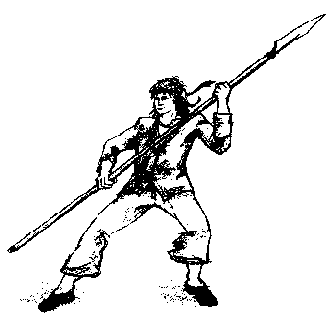
Martial Punch (d4): This is a special hand attack. See the Combat Skill for level bonuses. There is a penalty of 5 to the Attack Score, since this must be a Death Shot. There is no save against it, however.
One quarter of hand to hand damage may be added to the damage of the Martial Punch. If the character focuses (uses 1 EP per bonus), the character can gain a Penetration of up to half level, round down. The character can also do penetrating damage instead of bludgeoning, as desired.
If the character has a strength of less than 10, reduce the damage rolled by 10-Strength, on the Doubling Chart.
Martial Throw (d4): This is a special attack. See the Combat Skill for level bonuses. The character attempts to throw the target.
Compare the attacker’s damage to the opponent’s Mass (Square Chart). If the attacker’s damage is greater, the defender is thrown the difference, in meters. The defender also takes damage equal to the difference, in addition to any damage taken from flying into objects.
The attacker can use Martial Throw Quality to reduce the opponent’s effective Mass: each Quality point moves the Mass down 1.
If the defender’s mass is too high, the attacker loses a number of segments equal to the difference between the numbers (Sphere Chart), as surprise.
Mass Hypnosis (3d6): This is the skill of causing large numbers of people to see and hear things that aren’t there. Each target is allowed a saving throw vs. willpower, with a penalty equal to twice the character’s skill level. If the target knows that Hypnosis is being attempted, a bonus of willpower is gained.
The hypnosis can cause people to see illusions, but not to suffer from them.
Memory Training (3d6): Add twice the character’s skill level to perception, for purposes of remembering details seen earlier.
Mind Combat (2d4): This skill increases the chance of successful Mind Travel, and makes possible special attacks while in Mind Combat. See Mind Combat under Worldly Situations for more information.
Nerve Pinch (2d4): This skill is the knowledge of the correct nerves to pinch which will cause the target to fall unconscious. The attacker must hit with a Called Shot to the neck. The target is allowed a saving throw vs. perception, plus agility. The attacker can penalize this by 3 for each Quality Point applied to that. If the save is failed, the target will be unconscious for a number of rounds equal to the Q applied to that, modified for Ignore Damage and Skin Temper.
Nerve Pinch has a Performance Time of 20. See Combat Skill for more information on level bonuses for Nerve Pinch.
Opening Locks (3d6): The character must make a 2d10 roll vs. Level minus the Type of the lock. The bonus pool consists of half learning and half agility.
A skill level 7 person with a 10 learning and 10 agility, trying to open a skeleton key lock (type 1) will roll vs. 7-1, or 6, with a bonus of 9 (10 on the Sphere Chart). This is vs. 15.
Performance Time to Open Locks is the lock Type times 10 segments.
The character may leave a trace of tampering with the lock (which may set off an alarm) whether successful or not. Each try, the chance for not leaving a trace is level times 5 percent, plus the difference between the above Skill Roll and the die roll. Roll less than or equal to the chance on d100.
Picking Pockets (3d6): This skill applies to any action designed to take something from someone else surreptitiously. The character must roll 2d10 vs. Level. The target is allowed a Perception roll, at a penalty of three times the picker’s skill level. There is a bonus to the Bonus Pool of Agility minus 10, halved.
Picking Pockets has a Performance Time of 20.
Power Use (d4): Characters can train in their powers as for Combat Skill. This gives the same bonuses as Combat Skill, to the character’s Combat Roll with that Power.
Quick Change (3d6): The Performance Time to change one piece of clothing with another is 4 segments. The character can attempt to change multiple pieces of clothing at the same time, with a penalty to the bonus pool of the number of items being changed. The character’s Agility minus 10, halved, is a bonus to the Bonus Pool.
Quick Draw (3d6): This reduces the Performance Time for drawing a weapon by level segments, and reduces the time needed to sheath/holster a weapon by twice level segments. Quick Draw applies to only one weapon type, though the character can study it multiple times for additional weapon types.
Read People (3d6): When attempting to read a target’s mindset, the character gets a bonus of five times level on the perception roll. If the target attempts to foil the reading, reduce the chance by the target’s willpower.
Remote Attack (d4): If the character wishes to be able to attack with a remote-controlled weapon, the character must take that weapon as a Remote Attack skill. The character does not necessarily need to know how to use the weapon personally.
Rolling With Attacks (3d6): Add twice level to the character’s Virtual Damage Points.
Running (3d6): Add this to the character’s Move Pool.
Scaling (3d6): The character is able to climb walls and other structures. There is a penalty to the bonus pool equal to the number of degrees from straight up, divided by 10. A straight wall will subtract 0, and a flat ceiling will subtract 9. A flat floor will add 9. Also, subtract or add depending on the material being scaled:
| Wood: +5 | Rock: +4 | Brick: +3 | Metal: -2 | Glass: -3 |
The roll must be made every round that the character is moving. Movement is reduced to one tenth normal while using this skill. Add half Agility to the bonus pool.
Searching (3d6): This is the ability to find hidden things in an area. The character gets a bonus of three times level on the Perception roll to find the object/person. Searching for a small object in a small area takes ten minutes per 3 by 3 meter area. Searching for a large or moving object (that leaves traces, such as a human) in a large area can be done at the one tenth normal Movement rate, searching an area of one tenth Movement (in kmph) kilometers on a side, every hour.
Sex Appeal (3d6): Add this to the character’s Charm Pool (Beauty).
Sneak (3d6): Reduce Perception rolls involving seeing this character by three times the character’s level. When using this skill, the character cannot move faster than .1 m/segment. Doing so gives a bonus of 5 for every .1 m/segment to Perception rolls to see the character.
Special Use: Many times, players will come up with special uses for their powers. A character with power over Magnetism might decide to create electricity by rapidly varying a magnetic field around metal. This is a logical thing to be able to do. There are two ways to deal with these Special Uses. It is up to the Editor and Player to decide which is best applicable for each case.
| Option 1: | Create a new Basic Effect. The character starts out at 0 %Control in this new Basic Effect. In the above example, the character has the new Basic Effect of Create Current, up to one third PR (Sphere Chart) d6 worth. It requires at least PR squared pounds of ferrous metal, however. |
| Option 2: | Learn a new Power. The character starts out at 0 %Control in the new power, and PR 1. There will be a multiplier of at least 2 to the Editing Points required to train upwards (in both PR and %Control). The Player and Editor must determine the exact multiplier. In the above example, since the effect is so logical, and the power has the inherent weakness of requiring ferrous metal, the multiplier will be 2. The character will start out at PR 1, %Control 0 in Electric Power. The character must have at least Half PR, squared, pounds of ferrous metal on hand to use the power, however. |
Speed, Specific Action (3d6): The player can reduce the Performance Time of the Specific Action by the character’s Skill Level. For example, a character with Speed, Teleportation, level 10, subtracts 10 segments from the Performance Time of Teleportation.
Teamwork (3d6): Characters must study Teamwork together. If characters with different levels of Teamwork attempt to work together, the lowest level applies to the group. Teamwork skill levels only apply with the group the character trained with. It takes less training to learn Teamwork multiple times, however. When a character who already has Teamwork with one group attempts to learn it with another, it only takes 1 Editing Point times the character’s skill level, to gain the same Teamwork level with the new team.
Advantages of Teamwork: When attempting to Combine Attacks, the group’s Teamwork level is added to each member’s agility. The group’s Teamwork skill level is also used as a combat pool that each member can draw from. The amount that the character draws from the pool is added to the character’s Bonus Pool. That amount is also unavailable to the rest of the group.
Tracking (3d6): This is the ability to follow trails left by animals, people, or any moving object. The character’s perception is increased by level times 5 for purposes of following the trail. Generally, trails fade with age. Look up the number of minutes since the trail was made on Column 1 of the Doubling Chart, and multiply by 4, for the penalty to the Perception roll. In areas where the trail is less likely to fade, reduce the multiplier. Certain conditions can give penalties or bonuses to the Perception roll also.
Trailing (3d6): There are two facets to trailing—following someone without being seen, and keeping them in sight. Trailing can be combined with Sneak. Trailing gives a penalty to the target’s Perception roll of level. In order to keep the target in sight, the character must make a Perception roll, with a bonus of level times five. There will be other bonuses depending on circumstances.
Use Incorrect Hand: This allows the character to do any one thing with the character’s off hand (left hand for right-handed characters, right hand for left-handed characters). The character starts at 0% Control, and may train upwards as normal for %Control. This skill has no level.
Weight (3d6): Add this to the character’s build for purposes of determining the character’s mass.
Weightlifting (3d6): Add this to the character’s Lift Pool. This applies only to specially designed weights (such as barbells). Use half the character’s skill level (rounded up) as the bonus to the character’s Lift Pool for normal items. Use one quarter the character’s skill level for the bonus to the character’s Throw Pool.
Wizard Block (3d6): This skill uses EP, starting at Row 7. The character can reduce a specific caster’s chance of successfully casting a spell by skill level (minus 1 for each Newoen divided by 10 meters away the caster is). This skill is rare, and players who choose it must know where their character learned it. A character cannot have a level in Wizard Block greater than half Newoen.
Powers are listed in alphabetical order by name. Most powers have certain Basic Effects that define what the character can do with the power, and a Performance Time, which defines how long it takes. Some powers have Automatic Effects which do not use Endurance Points. For most powers, the PR is determined with 3d6. A few powers have a dice roll listed after the name, specifying the dice to use for the character’s PR.
| Basic Effects: | Basic Effects are effects that require EP to use, and can be used at different power levels in order to use less EP. Normally, the total PR for the Basic Effects of a single action cannot be greater than the character’s PR. |
| Automatic Effects: | Automatic Effects are those that do not require EP to use, and are automatically given to the character with the power. |
| Performance Time: | Most powers have a Performance Time of 20. |
Absorption: This is the ability to absorb other powers by touching the person who has them. Three types of Absorption can be chosen from: powers, material, and psyche.
Material Absorption is the absorption of Skin Temper, Ignore Damage, and DP of substances.
Psyche Absorption allows the absorption of knowledge, psychic powers, and intelligence. The character will absorb the memories, learning, and any psychic powers the target has.
Power Absorption allows the absorption of any power except robotic, item, or psychic. Power Absorption does not steal the basic abilities (increased Strength, Cosmic Rays). It steals the effects (Hand to Hand Damage, Cosmic Blast). Things that can be stolen include Hand to Hand Damage, Blasts, EP, DP, Carrying Capacity, Movement, Skin Temper, and Action Modifier. The abilities are only taken if there is a corresponding power. Hand to Hand damage will only be absorbed if the target has increased strength, for example.
Powers/Abilities that are automatic, such as Special Immunity, have a chance of working equal to the percentage taken. If the character steals 50% of the victim’s Immunity to Sausage, and is then attacked by a Vienna sausage, the Immunity has a 50% chance of working.
The character using this power must hit for DP, or use 3 Q points from the Combat Roll, to absorb powers from the target. Also, note that all the relevant powers or abilities are absorbed, including weaknesses if relevant or oriented towards the type of absorption (i.e. susceptibility to X-Rays for power absorption, phobia of zucchini for intelligence absorption, solubility in water for substance absorption, etc.)
Basic Effects: (Percentage Taken)
Percentage Taken: The percentage of power/material/ psyche taken per hit (per segment) is PR times 5. A character with Material Absorption PR 7 can steal 100% of a steel girder’s properties, after 3 segments of touching it. Upon absorption, the target must save on d100 greater than or equal to the percentage of power taken times Skin Temper (normal ST for physical powers, Mind ST for psychic powers), or fall unconscious for d100 rounds. Targets for Material Absorption will not fall unconscious or lose Skin Temper, Damage Points, or Ignore Damage.
Automatic Effects: (Duration)
Duration: Power/material/psyche is lost by the character with this power, and regained by the target, PR rounds after it was taken.
Acid Production: This is the ability to create acid and use it as a weapon. The acid type is equivalent to the character’s PR. See Acid, under Equipment.
Basic Effects: Acid Type, Range
Acid Type: The Acid Type is half the character’s PR, on the Sphere Chart.
Range: Maximum Range is PR minus 3, meters. Short Range and Range Set are PR (Square Chart).
Agility Bonus: Roll the dice given where the bonus was rolled up and add this to the character’s current agility. This power does not use EP.
Air Control: This is the power to control air motion.
Basic Effects: (Wind Speed, Wind Blast, Range)
Wind Speed: The maximum Wind Speed the character can bring wind to is PR times 10 kmph. The wind speed loses speed at the rate of 1 kmph for each meter beyond Maximum Range.
Wind Blast: The damage done by a Wind Blast PR/4, round down.
Range: The character can control air at up to PR (from Result to Square Chart) meters. This is also the Maximum Range of the Wind Blast. Short Range and Range Set are PR.
Alchemy: This is the ability to transmute matter from one form to another. Most (80%) of characters with this power must choose a specific matter that targets are transformed to. The rest can transform targets to any element.
Living things attacked with this power must save vs. constitution (Sphere Chart), on 2d10. Unliving things generally have a Constitution of 0. If this save is not successful, the target is transmuted for a duration equal to the amount it was missed by (Result to Sphere), minutes.
The character using this power in combat must either hit for DP or use 4 Quality Points from the Combat Roll in order to touch the target.
Basic Effects: Mass, Saving Throw Penalty
Mass: If the character cannot transmute all of something, none of it can be transmuted. The PR required for mass is the mass in kilograms (divided by 10), on the Sphere Chart.
Saving Throw Penalty: The character can give a penalty to the target’s saving throw of 1 per PR point.
Anti-Matter Production: The person with this ability can create tiny amounts of anti-matter.
Basic Effects: (Explosion, Range of Center)
Explosion: This does one fifth PR, rounded up, d6 damage as an Explosion (see Combat). It has a Short Range of PR divided by 5, Range Set of PR divided by 10, Maximum Range of PR divided by 4, and gets a bonus of twice PR to the Explosion Combat Roll.
Range of Center: The center of the explosion may be sent up to PR times 3 meters away from the person with the power. See Thrown Objects, under Combat, for what the character must do to attack the correct area. The character gets a bonus of 3 to Attack, since it isn’t really being thrown, but created at the target spot.
Half of these characters can create an even smaller amount of anti-matter and control it so as to keep it from blowing up immediately. The anti-matter appears as a glowing black sphere, PR/3 centimeters in diameter.
Astral Planes Travel: The character is able to travel in astral form anywhere, nearly instantly, if the character has already been there.
Basic Effects: (Movement, Passengers, Saving Throw Change)
Movement: If the character doesn’t or can’t travel instantly, astral flight is possible at normal movement times PR on the Doubles Chart.
If the character can travel instantly (usually because the character has already been to the destination before), look the distance (in km) on the Doubles Chart for the number of rounds the trip takes. The character can reduce this by up to PR rows.
Passengers: The character can only bring PR/3 passengers (round up) along on any astral trip, and each must make a save vs. Willpower minus the saving character’s Learning or be unable to become astral. Passengers can easily become lost in the astral planes. The EP used for taking passengers along is only used once—to bring them. It is not necessary to use EP to keep them there.
Passengers who are forced to come along are allowed a save vs. Willpower plus Learning.
Saving Throw Change: The penalty/bonus to targets’ saves is the character’s PR.
The character may also have access to another astral plane. Roll a d100 to see what plane(s) are accessible:
Planes Accessible: (d100)
| 01-50 | None (well, this one) |
| 51-70 | All Dream Planes |
| 71-90 | Roll Once for a Medium Plane |
| 91-99 | Roll Once for a Major Plane |
| 00 | Roll twice more |
Medium Planes: (d10)
| 1-4) | Plane of Universes |
| 5-7) | Plane of Time Lines |
| 8-9) | Plane of Multiverses |
| 10) | Plane of Time |
Major Planes: (d10)
| 1-4) | Plane of Light |
| 5-8) | Plane of Darkness |
| 9-10) | Plane of Neutrality |
See the descriptions of these planes for what the character can do there.
Being in a dream plane allows contact with other people by dreams.
See Astral Planes Travel, under Playing the Game, for combat and rules for the Astral Planes.
Beauty Bonus: Roll up the bonus with the dice given where this power was gained, then add it to the character’s Beauty. There is a 1% chance that a hero should actually subtract the roll from beauty, a 5% chance that Intelligent Robots should do so, and a 20% chance that villains should do so. This power does not use EP.
Brain Wave Hearing: The character with brain wave hearing has a hearing multiplier of 1/2. This is not ESP. The character can only hear what someone else is saying or directing mentally at the character, and the character can talk normally, but what is said is heard in the mind(s) of the target(s). In this case, learning is substituted for strength for loudness. This power does not use EP.
Breathe Water: This is the ability to breathe oxygen from water. Due to the fact that at greater depths there is less oxygen, the character will only be able to breathe at depths up to Power Roll divided by 4, kilometers. Fifty percent of characters with this power also have the ability to survive greater pressures. The character can reduce the Bonus Pool penalty due to high pressure by the character’s PR. This power does not use EP.
Burrow: This is the ability to burrow and tunnel through soil and ground. The character can move through non-cohesive materials (like soil and dirt) easily.
Basic Effects: (Movement)
Movement: Burrowing speed is normal movement, using PR as Move Q. When burrowing, divide this speed by the density of the material being burrowed through. If the character attempts to burrow through cohesive material (like wood, iron, cement), also multiply by the Skin Temper of the material.
Chameleon: This is the power to become almost invisible by changing color and hue to that of the surroundings.
Basic Effects: (Hiding)
Hiding: Subtract twice PR from the perception roll of those rolling to see the character. Defense is increased by half PR, round up. EP is only required to change color with chameleon, not to remain that way, unless the character moves around, in which case EP is used normally.
If the character is attacking, reduce the Defense Bonus by 4 and divide by 2.
If the character is moving, those rolling to see have a bonus of 1 per movement PR.
Charisma Bonus: Roll the dice given where the bonus was rolled up and add this to one of the character’s charisma scores. The character can divide the bonus up among both charisma scores if so desired. There is a 25% chance that villains who roll up Charisma Bonus are fear-inspiring villains. This power does not use EP.
Clairvoyance: Clairvoyance is the ability to see places other than where the person is. There is a 50% chance that the character can also hear things in the area being watched.
Basic Effects: Distance, Senses
Distance: Look up the distance to the desired target (in kilometers) on the Doubles Chart for the PR required. The character must either be looking at a specific distance and direction, or be looking at a place familiar to the character.
Senses: Sight (and Hearing, if the character can hear) for the power are equal to the character’s PR.
Constitution Bonus: Roll the dice given where the bonus was rolled up and add to the character’s constitution. This power does not use EP.
Control Chance: This is the ability to affect probabilities.
Basic Effects: (Chance Change, Hex Blast, Range)
Chance Change: The character can modify other people’s 2d10 rolls by up to PR (three times PR for d100 rolls). The modification is directly to the roll, not to the bonus pool.
Hex Blast: A hex is a random blast which warps probabilities at the target area. For example, causing a wall in New York City to choose that moment to topple, or causing a vehicle’s electrical system to stop working. The Editor should adjust the chance of a hex working, depending on how probable the hex is. The base chance will be the PR, on 2d10.
Range: Look up the distance to the target on the Sphere Chart, for the PR required for range.
Control Similar Animals: The character is able to control one or more species of animal (wolf, lion, house cat, etc).
To determine what type(s) of animals the character controls, roll 3d6. A result of 3 or 18 indicates control of all animals. A result of 4 or 17 indicates control of all of the type which the character represents (that is, all cat-like creatures, all bird-like creatures, water creatures, etc). 5 or 16 means control of d4+1 species, and anything else indicates one species.
Basic Effects: (Quantity, Distance)
Quantity: The character may control twice PR in Damage Points of animals at one time. Those numbers are those that can be explicitly controlled with exact commands. Five times as many can be controlled through emotions.
Animals are allowed a save vs. their willpower plus learning plus DP, minus this character’s PR, on d100.
Distance: The maximum distance at which animals can be controlled is PR (from the result column to the Sphere column) meters, times 2.
Convert To Energy: This is the ability to convert one’s own matter to energy and travel in the same manner as that energy does. The player must choose an energy form. As energy, the character automatically travels at the speed of light or below, with no EP cost. Some examples of energy forms: Radio waves, heat, light, electricity.
Basic Effects: (Extra Mass, Energy Blast)
Extra Mass: Besides the character’s body, up to half PR kilograms of continuous matter can also be converted.
Energy Blast: The character can use an energy blast doing up to half PR damage.
Automatic Effects: (Ignore Damage, Extra DA)
Ignore Damage: Energy forms will be immune to most physical attacks, but not to most energy attacks. They can ignore damage (energy) equal to their PR divided by 3, round up, when in energy form.
Defense: The character’s Defense can be increased by up to PR when in the energy form, but Attack is reduced by the same amount.
Cosmic Awareness: The character with this ability may attempt to know things.
Basic Effects: (Question)
Question: The player asks the Editor a question. The chance of finding the answer is a 2d10 roll vs. PR. It takes a number of minutes to find the answer equal to d100 minus the Q (plus the Q if the PR roll was failed). Roll 2d100 for the percentage of that time that the character perceives. (If 50 is rolled on 2d100, the character thinks that only half the actual time has gone by.) This power does require EP for the actual time.
Cosmic Rays: This is the power to create cosmic rays in a high intensity beam.
Basic Effects: (Damage)
Damage: The character’s cosmic ray does PR damage. Short Range, Range Set, and Maximum Range depend on the PR applied to damage: Look up the PR, from the Result column to the Sphere column, for Short Range. Move down 4 rows for Range Set, and up 5 rows for Maximum Range. Ranges are in meters.
Darkness: This power allows the character to negate light in a certain area. From the outside, this appears to be a perfectly black sphere, dome or whatever shape the character makes it. In this area nothing can be seen by normal methods. The character can even make the dome or sphere hollow, thus allowing light sources inside the shape to work, but not allowing light to flow into or out of the shape.
Basic Effects: (Size Points)
Size Points: The character has up to twice PR points for Range and Radius. Range is the maximum distance away that the center of effect may be placed. Each point used for Range counts 1 row on the Sphere Chart, for meters. Radius is the radius of the darkness sphere. Each point used for Radius counts 1 row on the Sphere Chart, for meters.
Half of those with Darkness can stop Ultraviolet light. Half of those with Darkness can stop Infrared light. Two percent stop all electromagnetic radiation, including radio waves.
Death Touch: This is the ability to kill with only a touch.
Basic Effects: (Death Touch)
Death Touch: Characters using this power must hit for DP for it to take effect, or spend 4 Quality Points from the Combat Roll. Targets are allowed a save vs. maximum DP plus constitution (Sphere Chart) minus half the Death Touch PR (Sphere Chart), on 2d10. If the save is not successful, the target dies (gains d% of half PR as Death Points). If the save is successful, the target merely loses PR EP (as EP that heals back sleeping), and half PR DP (as penetrating damage), saving throw not allowed and unmodified by Skin Temper or Ignore Damage.
Density Control: This is the ability to change density. The player must roll a d100 to see in which direction the density change occurs: 01-50 means both directions (but roll a separate PR for both), 51-75 means Lower Density, and 76-00 means Increase Density.
Basic Effects: (Low Density, High Density, Extra Mass)
Low Density: Half the character’s mass for each PR. See Atmosphere, under Special Rules, for changes due to very low density. The character can ignore PR in bludgeoning damage at the low density, and can multiply Jump Score by the PR.
High Density: Double the character’s mass for each PR. The character can ignore half PR in damage, and gains a bonus to Skin Temper equal to PR (Doubles).
Extra Mass: The character can bring along up to PR kilograms.
Duplication: This is the ability to duplicate physical powers, mind/psychic powers, or skills. The player must choose which to take. In order to be able to duplicate a power or skill, the power must be known. To know a power, the character must study someone with it for the amount of time needed to gain 2 training points. Learning a new power requires that these 2 training points be diverted to it also.
Basic Effects: (Number of Powers)
Number of Powers: The number of powers a character can hold at one time is the PR divided by 3, round up.
Automatic Effects: (Known Powers)
Known Powers: The character can know a number of powers equal to PR.
Remember also that EP is required to use the power as if the power were the character’s.
Only 20% of Human (Organic) characters can duplicate powers by studying a robotic/mechanical user, and only 60% of Robotic/mechanical characters can duplicate powers by studying a human/organic user.
Duplicate Person: This is the ability to duplicate the face and shape of another human.
Basic Effects: (Changing)
Changing: Multiply the PR by 2 for the number of points by which abilities can be changed to duplicate a person. In order to look like another person, beauty, height, and weight must be made the same. Changing physical beauty requires 1 point per beauty point changed. For height, 5 centimeters requires 1 point. For weight, 10 kilograms requires 1 point. Going down always uses half the number of points. Changing sex requires 5 points. If all these statistics are exactly the same as the person being duplicated, then the character looks exactly like the person being duplicated.
Close scrutiny by someone who knows the target may reveal the discrepancy. That person is allowed a perception roll, at a bonus equal to the PR needed to fully duplicate the target, and a penalty equal to the PR used to duplicate the target. Skills (such as Ventriloquism or Disguise) can also directly affect the perception roll, at the Editor’s option.
EP is only required to change with this power, not to remain changed.
Electric Power: This is the ability to control and create electricity.
Basic Effects: (Damage, Skin Temper, Lift/Throw, Control)
Damage: Electrical blast damage is PR/3 (round up). Add 50% if the target is grounded, and double if the target is well grounded.
ST: The character can increase Skin Temper by half PR (Sphere Chart).
Lift/Throw: The character can use static electricity to lift and move objects. The Strength for the Lift/Throw roll is the PR applied.
Control: The character can control a number of points of electricity equal to PR. Reduce PR by the distance to the electricity in meters, on the Sphere Chart.
Emotion Control: This is the ability to affect people’s emotions mentally.
Basic Effects: (Save Penalty, Range, Reactions)
Save Penalty: Targets are allowed a save vs. willpower minus twice the character’s PR, minus any modifications due to predisposition (already angry, already attracted, etc), on a d100. If the character concentrates on only one target, use 4 times PR instead of twice PR for the reduction. If the target realizes that emotion control is being attempted, willpower can be added to the saving throw.
Range: The emotion control will work on anyone within PR meters.
Empathic Healing: With this ability, the healer can take wounds from another person. 80% of Empathic Healers may take on penetrating damage. 75% of these can take on injury damage. 50% of these can take on permanent damage.
Basic Effects: (Wound Size, Restoration Rate)
Wound Size: The character can take wounds at the rate of half PR points per round.
Restoration Rate: The PR indicates the number of bludgeoning damage points the healer may heal from that which was taken, every round. Penetrating damage points are regained at half this rate. Injury and permanent DP are regained at this rate every minute.
Example: The Chessman loses 5 DP from a gunshot wound—4 Penetrating and 1 Bludgeoning. Healer (who has 6 DP) heals Chessman. Healer has a PR of 2, so it takes 3 rounds (2 and a half) to take the wound away, using 15 EP. Chessman now no longer has the wound, but Healer does, and is down to 1 DP. Healer heals the Penetrating Damage first (his choice), at his maximum rate of 1 per round. It takes 4 rounds to do so (using 20 more EP). Healer decides to let the Bludgeoning Damage heal on its own, since he’s already used 35 EP.
Remember that the empathic healer actually has the wound, and any bleeding or other effects of the wound take place on the healer.
Characters with this power cannot heal their own wounds with this power—those are healed at the character’s normal healing rate. However, 25% of villains who have this power are only able to heal themselves—by transferring their wounds to another person, in the same way as normal Empathic Healers transfer wounds to themselves. However, in this case the wounds transferred do not heal on the other person, except as normal.
Empathy: Empaths have the ability to feel other people’s emotions.
Basic Effects: (Bonus to Chance of Success)
Bonus to Chance of Success: To determine a target’s emotions, a roll must be made under perception plus the target’s newoen, plus five times PR, minus the distance in meters to the target (Sphere Chart), on d100. Touching the target adds the Empath’s newoen to the chance. If the target realizes what is happening and resists, subtract the target’s willpower from the chance. The empath will know what the target is feeling, towards whom, and what kind of a feeling it is.
80% of Empaths can show targets the empath’s feelings. The chance is the same as above, except that the empath’s willpower is used in place of perception + target’s newoen. Half of empaths who can Show Feelings can show fake feelings. That is, they can make others think the empath is happy, when actually angry, etc.
Empaths can scan the area around them. The chance of picking up emotions for any individual is the same as above. Roll only once. This scan is vaguer than a direct attempt (the empath only detects the kind of feeling), but it has a chance of picking up any individual in the area. The scan can be directed towards a particular direction, if desired, to weed out undesirable targets.
Explosive Touch: The character with this power can cause explosions upon touching solid matter.
Basic Effects: (Explosion)
Explosion: The character with this power can do PR/4 round up, d6 damage just by touching something, and can add this damage to Hand Damage attacks. The carrier attack must do DP, or the attacker must use 4 Quality Points from the Combat Roll.
Short Range for the explosion is the damage PR, millimeters. Range Set is the damage PR centimeters. Maximum Range is the damage PR decimeters. The explosion gets a bonus to Attack others of twice the damage PR. The explosion gets a bonus of half the damage PR (Sphere Chart) vs. Skin Temper against who/what ever was touched. This cannot bring a skin temper below one.
Half of these characters may cause explosions which do PR/5 round up, d6 damage when touching liquid matter.
The explosion does not go towards the character causing the explosion. Thus, people behind this character will not be affected by the explosion either.
Extra Appendage: This will usually be an arm, tentacle, etc., depending on the situation and planned origin of the robot. Some ideas are: telescoping arm, vise hand, normal appendage, eye in back of head. This will not add to any ability, basic or derived, although it should give advantages. The person with eyes in the back of the head would be allowed a full sight perception roll for attacks on all sides. A person with four arms won’t gain extra attacks/round, but will be able to hold 2 things while still fighting normally, etc.
This does not use EP.
Fire Coat: This is the ability to light up like a Roman candle, control fires, and create fire blasts.
Basic Effects: (Damage, Distance, Weight, Blinding, Skin Temper)
Damage: Damage is the PR/2. The character can spread the beam to get a better chance of hitting. For each point taken from damage, 1 can be added to the Combat Roll. Fire blasts may be forked, also, dividing the damage between more than one target. Attack Q must be supplied for each target. The Maximum Range for the Fire Blast is determined separately from the damage. See Distance, below. PR applied to Maximum Range cannot be applied to Damage.
Distance: The character can control fires at a distance of up to PR, read from the Result Column to the Sphere Chart, meters. This is also the Maximum Range with the Fire Blast. Short Range and Range Set are standard.
Weight: Weight is the mass that the character can cause to go into the air (caused by heat rising). This includes the character. Remember that the character is on fire when flying. If the character wishes to cause something else to fly on its own, it must be given a fire coat, which is likely to burn it up. Look up the weight being lifted on the Square Chart, for the PR required. Remaining PR can be used for speed in decimeters/segment.
Blinding: There is a chance that others will be blinded if the character lights up completely. Those in the area must make a Perception roll vs. blindness. If the save is not made, roll damage for the number of segments the target is blinded. All people in the area are targets. There is a penalty to that roll of the PR used for blinding, times 4.
Skin Temper: The character with this power can increase ST by PR divided by 2 rows when flaming.
Automatic Effects: (Safe Temperature)
Safe Temperature: The temperature of the fire is the PR applied to damage, times 100, degrees Celsius. Add this (using maximum PR) to the character’s Maximum Safe Temperature (see Temperatures under Situations).
Flight, Slow: This is the ability to fly.
Basic Effects: (Movement, Combat Bonus)
Movement: The Movement Roll Q is the PR plus height (Square Chart). Movement is in meters/segment.
Combat Bonus: The Combat Bonus Pool can be increased by up to half PR. This will only work when the character is flying in an open area.
Flight, Fast: This is the ability to fly at speeds which are a significant fraction of, or exceed, the speed of light.
Basic Effects: (Speed, Combat Bonus)
Speed: The Move Roll Q is the PR, and speed of flight is 10 to the power of half the Q, meters/segment. 7.2 times 10 to the 7th meters per segment is the speed of light, so characters moving at Q 16 and above will exceed the speed of light. See Space Travel, under Worldly Matters. The penalty to the Move Roll Bonus Pool is half the Q applied to movement, rounded up.
Combat Bonus: In flight, the character’s Combat Bonus Pool can be increased by PR.
Force Field: The Force Field is a sphere of force that helps keep out physical and energy attacks. Force fields also keep attacks from leaving the force field. Half of characters with this power can create walls as well as spheres. Ninety percent of characters with this power can create oblong spheres.
Basic Effects: (Diameter, Range, Skin Temper, Ignore Damage)
Size: The maximum diameter of the force field is the PR, meters. If a wall is created, the total of length and width cannot be greater than twice that. If an oblong sphere is created, the total of the vertical diameter and the horizontal diameter cannot be greater than twice the diameter listed.
Range: No part of the force field can be further than PR meters (Result to Sphere chart) from the character.
Skin Temper: The field has a Skin Temper of PR.
Ignore Damage: The field can ignore twice PR points damage.
Freeze Ray: This is the ability to project a freezing ray.
Basic Effects: (Ray)
Ray: Ray damage is one third the PR. The ray’s temperature is the PR applied to damage times 10, below zero Celsius. A bonus vs. ST of PR/3 (round up) is gained. This cannot bring ST below row 0.
Generate Self: The character with this power can fission into two or more bodies, each looking exactly the same. These bodies are controlled by one mind. The character can control all at the same time, see through all eyes, and react normally for each body.
Basic Effects: (Number of Bodies, Generate Mass)
Number of Bodies: The character can create up to PR bodies.
Generate Mass: Only half of characters with this power can generate extra mass when generating other selves. This means that if the character is wearing a suit, all characters end up wearing the same suit. Up to PR kilograms of possessions can be ‘copied’ to the generated selves, if the character can Generate Mass.
Characters who cannot generate outside mass can choose what possessions go where. A character with normal clothes over a costume could change into a person with normal clothes and a person with a costume, or a person with normal clothes over a costume and a nude person. It’s the character’s choice.
When recombining, average the scores for DP, VP, and EP of all selves to determine the DP, VP, and EP of the unbroken self. This power requires EP maintain the division. If the bodies cannot rejoin—they’re too far apart—then EP continues to be lost. However, any body that’s asleep only counts as ‘half’ a body for EP use (this cannot increase the number of bodies the character can become).
If one of the bodies falls unconscious, the player must save vs. willpower on d100, or all other bodies fall unconscious for 2d10 minutes. If one of the bodies dies, the player must make a save vs. willpower or the character is unable to re-absorb that body, and the abilities strength, agility, constitution, sight, and hearing, and the attribute build will be multiplied by the number of selves the character had become, divided by this number +1, ignoring fractions. If the character cannot join up with that body, a save vs. (new) constitution (Sphere Chart) on 2d10 must be made, or the character’s PR is reduced by the amount the roll was missed by.
Possession powers will only control the body possessed. Hypnosis and mind control powers, however, control the mind, thus controlling all bodies.
If one body is transported to another plane or universe, control of this body may be lost. The player should roll below to see where the bodies may be transported without losing control (roll d100):
| 01-40 | this plane, this universe only |
| 41-60 | other astral planes, this universe |
| 61-80 | other astral planes, other universes |
| 81-90 | other astral planes, other multiverses |
| 91-99 | other astral planes, multiverses, time-lines |
| 00 | other planes, multiverses, time-lines, times |
When a body is transported across planes, universes, or times without the knowledge of the character, the player is allowed a perception roll, with a bonus of newoen and agility, in order to choose where the controlling mind goes. This save is not allowed if the character is unconscious, and is not necessary if the character knows the travel is about to occur. Bodies lost due to travel become vegetables, and are treated as having died as far as re-absorbing.
Get Small: This is the ability to decrease size.
Basic Effects: (Size Change)
Size Change: Each PR halves the character’s height (for the number to divide height by, look up the PR used, +1 on the Result column, and read to the Doubles chart). This power requires EP only to change size (up and down). See Size Modifiers, under Combat Situations for special combat changes. In the new size, ranges and sight/hearing distances, may be modified. Many other figured statistics will change as well, most notably mass.
Get Tall: This allows a character to increase height. Increased height will affect combat. See Size Modifiers, under Combat Situations. Mass changes with height as well.
Basic Effects: (Height Increase)
Height Increase: Look up the PR used from the Result column to the Sphere Chart, and multiply by 10. This is the percentage increase in height. If the character uses 4 PR to increase height, this is a height increase of 40%. If the character’s height were 1.873, increase it by .1873 times 4, or .75, for 2.623. Get Tall only uses EP to change height, up or down.
Gliding: This is the ability to glide. Usually, though not always, the character will have vestigial wings.
Basic Effects: (Speed)
Speed: The character’s Move Roll is PR, in .1 meters per segment (as normal). The movement increase for each roll is halved, but the penalty to the rolls is normal. There is a bonus to the roll equal to the wind speed in kilometers per hour, if the character is going with the wind. Against the wind, this is a penalty. Crosswind, the penalty is half this. If it is raining, there is a penalty to the roll equal to the Weather Number (see Weather, under Worldly Matters).
Gravity Control: This power is the ability to cancel and reinforce gravity.
Basic Effects: (Gravity Change, Range, Radius, Flight, Gravity Barrier, Gravity Beam)
Gravity Change: Look up the PR used from the Result column to the Sphere Chart, and divide by 10, for the number of Gravities the character can create/cancel. A gravity of 1 is exactly equal to Earth’s gravity, allowing the character to cancel gravity or make it double. On the moon, a gravity of .2 can cancel gravity—the moon’s is 1/6 th of Earth’s.
Reinforcing gravity multiplies weights in the area by that amount plus 1: a .1 increase brings 100 kilograms to 110 kilograms, or 60 kilograms to 66 kilograms. A 1.4 increase brings 100 kilograms to 240 kilograms. An increase of 13 brings 100 kilograms to 1400 kilograms.
Range: The character can place the Gravity Change up to PR (result to Sphere Chart) meters away.
Radius: The Gravity Change can be as wide as PR (result to Sphere Chart) meters in diameter.
Flight: The character can fly by creating gravity greater than the planetary gravity ahead of the character. Subtract the planetary gravity (1 on Earth) from the gravity the character is using to fly. Multiply that number by 10 for the character’s Move Roll, in .1 meters/segment A character will need, on Earth, to create a gravity greater than 1 (PR of 10) to fly. Maneuverability is penalized by 1.
Gravity Barrier: The character can create a gravity barrier, increasing Skin Temper by up to half PR rows.
Gravity Beam: The character can create a gravity beam, doing PR/3 (round down) points of damage.
Healing: This is the ability to heal wounds, restoring Damage Points that other characters have lost.
Basic Effects: (DP)
DP: The PR is the number of DP which can be healed, with a Performance Time of 2 minutes. Thirty percent of characters with this power can also heal Injury Points, with a Performance Time of 6 minutes. Thirty percent of those can heal Permanent Injuries. This has the added basic effect of Permanent Points (up to PR), which transforms Permanent Injuries of up to Permanent Points to normal injuries. Wounds of greater than the healer’s Permanent Points cannot be healed at all. The Performance Time for Permanent Points is 10 minutes.
Five percent of healers can also heal Death Points. They have the added basic effect of Resurrection Points (up to half PR). The healer can bring dead characters whose Death Points do not exceed the healer’s Resurrection Points, back to life. The Death Points are transformed to Permanent Injury Points (which can then be transformed from Permanent Points to Injury Points, if the healer can do that). The Performance Time for Resurrection Points is 1 hour.
Ten percent of healers can heal at a distance instead of just on touch. They have the basic effect of Range, up to PR meters.
Ten percent of healers can heal themselves.
Hear More Frequencies: This is the ability to hear other than normal sound. Roll d4 to see what is heard, and the power roll is simply the character’s Hearing. For a description of the hearing, see that entry under powers. Eighty percent of characters who can hear more frequencies can talk on these frequencies also. This power uses no EP.
| 1) | Ultrasonic |
| 2) | Subsonic |
| 3) | Ultrasonic and Subsonic |
| 4) | Roll again, hearing in this manner is times (d6+1) |
Hearing Power: Roll this with the dice given where the power was rolled up. Hearing power allows the character to hear things as if they were closer. Divide the real distance by the hearing power PR for the distance which a noise seems to be. This power uses no EP.
Heat Ray: This is the ability to create rays of heat.
Basic Effects: (Heat Ray)
Heat Ray: The Heat Ray does PR/2 points damage. It has a bonus vs. Skin Temper of the PR used for damage, divided by 6. It’s temperature is 30 times the square of the PR used for damage.
Hold Breath: Multiply the character’s hold breath score by the PR (Result column to Sphere Chart). This power uses no EP.
Hypnotic Power: To hypnotize, the character must catch the eye (or other visual organ) of the target. Hypnosis only works against sentient creatures of similar mind-set to the character with the power.
Basic Effects: (Save Penalty, Time Between Saves)
Save Penalty: Once caught, the target is allowed a save vs. Willpower minus twice the PR used, on d100. If the target knows hypnosis is being attempted, there is a bonus of willpower on the roll. This save is allowed again every time the hypnotizer tries to have the hypnotized person do something, at a penalty of four times the PR used, and a bonus of from 1 to willpower, depending on the magnitude of the action. Having someone attack to kill close friends will usually add full willpower.
A post-hypnotic suggestion is also possible once a target is hypnotized. Every time the post-hypnotic suggestion is carried out, the target is allowed a saving throw vs. willpower minus the PR used to implant it, plus a number depending on the magnitude of the suggestion (see above).
Time Between Saves: The target is also allowed a save after a specific time, both to become unhypnotized and to throw off any post-hypnotic suggestions. Look up the PR used for Time Between Saves on the Result Column, read to the Doubles Chart, for the number of rounds between saves (divide by 5 for the number of minutes, 300 for the number of hours, or 7200 for the number of days).
This power requires EP to hypnotize only, not to keep someone hypnotized, although the subject will not have the Save Penalty if it’s not being applied. EP is also required each time a post-hypnotic suggestion is implanted. Post-hypnotic suggestions use the same Time Between Saves as the hypnosis itself.
Ice Coat: This is the ability to attract and freeze moisture in the atmosphere.
Basic Effects: (Blast Damage, Amount, Ice Coat)
Blast: An ice blast does PR/2 points of damage. Due to the relative slowness of the blast, there is a penalty of 1 to Attack. The Short Range of the blast is the PR used for damage, divided by 5. The Range Set is the PR divided by 4. The Maximum Range is the PR used.
Amount: The character can create PR cubed, cubic meters of ice per action. Use twice PR in heavy rain, and 10 times PR if the character is under water.
Ice Coat: The character can become covered with ice, increasing ST by up to one third PR, Ignore Damage by half PR points, round up, and decreasing Defense by PR/6, round up.
Automatic Effects: (Minimum Temperature)
Temperature: The temperature of the ice is 9 minus 3 times the PR used for Damage/Creation, in degrees Celsius. The character’s Minimum Temperature is at least this (see Temperatures, under Situations).
Ignore Damage: Roll the PR with the dice given where the power was rolled up. This allows the character to ignore that many points damage. Apply this before Skin Temper adjusts the damage. As an example, a person with the ability to ignore 4 points damage, with a Skin Temper of 2 (Row 4), would take 1 point damage from 6 points (6 minus 4 is 2, and 2 divided by 2 is 1) and would take 5 points from 14 points (14 minus 4 is 10, and divided by 2 is 5).
When Ignore Damage is used, it’s treated as if the character took DP for purposes of Throwback and Pushback. The player chooses whether or not to use Ignore Damage if only VP are lost. If DP would be lost, Ignore Damage is automatic.
There is a 50% chance that this is only partial protection. If so, it will only protect a character 50 + d20 percent of the time. Every time the character is hit for damage, a save must be made vs. that number, on a d100. The character can train in blocking damage with Ignore Damage as Armor Use. Opponents can attempt to get past the ignore damage as if trying to get past armor.
This power does not use EP.
Illusion, Psychic: This is the ability to manipulate the brain’s sensory centers.
Basic Effects: (Save Penalty, Number of Targets, Range, Sense Points)
Save Penalty: Those affected are allowed a Perception roll minus the PR used, plus the amount of damage the illusion can do. If they know that it is an illusion, they gain a bonus of their willpower. There is also a penalty equal to the number of sense points used in the illusion.
Number of Targets: Look up the number of targets on the Doubles chart for the PR required for number of targets. Only subjects who are in range and known to the psychic can be affected.
Range: The maximum distance a target can be from the psychic is the PR for range, read from the Result column to the Sphere Chart.
Sense Points: The character can use up to PR Sense Points. Each sense has a number of sense points corresponding to it. Illusions can have these components: olfactory (1 point), heat/cold (1 point), optical (2 points), auditory (2 points), and touch (4 points). There is also the option of movement. This doubles the cost of any illusion, but if a target under sway of the illusion attempts to move, the target will feel the illusion of movement, but will, in actuality, be staying right in the same spot, unmoving.
These illusions can damage, even kill, if a subject believes them (see Illusionary Damage, under Combat). Only illusions with a Touch component or a heat/cold component can cause damage, and damage will be what the target believes the illusion can do.
Immortality: This power causes the character to live longer than most people.
Automatic Effects: (Longevity, Fate, Injury Resistance)
Longevity: Multiply the age at which deterioration starts and all other ages given in the aging section (except for age of maturity, normally) by the number corresponding to the PR below.
| PR | Aging | PR | Aging | PR | Aging | PR | Aging |
| 3 | 2 | 4 | 5 | 5 | 10 | 6 | 15 |
| 7 | 25 | 8 | 40 | 9 | 60 | 10 | 100 |
| 11 | 150 | 12 | 220 | 13 | 320 | 14 | 480 |
| 15 | 750 | 16 | 1000 | 17 | 1500 | 18 | 2000 |
| +1 | X 3/2 |
Some immortals have Fate or Injury Resistance. Roll d100:
| 01-50 | Neither Fate nor Injury Resistance |
| 51-78 | Fate |
| 79-98 | Injury Resistance |
| 99-00 | Fate and Injury Resistance |
Fate: Immortality increases the number of Fate Points the character starts with by half the PR. The character gains .15 Fate Points per issue rather than the standard .1 Fate Point.
Injury Resistance: Add half PR, round down, to the character’s Resist Death score.
Increased Healing: Add the PR to the character’s Healing Roll Bonus Pool.
90% of characters with this power have the ability to heal DP while not resting, per minute. 70% of these characters heal Penetrating Damage at the healing rate per hour. If so, 70% of these characters also heal Injury Damage per day, and 50% of the characters who do that also heal Permanent Damage, but as if it were Injury Damage (healed at the normal rate, not per day).
25% of all characters with Increased Healing heal EP (that heals per round) while not resting at the healing rate per minute. 10% of these characters also heal EP (that heals per hour) as if sleeping—they don’t normally need to sleep.
This power does not use EP.
Increased Speed: This increases the character’s movement rate.
Basic Effects: (Increased Reaction)
Increased Reaction: When performing actions that take time, up to PR (Sphere Chart) can be used to reduce the Performance Time of the Action. In the case of Combat, up to PR can be added to the Bonus Pool.
Automatic Effects: (Move Increase)
Move Increase: Add PR to your Move Roll. For characters with this power, movement is increased/decreased in 1 meter/segment increments. If used to increase the speed of Flight, Slow, the increment becomes 10 meters/segment.
Infectiousness: The character is able to cause diseases. The player should choose whether infection occurs when the character does damage with the body, or when touching the target for prolonged periods in a way that traditionally spreads germs (kissing, for example).
Basic Effects: (Chance of Infection, Disease Type, Onset Time)
Chance of Infection: The target is allowed a save vs. Constitution minus PR, on 2d10.
Disease Type: If the person is infected, it is with a viral disease of type equal to half PR.
Onset Time: Once a target is infected, the disease will start at 0 and increase by 1 point every 60/PR minutes, until it is at the specified type. See Diseases, Viral for an explanation of what happens then.
There is a 10% chance that a character with this power infects with a chronic disease. The Onset Time for a chronic disease is 24 hours divided by the Onset Time PR. Once it hits the maximum, see Diseases, Chronic, for an explanation of what happens.
Infrared Vision: Infra-red is heat, just below the color red in the light spectrum. Infrared vision allows the character to see the outlines of living things in the dark—their heat signature. Different kinds of things will have a different heat signature. This power does not use EP.
Injury Resistance: Add the PR to the character’s Resist Death score. This power does not use EP.
Invisibility, Light: This invisibility is the power to control or change normal light in such a way as to become invisible.
Basic Effects: (Save Penalty)
Save Penalty: Persons attempting to see the invisible character are allowed a perception roll at a penalty of three times PR. Sight will not modify the roll, except for microscopic vision.
20% of characters who have light invisibility can be seen in infra-red. 10% can be seen in ultraviolet, 30% can be seen with X-Ray vision, and 60% can be seen with Radar. All can be seen with Sonar.
Half of characters with Light Invisibility only need to use EP to change back and forth. Other characters must use EP to stay invisible also.
Half of characters who use EP to stay invisible can turn other things invisible also. They have the added basic effect of Range and of Volume.
Range: The target must be PR (Result to Sphere Chart) meters away or closer.
Volume: The target must be less than or equal to PR (Result to Sphere)/2 cubic meters in volume.
Invisibility, Psychic: This is the ability to make people believe that something or someone is not there. The character can attempt to make anything within sight not there.
Basic Effects: (Save Penalty, Effect Range)
Save Penalty: Those viewing the character (or what the character is making invisible) are allowed a Perception roll at a penalty of twice PR. If the viewer knows there is something invisible in the area, there is a bonus equal to willpower on this save.
Effect Range: This power works on all sentients within PR (Result column to Sphere Chart), times 10 meters.
Jump: This is the ability to jump great distances.
Basic Effects: (Extra Dodge, Damage Increase)
Extra Dodge: The character can add PR (Sphere Chart) to Defense. However, the same amount must be subtracted from the character’s Quality with whatever Roll is being attempted.
Damage Increase: Hand Damage can be increased by PR (Square Chart) points.
Automatic Effects: (Jumping)
Jumping: Add the character’s PR to the character’s Jump Roll. Also, the character uses meters, instead of decimeters, for distance.
Laser Hearing: The character has a hearing multiplier of 10 with laser hearing. However, the laser must be aimed perfectly to be heard, and smoke, walls, trees, and other obstructions can kill signals. This power doesn’t require EP. Laser Hearing uses the character’s normal Hearing score.
Learning Bonus: Roll the bonus with the dice given where this power was rolled up. Then add the bonus to the character’s Learning. This power does not use EP.
Life Support: The character can create a life support field that surrounds the character’s body.
Basic Effects: (Vacuum, Pressure, Temperature)
Vacuum Protection: The power can provide enough atmosphere to make up for PR atmospheres.
Pressure Protection: For high pressures, the field can withstand up to PR squared atmospheres before it caves in.
Temperature Protection: For cold temperatures, the field can withstand down to PR times 200 degrees below zero. For high temperatures, it can withstand up to PR cubed, times 10 degrees before it breaks down.
Half of characters with this power also have the Basic Effect of Range, which is twice PR meters. They can provide a life support field for other characters in range. Each field uses EP separately.
Lifting: Add the character’s PR to the character’s Lift Roll and half the character’s PR to the Throw Roll.
Light Control: This is control over light—the ability to change its movement and create light.
Basic Effects: (Laser Blast, Light Area, Save Penalty)
Laser Blast: The character can create a laser that does PR/2 points damage. This damage can be done when there is an endless supply of light to turn into laser light. In darkness, the character can only create half this.
Light Area: The character can illuminate an area PR (Result to Sphere Chart) meters in diameter.
Save Penalty: The character can try to blind an opponent (+1 to Attack) or everyone in the vicinity (automatically hits). The flash blinds for PR times 5 segments (twice PR, d6 segments for an explosive flash). Reduce this time by the number of meters away each target is (Sphere Chart). The blinding flash does not cause any physical damage. Targets are allowed a Perception roll (see Perception) to see if they can avert their eyes.
The character cannot create darkness, because there will always be more light coming in. However, in special cases, if all incoming light can be controlled, darkness can be effected.
Light Illusion: This is the ability to create light and shape this created light into pictures. The light can be made into any shape with any colors.
Basic Effects: (Range, Size)
Range: Look up half the Range (in meters) on the Sphere Chart, for the PR required for range. No part of the illusion can be beyond this range.
Size: Add the height, width, and depth of the illusion (Sphere Chart), for the PR required for the size of the illusion.
Light Vision: A robot with this sight mode sees just like any normal human. If light can be transmitted, treat it as a flashlight: the robot can thus turn it on in the dark for normal sight range. The light can be in different colors. This power does not require EP.
Luck: Any die roll made against the character, and any saving throw made by the character with this power can be modified to the benefit of the lucky person. Whenever the Lucky character enters a situation where luck is important, the player should make a 2d10 roll vs. Luck (Sphere Chart). If successful, the Q modifies rolls in that situation to the benefit of the lucky character. If it’s a 2d10 roll, the Q modifies it directly. If it’s a d100 roll, modify it by Q times 2. This power does not use EP.
The character is also allowed a Lucky Escape Roll. In cases when die rolls are not normally made, but the character needs some luck (for example, when about to be captured by some attackers, being knocked unconscious, etc), the character is allowed a Lucky Escape Roll, which if made indicates that something happened to save the character from whatever was about to happen. The Editor is allowed much leeway as to exactly what saved the character, and as often as not the luck will land the character into another strange situation. There is a penalty of 3 to the Lucky Escape Roll for each previous Lucky Escape Roll that issue.
Magic Resistance: Any magic used around this character has a chance of simply not working or being reduced. Reduce the Level of Effect of any relevant spell effects by the character’s PR. Reduce the character’s PR by one for each meter beyond the character. Non-relevant spell-effects will include Range and Radius. If the Magic Resistance is still in effect at the caster’s location, it affects all the effect levels, including range and radius. If the Magic Resistance is still in effect at the center of effect, it’ll reduce all the effect levels except range.
Suppose a wizard casts the third level spell Radiation. The wizard is 10 meters from the character with Magic Resistance, PR 11. The wizard casts the Radiation with 5 levels in Range (50 meters, centered 40 meters from the Magic Resistant character), 8 levels in Radius (16 meter radius), 6 levels in amount, and 4 levels in Type. First, the Magic Resistance is still in effect at the caster: the caster is 10 meters away, and the PR is 11. So, all effects are reduced by 1 level (11 minus 10). This reduces the range to 40 meters (level 4), the radius to 14 meters (level 7), the amount to 5, and the Type to 3 (changing it from heat to light, probably infra-red).
If the wizard were 55 meters from the character, and cast it with a range of 50 meters, 5 meters from the character, all effects except range would be reduced by 6 (11 minus 5), effectively nullifying the spell. It’ll still have a radius of 4 meters, but the amount will be 0 and the type will be 0.
If the wizard were 65 meters from the character, and cast it 15 meters from the character, neither the caster nor the center of effect are within range of the character’s Magic Resistance, so only the last 2 effects (amount and type) are affected, and those only within 11 meters of the character. Directly at the character, both effects are reduced to nothing. Ten meters from the character, they’re each reduced by 1 level (11 minus 10).
This power does not use EP.
Magic Spell: Either the character has somewhere gained knowledge of a spell, or the character has the ability to use a magic spell as an innate power.
Roll d100 to see what level the spell is, and then roll to see which spell is gained, giving each spell an even chance. There is a 60% chance of having a minor spell also. Roll this until the roll is missed. All spells are cast at the level of the normal (high level) spell gained, even if this level is greater than the character’s intelligence (but if the level is greater, the character must choose option 1, below). The character has a 2 in 6 chance of adding 1 to the level, rolled until missed.
At this point the character must choose how to treat the spell(s). There are two choices:
1) treat it as a power. The character doesn’t have to worry about Concentration. The spell’s Effects are Basic Effects. The character’s PR is the character’s level plus 1d6. Performance Time is the Base Casting Time. The base EP Use row is 0 (4 for Minor Spells).
It really isn’t a magic spell, it just looks like one. There is a 35% chance that a spell which changes the universal or astral continuum does not do so as a power, and a 90% chance that a Ceremony does not require any objects/materials. Even if the Ceremony does require objects/materials, the player and Editor should work together to determine the requirements in a way that fits with the character. The training points required for training in the spell are halved for minor spells.
2) treat it as a spell. Treat the spell as if the character had learned it under the rules for Wizardry. The casting chance is not halved, even though the character probably has not yet learned magic. Any spells learned later also do not half the casting chance, and the roll to know is vs. willpower, not intelligence (see Learning Magic After Starting Play) for other spells the character attempts to learn. The character is sort of a ‘half’ wizard.
| Roll | Spell Level |
|---|---|
| 01-13 | 1 |
| 14-25 | 2 |
| 26-35 | 3 |
| 36-45 | 4 |
| 46-55 | 5 |
| 56-63 | 6 |
| 64-70 | 7 |
| 71-77 | 8 |
| 78-83 | 9 |
| 84-88 | 10 |
| 89-92 | 11 |
| 93-95 | 12 |
| 96-98 | 13 |
| 99 | 14 |
| 00 | Roll again, adding 14 to the level |
Magnetic Powers: This is the ability to create powerful magnetic fields.
Basic Effects: (Lift/Throw, Skin Temper, Metal Blast)
Lift/Throw: The character’s Strength for Lifting/Throwing metal is twice PR.
Skin Temper: A person with this power can increase ST by PR divided by 2 rows vs. metal weapons.
Metal Damage: The character can do damage to metal equal to PR. There’s a bonus of 3 to the combat pool for this.
Automatic Effects: (Non-Magnetic Weight)
Non-Magnetic Weight: For each kg of magnetic material controlled, PR/10 kg of non-magnetic material can be carried. The character still cannot magnetically lift more than the weight given by the applied PR. Thus, a character with PR 15, lifting 20 kilograms of metal can also lift 20 * 1.5, or 30, kilograms of non-metal. This requires 7 PR points to lift (20+30=50, which is 14 on the Sphere Chart).
Map Sense: The character’s sight multiplier with Map Sense is 1/4. With Map Sense, a character sees a mental map of the area nearby. The sense will even map around objects a person can, for example, map a person hiding behind a tree, or a room the character has yet to enter. This power does not use EP.
Microwave Hearing: The character’s hearing multiplier with Microwave is 10,000. This power does not use EP.
Mind Control: This is the ability to control minds from distances.
Basic Effects: (Save Penalty, Range)
Save Penalty: The target is allowed a save vs. Perception plus willpower minus PR times 3, on a d100. If the target knows that mind control is being attempted, there is a bonus equal to willpower on this save. There is another save allowed every time the controller has them do something they would not normally do. This save is as above, at a bonus of 1 to willpower, depending on the magnitude of the action.
Range: PR required for Range is the distance in meters, on the Doubles Chart. If the distance between the controlled and the controller ever goes beyond this, control is lost.
Mind Travel: This is the ability to travel into someone else’s Personal Mind-Reality.
Basic Effects: (Save Penalty)
Save Penalty: The target is allowed a save vs. willpower, minus twice the enterer’s PR.
See Astral Travel/Mind Combat under Worldly Situations for more information on Personal Mind-Realities. This power requires EP only to enter.
Missile Fire: This power does not have a PR. The character has a built in weapon. The character can store only a certain number of missiles, and must replenish these when they run out. This power does not use EP.
| Roll | Missile | Capacity |
|---|---|---|
| 1 | Handgun, Type d4 | 2d20 |
| 2-3 |
Needler, Type d4
1-2) poisoned, type d4+1 3-8) sleep poison, type d4+1 9-10) no poison supplied |
2d12 |
| 4 |
Grenade Launcher
type d4, and type d3 explosive grenades |
2d4 |
| 5 |
Dart Gun, Type d4
1-2) poisoned, type d4+1 3-9) sleep poison, type d4+1 10) no poison supplied |
3d10 |
| 6 |
Pod Gun, Type d4
1-2) poisoned, type d4+1 3-8) sleep poison, type d4+1 9) explosive pods, type d3+1 10) initial pods not special |
2d12 |
Modem: This device allows the robot to talk with computers and interface with electronic devices.
Basic Effects: (Connect, Range, Control)
Connect: The target is allowed a save vs. willpower (if it has any) minus three times the PR, plus any Protection Knowledge the target has (anti-connect software, anti-viral programs, etc.). If the target is non-sentient, this only requires EP to connect. If the target is sentient, the character must maintain control, and uses EP to do so.
Range: Only 60% of Robots have the basic effect of Range. They do not require a wired interface with the computer. The PR required for Range is the distance in meters, on the Sphere Chart.
Molecule Control: This is the ability to control non-living molecules, and reshape what they make up. This means reshaping molecules (separating hydrogen and oxygen in water, for example, or combining sodium and chloride into salt) as well as reshaping what the molecules make up (changing a chair to a table).
Basic Effects: (Mass, Molecular Blast)
Mass: Characters can control as much mass as could be Thrown to that range with half PR as the Throw Roll Q.
Molecular Blast: A molecular blast can be used which does PR points damage. To organic matter, this blast does half that, rounded up.
Ten percent of these characters have the ability to control living matter molecules also. The character must be able to control the entire mass of the creature or plant, and sentient creatures are allowed a saving throw vs. Willpower. The character has the added Basic Effect of Save Penalty, which reduces saves by PR. Characters who can control living matter do PR points of damage to living matter with their Molecular Blast.
Natural Weaponry: The player adds PR to the character’s strength for purposes of damage with a natural weapon. This must be a claw, tusk, hand, etc. The damage done with the character’s Natural Weapon counts as Penetrating Damage if it is a claw, tusk, or other edged/pointed body part. 10% of characters with this power have a Penetration of PR (Doubles). This power does not use EP, and cannot be trained in.
Open Locks: This is the ability to cause locks to open. A PR 7 person trying to open a skeleton key lock (type 1) at 0 range will roll 2d10 vs. 13 (7 times 2, minus 1). This will use 5 EP.
Basic Effects: (Chance of Success, Range)
Chance of Success: The player must roll vs. twice PR on 2d10, at a penalty of the lock type.
Range: The character’s range with this power is half the PR in meters.
Perception Bonus: Roll the bonus given where this power was rolled up, and add this to the character’s Perception. This power does not use EP.
Phobia: This is the ability to cause fear in people.
Basic Effects: (Targets, Range, Save Penalty, Worst Fear)
Targets: The character can cause fear in up to PR targets (Result column to Sphere Chart). The character must know about each target, and each target must be within Range.
Range: Targets must be within PR times 3 meters.
Save Penalty: Each target is allowed a save vs. willpower minus twice this character’s PR.
Worst Fear: The character can also attempt to cause the targets to feel their worst fear. This costs 5 PR. If a Worst Fear save is missed, the target’s worst fear manifests itself for the target, almost as an illusion.
If the target knows that phobia is being attempted, there is a bonus of willpower to the save.
Plant Control: This is the ability to control the movement of plants.
Basic Effects: (Plant Points, Range, Agility)
Plant Points: The character has a number of plant points equal to PR (Result column to Sphere Chart). This measures the amount of plants which can be controlled. Grass is worth 1 point per square meter. Flowers are worth 2 points per square meter, bushes are worth 1 point, and trees are worth 4 points each. Divide Plant Points by 8, ignoring fractions, for the 4 sided dice of damage that can be done with large grass. Divide the Plant Points by 4 for the number of d4 which can be done with large flowers and bushes. Divide Plant Points by 2 for the d6 which can be done with trees. Using grass gives a +5 to Combat, a flower patch or a bush gets +3, and a tree +1.
Range: The maximum range is PR, read from the Result column to the Sphere Chart, meters.
Agility: The plants have an agility of PR.
Power Beam: The power beam is a beam of force.
Basic Effects: (Mass, Force Blast)
Mass: Mass is the amount of matter which can be pushed or held with the beam. The PR required to push/hold something is half the mass of the target, on the Sphere Chart. Add 1 to the mass for each meter the target is from the character.
Force Blast: A Power Beam does half PR points damage. Power Beams cause bludgeoning damage.
Power Enhancement: These powers enhance another power’s effectiveness. The player can roll d100 to see what type of enhancement is gained:
| 01-75 | Minor Enhancement |
| 76-99 | Major Enhancement |
| 00 | Limited Godlike Ability |
If the player rolls 01 or 99, the enhancement gained works on d4+1 applicable powers.
Minor Enhancement: Choose one of these:
Area Effect: The power affects all possible targets (controlled by user) within a diameter of PR meters. The range of the effect remains normal, and becomes the range to the center of effect. Diameter uses EP as another Basic Effect.
Increased Range: Multiply the ranges (short range, range set, maximum range, range of center of effect, diameter of effect, etc) of one power by PR. This doesn’t use EP. If multiplying doesn’t do much, the character can add PR meters instead. This will use EP, as another Basic Effect.
Multiple Increased Ranges multiply the PR, rather than add (unless that’s what the player wants).
Increased Duration (3d6): Multiply the duration of one power by PR. This enhancement does not use EP. If multiplying doesn’t do much, add PR rounds to the duration. In this case, Duration does use EP, as an added Basic Effect.
Multiple Increased Durations multiply the PR, rather than add (unless that’s what the player wants).
Increased Effect (3d6): The number of things (or mass of objects) that can be affected is multiplied by PR. This does not use EP. Multiple Increased Effect multiply the PR, rather than add.
Minor Addition/Modification: Add something minor to one or more of the powers the character has. For example, a character with the Telepathic Operator power might also gain the ability to detect mutants and their powers along with psychics. A person with Molecule Control or Magnetism might gain the ability to build things with their power (for example, buildings and electric guitars). The possibilities are endless. This uses EP only as far as it is based on the other power.
Separate Power Source: The affected power(s) use EP from a source separate from the character’s normal EP. This power source will consist of 2d6 EP, plus 1d6 EP for each power affected. If it affects 1 power, the power source will have 3d6 EP; if 4 powers, 6d6 EP. This EP supply is inaccessible except to the affected powers, and the affected powers can generally not use normal EP. This supply ‘heals’ as normal EP.
Major Enhancement: Choose one of these:
Major Addition/Modification: Very similar to the Minor Enhancement of Minor Addition. Basically, assume this to be a major enhancement to the power. A character with Psychic Blast, for example, might gain the ability to ignore both Skin Temper and Ignore Damage with the attack. A character with Plant Control might gain the ability to cause the plants controlled to lift up their roots and move, at PR meters/round (increasing their bonus to hit by 2, among other things). Again, the possibilities are limited only by your imagination and your Editor’s judgment.
Permanent Effect: The player can choose one power to have a permanent effect. This power will always be on, and will not use EP. Effects with duration will last until the character says it stops (Alchemy, for example, or Charm). If used on a personal power (such as invisibility), the power is always in effect (always invisible, or at least when the character wants it). This enhancement does not use EP (nor does it have a PR).
Power Increase: Power Rolls of affected powers increase for a specific reason. This enhancement can also apply to an ability.
The reason and affected power/ability are set by the player and Editor. The reason is usually a trigger. The trigger could be damage—for every 10 points of damage taken to VP and DP, the more powerful the character’s Power Beam becomes. Or, the trigger can be an emotion—the angrier the character gets, the bigger the character gets. The trigger can be tied to the power itself—for each consecutive use of the power at full, the increase occurs. Or the trigger can be tied to another power, in the same way. Or the trigger can be completely different. A character with Generate Self might get stronger every 30 minutes apart. To keep something like this reasonable, there should be a danger to staying apart too long.
The player must make a 2d10 roll vs. the PR. The Quality of the roll can be used to reduce the EP cost for the increase or to increase any affected Power/Ability by one.
The Power Increase will be lost by 1 point every PR rounds, unless a specific trigger is also set for losing the Power Increase (such as a character with Generate Self rejoining, the character calming down, etc.).
Power Increase has a Performance Time of 1. Power Increase is often involuntary: although it will still use EP (and usually at maximum), it will only use EP when successful.
Special Transformation: The character can cause another target to momentarily be able to use a power that the character can use. The character can control the use. For example, a character with Astral Travel can force other persons to travel into the astral plane.
Basic Effects: (Range, Save Penalty)
Range: The Range of the Transformation is PR meters, and once the target leaves this range, the transformation ends.
Save Penalty: The target is must roll a saving throw (whether willing or not) vs. the target’s DP (Sphere) minus the transformer’s DP (Sphere), on 2d10.
EP use is as follows: The transformer must use EP just as if using the power being forced.
Never Misses/Never Fails: One of the character’s powers or attacks will either rarely miss, or rarely fail to work. Attack Scores with that power/attack have a bonus equal to half the character’s PR with Never Misses/Never Fails. Any saving throws of the target will be reduced by a certain amount: saving throws made on d100 are penalized by twice the PR. Saving throws made on 2d10 are penalized by half PR, round down. This power does not use EP.
Limited Godlike Ability: This is the ability to use powers to gain much more varied effects. A character with the Speed power might attempt to follow a villain across a lake by moving so fast surface tension doesn’t break, and then might appear in more than one place at a time by moving at extremely high speeds, and then might try to blow the villain away by creating high winds.
Basic Effects: (Basic Chance)
Basic Chance: The Basic Chance that the attempt will succeed is the character’s PR with Limited Godlike Ability (rolled on 2d10).
The further afield an attempt is, the more penalties to the Bonus Pool. Trying to affect non-ferrous materials with the power Magnetism will have a penalty of 20. Attempting to move between universes by ‘vibrating’ through them with the Vibratory Power will have a penalty of 4. The attempts given above for Speed all have no modifier.
| Reduction | Description |
|---|---|
| -4 | totally unrelated, but go together—high speed travel (flight, running) to travel between universes; |
| -10 | totally unrelated, but not completely different—using healing to control someone’s muscles; |
| -20 | totally unrelated use of power, completely different effect—using Shape Change to cause a block to spontaneously lift itself off the ground (ala telepathy), or using the power of Electricity to change a character’s form to that of a frog; |
Examples: Moving across the lake is movement: the character uses EP as movement, and has no penalty to the Bonus Pool. Appearing in more than one place at a time requires 5 PR from the Speed PR, so will use EP for that. Creating a high wind will use EP as if the character had Air Control at the character’s PR with Speed.
This enhancement affects d100 divided by d8 percent of the character’s powers, round up. EP used is normal EP for the power, and the added Basic Effect of Basic Chance.
Psionic Blast: This is a mind attack. Damage taken from this attack is modified by the target’s Astral/Mind Combat Skin Temper, not the normal Skin Temper and Ignore Damage. Psionic Blast can only affect living things with learning and newoen greater than 0.
Basic Effects: (Damage)
Damage: Damage is equal to half the Power Roll, and counts as penetrating to the head. The attacker must attempt to hit the head in a Called Shot (see Special Combat Adjustments). There is a +2 to the Combat Roll Bonus Pool.
Psychic Blast: The psychic blast is a beam of pure destructive psychic force. It does bludgeoning damage. It has the Basic Effect of Damage, equal to half PR.
Pyrokinesis: This is the ability to start fires and increase temperatures.
Basic Effects: (Temperature Increase, Explosion, Center, Radius)
Temperature Increase: The PR required for a temperature increase is the increase desired, on the Sphere Chart.
Explosion: The character can also elect to create an explosion of heat. This does PR/5 (round up) d6 points of damage as an Explosion, and the player must make a Combat Roll as a Thrown Weapon and then as an Explosion (see Combat).
The explosion gets a bonus of PR to its Attack Score. Maximum Range is half PR. Short Range is PR divided by 10, and Range Set is half Short Range.
Center: The explosion or temperature increase can be sent up to twice PR meters away.
Radius: The temperature increase can have a radius of up to PR/4 meters.
Radar: This is the ability to see the outlines of objects. Radar (whether or not true radar waves are involved) is emitted by the character, and the returning waves (those that bounce off of objects) are seen by the character. Thus, the character can see in the dark just as well as in the light, with radar. The character’s sight multiplier with Radar is 10. This power does not use EP.
Radiation: The character can increase radiation in an area.
Basic Effects: (Intensity, Area of Effect, Beam)
Intensity: The character can create up to PR intensity radiation.
Area of Effect: The intensity affects an area PR meters in diameter.
Beam: The character can also shoot a radiation beam doing PR/3, round down, points damage. Anyone hit for DP by a radiation beam must save as if just coming into contact with radiation of intensity equal to the damage (see Radiation, under Systems).
Radio Frequencies: This is the ability to hear radio waves. The character’s hearing multiplier with Radio hearing is 100,000. This power does not use EP.
Reincarnation: This is the ability to reform or replace the character’s body when it dies. The new body is exactly the same as the old, at full hit points. This power is used before Fate Points are used and after the Impossible Escape chance is tried. For the time it takes to reform/replace the dead body, make a 2d10 roll vs. the PR. Look the negative of this up, from the Result chart to the Doubles chart, for the number of days it takes to reform/reincarnate.
This power does not affect the astral form unless that Optional Rule is used on this power (in which case, it doesn’t affect the physical body).
A character with Reincarnation doesn’t have to roll Immortal Spirit rolls—they are automatically successful (the character’s spirit will automatically wait around for the reincarnation to take effect).
Sand Control: Sand Control is the ability to control sand and earth.
Basic Effects: (Lift/Throw, Sand Damage, Earthquake, Earthquake Radius, Earthquake Range)
Lift/Throw: Use the PR as the Strength for the Lift/Throw Roll for the amount of sand the character can lift.
Sand Damage: Against rock, earth and sand, the character can do damage equal to PR. There is a bonus of 3 to the Combat Pool for this.
Earthquake: Earthquakes measure PR minus 14, (Square Chart), on the Richter scale at the center.
Earthquake Radius: The radius of the earthquake will be PR meters. The intensity decreases by 1 every PR meters beyond the center.
Earthquake Range: The maximum range to the center of effect for an earthquake is PR squared, meters.
Automatic Effects: (Non-Sand Weight)
Non-Sand Weight: For every kilogram of sand which is moved, PR divided by 10 kilograms of non-sand can be carried with it. The total mass still cannot be greater than the mass given on the table.
Screw Up Magic: This person has the ability to jinx magic and casters in the area.
Basic Effects: (Area of Effect, Spell Penalty)
Area of Effect: The radius of effect can be up to twice the PR, in meters.
Spell Penalty: Reduce the chance of spell success by 5 times the character’s PR, and subtract half this from the Magic Screw Up roll.
Sensitive: This is the ability to know what is occurring/will occur/has occurred, in relationship to a person, place, or object. These have an Ectoplasmic Modifier, depending on the strength of the events ‘stored’ in the person/place/object. The average modifier is minus 10. The lowest is minus 50, and the biggest is plus 30. The average death leaves a modifier of zero.
Basic Effects: (Sensitivity, Concentration, Control)
Sensitivity: The chance that the character can pick up the events from an object or person is the PR plus Perception plus the Ectoplasmic Modifier, each round. The character may know certain parts of the vision, like time, place, or people involved. The character will know a percentage of the facts equal to PR plus the Ectoplasmic Modifier.
Characters will sometimes see visions without trying: the chance of this occurring is the Ectoplasmic Modifier plus PR. This will still use up EP—subtract the Ectoplasmic Modifier from the die roll. This is the PR used in Sensitivity. If the character is not surprised, the character can attempt to Concentrate and Control.
Concentration: The chance of keeping the vision is PR times 5%, rolled each round until the vision is lost.
Control: In order to control part of the vision, the player must roll underneath willpower plus PR minus the Ectoplasmic Modifier.
Shape Change: This is the ability to change shape and alter color. The character must choose which Type of Shape Change to use: Animal Life, Inanimate Object, or Plant Life.
Basic Effects: (Change Points)
Change Points: The character has a total number of points which decide how different these new shapes are. The number of points is equal to PR. It only costs EP to change shape, not to retain the shape.
Height in the following charts indicates the dimension which has most changed, whether height, width, or depth. The character can change into any shape within the confines of Type and Points.
Animal Life: The character changes shape into any form of animal life. Here is a list of what the character can change, how many points it takes, and what this modifies:
| Height: |
1 point halves height & mass
2 points per increase equal to normal height. |
| Mass: |
1 point per halving of mass.
3 points per doubling of mass. |
| Wings: |
2 points for normal Move,
additional points add to Move Roll |
| Natural Weapon: | 1 point per point of damage. |
| Skin Temper: | 3 points per row bonus |
| Ignore Damage: | 3 points per 1 increase |
| Attack Bonus: | 2 points per +1 |
| Defense Bonus: | 3 points per +1 |
Inanimate Object: The character changes into simple objects. The inanimate objects do not have Move Rolls, Jump Rolls, or Combat Rolls. To determine height points, assume the character starts as a box, each side as long as one third the character’s height. Point costs:
| Height: |
1 point per halving of height: half mass.
1 point doubling of height. |
| Mass: |
1 point per halving of mass.
1 point per doubling of mass. |
| Movement: | 1 point per point of Move Roll/Combat Roll |
| Jump Roll: | 1 point per point. |
| Skin Temper: | 1 point per row bonus. |
| Ignore Damage: | 1 point per 1 increase. |
| Lift Roll: | +1 point per bonus. |
Plant Life: This is the ability to become a plant. The character can do Hand damage to ground/rock, per minute. Plants do not have Move Rolls, Jump Rolls, or Combat Rolls. Changes/Point costs:
| Height: |
1 point per halving of height: halves mass.
1 point per doubling of height. |
| Mass: |
1 point per halving of mass.
1 point per doubling of mass. |
| Combat Roll: | 2 points (standard Combat Roll) |
| Movement: | 3 points per point of Move Roll |
| Jump Score: | 1 point per point |
| Skin Temper: | 2 points per Row bonus. |
| Ignore Damage: | 2 points per 1 increase |
Examples for Shape Change
Michael Doolittle has the power Shape Change. Here are his relevant abilities/attributes while normal:
PR=13, Height=2 meters, Mass=80 kilograms, Skin Temper=1 (Row 0)
Suppose Michael has Animal Life Shape Change, and wants to become a Pegasus. Here’s how he envisions it:
| Length +1 meter: | 1 point | |
| Mass times 2: | 3 points | |
| Wings: | 4 points | +2 to Move Roll |
| +1 to Defense: | 3 points | |
| +1 to Attack: | 2 points |
Final Abilities/Attributes: PR=13, Length=3 meters, Weight=160 kg, ST=1
Now he wants to become an ant:
| Length to .0078 meter: | 8 points | Mass halved 8 times |
| ST + 1 row: | 3 points | |
| Ignore Damage + 1 | 3 points |
Final Abilities/Attributes: PR=13, Length=.078 meters, Weight=.313 kg, ST=4/5
Now suppose Michael has Inanimate Shape Change, and wants to become a rope, 30 by .02 meters diameter:
| Height halved 6 times: | 6 points | mass halved six times |
| Mass doubled twice: | 2 points | |
| Lift Roll +3: | 3 points | |
| Skin Temper +2 rows: | 2 points |
He has become a 30 meter long, 5 kg, 3 cm thick rope with a Skin Temper of 4/5. His Strength is 14, so his Lift Roll is 10.
Finally, suppose Michael has Plant Life Shape change, and wants to become a small elm:
| Height doubled twice: | 2 points |
| Mass doubled four times: | 4 points |
| Skin Temper + 2 rows: | 4 points |
| Combat Roll: | 1 point |
He is an 8 meter tall elm with a Skin Temper of 4, and can attack nearby targets.
Sight Multiplier: Roll the dice given where this power was rolled up. The character can see far away things as if they were closer. Divide the true distance something is from the character by the sight multiplier for the distance it seems to be, for identification purposes, reading, or missile attacks. This power does not use EP.
Sixth Sense: This is the ability to sense attacks and danger without having to see the attack or attacker. When in battle, it will automatically work.
Basic Effects: (Combat Bonus)
Combat Bonus: Add half PR to the character’s Combat Bonus Pool.
Automatic Effects: (Perception, VP Bonus, Radius)
Perception: Add PR to the character’s Perception.
VP Bonus: Add PR to VP.
Radius: There is a penalty of 10 to the Perception roll for potential danger, every PR meters.
Characters with Sixth Sense are allowed a Perception roll when something potentially dangerous is happening nearby. If someone is in danger, there is a bonus of PR to the roll. If friends of the character are in danger, the bonus is twice PR, and if the character is in danger, the bonus is three times PR.
Skin Temper Bonus: Roll the dice given where this power was rolled up, and add this to the character’s Skin Temper Row.
There is a 25% chance that this only gives partial protection. If so, it has a Cover (see Armor) of 30 + 2d20. Every time the character is hit for damage, a save must be made vs. that number, on a d100. The character can train in blocking damage with Skin Temper as Armor Use. Opponents can attempt to get past the Skin Temper as if trying to get past armor.
This power does not use EP.
Slide Molecules: This is the ability to shift one’s own molecules in order to travel through solid matter.
Basic Effects: (Density, Skin Temper, Penetration, Extra Mass)
Density: The character may slide through any object of density equal to or less than PR (Result chart to Sphere chart) grams per cubic centimeters (g/cc).
Skin Temper: The character can increase Skin Temper by PR/3 rows (round up).
Penetration: The character can get a Penetration of PR divided by 2 (round up).
Extra Mass: The character may wear or carry up to PR times 5 extra kilograms of continuous matter when sliding.
The character cannot slide through energy, although the Skin Temper bonus will still count towards those attacks. The character can selectively slide body parts, and choose which parts of the target to slide through, thus attacking a person through armor, or attacking someone while sliding through the target’s own weapon. A character with Slide Molecules can also go right through Ignore Damage. Doing any of those (attacking through armor, sliding through a weapon while attacking, etc.) requires the use of 2 Combat Q points.
Smell (4d6): The character has an acute sense of smell, and is able to remember past smells. Add the strength of the smell to the character’s PR. Multiply by 5, and subtract the number of meters the smell is away from the character. The player must roll 2d10 less than or equal to this. Smell strengths are generally the DP of the animal being smelled, but they can be stronger or weaker. This power does not use EP.
Sonar: This is the ability to use sound as a sight, by listening for the reflections of the sound from objects. The character’s sight with Sonar is the character’s hearing score, with a ‘sight’ multiplier of 1/2. This power does not use EP.
Sound: This is the ability to create large quantities of sound. Half of these characters can create sound in the subsonic frequencies, and half can create sound in the ultrasonic frequencies. The character can use this power to imitate sounds if the character learns ventriloquism.
Basic Effects: (Damage, Range, Strength)
Damage: The Sonic Blast can either do normal (bludgeoning) damage or stun damage, character’s choice. The character can even do partially normal damage and partially stun damage. The damage done is half the PR.
Range: Range is the maximum distance that a sound source can be created at. It’s not the maximum range of the sound blast. The Range is the PR, read from the Result to the Sphere Chart.
Strength: The sound can have a strength (see hearing) of up to PR times 5.
Sound Hearing: This is normal human hearing. Hearing with sound is the character’s Hearing Score. This power does not use EP.
Special Immunity: The character can take one special immunity such as not needing food, not needing to breath air, being immune to any light (Laser) weapons, being immune to small iron, immunity to all plant-made weapons, etc. This power does not use EP.
Speed: This is the ability to move (run, think) at extremely fast speeds.
Basic Effects:
Speed: The character’s Move Roll is replaced by the Speed PR. The speed is 10 to the power of one third the Move Q (round up), meters/segment. Since 7.2 times 10 to the 7th meters/segment is the speed of light, characters moving at Q 24 and above will exceed the speed of light.
If the Move Roll is failed, assume a base (Q=0) movement of 1 meter/segment and modify for the failure as for normal movement, rather than using the above formula.
Automatic Effects: (Increased Reaction)
Increased Reaction: When performing actions that take time, up to twice PR can be used to reduce the Performance Time of the Action. In the case of Combat, up to PR can be added to the character’s Combat Q.
Sting: Stings are dart-like projectiles created from the body or a weapon. Damage is the damage done from the sting hitting a person. 25% of characters with the power Sting are able to use poison. If the character wants poison to take effect, the target must take DP, or the player must use 5 Quality Points. Roll d100 to see what kind of poison can be used:
| 01-48 | sleep poison |
| 49-96 | true poison |
| 97-00 | choose when shooting |
Basic Effects: (Damage, Poison Type)
Damage: The sting does a half PR points damage. Short Range is PR/2 meters, Range Set is PR/5 meters, and Maximum Range is PR times 3.
Poison Type: Poison Type is one third PR, on the Sphere Chart.
Strength Bonus: Roll the increase with the dice given where this power was rolled up, and add this number to the character’s present strength. This power does not use EP.
Stretch: This is the power to stretch the body long distances.
Basic Effects: (Length & Thinness, Attack Modifier)
Length & Thinness: Characters can increase to PR squared times their normal height, and at that point are decreased to normal width divided by PR squared.
Attack Modifier: The character can increase Attack or Defense by up to PR.
Automatic Effects: (Skin Temper, Injury Resistance)
Skin Temper: The character’s Skin Temper is increased by one fourth PR rows (round up).
Injury Resistance: Increase the character’s Resist Death score by PR/3, round up.
Stun: This is the ability to do stun damage. There is a 20% chance that the character must touch the target when attempting to stun. If this is the case, the stun attack can be used for all Unarmed hand attacks. Otherwise, the character stuns with a ray, with the standard Performance Time of 20 segments, as any other power.
30% of characters with this power actually have paralysis. Treat it exactly the same as stun, but when a target is paralyzed, the muscles lock up in the position they were in when paralyzed.
Basic Effects: (Damage)
Damage: The character can do two-thirds PR points of stun damage.
Subsonic Hearing: This is a frequency just lower than normal hearing. The character’s Hearing in the subsonic range is normal Hearing, although the character has the option of rolling for another Hearing score, which applies only to subsonic hearing. This power does not use EP.
Supersensitive Touch (4d6): With this power the character’s sense of touch has been amplified to an amazing degree. With supersensitive touch a character can feel shapes, size and position of objects in the range indicated. Even at a PR of 4, the character can read a book just by feeling it, assuming the character has learned how to recognize the feel of letters.
Automatic Effects: (Range, Defense and Attack)
Range: Double the character’s PR, and subtract the distance in decimeters from the character. The player must roll 2d10 less than or equal to this, to feel the target.
Defense and Attack: At medium to high Power Rolls of this ability, the character can use the power to see in the dark. Combat Pool penalties, Attack penalties, or Defense penalties will be reduced by PR/3 points. The player must choose which penalties to negate. This cannot give a Combat, Attack, or Defense bonus.
Telekinesis: This is the ability to move objects through the power of the mind.
Basic Effects: (Lift/Throw Roll, Telekinetic Punch, Telekinetic Shield)
Lift/Throw Roll: The character can lift as much as if Strength were PR.
Telekinetic Punch: The character can do half PR points bludgeoning damage in a punch. Short Range and Range Set are half the PR applied to the punch. Maximum Range is a separate effect, and requires PR equal to the distance to the target, on the Sphere Chart.
Telekinetic Shield: The Telekinetic Shield has 3 basic effects: Skin Temper, Ignore Damage, and Cover. Skin Temper is the PR. Ignore Damage is two thirds PR. Cover is PR times 20. The telekinetic shield is treated as a shield (see Armor).
Telepathic Operator: This is the ability to detect minds. The character can scan an area within range and determine how many sentient minds are within the area. The character can also see and remember brain patterns, and can use this ability to track minds within range, and recognize people from their brain patterns. The character can recognize minds with psychic power, and will be able to tell how powerful that mind is compared to other minds the character has scanned. The character will recognize those with magic aptitude, although until the character figures it out, this brain pattern may seem odd. The character will be able to recognize if the pattern is human or not, and with experience can learn to recognize specific animal patterns (treat it as a Knowledge Score).
Basic Effects: (Radius)
Radius: Look up the radius the character wants to scan (in meters) on the Sphere Chart for the PR required.
Eighty percent of Telepathic Operators can protect people from mind control, illusion, and similar psychic attacks. They have the added Basic Effects of Protection and Number of Targets.
Protection: They can give a bonus of PR times 5 to saves made on d100, and PR to saves made on d20.
Number of Targets: Protection can be given to PR people within range.
Fifty percent of Telepathic Operators can act as a focus for other minds with psychic powers. They have the added Basic Effects of Transfer Percentage and Number of Targets. See above for Number of Targets.
Transfer Percentage: The Transfer Percentage is the percentage of the PR that is focused. It is PR times 10. For example, if the Telepathic Operator is focusing the Teleportation power of a hero with Teleportation PR 12, at a transfer percentage of 60%, the Operator manifests Teleportation at a PR of 7. Transfer percentage cannot be greater than 100.
Note that use of Teleportation will also use EP—if the full PR 7 teleportation ability were used that round, 5 EP would be added to the EP the Operator is using to focus the Teleportation.
Telepathy: This is the ability to read minds. Sixty percent of telepaths have the ability to talk with the mind also.
Basic Effects: (Range, Talk, Save Penalty)
Range: At PR 1, the character must touch the target to use Telepathy. Otherwise, look up two-thirds the PR (round down) from the result to the Sphere chart, for the distance (in meters).
Talk: It takes 1 PR to talk via telepathy.
Save Penalty: If the target knows its mind is being read, and tries to stop it, it may save vs. willpower, minus twice the telepath’s PR on d100.
There are different thresholds of mind-reading. The top threshold is simply reading topmost thoughts. Each time the telepath tries to go to a deeper level, the target is allowed another saving throw. Each attempt to go deeper requires 1 action also. Here are the levels:
• Topmost Thoughts
• Reasons behind the thoughts
• Memories less than 1 month old
• Memories less than 1 year old
• Memories less than 10 years old
• Memories less than 100 years old
• etc.
Teleportation: This is the ability to warp space somewhat and travel immense distances in very short periods of time. Roll d100 to see how the character teleports:
| 01-80 | personal teleportation |
| 81-96 | portal teleportation |
| 97-00 | the character can use both methods. |
Basic Effects: (Mass, Portal Diameter, Portal Range, Teleport Distance)
Mass: Characters with Personal teleportation can bring up to PR times 5 kilograms of continuous matter.
Portal Diameter: Characters with Portal teleportation can create a door one fifth PR meters in diameter.
Portal Range: Characters with Portal teleportation can create a door one half PR meters away.
Teleport Distance: The PR required for teleportation distance is the distance in meters (Doubles Chart), minus 3.
Think Fast: This is the ability to think at speeds far faster than the normal rate. Except for minor sense-based functions (such as reading, listening), the body does not respond at the higher rate. For 80% of characters with Think Fast, the Effects are Automatic. For the rest, they are Basic Effects.
Effects: (Fast Thinking, Fast Working)
Fast Thinking: The character has twice PR points to use to reduce the Performance Time of mostly thought-based actions, such as Inventing, Reading, etc. The Editor and Player must decide whether Think Fast can be applied to any particular action.
Fast Working: Because of the high rate of thinking, the character can perform most other actions at a higher Quality. The character has a bonus of PR (Doubling Chart) to most of the character’s Bonus Pools (including Combat).
Time-Line Travel: This is the ability to travel to parallel time lines. The method of travel will be (roll d100)
| 01-40 | Personal Travel |
| 41-80 | Portal Travel |
| 81-00 | Both |
Basic Effects: (Mass, Portal Diameter, Portal Range)
Mass: Characters with Personal travel can bring up to PR times 5 kilograms of continuous matter.
Portal Diameter: Characters with Portal travel can create a door one fifth PR meters in diameter.
Portal Range: Characters with Portal travel can create a door one half PR meters away.
Automatic Effects: (Leave Chance)
Leave Chance: A character has a PR times 4 chance of being able to materialize (become non-ethereal) out of the time stream. Once a character misses a roll for a specific timeline, that timeline can’t be tried for again until PR is increased. Once the roll is made, the character can always materialize on that time-line.
The character cannot move around unless fully in the time line. Characters cannot move while ethereal.
Time Travel: Time Travel is done ethereally, like Time-Line Travel. The Editor should note that changing history adds at least 1 to the Universal Continuum. For the method of travel, roll d100:
| 01-40 | Personal Travel |
| 41-80 | Portal Travel |
| 81-00 | Both |
Basic Effects: (Time, Mass, Portal Diameter, Portal Range)
Time: In one round of the character’s time, the character can travel PR (Result to Doubles Chart) rounds. Divide by 5 for the number of minutes. Move down 8 rows for the number of hours, 12 rows for the number of days, 15 rows for the number of weeks, and 21 rows for the number of years.
Mass: Characters with Personal travel can bring up to PR times 4 kilograms of continuous matter.
Portal Diameter: Characters with Portal travel can create a door one fifth PR meters in diameter.
Portal Range: Characters with Portal travel can create a door one half PR meters away.
Automatic Effects: (Time Chance)
Time Chance: A character has a PR times 3 chance of being able to materialize (become non-ethereal) out of the time stream. Barring strange situations, the character can always materialize out of the time stream in a spot where he or she has already existed, either because of already traveling there or because it is the character’s home time. See Time Travel, under Worldly Matters, if the character fails the roll for a certain time.
A character cannot move around unless not ethereal—fully out of the time stream. A character with Time Travel may, through the use of 5 EP per PR minutes, stay motionless in time—freeze the action of time from the character’s perspective. Otherwise, the character in the time stream who is not actively traveling through time will travel at the normal rate into the future.
Transducer: This is the ability to convert one form of energy to one other form. The energies can be just about anything. The character can never be damaged by the energy which can be converted, unless this is gained as a weakness.
Basic Effects: Efficiency
Efficiency: The percentage of efficiency is PR times 5. If a combat roll is required to use the energy, divide the points being used by 4, rounding down, for the number of d6 done by the attack. For example, Ectol has the power of transducing cosmic energies to electrical energy. She gets hit by a 40 point Cosmic Ray, taking 40 points. Her PR is 10, so she has a 50% conversion rate. She converts it to a 20 point blast. Now, if she is touching something (a wall, for example) no combat roll is required, so she does 20 points damage. If she tries to send it back at the attacker, she will do 20/4, or 5d6 damage, if she hits. Sometimes, the actual damage of energy is unknown. In that case, the Editor should set a power level equivalent to what the energy being converted should do at 100% conversion, and then multiply it by the percentage of efficiency.
Automatic Effects: Dissipation Rate
Dissipation Rate: The character may store the energy instead of using it immediately. Stored energy dissipates at the rate of 1 point damage every PR rounds.
Ultrasonic Hearing: This is a frequency just higher than normal hearing. The character’s Ultrasonic Hearing Score is the character’s Hearing. This power does not use EP.
Ultraviolet Vision: The sun gives out almost enough ultraviolet to make this sight mode similar to normal light. However, since ultraviolet light is present at night, from stars, the character will be able to see nearly as well at night as in the daytime. Subtract a maximum of 2 from the rolls to see at night (at least on the surface of the earth), and give no penalties to Combat for being unable to see, since the character is able to. This power does not use EP.
Universe Travel: This is the ability to create entrances to other universes. There is a 50% chance that the character will be able to create a portal (door way) to the other universe. There is also a 50% chance that the character can pop in and out. (simply think about it and travel to the other universe) If neither or both of these rolls are made, the character has the ability to do both.
Basic Effects: (Mass, Portal Size, Range to Portal)
Mass: A character with Personal travel can bring 10 times PR kilograms of continuous matter.
Portal Size: The portal size is PR/4 meters.
Range to Portal: Look up the distance to the portal (in decimeters) on the Square Chart for the PR required for range.
Roll 4d8 for the number of universes:
| 4 or 32 | all universes are accessible |
| 5-6 or 30-31 | 5 universes are accessible |
| 7-8 or 28-29 | 4 universes |
| 9-11 or 25-27 | 3 universes |
| 12-14 or 22-24 | 2 universes |
| 15 to 21 | 1 universe |
Use your imagination, and see the descriptions of universes already catalogued, when making up your universes.
There are two types of universes that the character may be able to travel to. Roll a d100 once to see where the universes that the character can travel to are.
| 01-95 | Universes in this multiverse |
| 96-00 | Universes in another multiverse |
If the character travels to a universe in this multiverse, moves around, and travels back to this universe, the character will arrive in a different place. For example, if the space differential is 2 meters there to 1 meter here, and the character moved 12 meters in that universe, the character will come back 24 meters away from the starting position. If the character travels to a universe in another multiverse, then travel can only be to a spot the character has already traveled from or appeared at. That includes coming back to this universe. The first time the character travels to the universe, determine a random spot for the destination point (it will be near some mass with low energy, i.e., a planet, if it is that kind of universe). From that point on the character can only appear at a spot already appeared at or traveled from.
Universes have time and space differentials (see the Hero’s Guide). Our universe’s Time Differential is 45. Our universe’s Space Differential is 60. For the character’s universes (roll for each universe), roll d100 each for the space and time differentials.
If a 100 is rolled, there is a 10% chance of rolling d100 again and adding. If a 1 is rolled, there is a 10% chance of rolling d100 and subtracting. If the universe is in another multiverse, the chance of further rolling after rolling a 1 or 100 is 50%. If the resulting Differential is less than 1, make it positive, add 1, and divide into 1 for the true differential number.
Example: A player rolls 30 for the time differential, and 90 for the space differential. So, if the character goes to that universe, stays 6 minutes and moves 15 feet, then comes back to this universe, the character has been gone 9 minutes here, and has moved 10 feet.
Vacuum: The character can create a vacuum in a specific area.
Basic Effects: (Atmospheres, Range, Radius)
Atmospheres: The character can reduce atmospheric pressure by a number of earth atmospheres equal to PR (read from the Result chart to the Sphere Chart). Atmospheric pressure can never be less than zero. See Situations, Pressure and the Hold Breath Action Roll for the damage done by lack of atmosphere and oxygen.
Range: The center of the vacuum can be sent up to PR (Result to Sphere Chart) meters away.
Radius: The radius of the vacuum sphere can be up to half PR (Result to Sphere Chart) meters in diameter.
Automatic Effects: (Short Range, Range Set)
Short Range: The short range for the vacuum sphere is the character’s maximum PR divided by 4.
Range Set: The range set for the vacuum sphere is the character’s maximum PR divided by 5.
Vertical Crawl: The character is able to walk on walls and ceilings. The Move Roll is vs. PR plus Height (Square Chart). There is a penalty to the Bonus Pool for every 15 degrees away from straight up the angle is. A straight wall will subtract 0, a flat ceiling will subtract 6 (90 degrees off), and a flat floor will add 6. Also, subtract or add to the Bonus Pool depending on the surface material:
| Wood: +5 | Rock: +4 | Brick: +3 | Metal: -2 | Glass: -3 |
Vertigo: This is the ability to warp the target’s sense of direction and control. Each target gets a save vs. willpower, on d100. If the target knows what is happening and actively fights it, a bonus of willpower can be gained.
Targets affected by this power are almost helpless. They are unable to tell direction, cannot attack, and cannot defend. Treat them as stunned/unconscious. Targets may make another save at the beginning of each round, but with only half willpower, and no willpower bonus.
Basic Effects: (Range, Radius, Save Penalty)
Range: The character has a range equivalent to twice the PR in meters. Short Range and Range Set are PR/5 meters each.
Radius: The radius of effect is PR meters.
Save Penalty: The character can give the targets a save penalty of PR.
Vibratory Power: This is the ability to create vibrations at high rates and high amplitude. The main ability of this character is to induce rapidly increasing vibrations in objects.
Basic Effects (Vibrational Attack)
Vibrational Attack: Damage is the one third the character’s PR. For every consecutive attack (it must be maintained) the character hits something or someone with this attack, a bonus of 1 vs. Skin Temper is gained. This bonus can reduce the Skin Temper of something (or someone!) below zero. If the character ever misses the target, the Skin Temper bonus is completely negated, and the character must start over reducing the Skin Temper of the target.
Automatic Effects: (Maximum ST Bonus)
Maximum ST Bonus: The Maximum Bonus is the character’s PR (halved if the attack is being used at range instead of touch).
Water Control: This is the ability to control water molecules and the cohesive properties of water.
Basic Effects (Mass, Water Damage)
Mass: Replace Strength in the Lift/Throw Roll with PR.
Water Damage: The character can cause half PR damage to a target by controlling the water in the target. This requires 4 Quality points.
Automatic Effects (Non-water Mass)
Non-Water Mass: The character can lift up to PR/50 kilograms of non-water mass for every kilogram of water, although the total mass lifted can still not be greater than that given by the Lift/Throw Roll.
Weather Control: This is the ability to control the weather, or subsets of it.
Basic Effects: (Range, Radius)
Range: PR required for Range is the distance, in kilometers, on the Sphere chart.
Radius: PR required for the radius of effect is the radius, in hundred meters, on the Sphere chart.
Automatic Effects: (Detect Weather)
Detect Weather: The character with Weather Control can tell what kind of weather is going on elsewhere if a Perception roll is made, adding the character’s Weather Control PR, and subtracting the distance in kilometers to the area in question (Sphere Chart). The roll can be made as often as desired. It has a Performance Time of 50, but may be combined with most other physical actions.
The player must also see what aspects of weather control can be controlled. Roll d100 on each of the following chances, and if the player rolls less than or equal to the chance, that aspect can be controlled. If no powers are gained on the first try, choose d3+2 of them. The player can choose to roll a separate PR for each aspect.
| 75% | Change Temperature |
| 60% | Create Precipitation |
| 65% | Create Wind |
| 55% | Call Weather |
| 50% | Call Lightning |
Descriptions:
Change Temperature:
Basic Effects: (Maximum Degrees, Degrees per Round)
Maximum Degrees: The maximum degrees Celsius which the temperature can be shifted by is PR times 5.
Degrees per Round: The character can increase temperature by PR degrees per round.
Create Precipitation:
Basic Effects: (Weather Levels Moved, Levels Per Round)
Weather Levels Moved: See Weather for details. The character can move the weather from its present state up or down by PR, maximum.
Levels Per Round: The character can move up or down the chart by PR levels per minute.
Create Wind:
Basic Effects: (Wind Speed Shift, Per Round Increase)
Wind Speed Shift: The maximum kilometers per hour which the wind can be shifted by is equal to the character’s PR times 10.
Per Round Increase: The character can increase speed by half PR kmph per round.
Call Weather:
Basic Effects: (Speed)
Speed: Weather formations in the control area can be brought to wherever the character wants them at a rate of one tenth PR kilometers per round.
Call Lightning: This is the power to call a lightning bolt from the sky.
Basic Effects: (Damage)
Damage: It does PR points of damage. During a thunderstorm, add 3. To non-grounded targets, half the damage. The Performance Time is 40.
Web: This is the ability to create a web.
Basic Effects: (Size)
Size: Add the length of the web to its width (which is 0 for a single line), add look this up on the Square Chart for the PR required.
Automatic Effects: (Chance to Stick, Ranges, Weight)
Chance To Stick: The chance for the webbing to stick is PR times 10. Slick materials will reduce this chance—Glass reduces it by 20, metal by 10.
Ranges: Short Range is PR/5 meters, and Range Set is PR/4 meters.
Weight: The webbing has a ‘strength’ of PR. Assume its mass is the character’s mass, to determine the Lift Roll. Add the smallest of width or length to the bonus pool.
Willpower: The player can add twice the PR to the character’s EP. In addition to this, the character can make an Extra Effort using the Willpower PR as well as abilities. The Willpower PR heals per minute when resting, and per hour when normally active. This power does not use EP.
Wings: Wings allow the character to fly. The character cannot train in the Wings PR. The character can train in ‘running,’ but apply it to Wings instead.
Basic Effects: (Height, Movement, Combat Pool Bonus)
Height: The character can fly at a height of up to PR kilometers
Movement: The character has a Move Roll Q of twice the PR points, plus height (on the Square Chart).
Combat Pool Bonus: The character’s Combat Pool can be increased by 1 per 3 PR used for this, if the character is in an open area and flying while attacking.
Automatic Effects: (Wingspan)
Wingspan: The wings will have a span of one tenth the PR times the character’s height, meters.
Withering: This is the ability to age a target creature. The target is allowed a save vs. DP on 2d10.
There is a 9% chance that a character rolling up this power actually gets the opposite, which decreases the age by the power roll.
Fifty percent of all characters with Withering can affect objects.
When living things are aged beyond their age of deterioration, or younger than birth, they lose DP: Each attack, make a 2d10 roll vs. Constitution, minus the number of years beyond deterioration (months, if aged below birth), on the Sphere Chart. If unsuccessful, the negative Quality is taken as Penetrating Damage. This damage is affected by Skin Temper and Ignore Damage, and heals normally. It does not come back automatically as the aging wears off.
This power cannot affect the character using it.
Basic Effects: (Aging, Save Penalty)
Aging: The character causes the target to age half PR years on a successful attack. Forty percent of characters with this power can use it at range, doing half damage. For any withering to take effect, the target must take DP from the attack, or the attacker must use 4 Quality points. Skin Temper and Ignore Damage do not affect this attack.
Save Penalty: The Witherer can apply a penalty of up to PR on the saving throw.
Automatic Effects: (Duration)
Duration: The years come back at the rate of one every PR minutes, if the target is still alive.
Withstand Temperature Extremes: If the character can withstand both low and high temperature extremes, roll a separate PR for both. Multiply the character’s constitution by the PR for determining temperature damage for low temperatures, and by PR squared for temperature damage from high temperatures.
Divide the amount low or high temperatures are beyond the character’s minimum and maximum by PR, before looking it up on the Square chart. (See Temperatures under Situations)
Roll d100 for the type of extremes:
| 01-25 | withstand low temperature extremes |
| 26-50 | withstand high temperature extremes |
| 51-75 | both low and high extremes |
| 76-00 | both, with a separate PR for each. |
This power does not use EP.
X-Ray Vision: This is the ability to see through objects. This power does not use EP.
Weaknesses are special vulnerabilities, or drawbacks to being a superhero. Life as a superhero isn’t all fun and games! You need a steady job to pay for your analyst. Superheroes get to have some really great problems. Who do you know in the real world who’s allergic to fire?
Affects Another Ability/Power: The use of one or more powers reduces or otherwise adversely affects another of the character’s abilities or powers.
Attracts Attacks: When using one or more powers, certain attacks get bonuses to hit the character. Using a psychic attack form, for example, may allow other psychic attacks a better chance of hitting the character.
Bad Luck: Things happen around the character, in ways which are detrimental to the character. The character might have a 13% chance each Turn of something bad happening.
Blind: The character cannot see.
Conviction: The character has a conviction which cannot be broken. Sometimes this takes the form of an oath. The conviction can be against killing, fighting, using sharp weapons, using guns, using any weapon except a specific one, using electronics, or any thing/action/set of actions.
Deaf: The character cannot hear.
Drug Required: The character must take a pill, liquid, or injection regularly. The character might be diabetic, and have to have a shot of insulin regularly.
Fainting Spells: The character has problems staying conscious. The player might have to make a saving throw every Turn or the character faints. If power related, use of a power may cause the character to faint.
Focus: A focus—a wand, musical instrument, another person, another specific person, or just about anything—is required to use the power(s).
Fugue States: See Insanity. Perhaps the character enters a fugue state if the powers are used too often.
Immunological Deficiency: The character has a greater chance of getting sick, and sicknesses affect the character more.
Increased Cost: One or more of the character’s powers use EP that heals per hour (while awake) rather than per round. It/they may also or instead use more EP than normal— twice EP, three times, or more.
Induced Reaction: The character’s presence causes other people to react in a certain way. Maybe other sentients must save vs. half willpower or dislike the character intensely, or perhaps all reptiles attack the character if possible.
Limited Use: A duration power can only be used for a certain amount of time— the character can at maximum remain invisible for, say, three minutes. After that time the character might either lose use of the power for a period, fall unconscious, lose a certain number of DP or EP per round, or anything else. Single shot powers (like Cosmic Ray) might only be able to be used a certain number of times in a certain period of time—3 times per hour, for instance.
Loss of Use of Legs: The character has lost use of both legs.
Lost Aspect: One or more normal uses of a power are unusable by the character. A character with Fire Coat might not be able to fly, for example.
Low Self-Control: The character cannot control impulses very well, or cannot control some possible action.
Manic-Depressive: See Insanity. If power related, the power might set off the switch between manic and depressive.
Monomania: The character has one goal in life, and lets nothing get in the way of that goal.
Mute: The character cannot speak.
No Effect: One or more power(s) are useless against a common thing. The character’s Cosmic Rays might be blocked by normal glass, for instance.
Non human Form: The character’s only form(s) are completely non human.
Non-Linear Logic: The character simply cannot think in a way that any sane individual would consider logical.
Permanent Change: A power (such as Fire Coat or Ice Coat) is always partially in effect. This may be at a level too low to use more than 1 EP/hour, but it will be enough to cause problems.
Phobia: See Insanity. A character with Ice Coat, for example, could have a phobia about fire or heat.
Reaction Formation: The character dislikes powers so much that there is a reduced chance of success, or a chance of failure, every time the power is used. In some way the character has reacted against the power(s).
Restricted Change: The character cannot change to the form that has powers (see Optional Transformation, under Optional Rules) except under certain conditions—speaking a word, pressing a button, etc.
Restricted Healing: EP and/or DP and/or VP only heal under certain conditions, or when certain conditions aren’t present. For example, a character might never heal EP or DP in sunlight. Another character might never heal EP, DP, or VP unless in direct contact with ultraviolet light.
Restricted Recharge: EP used for the power(s) only returns under certain conditions. The character may require sunlight in order to regain EP used for the power Plant Control.
Restricted Use: The power(s) can only be used under certain conditions. Perhaps the powers were given to the character in order to fight a specific evil, and unless that evil or minions of that evil are around, the character cannot use the power(s).
Slow Death: Use of one or more powers causes the character to die slowly, possibly through aggravation of a disease or aging.
Slow Healing: The character heals EP and/or DP at a much slower rate than normal.
Slow Reaction Time: It takes a while for the character to act, or the character hesitates often. Because of this, the character might have a penalty on surprise rolls, and an increased Q cost to reduce Performance Times.
Split Personality: See Insanity. The character might have personalities that don’t know about the powers, or personalities that refuse to use them, or personalities that are meek, overbearing, etc.
Tires Easily: The character uses up EP at a greater rate than usual, and/or may use up EP that heals back sleeping when using powers.
Uncontrolled Effect: A power or some powers do not always work the way the character intends them to. Maybe the blast doesn’t always go off, or the character can’t choose accurately which power is going to be used.
Uncontrolled Use: The character has little or no control over when the power(s) are used. The character’s Fire Coat may be activated once every round in combat on a 1 in 6 chance, for example, or whenever the character is startled.
Vulnerability: The character is more vulnerable to certain things than normal. Fire might do double damage, or a certain common substance that hurts no one else hurts this character. An electrical hero might take damage merely from touching water.
Wrong Choice: The character often ignores correct data and logic and deliberately does what is obviously not the correct thing to do under the circumstances.
Be Original: The player should, in conjunction with the Editor, create a weakness or handicap. Once created, the Editor should write a general description here for future reference.
Magical spells are classified as either Intensive or Extensive. Intensive magic is power that comes from within—telekinesis, clairvoyance, empathy, et. al. Extensive magic is the flashy stuff, the powers that exist outside.
The spell list contains the spells described in the next section, by level. It also contains the suggested classification for that spell, the Study Time for the spell, and the Newoen Penalty for non-Wizards casting the spell, if it is Intensive.
I. Intensive
A. Physical
B. Mental
C. Temporal
D. Spiritual
II. Extensive
A. Special Magic
1. Attack
2. Defense
3. Confining
4. Servants
5. Binding
B. Ceremonial Magic
1. Create
2. Contact
3. Summoning
4. Binding
C. General Magic
1. Create/Destroy
2. Control
3. Information
4. Extensive magic has the further subdivisions of:
a) Matter/Energy
b) Psychic/Mind
c) Magic
d) Space/Time/Universal
e) Life/Soul/Planar
Skill Level One Spells Classification Study Time Newoen Penalty
1 Astral Projection Intensive (Spiritual) 1 19
2 Binding Extensive Special (Confining Soul) 6
3 Dream Divining Intensive (Spiritual) 8 21
4 Empathy Intensive (Mental) 4 22
5 Hypnosis Extensive General (Mind Control) 5
6 Levitation Intensive (Physical) 2 23
7 Mind Cloak Intensive (Mental) 4 22
8 Seance Intensive (Spiritual) 3 12
9 Special Duration Extensive General (Control Magic) 6
10 Special Protection Intensive (Physical) 4 22
11 Special Range Extensive General (Control Magic) 8
12 Stick Extensive General (Control Matter) 6
13 Trance Intensive (Physical) 2 10
Skill Level Two Spells Classification Study Time Newoen Penalty
1 Change Object Extensive General (Control Matter) 8
2 Detect Lie Intensive (Physical) 4 20
3 Divination Extensive General (Information) 6
4 Dream Message Intensive (Spiritual) 8 16
5 Night Vision Extensive General (Create Energy) 2
6 Protection from Extremes Intensive (Physical) 4 22
7 Release Magic Extensive General (Control Magic) 8
8 See Astrally Extensive General (Information Planar) 1
9 Shield Extensive Special (Defense Matter/Energy) 6
10 Ventriloquism Extensive General (Control/Create Matter) 3
Skill Level Three Spells Classification Study Time Newoen Penalty
1 Conditional Extensive Ceremonial (Binding Magic) 10
2 Contact Extensive Ceremonial (Contact) 5
3 Dispel Magic Extensive General (Destroy Magic) 4
4 Minor Magic Item Extensive General (Control Magic) 6
5 Noise Creation Extensive General (Control Matter) 3
6 Radiation Extensive General (Create Energy) 5
7 Telekinesis Intensive (Physical) 4 20
8 Understand Languages Extensive General (Information Mind) 4
Skill Level Four Spells Classification Study Time Newoen Penalty
1 Detect Foreign Matter Extensive General (Information Matter) 6
2 Detect Life Extensive General (Information Life) 5
3 Detect Magic Extensive General (Information Magic) 4
4 Fiery Arrow of Lodan Extensive Special (Attack Energy) 5
5 Gestalt Extensive Ceremonial (Contact) 8
6 Illusion Extensive General (Control Mind) 6
7 Increase Senses Extensive General (Control Matter/Energy) 4
8 Invisibility Extensive General (Control Energy) 6
9 Naming Awareness Intensive (Mental) 12 19
10 Nullify Sound Extensive General (Control Matter) 6
11 See Energy Extensive General (Information Energy) 2
12 Sleep Extensive Special (Attack Life) 8
13 Sleepwalking/talking Extensive General (Control Mind) 5
14 Web of the Elax Extensive Special (Defense Matter) 6
Skill Level Five Spells Classification Study Time Newoen Penalty
1 Beam of Energy Extensive Special (Attack Energy) 6
2 Bluston’s Magic Lightning Extensive Special (Attack Energy) 6
3 Convincing Extensive General (Control Mind) 4
4 Detect Evil or Good Intensive (Spiritual) 2 22
5 ESP Intensive (Mental) 6 20
6 Fake Magic Extensive General (Create Magic) 4
7 Friendship Extensive General (Control Mind) 8
8 Hide Magic Extensive General (Control Magic) 4
9 Increase Ability Extensive General (Create Matter/Control Mind) 5
10 Invisible To Magic Extensive General (Control Magic) 5
11 Light Creation Extensive General (Control Energy) 4
12 Luck Intensive (Temporal) 5 23
13 Mist of the Lochland Extensive Special (Defense Matter) 7
14 Nullify Energy Extensive General (Destroy Energy) 6
15 Psychic Fortress Extensive Special (Defense Soul) 6
16 Stun Extensive Special (Attack Life) 6
17 Truth Extensive Special (Binding Soul) 7
Skill Level Six Spells Classification Study Time Newoen Penalty
1 Check Health Extensive General (Information Life) 6
2 Clairaudience Intensive (Mental) 4 18
3 Control Chance Extensive General (Control Matter/Energy) 8
4 Detect Lie Extensive General (Information Life) 8
5 Enfeeble Extensive General (Life Control/Destruction) 8
6 Increase Skill Level Extensive General (Control Mind) 9
7 Knives of Kalasnam Extensive Special (Defense Matter/Energy) 4
8 Mind Beacon Extensive General (Control Mind) 3
9 Natural Armor Extensive General (Create Matter) 4
10 Nature Call Extensive General (Control Life) 3
11 Omen Extensive Ceremonial (Contact) 6
12 Return Spell Spell Extensive General (Control Magic) 6
13 Talk to Animals Extensive General (Information Life) 4
14 Talk to Plants Extensive General (Information Life) 7
Skill Level Seven Spells Classification Study Time Newoen Penalty
1 Body Control Intensive (Physical) 5 18
2 Check Psychic Health Extensive General (Information Mind) 6
3 Clairvoyance Intensive (Mental) 4 18
4 Enhance Psychic Ability Extensive General (Control Life/Soul/Matter) 10
5 Exploding Sphere of Phearax Extensive Special (Confining Energy) 6
6 Lock Extensive General (Control Matter/Energy) 2
7 Magical Connection Extensive Ceremonial (Binding Matter) 4
8 Mind Travel Extensive General (Control Psychic) 4
9 Purify Extensive General (Control Matter) 8
10 The Senses of the Dead Extensive General (Informational Time/Planar) 8
11 Shield of Eternal Light/Infinite Darkness Extensive Special (Defense Soul/Matter/Energy) 5
12 Speak in Tongues Extensive General (Informational Psychic) 4
13 Stop Animation Extensive General (Control Matter/Energy) 8
14 Wind Blast Extensive Special (Attack Matter) 6
Skill Level Eight Spells Classification Study Time
1 Ball of Energy Extensive Special (Attack/Confining Energy) 8
2 Chains of Mika Extensive Special (Confining Matter) 5
3 Detect Foreign Entity Extensive General (Informational Psychic) 6
4 Detect Magic Aptitude Extensive General (Informational Magic) 3
5 Disconnect Astral Form Extensive General (Destroy Planar) 8
6 Disintegrate Matter Extensive General (Destroy Matter) 8
7 Dispel Other-Worldly Being Extensive General (Control Planar/Universal) 8
8 Fly Extensive General (Control Matter) 2
9 Force Field, Physical Extensive General (Control Matter) 7
10 Hand of Phiasson Extensive Special (Servant Matter/Energy) 6
11 Healing Extensive General (Create Matter/Life) 8
12 Mind Control Extensive General (Control Mind) 8
13 Sailing Wind Extensive Ceremonial (Binding Matter) 6
Skill Level Nine Spells Classification Study Time
1 Babel Extensive General (Control Mind) 6
2 Cure Extensive General (Control Matter/Life) 7
3 Enhance Special Power Extensive General (Control Matter/Energy/Life) 8
4 Force Field, Energy Extensive General (Control Energy) 8
5 Friction Extensive General (Control Space) 7
6 Locate Ext. General (Inform./Space/Universe/Plane) 6
7 Nullify Gravity Extensive General (Destroy Energy) 8
8 Open Locks Extensive General (Control Matter/Energy) 5
9 Read Languages Extensive General (Information Psychic/Planar) 8
10 Recall Memory Extensive General (Information Mind) 4
11 Speak with Spirits Extensive Ceremonial (Contact) 9
12 Speed Extensive General (Control Time) 5
13 The Tearing Lights of Morgaine Extensive Special (Attack Life) 6
Skill Level Ten Spells Classification Study Time
1 Alchemy Extensive General (Control Matter) 7
2 Cryar’s Invisible Servant Extensive Special (Servant Matter/Energy) 8
3 Force Field, Magic Extensive General (Control Magic) 6
4 Incorporeal Form Extensive General (Control Matter) 8
5 Knowledge Absorption Extensive General (Control/Informational Mind) 8
6 Maelstrom Extensive General (Control Matter) 6
7 Pressure Extensive General (Control Matter) 6
8 Ray of Darkness/Light Extensive General (Destroy Soul) 9
9 Size Change/Non-Living Matter Extensive General (Control/Create Matter) 7
10 Spirit Chains Extensive Special (Confining Soul) 8
11 View Universe Extensive General (Informational Universal) 4
12 Weather Control Extensive General (Control Matter/Energy) 8
Skill Level Eleven Spells Classification Study Time
1 Attract Energy Extensive General (Control Energy) 6
2 Bands of Imprisonment Extensive Special (Confining Matter/Energy) 5
3 Chariot of Tonda Extensive Special (Servant Planar/Universal) 6
4 Create Elements Extensive General (Create Matter) 10
5 Exorcism Extensive General (Control Soul) 8
6 FreezeFrame Extensive General (Control Matter/Energy) 10
7 Mind Switch Extensive General (Control Psychic) 5
8 Possess Extensive General (Control Psychic) 6
9 See Through Time Extensive Ceremonial (Contact) 8
10 Space Warp Extensive General (Control Space) 8
11 Summon Extra-Planar Being Extensive Ceremonial (Summoning) 5
12 Time Warp Extensive General (Control Time) 10
Skill Level Twelve Spells Classification Study Time
1 Animate Matter Extensive Ceremonial (Binding Matter) 10
2 Control Plants Extensive General (Control Life) 6
3 Universe Warp Extensive Special (Control Space) 9
4 Size Change/Living Matter Extensive General (Control Life/Create Matter) 6
5 Soul Cage Extensive Ceremonial (Binding Life) 10
6 Summon Extra-Universal Being Extensive Ceremonial (Summoning) 5
7 Talk to Demons/Angels Extensive Ceremonial (Contact) 6
8 Toto’s Conjured Tornado Extensive Special (Defense Matter) 5
9 Transfer Knowledge Extensive General (Control Mind) 8
Skill Level Thirteen Spells Classification Study Time
1 Alant’s Sphere of the Void Extensive Special (Confining Universal) 12
2 Animate Energy Extensive Ceremonial (Binding Energy) 11
3 Earthquake Extensive Special (Attack Matter/Energy) 7
4 Increased Range Extensive General (Control Magic) 4
5 Meteor Strike Extensive Special (Attack Matter/Energy) 8
6 Permanent Force Field Extensive General (Create Energy) 6
7 Reverse Extensive General (Control Time/Universal) 8
8 Transform Self Extensive General (Control/Create Matter/Life) 10
Skill Level Fourteen Spells Classification Study Time Newoen Penalty
1 Create Undead Extensive Ceremonial (Create Life) 12
2 Independent Illusion Extensive Ceremonial (Create Magic) 8
3 Mass Mind Control Extensive Ceremonial (Binding Life) 10
4 Mirror Effect Extensive Special (Defense Magic) 8
5 Osir’s Avenging Ankh Extensive Special (Attack Soul) 10
6 Portable Universe Extensive General (Create Universal) 5
7 Repel Evil Intensive (Spiritual) 6 16
8 Transform Others Extensive General (Control/Create Matter/Life) 12
9 Trap Magic/Supernatural Being Extensive Special (Confining Magic/Life) 8
Skill Level Fifteen Spells Classification Study Time
1 Absorb Energy Extensive General (Control Energy) 8
2 Universe Transfer Extensive Ceremonial (Summoning/Binding Magic) 6
3 Imbue Spell into Object Extensive Ceremonial (Binding Magic) 4
4 Magic Resistance Extensive General (Control Magic) 8
5 Volcano Extensive Special (Attack Matter/Energy) 8
6 Wierdlings Extensive General (Control Psychic) 6
Skill Level Sixteen Spells Classification Study Time Newoen Penalty
1 Age Extensive General (Control Life) 8
2 Cosmic Awareness Extensive General (Informational All) 8
3 Trace Astral/Space Disturbance Intensive (Mental) 4 21
Skill Level Seventeen Spells Classification Study Time
1 Immortality Extensive Ceremonial (Binding Life) 10
2 Probability Storm Extensive General (Control Space/Time/Universal) 10
3 Renew Spell Extensive General (Create Magic) 6
4 Youth Extensive Ceremonial (Binding Matter/Life) 8
Skill Level Eighteen Spells Classification Study Time
1 Permanency Extensive Ceremonial (Binding Magic) 8
2 Regeneration Extensive General (Create Matter/Life) 10
3 Resurrection Extensive Ceremonial (Summoning) 12
Skill Level Nineteen Spells Classification Study Time Newoen Penalty
1 Improved Cosmic Awareness Extensive Ceremonial (Contact) 12
2 Pervert Effect Extensive General (Control Magic) 10
3 Dimensional Shift Intensive (Physical) 10 20
Skill Level Twenty Spells Classification Study Time
1 Reverse Time Extensive General (Control Time) 8
2 Transfer Spell Extensive General (Control Mind/Magic) 10
3 Translate Extensive Special (Create Matter) 10
Skill Level Twenty-One Spells Classification Study Time
1 Astral Vessel Extensive Ceremonial (Summoning) 10
Skill Level Twenty-Two Spells Classification Study Time
1 Stealspell Extensive General (Control Mind/Magic Inform) 12
Skill Level Twenty-Four Spells Classification Study Time
1 Meld Extensive Ceremonial (Binding Life) 10
Skill Level Twenty-Five Spells Classification Study Time
1 Time Travel, Area Effect Extensive General (Control Space/Time) 10
Skill Level Twenty-Six Spells Classification Study Time
1 Astral Travel, Physical Extensive General (Control Planes) 9
Skill Level Thirty-Three Spells Classification Study Time
1 Extend Animation Extensive Ceremonial (Binding Life/Matter) 24
Minor Spells Classification
1 Background Music Extensive General (Information Psychic/Create Magic)
2 Brighten Extensive General (Control Energy)
3 Bullhorn Extensive General (Control Matter)
4 Chill Extensive General (Control Energy)
5 Creak Extensive General (Control Matter)
6 Dampen Extensive General (Control Matter)
7 Dark Form Extensive General (Control Mind)
8 Dim Extensive General (Control Energy)
9 Distort Extensive General (Control Mind)
10 Dry Extensive General (Control Matter)
11 Energy Ghost Extensive General (Control Energy)
12 Flames Extensive General (Control Energy)
13 Flick Extensive General (Create Energy)
14 Groan/Moan Extensive General (Control Matter)
15 Gust of Wind Extensive General (Control Matter)
16 High Whistle Extensive General (Control Matter)
17 Light Form Extensive General (Control Mind)
18 Low Whistle Extensive General (Control Matter)
19 Luminous Balls Extensive General (Control Energy)
20 Matter Ghost Extensive General (Control Matter)
21 Mess Extensive General (Create Matter)
22 Misty Form Extensive General (Create Matter)
23 Permeating Laugh Extensive General (Control Mind)
24 Poltergeist Extensive General (Control Matter)
25 Puff Extensive General (Create Matter)
26 Rainbow Extensive General (Create Energy)
27 Shopping List Extensive General (Information Mind)
28 Smoke Ring Control Extensive General (Control Matter)
29 Spheres of Darkness Extensive General (Control Energy)
30 Stationary Upper/Lower Lip Extensive General (Control Space/Time)
31 Sweep Extensive General (Control Matter)
32 Tap Extensive General (Control Matter)
33 Tasty Extensive General (Control Mind)
34 Tie Extensive General (Control Matter)
35 Tint Extensive General (Control Energy)
36 Turn the Page Extensive General (Control Matter)
37 Untie Extensive General (Control Matter)
38 Warmth Extensive General (Control Energy)
39 Wizard Mark Extensive General (Create Magic)
40 Yuck Extensive General (Control Mind)
Spells are listed by level, alphabetically by name. The description gives the Concentration per effect, the Casting Time per Effect, and the Study Time, Range, and Duration. See Magic, under Rules, for more information.
| Concentration: | 45 | Study Time: | 1 |
| Casting Time: | 1 round | Range: | Touch |
| Duration: | Continuous |
Effects: (Movement, Destination Plane, Save Penalty)
Movement: The character’s movement PR is the average of Learning and Agility. Movement units are the Level, reading from the Result column to the Doubles column on the Action Chart, decimeters. (At level 0, the character cannot move astrally.)
Destination Plane: At level 1, the character can travel to the Universal Plane (the plane permeating this universe). At other levels:
| Level 2 | Dream Planes |
| Level 13 | Medium Planes |
| Level 24 | Major Planes |
Save Penalty: The penalty to saving throws for unwilling targets is twice level.
Description: This is the ability to separate astral form from body. The wizard can also bring anyone the wizard is touching. If they are unwilling, they are allowed a saving throw vs. Willpower.
| Concentration: | 35 | Study Time: | 6 |
| Casting Time: | DP/4 rnds | Range: | Special |
| Duration: | Continuous |
Effects: (Range)
Range: Level times 100 meters.
Save Penalty: Level.
Description: Binding binds an extra-planar or extra-dimensional being to the caster’s will. Casting Time is one quarter of the DP of the target, in rounds, or 5 segments per DP (per Effect). When attempting to get the target to do something besides leave, from 0 to the target’s Newoen is added to Concentration.
The target is allowed a saving throw vs. Willpower.
| Concentration: | 22 | Study Time: | 8 |
| Casting Time: | 8 hours | Range: | Caster |
| Duration: | Continuous |
Effects: (Range)
Range: Level squared miles.
Description: The wizard goes to sleep and dreams about an object or person within range. The wizard has no control over the contents of the dream, and only the most important aspects of the past, present, and future of the object will be dreamt of. The dream will be vague and dream-like, often with wild imagery.
| Concentration: | 40 | Study Time: | 6 |
| Casting Time: | 1 round | Range: | Special |
| Duration: | Continuous |
Effects: (Range, Save Penalty)
Range: Level times 100 meters.
Save Penalty: The penalty to saving throws for unwilling targets is four times level.
Description: The wizard can read the emotions of the target. The target is allowed a saving throw vs. Willpower if unwilling.
| Concentration: | 60 | Study Time: | 5 |
| Casting Time: | 2 minutes | Range: | Sight |
| Duration: | Continuous |
Effects: (Save Penalty)
Save Penalty: The penalty to saving throws for unwilling targets is five times level.
Description: The wizard can put the target into a magical trance. The target’s memories can be changed and the target can be told to perform certain actions. The target is allowed a saving throw vs. Willpower if unwilling. If the target realizes that Hypnosis is being attempted, a bonus of Willpower is gained. If the wizard attempts to force the target to do something against their beliefs or morals, the target is allowed another saving throw, with a bonus from 0 to Willpower.
| Concentration: | 40 | Study Time: | 2 |
| Casting Time: | 2 rounds | Range: | Special |
| Duration: | Continuous |
Effects: (Height, Range, External Mass)
Height: Level meters.
Range: Level divided by 4 meters.
External Mass: Level cubed kilograms.
Description: The wizard can levitate. Only the Effect of Height is required to levitate self. External Mass applies to the weight of other things that can be levitated—that ‘57 Chevy, for instance.
| Concentration: | 40 | Study Time: | 4 |
| Casting Time: | 1 round | Range: | Touch |
| Duration: | Continuous |
Effects: (Saving Throw Bonus)
Saving Throw Bonus: The bonus is level times 10 vs. d100 rolls and twice level for 2d10 rolls.
Description: The wizard increases the target’s saving throw vs. Psychic or Magical mind probing. This type of probing includes telepathy and empathy, for example.
| Concentration: | 50 | Study Time: | 3 |
| Casting Time: | 1 minute | Range: | Group |
| Duration: | Continuous |
Effects: (Save Penalty)
Save Penalty: The penalty to saving throws for those in the seance is four times level.
Description: This spell opens the minds of those in the seance to spirits which are present in the area. The contact can take many forms. The spirit can only enter someone if that person fails a saving throw vs. Willpower. If special props are used—Ouija boards, Pencil and Paper—there is an additional penalty of 10 to this saving throw. This penalty becomes a bonus when attempting to throw off the spirit.
When the seance is over, whichever character(s) are possessed must make another save vs. Willpower, with the same penalties. If unsuccessful, and the spirit does not leave willingly, the character automatically enters mind combat with the spirit (see Mental Combat, under Situations).
Remember that no contact can take place unless there is a spirit present and that spirit wishes to speak. Also, the penalty given above is applied to all saving throws vs. mind probing, mind control, and possession.
| Concentration: | 20 | Study Time: | 6 |
| Casting Time: | 25 segments | Range: | Special |
| Duration: | Instant |
Effects: (Range, Mass, Aging)
Range: Level meters.
Mass: Level cubed kilograms.
Aging: Level squared, times 2, hours
Description: This causes the mass affected to age. It affects living things also. Bacteria and mold grow as if the specified time period has elapsed.
| Concentration: | 20 | Study Time: | 8 |
| Casting Time: | as Spell | Range: | Caster |
| Duration: | Instant |
Effects: (Duration)
Duration: Level squared minutes.
Description: This spell is cast along with the target spell, and must be maintained for the Casting Time of the target spell. It gives the specified duration to the target spell. The target spell must normally have the duration of Continuous. Instant spells, such as Change Object and Ball of Energy, cannot be given a duration.
| Concentration: | 40 | Study Time: | 4 |
| Casting Time: | 1 round | Range: | Caster |
| Duration: | Continuous |
Effects: (Invulnerability)
Invulnerability: Level times 3 points of damage.
Description: This spell allows the wizard to make one body pair (eyes, hands, or feet usually) invulnerable to the specified damage.
| Concentration: | 20 | Study Time: | 8 |
| Casting Time: | as Spell | Range: | Caster |
| Duration: | Instant |
Effects: (Range)
Range: Level squared meters.
Description: This spell is cast along with the target spell, and must be maintained for the Casting Time of the target spell. It gives the specified range to the target spell. The target spell must normally have a range of Touch. Spells that already have range, or have a range only of Caster, cannot be given a Range.
| Concentration: | 25% | Study Time: | 6 |
| Casting Time: | 30 segments | Range: | Special |
| Duration: | Continuous |
Effects: (Mass, Strength, Range)
Mass: Level squared kilograms.
Strength: Level times 4 Ignore Damage
Range: Level meters.
Description: This spell causes two or more targets to stick to each other. The total mass affected cannot exceed the specified mass. The affected mass has an Ignore Damage as specified above for Strength, for purposes of pulling or prying apart the affected objects. The entire object does not have to be encompassed by the spell, but the Ignore Damage only applies to the affected part.
| Concentration: | 98% | Study Time: | 2 |
| Casting Time: | 1 minute | Range: | Caster |
| Duration: | Continuous |
Effects: (Slowing)
Slowing: 1 round per level days.
Description: This spell places the caster’s body into a trance. All body functions are slowed as specified—Cast at the fifth level of effect, the character’s body will age 1 round every five days. To most unsophisticated checks, the caster will appear dead. The caster’s senses are also slowed. The caster may pull out of the trance at any time. The spell uses EP according to the amount of time the body sees. Spells which require verbalization or movement cannot be cast while in Trance.
| Concentration: | 33% | Study Time: | 8 |
| Casting Time: | 2 rounds | Range: | Special |
| Duration: | Instant |
Effects: (Range, Mass, Complexity)
Range: Level divided by 4 meters.
Mass: (Level-1), cubed, divided by 10 kilograms.
Complexity: Level
Description: This spell allows the caster to change the shape of any non-living, non-sentient object. The object cannot have greater mass than the mass specified. The complexity is rated by level of effect, and affects what can be created. At fifth level, the caster can include less complicated aspects to the created object—a light bulb that works, for example. At tenth level, very complicated aspects may be included, such as a Swiss watch. At twelfth level, something as complicated as a transistor radio may be created.
| Concentration: | 40 | Study Time: | 4 |
| Casting Time: | 1 round | Range: | Special |
| Duration: | Continuous |
Effects: (Range, Detection Bonus)
Range: Half level meters.
Detection Bonus: Level times 10.
Description: This spell works only on sentient creatures of the same race (Human, Elf, Centauran) as the caster. The caster must roll d100 less than or equal to Newoen to successfully detect lies. If the target knows that some form of lie detection is being used, and actively attempts to hide the lie, there is a penalty equal to the target’s willpower.
| Concentration: | 20 | Study Time: | 6 |
| Casting Time: | 30 minutes | Range: | Touch |
| Duration: | Instant |
Effects: (Questions, Save Penalty)
Questions: Half level questions, rounded down.
Save Penalty: Four times level.
Description: This spell allows the caster to determine the nature of any living thing or once-living thing. The following knowledge is automatically gained: whether or not the object is alive, was once alive, is undead, or was never alive, whether it is/was plant life, animal life, and how sentient it is/was. If the object has been through an event with high psychic content, the caster will gain vague knowledge of the event(s).
Also, the caster has a specified number of questions which may be asked. The questions must pertain to some aspect of the divined object. This spell can only be cast once on any object by any one caster.
Sentient beings get a saving throw vs. Willpower against this spell. If the target is aware that a spell is being cast, and actively resists, there is a bonus of Willpower on the save.
| Concentration: | 68% | Study Time: | 8 |
| Casting Time: | 5 minutes | Range: | Special |
| Duration: | Instant |
Effects: (Range, Plane/Universe)
Range: 1 times 10 to (Level-2) meters.
Plane/Universe: With four levels, the message can cross into other dimensions. With thirteen levels, it can cross into Medium Planes. With fifteen levels, it can cross universes. With twenty levels, it can cross multiverses. With 24 levels, it can cross Major Planes, and with 25 levels, it can cross time lines.
Description: This spell sends a message in the form of a dream to any single sleeping target in range.
| Concentration: | 30 | Study Time: | 2 |
| Casting Time: | 25 segments | Range: | Touch |
| Duration: | Continuous |
Effects: (Distance)
Distance: Level times 5 meters.
Description: This spell allows the spell recipient to see as if it were full daylight, except that everything is in black and white. The spell recipient cannot see any further than the specified Distance, nor can the recipient see any further than would be possible in the daytime.
| Concentration: | 30 | Study Time: | 4 |
| Casting Time: | 25 segments | Range: | Special |
| Duration: | Continuous |
Effects: (Range, Mass, Low Temperature, High Temperature)
Range: Level meters.
Mass: Level times 100 kilograms
Low Temperature: Negative Level times 10 Celsius
High Temperature: Level times 10 plus 100 Celsius
Description: The caster can protect up to Mass objects/creatures within range from the specified temperature extremes.
| Concentration: | 25% | Study Time: | 8 |
| Casting Time: | 1 round | Range: | Special |
| Duration: | Continuous |
Effects: (Range, Control Chance, Save Penalty)
Range: Level times 2 meters.
Control Chance: Level times 8.
Save Penalty: Level times 4.
Description: Magical effects and creatures can be trapped in items or areas with various spells. With this spell, a caster can attempt to release such trapped effects/creatures. Effects/Creatures released with this spell are likely to be under the control of the caster.
First, the caster must Release the magical effect/creature. The player must roll d100 less than or equal to the Control Chance. There is a penalty to this roll equal to the effect levels of the spell that trapped the effect/creature.
Second, the caster can attempt to Control the released effect/creature. The player must roll d100 less than or equal to the Control Chance plus newoen. There is a penalty to this roll equal to the effect levels of the spell released. If successful, the caster has control. If unsuccessful by less than or equal to the Control Chance, the caster has partial control, and may attempt full control next action. Otherwise, the effect is loosed and uncontrolled.
If the thing released is sentient, the creature is allowed a saving throw vs. Willpower, at the specified Save Penalty. If this save is successful, the creature cannot be forced to take dangerous action. Also, the effect levels for purposes of the Control roll above are equal to twice the creature’s newoen.
Finally, if the caster has at least partial control, the caster can force the effect/creature back into its place of entrapment. This is handled like Control, but there is also a bonus equal to half the caster’s intelligence.
| Concentration: | 20 | Study Time: | 1 |
| Casting Time: | 1 round | Range: | Touch |
| Duration: | Continuous |
Effects: (Distance)
Distance: Level times 5 meters.
Description: This spell allows the spell recipient to see any astral things/creatures on the same plane as the recipient, within the specified distance.
| Concentration: | 20 | Study Time: | 6 |
| Casting Time: | 13 segments | Range: | Special |
| Duration: | Continuous |
Effects: (Range, Shield Bonus, ST Bonus, ID Bonus)
Range: Level divided by 5 meters.
Shield Roll Bonus: Half Level.
ST Bonus: Level Rows.
Ignore Damage Bonus: Level.
Description: This spell creates a shield which can block any attacks within range. The shield is treated as a normal shield. There is a bonus to the roll to block with the Shield as specified.
| Concentration: | 20 | Study Time: | 3 |
| Casting Time: | 25 segments | Range: | Special |
| Duration: | Continuous |
Effects: (Range, Distance, Strength)
Range: Level times 2 meters.
Distance: Level times 4 meters.
Strength: Level+2.
Description: This spell allows caster to transfer the target’s voice to any point within the specified Distance. The Strength of the voice can be no greater than specified.
| Concentration: | 15% | Study Time: | 10 |
| Casting Time: | 2 minutes | Range: | Touch |
| Duration: | Instant |
Effects: (Detection Range, Duration, Modifiers, Nouns, Verbs)
Detection Range: Twice level meters.
Duration: (Level-2), squared, weeks.
Modifiers: Twice level adjectives and adverbs.
Nouns: Level minus 1 nouns.
Verbs: Half level verbs. Round down.
Description: With this spell the caster creates a Conditional spell. The spell to be made conditional must be cast so that it is completed at the same time the spell Conditional is completed. The caster must lose EP (heals back sleeping) into the conditional spell to power the spell.
The Condition must be worded so as to have only up to the specified number of Modifiers, Nouns, and Verbs. The Conditional spell can ‘see’ as far as the specified Detection Range, and can see whatever the caster could have seen when the caster cast the Conditional spell. When the condition is met, the spell goes off immediately, and lasts as long as it can given the EP placed there by the caster.
Requirements: This depends on the spell(s) to be made conditional. One day of research per spell level is needed to determine the requirements. Two second level spells and two first level spells are taught ‘free’ along with the spell Conditional.
| Concentration: | 40 | Study Time: | 5 |
| Casting Time: | 2 hours | Range: | Caster |
| Duration: | Continuous |
Effects: (Contact Bonus)
Contact Bonus: Level.
Description: This spell allows the wizard to contact another wizard or psychic whom the caster knows. Psychic Immunity and Mind Cloak will operate against this spell. The player must roll d100 less than or equal to Willpower. Use the specified Contact Bonus. There is a bonus or penalty to the roll depending on how far away the target is. Subtract 4 from the number of digits in the distance (in meters), ignoring fractions. Multiply this by 2, and add this to the player’s roll. If the target is 33 meters away, subtract four from the roll. If the target is 400,000 meters away, add four to the roll.
| Concentration: | 40 | Study Time: | 4 |
| Casting Time: | 25 segments | Range: | Special |
| Duration: | Instant |
Effects: (Range, Dispel Roll)
Range: Level times 3 meters.
Dispel Roll: Level times 10.
Description: This dispels another magic spell or effect. The chance of dispelling is the Dispel Roll, on d100, with a penalty to the roll equal to number of effect levels of the target spell.
| Concentration: | 20 | Study Time: | 6 |
| Casting Time: | 1 minute | Range: | Special |
| Duration: | Instant |
Effects: (Range, EP Duration, Level Maximum)
Range: Level meters.
EP Duration: Level times 10 minutes.
Level Maximum: Twice Level
Description: This spell creates temporary magical items. The caster must place EP into the object. This EP is lost by the caster, and heals back at the Healing Rate per minute.
The spell(s) to be placed into the item must be cast so as to finish at the same time as Minor Magic Item finishes. Once the item is made, the EP placed in it disappears at 1 EP for each EP Duration.
The maximum number of effect levels placed in the object cannot be greater than the Level Maximum.
The caster must designate a simple command to activate (and possibly deactivate) the item. There is no casting time for the spell in the item, since the spell has already been cast. The effect levels of the spell in the item are as the caster placed them there. The spell uses EP from the item according to how much Concentration the spell was using when the caster placed it in the item.
| Concentration: | 25% | Study Time: | 3 |
| Casting Time: | 30 segments | Range: | Special |
| Duration: | Continuous |
Effects: (Range, Strength)
Range: Level times 3 meters.
Strength: Level times 3.
Description: This spell creates any noise the caster can think of, within the limit of Strength (Loudness).
| Concentration: | 20 | Study Time: | 5 |
| Casting Time: | 30 segments | Range: | Special |
| Duration: | Continuous |
Effects: (Range, Radius, Amount, Type)
Range: 10 plus Level meters.
Radius: Twice Level meters.
Amount: Depends on Type
| Type | Amount |
| Light | Penalty of Level to Blinding Roll |
| Heat | Plus Level times 3 degrees. |
| Radiation | Intensity Plus Level times 10 |
Type: At third level, light can be created. At fourth level, heat can be created. At fifth level, any electromagnetic radiation can be created. At sixth level, nuclear radiation can be created.
Description: This spell creates any radiation the caster can think of, within the limit of Type and Amount. The source of the radiation can be placed at Range, and the radiation affects a sphere given by radius. Light can blind if the caster desires it, for a duration equal to the Blinding Roll Penalty, in d6, segments.
| Concentration: | 40 | Study Time: | 4 |
| Casting Time: | 80 segments | Range: | Special |
| Duration: | Continuous |
Effects: (Range, Mass)
Range: Level meters.
Mass: Level squared, times 2 kilograms.
Description: This spell allows the caster to lift objects and creatures, given the limits of mass.
| Concentration: | 60 | Study Time: | 4 |
| Casting Time: | 2 rounds | Range: | Touch |
| Duration: | Continuous |
Effects: (Knowledge)
Knowledge: Level times 10%.
Description: This spell allows the recipient to understand one spoken language of the caster’s choice. The recipient will understand Knowledge percent of what is said in that language. The recipient is unable to speak the language.
| Concentration: | 40 | Study Time: | 6 |
| Casting Time: | 3 rounds | Range: | Special |
| Duration: | Continuous |
Effects: (Range, Chance of Knowing)
Range: Half level, meters.
Chance of Knowing: 50%+Twice Level,.
Description: This spell allows the caster to determine if an object is not from this plane/universe. The Chance of Knowing, above, is increased by the square root of the mass in question, in kilograms. If the caster determines that the matter in question is foreign, there is a chance equal to the Chance of Knowing (without the mass modifier) of knowing whether the object is from another plane or another universe.
| Concentration: | 75% | Study Time: | 5 |
| Casting Time: | 4 rounds | Range: | Special |
| Duration: | Continuous |
Effects: (Range)
Range: Level squared, times 10 meters.
Description: This spell allows the caster to detect any life within range. The caster will know whether or not the life is plant, animal, and/or sentient.
| Concentration: | 30 | Study Time: | 4 |
| Casting Time: | 1 round | Range: | Caster |
| Duration: | Continuous |
Effects: (Distance, Chance of Knowing)
Distance: Level meters.
Chance of Knowing: Level times 8%.
Description: This spell allows the caster to detect any magic within range. The chance of detecting whether something is magical is the specified Chance of Knowing, plus twice the number of effect levels of the magic. After determining that an object is magical, the caster may attempt to learn more. On each successive action, another roll can be made, at a penalty of 1 per try (so, minus 1, 3, 6, 10, 15, 21, etc). This can determine the Type of magic, some information about what the magic does, or some information about who placed the magic there.
| Concentration: | 30 | Study Time: | 5 |
| Casting Time: | 20 segments | Range: | Special |
| Duration: | Instant |
Effects: (Range, Damage, Combat Pool Bonus, Penetration)
Range: Level times 4 meters.
Damage: Level-2, d4 damage.
Combat Pool Bonus: Level.
Penetration: Level divided by 4.
Description: This spell creates an arrow of fire that shoots from the caster to the target. Short Range and Range Set are normal.
| Concentration: | 30 | Study Time: | 8 |
| Casting Time: | 2 minutes | Range: | Touch |
| Duration: | Continuous |
Effects: (Save Penalty, EP Transfer, Level Transfer)
Save Penalty: Level.
EP Transfer: Level times 10%.
Level Transfer: Level times 10%.
Description: This spell allows the caster to combine spell levels and EP with another wizard. If the target is unwilling, the target is allowed a save vs. Willpower, at the specified Save Penalty.
The wizard casting Gestalt is the one in control. The control wizard can use the other wizard’s EP—they transfer to the control wizard at a rate equal to the EP Transfer percentage. The wizard in control can also cast any spells that both wizards know at higher level: multiply the other wizard’s level by the Level Transfer percentage, and add this to the control wizard’s level.
Suppose the Rainbow Wizard is Gestalted by Red Sky. Rainbow is tenth level with all spells, and Red Sky is twelfth level. Red Sky casts Gestalt with the effects EP Transfer (Level 5, or 50%) and Level Transfer (Level 6 or 60%). All of the free levels go to Concentration, bringing that down to 21%. Red Sky is also casting another spell, bringing her total Concentration to 90. This uses 3 EP per round. She takes all the EP from Rainbow. Because the EP Transfer is 50%, she needs to take 6 of Rainbow’s EP in order to gain 3 for her spell use.
If Red Sky casts a spell that both wizards know, Red Sky’s level will be 18 for that spell—her own level of 12, plus 60% of Rainbow’s level of 10.
Neither the EP Transfer percentage nor the Level Transfer percentage can be greater than 100.
Mnemonic wizards can use Gestalt to transfer spells. One mnemonic wizard can lose a spell to another mnemonic wizard when under a Gestalt.
| Concentration: | 20 | Study Time: | 6 |
| Casting Time: | 8 segments | Range: | Special |
| Duration: | Continuous |
Effects: (Range, Diameter, Senses, Save Penalty)
Range: Level times 2 meters.
Diameter: Level meters.
Senses: Level minus 3.
Save Penalty: Level.
Description: This spell creates an illusion of something the caster has seen or made up. It works on the mind, and the wizard is able to simulate a number of senses equal to that specified above. The possible senses are: sight, sound, touch, taste, smell, movement. The illusion affects all those within a sphere surrounding the center of effect. Range is the distance to the center of effect, and Diameter is the diameter of the sphere.
Targets affected by the illusion are allowed a saving throw vs. Willpower. Besides the Save Penalty, there is also a penalty equal to the number of senses used. If a target knows there is an illusion, there is a bonus equal to Willpower.
| Concentration: | 30 | Study Time: | 4 |
| Casting Time: | 1 round | Range: | Touch |
| Duration: | Continuous |
Effects: (Sensory Increase)
Sensory Increase: Level minus 2, times 2.
Description: This spell adds the specified increase to either Sight, Hearing, Smell, or (Supersensitive) Touch. It can also be used to gain incredible taste ability.
| Concentration: | 40 | Study Time: | 6 |
| Casting Time: | 1 round | Range: | Touch |
| Duration: | Continuous |
Effects: (Diameter, Save Penalty)
Diameter: Level meters.
Save Penalty: Level times 4.
Description: This spell causes the target to become invisible. The target must fit within the sphere of the specified diameter. All objects/creatures to be invisible must be touching the caster.
Those who are in normal sight range of the invisible person/object are allowed a perception roll at the specified Save Penalty. Sight modifies the roll as normal, but Sight Multipliers do not.
| Concentration: | 20 | Study Time: | 12 |
| Casting Time: | 3 minutes | Range: | Special |
| Duration: | Continuous |
Effects: (Range, Distance, Thought Bonus)
Range: Half Level meters.
Distance: Level (Result to Sphere Chart), meters.
Thought Bonus: Twice Level.
Description: This spell allows the recipient to detect the thoughts of anyone within the distance specified, who is strongly thinking the recipient’s name. The recipient knows the direction that the thoughts are occurring at.
If the recipient makes a successful save vs. Willpower (with the specified Thought Bonus), the recipient knows the context of the thoughts—why the person was thinking the recipient’s name.
The Awareness extends to the specified Distance.
| Concentration: | 25% | Study Time: | 6 |
| Casting Time: | 2 rounds | Range: | Special |
| Duration: | Continuous |
Effects: (Range, Radius, Amount )
Range: Level times 5 meters.
Radius: Level meters.
Amount: Level points damage, or Level times 10 Strength.
Description: This spell nullifies any sound in the given radius, up to an amount which can cause the specified amount of damage or deafness, or the specified amount of Strength of noises.
| Concentration: | 30 | Study Time: | 2 |
| Casting Time: | 2 rounds | Range: | Touch |
| Duration: | Continuous |
Effects: (Range, Type )
Distance: Level times 5 meters.
Type: At Fourth Level, Infrared and Ultraviolet can be seen. At Sixth Level, Electromagnetic Radiation can be seen, and at Eighth Level, particle radiation (cosmic rays, nuclear radiation) can be seen.
Description: This spell shifts the recipient’s vision into other bands of radiation.
| Concentration: | 30 | Study Time: | 8 |
| Casting Time: | 30 segments | Range: | Special |
| Duration: | Instant |
Effects: (Range, Radius, Damage )
Range: Level meters.
Radius: Half Level meters.
Damage: Half Level d6 normal EP, or Level sleeping EP.
Description: This spell affects all creatures in the specified radius. It does the specified damage, as d6 to EP that heals per round, or as points to EP that heals per hour sleeping.
| Concentration: | 25% | Study Time: | 5 |
| Casting Time: | 2 rounds | Range: | Special |
| Duration: | Continuous |
Effects: (Range, Save Penalty )
Range: Half Level meters.
Save Penalty: Twice Level.
Description: This spell causes a sleeping target to do what the target is dreaming about. If the target is walking, running, jumping in the dream, the target’s body will do just that. The target is allowed a saving throw vs. willpower before the spell takes affect.
During any fifteen minute period, there is a 1 in 4 chance that a sleeping human is dreaming.
| Concentration: | 32% | Study Time: | 6 |
| Casting Time: | 1 round | Range: | Special |
| Duration: | Instant |
Effects: (Range, Amount, Strength)
Range: Twice Level meters.
Amount: Level square meters.
Strength: Level times 5 kilograms per square meter, and Level times 2 DP per square meter.
Description: This spell creates a mass of webbing which will stick to anyone it touches. The webbing can support an amount of weight given under Strength. The Strength of the webbing also indicates how many DP the webbing has.
| Concentration: | 20 | Study Time: | 6 |
| Casting Time: | 20 segments | Range: | Caster |
| Duration: | Instant |
Effects: (Maximum Range, Damage, ST Bonus, Combat Pool Bonus)
Maximum Range: Level times 10 meters.
Damage: Half Level, round down, d6.
ST Bonus: bonus of half Level, round down, vs. ST.
Combat Pool Bonus: Half level, round down.
Description: This spell creates a beam of energy that does damage to whatever or whoever it hits. See Situations for the Short Range and Range Set.
| Concentration: | 24% | Study Time: | 6 |
| Casting Time: | 1 round | Range: | Special |
| Duration: | Instant |
Effects: (Range, Damage, Penetration, Attack Bonus)
Range: Level times 3 meters.
Damage: Level d6.
Penetration: Bonus of Level/2 vs. ST.
Attack Bonus: Level.
Description: Bluston’s Blast calls a bolt of lightning from the sky. The total Casting Time is halved during a thunderstorm. If used indoors, the blast must first penetrate any ceilings between the target and the sky. It cannot be used underground or in space—there must be a sky to call the lightning from.
| Concentration: | 40 | Study Time: | 4 |
| Casting Time: | 30 segments | Range: | Special |
| Duration: | Continuous |
Effects: (Range, Save Penalty)
Range: Half Level meters.
Save Penalty: Level times 5.
Description: Convincing allows the caster to convince the target that the caster speaks the truth. The target is allowed a save vs. Willpower. For ‘truths’ drastically different from the target’s beliefs, the target will receive a bonus on the save, usually from 0 to willpower, depending on the clash between the two beliefs. If the target knows the spell is being cast, a bonus of Willpower is gained.
| Concentration: | 30 | Study Time: | 2 |
| Casting Time: | 1 round | Range: | Special |
| Duration: | Continuous |
Effects: (Range, Chance)
Range: Twice Level divided by 3 meters.
Chance: Level times 8.
Description: This spell detects if an individual has a major philosophical bent towards good or evil. Almost all normals, and most super heroes/super villains will not register as good or evil with this spell. Only the really good or truly evil will. Add the target’s newoen to the chance of detection.
The spell can also detect if objects have an extraordinarily good or evil purpose. The chance is halved, and from 1 to 24 or more is added depending on the level of goodness or evil of the object’s purpose.
| Concentration: | 25% | Study Time: | 4 |
| Casting Time: | 3 minutes | Range: | Special |
| Duration: | Instant |
Effects: (Range, Damage, Number of Classifications)
Range: Half Level meters.
Number of Classifications: Half Level.
Description: Fake Magic creates a fake magical aura that will be detected by Detect Magic. The wizard can recreate the specified number of classifications. For example, at the Tenth level of Effect for Number, 5 Classifications can be faked—Intensive Mental (2 Classifications) and Extensive Special (Attack) (3 Classifications), for example, could both be faked. A wizard can only fake magic classifications that the wizard is familiar with, having studied it or cast spells of that classification.
When someone detects magic on the fake magical aura, the fact that the area is fake will only be revealed after all of the classifications have been revealed, and there is no more information to get from the aura.
| Concentration: | 20 | Study Time: | 8 |
| Casting Time: | 1 round | Range: | Special |
| Duration: | Continuous |
Effects: (Range, Save Penalty)
Range: Level meters.
Save Penalty: Twice Level.
Description: This spell causes the target to become friendly with the caster—to, in fact, believe that they are best of friends. The target is allowed a save vs. Willpower. If the save is failed, further saves are allowed every hour, day, week, month, etc. See the Magic Save Progression at the beginning of this list of spells. The target is also allowed saves every time the caster does something to jeopardize the friendship. If the target realizes that this spell is being cast, there is a bonus of Willpower on the save. Also, if the target makes a saving throw without realizing that the friendship was magically created, friendship may very well continue, although it will not be as durable.
| Concentration: | 20 | Study Time: | 4 |
| Casting Time: | 2 minutes | Range: | Special |
| Duration: | Continuous |
Effects: (Range, Number of Levels, Chance Reduction)
Range: Level meters.
Number of Effect Levels Hidden: Level times 6.
Chance Reduction: Level times 10%.
Description: With Hide Magic, the caster hides a certain amount of magic from a detect magic spell, or from those able to see magic. Reduce the chance of the detect magic detecting the magic by the specified Chance Reduction. If all of the levels are not hidden, a detect magic will detect the unhidden levels as normal, but unless the roll is less than the normal chance minus the Reduction the hidden levels will not be detected. So, if a wizard hides 8 levels of a Contingency with 12 effect levels, and applies another 4 levels to Chance Reduction; and another wizard is trying to detect the magic (giving 10 levels to the Chance of Knowing—see Detect Magic), that wizard detects as if the spell is 4th level—twelve minus 8 hidden levels. This makes the total chance 88% (10 times 8, plus 4 time 2). The chance of detecting the hidden levels, however, is that minus 40%, or 48%. So if the player rolls 48 or less, the spell is detected as if it does, indeed, have 12 levels. If the player rolls 49 to 88, however, the wizard will think it only has 4 effect levels. Note that the levels of Hide Magic must be hidden also.
| Concentration: | 80 | Study Time: | 5 |
| Casting Time: | 1 minute | Range: | Touch |
| Duration: | Continuous |
Effects: (Increase)
Increase: Half Level, round down, minus 1.
Description: This spell increases any one of the recipient’s abilities (strength, agility, constitution, normal charisma, active charisma, or learning) by the specified amount. Each use of this spell can only increase one ability.
| Concentration: | 20 | Study Time: | 5 |
| Casting Time: | 4 minutes | Range: | Special |
| Duration: | Continuous |
Effects: (Range, Chance Reduction)
Range: Level meters.
Chance Reduction: Level times 10%.
Description: This spell hides an individual or object from magical scrying. This includes Telepathy, Empathy, Locate, Mind Beacon, and similar spells. The chance of finding the spell recipient is reduced by the specified Chance Reduction. If the searching spell is usually automatic, assume a 100% chance, and reduce from there.
| Concentration: | 30 | Study Time: | 4 |
| Casting Time: | 25 segments | Range: | Special |
| Duration: | Continuous |
Effects: (Range, Total Area)
Range: Level times 3 meters.
Total Area: Total of Level squared meters.
Description: The caster creates a holographic picture within the given range. The total of width, height, and depth of the picture can be no more than the specified Total Area.
| Concentration: | 30 | Study Time: | 5 |
| Casting Time: | 3 rounds | Range: | Special |
| Duration: | Continuous |
Effects: (Range, Modifications, Save Reduction)
Range: Level meters.
Modifications: Half Level, round down, for 2d10. Five times that, for d100.
Save Reduction: Twice Level.
Description: This spell makes the target either lucky (modifying die rolls to the better) or unlucky (modifying die rolls to the worse). Those being made unlucky are allowed a saving throw vs. Willpower.
| Concentration: | 30 | Study Time: | 7 |
| Casting Time: | 2 rounds | Range: | Special |
| Duration: | Continuous |
Effects: (Range, Diameter, Height, Lasting Power)
Range: Level times 50 meters.
Diameter: Level times 20 meters.
Height: Level meters.
Lasting Power: Level times 4 kmph wind.
Description: This spell conjures forth a thick mist. Visibility is reduced to 1 meter or less. Unless the Effect of Lasting Power is used, the mist will be blown away by high wind, reducing the diameter by 2 meters for each kmph of wind speed. The effect of Lasting Power gives the mist the ability to withstand up to the specified amount of windspeed. Any wind greater than that amount is ‘reduced’ by the Lasting Power. The actual wind is not reduced, but the mist acts as if the wind is reduced.
Once concentration is stopped, the mist disappears at the rate of 20 meters of diameter per round (plus 2 meters for each kmph of wind speed, per round).
| Concentration: | 60 | Study Time: | 6 |
| Casting Time: | 2 rounds | Range: | Caster |
| Duration: | Continuous |
Effects: (Radius, Save Bonus)
Radius: Level minus 4 meters.
Save Bonus: Level minus 2, times 5, on d100, and level minus 2 on d20.
Description: This spell blocks mind attacks within the radius specified. All saving throws vs. Mind Control, ESP, Possession, etc., made by those within the radius are made at the specified Save Bonus.
| Concentration: | 20 | Study Time: | 6 |
| Casting Time: | 20 segments | Range: | Caster |
| Duration: | Instant |
Effects: (Maximum Range, Damage, Combat Pool Bonus)
Maximum Range: Twice Level meters.
Damage: Level times 2 stun damage.
Combat Pool Bonus: Half Level, round down.
Description: This spell creates a stun ray that hits one or more targets. More than one target can be hit with a Stun.
| Concentration: | 40 | Study Time: | 6 |
| Casting Time: | 2 rounds | Range: | Special |
| Duration: | Continuous |
Effects: (Range, Save Penalty, Strength)
Range: Level meters.
Save Penalty: Level times 4.
Strength: Half Level, round down, minus 2.
Description: With Telepathy, the caster can read the mind of the target. The target is allowed a save vs. Willpower. If the target realizes that this spell is being attempted, willpower can be added to the save.
The caster can talk with telepathy also, at the specified speaking Strength.
| Concentration: | 30 | Study Time: | 7 |
| Casting Time: | 3 rounds | Range: | Special |
| Duration: | Continuous |
Effects: (Range, Save Reduction)
Range: Level minus 4 meters.
Save Reduction: Twice Level.
Description: This spell forces the target to respond to any question, and respond truthfully. A save vs. Willpower is allowed for each question, and once the save is made the target no longer has to answer any question truthfully. The caster does not necessarily know when the save has been made. If the target is asked to answer a question that put the target or the target’s friends in danger, there is a bonus of from 1 to the target’s Willpower on that saving throw, depending on the severity of the question.
| Concentration: | 90 | Study Time: | 6 |
| Casting Time: | 1 minute | Range: | Touch |
| Duration: | Instant |
Effects: (Success Chance)
Success Chance: Level times 10.
Description: This spell allows the caster to determine if anything physical is wrong with the target creature, and where the problem is. If the caster also has medical knowledge of the race of the creature, a successful Knowledge check (at a bonus of twice the level used for the Success Chance) will tell exactly what the problem is.
If the target creature is of a different species from the caster, there is a penalty of 10% to the Success Chance. If the target is of a different class (Mammal, Reptile, etc.), the penalty is 20%. If of a different kingdom (Insect, Animal, Plant), the penalty is 30%. If from a different planet, the penalty is 40%. If from a different universe, the penalty is 50%, and if from a different plane, the penalty is 60%.
| Concentration: | 40 | Study Time: | 4 |
| Casting Time: | 2 rounds | Range: | Touch |
| Duration: | Continuous |
Effects: (Range, Hearing)
Range: Level on column 1 of the doubling chart, meters.
Hearing: Level.
Description: Clairaudience allows the spell recipient to hear a different locale, as far away as the specified range.
| Concentration: | 40 | Study Time: | 8 |
| Casting Time: | 2 rounds | Range: | Special |
| Duration: | Continuous |
Effects: (Range, Modification)
Range: Half Level meters.
Modification: (Level-5, Sphere Chart) times 5%.
Description: Control Chance allows the sorceror to control chance-related occurrences, such as the roll of dice or the shuffling of cards, as long as everything is up to chance. The more the target event is random, the more Control Chance will affect it. Dice rolls are easiest to determine, and game mechanics controlled by dice rolls: the die roll is modified by the Modification times the maximum number rollable. If 8 levels are used for the modification, a 2d10 roll will be modified by 20 times 15%, or 3. A d100 roll will be modified by 100 times 15%, or 15.
| Concentration: | 40 | Study Time: | 8 |
| Casting Time: | 3 rounds | Range: | Special |
| Duration: | Continuous |
Effects: (Range, Save Penalty)
Range: Level meters.
Save Penalty: Twice Level.
Description: This spell tells the caster if a sentient being is lying. The target is allowed a save vs. Willpower, if the target knows a Detect Lie is being attempted.
| Concentration: | 30 | Study Time: | 8 |
| Casting Time: | 30 segments | Range: | Special |
| Duration: | Continuous |
Effects: (Range, Duration, Loss)
Range: Level meters.
Duration: Twice Level minutes.
Loss: Level minus 5.
Description: This spell reduces one ability by the specified Loss. Applicable abilities include strength, agility, constitution, learning, sight, hearing, and most powers (Editor’s discretion). The points return at the end of the specified Duration after the caster drops concentration. Multiple applications of this spell are cumulative. Virtual Damage Points, Damage Points, and Endurance Points are re-figured after applicable ability changes, but points are not lost unless the new maximum is below the current number of points.
| Concentration: | 25% | Study Time: | 9 |
| Casting Time: | 2 rounds | Range: | Special |
| Duration: | Continuous |
Effects: (Range, Increase)
Range: Half Level meters.
Amount: Level minus 5 for skills; Level minus 5, times 3 for Knowledges.
Description: This spell increases the target’s skill level in any one skill or knowledge from the skill list or the knowledge list. The target must have at least Skill Level 1 or Knowledge Score 1 to begin with, or the spell will not work.
| Concentration: | 25% | Study Time: | 4 |
| Casting Time: | 1 round | Range: | Special |
| Duration: | Continuous |
Effects: (Range, Damage, Sharpness, Speed)
Range: Level divided by 6 meters.
Damage: Level divided by 3, round down, d6.
Sharpness: Bonus vs. ST of Level divided by 6.
Speed: Level actions, plus twice level to hit.
Description: This spell creates a rapidly spinning blade 1 meter in diameter. Anyone attempting to cross the barrier will take the damage indicated.
| Concentration: | 35% | Study Time: | 3 |
| Casting Time: | 2 minutes | Range: | Caster |
| Duration: | Continuous |
Effects: (Targets, Radius, Force Save Penalty)
Targets: Level minus 5 people.
Radius: Level, read to the doubling chart, kilometers.
Force Save Penalty: Twice Level.
Description: This spell sends a mental homing signal to the chosen targets. The caster does not have to know where the targets are, but the caster must be familiar with the targets and they must be within the same universe as the caster. The homing signal leads to the caster. If the caster attempts to force the targets to follow the homing signal, the targets are allowed a saving throw vs. willpower, at the specified penalty. If they are currently busy with something important, or know that this spell is about to be cast, they gain a bonus of up to willpower on the save.
| Concentration: | 80 | Study Time: | 4 |
| Casting Time: | 4 rounds | Range: | Touch |
| Duration: | Continuous |
Effects: (Skin Temper)
Skin Temper: Level divided by 3, rounded up.
Description: This changes the target’s Skin Temper to the specified Row on the Skin Temper chart. If the target’s Skin Temper is normally that or better, move up half that many rows. For example, a character with a Skin Temper of 2/3 (Row 3) is the recipient of this spell at Effect Level 5 (Row 2). This is 4/5. Since 4/5 is worse than the character’s original 2/3, the character’s Skin Temper is moved up half of 2, or 1, from 2/3, to 1/2.
| Concentration: | 25% | Study Time: | 3 |
| Casting Time: | 10 minutes | Range: | Special |
| Duration: | Instant |
Effects: (Range, Amount)
Range: Level minus 5 kilometers.
Amount: Level times 3 DP.
Description: This spell attracts the specified DP of natural animals. The caster can specify what type of animals are being called—wolves, deer, felines, mammals, etc. There must be creatures of that type in the range indicated, or the spell fails. This spell will only attract animals—creatures of less than 3 intelligence and less than 4 newoen.
| Concentration: | 50 | Study Time: | 6 |
| Casting Time: | 30 minutes | Range: | Caster |
| Duration: | Instant |
Effects: (Chance Bonus)
Chance Bonus: Level.
Description: The chance of receiving a special omen is the caster’s willpower. The omen will be something culturally significant for the caster—forty-seven geese flying overhead, a dark cloud moving across the sun, someone in the kitchen spilling milk, etc. If no special omen is received, the Editor should roll d100. If this is less than the character’s intelligence, the character thinks an omen was received, but it was simply something that happened at the end of casting. The omen appears sometime within 20 minutes of the end of casting. The caster knows from experience what the omen means.
| Concentration: | 30 | Study Time: | 6 |
| Casting Time: | 8 segments | Range: | Special |
| Duration: | Instant |
Effects: (Range, Return Chance Bonus, Holding Time)
Range: Level divided by 4 meters.
Return Chance Bonus: Level times 5.
Holding Time: Level segments.
Description: This spell creates an aura that reflects spells back upon their caster. The chance that a spell will be successfully turned back is the caster’s willpower minus twice the total effect levels in the spell being returned.
The aura will last where it was created for the specified Holding Time until disappearing. The aura also disappears the first time a spell attempts to go through it, whether the spell is successfully returned or not. The aura must be between the target and the spell to be returned. This spell will return spells that are already in effect, if the spell has a Duration of Continuous.
The aura can be placed at any point within Range, and the aura cannot extend beyond the specified range.
| Concentration: | 40 | Study Time: | 4 |
| Casting Time: | 1 round | Range: | Special |
| Duration: | Continuous |
Effects: (Range, Past Multiplier)
Range: Level meters.
Past Multiplier: Level squared.
Description: This spell allows the caster to hold limited conversation with an animal. The spell does not increase the intelligence of the animal, but simply allows the wizard to extract needed information from the animal. The animal will not remember any further back than their intelligence, times the specified Past Multiplier.
| Concentration: | 40 | Study Time: | 7 |
| Casting Time: | 2 rounds | Range: | Special |
| Duration: | Continuous |
Effects: (Range, Past Multiplier)
Range: Level meters.
Past Multiplier: Level squared.
Description: This spell allows the caster to hold limited conversation with a plant. The spell does not increase the intelligence of the plant, but simply allows the wizard to extract needed information from it. The plant will not remember any further back than the specified Past Multiplier, in seconds for small plants (grass), in minutes for large plants (ferns, corn), in hours for shrubs and small trees, in days for normal and large trees, and in weeks for very large and huge trees. For ancient trees such as California Redwoods, this is in months.
| Concentration: | 90 | Study Time: | 5 |
| Casting Time: | 3 rounds | Range: | Caster |
| Duration: | Continuous |
Effects: (Control Quality)
Control Quality: Level.
Description: This spell gives the caster minor control over all bodily functions—heart rate, blood flow, digestion, adrenaline, etc. The Control Quality is a measure of how much body functions can be changed. Multiply by 10 for the percentage that functions can be sped up or slowed down. Use it for the reduction of Poison or Drug Type (per action). Most Body Control actions have a Performance Time of 10 segments, and this can be reduced with the Control Quality as normal.
For example, Red Sky is 12th level. She realizes that she has just been poisoned. She starts casting Body Control, with Control Percent at Effect Level 6. She uses 12 Quality points to reduce Casting Time to 19 segments. The poison is Type 3. The Editor rules that she must take 2/5th of the poison damage while casting. He rolls 11 points. Two fifths of that is 4, so she takes 4 points DP, and must save vs. her Newoen plus level minus the spell’s level (see Failure to Cast) minus 4, and succeeds. She immediately reduces the poison by 3 to Type 0—nothing. This has a Performance Time of 10 segments, but she uses 3 Control Quality points to reduce this to 5. During this time she takes 1/10th the damage, or 1 point. She is down by 5 DP, and has only 1 DP left.
| Concentration: | 40 | Study Time: | 6 |
| Casting Time: | 1 hour | Range: | Touch |
| Duration: | Instant |
Effects: (Success Chance)
Success Chance: Level times 10.
Description: This spell allows the caster to determine if anything mental is wrong with the target creature, and where the problem is. If the caster also has psychiatric/psychological knowledge of the race of the creature, a successful Knowledge check (at a bonus of twice the level used for the Success Chance) will tell exactly what the problem is.
If the target creature is of a different species from the caster, there is a penalty of 10% to the Success Chance. If the target is of a different class (Mammal, Reptile, etc.), the penalty is 20%. If of a different kingdom (Insect, Animal, Plant), the penalty is 30%. If from a different planet, the penalty is 40%. If from a different universe, the penalty is 50%, and if from a different plane, the penalty is 60%.
| Concentration: | 45% | Study Time: | 4 |
| Casting Time: | 2 rounds | Range: | Touch |
| Duration: | Continuous |
Effects: (Distance, Sight)
Distance: Use double the effect level on Column A of the Doubling Chart, for the number of kilometers.
Sight: Sight Score of Level.
Description: The spell recipient can see an area that the caster chooses, within the specified Distance. The recipient’s Sight in the vision is as specified.
| Concentration: | 40 | Study Time: | 10 |
| Casting Time: | 2 rounds | Range: | Special |
| Duration: | Continuous |
Effects: (Range, Increase)
Range: Level minus 7 meters.
Increase: Level times 5%.
Description: This spell increases the PR of all Psychic Powers possessed by the target, by the specified percentage. If a wizard casts Enhance Psychic Ability, with an Effect Level of 5, on a psychic with Telekinesis PR 11 and Telepathy PR 13, the psychic’s PRs increase to PR 13 and PR 16.
| Concentration: | 45% | Study Time: | 6 |
| Casting Time: | 3 rounds | Range: | Special |
| Duration: | Continuous |
Effects: (Range, Size)
Range: Level times three meters.
Size: Level divided by 20 meters in diameter, Half Level, minus 2, round down, d6 damage and a bonus of level minus 2 to Attack.
Description: This spell creates a glass-like ball of swirling purplish colors. The ball remains in existence for as long as the caster retains concentration on the spell. Once concentration is dropped, for whatever reason, the ball explodes.
| Concentration: | 10 | Study Time: | 2 |
| Casting Time: | 2 rounds | Range: | Special |
| Duration: | Continuous |
Effects: (Range, Duration, Toughness, Area of Effect, Friends)
Range: Level times 3 meters.
Duration: Level times 5 days.
Toughness: The locked area has Ignore Damage increased by Level points.
Area of Effect: Level square meters.
Friends: Up to half Level friends may be designated as being able to go through the lock.
Description: Lock magically locks a gate, door, window, or other shutting structure. It will only work on non-living structures. Only the caster and those designated will be able to open the lock. The lock returns to effect when the locked structure is closed again.
| Concentration: | 20 | Study Time: | 4 |
| Casting Time: | 30 minutes | Range: | Touch |
| Duration: | Continuous |
Effects: (Mass, Distance, Place)
Mass: Level squared kilograms.
Distance: 1 meter, with a number of zeroes after it equal to Level minus 1. So, at 9th level of effect, it is 100,000,000 meters, or 100,000 kilometers.
Place: Half Level meters.
Description: The spell can be cast on any object within the specified Mass limit. As long as the mass stays within the limit of Distance, the caster can teleport the object to any place in sight and within the distance specified by Place. The object can only be teleported once. The spell also ends if the object ever leaves the specified Distance.
Requirements: Silver thread and copper dust. The thread is tied around the object, and as the spell is cast, the dust is sprinkled over the object.
| Concentration: | 25% | Study Time: | 4 |
| Casting Time: | 5 rounds | Range: | Touch |
| Duration: | Continuous |
Effects: (Distance, Save Penalty)
Distance: Level meters.
Save Penalty: Level times 3.
Description: This spell allows the recipient to enter another person’s personal mind-reality. The person being entered is allowed a saving throw vs. Willpower, plus Mind Combat level, and minus the spell recipient’s Mind Combat level. For more information, see Mental Combat, under Situations.
| Concentration: | 48% | Study Time: | 10 |
| Casting Time: | 2 rounds | Range: | Touch |
| Duration: | Instant |
Effects: (DP, Success Chance)
DP: Half Level, round up, DP.
Success Chance: Level times 10.
Description: This spell purifies the recipient’s system. It gets rid of poisons, toxins, and other foreign matter.
If the target creature is of a different species from the caster, there is a penalty of 10% to the Success Chance. If the target is of a different class (Mammal, Reptile, etc.), the penalty is 20%. If of a different kingdom (Insect, Animal, Plant), the penalty is 30%. If from a different planet, the penalty is 40%. If from a different universe, the penalty is 50%, and if from a different plane, the penalty is 60%.
If the Success Chance is missed, subtract 100 from the roll. Multiply this percentage by the amount of DP the caster was purifying, and round down. The target takes this much damage. The caster can, if desired, attempt to cause damage. For the percentage, roll d50+50, subtracting the above penalties.
The caster cannot purify a creature who has more than the specified DP.
| Concentration: | 20 | Study Time: | 8 |
| Casting Time: | 3 minutes | Range: | Special |
| Duration: | Special |
Effects: (Range, Past, Time Dead)
Range: Level decimeters.
Past: Level minus 6 rounds.
Time Dead: Level days.
Description: This spell allows the caster to see, feel, taste, smell, and hear what a dead person felt just before dying (the specified Past). The corpse can have been dead for no more than the period specified by Time Dead.
If the caster does not ‘pull out’ before the death, the caster will feel the pain that the dead person felt, and may (Editor’s discretion) have to make a saving throw vs. Willpower, with a penalty for the painfulness as decided by the Editor, or fall unconscious for d100 segments.
| Concentration: | 30 | Study Time: | 5 |
| Casting Time: | 1 round | Range: | Special |
| Duration: | Continuous |
Effects: (Range, Size, Hardness, Thickness)
Range: Level meters.
Size: 1 square meter per level, all within range.
Hardness: Ignore Damage of Level, Skin Temper of Level divided by 2 on the Skin Temper Chart.
Thickness: Level centimeters, 2 DP per level
Description: This creates a shield of matter/energy from the Plane of Light or the Plane of Darkness. This spell adds 1 point to the Astral Continuum.
| Concentration: | 70 | Study Time: | 4 |
| Casting Time: | 3 rounds | Range: | Special |
| Duration: | Continuous |
Effects: (Range, Languages)
Range: Level minus 2 meters.
Languages: Half Level, round down, languages.
Description: The recipient of this spell will be understood in up to Languages different languages. Each listener will hear the recipient speaking in the listener’s native tongue.
| Concentration: | 25% | Study Time: | 8 |
| Casting Time: | 2 rounds | Range: | Caster |
| Duration: | Continuous |
Effects: (Range, People, Save Penalty)
Radius: Level meters.
People: Half level, round down.
Save Penalty: Level times 5.
Description: This spell stops a number of sentient targets specified by People. The targets are allowed a saving throw vs. Willpower, plus twice maximum DP, on d100. If the save is successful, the target has +10 on the EP Use chart for doing anything while within range of the spell. Targets who do not save simply stop moving, just as they are. All functioning ceases. When the spell ends, they resume what they were doing.
| Concentration: | 40 | Study Time: | 6 |
| Casting Time: | 1 round | Range: | Special |
| Duration: | Instant |
Effects: (Range, Distance Damage)
Range: Half Level meters.
Distance Damage: Level cubed meters.
Description: This spell creates a huge blast of wind which throws a person or object as if the target were hit by Distance Damage points of damage.
| Concentration: | 30 | Study Time: | 8 |
| Casting Time: | 2 rounds | Range: | Special |
| Duration: | Instant |
Effects: (Range, Explosion, Bonus to Place)
Range: Level squared meters.
Explosion: Half level, minus 3, round up, d6 damage. Plus twice Level to Attack.
Bonus to Place: Bonus of Level minus 7 to place the explosion.
Description: This spell creates a blast of energy centered at a point within range, as a thrown explosion. The caster gets a bonus to the ‘throw’ Attack equal to the specified Bonus to Place.
The explosion itself does the specified Explosion damage and gets the specified Explosion bonus to Attack.
| Concentration: | 42% | Study Time: | 5 |
| Casting Time: | 3 rounds | Range: | Special |
| Duration: | Continuous |
Effects: (Range, Strength)
Range: Twice Level meters.
Strength: Level divided by 3, round up, on the Skin Temper Chart; Ignore Half Level, round down, Damage; Level times 5 DP.
Description: This spell creates magical chains surrounding the target. The target must be entirely within range.
| Concentration: | 20 | Study Time: | 6 |
| Casting Time: | 10 minutes | Range: | Caster |
| Duration: | Continuous |
Effects: (Radius, Detection Bonus)
Radius: Level meters.
Detection Bonus: Level times 6 percent.
Description: This spell detects any entity from another plane or universe within the specified Radius. The chance of detecting is twice the entity’s Newoen. If the roll is less than or equal to half the Detection Chance, the caster also knows whether the entity is from another plane, or from another universe. If the entity is from both, the caster will ‘think’ it is one, determined randomly, unless the roll is less than or equal to one quarter the Detection Chance.
| Concentration: | 40 | Study Time: | 6 |
| Casting Time: | 30 minutes | Range: | Touch |
| Duration: | Instant |
Effects: (Detection Bonus)
Detection Bonus: Level times 4 meters.
Description: This spell allows the caster to determine whether the target has natural talent in magic, no talent, or reverse talent in magic. The Detection Chance is 10 times the Talent or Reverse Talent number.
| Concentration: | 48% | Study Time: | 6 |
| Casting Time: | 3 rounds | Range: | Touch |
| Duration: | Instant |
Effects: (Range, Save Penalty)
Range: Level meters.
Save Penalty: Level times 2.
Description: This spell disconnects an astral form from its body. To reconnect, the astral form need only re-inhabit the body. However, when not connected, the astral form does not automatically know where the body is. If the body has been moved, the astral form needs to find it first. See Astral/Mind Combat and the first level spell, Astral Projection, for guidelines on what to do with the astral person. This spell adds 1 point to the Astral Continuum. The target is allowed a saving throw vs. Willpower. The caster must be able to see either the body or the astral form.
| Concentration: | 32% | Study Time: | 8 |
| Casting Time: | 4 rounds | Range: | Special |
| Duration: | Instant |
Effects: (Range, Mass, Area)
Range: Level times 2 meters.
Mass: Level squared, times 20 kilograms.
Area: 1/2 meter cube per level.
Description: This spell disintegrates non-living matter in the specified area, and up to the specified mass. All of the matter must be within range. This spell adds 1 to the Universal Continuum.
| Concentration: | 40 | Study Time: | 8 |
| Casting Time: | 3 rounds | Range: | Special |
| Duration: | Instant |
Effects: (Range, Save Penalty)
Range: Level times 2 meters.
Save Penalty: 6 times level.
Description: This spell returns an entity to its home plane or universe. The target must be hit in a death shot, but the caster does get +4 to hit. The target is allowed a saving throw vs. Willpower plus maximum DP. This spell adds 1 point to either or both of the Astral Continuum and the Universal Continuum, depending on whether the entity was Extra-Planar, Extra-Universal, or both.
| Concentration: | 20 | Study Time: | 2 |
| Casting Time: | 25 segments | Range: | Touch |
| Duration: | Continuous |
Effects: (Speed, Number of Targets)
Speed: Level squared kilometers per hour.
Number of Targets: Level minus 7 creatures.
Description: This spell allows the wizard and a certain number of other people to fly. The total number of people flying (including the wizard) cannot exceed the specified Number of Targets.
| Concentration: | 30 | Study Time: | 7 |
| Casting Time: | 2 rounds | Range: | Special |
| Duration: | Continuous |
Effects: (Range, Radius, Skin Temper, Ignore Damage)
Range: Level meters
Radius: Level minus 7 meters.
Skin Temper: Half Level, round down, on the Skin Temper Chart.
Ignore Damage: Level.
Description: This spell creates a sphere of the specified Radius, centered at the specified Range. The force field blocks physical attacks and material objects from entering or leaving. If someone wants to leave, they must do at least 1 point of damage to the field pushing or punching it.
| Concentration: | 10 | Study Time: | 6 |
| Casting Time: | 5 minutes | Range: | Caster |
| Duration: | Continuous |
Effects: (Range, Speed, Skin Temper, Size)
Range: Level minus 4, on column 1 of the doubling chart, kilometers.
Speed: Level minus 4, on column 1 of the doubling chart, meters per segment.
Skin Temper: Half Level, round down, on the Skin Temper Chart.
Size: Twice Level DP, can carry Level times 20 kilograms.
Description: This spell summons a large hand the size of a human. The hand can be commanded to get anything, as long as the caster knows where it is. The hand will not and cannot attack. It can phase through things and people, but what it is carrying probably cannot. It is ‘smart’ enough to try exiting via windows instead of walls, so that the thing carried at least has a chance of making it.
| Concentration: | 90 | Study Time: | 8 |
| Casting Time: | 6 rounds | Range: | Touch |
| Duration: | Continuous |
Effects: (DP Healed)
DP Healed: Level Bludgeoning, half that Penetrating DP, and half again that of Injury DP, per minute.
Description: This spell heals Damage Points. It will not heal Permanent Injuries.
| Concentration: | 40 | Study Time: | 8 |
| Casting Time: | 4 rounds | Range: | Special |
| Duration: | Continuous |
Effects: (Range, Save Penalty, Number of Targets)
Range: Level times 5 meters.
Save Penalty: Level minus 7, times 5.
Number of Targets: Level.
Description: Targets are allowed a saving throw vs. Willpower. If they realize Mind Control is being attempted, they may gain a bonus of up to Willpower on the roll. Those who fail the save are under the mental control of the spell caster. They are allowed new saving throws according to the Magic Save Progression described at the beginning of this section. Those controlled can be mentally commanded to do anything, although certain things against their moral code will allow for a new saving throw, with a bonus of up to Willpower, depending on the severity of the command.
| Concentration: | 18% | Study Time: | 6 |
| Casting Time: | 4 minutes | Range: | Special |
| Duration: | Continuous |
Effects: (Range, Mass, Speed)
Range: Level meters.
Mass: Level squared, times 100 kilograms.
Speed: Level times 4 kilometers per hour.
Description: This ceremony conjures a sailing wind for a boat, in the direction desired. The spell also protects the boat from the effects of the wind, so even a rickety old raft can be propelled at high speeds.
Requirements: A tobacco and spring water mud must be spread onto the sails.
| Concentration: | 40 | Study Time: | 6 |
| Casting Time: | 3 rounds | Range: | Special |
| Duration: | Continuous |
Effects: (Range, Radius, Save Penalty)
Range: Twice Level meters.
Radius: Level meters.
Save Penalty: Level times 4.
Description: Babel causes everyone in the spell’s radius to be unable to understand what anyone else is saying, if a saving throw vs. Willpower is failed. The caster can choose who is affected by the spell.
| Concentration: | 30 | Study Time: | 7 |
| Casting Time: | 15 minutes | Range: | Special |
| Duration: | Instant |
Effects: (Range, Disease Rating)
Range: Level divided by 10 meters.
Disease Rating: Half Level, round down.
Description: Cure cures diseases of type Disease Rating or less.
| Concentration: | 48% | Study Time: | 8 |
| Casting Time: | 3 minutes | Range: | Special |
| Duration: | Continuous |
Effects: (Range, Increase)
Range: Level minus 5 meters.
Increase: Level
Description: This spell temporarily increases the target’s PR in a specific power by the specified Increase. A target with PR 14 Cosmic Rays, whose PR is increased 8, will have PR 22 while within range of the mage concentrating on the spell.
| Concentration: | 30 | Study Time: | 7 |
| Casting Time: | 2 rounds | Range: | Special |
| Duration: | Continuous |
Effects: (Range, Radius, Skin Temper, Ignore Damage)
Range: Level meters
Radius: Level minus 7 meters.
Skin Temper: Half Level, round down, on the Skin Temper Chart.
Ignore Damage: Level.
Description: This spell creates a sphere of the specified Radius, centered at the specified Range. It blocks energy attacks and radiative energy from entering or leaving. It does not block low levels of light energy, such as sunlight (or even blinding light), or low levels of heat.
| Concentration: | 20 | Study Time: | 7 |
| Casting Time: | 1 round | Range: | Special |
| Duration: | Continuous |
Effects: (Range, Diameter, Friction Change)
Range: Twice Level meters
Diameter: Half Level meters.
Friction Change: Level.
Description: This spell reduces or increases friction between two surfaces, by the specified Friction Change. The surfaces must be enclosed by the Diameter centered at Range. See Lift Roll for a description of friction numbers. Friction cannot be reduced below 0.
| Concentration: | 45% | Study Time: | 6 |
| Casting Time: | 15 minutes | Range: | Caster |
| Duration: | Continuous |
Effects: (Radius, Plane/Universe)
Radius: 1, with Level zeros, meters.
Plane/Universe:
| Level | Universe or Plane |
|---|---|
| This Universe | |
| 4 | The Universe’s Universal Plane |
| 8 | Other Dimensions |
| 12 | Dream Planes |
| 14 | Other Universes in the Multiverse |
| 20 | Other Multiverses |
| 24 | Medium Planes |
| 30 | Major Planes |
Description: This spell gives the caster the direction and approximate distance to any person or object that the caster is familiar with, within the specified Radius and in the specified Universe or Plane.
This spell adds 1 point to the Astral Continuum.
| Concentration: | 26% | Study Time: | 8 |
| Casting Time: | 1 round | Range: | Special |
| Duration: | Continuous |
Effects: (Range, Radius, Amount)
Range: Level times 5 meters
Radius: Half Level meters.
Amount: Level times .1 gravities.
Description: This spell reduces gravity in the specified radius by the specified Amount (of Earth Gravity). Gravity cannot be reduced more than 100%.
| Concentration: | 40 | Study Time: | 5 |
| Casting Time: | 2 rounds | Range: | Special |
| Duration: | Instant |
Effects: (Range, Success Chance)
Range: Level divided by 3 meters.
Success Chance: Level times 10.
Description: This spell opens physical locks. The chance of successfully opening a lock is reduced by 10 times the Lock’s Type.
| Concentration: | 45% | Study Time: | 8 |
| Casting Time: | 2 rounds | Range: | Caster |
| Duration: | Continuous |
Effects: (Comprehension, Reading Speed)
Comprehension: Knowledge Score Level times 5.
Reading Speed: Normal speed times Level.
Description: This spell allows the wizard to understand the gist, or main ideas, of a piece of writing. Once concentration is dropped, the language (and the writing) is again unreadable.
If the writing is from a different species from the caster, there is a penalty of 10% to the Comprehension Score. If the writing is of a different class (Mammal, Reptile, etc.), the penalty is 20%. If of a different kingdom (Insect, Animal, Plant), the penalty is 30%. If from a different planet, the penalty is 40%. If from a different universe, the penalty is 50%, and if from a different plane, the penalty is 60%.
If the player fails the Comprehension Score roll, the player will still understand the writing (unless the writing is totally incomprehensible, that is, the Comprehension Score is less than 1), but will make mistakes in the translation, depending on how badly the roll was missed.
| Concentration: | 25% | Study Time: | 5 |
| Casting Time: | 2 minutes | Range: | Touch |
| Duration: | Continuous |
Effects: (Depth, Projection, Save Penalty)
Depth: Level times 4 years.
Projection: Level divided by 5 meters.
Save Penalty: Level times 4.
Description: This spell projects a visible, audible representation of a memory from the target, up to a distance equal to Projection. The memory can be no older than Depth. Unwilling targets are allowed a saving throw vs. Willpower.
| Concentration: | 20 | Study Time: | 9 |
| Casting Time: | 1 hour | Range: | Caster |
| Duration: | Instant |
Effects: (Contact Time, Success Chance)
Contact Time: Half Level, d6 minutes.
Success Chance: Level times 2%.
Description: This spell calls a spirit of someone dead. If the wizard knew the person well in life, there is a bonus of 20% to the Success Chance. If someone else who knew the person is present, the bonus is 10%. Otherwise, something must be present that the person prized.
This spell adds 1 point to the Astral Continuum.
Requirements: The spell must be cast in relative darkness or fog.
| Concentration: | 40 | Study Time: | 5 |
| Casting Time: | 6 rounds | Range: | Special |
| Duration: | Continuous |
Effects: (Range, Speed Increase)
Range: Level meters.
Speed Increase: Plus Level times 25%.
Description: This spell speeds the target up by the specified Speed Increase.
| Concentration: | 30 | Study Time: | 6 |
| Casting Time: | 1 round | Range: | Special |
| Duration: | Instant |
Effects: (Range, Damage, Combat Pool Bonus)
Range: Level times 8 meters.
Damage: Level divided by 3, round up, d10.
Combat Pool Bonus: Level.
Description: These shards of light physically tear at the body, doing the specified damage. However, the character’s physical Skin Temper and Ignore Damage are ignored for the spell. Astral Skin Temper is used instead. The caster may attack multiple opponents (as normal).
| Concentration: | 60 | Study Time: | 7 |
| Casting Time: | 4 minutes | Range: | Special |
| Duration: | Instant |
Effects: (Range, Mass)
Range: Half Level meters.
Mass: Level times 5 kilograms.
Description: This spell converts the target to a specific form of ‘pure’ matter. The target must be pure also. Pure indicates that the target and result are made of a single element. If either the target or the result are made of a simple compound (such as water, stone, or salt), the Mass affected is halved. This spell cannot be cast on organic and living targets.
This spell adds 1 point to the Universal Continuum.
| Concentration: | 15% | Study Time: | 8 |
| Casting Time: | 2 rounds | Range: | Caster |
| Duration: | Continuous |
Effects: (Radius, Movement, Damage Points, Strength)
Radius: Level times 100 meters.
Movement: Half Level meters/segment, Dodging Ability and Agility of Level.
Damage Points: Twice Level.
Strength: Lift Level times 20 kilograms, do one fourth Level d6 damage, round up, hand to hand fighting.
Description: The Servant is an invisible, semi-independent non-entity which can perform manual labor, fight, or do anything physical, under the mental control of the caster. If commanded to fight, it does so at Level 1. It has a agility equal to the caster’s.
| Concentration: | 30 | Study Time: | 6 |
| Casting Time: | 2 rounds | Range: | Special |
| Duration: | Continuous |
Effects: (Range, Radius, Skin Temper, Ignore Damage)
Range: Level meters
Radius: Level minus 7 meters.
Skin Temper: Half Level, round down, on the Skin Temper Chart.
Ignore Damage: Level.
Ignore Levels: Effects of up to one third Level, Levels will not pass through the Field.
Description: This spell creates a sphere of the specified Radius, centered at the specified Range. The force field blocks magical attacks and effects from entering or leaving.
| Concentration: | 40 | Study Time: | 8 |
| Casting Time: | 2 rounds | Range: | Special |
| Duration: | Continuous |
Effects: (Range, Mass)
Range: Level divided by 3 meters.
Mass: Level squared kilograms.
Description: This spell causes the target object/creature to become incorporeal—non-physical. The target cannot be touched, nor can the target touch other things. The target is able to walk through walls, fire, people, etc. The target can talk, but speech is muffled. Spells which require talking or movement cannot be cast while incorporeal. Both Energy and Physical attacks pass through the incorporeal character, but mind and astral attacks will affect the character.
The character is able to move at normal speed, using the normal means of moving, but does not need ground or a floor—the character can walk up air or a wall just as well as walking on the ground.
If the spell is ended while the target is occupying the same space as another solid object, the target is ejected temporarily into a higher dimension, and then reappears in the nearest open space (gas, void, or liquid).
| Concentration: | 40 | Study Time: | 8 |
| Casting Time: | 1 minute | Range: | Touch |
| Duration: | Continuous |
Effects: (Amount, Duration, Save Penalty)
Amount: Level points of Knowledge Score per round.
Duration: Level squared hours.
Save Penalty: Twice Level
Description: This spell transfers knowledge from the target to the caster. The caster must know which Knowledge Score is desired, and gains Amount points of the target’s Knowledge Score in the Knowledge, each round. The caster forgets this knowledge once the specified Duration is past. Unwilling targets are allowed a saving throw vs. Willpower.
The caster can absorb knowledge of the target’s culture at the rate of Amount Knowledge Score points per round.
| Concentration: | 30 | Study Time: | 6 |
| Casting Time: | 2 rounds | Range: | Special |
| Duration: | Continuous |
Effects: (Range, Radius, Strength)
Range: Level meters.
Radius: Half Level meters.
Strength: Level times 20 kilograms.
Description: A Maelström is a random poltergeist effect. Objects of mass up to Strength will fly randomly about within the specified Radius from the center of effect.
| Concentration: | 25% | Study Time: | 6 |
| Casting Time: | 1 round | Range: | Special |
| Duration: | Continuous |
Effects: (Range, Radius, Pressure Change)
Range: Twice Level meters.
Radius: Level meters.
Pressure Change: Level minus 8 up, or Level minus 8, times 10%, down.
Description: This multiplies the natural pressure in the specified Radius by Pressure Change. If the pressure is being reduced, it is reduced by the specified Pressure Change percentage from natural.
| Concentration: | 24% | Study Time: | 9 |
| Casting Time: | 1 round | Range: | Special |
| Duration: | Instant |
Effects: (Range, Damage, Bonus vs. ST, Bonus vs. ID)
Range: Half Level meters.
Damage: Half Level, round down, d6 damage.
Bonus vs. ST: Half Level, round down.
Bonus vs. ID: Half Level, round down.
Description: The Ray of Light works only against creatures from the Plane of Darkness, or the Supreme Dark Plane (Hell). The Ray of Darkness works only against creatures from the Plane of Light, or the Supreme Light Plane (Heaven).
| Concentration: | 45% | Study Time: | 7 |
| Casting Time: | 3 rounds | Range: | Special |
| Duration: | Continuous |
Effects: (Range, Change)
Range: Level times 3 meters.
Change: Level minus 5.
Description: Size Change multiplies (or divides) size (height, width, depth) by the specified Change. Mass is multiplied/divided by Change cubed. The entire target must be within Range, both before and after the Size Change.
| Concentration: | 48% | Study Time: | 8 |
| Casting Time: | 2 rounds | Range: | Special |
| Duration: | Continuous |
Effects: (Range, Save Penalty)
Range: Half Level meters.
Save Penalty: Level times 3.
Description: The Spirit Chains bind a spirit or astral form. If the astral form/spirit is in a physical body, the body is chained also. The target is allowed one saving throw vs. Willpower plus maximum body DP, to break the chains.
| Concentration: | 60 | Study Time: | 4 |
| Casting Time: | 2 minutes | Range: | Special |
| Duration: | Continuous |
Effects: (Success Chance)
Success Chance: Level times 5%.
Description: The spell allows the caster to view into other universes where they connect with this universe, and also to move the viewpoint. If the caster is from the other universe, there is a bonus of 40% to the success chance. Otherwise, if the caster has an object from that universe, there is a bonus of 20% to the chance. If the universe is not connected to the current universe (that is, it is in another multiverse), there is a penalty of 60% to the success chance.
| Concentration: | 40 | Study Time: | 8 |
| Casting Time: | 1 minute | Range: | Special |
| Duration: | Continuous |
Effects: (Range, Weather Change, Temperature Change, Wind Change, Duration)
Range: Level kilometers.
Weather Change: Half Level.
Temperature Change: Twice Level degrees Celsius.
Wind Change: Level times 4 kilometers per hour.
Duration: 30 plus one third level, round down, d6 minutes.
Description: This spell gives the wizard control over specific aspects of the weather. The Weather Change is the number of rows weather can be changed on the Weather Chart (see Weather).
The changes remain in effect as long as the caster concentrates, and Duration minutes afterwards.
| Concentration: | 40 | Study Time: | 6 |
| Casting Time: | 10 segments | Range: | Special |
| Duration: | Continuous |
Effects: (Range, Radius, Amount)
Range: Level divided by 3 meters.
Radius: Level times 30 meters.
Amount: Twice Level damage points of Energy.
Description: This spell attracts energy from the specified Radius around the center of effect. The caster can specify what form of energy is to be attracted. If no energy of the specified form is in the Radius, no energy is attracted. Attract Energy does not create energy.
| Concentration: | 10 | Study Time: | 6 |
| Casting Time: | 2 minutes | Range: | Special |
| Duration: | Instant |
Effects: (Range, Wait, Speed, Passengers, Stops)
Range:
| Level | Where |
|---|---|
| 4 | The Universe’s Universal Plane |
| 5 | Anywhere in the Universe |
| 7 | Medium Planes |
| 8 | Other Universes in the Multiverse (3) |
| 12 | Other Multiverses (6) |
| 14 | Major Planes (3) |
| 18 | Time Lines (6) |
Wait: Level times 5 minutes.
Speed: It takes 2d6 hours, divided by Level, to bring the passengers to the caster. Multiply this time by the number, if any, in parentheses after Where.
Passengers: Half Level, round up, passengers.
Stops: Level divided by 3, round up.
Description: This spell conjures a fiery golden chariot pulled by black smoke-breathing horses (or something similar, depending on the caster’s background). It will go to the passengers, and can make a number of stops equal to Stops. It will wait no more than the specified Waiting period at each stop. The Chariot then brings the passengers to the caster.
If someone other than a passenger specified by the caster attempts to board the Chariot, that person discovers the Chariot to be insubstantial. The Chariot does not carry baggage. Passengers must carry whatever they wish to bring.
The Chariot adds 1 point to the Astral Continuum, at the destination and at each stop.
| Concentration: | 60 | Study Time: | 10 |
| Casting Time: | 1 minute | Range: | Special |
| Duration: | Instant |
Effects: (Range, Mass)
Range: Level divided by 3 meters.
Mass: Level minus 10 kilograms.
Description: This spell creates the specified Mass of an element, at Range. If the caster wishes to create a simple compound (water, stone, salt), the Mass is halved.
This spell adds 1 point to the Universal Continuum.
| Concentration: | 60 | Study Time: | 10 |
| Casting Time: | 1 minute | Range: | Special |
| Duration: | Instant |
Effects: (Range, Size, Strength)
Range: Level times 3 meters.
Size: Level divided by 5 meters.
Strength: Skin Temper of 2/Level. Reduces Casting Chance inside the bands by Level times 4.
Description: This spell completely surrounds the target, which can be no larger on any side than Size, with cloth-like bands. The bands cannot surround the caster. For each point of damage done to the bands (after Skin Temper modifies it), add 1 to the Concentration for the spell that round.
| Concentration: | 48% | Study Time: | 8 |
| Casting Time: | 4 rounds | Range: | Special |
| Duration: | Instant |
Effects: (Range, Save Penalty)
Range: Level meters.
Save Penalty: Twice Level.
Description: Exorcism attempts to dispel any Extra-Planar creature within Range. The caster must know who or what the creature is. The creature is allowed a saving throw vs. Willpower plus Intelligence. This spell requires no roll to hit, and will affect all known Extra-Planar creatures within Range.
This spell adds 1 point to the Astral Continuum.
| Concentration: | 25% | Study Time: | 10 |
| Casting Time: | 15 minutes | Range: | Special |
| Duration: | Continuous |
Effects: (Range, Radius)
Range: Level meters.
Radius: Level minus 9 meters.
Description: Freeze-Frame stops everything within the specified Radius. All movement, thinking, and time stops. If the caster is within the spell’s Radius, the caster is also affected, and the spell lasts until the caster’s EP score goes to zero.
Nothing physical, mental, or magical can enter the area of Freeze-Frame without being affected by it.
This spell adds 1 point to both the Universal Continuum and the Astral Continuum.
| Concentration: | 20 | Study Time: | 5 |
| Casting Time: | 1 hour | Range: | Special |
| Duration: | Instant |
Effects: (Range, Save Penalty)
Range: Level minus 10 kilometers.
Save Penalty: Level times 3.
Description: Upon casting this spell, the caster attempts to switch minds with the target. The target can be any living creature. The target takes over the body of the caster, and the caster takes over the body of the target creature. The target is allowed a saving throw vs. Willpower plus Intelligence. The mental abilities (Intelligence, Charisma, and Newoen) will be kept by each entity, while physical abilities will remain those of the bodies.
Spells requiring movement and voice cannot be cast from a body other than the one the caster trained in. This spell lasts until another Mind Switch is cast.
If the target realizes someone is attempting Mind-Switch, there is a bonus of Willpower to the saving throw.
| Concentration: | 25% | Study Time: | 6 |
| Casting Time: | 15 minutes | Range: | Special |
| Duration: | Continuous |
Effects: (Range, Save Penalty)
Range: Level times 5 meters.
Save Penalty: Level times 4.
Description: Possess allows the caster to take control of another person. The target must be human/humanoid, and sentient. The caster remains in connection with the caster’s own body, although the caster is not in physical control of that body, which will appear to be sleeping.
The target of this spell is allowed a saving throw vs. Willpower plus Intelligence. The save can be made at times according to the Magic Save Progression. The caster can remain in the body if the target saves successfully. Then, the caster can attempt more takeovers according to the Magic Save Progression.
Spells requiring movement and voice cannot be cast from a body other than the one the caster trained in.
EP use for spells and other mental abilities of the caster comes from the caster’s body. EP use for physical powers of the target come from the target’s body.
If the target is attacked mentally, the attack affects the mind of whoever is in control.
If the target realizes someone is attempting Possession, there is a bonus of Willpower to the saving throw.
| Concentration: | 40 | Study Time: | 8 |
| Casting Time: | 1 hour | Range: | Touch |
| Duration: | Continuous |
Effects: (Distance)
Distance: Level on the Doubling Chart (read to the Result column), years.
Description: The caster is able to see strong events in the past and future of the target creature/object. Distance in the future is halved.
This spell adds 1 point to the Universal Continuum.
Requirements: A perfectly shiny viewing surface is required (crystal ball, bowl of calm, dark liquid, etc.). A tallow candle is placed on each side of the viewing surface, and the target is placed just behind the viewing surface.
| Concentration: | 25% | Study Time: | 8 |
| Casting Time: | 9 rounds | Range: | Special |
| Duration: | Instant |
Effects: (Range, Size, Distance)
Range: Level divided by 3 meters.
Size: Level divided by 4 meters in diameter.
Distance: 10, with Level zeros after it, meters.
Description: This warps the Universal Continuum, allowing the wizard to create a hole in space through which large distances can be traversed.
This spell adds 1 point to the Universal Continuum.
| Concentration: | 25% | Study Time: | 5 |
| Casting Time: | DP/2 min. | Range: | Special |
| Duration: | Instant |
Effects: (Range, Save Penalty)
Range: Level kilometers.
Save Penalty: Level times 4.
Description: This summons a known creature from another plane. The target is allowed a saving throw vs. Willpower. If it realizes it is being summoned, it has a bonus of Willpower on the save. The caster has no control over the summoned creature, except for a penalty equal to the Save Penalty Effect Level on the target’s save vs. Binding spells cast by the caster.
The target will always (until it returns to its home plane) know where the caster is.
This ceremony adds 1 point to the Astral Continuum.
Requirements: The caster must have something from the home plane of the target. If the caster has something special to the target, there is a penalty of 10 to the target’s saving throw.
| Concentration: | 30 | Study Time: | 10 |
| Casting Time: | 2 minutes | Range: | Special |
| Duration: | Instant |
Effects: (Range, Size, Distance)
Range: Level divided by 3 meters.
Size: Level divided by 4 meters in diameter.
Distance: Level minus 5, on the Doubling Chart (read to the Result column), years.
Description: This warps the Universal Continuum, allowing the wizard to create a hole in space through which time can be traversed.
This spell adds 1 point to the Universal Continuum.
| Concentration: | 10 | Study Time: | 10 |
| Casting Time: | 15 minutes | Range: | Special |
| Duration: | Continuous |
Effects: (Range, Mass, Animations, Movement)
Range: Twice Level meters.
Mass: Level times 50 kilograms.
Animations: Half Level.
Movement: Level divided by 3 meters/segment, Combat Roll and Agility of Level.
Description: This ceremony animates a material object—a statue or a table, for example. The caster can animate a number of objects equal to the specified Animations, as long as the total mass animated is less than the specified Mass. Each Animation has the specified Movement.
The animations are under the complete control of the caster, and have no mind of their own. If they attack, they attack at Level 1, unless the caster has trained in Remote Attack. Each animation has a carrying capacity equal to its own mass, divided by it’s Skin Temper. If able to attack, look up its mass plus Agility on the Hand to Hand Damage chart for hand to hand damage.
Requirements: Toe- and/or Finger-nail clippings, depending on whether the caster wants the animations to walk, be able to grasp things, or both. The clippings must be placed in a circle around each object to be animated.
| Concentration: | 40 | Study Time: | 8 |
| Casting Time: | 2 rounds | Range: | Caster |
| Duration: | Continuous |
Effects: (Radius, Amount)
Radius: Level times 4 meters.
Amount: Level points of energy.
Description: This Control spell allows the caster to control an amount of energy within the specified Radius able to do Amount of damage.
| Concentration: | 40 | Study Time: | 6 |
| Casting Time: | 30 segments | Range: | Caster |
| Duration: | Continuous |
Effects: (Radius, Amount)
Radius: Level meters.
Amount: Level Plant Points.
Description: This Control spell allows the caster to control a certain amount of plants within the specified Radius. The caster can choose, on any action, which plants in the Radius are being controlled, as long as the spell remains in effect.
The Plant Points measure the amount of plants which can be controlled. Grass is worth 1 point per square meter. Flowers are worth 2 points per square meter, bushes are worth 1 point, and trees are worth 4 points each. Divide Plant Points by 8, ignoring fractions, for the 4 sided dice of damage that can be done with large grass. Divide the Plant Points by 4 for the number of d4 which can be done with large flowers and bushes. Divide Plant Points by 2 for the d6 which can be done with trees. Using grass gives a +5 to hit, a flower patch or a bush gets +3, and a tree +1 to hit.
| Concentration: | 40 | Study Time: | 6 |
| Casting Time: | 2 rounds | Range: | Special |
| Duration: | Continuous |
Effects: (Range, Change)
Range: Level times 3 meters.
Change: Level minus 5.
Description: Size Change multiplies (or divides) size (height, width, depth) by the specified Change. Mass is multiplied/divided by Change cubed. The entire target must be within Range, both before and after the Size Change.
| Concentration: | 40 | Study Time: | 10 |
| Casting Time: | 2 rounds | Range: | Special |
| Duration: | Instant |
Effects: (Range, Save Penalty, Takeover Save Penalty)
Range: Level divided by 5 meters.
Save Penalty: Level times 2.
Takeover Save Penalty: Level times 3.
Description: Soul Cage transfers the target’s soul into a specially prepared container. The target is allowed a saving throw vs. Willpower. If the target realizes that a Soul Cage is being attempted, there is a bonus of Willpower to the save.
Once the soul is in the Cage, it can attempt to take over any creature that touches the object. The target (of the takeover) is allowed a saving throw vs. Willpower. If the target knows a takeover is being attempted, there is a bonus of Willpower to the save.
Unless original owner of the body is evicted, the person who has just moved in from the Cage has no control over the body, except when the true owner is asleep.
Requirements: The original Cage must be attuned to the target’s soul. This requires a skilled craftsman working with the wizard. The wizard must ‘study’ the target, enough to gain a 20 Knowledge Score for the target’s Soul Cage. If the original Soul Cage is destroyed, the soul will enter the next solid or liquid which touches or is touched by the Cage.
| Concentration: | 25% | Study Time: | 5 |
| Casting Time: | DP/2 min. | Range: | Special |
| Duration: | Instant |
Effects: (Range, Save Penalty)
Range: Level kilometers.
Save Penalty: Level times 4.
Description: This summons a known creature from another universe. The target is allowed a saving throw vs. Willpower. If it realizes it is being summoned, it has a bonus of Willpower on the save. The caster has no control over the summoned creature, except for a penalty equal to the Save Penalty Effect Level on the target’s save vs. Binding spells cast by the caster.
The target will always (until it returns to its home universe) know where the caster is.
This ceremony adds 1 point to the Astral Continuum.
Requirements: The caster must have something from the home universe of the target. If the caster has something special to the target, there is a penalty of 10 to the target’s saving throw. If the creature is from another multiverse, the Casting Chance is halved, and there is a penalty of 20 to the Magic Screw-Up Roll if the Casting Chance fails.
| Concentration: | 45% | Study Time: | 6 |
| Casting Time: | 30 minutes | Range: | Caster |
| Duration: | Continuous |
Effects: (Contact Chance)
Contact Chance: Level times 6.
Description: This spell contacts entities from the Supreme Planes (known by many as Heaven and Hell). The name of the entity must be known. Once the entity is contacted, the caster must make it worth the entity’s while to give the information or help sought. Most demons, devils, and angels do not like to be bothered by mere mortals (or by other demons, devils, and angels, for that matter).
The entity does not actually come to the caster, but is placed in mental contact with the caster, and often a mental representation will appear in the smoke.
This spell adds 1 point to the Astral Continuum.
Requirements: The caster must be within a pentagram. Smoky tallow candles burn at each point.
| Concentration: | 30 | Study Time: | 5 |
| Casting Time: | 2 rounds | Range: | Special |
| Duration: | Continuous |
Effects: (Range, Size, Movement)
Range: Level times 3 meters.
Size: Level meters tall, Level divided by 4 meters wide; can carry objects up to Level times 500 kilograms; does Level divided by 4, d6 of damage.
Movement: Level meters per segment.
Description: The tornado is under the mental control of the caster. Once concentration is dropped, the tornado moves randomly for 2d4 rounds before dissipating.
| Concentration: | 40 | Study Time: | 8 |
| Casting Time: | 1 round | Range: | Touch |
| Duration: | Continuous |
Effects: (Transfer Amount, Duration, Save Penalty)
Transfer Amount: Level points of Knowledge Score, per round.
Duration: Level squared hours.
Save Penalty: Twice Level
Description: This spell transfers knowledge from the caster to the target. Transfer Amount points of the caster’s Knowledge Score in the Knowledge, each round. The target forgets this knowledge once the specified Duration is past. Unwilling targets are allowed a saving throw vs. Willpower.
| Concentration: | 48% | Study Time: | 9 |
| Casting Time: | 3 rounds | Range: | Special |
| Duration: | Continuous |
Effects: (Range, Size, Multiversal Travel)
Radius: Level divided by 3 meters.
Size: Level divided by 4 meters in diameter.
Multiversal Travel: 6 Levels required.
Description: This spell creates a hole to another universe within this multiverse. The caster must have viewed or traveled to the desired universe (otherwise, the hole is to a random universe). The use of 6 Effect Levels in Multiversal Travel allows travel to a universe in another multiverse as well.
This spell adds 1 point to the Universal Continuum.
| Concentration: | 45% | Study Time: | 12 |
| Casting Time: | 1 minute | Range: | Special |
| Duration: | Continuous |
Effects: (Range, Diameter)
Range: Level minus 10 meters.
Diameter: Level divided by 3 meters.
Description: The Sphere separates the target(s) from the universe. The inside of the Sphere is very similar to the Void. Physical Laws start to leak out of the Sphere after Diameter minutes, and will be completely gone after another Diameter minutes. To determine whether the spell hit the target, this spell is usually treated as a Thrown Object.
This spell adds 2 points to the Universal Continuum.
| Concentration: | 12% | Study Time: | 11 |
| Casting Time: | 15 minutes | Range: | Special |
| Duration: | Continuous |
Effects: (Range, Amount, Animations, Movement)
Range: Twice Level meters.
Amount: Level times 2 points.
Animations: Half Level.
Movement: Level meters/segment, Dodging Ability and Agility of Level times 3/2.
Description: This ceremony animates an amount of energy equal to Amount points of damage. The caster can animate a number of objects equal to the specified Animations, as long as the total amount animated is less than the specified Amount. Each Animation has the specified Movement.
The animations are under the complete control of the caster, and have no mind of their own. If they attack, they attack at Level 1, unless the caster has trained in Remote Attack. Each animation can do damage equal to half its Amount. Animations have DP equal to four times their Amount.
Requirements: A candle with a pentacle carved into it is lit, and held up. The energy to be animated must run through the candle as this spell is cast.
| Concentration: | 20 | Study Time: | 7 |
| Casting Time: | 4 minutes | Range: | Special |
| Duration: | Continuous |
Effects: (Range, Radius, Magnitude)
Range: Level squared meters.
Radius: Level on the doubling chart, read to the Result column, meters.
Magnitude: Half Level, round up.
Description: This spell creates an earthquake of the specified Radius, at Range. See Earthquakes, under Special Rules, for the effects of an earthquake. The magnitude drops by 1 for every Radius meters from the center of effect.
| Concentration: | 30 | Study Time: | 4 |
| Casting Time: | as Spell | Range: | Caster |
| Duration: | Continuous |
Effects: (Increase)
Increase: Level.
Description: Multiply the normal range of the target spell by the specified Increase. The casting time of Increase Range is the same as the spell whose range is being increased.
| Concentration: | 25% | Study Time: | 8 |
| Casting Time: | 5 minutes | Range: | Special |
| Duration: | Instant |
Effects: (Range, Size)
Range: Level squared meters.
Size: Level times 2 meters diameter, Level divided by 3 d6 damage to any it hits.
Description: This spell calls down a meteor storm. The caster must roll to hit the target area as for Thrown attacks. Those in the area take damage in accordance with the Size of the storm.
| Concentration: | 10 | Study Time: | 6 |
| Casting Time: | 30 minutes | Range: | Special |
| Duration: | Instant |
Effects: (Range, Radius, Strength, Duration)
Range: Level times 10 meters.
Radius: Twice Level meters.
Strength: Skin Temper of half Level, round up; Ignore Damage of Level, round up; DP ten times Level.
Duration: Level.
Description: The force field is a hemisphere that will not allow physical and energy attacks in or out. One the sphere takes damage equal to Strength, it is broken and dispelled. The field loses 1 point of DP every Duration months.
Requirements: The perimeter of the force field must be sketched out with diamond dust. At three equidistant points, a small thaumaturgic triangle must be drawn with the ashes of rosemary, and a small ruby placed in the center. Once the spell is cast, those parts are not necessary to maintain the spell.
| Concentration: | 45% | Study Time: | 8 |
| Casting Time: | 1 round | Range: | Special |
| Duration: | Instant |
Effects: (Range, Radius)
Range: Half Level meters.
Radius: Level divided by 4 meters.
Description: All flying objects fully within the specified Radius from the center of effect (Range) reverse direction. This spell does not affect living things, although it will effect plants anchored to an object such as a pot.
| Concentration: | 96% | Study Time: | 10 |
| Casting Time: | 6 rounds | Range: | Caster |
| Duration: | Continuous |
Effects: (Change)
Change: Level.
Description: This spell transforms the caster by shape and appearance only, into another creature. The caster can multiply or divide mass by no more than Change. The caster gains no special abilities of the new shape, except for movement forms (flying, swimming). If the caster is able to study the anatomy of the creature, the caster might also be able to use the creature’s senses and breathing methods.
| Concentration: | 20 | Study Time: | 7 |
| Casting Time: | 4 minutes | Range: | Special |
| Duration: | Continuous |
Effects: (Range, Duration, Animations, Commands)
Range: Level meters.
Duration: Level months.
Animations: Level undead.
Commands: The undead can understand Half Level commands, round up.
Description: This spell temporarily animates corpses and skeletons. The undead are created knowing a specific number of simple commands. Undead have agility halved from when they were alive. Corpses rot (see the 33rd level spell Extend Animation for effects of rotting).
This spell adds 2 points to the Astral Continuum.
Requirements: This spell must be cast on a night of a full moon. The corpse(s) must receive the full light from the moon. They are placed on a stone altar, with a circle drawn in it. A candle is placed at each of the four directions on the circle. Facing away from the moon, the caster casts the spell.
| Concentration: | 10 | Study Time: | 8 |
| Casting Time: | 15 minutes | Range: | Special |
| Duration: | Instant |
Effects: (Range, Duration, Size, Instructions, Save Penalty)
Range: Level meters.
Duration: Level days.
Size: The illusion must be encompassed by a sphere Level meters in diameter.
Instructions: Level squared words, not including the, an, and a.
Save Penalty: Level times 4.
Description: This spell creates a semi-independent illusion. The caster must state what the illusion will do using no more words then specified by Instructions. No part of the illusion can leave the sphere specified by Size. Those seeing the illusion (which is only visible within the sphere) are allowed a saving throw vs. Willpower. If they believe that this is an illusion, they gain a bonus of Willpower on the save.
As long as the caster maintains concentration, the caster retains control over the illusion.
Requirements: Lithium and salt are distilled into a gas that becomes the illusion.
| Concentration: | 15% | Study Time: | 10 |
| Casting Time: | 3 hours | Range: | Special |
| Duration: | Continuous |
Effects: (Range, Save Penalty, Radius)
Range: Level times 10 meters.
Save Penalty: Three times Level.
Radius: Level cubed, meters.
Description: This affects all minds of a specific species within the specified Radius. Targets are allowed a saving throw vs. Willpower, with a bonus of Willpower if they realize what is happening. The entire mass is allowed a save vs. average willpower according to the Magic Save Progression.
Requirements: Boil in a small cast iron pot clear spring water, the eyes of a cobra, the core of a meteorite, and brain matter from the species being controlled. Drain the water into a glass vial, seal the vial, and place the pot at the center of effect. Drink the contents of the vial when casting the spell. Also good with Peppermint Schnapps.
| Concentration: | 32% | Study Time: | 8 |
| Casting Time: | 1 round | Range: | Special |
| Duration: | Continuous |
Effects: (Range, Threshold, Attack Points)
Range: One third Level meters.
Threshold: Four times Level.
Attack Points: Level minus 10.
Description: This protects the target from certain types of attacks. Those attacks rebound from the Mirrored character and automatically hit the character that initiated the attack.
Which attacks are mirrored is determined by the Attack Points. Physical Attacks require 1 Attack Point. Energy Attacks require 2, Magical Attacks require 3, and Psychic Attacks require 4. In order to mirror Physical and Energy attacks, then, 3 points are required, and to mirror all attacks, 10 points are required (an Effect Level of 20 in Attack Points.
The spell will mirror attacks up to the specified Threshold. Any attacks doing more damage than that Threshold are not affected by the Mirror Effect. Spells that do not do physical damage break through the Threshold when half the total Effect Levels exceed the Threshold number.
The attack must hit in order for it to be Mirrored. Ranged attacks do have to take into account the extra range that the attack travels in order to return to the attacker.
| Concentration: | 32% | Study Time: | 10 |
| Casting Time: | 2 rounds | Range: | Special |
| Duration: | Continuous |
Effects: (Range, Damage, Bonus vs. ST)
Range: Level meters.
Damage: Half Level, d10 damage.
Bonus vs. ST: Half Level, on the Skin Temper Chart.
Description: Osir’s Ankh is a manifestation of the Major Plane of Light. It only affects buildings used to house creatures who have devoted their life to evil, either consciously or unconsciously.
| Concentration: | 20 | Study Time: | 5 |
| Casting Time: | 8 minutes | Range: | Special |
| Duration: | Continuous |
Effects: (Range, Diameter, Duration)
Range: Half Level meters.
Diameter: Half Level meters.
Duration: Level times 4 weeks.
Description: The Portable Universe is a spherical universe with the specified Diameter. The caster can place this universe within any container in range. The Portable Universe is infinitesimally small in the caster’s universe, except for the entrance, which corresponds to the opening of the container this spell is cast on—whether it be the top of a fishbowl, a small sack, a pocket, or a glass of beer.
A Portable Universe cannot be moved outside of the universe it was created in. If this happens, the Portable Universe dissipates, and the items within the Portable Universe reappear in the real universe, at the point where the container left the real universe.
| Concentration: | 40 | Study Time: | 6 |
| Casting Time: | 1 round | Range: | Special |
| Duration: | Continuous |
Effects: (Range, Strength)
Range: Level meters.
Strength: Level.
Description: With this spell, the caster attempts to hold extremely evil creatures at bay. This includes most undead creatures, creatures summoned by evil beings of the Plane of Darkness, and creatures from that Plane and the Supreme Dark Plane. Other creatures of incredible evil may be affected by this spell at the Editor’s option.
The player rolls d20 and adds newoen and the specified Strength. This is compared to d20 plus the evil creature’s newoen (twice newoen if the creature makes a roll vs. intelligence on d20). If the caster’s roll is greater than or equal to the target’s roll, the target must immediately leave the Range of this spell. This roll is made per round.
| Concentration: | 12% | Study Time: | 12 |
| Casting Time: | 6 minutes | Range: | Special |
| Duration: | Continuous |
Effects: (Range, Extra Mass, Duration, Save Penalty, Change)
Range: Twice Level meters.
Extra Mass: Half Level kilograms.
Duration: Level hours.
Save Penalty: Twice Level.
Change: Level
Description: This spell transforms living creatures. Learning and Newoen remain the same. The target is allowed a saving throw vs. Newoen plus 3 times maximum Body Damage Points, on d100.
The new mass of the target cannot be greater than old mass times Change, or less than old mass divided by Change.
| Concentration: | 33% | Study Time: | 8 |
| Casting Time: | 2 rounds | Range: | Special |
| Duration: | Continuous |
Effects: (Range, Success Bonus, Duration)
Range: Level meters.
Success Bonus: Three times Level.
Duration: Level weeks.
Description: This traps an extra-planar creature or a magical spell into a symbolic container (a statue, a book, or a light bulb). The Editor has final say on whether or not a specific container is symbolic for a specific creature/spell.
The caster must know the name of the creature, or what the spell is, in order to Trap it. The chance that the target will be trapped is the caster’s Willpower, minus the target’s Willpower (spells have a Willpower of 0), minus the creature’s DP (or the total Effect Levels of a spell). This can be rolled each round, until the target is Trapped. The roll which trapped the target must be remembered by the Editor.
Once Trapped, the creature/spell will be freed if the object is broken, or the Trap spell weakens. Each Duration, add 1 to the roll which trapped the target. When this is greater than the chance of Trapping, the target is free.
This spell adds 1 point to the Astral Continuum.
| Concentration: | 40 | Study Time: | 8 |
| Casting Time: | 2 rounds | Range: | Touch |
| Duration: | Continuous |
Effects: (Conversion, Threshold)
Conversion: Level minus 10, times 4%.
Threshold: Level EP.
Description: The spell recipient will absorb energy damage and gain EP at the Conversion rate specified. If the recipient ever gains more EP than the specified Threshold, that extra EP is also taken as a Death Shot to the Body, no saving throw.
| Concentration: | 15% | Study Time: | 6 |
| Casting Time: | 2 hours | Range: | Special |
| Duration: | Instant |
Effects: (Range, Mass, Save Penalty)
Range: Level minus 10 meters.
Mass: Level cubed kilograms.
Save Penalty: Three times Level.
Description: This spell trades mass between universes. This trade is done in a way that does not affect the Universal Continuum. The caster may transfer up to Mass of touching objects/creatures. There must be the same amount of mass at the corresponding point in the other universe. The matter traded must be the same mass (within 1%), and roughly equal in substance—inert matter traded for inert matter, vegetable life for vegetable life, animal for animal, and intelligent for intelligent. Unwilling targets of this spell are allowed a saving throw vs. Willpower.
| Concentration: | 25% | Study Time: | 4 |
| Casting Time: | 30 minutes | Range: | Touch |
| Duration: | Instant |
Effects: (Object EP, Regeneration Rate)
Object EP: Twice Level.
Regeneration Rate: Level squared, EP per day.
Description: This spell places a spell into an object. The caster must also place up to Object EP of the caster’s own EP into the object. This EP heals back on the caster at the caster’s Healing Rate per hour. The spell to be placed into the object must be cast, and end at the same time as the Imbue Spell spell ends.
The Effect Levels do not have to be allocated at the time of Imbuing (although they can be). The Quality of the Imbued spell’s Magic Roll is placed into the object. Any Quality points used to reduce the Concentration or Casting Time of the spell are not placed into the object. The user of the magic item determines where the Q points go. They can be used to reduce base Casting Time, base Concentration, and give each Effect an Effect Level. The total of the Effect Levels, on the Sphere Chart, is the number of Q points needed. The object uses EP as if it were a wizard, Concentrating at the base Concentration (modified if Quality is used for that).
Once all EP are used up, the object is no longer magical, although a caster can cast Imbue Spell again, without casting another spell, to add EP to it, if this is done before all EP is gone.
If the caster of Imbue Spell wishes the object to be able to regenerate its EP, the caster must also use the effect of Regeneration Rate. For each Effect Level placed in Regeneration Rate, the caster must permanently lose 1 half point of Constitution, Strength, or Agility.
The spell can be cast by anyone who holds the object. Characters need to make a roll vs. Willpower to take control the first time they try to use a magic item of this sort.
Requirements: The requirements vary according to the spell. Consult your Editor.
| Concentration: | 45% | Study Time: | 8 |
| Casting Time: | 3 rounds | Range: | Touch |
| Duration: | Continuous |
Effects: (Radius, Success Reduction)
Radius: Level meters.
Success Reduction: Level times 5.
Description: Any magic cast in the specified Radius around the center of effect has its Success Chance reduced by the Success Reduction. However, if the failure is due to Magic Resistance, no Magic Screw-Up roll is needed.
| Concentration: | 15% | Study Time: | 8 |
| Casting Time: | 3 minutes | Range: | Special |
| Duration: | Continuous |
Effects: (Range, Size, Lava)
Range: Level times 100 meters.
Size: Level meters tall, Level meters wide.
Lava: Damage: Level divided by 5, round down, d6; bonus of Level to Attack, as an explosion. Short Range is Level meters; Range Set is Level meters; Maximum Range is Level times 10 meters.
Description: This spell creates a Volcano. The volcano spews lava and hot ash and rocks for as long as the caster maintains concentration. When concentration is dropped, the volcano collapses back in on itself.
| Concentration: | 25% | Study Time: | 6 |
| Casting Time: | 1 round | Range: | Special |
| Duration: | Instant |
Effects: (Range, Size, Strength, DP)
Range: Level times 10 meters.
Size: Half Level meters diameter.
Strength: Damage of Level divided by 3, round down, d6.
DP: Twice Level DP.
Description: This spell creates illusions that are real. The illusion has the specified DP, and can do damage according to the specified Strength. The illusions cannot lift objects, however. Weirdlings cannot be disbelieved. Damage done by Weirdlings is unaffected by normal Skin Temper and Ignore Damage. It is affected by Mind Combat Skin Temper.
| Concentration: | 35% | Study Time: | 8 |
| Casting Time: | 4 rounds | Range: | Special |
| Duration: | Instant |
Effects: (Range, Time, Save Penalty)
Range: Level meters.
Time: Level times 2 months.
Save Penalty: Level times 3.
Description: This spell ages the target by the specified Time. The target is allowed a saving throw vs. Willpower plus three times DP. The target must be one object/creature, and entirely within Range.
| Concentration: | 40 | Study Time: | 8 |
| Casting Time: | 1 hour | Range: | Caster |
| Duration: | Instant |
Effects: (Answer Bonus)
Answer Bonus: Level.
Description: This spell puts the caster one with the universe. The caster can search for answers to questions. The chance of successfully finding an answer is 70%. Add Answer Bonus to this. It takes the caster a number of minutes equal to the d100 roll to find an answer. The caster can look for as many answers as necessary, until the roll is failed. A failure still wastes time: subtract the answer chance from the roll, for the number of minutes wasted.
The caster’s perception of time is very twisted while one with the universe. Roll 2d100. This percentage modifies the time that it takes to find the answer, from the caster’s perception. So, if it takes a caster 30 minutes to find an answer, and 50 is rolled on 2d100, the caster only thinks 15 minutes have gone by.
This spell adds 1 point to the astral continuum.
| Concentration: | 40 | Study Time: | 4 |
| Casting Time: | 4 rounds | Range: | Caster |
| Duration: | Continuous |
Effects: (Sense Bonus)
Sense Bonus: Level.
Description: This spell lets the caster to see very faint lines radiating from an astral or universal disturbance. The caster must make a perception roll each round, with a bonus of Sense Bonus. This is doubled once the caster knows whether the disturbance is astral or space/time. Also, add 5 times the difference between Continuum Number for the disturbance and the normal Continuum Number for the area.
| Concentration: | 20 | Study Time: | 10 |
| Casting Time: | 24 hours | Range: | Touch |
| Duration: | Instant |
Effects: (Success Chance)
Success Chance: Level times 5.
Description: This spell decreases the target’s rate of aging by a factor of two. The Success Chance is the chance that the spell will work correctly. If the spell does not work correctly, subtract the chance of success from the d100 roll. There is a twice Success Chance chance this many previous Immortalities are canceled (immediately aging the recipient by the number of years that had been saved by those applications).
There is a penalty of 100 to the spell if the target has been the recipient of another Immortality spell within the last year. This penalty is reduced by 5 for each year thereafter.
Requirements: A crushed pearl, well formed, and a glass of water that has never touched the Earth or the air of Earth. The pearl and water are mixed, and the recipient drinks it.
| Concentration: | 45% | Study Time: | 10 |
| Casting Time: | 2 minutes | Range: | Touch |
| Duration: | Continuous |
Effects: (Radius, Modifier)
Radius: Twice Level meters.
Modifier: Level.
Description: This causes completely improbable things to happen in the specified Radius. Many small improbabilities will be occurring. There is a 30% plus the specified Modifier chance, per round that something very strange will happen.
Within a Probability Storm, molecules can all decide to jump to the side, monkeys can type up Hamlet from scratch, and fish can swim by with banner ads for Yorkshire pudding tied to their tails.
| Concentration: | 30 | Study Time: | 6 |
| Casting Time: | 1 hour | Range: | Special |
| Duration: | Instant |
Effects: (Range, Renew Level)
Range: Half Level meters.
Renew Level: Half Level.
Description: This spell renews another spell which has duration beyond concentration. The caster must know what the spell is and where it is centered. The spell is renewed with a duration equal to what would have been gained with a Duration Effect Level of Renew Level. This cannot be greater than the level the spell was originally cast at.
| Concentration: | 30 | Study Time: | 8 |
| Casting Time: | 3 hours | Range: | Touch |
| Duration: | Instant |
Effects: (Age Reduction)
Age Reduction: Half Level.
Description: This spell decreases the target’s age by the specified Age Reduction. There is a percent chance equal to five times the number of times Youth has been cast on the target before, that the Age Reduction will actually age the target by that many years.
Requirements: The blood of a newborn rodent, pure cane sugar, ground pearl, and deep ocean water are mixed together. The target drinks the concoction at the end of the spell’s casting.
| Concentration: | 20 | Study Time: | 8 |
| Casting Time: | 1 hour | Range: | Special |
| Duration: | Instant |
Effects: (Range, Duration Increase)
Range: Level divided by 10.
Duration Increase: Multiply either the target spell’s duration, the EP placed in an object with Imbue Spell, or the time between saving throws for the target of the target spell, by Level squared.
Description: This spell makes the target spell more long-lasting. The Permanency must be cast at the same time as the target spell.
Requirements: A large diamond must be crushed and spread in the air as the spell is cast.
| Concentration: | 40 | Study Time: | 8 |
| Casting Time: | 30 minutes | Range: | Touch |
| Duration: | Instant |
Effects: (Wound Points)
Wound Points: Level.
Description: This spell heals permanent wounds. The target wound must be of points less than or equal to the specified Wound Points, or the wound is unaffected. The permanent injury points are changed to penetrating points of damage, which heal normally. Lost limbs and body parts are re-created with this spell, but are useless until the penetrating damage heals above 0.
This spell adds 1 point to the Astral Continuum.
| Concentration: | 49% | Study Time: | 12 |
| Casting Time: | 5 minutes | Range: | Touch |
| Duration: | Instant |
Effects: (Resurrection Chance, Resurrection Points)
Resurrection Chance: Level times 3.
Resurrection Points: Level.
Description: This spell restores the target body to life. It does not heal permanent injuries, diseases, or poisons.
The chance that the target’s soul will be called back to the body is the Resurrection Chance. Look up the number of hours the spirit has been gone, on the Column 1 of the Doubling Chart, for the reduction to this chance. The body cannot have more Death Points than the caster’s Resurrection Points. Whether or not the target’s soul comes back, the body is brought back to life—the Death Points are wiped out.
If the soul does not return to take ownership of the body, there is a 33% chance that something else will. If this ‘something else’ is intelligent, it will have random access (save vs. half intelligence on 2d10) to the body’s memories.
This spell adds 2 points to the Astral Continuum.
Requirements: A concoction of ground diamond, carbonated water, and flaked copper is mixed and scattered over the body.
| Concentration: | 40 | Study Time: | 10 |
| Casting Time: | 3 rounds | Range: | Special |
| Duration: | Instant |
Effects: (Range, Mass, Matrix Shift)
Range: Half Level meters.
Mass: Level squared kilograms.
Matrix Shift: 8 Levels are required.
Description: This spell shifts the target(s) into a different dimension. The caster must be familiar with the target dimension. With the use of eight Effect Levels in Matrix Shift, the caster can place the targets into a Matrix of the caster’s choice.
| Concentration: | 25% | Study Time: | 12 |
| Casting Time: | 1 hour | Range: | Caster |
| Duration: | Continuous |
Effects: (Answer Bonus, Companions)
Answer Bonus: Level.
Companions: Level divided by 4.
Description: This spell puts the caster and the desired companions in contact with a manifestation of the ‘one-ness of the universe.’ They can ask this manifestation questions. The chance of successfully getting an answer is 60%. Add Answer Bonus to this. It takes the manifestation a number of minutes equal to half the d100 roll to show an answer. They can ask as many questions as desired, until the roll is failed. A failure still wastes time: subtract the answer chance from the roll, and divide by 2, for the number of minutes wasted.
Their perception of time is very twisted while one with the universe. Roll 2d100. This percentage modifies the time that it takes to find the answer, from the caster’s perception. So, if it takes 30 minutes to get an answer, and 50 is rolled on 2d100, they only think 15 minutes have gone by.
This spell adds 1 point to the astral continuum.
Requirements: A pentagram is inscribed on a flat surface. At each point of the pentacle in the pentagram, a pure white pearl is placed. The circle of the pentagram is inscribed with silver. Incense is burned in each of the five spaces between the pentacle and the circle of the pentagram. The caster and the companions stay inside the pentagram, holding hands.
| Concentration: | 20 | Study Time: | 10 |
| Casting Time: | 2 rounds | Range: | Special |
| Duration: | Instant |
Effects: (Range, Pervert Chance, Waiting Period)
Range: Half Level meters.
Pervert Chance: Level times 10.
Waiting Period: Level segments.
Description: This spell changes the effects of another spell in a bad way. The caster cannot choose how the spell is perverted—this is up to the Editor. A perverted Cosmic Awareness will give wrong answers. A perverted Increase Skin Temper will reduce Skin Temper. The chance that the target spell will be Perverted is the Pervert Chance, reduced by 5 for each effect level in the target spell. Casters can automatically Pervert their own spells.
| Concentration: | 49% | Study Time: | 8 |
| Casting Time: | 10 segments | Range: | Caster |
| Duration: | Continuous |
Effects: (Radius, Time Reversal)
Radius: Level divided by 4 meters.
Time Reversal: Half Level rounds
Description: This spell reverses time in the specified Radius. Only objects completely within the Radius have time reversed. Time goes back the specified Time Reversal, and then continues on normally. Once the caster stops concentrating, time jumps ahead to rejoin the rest of the world.
This spell adds 1 point to the Universal Continuum.
| Concentration: | 30 | Study Time: | 10 |
| Casting Time: | 2 minutes | Range: | Special |
| Duration: | Instant |
Effects: (Range, Size, Size Change)
Range: Half Level meters.
Size: Less than one-quarter Level meters per side.
Size Change: Level times Level.
Description: This spell allows the caster to create a miniature version of the target. The target can be no larger than Size. The miniature can be as small as original size, divided by Size Change. Miniatures are not alive, even if the target was; miniatures of mechanical objects work exactly at the scale of their size. A miniature car will run (but will require miniature gas).
| Concentration: | 49% | Study Time: | 10 |
| Casting Time: | 10 segments | Range: | Special |
| Duration: | Instant |
Effects: (Range, Spell Level, Save Bonus/Penalty)
Range: Level divided by 5 meters.
Spell Level: Level.
Save Bonus/Penalty: Level times 3.
Description: This spell transfers a specified Mnemonic spell from the caster to the target. If the target is unwilling, a saving throw vs. Willpower is allowed. If successful, the target does not accept the spell.
Targets who are not Mnemonic wizards of the same tradition as the caster must save vs. Willpower, or go into shock for d100 rounds. The number of rounds is also the percentage chance that d6 points of penetrating damage is taken directly to the head. That is also the chance that the spell was not accepted. Wizards gain a bonus of Newoen on that saving throw, and Mnemonic wizards a bonus of twice Newoen.
The transferred spell cannot be greater level than the specified Spell Level. The caster can apply the specified Save Bonus/Penalty as a bonus or penalty to the above saving throws vs. Willpower.
Once the spell has been transferred, the owner can cast it when desired, although some coaching might be necessary for non-Mnemonic wizards. The spell is cast as if from the original wizard.
| Concentration: | 10 | Study Time: | 10 |
| Casting Time: | 2 hours | Range: | Special |
| Duration: | Continuous |
Effects: (Range, Capacity, Speed)
Range: Twice Level meters.
Capacity: Level times Level times 100 kilograms.
Speed: Level divided by 5.
Description: The Astral Vessel can transport passengers and luggage across or through planes, to other planes. The vessel skirts the barrier between astral planes and reality (see Astral Travel). Because of their appearance, Astral Vessels are usually shunned by the inhabitants of the planes, but if someone boards the vessel while en route, such stowaways will re-enter normal space/time with the rest of the passengers.
Astral Vessels are an ectoplasmic manifestation of the caster’s choice, usually a specific vessel of the caster’s culture. Sample vessels include a Spanish Galleon manned by a skeleton crew, a large canoe rowed by zombies. A cold mist usually accompanies the vessel.
Passengers/luggage do not create localized disturbances unless the total mass that entered the vessel when it entered the astral planes is different from the mass that left the astral planes.
Arrival time depends on the destination. It takes at least 2 hours to go to other realities, depending on the distance from the starting location. It will take at least 40 hours to cross the Medium Planes into other universes or time-lines, and approximately 500 hours to reach any of the Major Planes. These times can be divided by the Speed of travel.
Requirements: There must be a large river or body of water (or equivalent, in other realities/universes) at both the starting point and the destination. This spell can only be cast at night.
| Concentration: | 49% | Study Time: | 10 |
| Casting Time: | 10 segments | Range: | Special |
| Duration: | Continuous |
Effects: (Range, Radius, Rate)
Range: Level divided by 5 meters.
Radius: Half Level, (Result to Doubles), meters.
Rate: Half Level kilograms per round.
Description: This spell reconstitutes a destroyed object. The caster must have at least part of the target object. The spell finds all parts of the target (within the specified Radius) and brings them back to the target piece. The spell can only restore at the specified Rate.
| Concentration: | 32% | Study Time: | 12 |
| Casting Time: | 15 segments | Range: | Special |
| Duration: | Instant |
Effects: (Range, Spell Type, Save Penalty)
Range: Half Level meters.
Spell Type: Level divided by 6 parts.
Save Penalty: Twice Level.
Description: This spell steals a spell from the mind of one Mnemonic wizard to the caster. The caster must also be a Mnemonic wizard. The victim is allowed a saving throw vs. Willpower. The spell received is random, though the caster can specify Spell Type parts of the spell—the spell’s level, part of its classification (Intensive, Space/Time, Control, etc.).
If no spell of the desired Spell Type is there, the nearest approximation is stolen. The caster will not know what spell has been stolen until it is used. It is cast as if by the person it was stolen from. To place this spell in the caster’s book, Imbue Magic is required.
| Concentration: | 25% | Study Time: | 10 |
| Casting Time: | 90 minutes | Range: | Special |
| Duration: | Instant |
Effects: (Range, Save Penalty)
Range: Level divided by 3 meters.
Save Penalty: Level.
Description: This spell attaches an astral form with a vacant, but alive, body. The caster must be able to see both the body and the astral form, and both must be at the same point, in range.
Requirements: The requirements vary, depending on the life form and the astral form.
| Concentration: | 49% | Study Time: | 10 |
| Casting Time: | 5 minutes | Range: | Caster |
| Duration: | Continuous |
Effects: (Radius, Speed)
Radius: Half Level meters.
Speed: Level (Result to Sphere), days per round.
Description: This spell moves the caster and any targets the caster requires (all targets must be completely with Radius) through time, at the specified Speed.
| Concentration: | 35% | Study Time: | 9 |
| Casting Time: | 3 rounds | Range: | Special |
| Duration: | Instant |
Effects: (Range, Mass, Save Penalty)
Range: Half Level meters.
Mass: Level times 5 kilograms.
Save Penalty: Level times 3.
Description: This spell places the target (which can be no greater than Mass) physically in the Astral Plane. This is likely to cause an Astral Disturbance—see Continuums. Unwilling targets are allowed a saving throw vs. Willpower.
| Concentration: | 35% | Study Time: | 24 |
| Casting Time: | 3 rounds | Range: | Touch |
| Duration: | Instant |
Effects: (Mass, Save Bonus)
Mass: Level times 10 kilograms.
Save Bonus: Level times 2.
Description: This spell binds an astral form to a dying body, and at the same time forces the body to remain animated after it dies. The target must make a saving throw vs. Willpower for the spell to work.
A body kept alive due to Extend Animation does not need to sleep or eat. The body will lose 1 point of build for every point on the Magic Save Progression. For each point of build lost, 1 point of Ignore Damage is gained.
Every time the body goes to 0 DP, the inhabitant must save vs. willpower plus the amount of Build lost, or it falls down as if dead. Each round later, the inhabitant must save vs. Lost Build, on 2d10; when successful, the inhabitant wakes up.
The body is destroyed once it reaches 0 Build. For every 5 points DP lost, the body’s ST jumps one on the Skin Temper chart. There is a special ritual which can heal lost DP. This requires that raw flesh/blood be eaten—1 DP per DP needed.
The body may retain certain physical powers. Powers which are based specifically on being alive (such as Increased Healing) will not be retained.
Requirements: The blood of a newborn infant is mixed with the recipient’s own blood, and the mixture drunk. Poison may be added to the mixture also; otherwise, the body must be killed in some other way. But the body must die as the spell is cast for the spell to work.
Minor Spells require speaking/movement as if they were Skill Level 0. The Base Casting Time is 1 segment for each effect. Each has a study time of 1/4, or 7 days.
| Concentration: | 8% | Range: | Caster |
| Duration: | Continuous |
Effects: (Radius)
Radius: Twice Level meters.
Description: This spell creates background music appropriate to the occasion. The caster has no control over the music, except that it will be music the caster has heard before. Only people inside the Radius hear the music.
| Concentration: | 14% | Range: | Caster |
| Duration: | Continuous |
Effects: (Radius)
Radius: Level meters.
Description: This spell brightens the area within the Radius. This is enough to make things seem a little more cheery, and make it easier to read by candlelight.
| Concentration: | 6% | Range: | Touch |
| Duration: | Continuous |
Effects: (Increase)
Increase: Twice Level.
Description: This increases the target’s strength by the Increase for purposes of yelling only.
| Concentration: | 12% | Range: | Caster |
| Duration: | Continuous |
Effects: (Radius)
Radius: Level meters.
Description: This causes intelligent creatures in the Radius to feel chilly, although it doesn’t counteract the actual temperature. If it is extremely warm, those in the area will still feel the effects of the heat.
| Concentration: | 6% | Range: | Special |
| Duration: | Continuous |
Effects: (Range)
Range: Twice Level meters.
Description: This creates a quiet creaking noise (strength 1) at the range indicated.
| Concentration: | 6% | Range: | Special |
| Duration: | Continuous |
Effects: (Range, Diameter)
Range: Level meters.
Diameter: Level meters.
Description: This spell causes a light dew to appear on everything in the specified Diameter. The dew is pulled from the atmosphere, so drier air might produce little or no dew.
| Concentration: | 12% | Range: | Caster |
| Duration: | Continuous |
Effects: (Darkness)
Darkness: Twice Level.
Description: This obscures the wizard’s body or face with a shroud of darkness. Others view the caster as if their sight were Darkness less than normal.
| Concentration: | 14% | Range: | Caster |
| Duration: | Continuous |
Effects: (Radius)
Radius: Level meters.
Description: This spell darkens the area within the Radius. This is enough to make things seem a little more down, and make it just a little harder to see (Penalty of 1 to sight rolls.).
| Concentration: | 6% | Range: | Special |
| Duration: | Continuous |
Effects: (Range, Diameter)
Range: Twice Level meters.
Diameter: Level meters.
Description: This spell causes the affected spherical area to appear distorted, as if through water.
| Concentration: | 7% | Range: | Special |
| Duration: | Continuous |
Effects: (Range, Diameter)
Range: Level meters.
Diameter: Level meters.
Description: This spell causes a everything in the specified Diameter to lose surface moisture. Only a very thin film may be dried (a light dew, for example).
| Concentration: | 8% | Range: | Special |
| Duration: | Continuous |
Effects: (Range)
Range: Level times three meters.
Description: This spell allows the caster to create vague shapes out of ambient energy as it moves through the area. The caster can make dim, flowing faces appear in light, for example.
| Concentration: | 8% | Range: | Special |
| Duration: | Continuous |
Effects: (Range)
Range: Level times five meters.
Description: This spell can create heatless, non-burning flames anywhere in the specified Range.
| Concentration: | 8% | Range: | Caster |
| Duration: | Continuous |
Effects: (Size)
Size: Level centimeters.
Description: This spell creates a flame of the specified length. This will cause 1 point of damage every 3 rounds to things that don’t born (like humans). It is able to start fires on flammable objects.
| Concentration: | 5% | Range: | Special |
| Duration: | Continuous |
Effects: (Range)
Range: Level times three meters.
Description: This spell causes a ghastly groan or moan to be heard at the target point (Strength 2).
| Concentration: | 6% | Range: | Special |
| Duration: | Continuous |
Effects: (Range, Size)
Range: Twice Level meters.
Size: Half Level meters diameter.
Description: This spell creates a gust of wind Size wide and tall, anywhere in range. The wind will blow papers about, and flicker flames. It will blow out small candles.
| Concentration: | 6% | Range: | Special |
| Duration: | Continuous |
Effects: (Range)
Range: Level times 4 meters.
Description: This spell creates a high-pitched whistle of Strength 1, just on the edge of hearing.
| Concentration: | 11% | Range: | Caster |
| Duration: | Continuous |
Effects: (Brightness)
Brightness: Twice Level.
Description: This obscures the wizard’s body or face with a shroud of brightness. Others view the caster as if their sight were Brightness less than normal.
| Concentration: | 5% | Range: | Special |
| Duration: | Continuous |
Effects: (Range)
Range: Level times 4 meters.
Description: This spell creates a low-pitched whistle of Strength 1, just on the edge of hearing.
| Concentration: | 8% | Range: | Special |
| Duration: | Continuous |
Effects: (Range)
Range: Level times 10 meters.
Description: This spell creates numerous balls of light, from 0 to 5 centimeters in diameter, wherever the caster wills.
| Concentration: | 10% | Range: | Special |
| Duration: | Continuous |
Effects: (Range)
Range: Level times three meters.
Description: This spell allows the caster to create vague shapes out of falling matter as it moves through the area. The caster can make dim, flowing faces appear in rain or snow, for example.
| Concentration: | 6% | Range: | Special |
| Duration: | Continuous |
Effects: (Range, Diameter, Amount)
Range: Level meters.
Diameter: Level meters.
Amount: Half Level millimeters.
Description: This spell congeals dust, dirt, and slime out of the atmosphere. The Amount is what can be taken from the average urban atmosphere of America. You can get more out of Los Angeles, less out of Hesperia.
| Concentration: | 10% | Range: | Caster |
| Duration: | Continuous |
Effects: (Mistiness)
Mistiness: Twice Level.
Description: This obscures the wizard’s body or face with a shroud of mist. Others view the caster as if their sight were Mistiness less than normal.
| Concentration: | 5% | Range: | Caster |
| Duration: | Continuous |
Effects: (Radius, Strength)
Radius: Level times 4 meters.
Strength: Level.
Description: This creates a hideous, mocking, eerie laugh that permeates the specified Radius. The laugh is as loud as Strength. It can only be heard in the specified Radius.
| Concentration: | 13% | Range: | Caster |
| Duration: | Continuous |
Effects: (Radius)
Radius: Level meters.
Description: This creates a random poltergeist effect in the specified Radius. The effect is very small and harmless.
| Concentration: | 12% | Range: | Caster |
| Duration: | Continuous |
Effects: (Size)
Size: Level decimeters.
Description: This creates a puff of smoke extending Size from the caster’s body, that dissipates in 2d4 segments.
| Concentration: | 6% | Range: | Special |
| Duration: | Continuous |
Effects: (Range, Size)
Range: Level times 3 meters.
Size: Twice Level long, Level high.
Description: This creates a multi-colored rainbow of the specified Size, at the point indicated by Range.
| Concentration: | 4% | Range: | Caster |
| Duration: | Continuous |
Effects: (Items)
Items: Level times 10.
Description: With this spell the caster can remember a list of anything the caster desires.
| Concentration: | 7% | Range: | Special |
| Duration: | Continuous |
Effects: (Range, Size)
Radius: Twice Level meters.
Size: Rings up to Level decimeters in diameter.
Description: This allows the caster to control an amount of smoke equal to Size.
| Concentration: | 9% | Range: | Special |
| Duration: | Continuous |
Effects: (Range)
Range: Level times 10 meters.
Description: This spell creates numerous balls of darkness, from 0 to 5 centimeters in diameter, wherever the caster wills.
| Concentration: | 1% | Range: | Special |
| Duration: | Continuous |
Effects: (None)
Description: This spell causes the caster’s lip(s) to appear not to move when talking.
| Concentration: | 5% | Range: | Special |
| Duration: | Continuous |
Effects: (Range, Diameter, Amount)
Range: Level meters.
Diameter: Level meters.
Amount: Level millimeters.
Description: This spell cleans dust, dirt, and slime out of an area. The Amount is the maximum amount that can be moved. The dirt piles wherever the caster wills it, in Range.
| Concentration: | 6% | Range: | Special |
| Duration: | Continuous |
Effects: (Range)
Range: Level meters.
Description: This creates a quiet (Strength 1) tapping noise.
| Concentration: | 5% | Range: | Special |
| Duration: | Continuous |
Effects: (Range, Targets, Save Penalty)
Range: Level meters.
Targets: Level people.
Save Penalty: Level.
Description: This causes food to taste better. It can affect up to Targets people. If the food is really bad, they are allowed a saving throw vs. Willpower.
| Concentration: | 6% | Range: | Special |
| Duration: | Continuous |
Effects: (Range, Size)
Range: Level meters.
Size: Level times 200 grams, Level times 2 millimeters.
Description: This spell causes a knot no greater than Size to become tied in the target string or rope.
| Concentration: | 7% | Range: | Special |
| Duration: | Continuous |
Effects: (Range, Radius)
Range: Level times 3 meters.
Radius: Level meters.
Description: This spell can tint anything in the specified Radius a specific color.
| Concentration: | 4% | Range: | Special |
| Duration: | Continuous |
Effects: (Range)
Range: Level meters.
Description: This spell causes the page of a book to turn.
| Concentration: | 7% | Range: | Special |
| Duration: | Continuous |
Effects: (Range)
Range: Half Level meters.
Size: Level times 100 grams, Level millimeters.
Description: This spell causes a knot no greater than Size to untie.
| Concentration: | 10% | Range: | Caster |
| Duration: | Continuous |
Effects: (Radius)
Radius: Level meters.
Description: This causes intelligent creatures in the Radius to feel toasty, although it doesn’t counteract the actual temperature. If it is extremely cold, those in the area will still feel the effects of the cold.
| Concentration: | 10% | Range: | Special |
| Duration: | Continuous |
Effects: (Range, Strength)
Range: Half Level meters.
Strength: Twice Level.
Description: This places the caster’s unique marking at a certain spot in space. It can be detected and recognized by wizards who either detect magic, or make their perception roll to detect magic. Both of those are at a bonus equal to the Strength of the Wizard Mark. The strength drops by 1 at every point along the Magic Save Progression.
| Concentration: | 5% | Range: | Special |
| Duration: | Continuous |
Effects: (Range, Targets, Save Penalty)
Range: Level meters.
Targets: Level people.
Save Penalty: Level.
Description: This causes food to taste horrible. It can affect up to Targets people. They are allowed a saving throw vs. Willpower.
This section covers all of the non-weapon equipment that a hero or villain is likely to want. The Editor and players must decide what kind of equipment they want for their game. Weapons are so important to superheroes, I put them in another section entirely. Go there if you want to see guns, blades, and nega-beams.
Reliability: Some equipment will have Reliability scores (see inventing). Usually, equipment on the cutting edge of technology will have Reliability scores of less than 20. When an item with a Reliability of less than 20 is used, a 2d10 must be rolled. If the result is greater than the item’s Reliability, the item’s Reliability drops by the number missed by, on the Doubles Chart. If it is missed by 5 or less, the item still operates correctly. If it is missed by 6-8, the item operates incorrectly. If it is missed by 9 or more, the item fails to operate at all.
If the item has a type greater than 1, reduce the Reliability by the type of the item.
If the item is at the cutting edge of Earth technology, but the item was created by a culture that is more advanced than Earth, add 2-20 to the Reliability. The Reliabilities given here assume that the items were made on Earth, either through normal manufacturing methods, or, in the case of weird science, by a mad scientist.
If the person using the item does not know how to use it, reduce the Reliability by 1-10. If the person using the item is from a culture that is not advanced enough to use the item, reduce the Reliability by 1-10.
DP: Inanimate objects will generally have DP equivalent to their mass, on the Square Chart, divided by 2, rounded up. When a piece of equipment loses DP, it also loses Reliability. For each 10% of original DP lost (round up), 10% of original Reliability (round up) is lost as well. A Reliability 25 computer, with 15 DP (a huge computer) will lose 3 points of Reliability for every 2 points of DP lost.
Acid: Acids do Type points damage each standard unit, and have a bonus of type vs. Skin Temper.
Since acids attack the surface of the target, only the top millimeter is used to determine Ignore Damage. See Material Strength, under Special Rules.
Certain substances gain bonuses to Skin Temper and Ignore Damage when attacked by acid.
| Substance Type | Skin Temper | Ignore Damage |
|---|---|---|
| metals | -4 | |
| flesh | ||
| wood | +2 | 2 |
| plastic | +4 | 4 |
| rock/ground | +6 | 6 |
| crystal/glass | +10 | 10 |
Taken internally, acids do damage directly to DP for 10 standard units. Outside, they evaporate in 10/type standard units. The thing they are attacking gets a +1 bonus to ST every standard unit.
The standard unit is normally a round, but acids can be weaker or stronger.
The standard unit is normally a round, but acids can be weaker or stronger.
Alarms: There are many types of alarm systems. Generally, Alarms reduce the Quality of the Sneak roll by Type.
Capacitance: These detect people in their immediate area by measuring the capacitance of the air, and noting any changes. (Reliability: 25)
Electrical Connection: These use electricity in some manner to detect if someone is touching something, such as a doorknob, a window, etc. Some connection alarms go off when a connection is made, and some go off when a connection is broken. (Reliability: 30)
Heat: These detect local changes in heat. (Reliability: 23)
Beam: These alarms send a beam of infrared light, ultraviolet light, or some other invisible beam between a transmitter and receiver. If the beam is ever broken, the alarm is set off. (Reliability: 27)
Physical: These are set off by tripping a wire, pressure plate, or other physical alarm. (Reliability: 20 to 35)
Analyzer: These devices analyze nearby creatures or things. The distance which can be analyzed is found by looking up the Type on the Result Column, and reading to the Doubles Column, for meters. Analyzers generally have batteries with type times 40 EP. Each use at maximum Type uses up 5 EP, which can be reduced as normal. Type can be applied to sensitivity and range.
These are the subclasses of analyzers:
Air Analyzers test the atmosphere by running parts of it through the analyzer. The chance of detecting a gas is the percentage of the atmosphere made up by the gas on the Doubles Chart, moved up Type rows, and times 10. (Reliability: 25)
Substance Analyzers analyze substances within range. They work similarly to the air analyzer as far as percentage chance of detecting. (Reliability: 20)
Energy Analyzer: this analyzes energies within range, giving frequencies or bands. (Reliability: 20)
Life Analyzer: this detects and identifies life within its range. This type of analyzer is further subclassed by what type of life it detects or how it checks for life. Unknown life is classified by organic complexity.
Material based life: detects matter organisms. (Reliability: 19)
Energy based life: detects energy organisms. (Reliability: 17)
Psychic Patterns: detects intelligent or semi-intelligent beings by scanning the area for minds and intelligences. It can detect anything which has a mind. (Reliability: 8)
Medical Analyzer: these analyzers analyze a person’s physical or mental condition and allow a doctor to make a diagnoses from that. There are two types of medical analyzers.
Physical: analyze physical condition (Reliability: 10)
Psychic: analyze psychological condition (Reliability: 6)
Anti-Gravity Devices: These devices work like the power Gravity Control. They negate gravity up to 100% (Type times 20%). Anti-grav devices are used to make carrying or moving objects easier. The average battery holds 3000 EP. They use up 5 EP per round, brought down as normal. (Reliability: 6)
Armor: Armor is used to protect the wearer from damage. There are several types of armor, ranging from ancient to futuristic. Armor adds to the wearer’s Skin Temper and Ignore Damage.
Multiply the weight given by the height of the character (squared) for the weight of the armor or shield. Due to the encumbrance (not weight—though that may also cause a reduction) of the armor, the character will have an agility penalty. Multiply the character’s agility by the number given under agility here, and round up.
Armor has a rating which determines how much of the body it covers. The player must roll less than or equal to this on a d100 against every attack, or the armor did not help stop the blow. See the skill Armor Use for more information. If the attack was a Death Shot or Called Shot to a part of the body protected by the armor, the Cover Chance is increased by half of 100 minus the normal Cover Chance. A Helmet, with a Cover Chance of 10, increases to 10 plus half of 100-10, or a Cover Chance of 55 for Called Shots/Death Shots to the Head. The Cover Chance can be increased by 3 for each point of Combat Q applied to it.
Armor must make a Reliability roll whenever it takes a hit. There is a penalty to the roll equal to the damage done (modified by the Ignore Damage and Skin Temper of the Armor), on the Doubling Chart. If the armor completely fails to operate correctly, its Reliability is only reduced by half the failure. Cover is rolled first. If the Cover roll fails, a reliability roll is unnecessary.
| Armor | Skin Temper Bonus | Ignore Damage | Weight | Agility | Cover | Reliability |
|---|---|---|---|---|---|---|
| Plate Armor | 6 | 2 | 35 | 6/10 | 90 | 24 |
| Plate Mail | 5 | 1 | 30 | 5/10 | 80 | 23 |
| Chain Mail | 4 | 1 | 25 | 7/10 | 70 | 23 |
| Leather | 3 | 1 | 8 | 8/10 | 50 | 24 |
| Shield(1) | 2 | 1 | 5 | 1 | 50 | 24 |
| B. P. Vest | 2 | Type | 10 | 9/10 | 40 | 23 |
| Plastic(2) | 4 | Type | 20 | 8/10 | 70 | 22 |
| Disco Dan(3) | Type | Type | 2 | 1 | 80 | 20 |
| Army Helmet | 5 | 2 | 5 | 1 | 10 | 24 |
1. Using a shield gives -2 to Combat Bonus Pool for close combat.
2. Vs. light, Plastic Armor ignores 1 point. High tech plastic armor may have a built in computer with the Armor Use skill. This overrides the user’s skill.
3. This is simply high efficiency reflective clothing. The bonus to Skin Temper and Ignore Damage work only against light-based attacks.
Communicators: These devices have a strength and hearing, which is used as the hearing score and strength score in yelling. The Hearing Multiplier changes the number of meters it takes for a penalty to the Hearing Roll. A Hearing Multiplier of 1,000 means that there is a penalty of 1 for every kilometer—1,000 meters.
Communicators use much more EP when transmitting than when receiving. When transmitting, the user can usually reduce the power of the transmission, and thus reduce the EP usage. EP use reduces just as for a power.
Wrist or Pocket Radio: These devices are extremely small. They have a hearing of 10 (and a Hearing Multiplier of 1,000) and a strength of 10. They use up 1 EP per ten minutes listening, and 3 EP per round speaking (modified downward as normal, by reducing Strength). They’ll normally have 100 EP. (Reliability: 20)
Walkie-Talkie: The common kids toy will have a hearing of about 4 and a strength of about 1. The quality used by the services is much better, however, having a hearing of about 14 and strength of about 14. The Hearing Multiplier for the professional model will be 10,000. The toy will have a Hearing Multiplier of 100. These will have from 100 to 200 EP. (Reliability: 25)
Radio Transceiver: Hearing will range from 10 to 20, and strength is about 10. The Hearing Multiplier is 10,000 for direct communications, and 100,000 for bounced communications. Radio Transceivers are usually hooked up to a renewable power source (such as a wall outlet), but they can be hooked up to car batteries. In this case, assume the car battery to have 200 to 400 EP. (Reliability: 28)
Sub-Space Transceiver: Sends Messages through hyperspace, usually in a code such as RTTY or Morse. This allows the sending of messages between the stars, without any change in time. Subspace transceivers do not require a hearing or strength. If properly programmed and aligned, the message will be received correctly. (Reliability: 14)
Hyper-Torp: A Hyper-Torp is a torpedo which holds a message and can be programmed to go through hyper space to another point. (Reliability: 13)
Jammer: These transmitters are designed to completely disallow all radio communications on the frequencies the jammer was calibrated. The strength of jammers ranges from 1 to Type. They divide the Hearing scores of receivers by Type, and Type is reduced by 1 for every meter (multiplied by the Hearing Multiplier) between the Jammer and the receiver. Jammers based on batteries usually have 100-200 EP. (Reliability: 26)
Tracer: These devices transmit on a radio frequency, and are extremely small. They can be placed in purses, pockets, or in other clever spots. They generally have a strength of from 1 to 10. Tracers usually transmit for a short period and then turn off for a longer period, and then transmit again. This allows them to last much longer than if they transmitted continuously. They tend to last for 1 hour to many days. (Reliability: 24)
Video: Many of these communicators come in video models as well, with a penalty of 4 to Reliability.
Computer: Computers are typed according to ability. A type I computer is a 4-function calculator. Type II is a Programmable calculator. Type III is equivalent to most elderly personal computers, with a Type V equal to the reasonably powerful desktop computers of today (Macintosh PowerPC). A type X is the lowest artificially intelligent computer. (Reliability: 25)
Dark Cloud: This blocks light. It creates a cloud usually about 3-5 meters in diameter. Dark Clouds are used as protection against Flashes and Lasers. A Dark Cloud reduces the Type of a Flash by the Type of the Dark Cloud, and reduces the damage of a laser by three times the Type of the cloud. (Reliability: 18)
Disruption Field: This field disrupts all matter touching it into its component subatomic parts. Objects that touch the field take twice Type points damage, and the field gets a bonus vs. Skin Temper of Type. (Reliability: 10)
Drugs, Mind Numbing and Painful: These reduce agility by type times 5%. Skin Temper can reduce effects of drugs as if the Type were damage.
Duration of the drugs will generally depend on the time it takes the drug to take effect. For every segment between the time that the drug was injected and when it takes effect, it takes one round for the drug to dissipate. An amount of alcohol equal to one shot of whisky (Type 1 Mind Numbing), for example, takes three minutes (250 segments) to take effect, and 50 minutes (250 rounds) to dissipate.
These drugs reduce learning by type times 5%, EP by type times 3 points, Perception by Type times 3, and Willpower by Type, for the duration. Which is their allure, right?
Environment Suit: Designed to be a complete life support system, these suits hold an atmosphere (at least in the area where respiration takes place), maintain pressure, and dispose of/recycle waste. They can be as bulky as those first built in our space program to skin tight suits with a bubble head.
Environment Suits generally have 50 EP plus 20 times type. To determine how much EP is used, subtract the number of atmospheres outside the suit from the number inside. Take the absolute value of this, and look up on the Square Chart. Subtract Type. This is the number of EP used every minute. Also, subtract the temperature outside from the temperature inside, take the absolute value of it, and look this up on the Square Chart. Subtract Type. This is the number of EP used per minute to keep temperature regulated. (Reliability: 22)
Fire Extinguishers: Fire extinguishers can negate up to type points of fire, in a radius of type meters.
Water is a type 2 extinguisher (per gallon, on the Sphere Chart), and sand is a type 4 extinguisher (per bucket, on the Sphere Chart). (Reliability: 25)
Force Field Generator: These generators come in many sizes, for different strengths and portabilities. The average personal generator will resemble a very large backpack and generate a field with a bonus of 2-6 to Skin Temper, and/or ignoring 1-10 points. Larger fields, for ships and vehicles, will have smaller Skin Temper bonuses.
Portable generators generally hold 3-5 hours of use, and produce a field from 1 micrometer or closer to 1 meter from the user.
Force Fields, like the Force Field power, apply separately from the protected character’s Skin Temper/Ignore Damage. (Reliability: 10)
Flash: Flashes will blind all who do not make a perception roll against being blinded, with a penalty equal to the Bright Flash type times 5, and a bonus equal to the number of meters the character is from the center of the flash. If it blinds, it does so for type times d8 segments. (Reliability: 25)
Gas: Gasses generally dissipate in about 6 rounds, or less if there is a wind. Most gasses must be breathed to take effect, and act as Death Shots, no saving throw. After breathing poison or sleep gas, but when the gas is gone or the person is not breathing, damage is still done—reduce damage by one die per round. Skin Temper applies to all damage. Ignore Damage will only apply to external damage (for Tear Gas, for example).
Poison Gas: While breathed, this does type times d6 points of damage per round.
Sleep Gas: If breathed, this does type times d6 EP per round. This is usually EP that heals per round.
Tear Gas: Every five segments in the cloud created with this gas, there is a penalty of Type to the Bonus Pool for all Action Rolls. Once out, the Healing Roll made each round can be used to reduce these penalties. Also, while in the cloud, d4 points damage are taken per round. If inhaled, this is increased to d8 points. The number of dice of damage taken is equal to the Type of the tear gas, on the Doubles Chart.
Gas Mask: These protect the wearer from gasses meant to be inhaled. These are typed by the type of gas which they can allow the user to completely ignore. They also allow the user to ignore damage from gas of type higher than that of the mask, equal to the difference in Type. A Reliability roll will then need to be made every round, at a penalty equal to the difference in Type. (Reliability: 25)
Glider Wings: These wings allow the wearer to glide. They will work like the power Gliding, and give the wearer a power roll of twice Type.
Grappling Hook: Grappling hooks range from 10 to 60 meters in length and are capable of holding what the rope could hold. See Rope.
Gyroblade: This device looks like the blades on a helicopter. Users strap it onto their back and chest. EP Cost can’t be reduced below 1 EP per hour.
| Mass: | 15 kg | EP: | three times Type |
| Lift Q: | 19 | Move Q: | 12 |
| Reliability: | 20 |
Movement is in .25 meters/segment.
Gyrocopter: This device is a very small, usually open helicopter. EP Cost can’t be reduced below 1 EP per hour.
| Mass: | 40 kg | EP: | four times Type |
| Lift Q: | 18 | Move Q: | 10 |
| Reliability: | 20 |
Movement is in .25 meters/segment.
Handcuffs: Handcuffs can ignore about 2 points damage, and generally have 2-4 DP. The locks on handcuffs are generally type 3 to 4.
Heat Bomb: This bomb causes heat damage only, no concussive damage. It does d6 damage. The number of dice is the type of the bomb, minus 2, on the Sphere Chart. The bomb has a penetration of 4. It affects a Maximum Range of .25 meters, a Short Range of .1 meters, and a Range Set of .05 meters. Whatever takes the damage becomes fused. (Reliability: 28)
Hypodermic Needle: These are used to inject liquid (usually a drug, medicine, or poison). In order to succeed, the user of the needle must be capable of doing at least one point of damage with the needle. A needle is capable of 1 point of damage, with a maximum hand damage bonus of half type, round down. It counts as a thrusting, pointed weapon. Needles have a penetration of Type. The damage done is not real, however. It is used only to determine if the needle can penetrate the skin. No damage is actually done.
Jetpacks: Personal jet devices must be worn somewhere. Most are backpacks, but some are for belts or boots. They use EP for Movement and for Lifting. Movement is in meters/segment. Jetpacks will usually have either Lift or Top Speed increased by Type. EP cost can’t be reduced below 1 per hour.
Jetpacks have a Maneuverability of 2.
| Slimpack | Flatpack | Apepack | Beltjets | Boot Jets (1) | Wing Jets (2) | |
|---|---|---|---|---|---|---|
| Mass: | 8 kg | 15 kg | 30 kg | 3 kg | 6 kg | 10+2x type, kg |
| EP: | twice Type | three times Type | four times Type | twice Type | twice Type | twice Type |
| Lift Q: | 20 | 22 | 24 | 19 | 20 | 20 |
| Move Q: | 4 | 10 | 12 | 9 | 10 | 7 |
| Reliability: | 20 | 21 | 22 | 20 | 20 | 20 |
1. A character using boot jets must make a Lift Roll for lifting the character’s own weight, as worn weight.
2. Jetwings are more maneuverable than normal jet packs. Maneuverability is moved up 1 row.
Laser Pen: Laser Pens are usually designed to provide high power at a short range, for cutting the target. Damage is Type times 2. Penetration is Type. Short Range is 2 millimeters. Range Set is 1 millimeter, and Maximum Range is one centimeter. Laser Pens usually hold enough EP for 4-9 maximum strength segments of use. (Reliability: 20)
Lie Detector: Each time a character says something while hooked to a lie detector, the player must save vs. Willpower. If the character is lying, the penalty is four times the lie detector type. If the character is telling the truth, the bonus is four times the lie detector type. If the save is successful, the machine does not detect the statement as a lie.
In either case, if the save is unsuccessful, the machine tentatively detects the statement as a lie. The operator must make a Knowledge Roll vs. four times Knowledge Score in Operate Lie Detector. There is a bonus equal to four times the Lie Detector Type. If successful, the operator correctly interprets the lie detector’s response. If unsuccessful, the operator incorrectly interprets the lie detector’s response.
If the character lies without knowing it (because of a post-hypnotic suggestion, for example), this will be detected as a lie if the operator’s roll is less than or equal to 10% of what was needed. The operator will know that this is not a standard lie, though a roll vs. 3 times Knowledge Score will be required to recognize it as a post-hypnotic suggestion or similar. (Reliability: 30)
Life Box: These portable devices were designed to allow safekeeping of people about to die. It cryogenically freezes the person inside into suspended animation until the person can be given proper medical attention. Life Boxes divide aging by type, read from the Result column to the Doubling Chart. (Reliability: 25)
Lock: Locks are typed by how hard they are to pick. (see Open Locks, skill and power). A type 1 lock is a skeleton key lock. A cheap combination or key lock is type 2. Generally, a good portable lock is type 3 to type 4, and good locks on homes are type 3 to type 6. Locks have a Skin Temper of whatever material they are made of (generally an alloy), and have DP and ignore damage dependent on size and material.
Map Generator: This highly sophisticated device scans the area within a radius of type squared meters, and generates a map of the area. (Reliability: 22)
Mirror Smoke: This smoke can either simply obscure, or, if used skillfully, make duplicates of the people in its area of effect (generally a radius of up to type times 3 meters). For each duplicate that the user attempts to make (to make duplicates of other people, this must be stated before letting the smoke loose) a roll must be made against the character’s Magic Tricks skill score. There is a penalty to this equal to the total of the heights of those being duplicated, in meters. Wind will also provide a penalty.
Parabolic Mike: This mike picks up distant sounds, by concentrating the remaining sound waves into one louder sound wave, then amplifying this. It gives tape recorders or bugs a multiplier on hearing, generally from 2 to 8. (Reliability: 25)
Personal Flight Devices: These personal flight devices are described in this section: Jetpacks, Glider Wings, Gyroblades, Gyrocopter, Ultralight.
Plastic Explosives: Plastic explosives do d6 damage. Look up the Type on the Doubling Chart for the number of dice.
Plastic explosives are very light. One ten gram section is approximately equal to 1 cubic centimeter. Plastic explosives are very malleable, but it takes time to form into a shape. This time is equal to 10 segments per type per ten gram section, for simple shapes. Other shapes will require sculpting knowledge. If the shaper hurries, there is a chance that the plastic will explode. Each reduction of 10% to the shaping time gives a 10% chance of accidental explosion. This explosion will occur at a random point in the shaping process.
Plastic explosives are very easily set off. If it takes any damage, it explodes. If jostled heavily, give it a 1 to 100% chance of going off, depending on how close it was to taking damage.
The explosion has a Short Range of .5 per type, a Range Set of .5 per type, and a Maximum Range of 2 per type.
When using more (or less) than ten grams, look up the number of ten gram sections on the Sphere Chart for the number to multiply the number of dice by. Add this number/10 to Short Range and Range Set, and this number/5 to Maximum Range.
Poison: Poison does Type points damage the first round, half this the next, then half, until less than 1 point damage is taken. There are two kinds of poisons: those that take damage from EP (Sleep Poison) and those that take it from DP. Both types of poison are usually unaffected by Ignore Damage, but are affected by Skin Temper.
An attack carrying insinuative poison must cause penetrating DP damage for the poison to enter the bloodstream.
Damage done to DP by poison is considered Penetrating Damage. Some poisons take longer to work. Replace round with minute, hour, day, or whatever. Rare poisons can even work by segments. Poison is almost always penetrating damage.
When characters lose EP due to poison, they must make an Injury Roll, as if they are at a negative DP equal to the total amount of EP lost to that poison attack. There is a penalty of 3 to the roll if the character is at 0 or less EP. If the roll is successful, the character is unconscious until the poison EP is healed back. Poison EP usually heals back per hour.
Rope: Rope is capable of holding an amount of weight equal to type times 100. Rope has a Skin Temper of 1 plus type divided by 10, and can ignore type divided by 4, +1, points of penetrating damage and type +1 points of bludgeoning damage. DP is generally about 4, but will vary depending on the bulkiness and material, both of which vary.
Silencer: Subtract 10 times type from perception rolls to hear gunshots if a silencer is used. If a silencer is on the gun, multiply Short Range, Range Set, and Maximum Range by 3/4. (Reliability: 21)
Stasis Bomb: When a stasis bomb explodes, all possible targets within Type meters must save vs. maximum Body DP (Sphere Chart) minus the Stasis Type, on 2d10, or by paralyzed for Type d10 minutes. (Reliability: 19)
Stasis Ray Machine: This machine holds people and things in stasis—a complete halt of movement. Each round a target is within a stasis ray or field, a roll must be made less than or equal to maximum body DP (Sphere Chart) minus the stasis ray’s type, on 2d10. Once the save is failed, the target is paralyzed until the stasis machine is turned off. (Reliability: 20)
Tangler: If this hits (and to do so the thrower must make a Death Shot), the target is covered with a very gooey substance. Tangler goo has type times 4 DP, a Skin Temper equivalent to 1 plus type, and regenerates (by gooing) Type DP per round. Targets entangled are treated as if tied/bound. (Reliability: 19)
Time-Travel Device: Some time-travel devices only allow uni-directional (one way) travel through time. Most allow bi-directional (two way) travel, allowing for round trips. Some devices do not allow the traveler to fully leave the time stream, allowing vision, but not interaction. Most Time Travel Devices have approximately 20 EP, and a Time Travel PR of Type. (Reliability: 10)
Tractor Beam: A tractor beam pulls at targets. The beam generator must be firmly grounded, or it may be pulled towards the target. A tractor beam has a Lift Roll Q of Type, but mass is measured in metric tons, not kilograms. Distance reduces Q by distance, in kilometers, on the Sphere Chart.
The target can resist by adding its push/pull carrying capacity, with reversed penalties for slipperiness of surface, to its mass. (Reliability: 19)
Ultralight: An ultralight is a very small, single passenger, light plane. EP Cost can’t be reduced below 1 EP per hour. Ultralights have a Maneuverability of 1.
| Mass: | 40 kg | EP: | twice Type |
| Lift Q: | 16 | Move Q: | 11 |
| Reliability: | 20 |
Movement is in .25 meters/segment.
Universal Doorway: These create a doorway to another universe. Most are two-way. (Reliability: 4)
Vehicles: Vehicles use EP for Movement and for Lifting. There are two Performance Times given for vehicles: the time it takes to start the vehicle, and the time it takes to make a change in movement direction or rate. Vehicles usually take longer to accelerate, decelerate, and change direction than the normal Movement Performance Time.
If a number is given in parentheses after Total EP, this is the row on the EP Use Chart where EP Use starts. A Jet, for example, starts using EP at 2 EP per round.
Mass, Damage Points, and Skin Temper are given for average examples of the vehicle. Ignore Damage will vary more than Skin Temper, but will usually be a minimum of the Skin Temper Row number.
Aerial Vehicles: Add 1 to either Move Q, Lift Roll Q, or Reliability for each Type above 1. Minimum EP use is 1 per hour, and it requires 5 points of Q to reduce EP cost by 1 row.
| Propeller Planes | Jet Planes | Helicopter | VTOL | |
|---|---|---|---|---|
| EP: | 60 (5) | 120 (6) | 80 (6) | 100 (6) |
| Performance: | 200/20 | 500/20 | 200/15 | 200/10 |
| Lift Roll Q: | 20 | 18 | 24 | 24 |
| Move Q: | 9 (m/seg) | 15 (m/seg) | 11 (m/seg) | 12 (m/seg) |
| Maneuverability: | 15° | 15° | 30° | 15° |
| Minimum Speed: | 2 | 15 | 5 | |
| DP: | 24 | 45 | 36 | 36 |
| Mass: | 1000 kg | 8000 kg | 5000 kg | 5000 kg |
| Skin Temper: | 2/5 | 2/5 | 2/5 | 2/5 |
| Reliability: | 23 | 24 | 22 | 21 |
Jets get a bonus of 2 to Move Q for 1 point of Type.
Space Vehicles: Add 1 to either Move Q, Lift Roll Q, or Reliability for each Type above 1. Where two speeds are given, the first is sublight speed (bmph—billion meters per hour) and the second is hyperspeed (light years per day). Minimum EP use is 1 EP per hour. Reliability is given for Federation ships, since the Federation is the nearest culture that commonly uses space vehicles.
In general, equipment on ships uses up EP in a regular fashion. Lasers and sonic rays use half an EP per Type. CPR Cannons use 3 EP per Type, Cosmon Rays 5 EP per Type, and Annihilon Rays use 8 EP/Type.
Force Fields use 1 EP per Skin Temper bonus, per minute, and half an EP for each bonus to Ignore Damage, each minute.
Gravity Drives use 1 EP per hour of use, and 1 EP for each change in speed or direction.
Sample Ships
Courier
| EP: | 350 (2) | Performance: | 10 min/250 |
| Lift Roll Q: | 40 | Move Q: | 9 (bmph) |
| Maneuverability: | 15° | Reliability: | 21 |
| DP: | 500 | Mass: | 1,000,000 kg |
| Skin Temper: | 1/3 | Ignore Damage: | 8 |
| Passengers: | 15/30 | Size: | 20 m by 50 m by 8 m |
| Crew: | Captain, Computer Operator, Engineer, Navigator | ||
| Equipment: |
Type I Square Drive (+10 Man)
Navigational Computer, Pilot 7 |
The standard Courier is able to go an eighth of a light year every day—taking 8 days to go one light year. It takes 50 segments to accelerate to full hyperspace speed.
Passenger Liner
| EP: | 1200 (2) | Performance: | 1 hr/500 |
| Lift Roll Q: | 48 | Move Q: | 6 (bmph) |
| Maneuverability: | 10° | Reliability: | 24 |
| DP: | 5000 | Mass: | 100,000,000 kg |
| Skin Temper: | 1/3 | Ignore Damage: | 10 |
| Passengers: | 250/700 | Size: | 800 m by 2 km by 200 m |
| Crew: | Captain, Copilot, Computer Operators (2), Engineer, Navigator, Purser, Doctor, Chef | ||
| Equipment: |
Type 2 Linear Drive (+20 Man)
Navigational Computer, Pilot 4 Force Field, +3 ST, +5 ID |
The standard passenger liner is able to go 1/17th light years per day—taking 17 days to go one light year. It takes 43 segments to accelerate to full hyperspace speed.
Mosquito
| EP: | 100 (3) | Performance: | 6 min/20 |
| Lift Roll Q: | 31 | Top Speed Q: | 7 (km/seg) |
| Maneuverability: | 15° | Reliability: | 22 |
| DP: | 112 | Mass: | 50,000 kg |
| Skin Temper: | 1/3 | Ignore Damage: | 5 |
| Passengers: | 0/1 | Size: | 5 m by 10 m by 3 m |
| Crew: | Pilot | ||
| Equipment: |
Type 2 Linear Drive (+20 Man)
Combat Computer, Firearms 7 Laser, Type 9 |
||
| maybe: | Photon Bomb, Type 1-2, Missile Type 4 |
The maximum movement of the Mosquito (7 km/segment) is 105 million meters per hour. Mosquitoes do not carry gravity drives.
SpaceJacket
| EP: | 350 (2) | Performance: | 4 min/150 |
| Lift Roll Q: | 34 | Move Q: | 6 (bmph) |
| Maneuverability: | 15° | Reliability: | 23 |
| DP: | 224 | Mass: | 200,000 kg |
| Skin Temper: | 1/3 | Ignore Damage: | 8 |
| Passengers: | 0/6 | Size: | 12 m by 24 m by 8 m |
| Crew: | Captain, Copilot, Fighters (2) | ||
| Equipment: |
Type 1 Linear Drive (+10 Man)
Navigational Computer, Pilot 6 Force Field, +2 ST, +4 ID Dual Lasers, Type 10 |
||
| maybe: |
CPR Cannon, Type 1
Combat Computer, Firearms 7 |
Void Sled
| EP: | 240 (4) | Performance: | 30/15 |
| Lift Roll Q: | 22 | Move Q: | 9 (km/round) |
| Maneuverability: | 30° | Reliability: | 22 |
| DP: | 9 | Mass: | 300 kg |
| Skin Temper: | 1/2 | Ignore Damage: | |
| Passengers: | 0/2 | Size: | 1.5 m by 3 m by 1 m |
| Crew: | Pilot | ||
| Equipment: |
Force Field, +1 ST, +2 ID
Laser, Type 5 |
Each kilometer/round of speed is equivalent to 300 kilometers per hour. Void Sleds are open to space, but contain an atmosphere via electrostatic attraction, and keep dangerous cosmic rays out via magnetic fields.
Terrestrial Vehicles: Minimum EP use is 1 EP per hour. It requires a reduction of 3 of Move Q or Lift Roll Q to reduce EP use by 1 row.
| Bicycle | Motorcycle | Pick-Up Truck | Sedan | Semi Truck | Sports Car | Subcompact | Tank | |
|---|---|---|---|---|---|---|---|---|
| EP: | Rider’s | 250 (5) | 300 (6) | 300 (6) | 400 (6) | 300 (6) | 250 (6) | 250 (6) |
| Performance: | Rider’s Roll | 35/Rider+3 | 50/Rider+5 | 50/Rider+5 | 50/Rider+5 | 45/Rider+5 | 50/Rider+5 | 250/50 |
| Lift Roll Q: | Rider’s | 20 | 25 | 20 | 31 | 19 | 19 | 30 |
| Move Q: | Rider’s Roll, .4 m/s | 8 (m/seg) | 9 (m/seg) | 9 (m/seg) | 9 (m/seg) | 10 (m/seg) | 9 (m/seg) | 3 (m/seg) |
| Maneuverability: | 40° | 30° | 15° | 15° | 10° | 15° | 15° | 4° |
| Minimum Speed: | ||||||||
| DP: | 2 | 4 | 17 | 16 | 22 | 13 | 12 | 100 |
| Mass: | 15 kg | 60 kg | 1200 kg | 1000 kg | 2000 kg | 700 kg | 600 kg | 40000 kg |
| Skin Temper: | 2/3 | 1/2 | 1/2 | 1/2 | 1/2 | 1/2 | 1/2 | 1/3 |
| Ignore Damage: | 4 | 9 |
Water Vehicles: Minimum EP use is 1 EP per hour. It requires a reduction of 4 of Top Speed Q or Lift Roll Q to reduce EP use by 1 row. Water vehicles will usually sink if they lose over half their DP, and will be in danger of sinking if they lose over 10% of their DP.
| Aircraft Carrier | Cruiser | Destroyer | Frigate | Hydrofoil | Sailboat | Speedboat | Submarine | Transport | |
|---|---|---|---|---|---|---|---|---|---|
| EP: | 600 (2) | 450 (3) | 400 (3) | 350 (3) | 200 (4) | 150 (6) | 600 (4) | 500 (3) | |
| Performance: | 30 min/500 | 10 min/200 | 5 min/150 | 5 min/150 | 2 min/100 | 5 min/50 | 2 min/rider+7 | 30 min/200 | 10 min/200 |
| Lift Roll Q: | 60 | 50 | 45 | 43 | 34 | 24 | 20 | 30 | 50 |
| Move Q: | 9 (100 m/min) | 9 (100 m/min) | 9 (100 m/min) | 9 (100 m/min) | 6 (m/seg) | 9 (.1 m/seg) | 4 (m/seg) | 9 (100 m/min) | 8 (100 m/min) |
| Maneuverability: | 5° | 15° | 15° | 15° | 15° | 15° | 30° | 15° | 15° |
| Minimum Speed: | |||||||||
| DP: | 3535 | 1582 | 1000 | 867 | 194 | 16 | 10 | 867 | 1582 |
| Mass: | 50,000,000 kg | 10,000,000 kg | 4,000,000 kg | 3,000,000 kg | 150,000 kg | 1,000 kg | 400 kg | 3,000,000 kg | 10,000,000 kg |
| Skin Temper: | 1/4 | 1/3 | 1/3 | 1/3 | 1/2 | 1/2 | 1/2 | 1/3 | 1/3 |
| Ignore Damage: | 15 | 10 | 9 | 8 | 8 | 8 |
For sailboats, every 8 points of Lift Roll Q reduce Move Q by 1. Also, Move Q can vary up and down by up to 3, from wind speed, and even higher if the sailor is skilled. Q points on the sailing roll (a specialized Driving Skill) can be used to increase the Top Speed Q. Speed cannot be increased to faster than the wind speed.
Ventriloquism Device: This device throws the user’s voice up to type times 2 meters. Listeners are allowed a Perception Roll, at a penalty of Type times 5. Success indicates that the listener knows the direction the sound is actually coming from.
Vibrator: Vibrators cause structures to resonate dangerously—like the proverbial soldiers marching in unison across a bridge. The vibrator must be attached to the target structure to be effective. They do d6 damage to the structure per round, and get a bonus of 1 vs. Skin Temper per round, as Vibratory Power. The maximum bonus vs. Skin Temper is the vibrator’s type.
Eh? What did you think a “vibrator” was?
Vision Aids: These give the wearer enhanced vision in some specific respect. Those that require power (Flash protection Guard Glasses, Infra-red Goggles, Lit goggles, etc.) usually have enough power for many hours—8 to 100—of operation.
Guard Glasses (Sun Glasses): These reduce the amount of light reaching the wearer’s eyes. Some automatically adjust when the brightness changes. They give a bonus to ‘ignore flash damage’ of 1 per Type.
Infra-Goggles: These goggles convert infrared radiation into low frequency light radiation (red light), thus allowing night vision and the viewing of things that only give off infrared radiation.
Lit Goggles: These goggles intensify already existing light, thus allowing vision in dark areas, or nighttime, as long as some light exists. More primitive versions of this may blind the wearer when brought into normal light.
Laser Sight: A laser sight makes it much easier to get the drop on someone (Editor’s discretion). They give +2 to the Combat Pool, until the target realizes that the laser dot can be used to determine where not to be. When the target is unaware or not attempting to dodge, a laser sight (properly adjusted) allows the user to half all range modifiers except those due to Maximum Range.
Telescopic Sight: Adding a sight to a rifle will give +1 to the Combat Pool if the sight is aligned correctly. If a sight is not aligned, the sight power is subtracted from the combat bonus pool.
The Sight Multiplier reduces range as if the user had that sight multiplier.
Ultraviolet Glasses: These glasses shift the ultraviolet range down to normal vision, allowing the wearer to see very well in the dark, and to view the ultraviolet range instead of normal light.
The right of the people to keep and bear arms shall not be infringed. In a world where the yahoo next to you might well be able to shoot particle beams out of her arms, you’d better keep your hand tight on your magnum.
| Ranges | |||||||||
|---|---|---|---|---|---|---|---|---|---|
| Weapon | Damage | Speed | Pool | Penetration | Short | Set | Maximum | Recoil | Reload |
| Axe, Battle | 2d6 | 50 | -2 | 3 | |||||
| Axe, Hand | d6 | 20 | 1 | ||||||
| Axe, Throwing | d6 | 20 | -1 | 1 | 2 | 1 | 8 | 10 | |
| Axe, Chopping | d8 | 30 | -1 | 2 | |||||
| Billy Club | d4 | 20 | +1 | ||||||
| Body Hold | Hand/2 | 20 | |||||||
| Body Smash | d6 | 15 | -3 | ||||||
| Body Throw | -- | 30 | |||||||
| Club | d6 | 20 | -1 | ||||||
| Fist | Hand | 15 | +1 | ||||||
| Foil | d3 | 15 | +1 | ||||||
| Garrote | 1 | 20 | -1 | 1 | |||||
| Knife, Large | d5 | 20 | +1 | ||||||
| Lasso | -- | 30 | 1 | 1 | 5 | 20 | |||
| Mace | 2d6 | 30 | -1 | 2 | |||||
| Martial Kick | d10 | 20 | -1 | ||||||
| Martial Punch | d8 | 10 | |||||||
| Mind Combat | -- | 5 | |||||||
| Nunchuku | d6 | 20 | +1 | ||||||
| Rapier | d5 | 25 | +1 | ||||||
| Spear | d6 | 25 | |||||||
| Sword | d8 | 35 | +1 | 1 | |||||
| Sword, Short | d6 | 25 | +1 | ||||||
| Sword, Great | 2d6 | 50 | -1 | 3 | |||||
| Whip | d4 | 20 | -1 |
| Ranges | |||||||||
|---|---|---|---|---|---|---|---|---|---|
| Weapon | Damage | Speed | Pool | Penetration | Short | Set | Maximum | Recoil | Reload |
| Atomic Bomb | d100 | -- | +100 | 4 | 100 | 100 | 3000 | ||
| Type Increases | d100 | +10 | 1 every 5 | 100 | 100 | 1000 | |||
| Axe, Throwing | d6 | 20 | -1 | 1 | 2 | 1 | 8 | 10 | |
| Bola | d3 | 10 | +1 | 2 | 2 | 8 | 10 | ||
| Boomerang | d6 | 10 | 3 | 3 | 20 | 10 | |||
| Bow | d6 | 24 | 1 | 3 | 4 | 100 | 10 | ||
| Bow, Compound | d6 | 30 | 1 | 4 | 5 | 120 | 2 | 10 | |
| Bow, Long | d6 | 40 | 3 | 3 | 6 | 300 | 5 | 15 | |
| Cannon | 2d10 | 30 | -4 | 5 | 6 | 100 | 30 | 40 | |
| Type Increases | d10 | 2 | -2 | .5 | 1 | 20 | 10 | 4 | |
| Club, Thrown | d6 | 20 | -1 | 2 | 1 | 10 | 10 | ||
| Type Increases | d6 | 5 | |||||||
| Crossbow | d6 | 5 | +1 | 2 | 4 | 3 | 50 | 2 | 30 |
| Dart Gun | d3 | 10 | +1 | 2 | 3 | 2 | 20 | 2 | 15 |
| Type Increases | 4 | 1 | .5 | .5 | 4 | 2 | 5 | ||
| Explosives | d12 | -- | +20 | 2 | 1 | 10 | |||
| Type Increases | d12 | +1 | 1 | 1 | 5 | ||||
| Flame Thrower | d8 | 30 | +3 | 2 | 1 | 6 | 5 | ||
| Type Increases | d8 | 10 | +1 | .25 | .25 | 1 | 2 | ||
| Flechette Gun | d6 | 15 | +1 | 3 | 3 | 2 | 10 | 5 | 20 |
| Type Increases | 1 every 3 | .25 | .25 | 5 | 5 | ||||
| Grenade | 2d6 | -- | +18 | 1 | 1 | .5 | 6 | ||
| Type Increases | d6 | +1 | .20 | .25 | .5 | ||||
| Gyrojet | d8 | 15 | -2 | 2 | 1 | 3 | 60 | 5 | 20 |
| Type Increases | d8 | 1 every 4 | .5 | 1 | 10 | 4 | |||
| Handgun | d6 | 20 | +1 | 1 | 4 | 3 | 80 | 2 | 20 |
| Type Increases | 1 every 6 | .5 | .25 | 8 | 1 | 2 | |||
| Handgun, Small | d4 | 10 | 2 | 1 | 50 | 1 | 20 | ||
| Type Increases | 1/2 | 1/4 | 5 | 1 every 2 | 1 | ||||
| Handgun, Large | d8 | 30 | 2 | 4 | 4 | 100 | 4 | 20 | |
| Type Increases | 1 every 5 | .5 | .25 | 10 | 2 | 3 | |||
| Handgun, Huge | d10 | 40 | -1 | 3 | 4 | 5 | 150 | 8 | 30 |
| Type Increases | 1 every 5 | .5 | .5 | 15 | 3 | 4 | |||
| Harpoon | d12 | 30 | -2 | 2 | 3 | 15 | 8 | 35 | |
| Knife, Throwing | d4 | 15 | 2 | 2 | 10 | 8 | |||
| Javelin | d5 | 20 | 2 | 2 | 12 | 10 | |||
| Missile, Free | -- | 50 | -10 | 500 | 500 | 5000 | 50 | 50 | |
| Missile, Guided | -- | 50 | -10 | -- | -- | 5000 | 50 | 50 | |
| Type Increase | 25 | -1 | 500 | 500 | 2500 | 50 | 50 | ||
| Missile Launcher | d20 | 50 | -1 | 2 | 4 | 5 | 500 | 20 | 50 |
| Type Increases | 5 | 1 every 5 | 1 | 1 | 100 | 5 | 5 | ||
| Missile Thrower | -- | 25 | -1 | 3 | 1 | 10 | 8 | 20 | |
| Type Increases | 5 | 1 | 1 | 10 | 5 | 4 | |||
| Nuclear Bomb | 2d100 | -- | +100 | 4 | 200 | 300 | 6000 | ||
| Type Increases | d100 | +10 | 1 every 5 | 100 | 150 | 1500 | |||
| Shotgun, Shot | d8 | 25 | +3 | 1 | 3 | 3 | 50 | 4 | 25 |
| Shotgun, Slug | d10 | 25 | -1 | 2 | 3 | 4 | 100 | 4 | 25 |
| Spear, Throwing | d6 | 25 | 2 | 2 | 8 | 15 | |||
| Throwing Stars | d3 | 10 | 1 | 2 | 2 | 10 | 2 |
| Ranges | |||||||||
|---|---|---|---|---|---|---|---|---|---|
| Weapon | Damage | Speed | Pool | Penetration | Short | Set | Maximum | Recoil | Reload |
| Annihilon Beam | 4d100 | 200 | -35 | 6 | 100 | 200 | 8000 | 100 | 50 |
| Type Increases | 1d100 | 10 | -1 | 1 every 3 | 50 | 100 | 1000 | 5 | 5 |
| Antimatter Bomb | 4d100 | -- | +100 | 5 | 100 | 200 | 6000 | ||
| Type Increases | 1d100 | +10 | 1 every 4 | 50 | 100 | 1000 | |||
| Concussion Blaster | d6 | 25 | 2 | 2 | 30 | 6 | 20 | ||
| Type Increases | d6 | .5 | .5 | 5 | 4 | ||||
| Cosmon | 3d100 | 150 | -30 | 5 | 70 | 150 | 5000 | ||
| Type Increases | d100 | 25 | -1 | 1 every 4 | 30 | 50 | 500 | ||
| CPR Cannon | 2d100 | 100 | -10 | 4 | 100 | 500 | 15000 | 50 | 200 |
| Type Increases | half d100 | 20 | -1 | 1 every 5 | 25 | 250 | 2500 | 50 | 50 |
| Disruptor Ray | d12 | 20 | +2 | 3 | 2 | 3 | 30 | ||
| Type Increases | d12 | 2 | 1 every 3 | .5 | .5 | 5 | |||
| Electric Ray | d6 | 10 | +3 | 4 | 4 | 20 | 5 | 5 | |
| Type Increases | d6 | 5 | +1 | .5 | .5 | 2 | 5 | ||
| Freeze Ray | d6+1 | 25 | -1 | 2 | 2 | 12 | 5 | ||
| Type Increases | d6 | 5 | .25 | .25 | 1 | 5 | |||
| Heat Ray | d6 | 15 | +2 | 3 | 3 | 20 | |||
| Type Increases | d6 | 5 | .5 | .5 | 5 | ||||
| Laser Cannon | d100 | 50 | -8 | 2 | 10 | 50 | 1000 | 50 | |
| Type Increases | half d100 | 5 | 1 every 5 | 5 | 10 | 500 | 10 | ||
| Laser Ray | d8 | 20 | +2 | 3 | 4 | 50 | 10 | ||
| Type Increases | d8 | 5 | .5 | .5 | 10 | ||||
| Laser ball | d20 | -- | +30 | 2 | 1 | .5 | 5 | ||
| Laser sword | 2d4 | 15 | +2 | 4 | |||||
| Mindbender | -- | 25 | +2 | 5 | 2 | 10 | |||
| Needler | d2 | 25 | +2 | 1 | 3 | 2 | 20 | 1 | 20 |
| Type Increases | d2 | 5 | +1 every 3 | 1 every 4 | .5 | .5 | 5 | 1 | 4 |
| Negadeen Blaster | d12+1 | 30 | -3 | 2 | 4 | 10 | 15 | ||
| Photon Bomb | 2d100 | -- | +100 | 5 | 100 | 200 | 4000 | ||
| Type Increases | d50 every 2 | +10 | 1 every 5 | 50 | 100 | 1000 | |||
| Pod Gun | d2 | 20 | +1 | 2 | 2 | 15 | 2 | 25 | |
| Type Increases | 2 | .25 | .5 | 5 | |||||
| Radiation Ray | -- | 15 | +1 | 2 | 2 | 30 | 20 | ||
| Type Increases | 5 | .5 | 1 | 10 | |||||
| Sonic Ray | d8 | 25 | +3 | 2 | 2 | 20 | 2 | 15 | |
| Type Increases | d8 | 5 | .25 | .25 | 5 | 1 | 5 | ||
| Stun Bomb | d10 | -- | +25 | 1 | 1 | 8 | |||
| Type Increases | d10 | +1 | .5 | .25 | 2 | ||||
| Stun Ray | d8 | 15 | +1 | 3 | 3 | 25 | 10 | ||
| Type Increases | d8 | 2 | .5 | .5 | 5 | 5 | |||
| Tangler Gun | 40 | +1 | 1 | 1 | 10 | 10 | 20 | ||
| Type Increases | 5 | +1 every 2 | .5 | .5 | 5 | 2 | 2 | ||
| Warhead (Personal) | d20 | -- | +10 | 1 | .5 | 10 | |||
| Type Increases | d20 | +5 | 1 | .5 | 10 |
Type: Most weapons are Typed. The weapon chart lists statistics for weapons of Type 1. Increases for Type greater than 1 are given beneath the weapon, on the line labeled Type Increases. You can round these normally if you don’t want to deal with decimal points.
Damage: This is the damage done by the weapon. Most weapons do a random amount of damage. If it is a Hand to Hand weapon (such as a sword, or club), the player will add the character’s Hand Damage to the weapon’s damage. This cannot normally exceed the damage rolled for the weapon, for pointed weapons, or twice the damage rolled for the weapon, for slashing and blunt weapons.
Only half of the character’s Hand Damage is added to pointed hand weapons (such as spears and foils), and blunt thrown weapons (such as thrown clubs). Only one quarter of the character’s Hand Damage is added to missile weapons that are affected by the strength (such as bows, and throwing knives).
Players can use Combat Q to limit the minimum damage the weapon does. Each point adds 1 to the minimum damage. A Whip, for example, does d4 points damage, so the minimum is automatically 1. If 3 Quality points are used for minimum damage, a die roll of less than 4 is assumed to be 4. The minimum damage cannot be greater than the maximum damage rollable. If the weapon does 2d6, the minimum damage is 2. 3 Quality points here will mean a minimum damage of 5. Any dice total of less than 5 is assumed to be 5.
Speed: This is the weapon’s Action Speed. It takes this many segments to attack with the weapon. The minimum Action Speed for any weapon is one tenth the normal Action Speed, rounded up.
Pool: This is the modifier to the character’s Combat Pool when using the weapon.
Penetration: If a weapon has a penetration above 0, the target’s Skin Temper is reduced by that many levels before applying damage. Skin Temper cannot be reduced below 1.
Short Range: This is the range, in meters, at which the character has no added penalty to the combat pool with the ranged weapon.
Range Set: After Short Range, the character has a penalty of 1 to the Bonus Pool with the weapon, with an additional penalty of 1 every Range Set meters.
Maximum Range: After Maximum Range, the weapon loses power. At Maximum Range, the target’s Skin Temper is increased by 1 level, and is increased again every Range Set meters afterwards.
Recoil: After a missile weapon is fired, the attacker loses this many segments before being able to attempt another action. The player can reduce this time by stealing points from the character’s Action Modifier. The Action Modifier is permanently reduced—until the player makes a successful straight Perception roll.
Recoil is reduced by 1 for every 5 points of the character’s Throwback Roll. If the character has a Throwback Roll of 14, Recoil is reduced by 2. Every 5 points of final Recoil will do 1 point of Bludgeoning Damage, directly to DP (modified by Skin Temper and Ignore Damage). This does throw.
The character’s defense while under the effects of recoil is reduced by the Recoil (on the Sphere chart).
Reload: This is the Action Speed of reloading the weapon. If a missile weapon does not have a Reload time, reloading requires special procedures that can’t generally be done in combat. See the weapon’s description.
At the Editor’s discretion, characters can reduce the reload time of some weapons by taking special preparations. A trick with weapons that use clips, for example, is to tape an extra clip to the weapon. This will reduce the reload time by 25%.
Ranges of Strength Weapons: Divide the character’s average Hand Damage by 5, and round down. Double Range Set and Maximum Range this many times. This can only apply to weapons that are influenced by strength, such as bows and thrown weapons.
Drawing Weapons: The above Speeds assume that the character is wielding the weapon. If not, the character must Draw the weapon. It takes an Action of one half of the weapon’s Speed to Draw a weapon.
Exploding Missiles: Certain weapons, such as the Bazooka, and Pod Explosives, must impact in order to explode. The target must take DP in the attack (or would have, if the target’s Skin Temper were 1, and Ignore Damage were 0). Otherwise, the missile barely missed, and probably explodes as soon as it hits something behind the target.
Rifles: Rifle versions of handguns will generally have a Range Set of 1.5 times the handgun’s. Maximum Range will be doubled. There is an additional 50% to Speed, Reload, and Recoil. Damage is at +1 per die. Rifles usually have twice the ammunition capacity of the equivalent handgun.
Intensity Dials: Most energy weapons of Type greater than 1 will have an Intensity Dial that can be used to set the intensity of weapon. A Type III laser, for example, can be set for Type I, II, or III use.
Semi-Automatic: In the game terminology, a semi-automatic is any missile weapon that can be fired simply by pulling the trigger over and over again. No action other than pulling the trigger (and occasionally reloading) is required. Most of the handguns listed are the semi-automatic versions.
Maintaining Fire: A character can maintain firing once the attack is made. The same attack score is used, reduced by the opponent’s Defense for each successive attack. The successive attacks occur in one tenth the time that it took the first attack to occur (round up), plus the recoil of the weapon. If the character doesn’t wait for recoil, subtract the recoil from the Attack, each successive attack. A character cannot maintain fire and have multiple opponents.
An automatic is a missile (or energy) weapon that can be fired by holding the trigger down. The weapon has a mechanism that continually fires ammunition while the trigger is held.
Automatic weapons generally hold more ammunition than their semi-automatic counterpart. Reload time is increased by 50%. Recoil will be increased by the number of shots fired, divided by 5.
| Weapon Size | Shots per Type | Shots Held |
|---|---|---|
| Small | 5 | times 5 |
| Normal | 10 | times 10 |
| Large | 20 | times 20 |
| Huge | 40 | times 40 |
Energy Automatics: Most energy weapons are considered Normal, and have no recoil. The number of Shots per Type is divided by 5.
When attacking with an automatic weapon, there is a bonus to the Bonus Pool equal to the number of shots fired. The Quality of the Attack Roll can be applied in two additional ways. The number of shots total cannot exceed the number of shots fired.
When attacking with an automatic, attacks against multiple opponents occur in the same segment. For every 30 degrees between each opponent, 1 shot is lost for every 5 shots fired.
Number of Shots: For each target (additional targets cost as normal), apply Q separately. This is the number of shots that hit that target. The total number of shots cannot exceed the number of shots fired.
Increased Damage: For each target, apply Q separately. Divide the Q by 2 (round up, Sphere Chart). The result is the multiplier to the number of dice rolled for damage. The equivalent damage is rolled all at once, and applied to Skin Temper and Ignore Damage as if it were one shot. The applied Q cannot exceed the number of shots fired.
Maintaining Fire: A character can maintain fire with an automatic in the same way as with a semi-automatic.
Firing Blindly: Characters can simply fire blindly into an area. Once the attacker starts firing, the action continues for as long as the attacker desires, or until the ammunition runs out.
The attacker chooses an area, and fires there. The Editor randomly determines the target(s), and rolls d10 against each target, subtracting from the number of shots headed for the target, and applying Range penalties as needed. If this is greater than the target’s Defense Score, the target is hit.
Hits vs. Misses: Subtract the target’s Defense Score from the resulting Attack. Divide by 2, and round up. This is the number of shots that hit. It cannot be greater than the original number of shots headed towards the target.
Retaining Control: A character firing for more than 1 segment must retain control of the automatic. This applies to both Maintaining Fire and Firing Blindly. The player must roll d100 greater than the weapon’s Recoil for that segment. Once the attacker loses control, subsequent attempts to regain control use 2d10. If the attacker loses control, the next segment the attack will move up, down, left, or to the right of the previous area. Roll on the Miss chart for the direction to move towards, and it will be 2d3-1 times 10 degrees in that direction. The next attack will cover the arc between the original direction and the new direction, as Firing Blindly.
Attempts to Retain and Regain control happen at the end of the segment.
Reducing Number of Shots: Save vs. Skill Level on 2d10. If the save is failed, the number of shots fired is the number the save was missed by times 5% of the maximum number of shots, rounded up. Some weapons will have a dial that can set the maximum number of shots fired per attack to less than normal.
Automatic Fire Example
The Lurking Grue shoots at two targets 20 degrees apart. His uzi is a normal-sized, automatic handgun, firing 10 shots. The Quality of his Combat roll is 14. The extra target costs 1 Q point. He loses 2 shots per 30 degrees, so he loses 1 shot between them. He applies 2 Q to increase the number of shots that hit the first target. He’s used 4 shots. He applies 5 Q to increase the damage done to the second target. This is 5 shots, but will count as one that does 3d6 damage. This is a total of 8 Q points, leaving 6 Q points. He uses 3 points to decrease the Speed from 20 to 10, and 1 point to increase damage by 1 point for the second target. He uses the remaining 2 points to increase the Attack to 1 for each target.
If he hits the first target, he does 1d6 damage 4 times. If he hits the second target, he does 3d6+1. One of the shots is unaccounted for, and may hit a bystander (as might the two that passed between them).
Annihilon Beam: The Annihilon’s beam sets up a reaction that brings into existence the anti-matter for whatever matter the beam passes through. This causes the destruction of that matter. Because of the manner in which the anti-matter is created, the energy released sets up the same reaction in the beam’s line, thus perpetuating the beam. Increase Short Range by 50, Range Set by 100, and Maximum Range by 1000 meters for every Type greater than 1. Damage is increased by d100 for every Type greater than 1.
The width of the beam is found by looking up the number of meters from the target on the Doubling Chart, for meters.
Anti-Matter Bomb: The Anti-Matter Bomb usually consists of a specific anti-matter and matter separated by force fields. When the force field is let up, the bomb goes off. To minimize the chance of a force field failure, the force field is usually powered by a special matter-antimatter reaction, using the fuel of the bomb. Because of this, anti-matter bombs lose 1 Type every 10,000 years.
Anti-matter bombs can still be unreliable, however, and are thus rarely carried except on drones. Remember, anything that could damage the force field circuitry could cause the bomb to explode. Anti-matter bombs usually weigh around 300 kilograms, most of which is the circuitry.
Axes: There are three types of axes described here. The battle axe is large, weighing about 15 kilograms. The chopping axe is the axe normally used to chop trees, and weighs 5 kilograms. The handaxe and throwing axe are the same thing, simply used to different purposes, and basically equivalent to the Indian tomahauk, weighing 2 kilogram.
Atomic Bomb: Atomic bombs use uranium surrounded by a conventional explosive. The conventional explosives go off first, and compress the uranium so that it reaches critical mass. Then, the real explosion occurs. Atomic bombs usually weigh around 200 kilograms.
Bola: The bola consists of balls tied to the ends of a strong cord. It is usually used to hit someone in the legs or the neck. When a bola does damage to DP, it has wrapped around whatever body part it hit.
Boomerang: Boomerangs can return to the thrower if they miss the target. Boomerangs that are sharp do d8 damage, with a bonus of 1 vs. Skin Temper. To catch a returning boomerang, the thrower must save vs. half dexterity, plus twice skill level.
Bow: Bows generally weigh around 4 kilograms, and arrows about .8 kilograms each.
With compound bows, strength cannot modify damage—the pull of the bow does. Read the pull of the bow (in kilograms) on the Hand to Hand Damage chart for the effective Hand to Hand damage bonus (modified, of course, as normal for a pointed missile weapon).
Compound bows and long bows weigh about 6 kilograms.
Cannon: This ancient weapon shoots a large ball at opponents.
Club: Club includes any non-weighted bludgeoning weapon not already on the chart. It usually includes makeshift weapons: a chair, a car, a telephone pole, or a manhole cover all qualify as a club.
Clubs are classified by mass. Look up the mass of the club on the Doubling Table. To use a club as a weapon, the club cannot weigh more than the mass that causes the character to lose 1 EP per round.
Any club that weighs more than the mass that causes the character to lose 1 EP per 5 minutes is a two-handed weapon, giving -2 to the combat pool.
Length for Clubs (Width for Thrown Clubs) modifies the combat pool: Look up the size in meters on the Doubling Chart for the bonus to the combat pool.
Concussion Blaster: This weapon sends out a blast of concussive force, doing bludgeoning damage.
Cosmon: The cosmon ray accelerates the subatomic particles of any matter in its path.
CPR Cannon: CPR Cannons shoot particle rays. The most common types are from 1 to 5, although occasionally a type 6 or 7 may be found. CPR Cannons usually hold just one charge. (CPR is Controlled Particle Ray.)
Dart Gun: Darts usually will not be used simply to inflict damage, but will be poisoned. The dart must do DP for the poison to enter the blood stream. Dart guns generally hold one to six darts at a time.
Disruptor Ray: This dangerous, rare weapon disrupts the molecular make-up of living beings (carbon or silicon-based). The most common type is Type 1, and types above 3 are very rare. Disruptor guns hold 5-8 charges.
Explosives: Dynamite is a Type 1 explosive, with 1 bar of dynamite the standard amount. For each doubling of the amount, short range is increased by 25% normal, range set by 50%, and maximum range by 100%. Damage is increased by d12. Plastic Explosives range in Type up from 2. The standard amount ranges, but is usually approximately .5 kg.
Electric Ray: Also known as a zap gun, this weapon shoots a blast of electricity. Electric Guns hold 5-12 charges.
Fist: Brass Knuckles add d3 points to fist-fighting damage, and coin rolls wrapped inside the hand add 1 point damage. These are not cumulative.
Flame Thrower: A flame thrower consists of a nozzle attached to a backpack.
Flame throwers generally have 50 segments of flame in a backpack. They usually weigh 10 kilograms, plus half the number of segments remaining. Most flame-throwers have autofire capability, but not all. Some nozzles will break down if they shoot flame too long.
Freeze Ray: This gun shoots freezing gasses. Freeze Guns hold 5-8 charges.
Garrote: This is fine wire or strong, fine string, used to strangle an opponent. A garrote can only be used in a Body Hold to the neck, and adds the lowest of the attacker’s strength or dexterity to the attacker’s pool to keep hold of the target. Only 1/4 of the Hand damage bonus may be added to the damage done with this weapon.
Grenade: There are three normal types of grenades: Standard, Gas, and Incendiary. Grenades can be thrown as clubs.
Standard: Standard grenades are simply explosive. There are Defensive grenades with half the given ranges.
Gas: The type with gasses dissipate after about Type d6 rounds, depending on air flow. The volume of the gasses is a sphere of diameter equal to Maximum Range. Any type of gas may be used in a gas grenade. Gas grenades do one tenth the standard grenade damage, with half the standard bonus to hit, rounding down.
Incendiary: On the first hit, an incendiary grenade does the stated damage. If this hits a target for DP (before ST and Ignore Damage modify it), the body locations hit will take half that damage in the following segment. Damage continues to halve each succeeding segment until only 1 point of damage is taken (always rounding down). These secondary are also treated as Death Shots.
Gyrojet: This weapon shoots a tiny explosive rocket powered missile. Gyrojets hold anywhere from 1 to 10 missiles. Four Q points are required to do the listed damage (since the missile must hit the target to explode on the target). Otherwise, the Gyrojet does d6+Type damage. (If d6+Type would end up doing DP damage, roll the listed damage instead).
The Short Range and Range Set of the explosion are Type decimeters. The Maximum Range is Type meters.
Handgun: Handguns hold 5-9 bullets or more. New handguns, by law, can hold no more than 10. My Glock holds 13, and if I dig around in my closet there’s a 30 round magazine. Don’t you feel much better knowing that?
Heat Ray: This shoots a beam of coherent heat. Heat Ray guns generally hold 10 charges. Ranges are multiplied by 10 in the vacuum of space, and divided by 10 underwater.
Laser Ray: Laser guns shoot beams of highly concentrated coherent light. Lasers usually hold 12 charges. Ranges for lasers (including laser cannons) are multiplied by 10 in the vacuum of space, and divided by 10 in dense atmospheres, such as underwater. Laser cannons often hold only 1-3 charges. Oh, and if you were born before 1960, LASER is Light Amplification by Stimulated Emission of Radiation.
Laser Ball: This light bomb consists of confined coherent light. They are often highly volatile, and any sudden jar will set them off. If not used, a laser ball will explode 20+2d10 hours after being taken out of its protective storage device. This was stolen directly from Battlestar Galactica, so if you don’t like silly science fiction series, don’t use this weapon. But if you don’t like silly science fiction, why are you reading comic books?
Laser Sword: A laser sword is coherent light, kept coherent not by a lens but by a powerful energy field. The power supply of laser swords generally last 2 hours.
I’m not even going to tell you where this weapon came from.
Lasso: For a lasso to be effective, it must hit as a thrown object as a Death Shot. If a lasso hits as a Death Shot, it has caught and snared that location on the body. Lassos are generally made of type 3 rope.
Don’t you have more respect for Linda Carter now?
Mindbender: This weapon attacks the nervous system and causes great pain. The attacker must hit the target in a Death Shot for the weapon to be effective. If it hits, the target must save vs. willpower minus twice Type or become mad with pain—unable to do anything for as long as the mindbender is trained on the character, and for (Type)d10 rounds afterwards. If the target fails a save vs. twice willpower minus the number of segments the weapon was used, the target takes Type points penetrating damage to the body (nervous system), unaffected by Skin Temper or Ignore Damage.
Each version of the mindbender works on one type of creature (since it must be attuned to that type of nervous system). Usually, the same mindbender will work on all animals on a planet.
Missiles: There are two types of powered missiles: free and guided. Free missiles have to be aimed, while guided missiles have some means of homing in on their target. Free missiles travel at a speed equal to their Range Set per segment. Guided missiles travel at half the speed of a free missile of the same type.
Missile Launcher: These portable missile launchers usually hold one warhead at a time, and weigh about 15 kilograms.
Missile Thrower: This launches non-powered missiles or projectiles, such as grenades or laser balls. For each type above one, add 1 to short range, one to range set, and 10 to maximum range.
Needler (Pore-Gun): This weapon shoots a cluster of needles which often contain poison. The target must lose DP for the poison, if any, to take effect. Needlers hold 15 clusters. Each cluster is usually 4 needles. The bonus to the combat pool is half the number of needles.
Negadeen Blaster: This weapon perpetuates a beam of plasma—it causes the matter in its path to revert to plasma; this is relatively slow. The beam has a Defense Score of 10. Negadeen blasters hold 12 charges. Negadeen blasters are worthless in a vacuum. They cannot be automatic. The Negadeen Blaster is the beam weapon of the Imperial Guard of the nearby Xinu Imperium.
Nuclear Bomb: The hydrogen bomb is a fusion bomb. It converts hydrogen into helium, or some such nonsense. Most nuclear bombs use an atomic explosion to create the pressures needed for fusion to take place.
Photon Bomb: Type increases Short Range by 40, Range Set by 100, and Maximum Range by 500. Damage is increased by d100 per type.
Pod Guns: Pod Guns are guns which shoot pods. Simple pods do not do that much damage, but the variations are very formidable, especially those that hold gasses or acid. Pod Guns hold from 7-12 pods.
Explosive Pod: The pod explodes and does Type d6 damage as an explosion. For the pod to explode, it must hit something. In order for it to hit the target, it must have done DP (before ST or Ignore Damage modify it). The explosion automatically hits what the pod hit, and has a bonus of type times 6 to hit other possible targets. Short Range is half Type, Range Set is one fourth Type, and Maximum Range is Type times 2.
Gas Pod: Gas Pods usually hold enough gas for Type meters in diameter, lasting Type times 20 segments. Any kind of gas can be put in a pod.
Acid Pod: Acid Pods splash acid onto whatever the pod impacts with. The pod must do DP (before ST and Ignore Damage modify it) for the pod to break apart and splash acid. An amount of acid equal to Type standard units can be held in the pod.
Radiation Ray: This shoots a beam of hard radiation, of intensity type times 20. These guns require backpacks to generate the radiation. Look up the distance to the target, in meters, on Column 1 of the Doubling Chart for the diameter of the beam in decimeters.
Shotgun: Shotguns usually hold 1-2 shots, though there are shotguns which hold more. Shotguns weigh about 3 kilograms. The damage of a sawed-off shotgun is d6. The diameter of a shot’s spread is found by looking up the distance to the target, in decimeters, on the Doubling Chart, for decimeters. Double this for a sawed-off.
Sonic Ray: This weapon produces concentrated sound. Sonic guns hold 8 charges. They weigh Type times 5 kilograms. They are useless in a vacuum. They gain a bonus of Type against Ignore Damage.
Stun Bomb: This weapon does stun damage. The maximum cumulative stun damage for a stun bomb is Type rounds. Most are potentially deadly.
Stun Ray: This weapon does stun damage. A stun gun holds 15 charges. The maximum cumulative stun damage is Type rounds. Most are potentially deadly.
Tangler Gun: This shoots something, usually a net, which spreads out and tangles the target(s). Tangler guns must hit for DP to be effective.
Tangler guns usually have one shot. Those that have more, usually are quite large, or require a backpack.
Warhead (Personal): These warheads are for use with a portable Missile Launcher. Warheads usually weigh about 10 kilograms.
In role-playing games, there are rules that cover things such as “what happens when I hit him really hard”. There are also rules to handle the more philosophical questions, such as “will I survive to hit him really hard tomorrow?”
Time in Men & Supermen is measured the same way as time in the real world. To the normal units of time, we add the Panel, the Round, and the Segment. Space is measured using the metric system, with the meter being the most common.
The Segment: The smallest unit of time in Men & Supermen is the segment. A segment is approximately a quarter of a second—there are 50 segments each 12 seconds, and 250 segments every minute. When conducting combat, you’ll count up from Segment: 0. You’ll know when a round has gone by whenever you pass a segment number ending in 50 or 00—Segments: 50, 100, 150, 200, etc. What’s a round? Well…
The Round: The round is 12 seconds long, and there are 5 rounds in a minute. Powers, spells, and abilities that remain in effect over time usually must be paid for (in Endurance Points) each round. A round is approximately one panel during a fight. So, what’s a panel?
The Panel: The panel is an indeterminate amount of time. It is however long you and the other players want it to be, at any point. It’s the amount of action that takes place in one panel of a comic book. It’s enough time for a change in scenery, or the normal amount of space needed to show the passage of time.
Between adventures, players will want to outline what their characters are doing. These actions take place off-panel. Rarely, you may have need of the Issue which is simply one gaming session.
Meters: Most of the time, you’ll be measuring distances in meters. If you use hex paper and miniatures (highly recommended), one hex/square should be 1 meter across.
Three Point Pools describe each character’s physical and story potential. These are Endurance Points, Virtual Damage Points, and Damage Points.
Endurance Points describe the extent to which the character can handle exertion. Endurance Points are used when the character runs, lifts something, or uses a power. When Endurance Points are at 0 or less, the character is officially tired.
There are usually two types of lost EP. There is EP that returns per round, and EP that returns per hour. Most EP lost is EP that returns per round. Powers, skills, and ability rolls all use this type of EP. This EP is easily regained by stopping for a moment and resting.
| EP Use | ||
|---|---|---|
| Row | Duration | Per Action |
| 0 EP | 0 EP | |
| 1 | 1 EP/day | see text |
| 2 | 1 EP/hour | see text |
| 3 | 1 EP/ten minutes | 1 EP/50 Actions |
| 4 | 1 EP/minute | 1 EP/5 Actions |
| 5 | 1 EP/round | 1 EP/Action |
| 6 | 2 EP/round | 2 EP/Action |
| 7 | 3 EP/round | 3 EP/Action |
| 8 | 4 EP/round | 4 EP/Action |
| 9 | 5 EP/round | 5 EP/Action |
| +1 | +1 EP/round | +1 EP/Action |
EP that returns per hour returns when sleeping. Characters who don’t get enough sleep use EP this way. Only very special actions use EP that returns per hour. Heavy physical exertion within a short time will also use this type of EP:
When healing back EP Lost (heals per round), every time the number of EP Lost goes past a multiple of 10 (…, 30, 20, 10), one EP is added to EP Lost (heals per hour).
The EP Use Chart: Most of the rules which require EP use tell you which row on the EP chart to use. For example, a character who is lifting a refrigerator, and who has moved EP Use to row 5 will use 1 EP per round to hold up the refrigerator.
Using EP Rows 1, 2, and 3: When the character is performing an action that uses 1 EP per hour or 1 EP per day, this EP will not heal until the character stops using the EP at that rate. If the character uses EP at that rate for an entire day, it moves to EP that heals per hour.
Staying Awake: If the character stays awake for longer than 8 hours, the character will start to lose EP, for every succeeding hour. If the character was energetic (1 EP per round or more) at any point during the hour, 4 EP are lost. If the character was resting (1 EP per hour or less), the character loses 1 EP. An active character loses 2 EP. This EP lost is EP that returns per hour.
Resting: A character is considered to be resting when the character is using 1 EP per hour or less.
Active: A character is considered to be active when the character is using more than 1 EP per hour and less then 1 EP per round (usually, when using 1 EP per minute or ten minutes).
Energetic: A character is considered to be in Fast Action when the character is using 1 EP per round or more.
Less than Zero EP: A character with less than 0 EP has a penalty equal to EP on all d100 rolls, and to the Bonus Pool for all 2d10 rolls.
A character cannot rest and remain conscious while at zero or less EP, unless a saving throw is made vs. Willpower plus Constitution, on d100. This saving throw must be made each panel that the character is both resting and at 0 or less EP. On a failure, the character falls asleep.
Mass or Size Changes: When a character’s mass or size changes, EP changes as well, since DP affects EP, and Mass affects DP. The amount of EP Lost remains the same.
Virtual Damage Points measure the likelihood that the character will survive an attack unscathed. Damage done to the character is usually taken from VP first, and is only taken from DP after the character runs out of VP. An attack that causes the character to lose only VP hit, it just didn’t hit well enough.
VP represent luck, skill, and the ability to roll with attacks. Objects do not have VP unless they are being operated by a character, in which case they have the VP of the operator. Multiple operators (a pilot and copilot, for example) add both their VP totals to the object. VP that the object loses is divided evenly between the operators.
When a character loses DP, the character has been damaged, and feels it. When a character reaches 0 or less DP, the character is in serious trouble, and is near unconsciousness. When Body or Head DP are negative, the negative DP is used as a penalty to all d100 rolls, and to the Bonus Pools of all 2d10 rolls. When a limb reaches 0 or less DP, the negative DP is applied as a penalty directly to any Action Rolls the limb is used for. Unless specified otherwise, DP lost is Body DP.
Damage Types: There are two basic types of damage: bludgeoning and penetrating. Fists and blunt weapons generally do bludgeoning damage to the victim. This damage heals fairly quickly. Penetrating damage, on the other hand, heals much more slowly. Blades, points, and projectiles usually do penetrating damage. One tenth of penetrating damage, though, is bludgeoning. A laser that does 13 points damage will do 2 points bludgeoning and 11 points penetrating.
Injuries: Both bludgeoning and penetrating damage can cause injuries. Injuries only occur to Special characters when they lose DP and one of their DP scores is at or below zero. Look up the amount the current DP score is below zero, on the Doubles Chart. Add the weapon’s penetration. This is the Injury Roll. The player rolls 2d10 and adds the character’s Resist Death.
• If the result is less than or equal to the Injury Roll, the character is Injured and possibly unconscious. If the result is less than or equal to the Injury Roll+3, the character is possibly unconscious. Characters will not fall unconscious due to limbs unless the limb receives a Deadly Injury.
• If the result is less than or equal to the Injury Roll-3, part of the character’s Injury is a Permanent Injury.
• If the result is less than or equal to the Injury Roll-6, part of the Permanent Injury is a Deadly Injury.
If only Bludgeoning Damage has been lost, the chances are reduced by 1.
Deadly Injuries to limbs do not kill the character, but that limb becomes useless. If the Deadly Injury has more points than the limb’s maximum DP, the limb is destroyed.
Characters are allowed a saving throw vs. Willpower plus Constitution, minus the Injury Roll, before falling unconscious. Once a character falls unconscious, the character will not awaken until all DP scores are above 0, or Body and Head DP fully heal.
If an attack causes an injury, d100% of damage lost is Injury Damage. Permanent Injuries are d100% of the Injury, and Deadly Injuries are d100% of the Permanent Injury. Round those up.
Remember that the Injury Roll will be affected by both low EP and low DP—the more tired and wounded you are, the worse you’re going to be injured when you get hit.
Players can replace a Permanent Injury with a permanent disability. The disability is 1 point stronger than the injury. A player might choose to transform a 5 point head injury into 6 point blindness, for example. The disability can be cured in the same way as a Permanent Injury of the same number of points, except that the doctor must be a specialist in that disability.
Bleeding: Whenever a character has less than 0 DP in any part of the body, that wound may bleed. The wound must be at least partially penetrating damage. The Bleeding Roll is vs. Constitution (Sphere) minus the DP lost (Doubles) plus 10. If the roll is successful, nothing happens. If the roll is successful by 8 or more, double the time between bleeding rolls from now on (this is cumulative). If the roll fails, look up the failure amount on the Doubles chart. Half of this (round up) is lost as penetrating DP to the Body. The rest is lost as penetrating DP to the body part in question. Low EP and DP do affect the Bonus Pool for this roll. Only Body DP will be relevant. If either of the dice come up ‘10’ on the roll, DP is lost to the Head instead of the Body.
For example, a character with a Constitution of 15, 10 Body points and 7 Arm points has lost 10 points to the arm. The arm is at -3 DP. Constitution (15, becomes 10 on the Sphere chart) minus the Wound (10, becomes 4 on the Doubles chart) plus 10 is 16. The player rolls 2d10 and gets (10,9) 19. This fails by 3. Three on the Doubling Chart is 2. The arm’s wound is worsened by 1 point, and the character loses 1 point of Head DP (because one of the dice was 10. Normally this point would have been lost to the Body).
When a character loses DP due to bleeding, an Injury Roll is not necessary unless the character loses blood (on a single roll, and to a specific area) exceeding the character’s Resist Death (Doubles).
The Bleeding Roll is made every minute (on segments ending in 250, 500, 750, or 000). Eventually, bleeding should slow to every 2 minutes, every 4 minutes, etc., if the player can manage a few good rolls.
Optional Bleeding Rule: When a wound is still at zero DP or higher, a Bleeding Roll is required if the wound includes any penetrating damage. Only the penetrating damage is used to determine the Bleeding Roll. If a character has lost 3 points of penetrating damage and 8 points of bludgeoning damage to the body, but still has 5 points left, the Bleeding Roll will be reduced by 2—the number of penetrating points lost, on the Doubling Chart.
The roll is still made every minute. Use this rule if you want more blood.
Unconsciousness: If a character loses more than maximum DP in a single attack, or loses any DP in a surprise attack, the player must save vs. Willpower plus Constitution (Sphere Chart), or fall unconscious. Remember to modify by low DP and EP.
Mass or Size Changes: When a character’s mass or size changes, DP changes as well, since Mass affects DP. The amount of DP Lost remains proportionally the same. Multiply DP Lost by New DP and divide by Old DP.
“Talk is cheap, hero.”
Fighting happens often in superhero comics. In Men & Supermen, fighting goes by very quickly. The standard unit of time for combat is the segment, which is approximately a quarter second. Fifty segments make up a round, and 250 segments make up a minute. When combat starts, start it at Segment 0 and count up.
Surprise is generally taken care of just before combat erupts. If everyone knows that fighting is about to occur, there is no surprise. Any participants who are not aware that fighting is about to occur (even if they know that fighting is likely) must make a Detect Danger Perception Roll. Surprised characters lose the amount this roll was missed by, (Sphere Chart) segments. If their Combat Bonus Pool is negative, increase the number of segments of surprise by that much.
Characters can reduce the amount of time they are surprised, by up to the number of segments they are surprised. The number of segments that surprise is reduced by is the penalty to all Action Rolls that follow, until the player makes a successful Perception Roll, at a penalty equal to the number of segments reduced. This save is made at the end of each non-passive action, until the save is successful. The character can also decide to rest for a number of segments—every two segments during which the character uses no actions, the penalty is reduced by 1.
A surprised character cannot initiate any action.
An Example of Surprise: Lariat is surprised for 8 segments. She reduces that by 5 segments. On her next Action (segment 3), she has a penalty of 5 to her Action Roll (presumably a Combat Roll) Q. She can also make a saving throw vs. Perception minus 5. If successful, she doesn’t have a penalty on her next Action Roll. Otherwise, she does. On each Action, she may make another Perception saving throw, until she is successful.
Non-Player Characters: Editors could have a tough time handling a large number of non-player characters in combat. If you’re using more than three non-player characters, keep their character sheets (or 3x5 cards with their names, Attack, Defense, and when their action is completed) in a ‘pile’ in order of when their next action is. When their turn comes due, complete their action, roll again, and put them back in the pile in order of when their new action will be completed.
A character can only initiate one action on any segment, and most actions cannot be initiated while another action is in progress. Each Combat Action requires a specific Performance Time (see the Weapons Chart). A fist, for example, takes 10 segments to use, while a normal handgun takes 20 segments. If a character initiates firing a handgun on segment 12, the action will be performed 20 segments later, on segment 32.
Payment Segment: Actions must be paid for when performed. Some actions can remain in effect for a duration. Power shields are a common example. These must also be paid for every round, on the Payment Segment. Payment Segments occur every 50 segments (every round), starting on segment 50.
Attacking: Players roll to attack with a 2d10, the same as any other Action Roll. Look up the character’s Combat Bonus Pool on the Sphere Chart, and add this to the character’s Combat Roll. If the player rolls less than or equal to this on 2d10, the attack is successful, though it may or may not actually hit, and if it hits, it may or may not actually do any damage.
If the Combat Roll fails, apply the negative Q evenly to Attack and Damage. It is possible that the target has a negative Defense, so a negative Attack can still hit.
Combat Q: Subtract the dice total from the roll needed for the Quality of the Combat Roll. The Quality can be used to increase the character’s Attack, Defense, or Damage, and may also be used to decrease the attack’s Performance Time. See the description of the Combat Roll under Action Rolls.
Introducing Quality: If you feel that using Quality points in combat will be confusing at first, introduce it slowly. First, just assume that a successful Combat Roll hits, and an unsuccessful one misses. Then, add Attack and Defense into combat. Finally, include Damage and Performance Time. Don’t do this too slowly, though. Speedsters and skilled heroes need to be able to reduce Performance Time.
There are four different kinds of attacks: Close Combat attacks, Projectile attacks, Throwing attacks, and Explosive attacks.
Close Combat attacks are traditionally called melee attacks, or hand to hand combat. Weapons such as fists, swords, clubs, and knives are all used in Close Combat. Hand damage is generally added to the damage caused by Close Combat weapons (see the Weapons section). Remember that using Hand Damage costs EP.
Projectile Attacks are those in which the weapon is projected by a device. Guns, bows, and slings are all examples of weapons used for Projectile attacks. Range is important for Projectile attacks—it gives a bonus to the target’s Defense. Each Projectile weapon has a Short Range, a Range Set and a Maximum Range. If the target is within the Short Range (usually given in meters) of the weapon, there is no bonus to Defense. Otherwise, there is a bonus of 1, plus 1 for every Range Set between the target and the end of Short Range. Subtract Short Range from actual range, divide by Range Set, round up, and look this up on the Sphere Chart, for the bonus to Defense.
A normal handgun, for example, has a Short Range of 4, a Range Set of 3, and a Maximum Range of 80. If the target is 17 meters away, the Defense bonus is 5—the target is 13 meters beyond Short Range, and 13 divided by 3 (Range Set) gives 5.
If the target is beyond Maximum Range, there is an additional penalty applied to Damage. Divide the distance beyond Maximum Range by the Range Set, for the penalty. If the above target were 98 meters away from the handgun, this is 94 meters beyond Short Range, and 18 meters beyond Maximum Range. So, there is a bonus of 13 (94/3 = 32, on the Sphere chart) to the Defense, and a penalty of 6 to Damage (18/3).
Projectile Misses: When a Projectile Attack misses, it can still cause trouble somewhere else. Subtract the Attack from the Defense, and multiply by the distance to the target (in meters) for the number of centimeters the shot missed by. Use a d8 on the Misses diagram to determine which direction the miss went.
Anyone in the line of the miss must make a Detect Danger roll, or be hit. There is a bonus to this roll equal to Agility, and a penalty of 10 (if the miss is coming from behind) or 5 (if it’s coming from the side).
Thrown Attacks are those in which the character throws the weapon at the target. Often, Thrown attacks are carriers for Explosive attacks, and the attacker is not trying to hit a single target, just a place. In this case, treat the attack as against a 1 by 1 meter square (Defense 0).
 Thrown Misses: When a Thrown attack misses, it’ll still land somewhere. Roll d8 on the Misses diagram to find the direction (from the target). For the distance from the target, subtract the Attack from the Defense and multiply by the distance from the attacker to the target. Divide by 10. If the d8 roll for direction was either 7 or 3, half this. This is the distance the miss lands, from the target.
Explosive Attacks are those which explode, usually in all directions. They generally hit everyone within range, but range usually drops off very quickly. Explosive attacks often have to be Thrown first. An Explosion attacks everyone in sight like a Projectile attack. A separate Combat Roll is used for each possible target, and Q is applied evenly to Attack and Damage. Explosions are usually Massive Body Attacks, and always Death Shots, usually to the Body. See the section on special combat rules for a description of Massive Body Attacks and Death Shots.
Explosions usually do a random amount of damage.
Damage: Most attacks do some sort of damage to the target. A normal handgun, for example, does d6 points of damage. Standard damage is subtracted from the target’s Virtual Damage Points (VP). When the target is out of VP, damage is subtracted from Damage Points (DP). If the target has an Ignore Damage greater than 0, subtract this from the damage done. If the target has a Skin Temper above (or below) 1 (Row 0), multiply the damage done by Skin Temper.
There are three special types of damage: Stun Damage, Poison Damage, and Illusory Damage. Stun Damage is subtracted from VP as normal, but does not subtract from DP. After VP runs out, every point of stun damage stuns the target for 2 segments. Targets have an increased Ignore Damage to stun damage. Look up the target’s Maximum Body DP on the Square Chart for the bonus to Ignore Damage (subtract 1).
Some Stun Damage is listed potentially deadly. If an attack causes 10 or more segments of stun, the target also takes 1 DP of damage per 10 segments stunned by that attack.
Poison Damage is only effective if the carrier attack does at least one point of DP damage, or the poison is ingested/injected into the target. The description of the poison will describe the damage the poison does. If the poison is being carried by a carrier attack (poison on a blade, for example), the target is allowed a saving throw vs. Resist Death, on 2d10. There is a penalty to the pool equal to the Type of the Poison.
Some poisons are so potent that merely touching the skin or the tiniest scratch is enough to get into the bloodstream. In this case, even carrier attacks that only do VP damage can carry the poison to the target, if the attack is a Called Shot to an unprotected part of the body. The saving throw is the same as above, with a bonus equal to agility to the pool.
An attacker using a carrier weapon (such as a dart gun) to inject poison will often have a hard time getting through the target’s VP. Players in that situation can use 5 Quality points to make the carrier successful. Carrier damage is treated the same, but if the carrier does do VP damage, the carried poison will affect the target.
Illusory Damage is only real if the target believes it. For the duration of belief, treat it as real. Once the target realizes it is illusionary, all but one tenth (round up) of the damage disappears, healing per round. The one tenth that remains is standard Bludgeoning Damage.
Pushback: Every point of DP and every 10 points of VP add to the Pushback. Look up the Pushback on the Sphere Chart for the number of segments the character’s next Action is delayed. Also add any damage that is ignored with Ignore Damage to the pushback. If a character’s next Action is on segment 35, but the character loses 15 points of VP (1 point of pushback), then uses Ignore Damage to ignore 3 points of damage (3 points of pushback), then takes 25 VP and 3 DP (5 points of pushback), the character’s total Pushback is 9, and the character’s next Action will be pushed back 8 segments (9 on the Sphere Chart) to segment 43.
Throwback: After a character takes damage, that character may be thrown. There are two situations that can throw a character: being hit for DP, and being hit for VP while surprised. The player must roll 2d10 vs. their Throwback Roll, with a penalty of the damage rolled. If the character was only hit for VP, there is a bonus of the highest of Strength or Agility, on the Sphere Chart. If the character lost any DP from the attack, the bonus must be from Strength, and if the character was surprised and lost DP, Strength is halved. If this roll is failed, the character is thrown back. Look up the amount it was failed by from the Result column to the Sphere column of the Action Chart, for the distance thrown, in meters. See the description of the Throwback Roll for a longer explanation.
If a character is thrown into a wall or other obstruction, see Collisions, under Situations for the damage taken. Assume that the character’s speed is the distance thrown.
Defending and Attacking Multiple Opponents: Normally, the Attack and Defense scores are effective against one opponent. If the player wants the defense (and possibly attack) scores to apply to multiple opponents, each extra opponent gives a penalty of 1 to the character’s Combat Bonus Pool.
If the character has multiple opponents, the character can attack these multiple opponents as well. The character’s combat Q must be applied separately to the Attack for each target, but damage is only rolled once and divided as desired. Each attack occurs on succeeding segments.
These are special, optional rules that add to combat. You can use them, replace them, or not use them at your option. Some of them are simply special clarifications of other rules.
Bank Shots: It is possible to bank Thrown Attacks off of preliminary targets in order to either hit multiple targets or just to bank the weapon for whatever reason. Treat the banks as multiple opponents. If one bank is required, there is a penalty of 1 to the Combat Bonus Pool. If two banks, the penalty is 2. The Attack Q must be greater than the Defense of each bank.
The weapon must be disc-shaped or ball-shaped. If the weapon does not spring or bounce, the angle of the bank must be 120 degrees or more. If the weapon does not normally return to the user, all banks must be from solid objects.
One bank is executed per segment.
Blocking Shots: Sometimes, heroes want to block an attack that’s intended for a friend or innocent bystander. In order to do this, the hero must be between the attacker and the target on the segment that the attack is performed. In addition, the hero must make a Combat Roll, and Attack must be greater than the intended target’s Defense.
When an attack is blocked, the attack is automatically a Death Shot.
Called Shots: If the attacker wants to hit a specific part of the defender, a Called Shot is required. Called Shots require 3 points of Combat Q for Arms, Legs, or the Head, 4 points for the Neck, and 2 points for the Body.
Careful Attacks: Characters can delay an attack by up to the lowest of Agility or Learning, segments. This grants the delay time (Doubles) as a bonus to the Attack for that attack. If the character takes any VP or DP damage between when the attack should have occurred and when it is delayed to, that attack is lost, and a new Combat Roll is required.
Chains: Characters who are chained lose a lot of leverage. For them, the Skin Temper of the chains (be they rope, sheets, or arms) is increased by 5 rows, for purposes of physically breaking out.
Combining Attacks: Often, characters will want to combine their attacks against a single, powerful opponent. In order to combine two attacks, the attackers must all attack on the same segment, all must successfully hit the target, and all must make a Perception roll, modified by Agility.
Only similar attacks (Close Combat, Projectile, or Thrown) can be combined. If the attacks have different Penetrations, use the highest penetration for all of the attacks.
Add the damages of all the combined attacks together, before applying to the target—the combined attacks act as one attack.
Cover Attacks: If a character not in combat takes aim on another character not in combat, the attacker has the defender covered. If the target is within the weapon’s Short Range, the attack is a Death Shot. In half that range, the attack is a Called Shot, no Q required. If the weapon touches the defender, there is a bonus of 5 to the Bonus Pool. Speed for the Cover Attack is divided by 4, round up.
A character can attempt to get an opponent covered without planning on firing. This gives a bonus of 1 to the Combat Pool, but the character cannot fire as a result of this action. Another combat roll will be required to fire the weapon.
Death Shots: Some attacks ignore the target’s VP, and subtract their damage directly from DP. Many Massive Body Attacks fall into this category. If the target is conscious, up to one tenth of the target’s current VP can be used to reduce the DP damage done.
Disorienting Attacks: Some attacks aren’t meant to cause damage, but are meant to disorient the target. Tearing up the road beneath the target, for example. What constitutes a Disorienting Attack is up to the Editor. The target is allowed a Detect Danger perception roll, with a bonus of Agility. If failed, the target loses 2d10 segments to disorientation, treated as surprise.
Flying Smash: Some of the more macho heroes and villains often initiate a combat by charging into their opponent. It’s a fun way to cause damage. Yelling usually adds to the effect.
In game terms, the target is being run over by the attacker. See Moving Objects, under Situations for an explanation. Also, make sure you increase the target’s defense, based on the speed of the attacker.
Both the attacker and the defender take the damage, but the attacker reduces the damage taken by base Hand Damage.
Holding: Most Close Combat weapons can be used to grab or hold, including fists, and especially wrestling. An attempt to Hold (or grab) requires 4 Q points, and must be a Called Shot. Weapons have a penalty vs. Skin Temper of 5 in a hold.
Once a target is held, the holder has the target Covered. See Cover Attacks for an explanation. The target is also treated as Chained. At this point, the attacker can either use the advantages of Cover Attacks in a normal attack, or the attacker can maintain the hold.
If the attacker wishes to maintain the hold, the attacker must continue to attack, (using the advantages of Cover Attacks) but skill with the weapon is not relevant (unless the weapon is Wrestling). The 4 Quality points are not required to maintain the hold.
The target will presumably wish to escape from the hold. Escaping has a performance time of 10. Wrestling Skill is relevant, but not fistfighting or other weapon skills. In order to escape, the target must raise Defense above the holder’s Attack. Held characters who try to attack have their Attack score reduced by the holder’s Attack. Targets who escape do damage to the holder.
Strangling is a special form of holding. This requires that the target be held at the neck. Once the strangle attempt is announced, the attacker roll at least 1 point of DP damage. Actual DP damage is halved again, though, rounding down. Once this requirement is met, the held character can no longer breath, until the holder releases the stranglehold or the target escapes.
A combatant can also attempt to grab an item from an opponent. The Called Shot required is to the arm. The defender is allowed a Perception Roll, with a bonus of Agility (Sphere Chart) and Strength (Sphere Chart). If successful, both combatants have a hold on the item.
Hurried Action: An Action can be moved up as soon as the next segment. The number of segments the action is hurried by are taken from the Attack. If Attack is reduced below zero, the amount that it is below zero is applied as a penalty to all action rolls that follow (as for Surprise).
Injured Limbs: All limbs with DP less than 0 affect the Combat Roll at least indirectly (via the Combat Bonus Pool). The limb that the character uses the weapon with (or the character’s main hand, if fighting with fists) affects the Combat Roll directly, by the amount that the limb’s DP is less than zero. For other limbs, divide the DP by the number of limbs of that type (arms or legs), and subtract that from the Combat Bonus Pool.
Ranges: Unless a power or spell description specifies the ranges for the power or spell’s beam attack, use these standard ranges. Round to 1 or 2 digits, as you prefer.
| Ranges | |||||
|---|---|---|---|---|---|
| Type | Short | Set | Maximum | Attack | |
| Powers | |||||
| Beams | PR/2 | PR/4 | PR times 4 | ||
| Explosions | PR/5 | PR/10 | PR | PR | |
| Center | PR | PR/2 | PR times 2 | ||
| Other Use | Range/4 | Range/8 | Range | ||
| Magic | |||||
| Spell Effect | Level/2 | Level/4 | Spell Range |
For power beams, Short Range is the PR used for damage, divided by 2. Range Set is the PR divided by 4. Maximum Range is the PR times 4.
For explosions, the Short Range of the explosion is the PR used for damage, divided by 5. The Range Set is the PR divided by 10, and Maximum Range is the PR. The explosion also has a bonus to Attack equal to the PR used for damage.
To target the center of an explosion, the Short Range is the PR used for damage. The Range Set is half this, and the Maximum Range is twice the PR.
For other generic uses of a power, Short Range is the Maximum Range divided by 4. Range Set is half that.
For targeting a spell’s center of effect, the Short Range is the number of levels applied to Spell Range, divided by 2. Range Set is half that, and Maximum Range is the spell’s Range.
Situational Combat Modifiers: There are various modifiers to the Combat Bonus Pool or Defense, due to odd forms of sight, attacking while in motion, or being unable to see the opponent. See the Situational Modifiers table.
Size Modifiers: Characters, objects, and animals whose size is different from the norm will have modifiers to Attack scores and sensory rolls.
The Size Difference Modifier is found by looking up the shortest dimension (Height or Width) of each of the two combatants on the Doubles Chart, and subtracting.
The smaller character has this as a bonus to Attack in Ranged Combat, or a bonus to Defense in Close Combat.
If a character changes size (using Get Small, or Get Tall, for example), Short Ranges, Maximum Ranges, and Range Sets will be modified. Compare the character’s Height with 1.8 (the average), as above, and add 1. Divide Short Range and Maximum Range by the resulting Size Difference Modifier, if the character is smaller, or multiply if the character is larger. If the character is smaller, this number (Size Modifier plus 1) is the bonus, per Range Set to the target’s Defense (normally, of course, this is 1: Size Modifier of 0). If the character is larger, multiply Range Sets by that number. Note that unless weapons change size, their Ranges won’t change.
Stunned/Paralysed/Unconscious/Immobile Opponents: Opponents who are completely unable to defend will have Defense reduced by 6. This includes inanimate objects. Most attacks against non-defending targets will be Death Shots.
Touch Attacks: Some attacks require that the attacker touch the target. If the attacker hits for DP, touch is automatic. Otherwise, the attacker must pay 4 Combat Quality Points in order to touch the target.
Using Offhand: Using the offhand to wield a weapon gives a penalty of 4 to the Combat Bonus Pool. A right-handed person using the left hand to attack, or a left-handed person using the right hand incurs this penalty. Ambidextrous characters can use both hands equally well.
Situational Modifiers
Speed in Projectile/Thrown Combat: Check the relative speed of the attacker on the Doubles Chart for the bonus to the defender’s Defense.
Projectile/Beams in Close Combat: There is a bonus or penalty to the Bonus Pool for using certain Projectile Attacks while the opponent is engaging in Close Combat.
Bows: -3 Crossbows: -2
Guns/Pistols: +1 Rifles: -2
Personal Power Beam: +2
Unable to See Opponent: Combatants who cannot see their opponent have a penalty of 6 to their Bonus Pool.
Restrained: Combatants who are restrained have a penalty of 1 to Defense for each of left, right, forward, and back that they cannot move. Fliers also have a penalty of 1 each for up and down, as well.
Modifications for Non-Standard Sight: A combatant who is using a non-standard form of sight will usually have a penalty to their Bonus Pool. Vague Detection covers any form of sighting that only gives a vague idea of where the opponent is. Various Detect spells, such as Detect Life fall into this category.
Infrared Vision: -2 Ultraviolet Vision: no change
Radar: -1 X-Rays: -1
Sonar: -2 Vague Detection: -4
Map Sense: no change
Many actions and situations require one or more of the Action Charts. There are three charts: The Square chart, the Sphere chart, and the Doubles chart.
There are two ways of reading the Action Charts. You can read from one of the charts to the Results column, or from the Results column to one of the charts.
When looking up a number on an Action Chart, look up the largest number that is still less than or equal to the reference number, and read to the result. If you are looking up 42 on the Sphere Chart, the largest number that is still less than or equal to 42 is 32. The result is 13. (This result, by the way, is often considered a part of the answer to, well, everything.)
The Action Charts
| Square | Sphere | Doubles | Result |
|---|---|---|---|
| .0059 (-169) | .018 (-32) | .000061 (-4096) | .077 (-13) |
| .0069 (-144) | .024 (-24) | .00012 (-2048) | .083 (-12) |
| .0083 (-121) | .032 (-18) | .00024 (-1024) | .091 (-11) |
| .01 (-100) | .042 (-14) | .0005 (-512) | .1 (-10) |
| .012 (-81) | .056 (-10) | .001 (-256) | .11 (-9) |
| .016 (-64) | .075 (-8) | .002 (-128) | .13 (-8) |
| .020 (-49) | .10 (-7) | .004 (-64) | .14 (-7) |
| .028 (-36) | .13 (-6) | .008 (-32) | .17 (-6) |
| .04 (-25) | .18 (-5) | .016 (-16) | .2 (-5) |
| .063 (-16) | .24 (-4) | .031 (-8) | .25 (-4) |
| .11 (-9) | .32 (-3) | .063 (-4) | .33 (-3) |
| .25 (-4) | .42 (-2) | .13 (-2) | .5 (-2) |
| .49 (-1) | .56 (-1) | .25 (-1) | .7 (-1) |
| .81 (0) | .75 (0) | .5 (0) | .9 (0) |
| 1 | 1 | 1 | 1 |
| 4 | 2 | 2 | 2 |
| 9 | 3 | 4 | 3 |
| 16 | 4 | 8 | 4 |
| 25 | 5 | 16 | 5 |
| 36 | 6 | 32 | 6 |
| 49 | 7 | 64 | 7 |
| 64 | 8 | 128 | 8 |
| 81 | 10 | 256 | 9 |
| 100 | 14 | 512 | 10 |
| 121 | 18 | 1,024 | 11 |
| 144 | 24 | 2,048 | 12 |
| 169 | 32 | 4,096 | 13 |
| 196 | 43 | 8,192 | 14 |
| 225 | 57 | 16,384 | 15 |
| 256 | 75 | 32,768 | 16 |
| 289 | 100 | 65,536 | 17 |
| 324 | 133 | 131,072 | 18 |
| 361 | 178 | 262,144 | 19 |
| 400 | 237 | 524,288 | 20 |
| 441 | 316 | 1,048,576 | 21 |
| 484 | 421 | 2,097,152 | 22 |
| 529 | 561 | 4,194,304 | 23 |
| 576 | 748 | 8,388,608 | 24 |
| 625 | 997 | 16,777,216 | 25 |
| 676 | 1,329 | 33,554,432 | 26 |
| 729 | 1,772 | 67,108,864 | 27 |
| 784 | 2,363 | 134,217,728 | 28 |
| 841 | 3,150 | 268,435,456 | 29 |
| 900 | 4,200 | 536,870,912 | 30 |
| 961 | 5,600 | 1.0 billion | 31 |
| 1,024 | 7,467 | 2.1 billion | 32 |
| 1,089 | 9,955 | 4.3 billion | 33 |
| 1,156 | 13,274 | 8.6 billion | 34 |
| 1,225 | 17,698 | 17.2 billion | 35 |
| 1,296 | 23,597 | 34.4 billion | 36 |
| 1,369 | 31,463 | 68.7 billion | 37 |
| 1,444 | 41,951 | 137.4 billion | 38 |
| 1,521 | 55,934 | 274.9 billion | 39 |
| 1,600 | 74,578 | 549.8 billion | 40 |
| 1,681 | 99,438 | 1.1 trillion | 41 |
| 1,764 | 132,584 | 2.2 trillion | 42 |
| etc. | times 4/3 | times 2 | +1 |
Characters who are climbing add their own weight to the weight they are carrying. If the character is climbing at an angle, you are free to use this angle, divided by 90 (straight up), as a multiplier for the character’s mass. This additional weight is as if the character is wearing it.
When one object runs into another object, both will usually take damage. Choose the lighter of the two objects. Square its speed (in m/segment, in relation to the object it has collided with), and multiply by its mass. Look this up on the Doubles Chart, and subtract 5, for the d6 damage done by and to the object. Note that 1 meter/segment is equal to 15 kmph. Collisions are often also Death Shots and Massive Body Attacks. So don’t drink and drive, y’hear?
Example: A small automobile (weighing 800 kg and going north at 88 kmph) runs headlong into a semi-truck (weighing a whole lot more, and going south at 88 kmph). Who survives to talk to the news crew?
Answer: Total speed is 176 kmph, which is 12 m/segment. Twelve squared is 144, times 800 (the mass of the lighter object), is 115,200. On the Doubles Chart, this is 17, and subtracting 5 gives 12d6 damage. The truck and the car take 12d6 damage each.
Crawling reduces the EP cost for mass carried by 2 Rows. It also halves movement, and looks real silly.
Diseases are treated in the same way as wounds—they have a Type, just as wounds do, and this determines how hard it is to cure the disease. Some diseases have no known cure. If the doctor does not know the cure to a specific disease, the doctor cannot cure the disease (unless the doctor creates a cure).
The Editor is allowed much leeway in deciding how a disease acts. Usually, a disease will start at 1 point and increase by 1 per day (or hour, for fast-acting diseases), until the number of points equals the Type of the disease.
Viral Diseases: Viral diseases reduce strength by half Type, and constitution by half Type. Viral diseases usually increase by 1 point per 6 hours. Each day, the victim is allowed a save vs. constitution on 2d10, with a penalty to the Bonus Pool equal to the Type of the disease. If successful, the disease’s Type is reduced by the Quality of the success. There is an additional penalty of 1 to the save if the character does not sleep a lot, and a penalty of 2 if the character remains active.
Chronic diseases do not actually have the Type reduced with a successful save. For that day only, the type is merely effectively reduced. At the end of the day, the Type increases back to maximum.
Cold/Flu: A cold is a Type 2 viral disease. The flu varies from Type 1 to Type 6. A character with a cold or flu will have a penalty of the cold’s Type directly to all Action Rolls.
Small, flexible things (such as most characters) do not take damage from earthquakes, but large, inflexible things (such as most buildings) do. Use the Richter scale, and subtract three from the magnitude, for the number of d6 to roll for damage, each round. Earthquakes of less than 4 do not cause damage.
Characters who go for long periods of time without eating will start taking damage and losing EP. They will also not be able to heal normal damage properly. Each full day that a character goes without eating, subtract 1 from EP lost (heals per hour), and this EP doesn’t start to heal until the character has eaten for at least as many days as were missed.
The number of days of starvation is also used as a penalty to the bonus pool for Healing Rolls.
One point of DP (penetrating damage) is lost at the end of each 3 days. This damage is not affected by skin temper or ignore damage, and completely ignores VP.
Flammable objects can continue burning after being hit by a fire attack. Particularly flammable objects will burn out of control until they’re destroyed.
To determine the chance that a fire attack starts a fire, look up the number of points damage done, on the Sphere Chart. Multiply this by the Flammability number on the Materials chart. Roll 2d10. If less than or equal to this number, a fire has started. (Ones do not affect this roll.)
The amount the roll is made by is the amount of damage that the fire does, to the object and to anyone touching the object. Fire damage is halved if the person is not touching the object, and halved again for every meter away from the object the person is. This damage is per round, and the damage is reduced proportionately if exposure is less than a round. Round down each time.
If the intensity of the fire is greater than the object’s flammability, the intensity of the fire drops by half each round, until it equals the flammability of the substance, at which point the fire continues until the substance is destroyed or the fire is extinguished. If the intensity drops to less than one, multiply by 100 for the percent chance, per round, that the fire does not extinguish itself.
If the intensity of the fire is less than the object’s flammability, continue rolling for flammability as if it had taken that much damage in an attack. If the roll is failed, half the intensity for the next round, until the intensity drops to less than one (at which point, see above paragraph).
Example: A wooden building takes 10 points of fire damage. Rolling 2d10, get a 9. The wood is on fire for 11 points in the first round, 5 in the second, and 2 in the third and subsequent rounds, until it burns up or is put out.
Example: A load of 15 DP paper takes 3 points damage. Round 2: Paper’s flammability is 6, so 6 times 3 is 18. Rolling 2d10, get 15. Paper is on fire for 18 minus 15, or 3 points per round. Round 3: Since the paper has a flammability of 6, and six is more than three, we roll again, vs. 18, and get a 19. The roll “fails”, so this round, the paper burns 1 point (3, halved, rounded down), and, Round 4: we roll again, this time vs. the 1 point times the flammability of 6, so, 6. Rolling a 12, another failure, the intensity is down to half a point, which gives it only a 50% chance of staying on fire. Round 5: Rolling d100, we get a 55. The fire has gone out. The paper went from 15 DP to 8 DP (seven and a half, but we’ll be nice to it).
Falling doesn’t actually cause damage. Landing does. Falling is the fun part. For the amount of time a falling character or object is in the air (on Earth), look up the distance from the ground on the Square Chart, and multiply by 2. This gives the number of segments it takes to reach the ground.
For the damage the character takes, multiply the character’s mass by the distance the character fell. Look this up on the Doubles Chart, and subtract 7, for the number of d6 to roll for damage.
Falling is a Massive Body Attack, and almost always a Death Shot. Duh.
Electricity is a Massive Body Attack that does damage according to voltage and frequency. Standard U.S. electrical outlets provide 110-120 volts at 50-60 Hz. Electrical attacks from powered heroes or weapons are not Massive Body Attacks, and are treated normally.
Look up the voltage divided by 10 on the Doubles Chart, for the number of d6 to roll for damage. Look up the frequency on the Doubles Chart, for the subtraction to the damage. Standard house current will thus do 4d6-7 points damage.
Characters must either be grounded or touching both leads, in order to take damage from electricity: the electricity must go through them.
Only flesh targets divide the voltage by 10. Metal targets divide the voltage by 2. Most robots will take 6d6-7 points damage from house current. Plastic/Ceramic targets divide the voltage by 100.
If more than one target is in the electricity’s circuit, only the one(s) with the highest resistance (highest divisor) take any damage.
Some sources of electricity simply do not have the capability to cause damage. A lantern battery is an example of this: At 12 volts, frequency 0, it should do 1d6 points of damage per round. It doesn’t, though, because it can’t generate the current required to cross high-resistance things such as flesh. A 12 volt car battery will do d6 points of damage. Car batteries can generate enough current, though smaller ones won’t do so for over a minute.
When characters blast large flat things (such as walls) they create holes. Usually, holes will be about the size of the character’s hand. Look up the amount of extra damage done to the object on the Square Chart. Multiply this by the size of the character’s hand, for the size of the hole created. Extra damage is damage beyond what was needed to go through the wall or object.
Under normal circumstances, this “extra” damage cannot be more than the damage that was actually done to the wall: the weaker the wall is, the more likely it is that you’re just going to make a hole the size of your hand, no matter how much force you put into the punch.
If a character is lugging around enough mass to use EP, the character will have a penalty to Agility-based Bonus Pools, equal to the EP Use Row. This will apply only to Agility Rolls that require gross motor movement, such as the Combat Roll, the Movement Roll, the Jump Roll, and any Agility-based saving throws.
Massive Body Attacks are any attacks which hit all of the body at the same time. Radiation, temperature extremes, electricity, and falling are all examples of Massive Body Attacks. Almost all explosions will be Massive Body Attacks. The Editor is allowed a large amount of leeway in deciding whether a specific situation is a Massive Body Attack.
Most Massive Body Attacks will also count as Death Shots to the body parts they hit.
Random Body Location Chart
| 01-15 | Head | 16-20 | Neck |
| 21-30 | Left Arm | 31-40 | Right Arm |
| 41-80 | Body | ||
| 81-90 | Left Leg | 91-00 | Right Leg |
Roll d5 times on the Random Body Location chart for the body locations that take the rolled damage. If the same location is rolled twice, roll again (if 5 locations are required, don’t roll: each location has a chance of being injured).
Massive Body Attacks use the Sphere Chart, not the Doubles Chart, to determine the Injury Roll. However, when determining the size of injuries, use only the damage lost to the Massive Body Attack.
For example, the Rainbow Wizard (Resist Death 4, Body DP 7, Arm DP 4) is at 3 Body DP. She takes 7 Bludgeoning DP from falling. On 1d5, the Editor rolls 2, so two parts take the damage. From the Random Body Location chart, the Editor determines that these are the Body and the Right Arm (rolls 53 and 32). She has a Body DP of -4, and Right Arm DP of -3. The Injury Roll for them will be 3 and 2, respectively (the negative DP, on the Sphere Chart, minus 1 because it’s all Bludgeoning). She has to roll 2d10+4 (her Resist Death). For the Body, she rolls 5+6, or 11, +4, or 15. She is not injured there. For her Right Arm, she rolls 1+2, or 3. Rerolling the 1 gets 8, for -5. Adding her 4 Resist Death brings it to -1. This gives an Injury and a Permanent Injury. Rolling d100 for the Injury, it is 35% of the damage lost (7), or 3 points. Her Permanent Injury is, rolling d100, 59% of that, or 2 points. She now has a 2 point Permanent Injury, an extra point of Injury, and 4 points of Bludgeoning damage in her Right Arm.
When characters are in an atmosphere with a higher pressure than they are used to, they will be affected by it. Some powers also can change the pressure around a target. Look up the character’s density (usually 1.4 g/cc, for flesh) on the Sphere chart. Subtract this from the atmospheric density (on the Sphere Chart). Add 10. If positive, this is the penalty to the Bonus Pool for the Combat Roll, the Movement Roll, and the Jump Roll. Also, move the result for falling damage down this many rows.
If pressure is really high, the character will take damage. For every 5 points above 10 the Bonus Pool penalty is, the character takes d6 points of bludgeoning damage each minute.
Standard atmospheric density on earth is .00129 g/cc, and this is reduced by a factor of 3 approximately every 10 kilometers. Water is 1.0 g/cc. This doubles every 10 kilometers of depth.
Characters can swim in any liquid whose density is greater than or equal to half their own density. Characters who know how to swim can reduce the Move Roll penalty by up to their Swimming Score on the square chart.
Characters can float on any liquid whose density is greater than or equal to their own density. They can walk on any liquid whose density is greater than or equal to twice their density (and movement penalties are then negated).
Extreme reductions in pressure over a period of less than a round can also cause problems to breathing creatures (such as humans). Look up the percentage that the new pressure is of the pressure the victim was normalized at. Look this up on the Square Chart, and subtract from 10 for the number of d6 points of stun damage lost each round. One out of every 5 points are bludgeoning DP. After d6 rounds, pressure has normalized inside the victim, and no more damage is lost.
Pressure damage will usually be considered a Massive Body Attack.
Radiation is pretty keen stuff. Without it, there’d be a lot less heroes and villains. Also, it’d always be dark and cold.
What we’re talking about here is what’s normally referred to by radiation, which is nuclear radiation, or, more technically, gamma radiation. This is the stuff that causes your hair and teeth to fall out and makes you glow in the dark.
Radiation is classified by its intensity. The intensity at the site of a nuclear explosion is generally the damage rolled at that spot (Square Chart). Dirty bombs will cause greater radiation, and clean bombs (such as the neutron bomb) will cause less. Neutron bombs cause an intensity of half what a normal bomb causes.
When a character encounters nuclear radiation, roll 2d10 vs. constitution, with a penalty equal to the radiation’s intensity. If unsuccessful, the character has a radiation problem, equal to the negative Quality of the roll.
Half of the Quality goes to radiation sickness. Radiation sickness is a chronic disease of type equal to half the quality. It starts at Type equal to half it’s maximum, and increases by 1 point per day until at maximum. Radiation sickness affects constitution, physical beauty, and Damage Points (Body).
There is a chance that the character will gain a mutation percentage. The chance is half the Quality, on 2d10. If this roll is successful, the character’s mutation percentage is increased by half the Quality. For areas where the character is not already mutated, roll for mutations, with the increase as the percentage. This increase is also the chance that the character’s current mutations will need to be re-rolled (at the full percentage). New mutations will show up in 2d10 weeks.
The Radiation Problem Quality increases the longer a character remains in an irradiated area. Look the intensity minus 10 up on the EP Use Chart. This is the rate the Quality is increased. At 0, the increase is 1 per week. At -1, it’s one per month. At -2, it’s one per year, and at -3, it’s one per decade. At -4, it’s one per century, etc.
If it is too hot or too cold, characters will lose EP and DP. Add the character’s constitution to the character’s maximum DP (Square Chart). Subtract from 25_ Celsius for the minimum safe temperature for the character. Add to 25_ Celsius for the maximum safe temperature.
If the temperature is greater than the character’s maximum temperature, subtract maximum temperature from actual temperature, and look this up on the Square Chart. This is the EP Use row. Do the same for low temperatures, but subtract actual temperature from minimum temperature. For the amount of penetrating DP lost, move this down 8 rows.
Characters can get used to higher or lower temperatures: if a character spends over a week in an area with a temperature that causes EP loss, a saving throw must be made vs. constitution, at a penalty equal to the number of adjustments already made. If successful, shift the 25˚ up (or down) by 1˚. The character can choose not to adjust, by staying in an air-conditioned/heated area whenever possible. This save is made every week (Sphere Chart). The save is unnecessary when shifting towards the character’s average (25˚).
If you want to get really complex, people can have different averages (other than 25˚) depending on where they’re from. The average is unlikely to move more than 5˚ in any direction, however.
It’s easiest to figure out what a character will be like when physically mature, and then modify these statistics for how young the character is. Strength, build, agility, height, constitution, and willpower change with age. Optionally, the PR of powers can change with age as well. There are 6 plateau ages—0, 2 years, 5 years, 11 years, 15 years, and maturity. Look on the Youth Chart and each has a percentage, for each statistic that needs to be modified.
| Age | Strength | Build | Agility | Height | Constitution | Willpower | Powers |
|---|---|---|---|---|---|---|---|
| 70% | 80% | 70% | 25% | 80% | 50% | 20% | |
| 24 months | 80% | 120% | 90% | 50% | 90% | 60% | 40% |
| 60 months | 85% | 110% | 95% | 60% | 95% | 70% | 50% |
| 132 months | 90% | 80% | 100% | 80% | 95% | 80% | 70% |
| 180 months | 95% | 90% | 100% | 90% | 100% | 90% | 80% |
| maturity | 100% | 100% | 100% | 100% | 100% | 100% | 100% |
If you want some variation, add 2d6-7 to each percentage.
If you want to vary percents between the plateau ages (height, for example), use the following (yuck) formula to determine the percentage at a between-age:
| Low Percent+ (Age-Low Age)* | (Next Percent-Low Percent) |
| (Next Age - Low Age) |
In English: Take the difference between the two percents, and divide by the difference between the two ages, multiply this by the amount of time since the lower age, and add to the lower percent. Whew. Round normally.
Powers: For powers, you’ll have to decide whether or not the powers arrive full blown at birth, at maturity, or at any age in between, or if the power arrives at a percentage and grows. In the latter case, the percentages on the Youth Chart can be used.
Training: If a youth attempts to train or edit a modified ability, the point cost is for the full ability/power/whatever, and the full ability or power is trained in. For example, a 5 year old, with 85% strength and a mature strength of 15 (present strength 13), will need 11 points to train to a strength of 16. Since 85% of 16 is 14, the character’s current strength will change as well.
Height: Remember that youths will often have modifications to their statistics due to height.
Old Age starts at age 38, plus the average of the character’s strength and constitution. Every year thereafter, the player must check for the abilities Strength, Constitution, and Agility, and the attributes Beauty, Hearing, and Sight. Multiply the ability by 3, for the chance that the ability will be reduced that year. Roll d100. If the dice show less than that chance, look up the amount the dice are less, on the Doubles Chart, for the percentage that the ability is reduced by.
It is up to the player and Editor whether or not powers are affected by age in the same way.
For example, Diamondfist has a strength of 28. This gives an 84 chance that strength will be reduced. The player rolls 35. This is 49 less than 84; 49 on the Doubles Chart is 6. Reducing 28 by 6% (round up) reduces to 26.
If a character is sedentary, the multiplier can be increased to 4, 5, or even 6.
Old age causes cosmetic changes as well, such as baldness or white and grey hair.
Any character who has more than 0 Death Points is dead. There are a number of ways that a dead character (player or non-player) can remain in the game, and/or return to the game. These are with fate points, as ghosts, or through the natural progression of time in comic books. You can also put statues up in the town hall, but statues don’t usually have many adventures. Your mileage may vary.
Spontaneous Combustion: When someone with physical powers dies, there’s a chance that those powers will manifest themselves uncontrollably for a short period of time. Roll d100 for each power; if this is less than or equal to the PR for the power, the power manifests itself at a Q equal to the amount the d100 roll was below the PR, plus one. Assume the body has as many EP as its original Maximum Body DP, and the power runs until this EP runs out.
Fate Points: As described in the section about Fate Points, a Fate Point can reduce the character’s Death Points to Permanent Injuries.
Ghosts: If a character dies while traveling astrally, the character might become a ghost. The player must make a saving throw vs. Willpower. If successful, the character remains in this world as a spirit. If unsuccessful, the character still remains, but as a haunt: the character is stunned by the death, and confused. They will remain confused, haunting the place of their death (or some other place of high emotional value) until someone convinces them that they’ve died. Then they go to the aprés-vie party appropriate for their religion.
Characters who are sleeping when they die might be astral. The chance is 1 in 100 (1 in 10 for wizards or psychics). In this case, however, the saving throw for confusion is vs. half willpower.
At the moment of death, a conscious character can try to remain on this plane (or try to refuse to die). The player must save vs. Newoen-19; if successful, the character is treated as if astral while dreaming. A save vs. willpower must be made to see if the ghost is confused or not.
In some cases, the character’s death deity may come for the ghost, whether confused or not. Check up on the mythology of the character’s religion/nationality.
There are many causes of insanity in Men & Supermen. Insanity is caused by terror, magic, or knowing things man wasn’t meant to know.
When a character becomes insane, and the insanity is not obvious from the cause, roll on the following charts. If the class of insanity must be determined randomly as well, 80% of insanities are Minor. The rest are Major. If severity is not specified, severity is found by rolling d10.
| Major Insanity (roll d100) | |
|---|---|
| 01-13 | Megalomania |
| 14-24 | Split Personality |
| 25-31 | Personality Change |
| 32-50 | Amnesia |
| 51-60 | Catatonia |
| 61-69 | Schizophrenia |
| 70-79 | Paranoia |
| 80-85 | Suicidal |
| 86-96 | Manic-Depressive |
| 97-98 | Roll for one major and one minor insanity |
| 99 | Roll for a major and two minor insanities |
| 00 | Roll for two major insanities |
| Minor Insanity (roll d100) | |
| 01-11 | Migraines |
| 12-22 | Amnesia |
| 23-28 | Paranoia |
| 29-38 | Phobia |
| 39-50 | Hysteria |
| 51-52 | Fugue States |
| 53-65 | Depression |
| 66-73 | Mania |
| 74-78 | Hysteric Personality |
| 79-90 | Obsessive-Compulsive |
| 91-98 | Reaction Formation |
| 99 | Roll for two minor insanities |
| 00 | Roll for three minor insanities |
For minor amnesia, look up the severity on the Result column of the Actions Chart, and read to the Sphere column, for the number of days the character forgets, up to and including the triggering event.
For major amnesia, the character forgets everything from birth to the trigger. Some knowledge and skills will remain, though the character will not know where they came from. In order to use a skill or knowledge the first time following onset of amnesia, the player must save vs. Newoen. This roll may be made any time the character is in a situation requiring that skill or knowledge.
Most saving throws that players of insane characters must make are saving throws vs. Newoen, on 2d10, at a penalty equal to the severity of the mental illness.
When a triggering event is mentioned, this is the event that caused the insanity. Onset time is measured from the triggering event to the time the insanity surfaces. Insanity most often occurs either immediately, during sleep, or during another stressful incident.
If a player wishes to role-play the amnesia without making severity rolls, the Editor should allow it, but should make sure that the player is not under-playing the insanity. It’s all right if the player over-plays the insanity. This often happens in real life as well. People like to be the best at what they do.
Amnesia: Amnesia causes the afflicted to forget events within a specific time frame.
Catatonia: Characters in a catatonic state must save vs. Newoen, in order to perform any action at all. This includes even as much as moving out of a position that someone else moved the character into.
Depression: Characters in a depressed state will not initiate new projects, and will find it hard to finish old ones. Whenever the character is contemplating getting some work done, a save should be made vs. Newoen. Performance Time will be increased by the severity, times 10, percent if the roll is successful.
Fugue States: Characters with this problem will occasionally undergo short-term memory loss. Whenever the character is under some form of stress, the player must save vs. Newoen. If the roll is failed, read the amount it was failed by from the Result column to the Sphere column, for the number of hours the character spends in a fugue state.
During a fugue state, the character will remember nothing, will not be capable of coherent speech, and will wander aimlessly.
Hysteria: Characters with hysteria will lose the use of one part of their body. The source of the hysteria will affect the manifestation of the hysteria. A right-handed person whose hysteria is focused on paperwork may develop glove hysteria, in which the right hand is paralyzed. If hysteria is caused by something the character saw, blindness may result. If anger caused the hysteria, the character’s hand and arm may become paralyzed into an upraised fist.
Hysteric Personality: The hysteric tries to lose unwanted responsibility and gain power through weakness. The character is likely to get sick often, develop problems moving, and require some form of attention and care.
Mania: Manic characters say things like “why don’t you just back up the system folder. It can’t be that huge.”
The character will never stay still. If forced to, the character will fuss and fidget incessantly. The character must even save vs. Newoen, at a penalty equal to the severity, to go to sleep at night. If this is failed, another roll may be made in the middle of the night. If failed, the character simply doesn’t have time to sleep, and fretters the night away. Manic characters will always favor a plan of action over a plan of waiting.
Manic-Depressive: Manic-depressives alternate between periods of mania, depression, and normality. Every morning, the player must save vs. Newoen, or awaken in a manic or depressed state (even chance of each). During periods of stress, the player must save again, or switch to the opposite of the most recent state. See Mania and Depression for a description of the two states.
Megalomania: Most player characters are megalomaniac anyway, or at best, highly egocentric. However, characters who are actually insanely megalomaniac are even worse. They must always be in charge. If their authority is questioned, the player must save vs. Newoen or get into an argument, or even a fight. Characters with megalomania will always seek to increase their influence in any way and sphere possible.
Migraines: Ask anyone who has them, they’ll tell you: migraines are shitty. Under stress, the player must save vs. Newoen. If unsuccessful, the character has a penalty of the severity of the migraines to most Bonus Pools. The migraines last for a number of minutes equal to the amount the Newoen save was missed by, read from the Result chart to the Sphere chart.
Obsessive-Compulsive: Obsessive Compulsive characters retreat into a ritual to hide from unwanted feelings and troubles. The ritual will become more complex as time goes on. The player must choose a reasonable stimulus for the obsessive-compulsive behaviour. When the character is confronted with this stimulus (scantily-clad women, for example), the player must save vs. Newoen. If unsuccessful, the character performs the ritual (sniffing his underarms, perhaps). If the save is missed by 5 or more, the character adds to the ritual (sniffs his underarms and then pops a breath mint).
Paranoia: Characters with Minor Paranoia believe that a specific person or group is out to get them and is powerful enough to watch them everywhere. Characters with Major Paranoia believe that almost everyone is out to get them. Whenever the character meets a new person, the player must save vs. Newoen or believe that person is part of the conspiracy. Characters with Major Paranoia will eventually believe that anyway.
Phobia: A phobia is an unreasoning fear of a specific object or situation. Common phobias include fear of heights, dogs, and enclosed spaces. Whenever the character is confronted with the source of the phobia, the player must save vs. Newoen in order to stand firm. If failed, the character attempts to leave. If failed by 5 or more, the character freezes in fear. If failed by 10 or more, the character faints. If failed by 15 or more, the character simply blocks the source and doesn’t perceive it. A character who is afraid of dogs would simply not see the dog, no matter what it did.
Personality Change: The character develops a new personality to replace the old one. Go over the character sheet, and for each power, skill, or knowledge, a save should be made vs. Newoen. If failed, the new personality doesn’t have that ability.
The player and Editor should create a new personality and history. The character will not gain new skills or knowledge—the history must stay within the framework of whatever skills and knowledge remain. If it is not obvious what the new personality should be, it may be determined randomly, using the Personality rolls for non-player characters, given in the Brand X Hero’s Guide.
Reaction Formation: The character forms a fanatical viewpoint in reaction against a feeling the character has, especially a guilty feeling involving the opposite of the Reaction Formation. The Editor and player must choose the form of the Reaction Formation. A character worried about lack of faith might become fanatically religious. A character who feels guilty about air pollution may become fanatically pro-automobile, to hide guilt about causing pollution.
When the opportunity arises to expound on the belief, the player must make a save vs. Newoen or attempt to gain converts and prove the reality of the character’s viewpoint.
Characters with this type of fanaticism will not be affected by facts or statistics that disprove their beliefs. Such characters can even hold contradictory beliefs without faith in either belief being shaken.
Schizophrenia: Schizophrenic characters cannot maintain their train of thought or pay attention to a single event. They will jump from one idea to idea and event to event. Often, schizophrenics will be unable to distinguish between their own thoughts and memories and what is actually happening. Thus, they hallucinate voices, objects, and persons.
Split Personality: The character gains a new personality (see Personality Change), in addition to the character’s real personality. Whenever the character is under stress, a save vs. Newoen must be made, or the character will switch personalities.
Every issue, the player should save vs. Newoen. If successful, the player can choose which personality to use. If unsuccessful, the personality is chosen randomly. If the save is missed by 10 or more, the character develops yet another personality, and switches to that one.
Suicidal: The character will, at random moments, decide that life isn’t worth living, to such an extent that the character will either attempt suicide, or attempt a suicide mission. When given the opportunity for a suicide, the player must save vs. Newoen. If successful, the character does not take the chance. This save must also be made once per issue. If unsuccessful, the character will, in some way, attempt suicide in that issue.
Players normally do not edit Knowledge Scores (although they’re free to do so, within the confines of Discretionary Knowledge). Players have their characters study when they want to learn new knowledge. Each knowledge area has a Learning Time, which is the number of hours a character must study to increase a Knowledge Score in that area by 1%. The character’s Learning Modifier (based on the character’s ability Learning) changes this time.
A character with an 18 Learning, for example, has a Learning Modifier of 1/5. So, this character can divide all Learning Times by 5. If such a character studies Biology for 15 hours, the character’s Knowledge Score will increase by 3%. Biology has a Learning Time of 20, and this divided by 5 is 4, so every four hours of study, the character’s Knowledge Score increases by 1.
Some Knowledge Areas are easier to learn if other abilities are high—Sports is a good example. If a character tries to learn one of these knowledge areas, average the character’s Learning with the relevant ability, for the character’s Learning in that knowledge area.
For knowledge areas not listed, use a similar knowledge to determine Learning Time. American History, for example, will have the same Learning Time as History.
Characters cannot study (or practice) for more than a certain amount of time per day. Add Charisma (Square Chart) to Newoen and divide by 4, for the maximum hours a character can study per day. Anyone who actually does study/train for this amount of time is a real dweeb. A 10 minute set-up time is required.
If a power, skill, knowledge, or ability is not used for more than a month, the character will grow rusty with it. Look up the number of months that it hasn’t been used on the Sphere Chart, for the number to subtract from 100 for %Control. Once the downward slide starts, the only way to stop it is to train or edit back up to 100%Control.
Occasionally, players will want their characters to do something new with a power, or use skills in a completely new environment. Such characters will start with a Percent Control of 0 (the Editor can start the Percent Control higher, if desired) in that action.
For example, a sculptor who also has Ice Control decides to use her powers to create ice sculpture. The character will start with a Percent Control of 50 in Ice Sculpting.
When characters operate in zero gravity for the first time, they’ll have a Percent Control of 30.
Characters train in this Percent Control the same as normal Percent Control—1 Training Point increases %Control by 10.
Characters with Mutation Percentages are considered Mutants. Mutants are affected by gasses, drugs, poisons, and radiation differently from non-mutants. Whenever a mutant comes in contact with a new gas, drug, or poison, make a d100 roll vs. the character’s Mutation Percentage. If successful, roll 2d10 and subtract from 10. This is the bonus (or penalty, if negative) to the character’s Skin Temper when determining the effects of the substance, or the bonus to the Radiation Roll for radiation. Record this number for later encounters with the substance.
Each character has a %Recognition. This is, on average, the chance that someone in the character’s home continent will recognize the character. %Recognition should be modified upwards in areas where the character appears often, and downward in areas where the character rarely appears and is rarely heard of.
The Editor should increase and decrease each player’s %Recognition every couple of months, depending on what the character’s been doing, and how high a profile it has been.
%Recognition has nothing to do with whether or not the character is liked or disliked. It only determines whether or not the character is recognized.
Terrible things can cause viewers to be stunned (much like horrible things can), and can even cause insanity. Terrible things have a certain number of Terror Points. Most things with a Beauty of less than 0 have Terror Points equal to their Beauty.
See Beauty, for the description of stunning. Assume a Beauty equal to the thing’s Terror Points. Any viewers who are stunned may also be driven temporarily insane. The viewer’s player must save vs. Willpower, at a penalty equal to the Terror Points of the thing, on d100. If this save is failed, the character will gain a temporary insanity. If the die roll (before modifications) was less than or equal to the Terror Points of the thing, it is a major insanity. Otherwise, it is a minor insanity. Insanity lasts for d1000 divided by d20 days. Severity is d10, plus the terror points of the thing on the Square Chart.
Every successful save vs. insanity increases the character’s Weirdness Bonus by 5. Every unsuccessful save decreases the Weirdness Bonus by 3. Insanity helps us to stay sane. For each minor insanity a character has, there is a bonus of 3 to the insanity roll. For each major insanity, the bonus is 6. If the character succeeds at the roll, but would have failed without the bonus, the severity of one appropriate insanity is increased by 1.
Insanity might not take effect immediately. It will usually set in within 24 hours, but may be set off by a stressful action, such as combat, or it may set in while the character is sleeping. This much is left completely to the Editor and the Player.
Characters can practice to increase powers, skills, or abilities. For every hour that a character spends practicing, .15 training points are gained for the skill, power, or ability that was practiced. The character’s Point Multiplier for Experience will increase this.
Characters cannot practice (or study) for more than a certain amount of time per day. Subtract 10 from Charisma, and add Newoen to this. Divide by 4, for the maximum number of hours per day. Anyone who actually does train/study for this amount of time is a real dweeb. A 10 minute set-up time is required.
The training points must be used within 2 days, or the character must train again on the second day. If a character goes for more than 1 day without practicing the skill, power, or ability, the character will lose .05 training points per day from those saved up to increase the power, skill, or ability.
Robots cannot train in powers or abilities. Characters whose powers come from an item cannot train in those powers. Such characters can train in skills involving those powers, however. An intelligent robot with a Power Blast cannot train in the Power Blast PR, but can train in Combat Skill with Power Blast.
Training points do not add to Experience. Characters cannot train in attributes.
Most animals attack at Skill 2. Animals can be trained to higher levels by animal trainers. Animals also get the standard +1 to Combat when they’re using their body to attack. This is in addition to any combat bonus listed below. Remember that size differences will often affect combat with animals. Animals will usually put all their Combat Q onto Attack if attacking for food or irrationally. If defending territory, they’ll usually put half on Attack and half on Defense.
The abilities listed below are averages. If you desire variation, modify build, strength, agility, constitution, hearing, sight, smell, and height up or down by 2d10%. Normal charisma for animals is generally d6. Beauty is in the eye of the beholder. Some people even like cats. Wild animals have a bonus to their Perception equal to their age in days, on the Doubles chart.
Animals are almost always Normals. Super-pets, of course, are Special.
Under Damage, a p indicates the animal’s attack causes penetrating damage. Such animals usually have a bonus of 1 vs. Skin Temper. The number given under Skin is the bonus to Skin Temper for the animal. The number given under Movement is the modifier to the animal’s Move Roll. If only one number is listed, it modifies the animal’s land movement. If two numbers are given, the first modifies the animal’s normal movement, and the second modifies the animal’s land movement.
Animals that can attack with their tail (such as alligators and crocodiles) will attack with whatever is nearest the target. The tail will often get a bonus because of its size (see Clubs). Tails do bludgeoning damage.
Animal poison (snakes, for example) is usually a DP poison of type 1 to 3, although extremely deadly poisons do exist in the animal world. Animals with a poisonous bite often have an added bonus of 1 vs. Skin Temper.
| Animal | Build | Str | Agil | Con | Learn | Newoen | Hear | Sight | Move | Ht | Skin | Damage | Combat | Smell |
|---|---|---|---|---|---|---|---|---|---|---|---|---|---|---|
| Alligator | 35 | 17 | 12 | 19 | 1 | 1 | 6 | 7 | -4 | 2.5 | +1 | -1d6 | 1 | |
| Ape | 40 | 15 | 13 | 19 | 3 | 3 | 16 | 16 | 1.9 | +1 | 4 | |||
| Bear | 50 | 14 | 13 | 20 | 2 | 2 | 18 | 16 | 2.3 | +3 | 4 | |||
| Bird, Large | 15 | 15 | 14 | 9 | 2 | 3 | 19 | 23 | +5/-3 | 1.9 | +1d6/p | +1 | 2 | |
| Bird, Small | 25 | 10 | 16 | 12 | 1 | 1 | 18 | 22 | +3/-3 | .3 | p | +2 | 1 | |
| Bull | 55 | 15 | 8 | 17 | 1 | 1 | 17 | 14 | +3 | 2.1 | -2 | 1 | ||
| Cat, Large | 32 | 18 | 16 | 15 | 2 | 2 | 22 | 19 | +4 | 1.9 | p | +2 | 5 | |
| Cat, Normal | 20 | 9 | 17 | 14 | 2 | 2 | 18 | 18 | +5 | .46 | p | +2 | 3 | |
| Crocodile | 30 | 16 | 8 | 16 | 1 | 1 | 6 | 6 | -5 | 3 | +2 | -1d6 | -1 | |
| Dog | 24 | 14 | 12 | 16 | 2 | 1 | 16 | 15 | 1.4 | p | 3 | |||
| Dolphin | 29 | 15 | 16 | 12 | 3 | 3 | 18 | 15 | 2.3 | +1 | +1 | |||
| Elephant | 50 | 9 | 10 | 15 | 1 | 2 | 19 | 16 | 1 | 4.9 | +4 | -4d6 | +1 | 2 |
| Fox | 30 | 15 | 15 | 13 | 2 | 1 | 20 | 21 | +2 | 1.5 | +1d6/p | +2 | 2 | |
| Gorilla | 32 | 17 | 12 | 17 | 2 | 1 | 15 | 15 | 2.2 | 3 | ||||
| Horse | 35 | 13 | 16 | 15 | 1 | 2 | 15 | 16 | +10 | 2.3 | 3 | |||
| Snakes, Large | 3 | 5 | 9 | 7 | 1 | 1 | 8 | 8 | -5 | 10 | +2 | -4d6 | ||
| Snakes, Normal | 1 | 9 | 13 | 10 | 1 | 1 | 7 | 7 | -3 | 2 | +1 | |||
| Wolf | 25 | 16 | 12 | 15 | 2 | 1 | 17 | 16 | 2.1 | p | +1 | 3 |
There are psychic dimensions to the world as well as physical dimensions. The astral (or ethereal) planes are the result of a psychic or astral shifting of dimensions. Their are four major ‘types’ of planes. See the section on Mental Combat for the effects that travelers can have on various planes.
Each universe (or at least each universe that is, or has at one time been, inhabited) is permeated by an astral plane. This is the simplest plane for wizards to reach. The physical world is fully visible from the universe’s universal plane.
Dream planes exist when people dream. Some wizards maintain that there are an infinite number of dream planes. Others claim that there is only one dream plane that reacts differently to different dreamers’ psyches. Certainly, dream planes do react easily to travelers’ thoughts and emotions. Most likely, there are more than one dream planes, each with many separate areas.
The dream planes are inhabited by many ghosts of previous dreams, constructs created by previous dreamers that have managed to hang on to their ethereal existence.
There are many medium planes, as well: the plane of dimensions, the plane of universes, the plane of time-lines, the plane of time, the plane of multi-verses. These planes connect every physical location that has life with every other physical location that has life. A wizard can travel (astrally) from universe to universe by using the plane of universes. By using the plane of time, the wizard can astrally travel to different times.
There is one plane of universes for each multiverse, one plane of time for each time-line, one plane of time-lines, one plane of dimensions, for each time-line, and one plane of multiverses for each time-line.
The medium planes are inhabited by many strange and fierce creatures, making travel a dangerous thing at best.
The major planes, or ethical planes, are manifestations of the ethos of living things. The three dominant major planes are the planes of light (goodness), the plane of darkness (evil), and the plane of eternity. Of course, there can be good in darkness and evil in light.
The major planes are inhabited by creatures who work for their ethical stance. These planes have many levels.
The fabric of reality is delicate. Each aspect of reality has its own ‘fabric’. These are known as the universal continuum and the astral continuum.
Each continuum has a number associated with it, and this number is variable over time and space.
The Universal Continuum is weakened mainly by large masses. Look up the gravitational pull of large objects (in Earth gravities) on the Doubles Chart, for the Universal Continuum. The sun’s gravitational pull is 27.9 gravities. At the ‘surface’ of the sun, the Universal Continuum is 5.
The Astral Continuum is weakened by large populations of sentient creatures in one area. Look up the billions of intelligent creatures in the area on the Doubles Chart. Earth has four billion people. This gives it an Astral Continuum of 3.
The continuum number is the chance, on 2d10, that the continuum will break down when the continuum number changes. If the Astral Continuum suddenly goes from 3 to 4 in the heroes’ headquarters because the wizard cast a spell that raises the Astral Continuum, the continuum will break down on 4 or less on 2d10. When the continuum returns to normal 1 day later, it will break down on 3 or less.
Temporary points (because of spell use or time travel, for example) disappear at 1 point every 1/2/4/8/etc. days.
Continuum breakdowns last a number of hours equal to the Quality of the breakdown roll, read from the Result column to the Sphere column. What happens when it breaks down? Travelers from the other side can get through to this side, and travelers from this side can get through to other parts of the Universe, other Universes, or other Astral planes.
Localized Disturbances: When mass or energy is transferred between universes, times, or time-lines, a localized disturbance in the space/time continuum will result.
Look up the amount of mass that’s been moved (in kilograms) on the Doubling Chart, for the amount the space/time continuum is increased by. If it’s energy, look up the number of d6 that the energy does, on the Doubling Chart. As the energy disperses, the continuum will return to normal, as given for temporary points.
Results of Weaknesses: The higher the continuum number, the easier it is for characters or items that travel times or time-lines to break through the time/space barrier—increase the chance of successfully materializing in the new time/time-line by the continuum number times 5.
When on other planets, or, for whatever reason, under the effects of a gravitational pull different from Earth’s, characters will weigh more or less.
Multiply the character’s mass by the number of gravities of the planet. If the character weighs more on the new planet, a Lift Roll is required to carry this extra mass (as if worn). And, of course, any lifted objects will weigh more.
Note that it does not get any harder (or easier) to push or pull objects under different gravitational pulls. The change is only noticeable when characters try to move an object against the force of gravity (that is, lift the object).
Weightlessness: Under weightless conditions, a character who is unable to move (either by flying or walking), is treated as fully restrained—see Situational Modifiers. If a character physically attacks someone else, a successful attack will push each combatant in opposite directions. Both combatants must make throwback rolls, using half the damage done by the attacker. A character who Jumps from a surface while weightless will move off and not come back. Speed (in meters/segment) is found by looking up the meters the character would have jumped on Earth, on the Square Chart.
The Action Roll for Magic is Skill Level plus Newoen, minus the spell’s level, plus or minus the character’s Talent or Reverse Talent with magic. The Bonus Pool is equal to the character’s Wizardry divided by 10 (round up). If the wizard uses movement, add Agility minus 15 to the Bonus Pool. If the wizard uses spoken words, add Learning minus 15 to the Bonus Pool. Movement and speaking aid only Extensive spells. They don’t help when casting Intensive spells.
The Quality of the Magic Roll is used to apportion levels among the effects. Add up the total levels used and look on the Sphere Chart for the Q required. The Quality can also reduce the Casting Time or Concentration Cost, or give the caster a Defense Score while casting. (If the caster already has a Defense Score, and makes a(nother) Magic Action Roll, the new Defense Score replaces the old one.) It can be used to increase the holding time—the amount of time an instantaneous spell (such as Stun) can be held between the time it is cast and the time it is loosed. The number of segments a spell can be held is the number of Quality points devoted to holding.
Two points add 1 to Defense. Three points reduce the Casting Time by half or reduce the Concentration by half. Concentration cannot be reduced below the number of effects. Casting Time cannot be reduced to fewer segments than there are effects, plus 1 if speaking was used, and another 1 if movement was used.
Example: Cerest-Ranon is a tenth level General Classical wizard. She has a Newoen of 18, an Agility of 12, and a Wizardry of 28. She casts Fiery Arrow of Lodan, a 4th level spell. She uses the effects Range, Damage, and Combat Pool Bonus.
Her Action Roll is vs. 10 (her skill level) plus 18 (her Newoen) minus 4 (the spell’s level), or 22. Her Bonus Pool is 3 (Wizardry) minus 3 (Agility), for a total of 0. She must roll 22 or less. The base Concentration is 90 (3 Effects times 30), and the base Casting Time is 60 segments (3 Effects times 20 segments). She rolls 8, for a total Quality of 14. She wants a Range of 6th level, a Damage of 10th level, and a Combat Pool Bonus of 7th level. This is a total of 23 levels, which is 11 Q. This leaves her with 3 Q.
She uses the other three to reduce the Casting Time (halving it once). Casting Time is 30 segments. During these 30 segments, her Defense is 0, she has a penalty of 9 to all Action Rolls because of her 90% Concentration (including her roll to Attack with the Arrow) and she’s using 5 EP per round.
Example: Marcellus is 12th level with Change Object. He wishes to change a small stone into a large chocolate bar. Change Object has 3 effects—Range, Mass, and Complexity. Marcellus’ Newoen is 20, his Learning is 18, his Agility is 16, and his Wizardry 10. His Magic Roll will be 12 (skill level) plus 20 (Newoen) minus 2 (the spell’s level), or 30. He has a bonus of 1 (Wizardry) to his Bonus Pool. He must roll 31 or less. He rolls 10, for a total Q of 21.
The wizard is touching the object, so a Range of 0 is all that’s required. The stone is only 2 kilograms. This requires a level of effect of 4 for Mass. A chocolate bar is fairly complex, however. Complexity requires a level of effect of 7. This is a total of 11 effect levels, which requires 9 Q points. This leaves him with 12 Q.
The base Concentration is 3 times 33, or 99. The base Casting Time is 3 times 2 rounds, or 6 rounds. He uses 6 points to half the Casting Time twice and 6 points to half the Concentration twice. Casting Time is 75 segments (1 and a half rounds), and Concentration is 25 (99 halved twice).
The Action Roll for Magic is Skill Level plus Newoen. The base Casting Time is 250 segments (1 minute), and the base Concentration is 100. The Bonus Pool includes the following:
Arcane Gestures: If the wizard makes arcane gestures, a bonus of up to Agility can be added to the Bonus Pool. This adds that bonus to the final Performance Time of the spell.
Magical Words and Phrases: If the wizard speaks magical words or phrases, up to Learning can be added to the Bonus Pool. This adds that bonus to the final Performance Time of the spell. If words and gestures are used at the same time, the smaller bonus only adds half itself to the final Performance Time.
Strange Ingredients: If the wizard uses ingredients for the spell, any bonus can be gained to the Bonus Pool. Wing of Bat and Eye of Newt are commonly used, but there are more moderne equivalents. The Editor must decide on the bonus, depending on the rarity, cost, quality, and suitability of the ingredient. The bonus will usually range from 3 to 18, with 5 to 10 being the most common. Ingredients, once used, are not re-usable. They either disappear, are transformed, or have their magical essence drained. Using ingredients adds double the bonus to the final Performance Time.
Level: The character’s Level determines what the character can use as the Basis for the spell.
| Level | Basis | Quality Cost |
|---|---|---|
| Magic | ||
| 2 | Physical | 1 |
| 4 | Energy | 2 |
| 6 | Mind | 3 |
| 8 | Planes | 4 |
| 10 | Universes | 5 |
| 12 | Dimensions | 6 |
The Quality of the Magic Roll: The Quality of the Magic Roll can be used for a number of things, and it is this that defines the spell. First, the Basis for the spell must be chosen, with Q-cost as shown on the table above.
| Weaver Effect Cost | |
|---|---|
| Effect | Cost |
| Range (meters) | Doubles |
| Mass Affected (kg) | Doubles |
| Duration (segments) | Doubles |
| Mass Destroyed/Created (kg) | Sphere |
| Number of Targets | Sphere |
| Damage | Damage/2 |
| Action Roll Modifiers | Modifier |
| Hold Before Loosing (segments) | Doubles |
| Radius of Sphere (meters) | Sphere |
| Time Between Saves (special) | Straight |
| Willpower Save Modifier | Modifier/3 |
Hold Before Loosing: This is the amount of time the spell can be held, after it is cast, before it is loosed.
Time Between Saves: Any spell that affects the mind, or banishes or conjures extra-planar, extra-universal, or extra-dimensional creatures, can be saved against. The saving throw is vs. Willpower. If the saving throw is failed, additional saving throws can be made later: Subtract half the target’s Newoen from the number of points placed in ‘Time Between Saves’, and look this up on the Action Chart, from Result to Doubles, for the number of months (30 days). Each time an additional save is attempted, add 1 to this number. An average person (14 Newoen, -7 on the Chart) will make a second save after 3 hours (.004 times 30 days). Their next save will be about 6 hours later (.008 times 30), and their next 12 hours after that (.18 times 30). The Editor may allow additional saving throws at special instances. When an additional saving throw is allowed, the progression starts over.
Example Weaver Spell: There are four steps to casting a Weaver spell.
1. Choose Basis and Effects
2. Roll Magic Roll
3. Weight Effects
4. Loose Spell
Arthur Tremaine has a Newoen of 20, Learning of 18, Agility of 10, and a bat’s wing. He’s level 5, and he wants to cast a Darkness spell. The basis of Darkness is Energy, so that costs 2. He wants it to have the effect of Radius only. He goes all out, with full gestures and words, and, of course, the bat’s wing. The gestures give +10 to the Bonus Pool. The words give +18. The bat’s wing is quite appropriate to darkness, so it gives +10, for a total of +38. This gives a bonus of 12 on the roll (see Action Rolls and Bonus Pools). His Newoen is 20, plus 5 (his level) and 12 (the Bonus Pool) is 37. He rolls 2d10, getting 3 and 6, for a total of 9. The Quality is 37-9, or 28. Two points are required because it’s an Energy spell, leaving 26 points. He uses 5 points for the Radius (5 meters), leaving 21 points, and uses fifteen of these to reduce the casting time—halved five times, for 8 segments. He adds 18 segments for the Words, 5 segments for the gestures, and 20 segments for the bat’s wing, for 53 segments (about 1 round). Concentration is 100, reduced with the remaining 6 points, to 25. This costs 1 EP/hour and gives a penalty of 2 to all Action Rolls.
Mass and Size Modifications: If the wizard’s mass is less than 64 or greater than 128, look it up on the Doubles Action Chart. Subtract 7 from the result. Shift the cost of Mass up (for light) or down (for heavy) that much.
If the wizard’s height is less than 1 or greater than 2, look it up on the Doubles Action Chart. Shift the cost of range/radius up (for small) or down (for tall) that much.
The wizard may only initiate casting of a spell on an action segment. If the spell is an attack spell, such as Beam of Energy, or any spell which requires an action to aim or focus it, the wizard must complete an Action Roll to Sight as soon as the spell is cast. Passive spells such as Night Vision, Incorporeal Form, and Luck do not require sighting, so do not require that the character make a Combat Roll when cast. This Sighting Roll has a Performance Time of 10 and costs 1 EP per round.
Wizards can train in Combat Skill with Magic to get a bonus to any Combat Rolls for magic spells.
Only one spell requiring voice and one spell requiring movement can be cast at the same time.
Casting spells requires concentration for General and Classical wizards. The more concentration that’s required, the more EP is used up, and the harder it gets for the wizard to do anything else.
Divide the total Concentration by 10, and round down. This is the penalty to all Action Roll Pools while the character is concentrating this much on magic. This is also the level on the EP Use Chart while concentrating. Pay this when initiating the spell, and every Round thereafter. Multiply it by 3 for the penalty to Willpower Rolls and Perception Rolls.
Spells such as Release Magic and Dispel Magic allow other wizards to ruin the caster’s hard work. Wizards can make it harder for other wizards to dispel their magic by taking more care in casting. For each Quality point used for this, the number of effect levels of the spell (for purposes of dispelling or releasing type actions only) is increased by the wizard’s level. So, Red Sky at Night, a ninth level wizard, is casting Conditional with 18 Effect Levels, placing Noise Creation. If she uses one Quality point into decreasing the chance of dispelling, the Conditional will be counted as having 27 Effect levels (18 plus 9) if someone tries to release or dispel the conditional. If she puts 2 points into it, the spell will have 36 levels.
The character can get a bonus on the Action Roll by increasing the amount of time or concentration used. Each doubling of the base time or concentration adds 2 to the character’s Magic Roll. (The same as for a skill roll.)
If the Magic Roll is missed, the wizard must either increase the EP cost of the spell by a number of rows equal to the amount the roll was missed by, or the wizard must fail casting. Allow the wizard to make a 2d10 roll vs. the amount the roll was missed, with a bonus pool equal to Learning, Magic Level, and Wizardry/10. The base time it takes the wizard to realize something’s going wrong is the spell’s Performance Time. Each 3 Q points on the roll divide this by 2. Increased EP cost only starts once the spell is completed.
If the wizard decides to fail, make a saving throw vs. Newoen, plus the character’s Skill Level (Sphere Chart). The bonus pool is the character’s Wizardry divided by 10 minus the spell’s level (or Basis, for Weavers), plus the amount the Magic Roll was missed by. If unsuccessful, look up the amount the save was missed by, on the Magic Screw-Up Table, for the result of the failure.
If the wizard is hit while casting a spell or concentrating on one, the player must make the same saving throw, with an additional penalty (directly to the roll) equal to the amount of DP damage taken (and a tenth of the VP taken, rounded down).
If the wizard decides to cut off an attempt to cast a spell, the player must make the same saving throw.
Certain spells use the Magic Time Progression to determine when saves are allowed. This means that a save is allowed after a minute, then after an hour, then after a day, then after a week, then after a month, then after a year, then 10 years, 100 years, 1000 years, etc.
| Miss | Effect |
|---|---|
| 15 or more | Lose Miss+5 DP (as Penetrating Damage) and the spell does very strange things. |
| 13-14 | Lose Miss+5 DP (as Bludgeoning Damage) and the spell does very strange things. |
| 10-12 | Lose Miss+5 EP, and the spell takes place on you or centers on you. |
| 5-9 |
Lose Miss+5 EP, and do whichever of the following makes more sense:
a) roll a die to see who in the spell range the spell takes effect on; b) roll a d100 to see at which percentage of the full range the spell takes place, and roll d36 times 10 for the angle from the front of the caster to see where the spell takes effect; |
| 0-4 | Nothing happens; Lose a number of EP equal to Miss+5. |
If magic (spells or items) are utilized near a wizard, the wizard has a chance of noticing this. The chance is equal to the wizard’s perception, plus level (in the spell being used for Special wizards, or simply level for General and Weaving wizards) plus the level the spell is being cast at. Subtract 1 from this chance for every meter beyond the wizard this magic is utilized. Roll for this the moment the caster has a chance of noticing the magic. If this chance is missed, roll for it 1 minute later, and continue as per the Magic Time Progression, until the magic is no longer near the wizard.
Most mind control and illusion spells and their variants affect only sentient creatures—creatures with greater than 2 learning and greater than 3 newoen—unless otherwise noted in the spell description.
Classical wizards are the normal form of wizard (and General Classical the most normal form). The Classical wizard learns how to cast a spell when learning a spell, as opposed to the Mnemonic wizard, who must continually “re-impress” spells in order to cast them. Once the Classical wizard learns how to use a specific spell, the wizard can cast that spell at any time.
The General Wizard learns how to use magic, as opposed to the Special Wizard, who learns how to use spells. When the General wizard gains a level, all the spells that the wizard knows are cast at the new level.
Mnemonic wizards must continually recreate their spells, as opposed to Classical wizards, who always have all their spells at their disposal.
In order to cast a spell, the mnemonic wizard must have first impressed the spell. Mnemonic wizards can impress a spell two or more times in order to be able to use it that many times without having to impress it again. A focus (usually a book) is required to impress the spell the character knows.
The mnemonic wizard can only impress a certain number of spells. The total of the spell levels impressed cannot be greater than the character’s Learning (Sphere Chart) times Newoen. The character can train in Impressing. This is a standard skill, which adds to Learning for the purpose of determining the number of spell levels that can be impressed.
It takes a certain amount of time to impress spells. This is equal to the spell’s level, in minutes. If the character wishes to hurry, an Impressing roll can be made, vs. the character’s Impressing skill. If unsuccessful, the character has not impressed the spells. Divide the amount of time it would have taken by the amount the roll was missed by, for the amount of time it takes the character to realize things aren’t going well. If successful by more than 2, half the base time once every three points the roll was made by. (Basically, you’re reducing the Performance Time of Impressing the spell.) This can be done once for each spell, or once for all the spells, as the character desires.
Mnemonic wizards can increase the Magic Roll for a spell or group of spells by spending more time impressing them. For each doubling of the time spent impressing, 1 can be added to the Magic Roll for that spell or group of spells.
The Base Casting Time for Mnemonic Wizards is half the listed time.
Mnemonic Wizards take more time to learn magic and less time to learn spells. See Studying.
Mnemonic wizards can impress spells that they haven’t yet learned. The Concentration Cost is doubled.
The Special Wizard learns how to use spells. The Special wizard advances with each spell’s level separately, as opposed to the General Wizard, who advances all spell levels at the same time.
Weaving wizards do not learn spells at all. They learn how to shape the forces of magic in general ways.
Specialists: Weaving wizards can specialize in Energy, Mind, Planes, Universes, or Dimensions. The minimum level to cast the spell is always twice the Basis Quality Cost.
Energy: Switch the Basis cost for Energy and Physical.
Mind: The Basis cost for Mind becomes 1, and Energy and Physical become 3 each.
For the next three specializations, add 3 to Physical, Energy, and Mind, and subtract 3 from Planes, Universes, and Dimensions.
Planes: No change from above.
Universes: The Basis cost for Universes becomes 1, Dimensions becomes 2, and Planes becomes 3.
Dimensions: The Basis cost for Dimensions becomes 1, Universes becomes 2, and Planes becomes 3.
Magic is a combination of skill and knowledge. It is learned, mostly, as if it were knowledge, but treated by the game as if it were a skill. Learning modifies the time to learn as it does other knowledges.
General wizards must study for 1,000 hours in order to learn how to use magic. This brings them to Skill Level 0 with magic, and they know a number of minor spells equal to Newoen plus 4. The character must have at least a 3 knowledge score in Wizardry. The character must use 1 Training Point to become Level 0 in General wizardry. (Mnemonic wizards take 2,000 hours.)
Afterwards, increasing in level requires 1,000 hours times the level to be gained, and Training Points equal to twice the level to be gained. The character must have a knowledge score in Wizardry of at least 3 plus the level to be gained. (Mnemonic wizards take 2,000 hours times the level to be gained.)
Learning spells requires studying for a number of hours equal to the spell’s Study Time times 10 times the spell’s Level. (Mnemonic wizards multiply by 6, not 10.)
Special wizards only need to spend 500 hours and 1 Training Point learning to use magic. They only need to have a knowledge score of 1 in Wizardry. After this time, they know a number of minor spells equal to half Newoen. (Mnemonic Wizards take 1,000 hours.)
Learning spells requires studying for a number of hours equal to the spell’s Study Time times 10 times the spell’s Level. At this point, the character knows the spell at a level equal to the spell’s level. Increasing in level with the spell requires study for a number of hours equal to the Study Time times the level increase times 10. (Mnemonic wizards multiply by 6, not 10.
Weavers need to spend 800 hours and 1 Training Point learning to use magic. They need a knowledge score of 2 in Wizardry.
Afterwards, increasing in level requires 500 hours times the level to be gained, and Training Points equal to the level to be gained. The character must have a knowledge score in Wizardry equal to 2 plus half the level to be gained (round up).
Using Spells Without Knowing Magic: It is possible to learn spells before learning how to use magic. The character must make a saving throw vs. Learning (Sphere Chart), minus the level of the spell, after spending the time studying it. Success indicates that the character understands it enough to cast it. Failure indicates (by how much the roll was missed) how many Training Points must be expended in order to understand it. Characters who do not know how to use magic use half their Newoen to make the Magic Roll. They know the spell at a level equal to the spell’s level.
Characters can study casting specific spells, gaining a skill level in that spell. Their level is added to the Pool for that spell, but can’t be greater than half Newoen.
Intensive Spells: Anyone can cast intensive spells, even without learning them. If a character who does not know an intensive spell (such as Seance, or Telekinesis) tries to cast it, the character must focus. Focussing is a roll vs. Newoen (multiplied by the fraction listed on the Spell Classification List), with a bonus (or penalty) equal to the character’s talent/reverse talent with Magic. If faith enters into the picture (the spell Repel Evil, for example), the character might be able to use up to full Newoen. Focussing has a performance time of 1 minute, and uses 1 EP/round (EP Use row 4).
If the focussing is successful, the character can make a Magic Roll as normal (normal for someone who doesn’t know magic, that is).
Creating new spells requires Inventing. Looking for already existing spells requires research (one reason for apprentices). For inventing, use the level of the spell as the type number of the invention. Complexity and other modifiers will be determined by the Editor. A wizard only needs to spend half the normal time studying a spell (to learn it) that the wizard has invented.
Research is left up to the players and Editors, and will depend on what sources of magical knowledge exist in the world.
No character can have any level in magic greater than that character’s learning (see the power Magic Spell for one exception).
Spells can be modified by the caster in small ways. The ninth level spell Force Field, Energy, for example, normally allows low level light and heat in and out. The wizard can modify the spell on the spot to block those forms of energy also.
However, the player must make a roll vs. the character’s Wizardry Knowledge Score, with standard modifiers. The above example is simple enough to require a roll vs. twice Wizardry. If the roll is failed, the character has a penalty on the Magic Roll equal to one tenth the difference between the failing roll and the roll required (round up). If the spell is still successful with this penalty, it is cast as normal, without the desired change.
A spell that is currently being concentrated on can be modified (if the character wishes to move the Effect levels around, or reduce the Concentration, for example). Another Magic Roll is made (with the penalty for Concentration), and the new Q is used to determine the Effects and the Concentration. Performance Time (not Casting Time, since it’s already cast) is 250 segments (1 minute).
Often, other Action Rolls will need to be made to really successfully cast a spell. A wizard can duplicate a dollar bill, but unless the wizard makes a successful Counterfeiting roll, the bill is likely to be spotted as counterfeit. Spells that need to physically hit the target require Attack Rolls (with a Performance Time of 6).
The spell descriptions are organized alphabetically by spell level. Spells are described in this format:
Name
| Concentration: | Study Time: |
| Casting Time: | Range: |
| Duration: |
Effects: ()
Description:
Concentration: This is the base Concentration Cost for each Effect. Multiply by the number of Effects used.
Casting Time: This is the base Casting Time for each Effect. Multiply by the number of Effects used.
Range: If the spell can only be used on the Caster, or the caster must touch the target, that is listed here. Range of Special indicates that the range is one of the effects of the spell. Any targets must be fully within the range of the spell.
When the wizard gives the effect of Range a distance of 0, that indicates the wizard must touch the target. If the wizard does not use the effect of Range at all, the spell can only be used on the spell’s caster.
Duration: Most spells are either Instant or Continuous. Instant spells finish as soon as the Casting Time is up. Continuous spells can be kept up as long as the caster concentrates on them.
Study Time: Study Time determines how long the character must study to learn the spell.
Inanimate objects are as tough as the material they’re made from. Materials have a specific Skin Temper, and they have Ignore Damage according to their thickness. The Material Strength table gives each material’s ST, base Ignore Damage, base DP, as well as density (in grams per cubic centimeter) and melting point (in Celsius degrees).
The thicker the material is, the higher the Ignore Damage. Look up the thickness (in centimeters) on the Sphere Chart, and multiply the base Ignore Damage by this. Alloying can increase the Skin Temper and/or the Ignore Damage of a material.
Inanimate materials don’t have a specific, total DP count. The amount of damage done to the material determines how deep the attack penetrates. Look up the damage done (after Skin Temper and Ignore Damage) on the Result part of the Action Charts, and read over to the Square Chart, for the number of centimeters deep the attack penetrates.
Example: Seraph does 15 points damage to a wooden door. Wood has a Skin Temper of 1 and a base Ignore Damage of 2. The door is 5 centimeters thick, so its Ignore Damage is 10. He does 5 points of damage to it, busting it completely open. If the Hole rule is used, the hole is about 5 hands wide.
| Material Strengths | |||||
|---|---|---|---|---|---|
| Material | ST | Ignore Damage | Flammability | Density | Melting Point |
| Adamantium | 1/4 | 30 | 0 | 13.3 | 20000° |
| Aluminum | 1 | 3 | .1 | 2.83 | |
| Brick | 1 | 4 | .3 | 1.66 | |
| Bronze | 9/10 | 8 | 0 | 8.33 | |
| Cement | 1 | 1.5 | .2 | 3.33 | |
| Copper | 9/10 | 5 | 0 | 8.30 | |
| Diamond | 1/3 | 3 | 0 | 3.50 | |
| Dirt | 1 | variable | 0 | variable | |
| Loose packed soil | 0 | 0 | 1 | ||
| Wet Clay | 0 | 0 | 4 | ||
| Packed/Wet Sand | 0 | 0 | 3 | ||
| Dry Clay | .5 | .2 | 2 | ||
| Dry Sand | 0 | 0 | 2 | ||
| Glass | 10/9 | 2 | 0 | 2.00 | |
| Gold | 9/10 | 4 | 0 | 20.0 | |
| Ice | 1 | 1.5 | 0 | .92 | 0° |
| Iron | 9/10 | 8 | 0 | 7.49 | 1370° |
| Lead | 2/3 | 5 | 0 | 11.7 | 327° |
| Paper | 2 | 2 | 6 | .3 | 233° |
| Plastic | 1 | 2 | .2 | c.4 | 250° |
| Platinum | 9/10 | 4 | 0 | 21.4 | 1775° |
| Steel | 4/5 | 8 | 0 | 8.35 | |
| Styrene | 3 | 1 | .3 | c.02 | |
| Tin | 1 | 3 | .05 | 7.48 | |
| Titanium | 1/2 | 20 | 0 | 5.00 | |
| Wood | 1 | 1.6 | 2 | .833 |
(Mind Combat/Astral Combat)
Mental Combat is pretty much the same as physical combat. The character’s Learning replaces Agility, and the appropriate Charisma (usually Active for Special characters, Normal (for Normals) replaces Strength.
Damage Points: The character has Newoen Damage Points. Injuries occur as normal, although there is no hit location chart for Mental Damage. It’s all considered Mind DP, and is treated as Body DP.
Injury Damage, Permanent Damage, and Death Points are applied to both Mind and Head DP for Mind Combat. They apply only to Mind DP for Astral Combat.
Endurance Points: Endurance Points are the same. EP lost Mentally are lost Physically as well.
Mental Action Roll: The Mental Action Roll is used for Mental Combat and most other Mental Actions. Look up twice Learning on the Sphere Chart for the Combat Roll. There are no sight or size modifiers to the Combat Pool. Add true Agility divided by 10, round down, to the Combat Pool. Range does not modify Mental Combat. If something’s mentally in sight, it can be attacked. The Combat Roll costs 1 EP (it starts at row 5). The Combat Roll has a Performance Time of 12.
The mind’s owner and controller each have a bonus of 1 to the Pool. If the owner and controller are the same, the bonus is 2.
Combat Q can be used for:
• Attack: One point of Q adds 1 point to Attack.
• Reduce Opponent’s Q: Two points of Q reduce the opponent’s Q by 1. If the opponent has used Q for more than one thing, the character can choose which aspect this applies to. Characters who don’t know what their opponent has applied Q to, cannot reduce that Q.
• Damage: Add 1 point to damage done per Q point applied (Doubles Chart).
• Powers: The character can gain a PR in any power equal to the Q applied.
• Increase Strength or Agility: Increase Mental Strength or Mental Agility by the Q applied.
Control Terrain: In Mind Combat (and in certain Astral Planes, such as Dream Planes) the Terrain can be controlled. If more than one character tries to control the terrain, the terrain will include all the features. Characters can use Reduce Opponent’s Q to block their control.
Mental Damage: Look up Mass divided by 10 on the Doubles Chart, and add Charisma divided by 4 (round down). Mental Damage starts at row 7 on the EP use chart.
Skin Temper: Base Mental Skin Temper is row 0 (1). If the character has a Newoen of greater than 20, add Newoen minus 20 to the character’s Skin Temper Row. If the character’s Charisma is greater than 20, subtract 20 from Charisma, divide by 10, and round up for the number of rows to move up.
Virtual Damage Points: VP are Learning plus Charisma plus 1/3 Newoen plus 1/3 Constitution. VP Lost remains the same whether Mental or Physical. A character with 30 Physical VP and 45 Mental VP, who loses 41 VP, has 4 VP left Mentally and is at -11 VP Physically. This is the only case where VP can go below zero. VP below zero is treated as zero.
Death: A character who dies in Mind Combat dies physically as well. A character who dies in Astral Combat becomes a vegetable—the body and mind are still in perfect condition, but there is no ruling sentience.
There are many ways of traveling interstellar space. Some methods are more useful than others. The most common (in this neck of the woods, anyway) is the use of the Gravity Drive to enter hyperspace. High speed travel is usually measured in bmph, or billions of meters per hour.
Gravity Drives: A gravity drive accelerates all mass within it’s confines at the exact same rate. This allows the ship to reach speeds close to and in excess of light speed without the ship shearing apart. It also negates the effects of acceleration inside the ship.
In order to enter hyperspace (faster than light speed), the ship must already be going at a speed equal to the Gravity Drive Type, squared, bmph. Ships should not enter hyperspace near a large mass: Look up the gravity (in multiples of Earth gravity) on the Doubles Chart, and subtract the Gravity Drive type, for the amount of damage the ship takes, directly to DP.
The Top Speed of a ship equipped with a gravity drive is the ship’s Top Speed in bmph minus Mass (Doubles) plus the Drive Type squared. This number cannot be greater than the ship’s Top Speed in bmph. This is the ship’s hyperspatial speed in light years per day. Performance Time for Maneuverability is the ship’s Mass (Doubles), squared, segments.
There are three types of gravity drives: Linear drives, Square drives, and Cubic drives. Linear drives allow maneuverability in a line: forward and reverse. In order to turn, the ship must exit hyperspatial travel and turn on normal drive. Square drives allow maneuverability in a plane, and Cubic drives allow maneuverability in any direction.
Hyperspace: Hyperspace is that restricted part of the universe where mass travels at greater than the speed of light. Any mass that travels through the light barrier is translated into hyperspace. The perception of time in hyperspace is similar to the perception of time at near light speed. The formula is as follows. C is the speed of light:
Take the square of the number of Cs the character is moving at, and divide this into 1. Subtract this from 1. Take the square root of this. Multiply normal time by this for perceived time. For example, if a character spends 20 hours traveling at twice the speed of light, the character will perceive .87 times this, or about 18 hours. Which isn’t really worth worrying about, unless the character is carrying a bomb set to go off at a certain time.
Near Light Speed: At near light speeds, it takes a long time for travel to occur, but the ship occupants don’t necessarily know this. At speeds near that of light, the occupants of the ship will see less time than those outside of the ship. If the ship is going at 90% of the speed of light, and the ship is gone for 20 years, the crew will only think 9 years have gone by. At 95% of the speed of light, 20 years would seem like 6 years. At 99% of the speed of light, 20 years would seem like less than 3 years. Here’s the formula (yuck) for determining the fraction of ‘real’ time the occupants see:
Square the fraction of the speed of light that the ship is traveling (.9 becomes .81, .95 becomes .9025, etc.) and subtract this from 1 (.81 becomes .19). Take the square root of this (.19 becomes .44). That’s the multiplier to ‘real time.’ So, 20 years of traveling seems like 8.8 years to someone traveling at 90% of the speed of light.
While characters who can travel at nearly the speed of light are assumed to be able to do so, ships will need protection, usually in the form of a gravity drive. Ships that are unprotected at such high speeds will take damage. For every one tenth of the speed of light (round down), the ship will take one point of damage per minute.
Sublight Speeds: This is the most primitive form of space travel. The ship travels at low speed, and takes hundreds, if not thousands or millions of years, to reach its destination. The crew is either placed in stasis or suspended animation, or the ship is designed to sustain generations of crewmembers.
What happens after the villain is apprehended? Usually, the villain will be tried and convicted, assuming the characters restrict themselves to bringing in supervillains.
There may also be times when one of the player characters is brought to trial, for a mistake the character made, or a frame by an enemy.
If the defendant pleads not guilty a trial is required to determine legal guilt. If this is a criminal trial (which is the only kind of trial discussed here), a jury is required as well. The jury decides whether or not the defendant is guilty, and the judge determines the severity of the sentence (although the jury can make a recommendation).
In order to succeed in a not guilty plea, the defendant must make a successful roll vs. Charisma. Usually, the applicable charisma is Normal Charisma, since a courtroom is not an action-oriented situation. If something happens to invoke Active Charisma, it can (and should) be used. See the Trial Modifiers for a list of modifiers to the Bonus Pool for this roll.
The more this roll is missed by, the closer the sentence will be to the maximum possible for the offense. Each 1 the roll is missed by is 10% of the maximum sentence. If the roll is missed by greater than 10, the extra points are applied as penalties to any Appeal rolls or Parole rolls. The Editor can overrule this recommended sentence if the judge has already chosen a sentence. Judges will often choose odd sentences for highly visible defendants. Often, these sentences will involve some form of community service.
Appeals take from 1-8 months. If an Appeal roll is missed by more than 10, the points greater than 10 are applied as a penalty to any other appeal rolls. See the Appeal Modifiers for other modifiers to the Appeal roll. The Appeal Roll is vs. 2.
Parole can usually be tried for after half the actual sentence, depending on how much the prison space is needed, and the demeanor of the prisoner. Once eligible for Parole, a Parole Roll can be made each year. Parole is very much like a mini-trial—the Roll is vs. Charisma, and most Trial modifiers apply to this roll.
Appeal Modifiers
New Evidence: There is a bonus of 1 for each piece of new, previously unattainable bit of major evidence. There is a bonus of 1/2 for each piece of new, previously unattainable bit of minor evidence.
Lawyer: There is a bonus equal to the defendant’s lawyer’s Law knowledge, on the Doubles Chart.
Previous Appeals: There is a penalty of 1 for each previous appeal roll by the defendant.
Trial Modifiers
Judge: The judge can modify the Pool by up to 2 in either direction, if the judge is not impartial.
Lawyers: The Prosecutor’s Law knowledge (Sphere Chart) and Oratory Knowledge (Doubles Chart) act as a penalty to the Pool. The Defense Attorney’s knowledge is a bonus to the Pool.
Defendant:
Guilt: There is a penalty of 1 to the Pool if the defendant is guilty.
Arrest: If the defendant was arrested by a police officer, there is a penalty of 1 to the Pool.
Prison: If the defendant is currently in prison, there is a penalty of 1 to the Pool.
Victim and Defendant: (reverse penalties to bonuses and bonuses to penalties if it refers to the victim)
Social Prejudice: For each non-mainstream social group the defendant is a member of, there is a penalty of 1 to the Pool. Black female lesbian mutants have a penalty of 4 to the Pool.
Social Standing: Middle-class defendants have a bonus of 1 to the Pool. Upper-class defendants have a bonus of 2.
Victim: If the victim is a strong part of the prosecution’s case, there is a penalty of the victim’s normal charisma minus 10 to the Pool. This is a bonus if the victim’s charisma is less than 10.
Crime:
Evidence: Each piece of circumstantial evidence modifies the Pool by 1/2. Each piece of minor evidence modifies the pool by 1. Each piece of major evidence modifies the pool by 2.
Fad Crime: If this is a crime everyone’s jumping on the bandwagon to stop, there is a penalty of 2 to the Pool. Drugs are the biggie now.
Nobody Cares: If nobody really considers this a crime, there is a bonus of 2 to the Pool.
There are many universes within this multiverse, and many multiverses within the ultra-multiverse.
All universes within the same multiverse usually have similar physical laws, and mass/energy in one universe will attract mass/energy in the other universes. Different multiverses usually have quite different physical laws.
Each universe has it’s own time differential and space differential. Our universe’s time differential is 45. Our space differential is 60. Time and space pass differently in different universes. The time ratio and space ratio are the respective differentials, divided by each other. If you travel to a universe with a time differential of 15 and a space differential of 40, the time ratio between there and here is 3, and the space differential is 3/2. So, if you spend 20 minutes there, you’ll return here 60 minutes later (20 times 3 is 60). And if you walk 4 kilometers there, you’ll return 6 kilometers from where you started here (4 times 3/2 is 6).
Weather Number: Roll 2d10 vs. 4 (temperate areas). This is the weather number. If it is positive (successful), it’s raining. The weather number affects the amount of precipitation, the windspeed, the temperature, and the duration of the weather.
Precipitation: The number of centimeters of rain that fall per hour is the weather number.
Temperature: Subtract the weather number from 14 (summer, temperate), for the temperature in degrees celsius. Use 6 for fall, and -8 for winter.
Wind: Look up half the weather number on the action chart, from the result column to the square chart, for the wind speed in kilometers per hour.
| Wind Effects | |
|---|---|
| Speed | Description |
| 0-2 | calm: smoke rises vertically |
| 2-5 | light air: smoke drifts slowly |
| 5-11 | slight breeze: leaves rustle |
| 11-19 | gentle breeze: leaves and twigs in motion |
| 19-29 | moderate breeze: small branches move |
| 29-39 | fresh breeze: small trees sway |
| 39-50 | strong breeze: large branches sway |
| 50-61 | moderate gale: whole trees in motion |
| 61-74 | fresh gale: twigs break off trees |
| 74-87 | strong gale: branches break |
| 87-101 | storm: widespread damage |
| 101- | hurricane: extreme damage |
High winds will blow items and creatures about. When in high winds, there is the potential of taking damage, if there is a lot of debris being blown about. The Attack of the wind is found by rolling 2d10 against the wind speed (in kmph, on the Sphere Chart). If the attack is greater than or equal to the character’s defense, the stated damage is done. The Editor can modify the Attack roll or the damage roll as necessary to take into account more or less debris that can cause damage. Standard damage is the windspeed minus 60, on the square chart. Subtract 4, and look this up on the Hand Damage chart, for the damage to roll. Wind uses a performance time of 50.
Duration: If you need to know how long the weather will last, roll 2d10 vs. 20, (yes, re-roll ones, as long as the heroes are involved) and subtract the Quality from the result. Look this up from the Result Column of the Action Chart to the Sphere Chart, for the number of hours.
Metarules describe the game itself, rather than the world the game simulates.
These rules allow the players to “bend” the story-line in favor of a better story.
Characters gain Editing Points for how often they are played. See the Hero’s Guide if you want a more in depth explanation. Characters gain 1 Editing Point for every hour they are played. These points are awarded at the end of each issue.
Award Multipliers: If an adventure is especially tough, the characters can gain more editing points: multiply the total editing award by a number from 1.1 to 1.5. More experienced characters (see below, and the Experience Table) will also gain more editing points. The multipliers can be used together. For example, if a character with an Experience total of 35 goes through an adventure with a toughness of 1.3, the total multiplier will be 1.2 times 1.3, or 1.56. If the players played for 4 hours, that character gains 4 times 1.56, or 6.24 Editing Points.
When Editing Points are used, they are added to the character’s Experience. If a player uses 12 Editing Points to raise Constitution from 23 to 24, the character’s Experience is raised by 12.
More experienced characters will also gain more Editing Points from being played, and more Training Points from training. See the Experience Chart for the point multiplier. Every time a character jumps a level on the Experience Chart, the character gains some bonuses:
| Experience | Point Multiplier | Row Number |
|---|---|---|
| 0-10 | 1 | |
| 10-20 | 1.1 | 1 |
| 21-40 | 1.2 | 2 |
| 41-80 | 1.3 | 3 |
| 81-160 | 1.4 | 4 |
| x 2 | +.1 | +1 |
• Perception Increase: Add the Row number to the character’s Perception.
• Ability Increase: Add 1 to any of learning, strength, agility, constitution, build, or beauty.
• Resist Death Increase: Add 1 to the character’s Resist Death.
• Power or Weakness Change: There is a chance that the character will gain or lose a power or weakness. This is a voluntary roll. Roll d100:
| 01-03 | Gain Latent Power (see character creation) |
| 04-07 | Gain Latent Power and new Weakness |
| 08 | Gain new Weakness |
| 09 | Lose random power |
| 10-11 | Lose random weakness. |
| 12-00 | No change in powers. |
• Charisma Change: Divide the Row number by 10 and add this to the character’s Active charisma. Non-player characters with negative charisma will subtract from charisma, rather than add.
Players can use Editing Points for two things: increasing their abilities, powers, or skills; and affecting their 2d10 die rolls.
Increasing Abilities: Increasing something requires a number of Edit Points equal to the next number, on the Sphere Chart. Increasing Strength from 15 to 16 requires 10 Edit Points, because 16 is 10 on the Sphere Chart. Players should not be able to edit a character’s Newoen, and should have a good reason for editing other attributes, such as build, sight, or hearing.
Editing Die Rolls: Players can also edit their die rolls. Each Edit Point modifies the die roll by 1. The player then gains the use of half that number of Edit Points for increasing whatever the roll was for. If Seraph applies 3 Edit Points to modify a combat roll with Electricity, he has 1.5 Edit Points to apply to increasing his combat skill with Electricity.
Players need only use as many editing points as necessary. The player tells the Editor how many editing points they are prepared to use to modify the die roll. If that many points would modify the die roll successfully, the Editor tells them how many points they need to use to be successful, and that’s how many points the character uses.
Players can turn a normal attack into a Death Shot by using 4 Editing Points. Editors cannot use this option. These Edit Points go to the combat skill being used, the same as for Editing Die Rolls.
The Editor can Edit any die roll desired (except for one that a player is editing). The Editor should only edit a die roll if it is necessary for the story, and should keep track of whose die rolls were edited—they get the benefit of the amount that it was edited in the same way as player characters do. If the Editor edits a villain’s Combat roll with 5 Edit Points, the villain has 2.5 Edit Points to increase his fighting skill, and has 5 Edit Points added to his Experience. If the Editor decreases a non-player character’s die roll, those Edit Points reduce the relevant skill or ability.
Fate Points allow players to massively change things that have happened to their character. All non-player Special characters gain 1 Fate Point for every 10 issues they appear in (.1 Fate Point per issue). All Players gain .1 Fate Point per issue, which they can apply to any character they desire, although they will usually apply them to the character they played.
Any time the player wishes to change the current state of affairs with regard to the player’s character, a Fate Point can be used. A Fate Point can be used to restore a character to life (turning all Death Points to Permanent Injuries), restore a character from Permanent Injuries (turning them to standard Injuries), turn Injuries to Penetrating Damage, erase all Penetrating and Bludgeoning damage, or erase all VP and EP Lost. Flaws in impossible traps can be found. A route home can be found if the character is lost in space or a desert. Food and water can be found if the character is starving. A character can retroactively have remembered to bring an item, all for the cost of one Fate Point. Returning from the dead can take time, depending on the circumstances under which the character died. In general, the Fate Point will return the character to life at the next game session.
A Fate Point can give the character a new power until the end of the adventure (%Control will be halved, as per Latent Powers), or take away a weakness until the end of the adventure. Fate points can also increase a character’s power or skill by six points for the duration of an adventure. At the end of the adventure, the character receives twelve training points for use in that power or skill.
Normals are those non-player characters who aren’t important to the story line. They tend to be more like real-life people than the heroes and villains. And they can die more easily.
• Any time a Normal is hit for DP, an Injury/Death roll must be made. Look up the number of DP lost, not the number of DP that the normal is below zero.
• All attacks against Normals are Death Shots.
• Normals subjected to mind control attacks, mind probes, illusions, and similar effects must save vs. Willpower before being allowed the normal saving throw applicable to the effect. A group of Normals only gets one save for the entire group.
Knowledge is measured on a ‘scale’ of 0 to 100, although Knowledge Scores can be more than 100. Knowledge Scores of 20 or above indicate competency (job-level ability). Scores of 50 or above indicate Doctorate-level ability, and scores of 70 or above are for those considered the top of their field. When you create new knowledges, design them around that.
Knowledges are things that people know. Stop and think for a moment, and out pops a fact, or a connection between two facts. Knowledge requires that you study to get better. On the job training helps, but it’s not quite enough.
Powers are measured on a ‘scale’ of 3 to 18 (3d6), although Power Rolls can be less than 3 or more than 18. When you create a new power, you’ll have to decide what the ‘average’ person with the power can do, at the beginning of their career. If you don’t have many examples to go on (only one comic book character has the power, for example), decide whether you want that example to be weak, average, or powerful, and design the power’s scale around that decision.
Powers should be limited to things that require a definite change in genetics or anatomy to accomplish. If a power could also be a skill, then it shouldn’t be a power. Can people learn this ability, or do they have to undergo some strange sci-psi-magical accident to gain it?
Skills are measured on a ‘scale’ of 3 to 18, although Skill Levels can be less than 3 or more than 18. Normal people aren’t likely to have a skill level of more than seven in a skill unless they’re especially dedicated. Competency is gained at skill level 2, and anyone with a level of 5 should be fairly good. When you create new skills, design them around those levels.
Skills are usually things that directly affect specific panels in a comic book. They are physical or mental actions. Skills require that you train to get better. Studying helps, but it’s not enough.
When you create spells, measure them against other spells to determine the appropriate level. Spell level is tied more to the spell’s complexity than to the apparent power. A spell that causes a small wind by telekinetically moving air will be very low level. A spell that causes a small wind by opening numerous tiny holes to another dimension will be very high level (and will probably cause problems with the Space/Time Continuum).
Spells that transfer mass or energy between times, time-lines, or universes are likely to create vortices or warps in the Space/Time Continuum. Spells that transfer mass, energy, or spirits between the astral planes are likely to do the same to the Astral Continuum.
For this example, we will watch Carol Channing, the Rainbow Wizard (see character sheet) take on a couple of wimpy bad guys. Carol is a Level 10 General Classical Wizard, with a 12 Agility, a 17 Learning and 31 EP. For purposes of simplicity in this example, we will assume Carol’s weakness has not shown up today.
Segment 1: As soon as she gets the alarm that something is happening at warehouse #3, she initiates a Fly spell, at Level 10 for speed and level 8 for Number of Targets. Base Concentration is 40 and Casting Time is 50. Her Magic Roll is 20 (28 minus 8), and her bonus pool is (3-18-3: see her character sheet) -18, giving a penalty of 11 to her Roll. She must roll 9 or less. She rolls 9. She is using 1 EP per minute (4, on the EP Use Chart), so she loses 1 EP. She’ll be finished on segment 51.
Segment 6: On her next action, she initiates the spell Night Vision at level 6 for distance. Her Magic Roll is 26 and her bonus pool is (3-6, -5 for her current Concentration level)) -8, giving a penalty of 8. She must roll 18 or less. She rolls 6, giving a Quality of 12. Base Concentration is 60, Casting Time 50. She uses 3 Q to reduce Casting Time to 25, and the other 9 to reduce Concentration to 13. Her current Concentration is 53. She’ll be finished on segment 26. This pushes the Fly spell back one segment. It’ll be completed on segment 52.
Segment 26: The Night Vision spell is completed. She can now see 30 meters in the dark. She goes to open the window. This takes 30 segments (Editor’s ruling). She’ll be done on segment 56. This pushes the Fly spell back to segment 53.
Segment 50: It’s payment time. She’s using a Concentration of 53. This is 5 on the EP Use Chart, or 1 EP/Round. She uses 1 EP. She’s used a total of 2 EP so far, bringing her down to 29 EP.
Segment 53: Her Fly spell is done. She can now fly at 100 kmph.
Segment 56: The window is open. She flies into the night. At 100 kmph, she arrives at the warehouse 50 segments later. It’s only a block away.
Segment 100: Payment Segment. She’s using a Concentration of 53 still, so loses 1 more EP. She has 28 EP left.
Segment 106: She sees the criminals still trying to get into the warehouse. She lands softly about 6 meters from them, and drops the Fly spell (no action required for this—dropping a spell). She is now using Concentration 13. She initiates a Stun spell, with Maximum Range at level 7, and Damage at level 8. The base Magic Roll is 23. The bonus pool is (3-7-8, -1 for Concentration) -13, for a penalty of 9. She must roll 13 or less. Base Casting Time is 40 segments. Base Concentration is 40. She rolls 17. This will be a failure. She missed by 4. She must roll vs. 4, with a bonus pool of 17 (learning) plus 10 (level) plus 3 (wizardry), or 30, for a bonus of 12 and a total of 16. She rolls 17, and will not realize that something’s gone wrong until the spell is cast, 40 segments later, on segment 146. She is using a Concentration of 53.
Segment 116: On this segment, the criminals succeed in opening the door. Six segments later, they start moving inside. Carol starts moving towards the door, following them. She makes her Move Roll (17, but at a penalty of 5, for 12) and rolls 14. She’s a bit disoriented because most of her Concentration is wrapped up in spellcasting. She does not move, but she does use 5 more EP. Her Stun is moved back to segment 147 (Pushback 1).
Segment 122: The criminals go inside the warehouse. Carol makes another Move Roll in order to speed up. This time her roll is still vs. 12. She rolls 12. On segment 128 she will start moving at .1 meter/segment (0 Q in Movement). This pushes her Stun back to segment 148 (Pushback 2). She uses 5 EP, and is now using 5 EP per round for movement.
Segment 128: Carol is now moving .1 meters/segment. She rolls vs. 12 again, this time getting a 9. This will increase her movement to .3 meters/segment (3 Q). Her Stun is moved back to segment 149 (Pushback 3). She uses up 5 more EP.
Segment 134: Carol has moved .6 meters. She is now moving .3 meters/segment. She rolls again (this time vs. 17-5-3, or 9) and gets 4, for a Quality of 5. She increases her movement to .6 meters/segment (6 Q), and reduces the EP use to 3 EP/round. The Stun is moved back to segment 150 (Pushback 4). She uses 3 more EP.
Segment 140: Carol has moved .6 plus 1.8 meters, or 2.4 meters. She’s now moving at .6 meters/segment. She doesn’t accelerate this time: in 4 segments, she’ll need to start sighting for her Stun spell.
Segment 141: Carol has moved 2.4, plus .6 meters, or 3 meters. At this point, she needs to start sighting for her Stun spell. Fortunately, she can see them, about 6 meters away (remember, she has her Night Vision going) inside, through the open loading door. ‘Sighting’ has a Performance Time of 10, and she needs to go on segment 151. (Because initiating the ‘sighting’ will move the stun back one again.)
She must roll vs. her Combat Roll. Her combat roll is 12. Her combat pool is 1 minus 5 (because of her Concentration), or -4. She must roll 8 or less.
She rolls -2 on her Combat Roll. This gives a Quality of 10. The Stun does 16 points damage (Effect Level of 8, times 2). She decides to divide the damage up between the targets—8 for each. She uses 1 Q for the extra target. She uses 2 Q each for increasing damage by 2. She uses 2 Q each to increase the Attack by 2. She uses 1 EP.
Segment 150: This is a Payment Segment. She’s using a Concentration of 53, so she uses 1 EP again, plus 3 for her Movement.
Segment 151: Carol has moved another 5 meters, for 8 meters total—she’s just inside the door. They’re well in range of her Stun—it has a range of 14 meters. They’re 8 meters away. Her Short Range is 4 meters, and her Range Set is 2 meters, so there’s a penalty of 2 to her Attack for each. Her Attack for each is reduced from 2 to 0, and their defenses are 0, so she hits.
She also must pay 4 extra EP in order to use the spell—remember, she missed the Magic Roll by 4. She decides to cast the spell, rather than risk a magical screw-up. She has only 1 EP left!
She does 8+2 to the first criminal, for 10 points. She does 8 plus 2 to the second criminal, for 10. The villains each have 28 VP and 5 DP. They’re normals, so they lose 2 VP. Their DP gives them an Ignore Damage of 1 for Stun Damage. The first takes 16 points of Stun (the remaining 8 points of damage, times 2 segments), and the second takes the same amount. They’ll recover on segment 166.
She is no longer Concentrating on Stun, so her Concentration is back down to 13.
Segment 152: She initiates casting Telekinesis, with the effects Range (at level 1), and Mass (at level 2). Her Magic Roll is 28 minus 3 (the spell’s level), or 25. Her bonus pool is 3, minus 1 (Concentration), minus 3 (the effect levels), or -1. She must roll 24 or less. Base Concentration is 80, and Base Casting Time is 160 segments. She rolls 6. This gives a Quality of 18. She uses 15 of those points to reduce the Casting Time to 5 segments. She uses the other 6 to reduce Concentration to 40. Her Concentration total is now 53. The spell will be completed on Segment 157.
Segment 153: One-tenth of 5 segments is 1, so she can start aiming the spell now (1 segment after initiating it). Carol starts grabbing the first villain’s gun with telekinesis. She makes a Combat Roll, with a bonus pool of 1 minus 5 (Concentration), or -4. She needs to roll 8 or less to succeed. She rolls 12. Fortunately, the villain will hopefully still be stunned; if so, he has a defense of -6. Her attack will be -2 (because she missed by 4). She doesn’t need to worry about paying for a Called Shot, since she’s got him covered. The spell is moved back to segment 158. The grab will be completed on segment 163.
Segment 154: Carol starts stopping. She’s moved 1.8 meters since segment 151, placing her about 2 meters from the stunned criminals, and she needs to be 1 meter away. She makes a movement roll. Her penalty is 5 (for Concentration) and 6 (for Movement), for a total penalty of 9 (11 on the Sphere Chart). Her Move Roll is 17; she rolls vs. 8. She rolls a -6. This gives her a Q of 14. She uses 6 Q to reduce the Performance Time to 2 segments. She uses 4 Q to reduce the EP cost to 1. She can automatically reduce her movement by 6 (the amount of Q already applied to Movement, on the Sphere Chart), so 2 more Q are all she needs to reduce her movement to 0. She uses 1 more EP, going to zero EP.
Her spell is pushed back to segment 159. The Grab is pushed back to segment 160.
Segment 157: Carol stops in her tracks. She’s moved another 1.2 meters, so she’s right on top of the criminals (a bit less than a meter away).
Segment 159: Carol’s telekinesis goes off. She won’t be ready to use it, though, until segment 160, when her grab attempt is completed. Fortunately, telekinesis has a duration of concentration, so she can hold it until then.
Segment 160: Finally. She grabs the gun telekinetically.
Segment 161: She starts aiming the gun at the villains, hoping to have them covered when they recover. She drops the Telekinesis, bringing her Concentration total down to 13. Her Combat Roll is 12, and her bonus pool is 1, minus 1 for her Concentration, or 11. She rolls 8. She uses all 3 Q points to reduce the Performance Time by half, to 3 segments. This action will be completed on segment 164. (Remember, she’s not planning on firing, just getting them covered. That automatically halves the Performance Time twice.) She uses 1 EP.
Segment 166: The burglars recover. Seeing the wrong end of a gun, and seeing each other slightly disoriented, they surrender.
She’s got ‘em covered now. She initiates the spell Fly, at 10th level for speed (100 kmph) and 10th level for number of targets (3). This has a base Concentration of 40, and a base Casting Time of 50. She has a penalty of 1 due to her current Concentration (Night Vision, at 13) and another penalty of 1 for her low EP. Her Magic Roll is 20 (28 minus spell level), with a bonus pool of 3, minus 1 for Concentration, minus 10 for each effect, minus 3 (because she has to gesture), minus 1 for low EP, for -22. This becomes a penalty of 11. She needs to roll 9 or lower to succeed. She decides to double the Performance Time twice, increasing the time to 200 (4 rounds), and increasing the roll by 4 to 13. She rolls 10. This gives her a Q of 3. She uses these 3 Q to reduce the Concentration to 20 segments (for a total of 33). Her spell will be completed on segment 366, a minute later.
She’s just jumped her Concentration to 33. This is 1 EP per ten minutes, but she’s already used this much, so she doesn’t have to pay it again.
Segment 200: Payment Segment. She’s using 1 EP per ten minutes for a 33 Concentration. She uses no EP. She also starts interrogating the criminals.
Segment 250: Payment Segment. She uses no EP, although she does start discussing Sartre with the criminals.
Segment 300: It’s been half a minute since she got the villains covered. She shifts to Camus.
Segment 350: One of the villains brings up Desmond.
Segment 366: She flies herself and the burglars out of the warehouse, and to the police station. It takes her 15 minutes to do this, so she uses 2 more EP, bringing her to -3.
In this example, Seraph and the Sphinx will engage in a friendly match of fisticuffs. They promise not to use their powers. (Seraph can throw bolts of lightning, and Sphinx can turn people into babies. Could make for a good re-match later on!)
Seraph has a Combat Roll of 14, a Combat Pool of 1, and a Hand Damage of 6. He has 43 VP and 74 EP. His Move Roll is 29. Seraph is played by Biff.
Sphinx has a Combat Roll of 11, a Combat Pool of 1, and a Hand Damage of 7. She has 34 VP and 38 EP. Her Move Roll is 19. Sphinx is played by Sarah.
Okay, it’s segment 0. No one is surprised, so each player rolls their first Combat Roll. Biff rolls 20, and Sarah rolls 12. Since Seraph needs a 15 or less for a success, he misses by 5. This is going to give him a -2 Attack, a -2 Damage, and a 0 Defense. Sphinx has succeeded by 0 points. Her Attack, Damage, and Defense are at +0. Both attacks have a Performance Time of 15, so they are both performed at segment 15. They each use 1 EP, since the Combat Roll starts at row 5, plus 3 EP, since Hand Damage starts at row 7, for a total of 4 EP.
Segment 15: Seraph’s Attack of -2 is not good enough to hit Sphinx’s Defense of 0. Sphinx’s Attack of 0 is good enough to hit Seraph’s Defense of 0. Her base damage is 7, plus 0 is still 7. Seraph takes 7 VP damage. He has 36 VP left. (Normally, of course, there’d be a chance for Seraph’s automatic Skin Temper bonus to reduce this. Seraph is consciously not using that bonus right now.)
Now, they roll their Combat Roll again. Biff rolls 6 and Sarah rolls 14. Seraph’s Quality is 9, and Sphinx missed by 2. Her Attack and Damage are -1 and her Defense is 0. She’ll attack on segment 30 (15+15). Biff decides that Seraph will reduce his Performance Time twice. This costs 6 Q and halves his Performance Time twice, to 4 segments. He uses 1 Q to increase his Attack to 1, and 2 Q to increase his Defense to 1. His attack will be finished on segment 19 (15 plus 4). They each use 4 EP (1 for the Combat Roll, 3 for Hand Damage) more EP, for a total of 8 EP lost each.
Segment 19: Seraph hits Sphinx. His Attack of 1 is better than her Defense of 0. He does 6 points damage to her. She now has 28 VP.
Biff decides to do 1 less point of damage this time, to reduce the EP cost by 1 row (to 2 EP). He rolls 1 on his Combat Roll. Seraph is doing very well. This gives him a Quality of 14. He uses 9 Q to halve the Performance Time three times, to 2 Segments. He uses 4 Q to increase his Defense to 2, and the remaining 1 Q to increase his Attack to 1. He’ll attack again on segment 21. He uses 3 more EP, for a total of 11.
Segment 21: Seraph does 5 points to Sphinx. She now has 23 VP.
Biff rolls 10 for his Combat Roll. This gives him 5 Q. He uses 4 to increase his Defense to 2, and 1 to increase his Attack to 1. He’ll attack on segment 36. He uses 4 more EP (doing maximum Hand Damage again), for a total of 15.
Segment 30: Sphinx’s -1 Attack is not enough to hit Seraph’s 2 Defense.
Sarah rolls -3 on her Combat Roll. This gives her a Quality of 15. She uses 12 to reduce her Performance Time down to 1 segment (15, halved 4 times!) and the other 3 to increase her Attack to 3. She’ll attack again on segment 31. She uses 4 EP, for a total of 12.
Segment 31: Sphinx’s 3 Attack is good enough to hit Seraph’s 2 Defense. She does 7 points damage to him, reducing him to 29 VP.
Sarah rolls 5 on her Combat Roll. This gives her a Quality of 7. She uses 3 points to reduce the Performance Time to 8, 2 points to increase her Defense to 1, and 2 points to increase her Attack to 2. She’ll complete her attack on segment 39. She uses 4 EP, for a total of 16.
Segment 36: Seraph’s 1 Attack is good enough to hit Sphinx’s 1 Defense. He does 6 points damage, leaving her with 19 VP.
Biff rolls 0 for his Combat Roll, giving him a Quality of 15. He uses 9 to reduce his Performance Time to 2 segments, 4 to increase his Defense to 2, and 2 to increase his Attack to 2. He’ll attack on segment 38. He uses 4 EP, for a total of 19.
Segment 38: Seraph’s Attack of 2 hits Sphinx’s Defense of 1. He does 6 points damage. She has 13 points left.
Biff rolls 8 for his Combat Roll, giving him a Quality of 7. He uses 3 to reduce his Performance Time to 8 segments, 2 to increase his Defense to 1, and 2 to increase his Attack to 2. He’ll attack again on segment 46. He uses 4 for EP, for a total of 23.
Segment 39: Sphinx’s 2 Attack will hit Seraph’s Defense of 1. She does 7 points damage, reducing him to 22 VP.
Sarah rolls 15 on her Combat Roll. This is -3 Q, giving her an Attack of -1, a Defense of 0, and -1 to Damage. She’ll attack on segment 54. She uses 4 more EP, for a total of 22.
Segment 46: Seraph’s 2 Attack hits Sphinx’s 0 Defense. He does 6 points damage, bringing her to 7 VP.
Biff rolls 13 for his Combat Roll, for a Quality of 2. He uses both to increase his Attack to 2. He’ll attack on segment 61. He uses 4 more EP, for 27 EP lost total.
Segment 50: One round has gone by. If any special powers were being used (Seraph’s Electrostatic Protection field, for example), they’d be paid for now.
Segment 54: Sphinx’s Attack of -1 does not hit Seraph’s Defense of 0.
Sarah rolls 18. This is a Quality of -6, giving her an Attack of -2, a Defense of -1, and a Damage of -2. She’ll attack on segment 69. She uses 4 more EP, for 26 EP lost total.
Segment 61: Seraph’s Attack of 2 easily hits Sarah’s Defense of -1. He does 6 more points of damage, bringing her to 1.
Seeing that she’s quite worn down by this fighting, Seraph stops the match.
Segment 62: Seeing as Seraph has stopped, Sphinx stops as well. Since she’s in the middle of trying to punch him, though, that might be hard. Her Drop an Action roll is her Learning (14) plus her Agility (10), minus 6 (the negative Q for this action), on the Sphere Chart, or 11. Sarah rolls 8. Dropping an action has a Performance Time of 6 segments. She uses 3 Q to reduce this to 3 segments. Dropping the action uses 2 EP. During those 3 segments, her Defense is reduced by 1 more, to -1. She’s finished at segment 65.
Aftermath: The combat was completed in 62 segments, or around 15 seconds. Because they were both fighting all-out, they’ve used a lot of EP. Seraph has used 27 EP and Sphinx has used 28 EP. They have 47 and 10 EP left, respectively.
Seraph has 22 VP left. Sphinx has 1 VP left.
Seraph has a Healing Roll of 13. Plus 8 (his current Body DP, on the Sphere Chart) gives him 21. He’ll heal 11 VP and 10 EP per round as long as he is resting. Sphinx’s Healing Roll is 10 plus 5, or 15, so she’ll heal 8 points of VP and 7 points of EP per round. However, when healing their EP, they’ll add 1 point of EP to EP Lost (Heals Sleeping) when the EP Lost goes past 20 and 10, for a total of 2 EP Lost (Heals Sleeping).
These are the characters used in the preceding examples. You can also use them for non-player characters or even player characters if you so desire. Seraph is the same character that you saw Biff roll up in the character creation example.
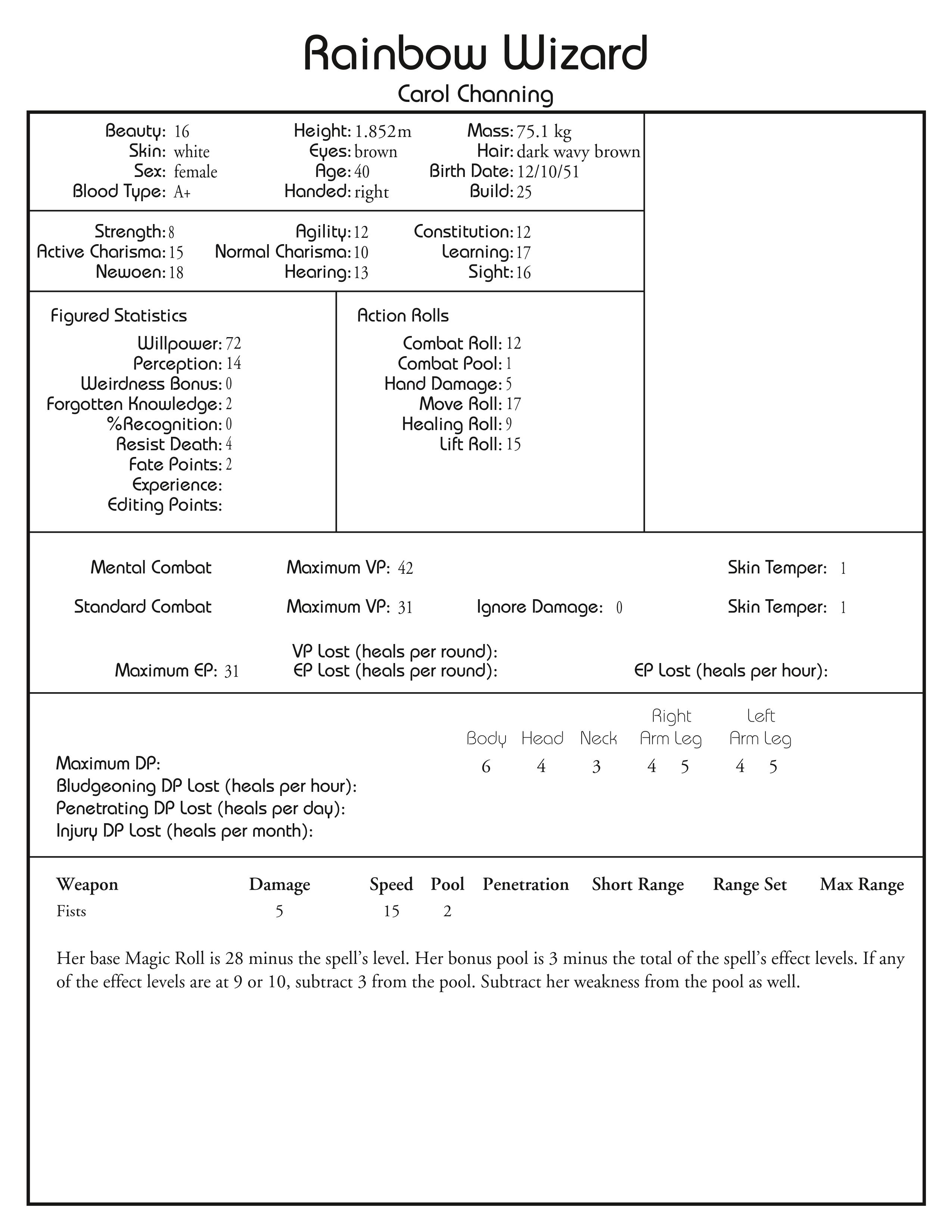
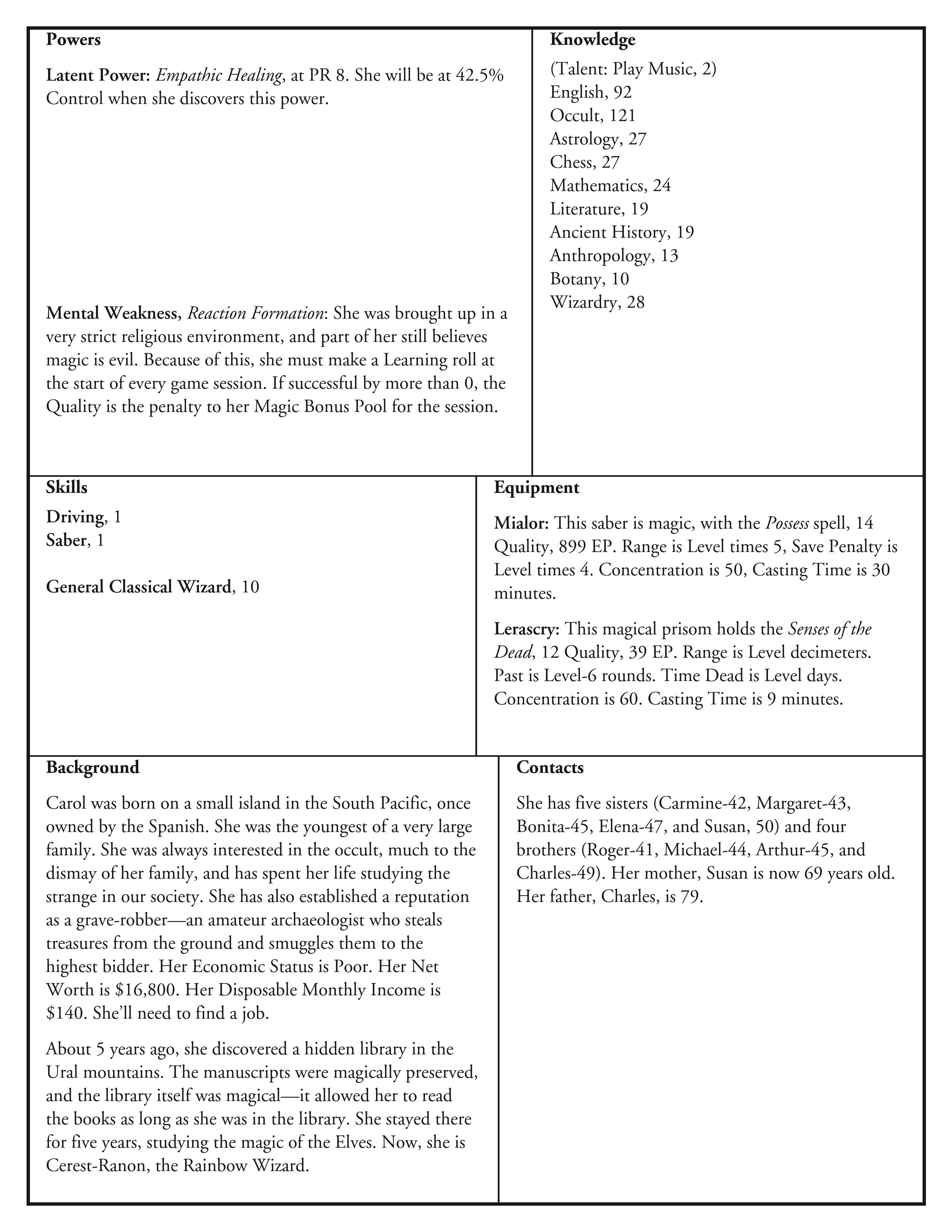
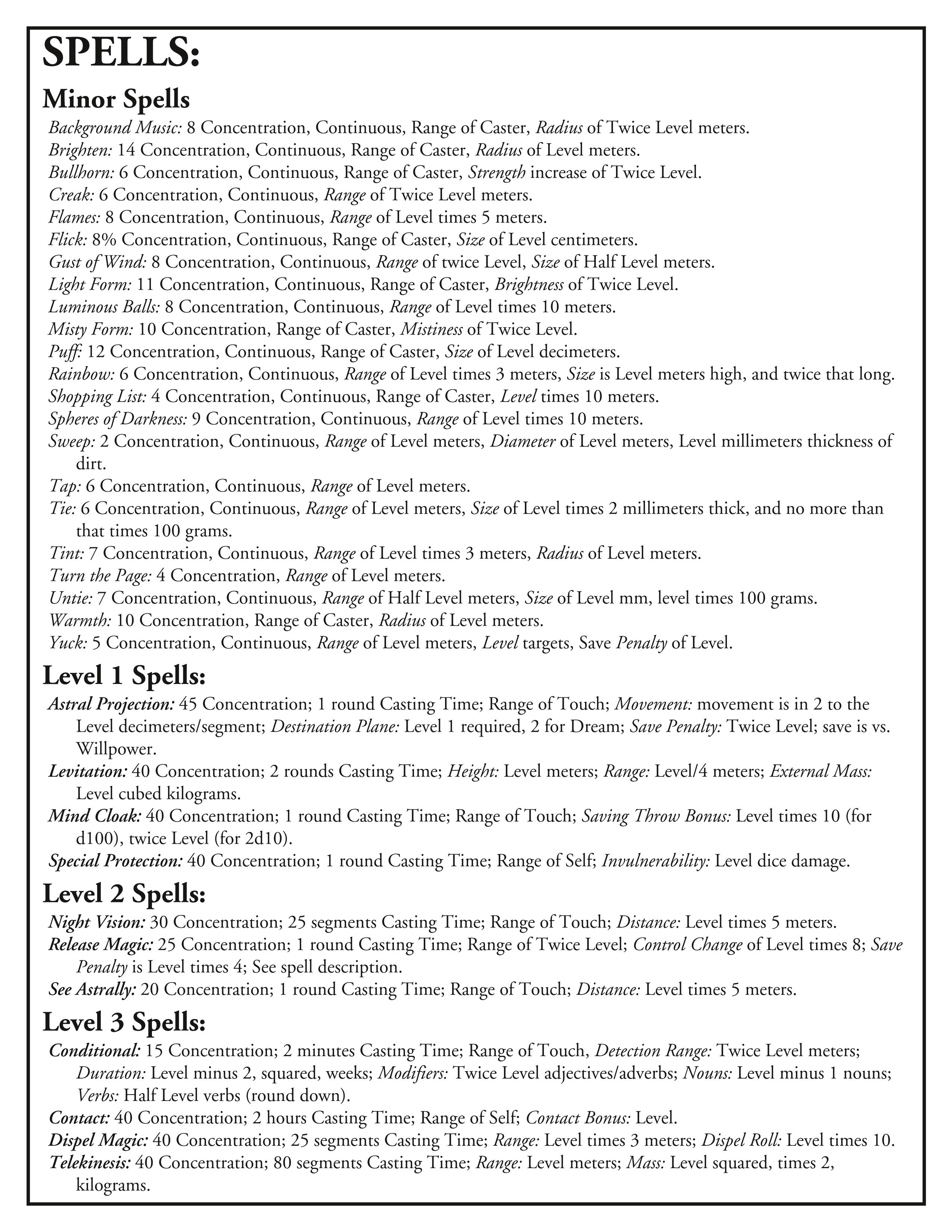
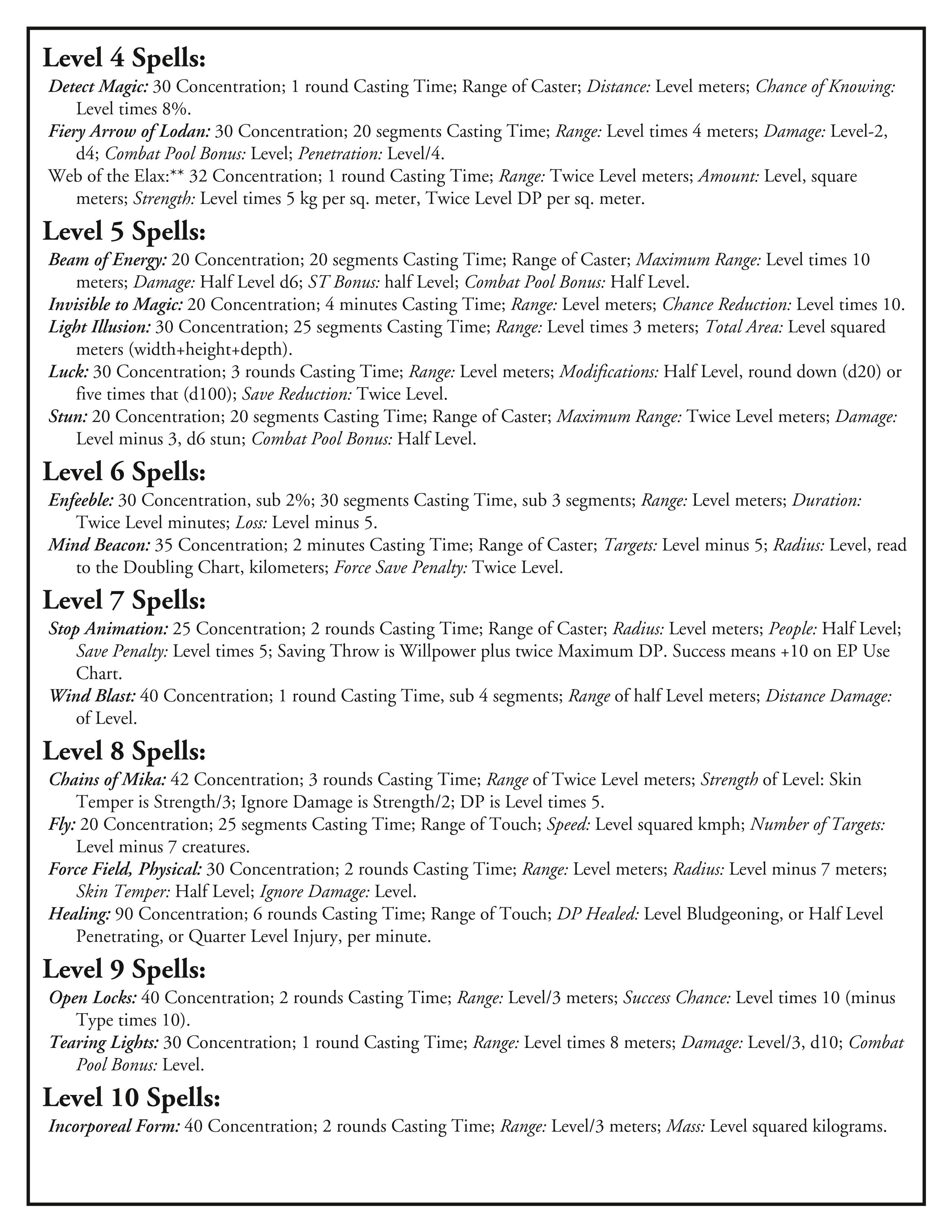
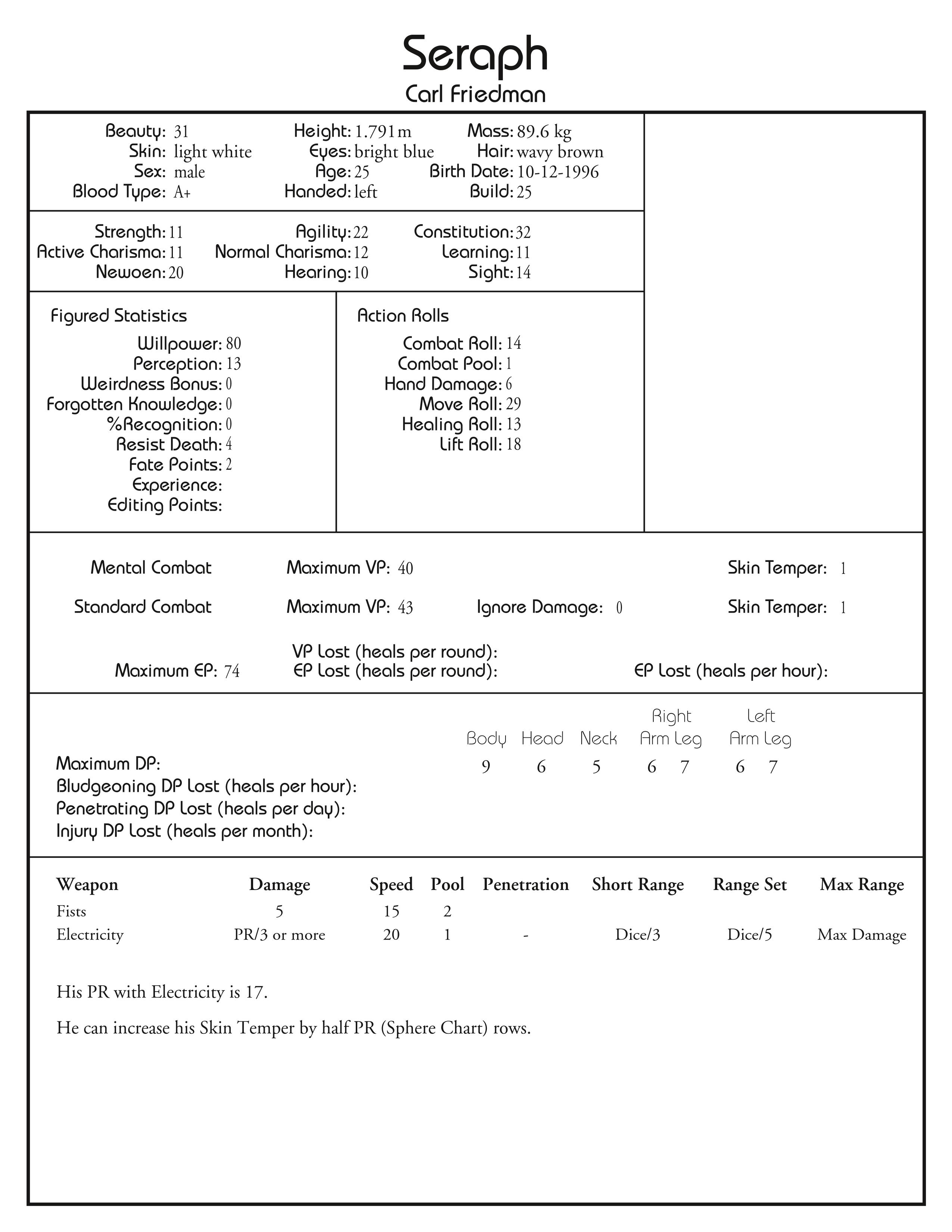
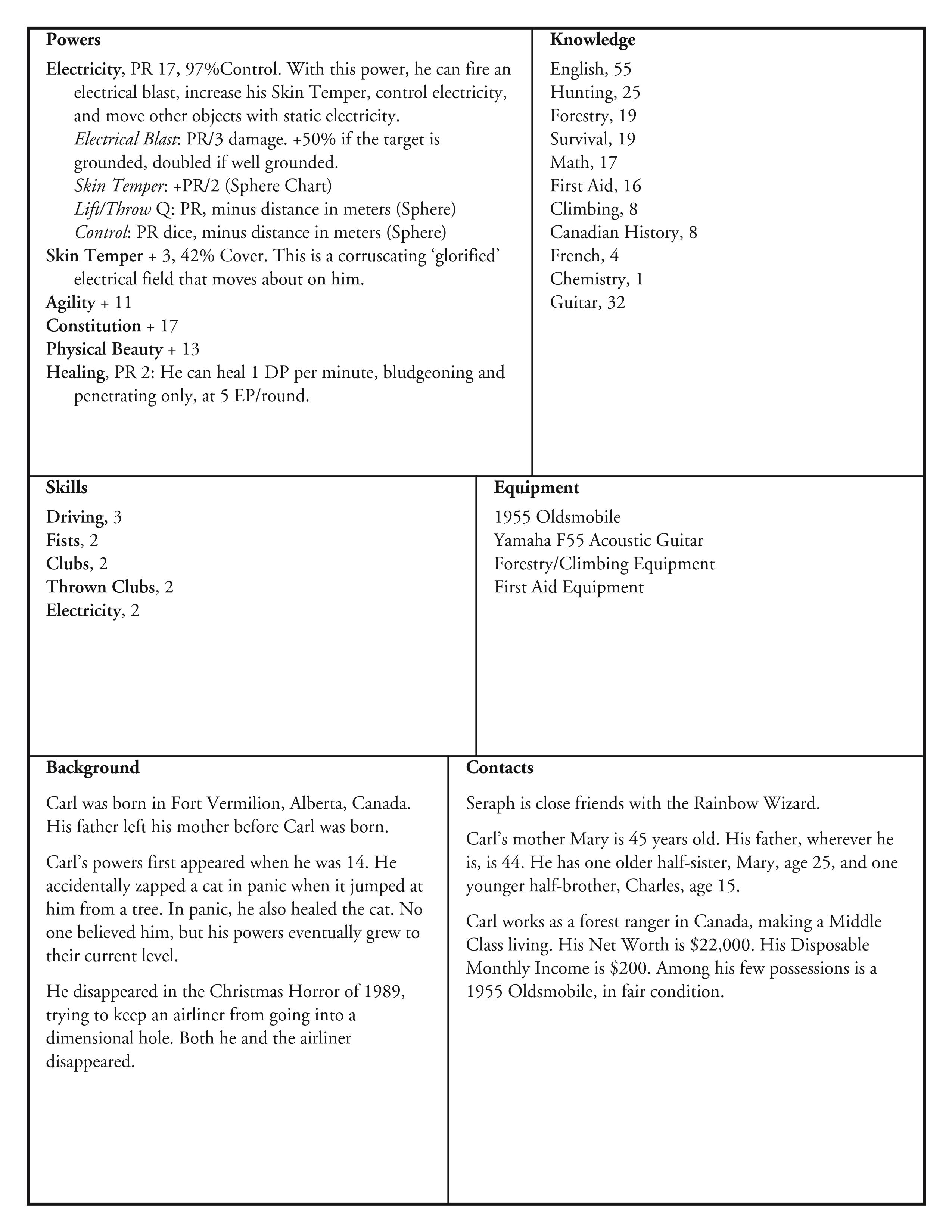
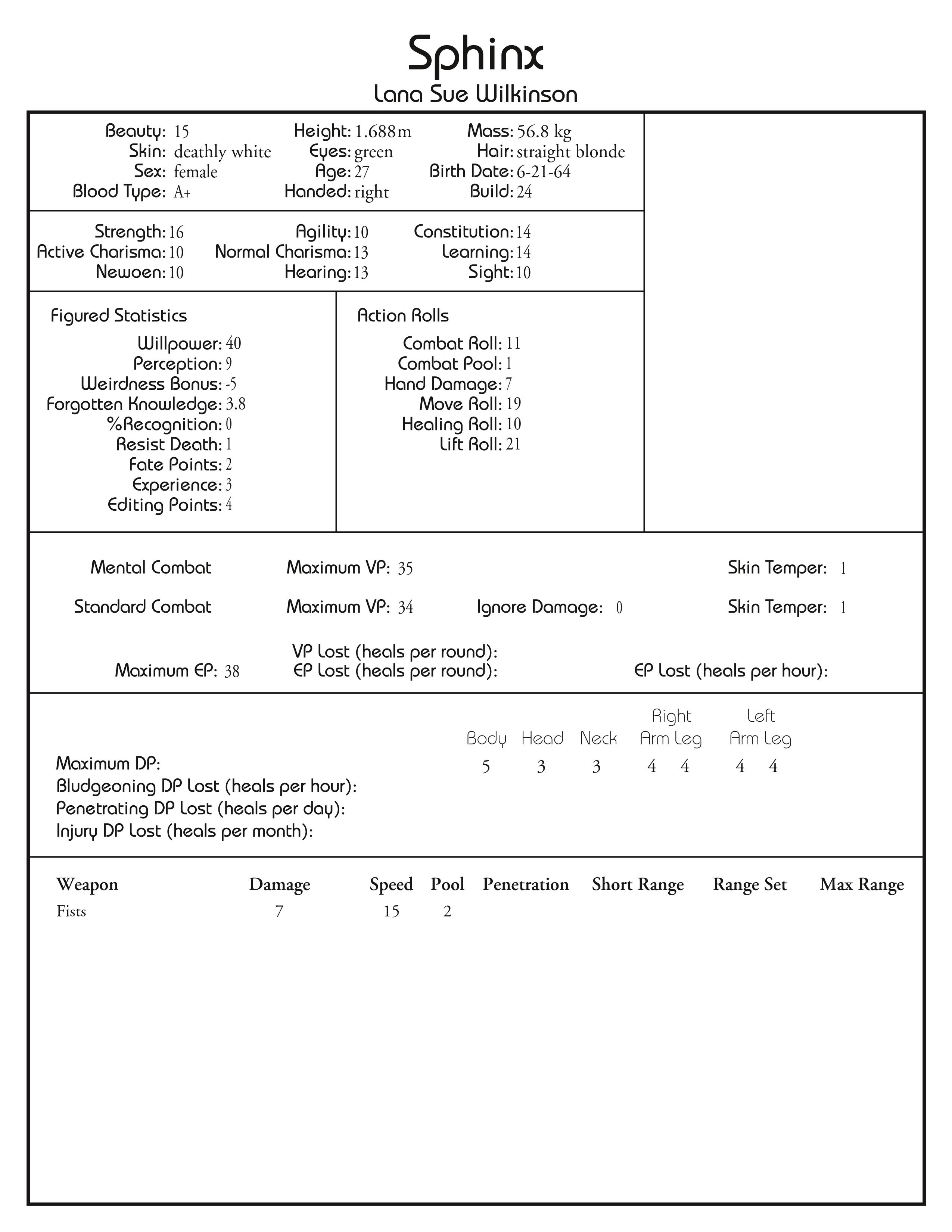
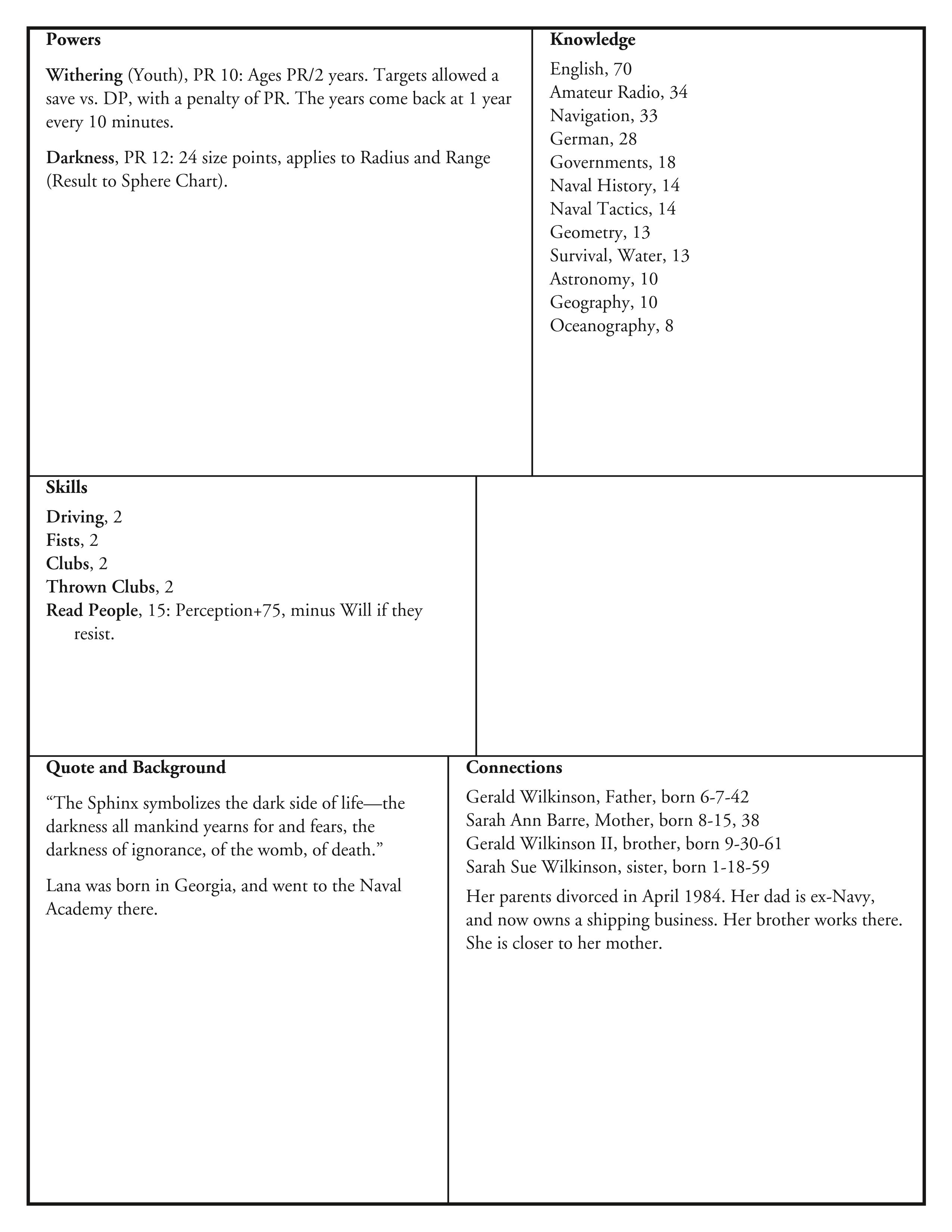
1. Roll three sets of abilities.
2. Decide which Type of Hero you wish to have as your main Type.
3. Determine Powers.
4. Determine Extra Powers.
5. Determine Power Rolls for powers requiring them.
6. Determine %Control for applicable powers (76+4d6).
7. Use the Optional Rules if necessary/applicable/desired.
8. Determine remaining Attributes (height, build, beauty).
9. Determine age.
10. Determine birth date.
11. Check for mutations and determine appearance.
12. Determine handedness.
13. Determine place of birth.
14. Determine family.
15. Determine income and savings.
16. Determine knowledge and skills.
17. Check for base.
18. Check for pet (2%).
19. Check for handicaps/weaknesses.
20. Check for Psychic Immunity.
21. Have Editor check for latent powers.
22. Determine Mass: (build + constitution/10)*height cubed/2.
23. Damage Points: Build/5, + Mass (Square Chart)-7.
24. Virtual Damage Points: strength + agility + learning/3 + newoen/3, round down.
25. Endurance Points: constitution*2 + strength/2 + Damage Points/2, round down.
26. Skin Temper: 1; Add strength divided by 50 to constitution divided by 25. Look this up on the Doubling Chart for the number of the rows to move up.
27. Willpower: 4*Newoen
28. Combat Roll: Twice Agility (Sphere Chart)+Bonus Pool (Doubles Chart)
29. Combat Pool: Learning/10, plus Sight Bonuses/Penalties
30. Move Roll: Agility + Strength/2 + Height (Square Chart)
31. Healing Roll: Constitution (Sphere Chart)
32. Lift Roll: (Strength-9) + Mass (Sphere Chart)
33. Resist Death: Newoen-14, +DP, on the Doubles Chart
34. Hand Damage: Mass/10 (Doubles Chart)+Strength/4 (round down)
35. Perception: Newoen/2 + Learning/4, round up.
36. Determine special ability based powers (charm/terror, knowledge of good and evil, charm/horror).
37. Record %Recognition.
38. Discretionary Knowledge Points: Age plus Learning, divided by 10.
Men & Supermen allows for more variability in character type than most roleplaying games of any genre, even if you decide to follow the rules. You are more than welcome to simply create a character non-randomly by choosing your powers, skills, and abilities. Your Editor, of course, has final say on any character’s existence.
Superpowers: Do you want superpowers, abilities far different from anything a human has ever before experienced? Then choose a Class Power or a Special Power. The Class Power tables create general super-powered characters. Each Class Power table produces a set of powers that originate from a certain base. These are psychic, animal oriented, enhanced human, and cosmic. The Special Powers table lists powers that are self-contained. Choose the Class Power Superhuman and you might become stronger, healthier, more skilled in unarmed combat, and able to see infrared light. Choose Special Powers and you may instead end up with the ability to Control Magnetism—one power, but as versatile as a set of powers from the Class tables.
Package Heroes: What about heroism without superpowers? Check out the Package Heroes. With the Special Agent Package you can be a hardboiled detective or a debonair superspy. With the Civilian Package, you can be something even more normal—perhaps a journalist, a computer operator, or a charter boat captain. Any civilian occupation can be created using this package. If you want something less normal, try the Eccentric Professor, the Magician, or the Combat Skill Packages. The Eccentric Professor, also known as the Mad Scientist, is the quintessential inventor/sage devoted to pseudoscience, and can be a great change of pace from standard characters. The Magician is a master of sleight-of-hand, and is often a con artist also. The Combat Skilled hero has mastery of a specific combat skill, be it archery, swordsmanship, martial arts, or any other combat form. For those of you who like to be completely different, there is the Intelligent Robot Package, for the creation of an intelligent, nonorganic being. Finally, there is the Wizard package. Wizards control (or channel) the forces of magic and the occult. Wizards can be either general or special; classical or mnemonic. This allows you to create most styles of sorcerer from most literary works. In addition, there are magic styles, for specialization within magic.
If the selection of Types of Heroes is not enough variety for you, check out these possibilities, from the Optional Rules: the Alien Option, the Item-Based Option, the Electronic and Animal Control Options, the Astral Effect Option, the Optional Transformation, and the Mutation Option.
Aliens: As an alien, you are nonhuman, from another civilization on this planet, in this solar system, in this galaxy, in this universe, or even from another dimension or plane of existence. You might even be a created race, designed by a mad scientist in a foreign land. It’s your choice with the Alien Option.
Item-Based Powers: With the Item-Based Option, some or all of your powers come from an item you carry. This item has its own power source and can be used by anyone—features that can be both advantageous and disadvantageous.
Electronic and Animal Control: Normally, if you have some form of mind control or similar ability, this only works on sentient, organic creatures. With the Electronic Control Option, these powers work, instead, on electronics—computers, robots, home appliances. With the Animal Control Option, these powers work on animals—non-sentient, rather than sentient lifeforms.
Astral Powers: Most powers with physical effects will not work in the astral planes. With the Astral Effect Option, these powers will work in the astral planes, but not on the physical plane. For those who travel in their astral form, this can be quite useful.
Metamorphosis: The Optional Transformation gives you two physical forms—a normal form, and a superhero form. Generally, powers are not available for use in your normal form, but are available in superhero form. This makes you more vulnerable when in your secret identity, but makes it much easier to keep a secret identity.
Mutants: If your Editor allows it, you can also choose to be a Mutation: a normal human with modified genes. You will probably look strange compared to normal humans, and will also react differently (better and worse) to various poisons and chemicals.