


The first historical marker on State Highway 29 west of U.S. Route 183 is very close to Route 183, in Liberty Hill. It’s on the left side of the street going west, so I visited it on the way back when I took the road trip with my dad. It’s not a street I’m interested in crossing on foot.
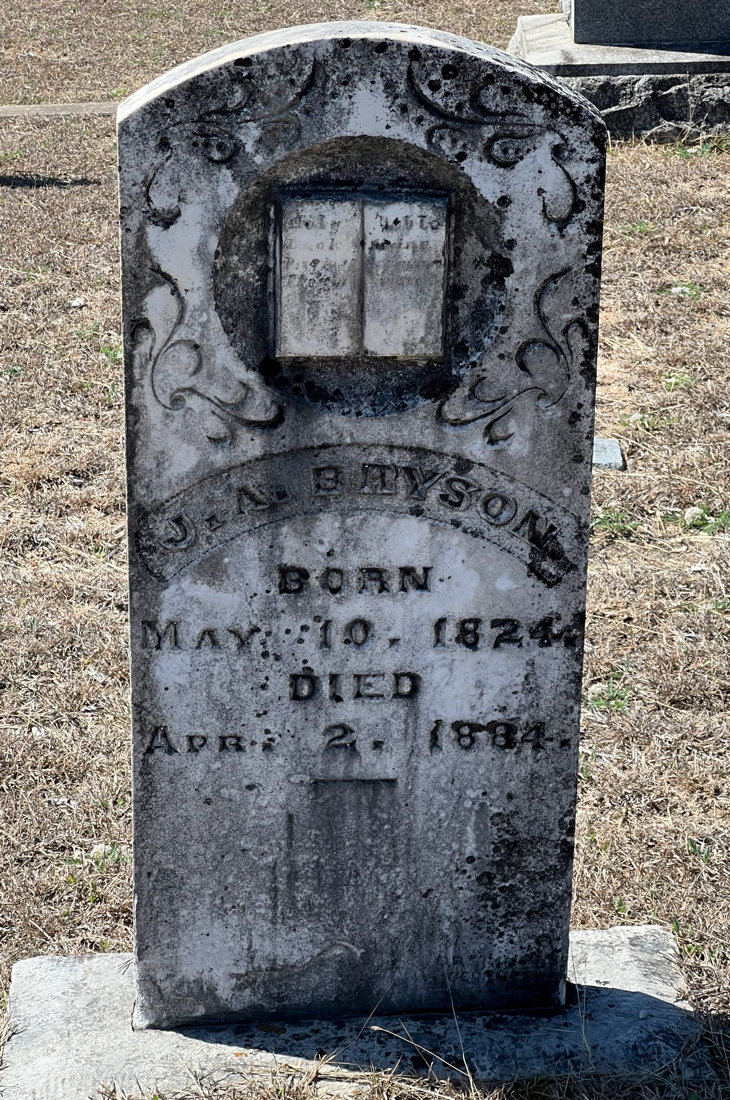
Is J. A. Bryson related to the Brysons who helped build the cemetery?
Liberty Hill Cemetery
Weathered gravestones show usage of this spot for burials since 1852, when the earliest settlers were establishing homes in area [sic]. The first formal grant of land here as a community burial ground was made by John T. and Amelia Edwards Bryson in 1875, when three and one-half acres were deeded to the Liberty Hill Cemetery Trustees: T.N. Bryson, C.C. Chance, W.H. Poole, J.B. Roddy, and T.S. Snyder. This acreage was protected by a stone fence built with their own hands by the Brysons and their neighbors. Additions to original plot include land formerly owned by John T. Bryson and donated by Dr. and Mrs. H.L. Fowler. Royal Arch Masons in 1932 established an adjacent three-acre Masonic cemetery, later transferring title to the Liberty Hill Lodge no. 432, A.F. & A.M., which gave it in 1959 to the Liberty Hill Cemetery Association.
By later land purchases, the cemetery now contains more than twenty acres. Funds have come by bequests from Walter Gardner, Arthur Gray, and T.L. McDaniel. Many other persons have also contributed to funds for the cemetery. In 1953 the Liberty Hill Cemetery Association was incorporated, with Dr. J. Gordon Bryson as president; C.L. Chance, vice president; C.F. Hickman, treasurer; and Mrs. Letitia Russell, secretary.
(1971)
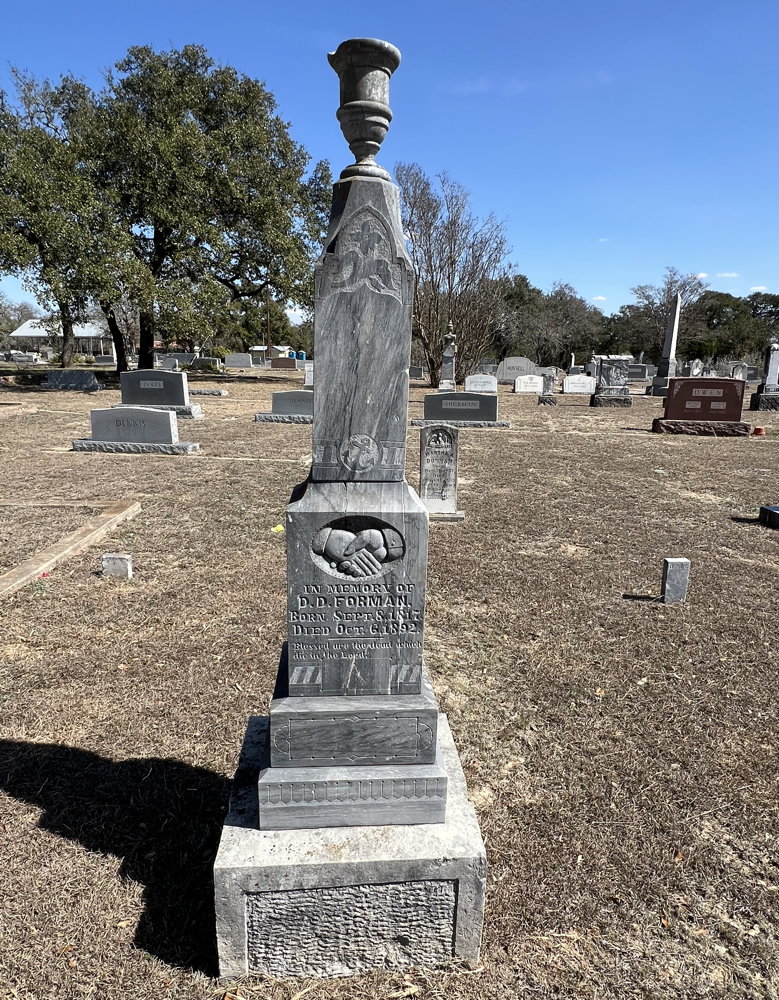
Mr. Forman was born before Bryson, and died after him.
While the rest of the historical markers on State Highway 29 are easily looked at by the side of the road, Liberty Hill Cemetery is the perfect stop for when you need to get out and walk around a bit. There are some fascinating gravestones here, and monuments or semi-monuments.
David D. Forman died at seventy-five in 1892. His monument features a flower toward the top, and an anchor toward the bottom. Why an anchor? Liberty Hill is about as far inland as you can get. I initially thought it was something to do with his life in Louisiana before moving to Texas. But most likely, it’s a symbol of Christian hope.
If you look behind D.D. Forman and to the right, you can see Martha A. Dunnam, who “died 65 years, 6 months, and 23 days” old in 1893. Many of the inscriptions on these stones are things we wouldn’t think of saying today. David’s inscription was “Blessed are the dead which die in the Lord”. Nowadays we’d say something a little less blunt, such as “Blessed are they” or “Blessed is the man”. His monument also features the ubiquitous final handshake.
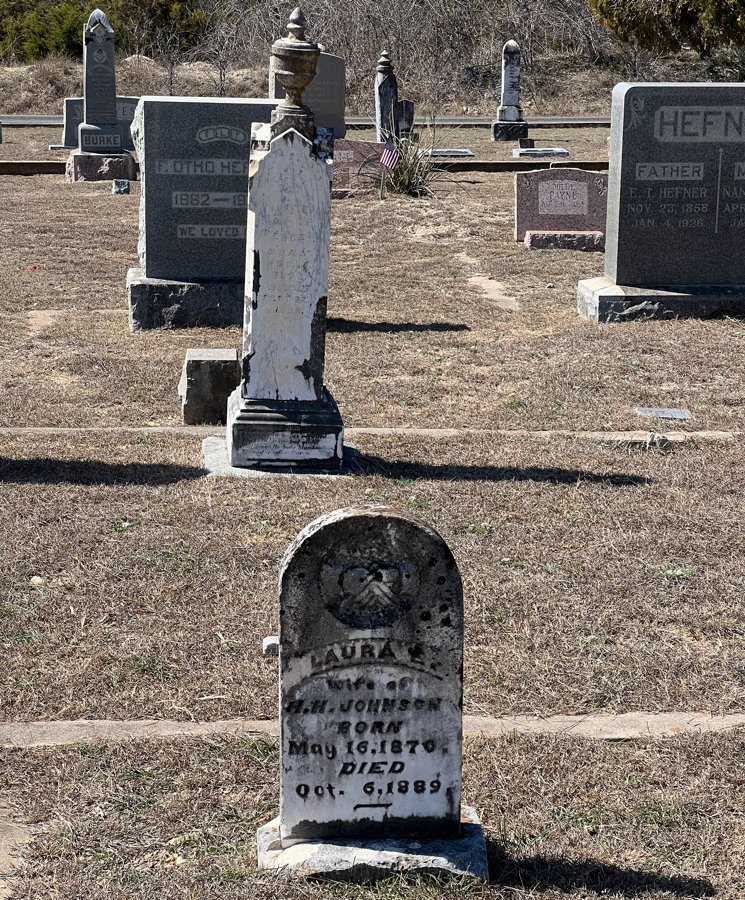
Martha’s inscription is similar. “One less to love on earth/One more to meet in Heaven”. It’s not an inscription you’ll commonly find today, but do a search on it and you’ll see it was very common in the past. Nowadays you might see the second line, but not the first.
Another grave marker that testifies to the hardness of the times is Laura E. Johnson’s, “Wife of H.H. Johnson/Born May 16, 1870/Died October 6, 1889.” Hers also features the final handshake.
Look behind 19-year-old Laura and you can see 18-year-old Lucy E. Ferges, born December 16 1873 and died September 27 1890. She died of typhoid fever.
Directly behind Lucy is F. Otho Hefner. His inscription? “We loved him.” He is very likely the teacher who was reported in the Austin American Statesman of August 31, 1908, as being one of the many Liberty Hill teachers working in the area.
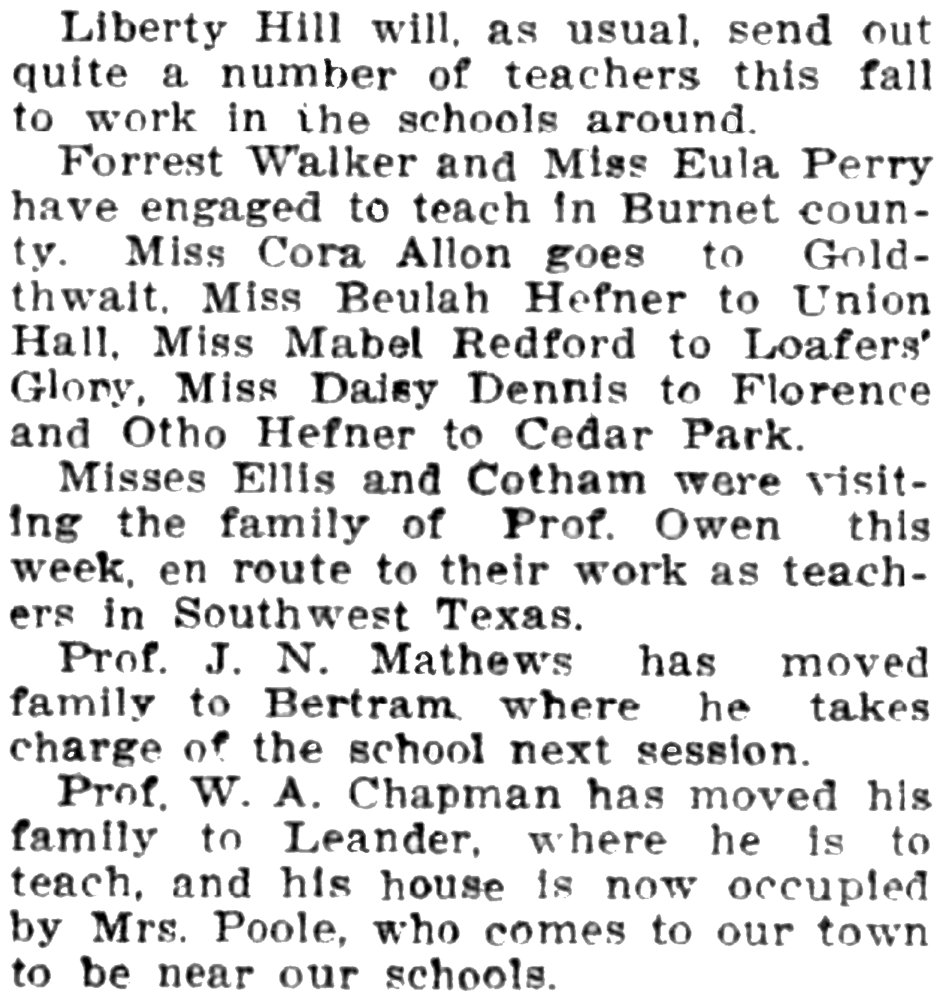
Liberty Hill was, apparently, known for the teachers it produced. Burnet and Bertram are both towns you’ll pass through on this road trip.
People: |
|
|---|---|
Symbolism: |