


On the receipt of the first information of the death of Mr. Adams, we suggested that his life, as well as Mr. Jefferson’s, might have been shortened by the excitement produced on witnessing the first Jubilee of American Independence. The following article on that subject, which we extract from the Pittsburgh Gazette of the 31st ult. imparts valuable information, and will, we think, be read with interest. The influence which the mind has upon the health of the body is a subject which has hitherto been principally confined to the Faculty, but its importance merits the attention of every individual.
An attempt to explain the cause of the death of Mr. Jefferson and Mr. Adams on the 4th of July.
The following facts and opinions are thrown together for the purpose of shewing the influence that strong passions and emotions have on the human system, producing sudden death, under certain circumstances, and, under those of an opposite character, serving as a shield and protection against the operation of some of the most destructive agents. They are adduced to support a suggestion, which I here venture to make, that the very remarkable decrees, I might say, the almost simultaneous exit, of two of our chief apostles of liberty, Thomas Jefferson and John Adams, from the stage of life, on the last 4th of July, was owing to an influence of this kind—that it was, indeed owing to an explosion of patriotic joy and patriotic feeling, which feeble nature could not sustain. This suggestion does not come in collision with the pious and elegant sentiment of the Secretary of War, that “a coincidence so wonderful gives confidence to the belief, that the patriotic exertions of these men were heaven-directed, and furnishes a new seal to the hope, that the prosperity of these states is under the special protection of a kind Providence.” The agency of Providence is seldom exerted, except through the medium of second causes—an explanation equally applicable to the patriarch of fourscore, gathering up his feet to sleep with his fathers, and to the more youthful prophet, borne off to heaven in a chariot of fire.
A number of the following selections are from the writings of Dr. Rush, than whom, perhaps, no higher authority could be cited on any subject to which he has directed the energies of his vigorous and highly cultivated mind.
“The desire of life is a principle deeply and universally implanted in human nature, and acts very powerfully in supporting our existence. It has been observed to prolong life.—Sickly travellers, by sea and land, often live under circumstances of the greatest weakness till they reach their native country, and then expire in the bosom of their friends. Its influence will appear from the difference in the period in which death was induced, in two persons who were actuated by opposite passions with respect to life. Atticus we are told died of voluntary abstinence from food, in five days. In Sir William Hamilton’s account of the earthquake at Calabria, we read of a girl who lived eleven days without food, before she expired. In the former case, life was shortened by an aversion from it; in the latter, it was protracted by a desire of it.”
“The love of country is a deep seated principle of action in the human breast. Its stimulus is sometimes so excessive as to induce diseases, in persons who recently emigrate and settle in foreign countries. It appears in various forms; but exists most frequently in the solicitude, labors, attachments, and hatreds of party spirit.—All these act forcibly in supporting animal life. It is because newspapers are supposed to contain the measure of the happiness or misery of our country, that they are so interesting to all classes of people. Those vehicles of intelligence, and of public pleasure or pain, are frequently desired with the impatience of a meal, and they often produce the same stimulating effect upon the body. They have been happily called by the poet “the manna of the day.”
“Doctor Blane ascribes the extraordinary healthiness of the British fleet, in the month of April, 1782, to the effects produced on the spirits of the soldiers and seamen by the victory obtained over the French fleet on the 12th of that month, and relates an instance in the war between Great-Britain and the combined powers of France and Spain, in 1774, in which the scurvy, as well as other diseases, were checked by the prospect of a naval engagement.”
“The American army furnished a remarkable instance of victory upon the human mind. The Philadelphia militia, who joined the remains of Gen. Washington’s army in Dec. 1776, and shared with them, a few days afterwards, in the capture of a large body of Hessians at Trenton, consisted of 1500 men, most of whom had been accustomed to the habits of a city life. These men slept in tents and barns and in the open air, during the usual colds of December and January, and yet there were but two instances of sickness and one of death, in that body of men, in the course of nearly ten weeks in those winter months. This extraordinary healthiness of so great a number of men, under such trying circumstances, can only be ascribed to the vigor infused into the human body, by the victory of Trenton having produced insensibility to the usual remote causes of diseases.”
“The patience, firmness, and magnanimity, with which the officers and soldiers of the American army endured the complicated evils of hunger, cold and nakedness, can only be ascribed to an insensibility of body produced by an uncommon tone of mind, excited by the love of liberty and their country.”
“Apoplexies were more frequent in Philadelphia in the winter of 1774-5, than in any former year, owing to the uncommon anxiety amongst the citizens.”—“The apoplectic fit which deprived the world of the talents and virtues of Peyton Randolph, while he filled the chair of Congress, in 1775, appeared to be occasioned in part by the pressure of the uncertainty of great political events upon his mind.”
“Mr. Hume informs us, in his history of England, that some old people, upon hearing the news of the restoration of Charles II, died suddenly of joy.”
“The doorkeeper of Congress, an aged man, died suddenly immediately after hearing of the capture of Lord Cornwallis’s army. His death was universally ascribed to a violent emotion of patriotic joy. This species of joy appears to be one of the strongest emotions that can agitate the human mind.”
There have been several instances amongst the ancients of mothers dying immediately on seeing their sons unexpectedly return from battle.
An instance occurred within my own knowledge of a wife dying suddenly, on the return of her husband, after a long absence from home. It was no doubt a paroxysm of joy. I have also observed a temporary suspension of life in a parent, from witnessing the restoration of a son to sight, after a long period of blindness, by a successful operation.
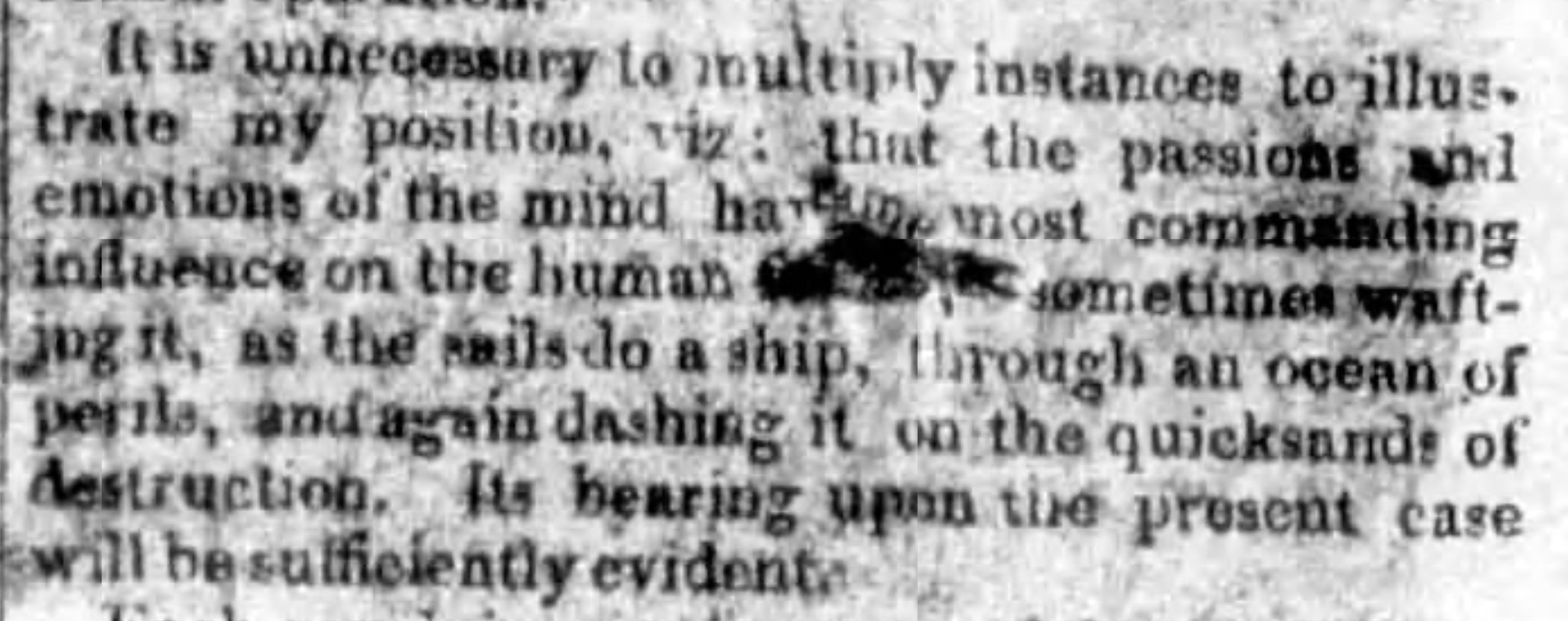
How many words would fit in that slot and end in -ame? I went with “frame”. But even that is making an assumption that the word above the splotch is mean to be the word in the splotch.
It is unnecessary to multiply instances to illustrate my position, viz: that the passions and emotions of the mind have a most commanding influence on the human [frame], sometimes wafting it, as the sails do a ship, through an ocean of perils, and again dashing it on the quicksands of destruction. Its bearing upon the present case will be sufficiently evident.
Each revolving anniversary of the 4th of July, raises a tumult of delightful emotions in the breast of almost every individual in our happy country. They who feel not such emotions, must be insensible to the usual motives that operate on the mind of man, or grossly ignorant of the excellent form of government we enjoy, the perils it cost to achieve it, and the execrable thraldom that would have been our inheritance, if the result of the revolution had been different.
But who could be supposed to approximate in emotions of this kind to those whose gigantic minds first conceived the mighty project of sundering, by one herculean struggle, the shackles that enslaved us and of publishing to the word, and in the teeth of tyranny, the bold declaration “that these United States are, and of right ought to be, free and Independent States?” What an overflowing of patriotic joy must Mr. Adams have felt, when, in the spirit of prophecy, and in the fervor of the most delightful anticipations, he penned the belief, in writing to a friend, on the day after the memorable Declaration of Independence was made, that “the 4th of July would be celebrated as the great Anniversary Festival. It ought to be commemorated,” said he, “as the day of deliverance, by solemn acts of devotion to the Almighty God. It ought to be solemnized with pomp, shows, games, sports, guns, bells, bonfires, and illuminations—from one end of the continent to the other, from this time forever!” Believing, as those men did, that not only the destinies of the United States, but the existence of liberty on the globe, depended on the result of that most memorable of all memorable national deeds, how would they have rejoiced, at that awful and perilous moment, if they could have been assured that they should both live to see the experiment they were about to make fairly tested and triumphantly successful, that after the lapse of fifty years, they too, with the more than tripled millions of their countrymen, should be eye-witnesses, to so glorious a work of their own hands; that their own ears should hear the rejoicings of the Jubilee of American Liberty? This consummation of their wishes, they probably could not have expected till within a few years, and it is quite probable, it was this stimulus, as soon as it became matter of reasonable hope, that lengthened out their span, and carried them to the wished for goal. The last words of Mr. Adams were, “it is truly a great and glorious day;” and Mr. Jefferson expressed the strongest desire, that he should not die till the 4th of July. That truly great and glourious day having arrived, we may easily conceive that the tide of feelings and emotions it brought with it, was sufficient to deluge the powers of life, “to burst their mighty hearts;” and that, like good old Simeon, each, in the fulness of his joy, would be willing to exclaim in reference to his country, “Lord, now lettest thou thy servant depart in peace, for mine eyes have seen thy salvation.”
MEDICUS.