


Mr. Webster’s Address.—We have just received the long expected address of Mr. Webster, delivered at Faneuil Hall, on the second instant. We have only had time for a rapid perusal of this eloquent oration, and cannot attempt an analysis today. Perfectly aware of the bad taste which has poured extravagant eulogy and measureless laud upon so many of the addresses recently delivered, we cannot forbear expressing the feelings of admiration & elevated excitement with which a hasty reading of Mr. Webster’s speech has inspired us. We think it is admirable managed, in the luminous order in which the facts it embraces, are arranged, and in the mode in which the parallel is conducted of the history and characters of the departed Presidents. If more time is allotted to Adams, justice is done to Jefferson. Where the orator forsakes the path of narration, and exerts the powers of his eloquence on those topics, which his genius has suggested to him as fit for their exercise, none will deny that he stands unrivalled by any other eulogist on this occasion. We may instance his exordiam; his description of the practical eloquence, which comes home to the business and bosoms of men, in times of difficulty and danger;—his imaginary debate between a delegate who feared to adopt the eventful measure of declaring Independence, and the resolute Adams;—and the splendid peroration.
We insert to day the commencement of this oration; and shall take occasion to examine its merits more at length hereafter. Mr. Webster alludes to the circumstance, that it was delivered on the anniversary of the day, on which the declaration of Independence was actually signed by the delegates. On the 4th day of July it received the signatures of the President and the Secretary.
“This is an unaccustomed spectacle. For the first time, fellow-citizens, badges of mourning shroud the columns and overhang the arches of this hall. These walls, which were consecrated so long ago, to the cause of American liberty, which witnessed her infant struggles, and rung with the shouts of her earliest victories, proclaim, now, that distinguished friends and champions of that great cause have fallen. It is right that it should be thus. The tears which flow, and the honors that are paid, when the Founders of the Republic die, give hope that the Republic itself may be immortal. It is fit, that by public assembly and solemn observance, by anthem and by eulogy, we commemorate the services of national benefactors, extol their virtues, and render thanks to God for eminent blessings early given and long continued to our favored country.
Adams and Jefferson are no more; and we are assembled, fellow citizens, the aged, the middle aged, and the young, by the spontaneous impulse of all, under the municipal government, with the presence of the Chief Magistrate of the Commonwealth, and others its official representatives, the university, and the learned societies to bear one part, in those manifestations of respect and gratitude which universally pervade the land. Adams and Jefferson are no more. On our fiftieth anniversary, the great day of National Jubilee, in the very hour of public rejoicing, in the midst of echoing and re-echoing voices of thanksgiving, while their own names were on all tongues, they took their flight together to the world of spirits.
If it be true that no one can safely be pronounced happy while he lives; if that event which terminates life can alone crown its honors and its glory, what felicity is here! The great Epic of their lives, how happily concluded! Poetry itself has hardly closed illustrious lives, and finished the career of earthly renown, by such a consummation. If we had the power, we could not wish to reverse the dispensation of the Divine Providence. The great objects of life were accomplished, the drama was ready to be closed; it has closed; our patriots have fallen; but so fallen, at such age, with such coincidence, on such a day, that we cannot rationally lament that that end has come, which we knew could not be long deferred.
Neither of these great men, fellow citizens, could have died, at any time, without leaving an immense void in our American society. They have been so intimately, and for so long a time, blended with the history of the country, and especially so united, in our thoughts and recollections, with the events of the Revolution, that the death of either would have touched the strings of public sympathy. We should have felt that one great link, connecting us with former times, was broken; that we had lost something more, ass it were, of the presence of the Revolution itself, and of the art of independence, and were driven on, by another great remove, from the days of our country’s early distinction, to meet posterity, and to mix with the future. Like the mariner, whom the ocean and the winds carry along, till he sees the stars which have directed his course, & lighted his pathless way, descend, one by one, beneath the rising horizon, we should have felt that the stream of time had borne us onward, till another great luminary, whose light had cheered us, and whose guidance we had followed, had sunk away from our sight.
But the concurrence of their deaths on the anniversary of independence, has naturally awakened stronger emotions. Both had been Presidents, both had lived to great age, both were early patriots, and both were distinguished and ever honored by their immediate agency in the art of independence. It cannot but seem striking, and extraordinary, that these two should live to see the fiftieth year from the date of that act; that they should complete that year; and that then, on the day which had fast linked forever their own fame with their country’s glory, the heavens should open to receive them both at once. As their lives themselves were the gifts of Providence, who is not willing to recognize in their happy termination, as well as in their long continuance, proofs that our country, and its benefactors, are objects of His care?
Adams and Jefferson, I have said, are no more. As human beings indeed, they are no more. They are no more, as in 17876, bold and fearless advocates of independence; no more as on subsequent periods, the head of the government; no more as we have recently seen them, aged and vulnerable objects of admiration and regard. They are no more. They are dead. But now little is there of the great and good which can die. To their country yet they live, and live forever. They live in all that perpetuates the remembrance of men on earth; in the recorded proofs of their own great actions, in the offspring of their intellect, in the deep engraved lines of public gratitude, and in the respect & homage of mankind. They live in their example; they live, emphatically, and will live in the influence which their lives & efforts, their principles & opinions, now exercise, and will continue to exercise, on the affairs of men, not only in their own country, but throughout the civilized world. A superior & commanding human intellect, a truly great man, when heaven vouchsafes so rare a gift, is not a temporary flame, burning bright for a while, and then expiring, giving place to returning darkness. It is rather a spark of fervent heat, as well as radiant light, with power to enkindle the common mass of human mind; so that when it glimmers, in its own decay, and finally goes out in death, no night follows, but it leaves the world all light, all on fire, from the potent contact of its own spirit. Bacon died; but the human understanding, roused, by the touch of his miraculous wand, to a perception of the true philosophy, and the just mode of inquiring after truth, has kept on its course, successfully and gloriously. Newton died; yet the course of the spheres are still known, and they yet move on, in the infinity of space.
(To be continued.)
Webster’s Discourse.—We inserted yesterday the commencement of this address, and shall continue to extract those parts to which we referred, as being the most eloquent. As the Discourse is not yet to be had from the booksellers, we know of nothing more calculated to afford pleasure to our readers. The following extract is a continuation of the exordium, with which we began yesterday.
“No two men now live, fellow citizens, perhaps it may be doubted, whether any two men have ever lived, in one age, who, more than those we now commemorate, have impressed their own sentiments, in regard to politics and government, on mankind, infused their opinions more deeply into the opinions of others, or given a more lasting direction to the current of human thought.—Their works do not perish with them. The tree which they assisted to plant, will flourish, altho’ they water it and protect it no longer; for it has struck its roots deep, it has sent them to the very centre; no storm, not of force to burst the orb, can overturn it; its branches spread wide; they stretch their protecting arms broader and broader, and its top is destined to reach the heavens. We are not deceived. There is no delusion here. No age will come, in which the American Revolution will appear less than it is; one of the greatest events in human history. No age will come, in which it will cease to be seen and felt, on either continent, that a mighty step, a great advance, not only in American affairs, but in human affairs, was made on the 4th of July 1776. And no age will come, we trust, so ignorant or so unjust, as not to see and acknowledge the efficient agency of these we now honor, in producing that momentous event.
“We are not assembled, therefore, fellow-citizens, as men overwhelmed with calamity by the sudden disruption of the ties of friendship or affection, or as in despair for the Republic, by the untimely blighting of its hopes. Death has not surprised us by an untimely blow. We have indeed, seen the tomb close, but it has closed only over mature years, over long protracted public services, over the weakness of age, and over life itself only when the ends of living had been fulfilled. These suns, as they rose slowly and steadily, amidst clouds and storms, in their ascendant, so they have not rushed from their meridian, to sink suddenly in the west. Like the mildness, the serenity, the continuing benignity of a summer’s day, they have gone down with slow descending, grateful, long lingering light; and now that they are beyond the visible margin of the world, good omens cheer us from ‘the bright tract of their fiery car!’
“There were many points of similarity in the lives and fortunes of these great men. They belonged to the same profession, and had pursued its studies and its practice, for unequal lengths of time indeed, but with diligence and effect.—Both were learned and able lawyers. They were natives of and inhabitants, respectively, of those two of the colonies, which at the revolution, were the largest and most powerful, and which naturally had a lead in the political affairs of the times. When the colonies became in some degree united by the assemblage of a general congress they were brought to act together, in its deliberations, not indeed at the same time, but both at early periods. Each had already manifested his attachment to the cause of the country, as well as his ability to maintain it, by printed addresses, public speeches, extensive correspondence, and whatever other mode could be adopted for the purpose of exposing the encroachments of the British parliament and animating the people to a manly resistance. Both were not only decided, but early friends of Independence. While others yet doubted, they were resolved; where others hesitated, they pressed forward.—They were both members of the committee for preparing the Declaration of Independence, and they constituted the sub committee, appointed by the other members to make the draught.—They left their seats in congress, being called to other public employments, at periods not remote from each other, although one of them returned to it, afterwards, for a short time. Neither of them was of the assembly of great men which formed the present constitution, and neither was at any time member of congress under its provisions.—Both have been public ministers abroad, both vice presidents, and both presidents. These coincidences are now singularly crowned and completed. They have died together; and they died on the anniversary of liberty.
“When many of us were last in this place, fellow-citizens, it was on the day of that anniversary. We were met to enjoy the festivities belonging to the occasion, and to manifest our grateful homage to our political fathers.
“We did not, we could not here, forget our venerable neighbor of Quincy. We knew that we were standing at t time of high and palmy prosperity, where he had stood in the hour of utmost peril: that we saw nothing but liberty and security, where he had met the frown of power; that we were enjoying every thing, where he had hazarded every thing: and just and sincere plaudits rose to his name, from the crowds which filled this area, and hung over these galleries. He whose grateful duty it was to speak to us, on that day, of the virtues of our fathers had, indeed, admonished us that time and years were about to level his venerable frame with the dust. But he bade us hope, that ‘the sound of a nation’s joy, rushing from our cities, ringing from our valleys, echoing from our hills, might yet break the silence of his aged ear; that the rising blessings of grateful millions might yet visit, with glad light his decaying vision.’ Alas! that vision was then closing forever. Alas! the silence which was then settling on that aged ear, was an everlasting silence! For, lo! in the very moment of our festivities, his freed spirit ascended to God who gave it! Human aid and human solace terminate at the grave; or we would gladly have borne him upward, on a nation’s outspread hands; we would have accompanied him, and with the blessings of millions, and the prayers of millions, commended him to the Divine favor.
“While still indulging our thoughts on the coincidence of the death of this venerable man with the anniversary of independence, we learn that Jefferson, too, has fallen; and that these aged patriots, these illustrious fellow-laborers, had left our world together. May not such events raise the suggestion that they are not undesigned, and that Heaven does so order things, as sometimes to attract strongly the attention, and excite the thoughts of men? The occurrence has added new interest to our anniversary, and will be remembered, in all time to come.”
Mr. Webster then enters upon a detail of the prominent incidents in the lives of Adams and Jefferson. We pass on to what will probably be considered the most masterly passage in his eulogy; in which, though he refers particularly to what he conceives to have been the character of Mr. Adams’s eloquence, he may be supposed to express his own opinion of the nature of powerful oratory.
“The eloquence of Mr. Adams resembled his general character, and formed, indeed, a part of it. It was bold, manly, and energetic; and such the crisis required. When public bodies are to be addressed on momentous occasions, when great interests are at stake, and strong passions excited, nothing is valuable, in speech, farther than it is connected with high intellectual and moral endowments. Clearness, force, and earnestness are the qualities which produce conviction. True eloquence, indeed, does not consist in speech. It cannot be brought from far. Labor and learning may toil for it, but they will toil in vain. Words and phrases may be marshaled in every way, but they cannot compass it. It must exist in the man, in the subject, and in the occasion. Affected passion, intense expression, the pomp of declamation, all may aspire after it—they cannot reach it. It comes, if it come at all, like the outbreaking of a fountain from the earth, or the bursting forth of volcanic fires, with spontaneous original, native force. The graces thought in the schools, the costly ornaments, and studied contrivances of speech, shock and disgust men, when their own lives, and the fate of their wives, their children, and their country, hang on the decision of the hour. Then words have lost their power, rhetoric is vain, and all elaborate oratory contemptible. Even genius itself then feels rebuked, and subdued, as in the presence of higher qualities. Then, patriotism is eloquent; then self devotion is eloquent. The clear conception, out running the deductions of logic, the high purpose, the firm resolve, the dauntless spirit, speaking on the tongue, beaming from the eye, informing every feature, and urging the whole man onward, right onward to his object—this, this is eloquence; or rather it is something greater and higher than all eloquence, it is action, noble, sublime godlike action.”
The orator then calls up before his audience the images of those who sat in that august assembly, which pronounced the solemn declaration of our independence. He imagines what would be the arguments of one, not yet prepared to adopt the decisive and irrevocable step; and what might have been the reply of Adams.
“‘Sink or swim, live or die, survive or perish, I give my hand, and my heart, to this vote. It is true, indeed, that in the beginning, we aimed not at independence. But there’s a Divinity which shapes our ends. The injustice of England has driven us to arms; and, blinded to her own interest for our good, she has obstinately persisted, till independence is now within our grasp. We have but to reach forth to it, and it is ours. Why then should we defer the declaration? Is any man so weak as now to hope for a reconciliation with England, which shall leave either safety to the country and its liberties, or safety to his own life, & his own honor? Are not you, sir, who sit in that chair, is not he, our venerable colleague near you, are you not both already the proscribed and predestined objects of punishment and of vengeance? Cut off from all hope of royal clemency, what are you, what can you be, while the power of England remains, but outlaws? If we postpone Independence, do we mean to carry on or give up the war? Do we mean to submit to the measures of parliament, Boston port bill and all? Do we mean to submit, and consent that we ourselves shall be ground to powder, and our country and its rights trodden down in the dust? I know we do not mean to submit. We never shall submit. Do we intend to violate that most solemn obligation ever entered into by men, that plighting before God, or our sacred honor to Washington, when putting him forth to incur the dangers of war, as well as the political hazards of the time, we promised to adhere to him in every calamity, with our fortunes and our lives? I know there is not a man here, who would not rather see a general conflagration sweep over the land or an earth quake sink it, than one jot or tittle of that plighted faith fall to the ground. For myself, having, twelve months ago, in this place, moved you, that George Washington be appointed commander of the forces, raised or to be raised for defence of American liberty, may my right hand forget her cunning, and my tongue cleave to the roof of my mouth, if I hesitate or waver in the support I give him. The war, then, must go on. We must fight it through. And if the war must go on, why put off longer the Declaration Of Independence? That measure will strengthen us. It will give us character abroad. The nations will then treat with us, which they never can do while we acknowledge ourselves subjects, in arms against our sovereign. Nay I maintain that England herself, will sooner treat for peace with us on the footing of Independence, than consent, by repealing her acts, to acknowledge that her whole conduct towards us has been a course of injustice and oppression. Her pride will be less wounded by submitting to that course of things which now predestinates our independence, than by yielding the points in controversy to her rebellious subjects. The former she would regard as the result of fortune; the latter she would feel as her own deep disgrace. Why then, why then, sir, do we not as soon as possible change this from a civil to a national war? And since we must fight it through, why not put ourselves in a state to enjoy all the benefits of victory, if we gain the victory?
If we fail, it can be no worse for us. But we shall not fail. The cause will raise up armies; the cause will create navies. The people, the people, if we are true to them, will carry us, and will carry themselves, gloriously through this struggle. I care not how fickle other people have been found. I know the people of these colonies, and I know that resistance to British aggression is deep and settled in their hearts, and cannot be eradicated. Every colony, indeed, has expressed its willingness to follow, if we but take the lead. Sir, the declaration will inspire the people with increased courage. Instead of a long and bloody war for restoration of privileges, for redress of grievances for chartered immunities held under a British king set before them the glorious object of entire independence, and it will breathe into them anew the breath of life. Read this declaration at the head of the army—every sword will be drawn from its scabbard, and the solemn vow uttered, to maintain it, or to perish on the bed of honour. Publish it from the pulpit—religion will approve it, and the love of religious liberty will cling round it, resolved to stand with it, or fall with it. Send it to the public halls—proclaim it there: let them hear it, who heard the first roar of the enemy’s cannon—let them see it, who saw their brothers and their sons fall on the field of Bunker-hill, and in the streets of Lexington and Concord, and the very walls will cry out in its support.
Sir, I know the uncertainty of human affairs, but I see, I see clearly, through this day’s business. You and I, indeed, may rue it. We may not live to the time when this declaration shall be made good. We may die; die, colonists; die, slaves; die, it may be, ignominiously and on the scaffold. Be it so. Bet it so. If it be the pleasure of Heaven that my country shall require the poor offering of my life, the victim shall be ready, at the appointed hour of sacrifice, come when that hour may. But while I do live, let me have a country, or at least the hope of a country, and that a free country.
But, whatever may be our fate, be assured, be assured that this declaration will stand. It may cost treasure, and it may cost blood; but it will stand, and it will richly compensate for both.—Through the thick gloom of the present I see the brightness of the future, as the sun in Heaven.—We shall make this a glorious, an immortal day. When we are in our graves, our children will honor it. They will celebrate it with thanksgiving, with festivity, with bonfires, and illuminations.—On its annual return they will shed tears, copious, gushing tears, not of subjection and slavery, not of agony and distress, but of exultation, of gratitude, and of joy. Sir, before God, I believe the hour is come. My judgment approves this measure, and my whole heart is in it. All that I have, and all that I am, and all that I hope, in this life, I am now ready here to stake upon it; and I leave off, as I begun, that live or die, survive, or perish, I am for the declaration. It is my living sentiment, and, by the blessing of God, it shall be my dying sentiment—independence, now, and independence forever!’
And so that day shall be honored, illustrious prophet and patriot! so that day shall be honored; and as often as it returns, thy renown shall come along with it, and the glory of thy life, like the day of thy death, shall not fail from the remembrance of men.”
Webster’s Discourse.—We insert to-day our last extract from this oration. After his apostrophe to Adams, with which we concluded our selections yesterday, Mr. Webster names some of the revered co-patriots of the deceased Presidents, and gives a brief sketch of the events in the lives of Adams and Jefferson, which belong to the history of our country.
“Fellow citizens, I will detain you no longer by this faint and feeble tribute to the memory of the illustrious dead. Even in other hands, adequate justice could not be performed, within the limits of this occasion. Their highest, their best praise, is your deep conviction of their merits, you affectionate gratitude for their labors and services. It is not my voice, it is this cessation of ordinary pursuits, this arresting of all attention, these solemn ceremonies, and this crowded house, which speak their eulogy. Their fame, indeed, is safe. That is now treasured up, beyond the reach of accident. Although no sculptured marble should rise to their memory, nor engraved stone bear record of their deeds, yet will their remembrance be as lasting as the land they honored. Marble columns may, indeed, moulder into dust; time may erase all impress from the crumbling stone; but their fame remains;—for with American liberty it rose, and with American liberty only can it perish. It was the last swelling peal of yonder choir, ‘their bodies are buried in peace, but their name liveth evermore.’ I catch that solemn song, I echo that lofty strain of funeral triumph, ‘their name liveth evermore.’”
“And now, fellow-citizens, let us not require from this occasion, without a deep and solemn conviction of the duties which have devolved upon us. This lovely land, this glorious liberty, these benign institutions, the dear purchase of our fathers, are ours; ours to enjoy, ours to preserve, ours to transmit. Generations past, and generations to come, hold us responsible for this sacred trust. Our fathers from behind admonish us, with their anxious paternal voices, posterity calls out to us, from the bosom of the future, the world turns hither its solicitous eye—all, all conjure us to act wisely, and faithfully, in the relation which we sustain. We can never, indeed, pay the debt which is upon us; but by virtue, by morality, by religion, by the cultivation of every good principle and every good habit, we may hope to enjoy the blessing through our day, and to leave it unimpaired to our children. Let us feel deeply how much, of what we are and what we possess, we owe to this liberty, and these institutions of government. Nature has, indeed, given us a soil, which yields bounteously to the hands of industry, the mighty and fruitful ocean is before us, and the skies over our heads shed health and vigor. But what are lands, and seas, and skies to civilized man, without society, without knowledge, without morals, without religious culture; and how can these be enjoyed, in all their extent, and all their excellence, but under the protection of wise institutions and a free government? Fellow-citizens, there is not one of us, there is not one of us here present, who does not, at this moment, and at every moment, experience, in his own condition, and in the condition of those most near and dear to him, the influence and the benefits of this liberty, and these institutions. Let us then acknowledge the blessing, let us feel it deeply and powerfully, let us cherish a strong affection for it, and resolve to maintain and perpetuate it. The blood of our fathers, let it not have been shed in vain; the great hope of posterity, let it not be blasted.
“The striking attitude, too, in which we stand to the world around us, a topic to which, I fear, I advert too often, and dwell on too long, cannot be altogether omitted here. Neither individuals nor nations can perform their part well, until they understand and feel its importance, and comprehend and justly appreciate all the duties belonging to it. It is not to inflate national vanity, nor to swell, a light and empty feeling of self-importance, but it is that we may judge justly of our situation, and of our own duties, that I earnestly urge this consideration of our position, and our character, among the nations of the earth. It cannot be denied, but by those who would dispute against the sun, that with America, and in America, a new era commences in human affairs. This era is distinguished by Free Representative Governments, by entire religious liberty, by improved systems of national intercourse, by a newly awakened, and an unconquerable spirit of free inquiry, and by a diffusion of knowledge through the community, such as has been before altogether unknown and unheard of. America, America, our country, fellow-citizens, our own dear and native land, is inseparably connected, fast bound up, in fortune and by fate, with these great interests. If they fall, we fall with them; if they stand, it will be because we have upholden them. Let us contemplate, then, this connexion, which binds the prosperity of others to our own; and let us manfully discharge all the duties which it imposes. If we cherish the virtues and the principles of our fathers, Heaven will assist us to carry on the work of human liberty and human happiness. Auspicious omens cheer us. Great examples are before us. Our own firmament now shines brightly upon our path. Washington is in the clear upper sky. These other stars have now joined the American constellation; they circle round their centre, and the heavens beam with new light. Beneath this illumination, let us walk the course of life, and at its close devoutly commend our beloved country, the common parent of us all, to the Divine Benignity.”
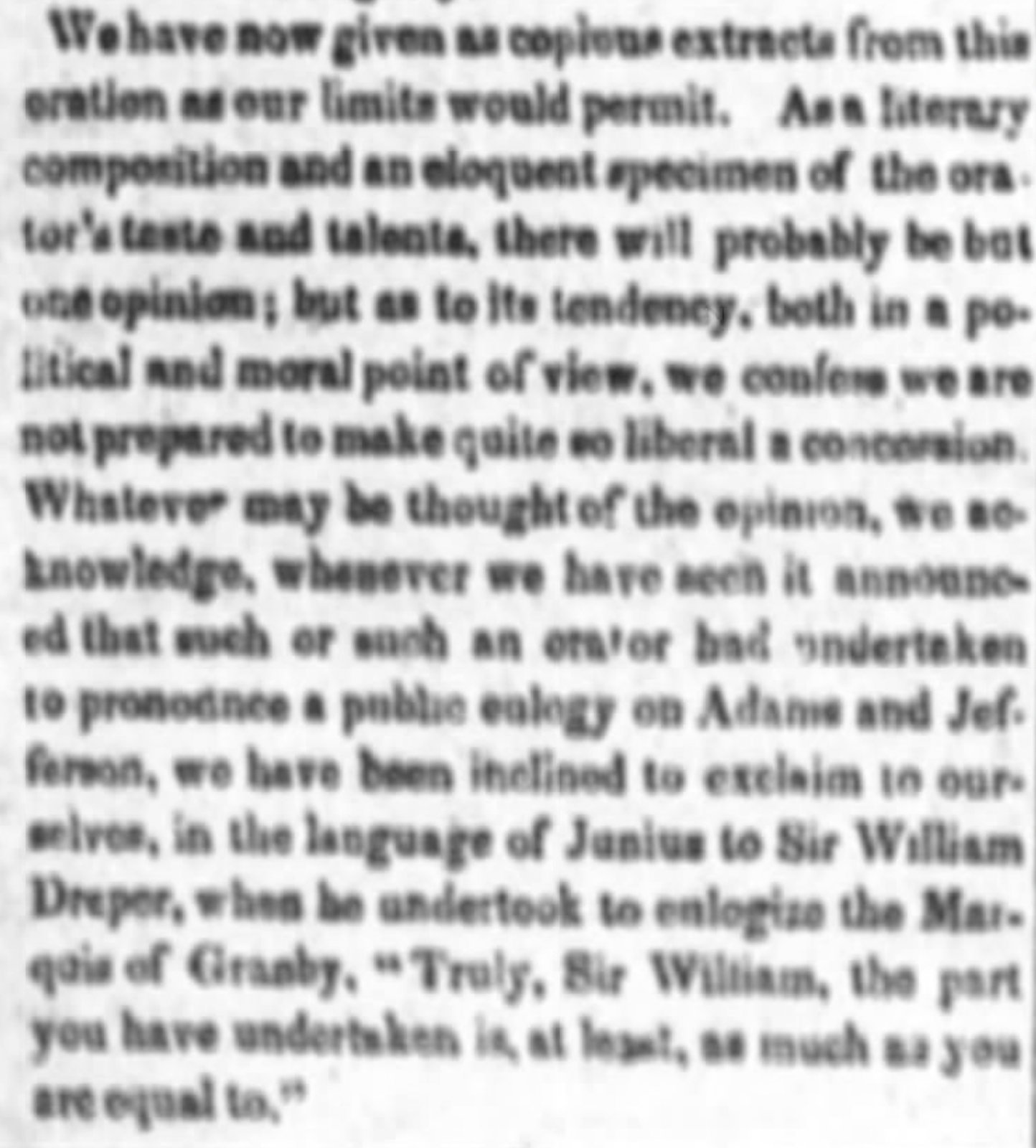
”Concorsion”, if I’m even reading it right, might be a form of “concursion” which the OED lists as “running or rushing together; concourse”.
We have now given as copious extracts from this oration as our limits would permit. As a literary composition and an eloquent specimen of the orator’s taste and talents, there will probably be but one opinion; but as to its tendency, both in a political and moral point of view, we confess we are not prepared to make quite so liberal a concorsion. Whatever may be thought of the opinion, we acknowledge, whenever we have seen it announced that such or such an orator had undertaken to pronounce a public eulogy on Adams and Jefferson, we have been inclined to exclaim to ourselves, in the language of Junius to Sir William Draper, when he undertook to eulogize the Marquis of Granby, “Truly, Sir William, the part you have undertaken is, at least, as much as you are equal to.”