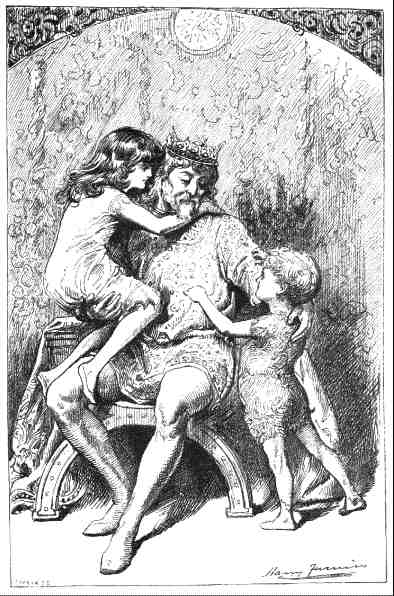
Let me here express my sincere gratitude to the many Reviewers who have noticed, whether favourably or unfavourably, the previous Volume. Their unfavourable remarks were, most probably, well-deserved; the favourable ones less probably so. Both kinds have no doubt served to make the book known, and have helped the reading Public to form their opinions of it. Let me also here assure them that it is not from any want of respect for their criticisms, that I have carefully forborne from reading any of them. I am strongly of opinion that an author had far better not read any reviews of his books: the unfavourable ones are almost certain to make him cross, and the favourable ones conceited; and neither of these results is desirable.
Criticisms have, however, reached me from private sources, to some of which I propose to offer a reply.
One such critic complains that Arthur’s strictures, on sermons and on choristers, are too severe. Let me say, in reply, that I do not hold myself responsible for any of the opinions expressed by the characters in my book. They are simply opinions which, it seemed to me, might probably be held by the persons into whose mouths I put them, and which were worth consideration.
Other critics have objected to certain innovations in spelling, such as “ca’n’t”, “wo’n’t”, “traveler”. In reply, I can only plead my firm conviction that the popular usage is wrong. As to “ca’n’t”, it will not be disputed that, in all other words ending in “n’t”, these letters are an abbreviation of “not”; and it is surely absurd to suppose that, in this solitary instance, “not” is represented by " ‘t”! In fact “can’t” is the proper abbreviation for “can it”, just as “is’t” is for “is it”. Again, in “wo’n’t”, the first apostrophe is needed, because the word “would” is here abridged into “wo”: but I hold it proper to spell “don’t” with only one apostrophe, because the word “do” is here complete. As to such words as “traveler”, I hold the correct principle to be, to double the consonant when the accent falls on that syllable; otherwise to leave it single. This rule is observed in most cases (e.g. we double the “r” in “preferred”, but leave it single in “offered”), so that I am only extending, to other cases, an existing rule. I admit, however, that I do not spell “parallel”, as the rule would have it; but here we are constrained, by the etymology, to insert the double “l”.
In the Preface to Vol. I. were two puzzles, on which my readers might exercise their ingenuity. One was, to detect the 3 lines of “padding”, which I had found it necessary to supply in the passage extending [here]. They are [Sylvie’s lines]. The other puzzle was, to determine which (if any) of the 8 stanzas of the Gardener’s Song (Stanzas one, two, three, four, five, six, seven, eight) were adapted to the context, and which (if any) had the context adapted to them. The last of them is the only one that was adapted to the context, the “Garden-Door that opened with a key” having been substituted for some creature (a Cormorant, I think) “that nestled in a tree”. At [stanzas two, five, and seven], the context was adapted to the stanza. At [stanza four], neither stanza nor context was altered: the connection between them was simply a piece of good luck.
In the Preface to Vol. I., I gave an account of the making-up of the story of “Sylvie and Bruno”. A few more details may perhaps be acceptable to my Readers.
It was in 1873, as I now believe, that the idea first occurred to me that a little fairy-tale (written, in 1867, for “Aunt Judy’s Magazine”, under the title “Bruno’s Revenge”) might serve as the nucleus of a longer story. This I surmise, from having found the original draft of the last paragraph of Vol. II., dated 1873. So that this paragraph has been waiting 20 years for its chance of emerging into print-more than twice the period so cautiously recommended by Horace for “repressing” one’s literary efforts!
It was in February, 1885, that I entered into negotiations, with Mr. Harry Furniss, for illustrating the book. Most of the substance of both Volumes was then in existence in manuscript: and my original intention was to publish the whole story at once. In September, 1885, I received from Mr. Furniss the first set of drawings-the four which illustrate “Peter and Paul”: in November, 1886, I received the second set-the three which illustrate the Professor’s song about the “little man” who had “a little gun”: and in January, 1887, I received the third set -the four which illustrate the “Pig-Tale”.
So we went on, illustrating first one bit of the story, and then another, without any idea of sequence. And it was not till March, 1889, that, having calculated the number of pages the story would occupy, I decided on dividing it into two portions, and publishing it half at a time. This necessitated the writing of a sort of conclusion for the first Volume: and most of my Readers, I fancy, regarded this as the actual conclusion, when that Volume appeared in December, 1889. At any rate, among all the letters I received about it, there was only one which expressed any suspicion that it was not a final conclusion. This letter was from a child. She wrote “we were so glad, when we came to the end of the book, to find that there was no ending-up, for that shows us that you are going to write a sequel.”
It may interest some of my Readers to know the theory on which this story is constructed. It is an attempt to show what might possibly happen, supposing that Fairies really existed; and that they were sometimes visible to us, and we to them; and that they were sometimes able to assume human form: and supposing, also, that human beings might sometimes become conscious of what goes on in the Fairy-world—by actual transference of their immaterial essence, such as we meet with in “Esoteric Buddhism”.
I have supposed a Human being to be capable of various psychical states, with varying degrees of consciousness, as follows:
- the ordinary state, with no consciousness of the presence of Fairies;
- the “eerie” state, in which, while conscious of actual surroundings, he is also conscious of the presence of Fairies;
- a form of trance, in which, while unconscious of actual surroundings, and apparently asleep, he (i.e. his immaterial essence) migrates to other scenes, in the actual world, or in Fairyland, and is conscious of the presence of Fairies.
I have also supposed a Fairy to be capable of migrating from Fairyland into the actual world, and of assuming, at pleasure, a Human form; and also to be capable of various psychical states, viz.
- the ordinary state, with no consciousness of the presence of Human beings;
- a sort of “eerie” state, in which he is conscious, if in the actual world, of the presence of actual Human beings; if in Fairyland, of the presence of the immaterial essences of Human beings.
I will here tabulate the passages, in both Volumes, where abnormal states occur.
| Historian’s Locality and | State. | Other Characters | |
|---|---|---|---|
| link | In train | c | Chancellor (b). |
| link, link | do. | c | |
| link, link | do. | c | |
| link, link | At lodgings | c | |
| link, link | On beach | c | |
| link, link, link, link, link | At lodgings | c | S. and B. (b). Professor (b). |
| link, link | In wood | b | Bruno (b). |
| link | In wood, sleep-walking | c | S. and B. (b). |
| link | Among ruins | c | do. (b). |
| link | do. dreaming | a | |
| link | do. sleepwalking | c | S. B. and Professor in Human form. |
| link | In street | b | |
| link, link | At station, &.c. | b | S. and B. (b) |
| link, link | In garden | c | S. B. and Professor (b) |
| link | On road, &c. | a | S. and B. in Human form. |
| link | In street, &c. | a | |
| link | In wood | b | S. and B. (b). |
| Historian’s Locality and | State. | Other Characters | |
|---|---|---|---|
| link | In garden | b | S. and B. (b). |
| link | On road | b | do. (b). |
| link, link | do. | b | do. in Human form. |
| link, link | do. | b | do. (b). |
| link, link, link, link | In drawing-room | a | do. in Human form. |
| link, link | do. | c | do. (b). |
| link | In smoking-room | c | do. (b). |
| link | In wood | b | do. (a); Lady Muriel (b). |
| link, link | At lodgings | c | |
| link, link, link | do. | c | |
| link | do. | b |
In the Preface to Vol. I., I gave an account of the origination of some of the ideas embodied in the book. A few more such details may perhaps interest my Readers:
I. [link]. The very peculiar use, here made of a dead mouse, comes from real life. I once found two very small boys, in a garden, playing a microscopic game of “Single-Wicket”. The bat was, I think, about the size of a tablespoon; and the utmost distance attained by the ball, in its most daring flights, was some 4 or 5 yards. The exact length was of course a matter of supreme importance; and it was always carefully measured out (the batsman and the bowler amicably sharing the toil) with a dead mouse!
I. [link] The two quasi-mathematical Axioms, quoted by Arthur at p. -- of Vol. I. (”Things that are greater than the same are greater than one another”, and “All angles are equal”) were actually enunciated, in all seriousness, by undergraduates at a University situated not 100 miles from Ely.
II. [link] Bruno’s remark (”I can, if I like, &c.”) was actually made by a little boy.
II. [link] So also was his remark (”I know what it doesn’t spell”). And his remark (”I just twiddled my eyes, &c.”) I heard from the lips of a little girl, who had just solved a puzzle I had set her.
II. [link] Bruno’s soliloquy (”For its father, &c.”) was actually spoken by a little girl, looking out of the window of a railway-carriage.
II. [link] The remark, made by a guest at the dinner-party, when asking for a dish of fruit (”I’ve been wishing for them, &c.”) I heard made by the great Poet-Laureate, whose loss the whole reading-world has so lately had to deplore.
II. [link] Bruno’s speech, on the subject of the age of “Mein Herr”, embodies the reply of a little girl to the question “Is your grandmother an old lady?” “I don’t know if she’s an old lady,” said this cautious young person; “she’s eighty-three.”
II. [link] The speech about “Obstruction” is no mere creature of my imagination! It is copied verbatim from the columns of the Standard, and was spoken by Sir William Harcourt, who was, at the time, a member of the “Opposition”, at the “National Liberal Club”, on July the 16th, 1890.
II. [link] The Professor’s remark, about a dog’s tail, that “it doesn’t bite at that end”, was actually made by a child, when warned of the danger he was incurring by pulling the dog’s tail.
II. [link] The dialogue between Sylvie and Bruno, which occupies lines 28 to 36, is a verbatim report (merely substituting “cake” for “penny”) of a dialogue overheard between two children.
One story in this Volume-”Bruno’s Picnic”-I can vouch for as suitable for telling to children, having tested it again and again; and, whether my audience has been a dozen little girls in a village-school, or some thirty or forty in a London drawing-room, or a hundred in a High School, I have always found them earnestly attentive, and keenly appreciative of such fun as the story supplied.
May I take this opportunity of calling attention to what I flatter myself was a successful piece of name-coining, at [link] Vol. I. Does not the name “Sibimet” fairly embody the character of the Sub-Warden? The gentle Reader has no doubt observed what a singularly useless article in a house a brazen trumpet is, if you simply leave it lying about, and never blow it!
Readers of the first Volume, who have amused themselves by trying to solve the two puzzles propounded at [link] of the Preface, may perhaps like to exercise their ingenuity in discovering which (if any) of the following parallelisms were intentional, and which (if any) accidental.
| “Little Birds” | Events, and Persons |
Stanza |
I will publish the answer to this puzzle in the Preface to a little book of “Original Games and Puzzles”, now in course of preparation.
I have reserved, for the last, one or two rather more serious topics.
I had intended, in this Preface, to discuss more fully, than I had done in the previous Volume, the “Morality of Sport”, with special reference to letters I have received from lovers of Sport, in which they point out the many great advantages which men get from it, and try to prove that the suffering, which it inflicts on animals, is too trivial to be regarded.
But, when I came to think the subject out, and to arrange the whole of the arguments “pro” and “con”, I found it much too large for treatment here. Some day, I hope to publish an essay on this subject. At present, I will content myself with stating the net result I have arrived at.
It is, that God has given to Man an absolute right to take the lives of other animals, for any reasonable cause, such as the supply of food: but that He has not given to Man the right to inflict pain, unless when necessary: that mere pleasure, or advantage, does not constitute such a necessity: and, consequently, that pain, inflicted for the purposes of Sport, is cruel, and therefore wrong. But I find it a far more complex question than I had supposed; and that the “case”, on the side of the Sportsman, is a much stronger one than I had supposed. So, for the present, I say no more about it.
Objections have been raised to the severe language I have put into the mouth of “Arthur”, at [sermon], on the subject of “Sermons”, and at [link], on the subjects of Choral Services and “Choristers”.
I have already protested against the assumption that I am ready to endorse the opinions of characters in my story. But, in these two instances, I admit that I am much in sympathy with “Arthur”. In my opinion, far too many sermons are expected from our preachers; and, as a consequence, a great many are preached, which are not worth listening to; and, as a consequence of that, we are very apt not to listen. The reader of this paragraph probably heard a sermon last Sunday morning? Well, let him, if he can. name the text, and state how the preacher treated it!
Then, as to “Choristers”, and all the other accessories -of music, vestments, processions, &c.-which have come, along with them, into fashion-while freely admitting that the “Ritual” movement was sorely needed and that it has effected a vast improvement in our Church-Services, which had become dead and dry to the last degree, I hold that, like many other desirable movements, it has gone too far in the opposite direction, and has introduced many new dangers.
For the Congregation this new movement involves the danger of learning to think that the Services are done for them; and that their bodily presence is all they need contribute. And, for Clergy and Congregation alike, it involves the danger of regarding these elaborate Services as ends in themselves, and of forgetting that they are simply means, and the very hollowest of mockeries, unless they bear fruit in our lives.
For the Choristers it seems to involve the danger of self-conceit, as described at [link] (N.B. “stagy-entrances” is a misprint for “stage-entrances”), the danger of regarding those parts of the Service, where their help is not required, as not worth attending to, the danger of coming to regard the Service as a mere outward form-a series of postures to be assumed, and of words to be said or sung while the thoughts are elsewhere-and the danger of “familiarity” breeding “contempt” for sacred things.
Let me illustrate these last two forms of danger, from my own experience. Not long ago, I attended a Cathedral-Service, and was placed immediately behind a row of men, members of the Choir; and I could not help noticing that they treated the Lessons as a part of the Service to which they needed not to give any attention, and as affording them a convenient opportunity for arranging music-books, &c., &c. Also I have frequently seen a row of little choristers, after marching in procession to their places kneel down, as if about to pray, and rise from their knees after a minute spent in looking about them, it being but too evident that the attitude was a mere mockery. Surely it is very dangerous, for these children, to thus accustom them to pretend to pray? As an instance of irreverent treatment of holy things, I will mention a custom, which no doubt many of my readers have noticed in Churches where the Clergy and Choir enter in procession, viz. that, at the end of the private devotions, which are carried on in the vestry, and which are of course inaudible to the Congregation, the final “Amen” is shouted, loud enough to be heard all through the Church. This serves as a signal, to the Congregation, to prepare to rise when the procession appears: and it admits of no dispute that it is for this purpose that it is thus shouted. When we remember to Whom that “Amen” is really addressed, and consider that it is here used for the same purpose as one of the Church-bells, we must surely admit that it is a piece of gross irreverence? To me it is much as if I were to see a Bible used as a footstool.
As an instance of the dangers, for the Clergy themselves, introduced by this new movement, let me mention the fact that, according to my experience, Clergymen of this school are specially apt to retail comic anecdotes, in which the most sacred names and words-sometimes actual texts from the Bible-are used as themes for jesting. Many such things are repeated as having been originally said by children, whose utter ignorance of evil must no doubt acquit them, in the sight of God, of all blame; but it must be otherwise for those who consciously use such innocent utterances as material for their unholy mirth.
Let me add, however, most earnestly, that I fully believe that this profanity is, in many cases, unconscious: the “environment” (as I have tried to explain at [link]) makes all the difference between man and man; and I rejoice to think that many of these profane stories-which I find so painful to listen to, and should feel it a sin to repeat-give to their ears no pain, and to their consciences no shock; and that they can utter, not less sincerely than myself, the two prayers, “Hallowed be Thy Name,” and “from hardness of heart, and contempt of Thy Word and Commandment, Good Lord, deliver us!” To which I would desire to add, for their sake and for my own, Kebel’s beautiful petition, “help us, this and every day, To live more nearly as we pray!” It is, in fact, for its consequences-for the grave dangers, both to speaker and to hearer, which it involves-rather than for what it is in itself, that I mourn over this clerical habit of profanity in social talk. To the believing hearer it brings the danger of loss of reverence for holy things, by the mere act of listening to, and enjoying, such jests; and also the temptation to retail them for the amusement of others. To the unbelieving hearer it brings a welcome confirmation of his theory that religion is a fable, in the spectacle of its accredited champions thus betraying their trust. And to the speaker himself it must surely bring the danger of loss of faith. For surely such jests, if uttered with no consciousness of harm, must necessarily be also uttered with no consciousness, at the moment, of the reality of God, as a living being, who hears all we say. And he, who allows himself the habit of thus uttering holy words, with no thought of their meaning, is but too likely to find that, for him, God has become a myth, and heaven a poetic fancy -that, for him, the light of life is gone, and that he is at heart an atheist, lost in “a darkness that may be felt”.
There is, I fear, at the present time, an increasing tendency to irreverent treatment of the name of God and of subjects connected with religion. Some of our theatres are helping this downward movement by the gross caricatures of clergymen which they put upon the stage: some of our clergy are themselves helping it, by showing that they can lay aside the spirit of reverence, along with their surplices, and can treat as jests, when outside their churches, names and things to which they pay an almost superstitious veneration when inside: the “Salvation Army” has, I fear, with the best intentions, done much to help it, by the coarse familiarity with which they treat holy things: and surely every one, who desires to live in the spirit of the prayer “Hallowed be Thy Name”, ought to do what he can, however little that may be, to check it. So I have gladly taken this unique opportunity, ho ever unfit the topic may seem for the Preface to a boo of this kind, to express some thoughts which have weighed on my mind for a long time. I did not expect when I wrote the Preface to Vol. I, that it would be read to any appreciable extent: but I rejoice to believe, from evidence that has reached me, that it has been read by many, and to hope that this Preface will also be so: and [ think that, among them, some will be found ready to C sympathize with the views I have put forwards, and ready to help, with their prayers and their example, the revival, in Society, of the waning spirit of reverence.
Christmas, 1893.
Related Pages
- Sylvie and Bruno
- Sylvie and Bruno Concluded
- Preface
- Bruno’s Lessons
- Love’s Curfew
- Streaks of Dawn
- The Dog-King
- Matilda Jane
- Willie’s Wife
- Mein Herr
- In a Shady Place
- The Farewell-Party
- Jabbering and Jam
- The Man in the Moon
- Fairy-Music
- What Tottles Meant
- Bruno’s Picnic
- The Little Foxes
- Beyond These Voices
- To the Rescue!
- A Newspaper-Cutting
- A Fairy-Duet
- Gammon and Spinach
- The Professor’s Lecture
- The Banquet
- The Pig-Tale
- The Beggar’s Return
- Life Out of Death
- The Gardener’s Song