


The World of Refrigerators in 1926
My dad remembers his parents renting freezer space in the local grocery store. They lived on a working farm and had to drive about five miles into town to access that rented space. Having that refrigeration space allowed them to store purchases and excess food. But it didn’t allow them to forego the daily trip to the market, because their refrigerated food was at the market.
Revolution: Home Refrigeration
- Frigidaire, 1928
- Cold Cooking, 1942
- Cold Cookery, 1947
- Kitchen-Proved, 1937
- General Electric, 1927
- Refrigeration, 1926 ⬅︎
With the 1927 introduction of General Electric’s monitor-top all-in-one system home refrigeration changed drastically, just as home computers would exactly fifty years later with the introduction of all-in-one home computers from companies like Radio Shack.
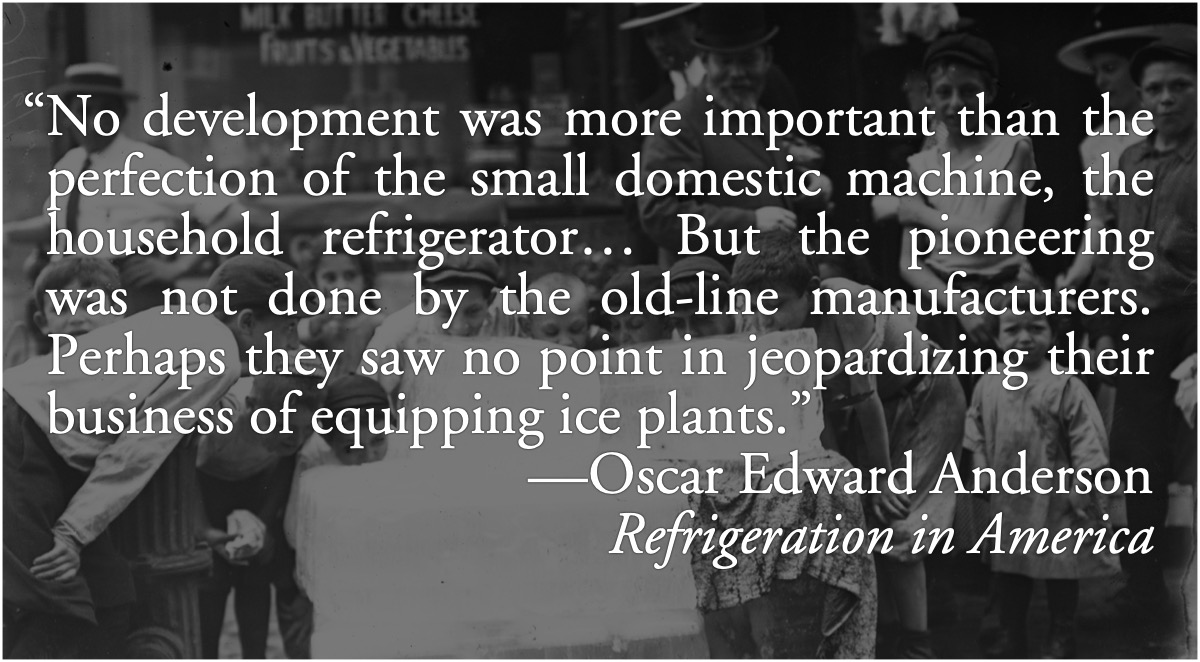
The story of home refrigeration happened slowly… and then quickly. It took place over hundreds and even thousands of years, depending on how deep you go. Here’s how Oscar Anderson, in Refrigeration in America, described the life of farmers in pre-refrigeration America:
Farmers continued to carry their products to market during the night to receive the benefit of the comparatively low temperatures, and the coastwise trade in perishables was confined to the cool seasons of the year. There was little use of refrigeration in the market place. In northern cities a few butchers used ice for holding their fresh meat, and in southern ports some products were stored in the icehouses built by Yankee traders. But ice, in both the North and the South, was difficult and expensive to obtain before 1830, and in its absence most marketing was done in the early morning hours. Most butchers slaughtered for only a day’s fresh-meat trade, while dealers in fresh fish tried to keep their product alive until sale.
Even after ice became readily available in icehouses, it was still a royal pain to use in the home. The home refrigerator/freezer changed all of that. Here’s how I described the switch in The domestication of frozen water:
Storing ice became popular only when it became easy to cut ice, transport it, and keep it stored in bulk through the summer. A relatively wealthy market was also necessary for icehouses to become viable. Persia did it, when Persia was the center of civilization, and it was common enough in the United States as average wealth began to rise. But even then, ice was bulky and difficult to work with, and required year-long planning.
Simply popping water into a kitchen storage unit and waiting an hour? Incredible! The stuff is so cheap now we even toss it in chunks to kids to keep them quiet and amused. Ice is so cheap that soda—itself so cheap that it usually comes with free unlimited refills—is always cut with ice in restaurants. Think about that: this thing that was usually impossible at any price is now filler in sugared water.
In 1927, ice went almost overnight from unwieldy, heavy, and expensive to small, simple, and cheap. Ice was no longer something that needed to be shipped, at least not as ice. It was something that was made in the home, as needed, from tap water or well water.
But 1927 didn’t just change ice. It changed everything about how we store and eat food. Before home refrigeration excess food required special preservation methods. I am convinced that one of the reasons salt is rarely mentioned in older recipes is because all of the food already had so much salt in it. Butter had more salt than it does today. Meat had salt. Salt was a preservative, and absent refrigeration it was just assumed that everything had salt in it. That the problem was removing salt rather than adding it.
Canning, drying, pickling, even fermenting fruit into alcohol, were all means of preserving food. I have a Calumet Cook Book from somewhere between 1922 and 1926. Its only mention of refrigerators is as a place to keep “preserves, cake and other sweets attractive to ants” safe from such pests.
It has a recipe for puff paste that requires putting the dough in a “cold place to chill”…
…if outside temperature is not sufficiently cold, fold paste in a towel, put in a dripping pan, and place between dripping pans of crushed ice. If paste is to be kept for several days, wrap in a napkin, put in tin pail and cover tightly, then put in cold place; if in ice box, do not allow pail to come in direct contact with ice.
People knew that keeping pastry cold while working it was important: “place between dripping pans of crushed ice”. Technically, “dripping pans” does not mean pans that drip, but I’m betting these did. Nowadays we’d just pop the pastry into the fridge for a few hours. No need to wrap it and cover tightly. But storing the pastry in your moldy and smelly icebox risked absorbing the odors iceboxes are prone to:
To Remove Odors from Ice Box, Cupboard or Pantry, etc.—Fill a dish with boiling water, place in icebox, and drop in a piece of charcoal.
Freezing, for ice creams and sherbets, is performed with salt and ice, which Calumet provides instructions for:
Proportions of Ice and Salt for Freezing Mixture
Three parts of cracked ice and one of rock salt are used for freezing ice creams. Equal parts of ice and salt are used for sherbets and water ices.
The California Peach Growers’ 1920 Delicious Recipes has a recipe for Peach and Nut Parfait. As a parfait, this is not a recipe that needs churning. All it needs is freezing. In order to get the temperature required for freezing, it used an ice and salt mixture such as the above:
Blend well together, pack in molds, and put in ice and rock salt five hours before serving time.
It’s a corrosive mixture (which is likely part of why most ice cream churns were made of wood before they were made of plastic) and, of course, the ice is extremely perishable. Unless you had your own personal ice house, to make this parfait you (or, more likely, your cook) would need to go out and get the ice before starting the parfait.
Delicious Recipes itself was a promotional pamphlet for Blue Ribbon Peaches. They were dried peaches that needed reconstitution usually by soaking overnight. Making a parfait at home in 1920—and through 1926—required serious planning.
And yet, there were refrigerators before 1927. In my announcement for the Padgett Sunday Supper Club Ice Cream Cookery I included a cover scan of a 1926 pamphlet from Frigidaire touting “Frozen Desserts and Salads made in Frigidaire”.
That pamphlet worried me a little. It looked like a cabinet that was also a refrigerator. Yet all of my sources put 1927 as the beginning of the modern home refrigerator/freezer, when General Electric brought out their “monitor top” model. Before the monitor top, home refrigeration was really the province of businesses, such as grocers, that could afford huge coolers—both the cost to buy them and the space to install them—and individuals similarly placed, wealthy enough to afford both a special refrigeration unit and the spare space in their home to put it.
So what was this Frigidaire pamphlet doing advertising home refrigeration in 1926 if the General Electric first modern refrigerator wasn’t due for another year?
It got even worse when I found a similar Frigidaire pamphlet from 1925, Frozen Desserts Deluxe from Frigidaire!
The problem, it turns out, is that I was only seeing partial scans of those documents. It’s true that Frigidaire had home refrigerators, but those refrigerators were far from modern. It was only when I found some online images that included more pages from that pamphlet that I understood the extent of how different Frigidaire’s—and everyone else’s—pre-1927 refrigerators were from General Electric’s new design. On the back page of Frigidaire’s pamphlet, there’s a sketch of how pre-1927 systems worked.
Frigidaire for Home and Business
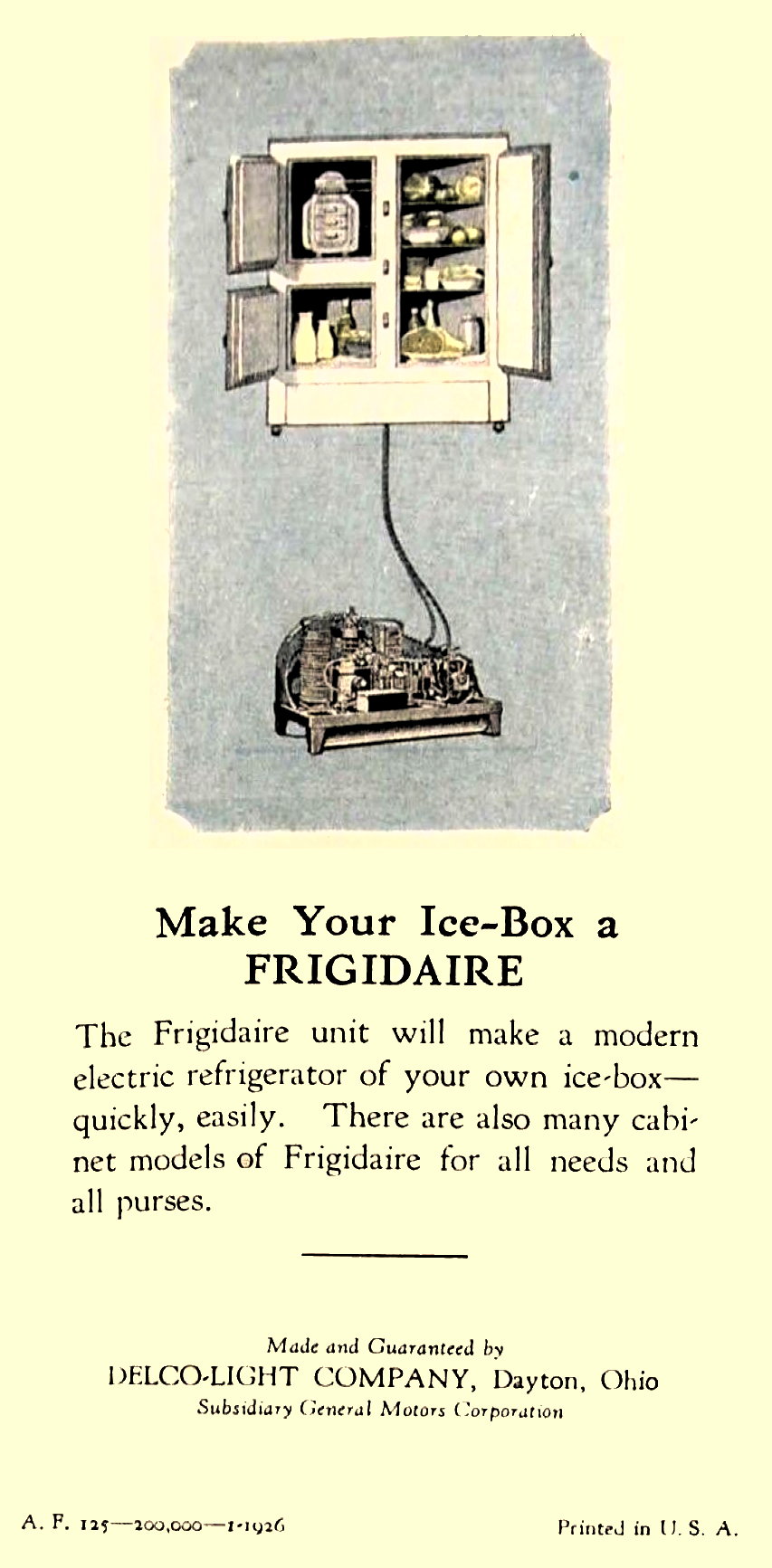
“…make a modern electric refrigerator of your own ice-box…”—Frozen Desserts and Salads made in Frigidaire, 1926.
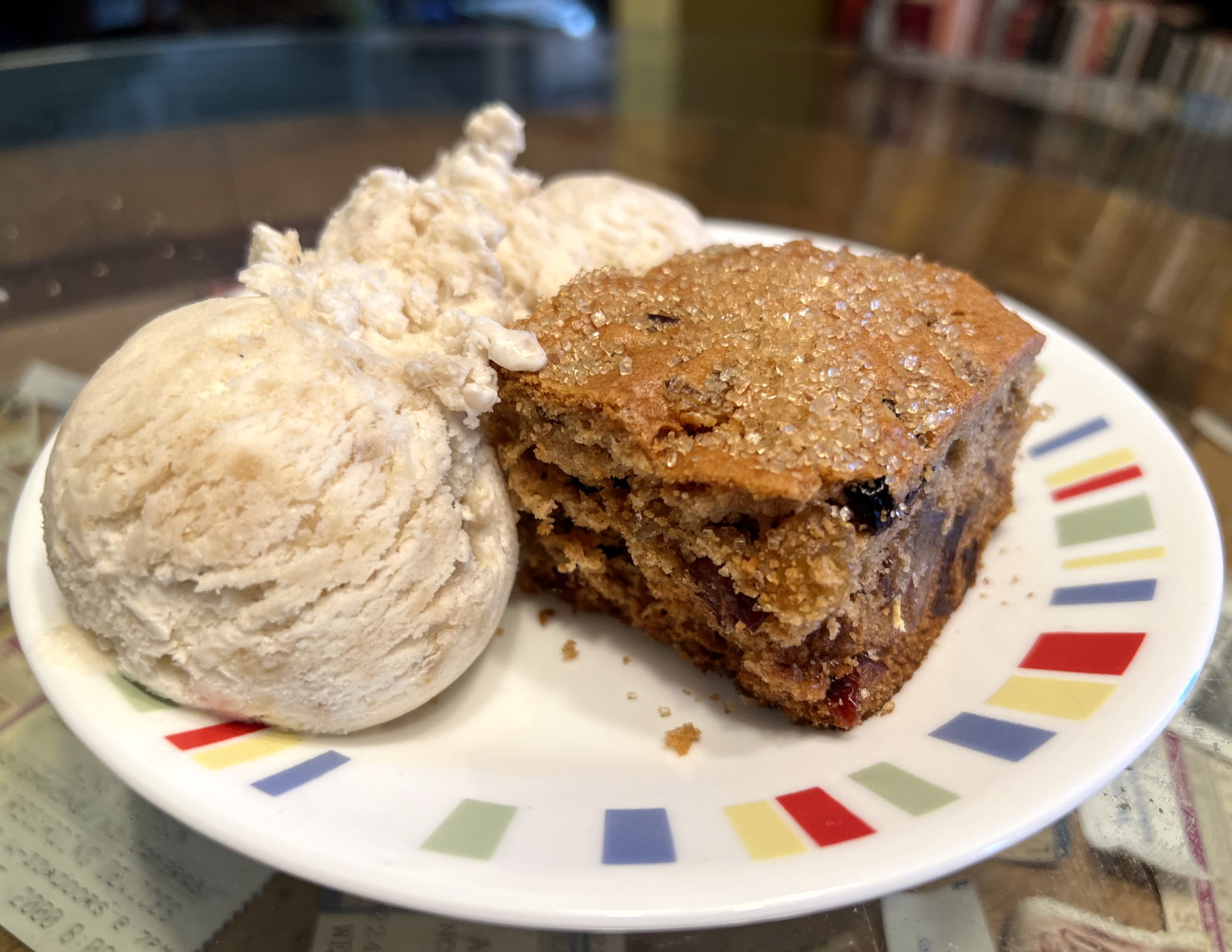
The Banana Ice Cream from Frozen Desserts and Salads was very good with Aunt Battersea Cake.
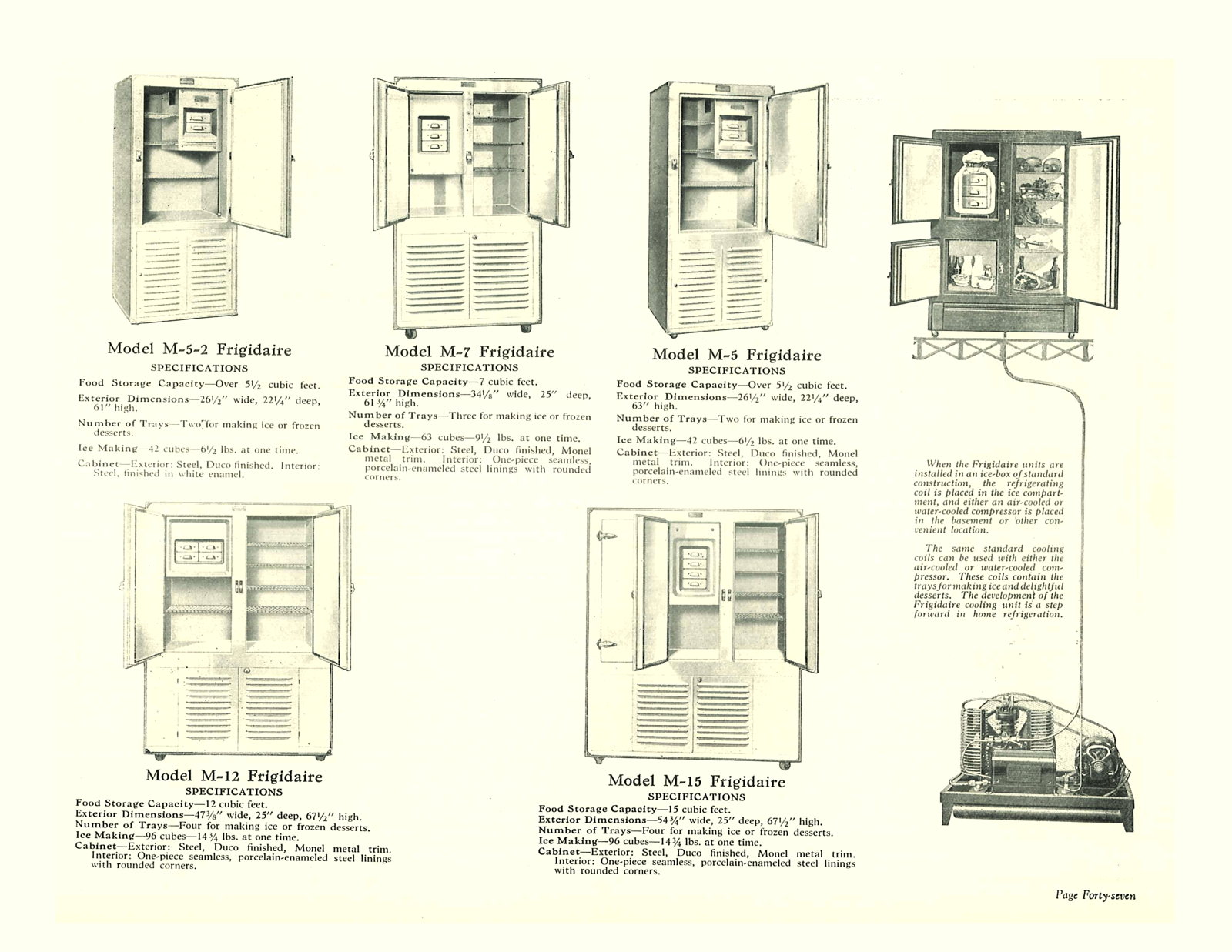
“…either an air-cooled or water-cooled compressor is placed in the basement or other convenient location.”—Frigidaire Model Kitchens, 1926.
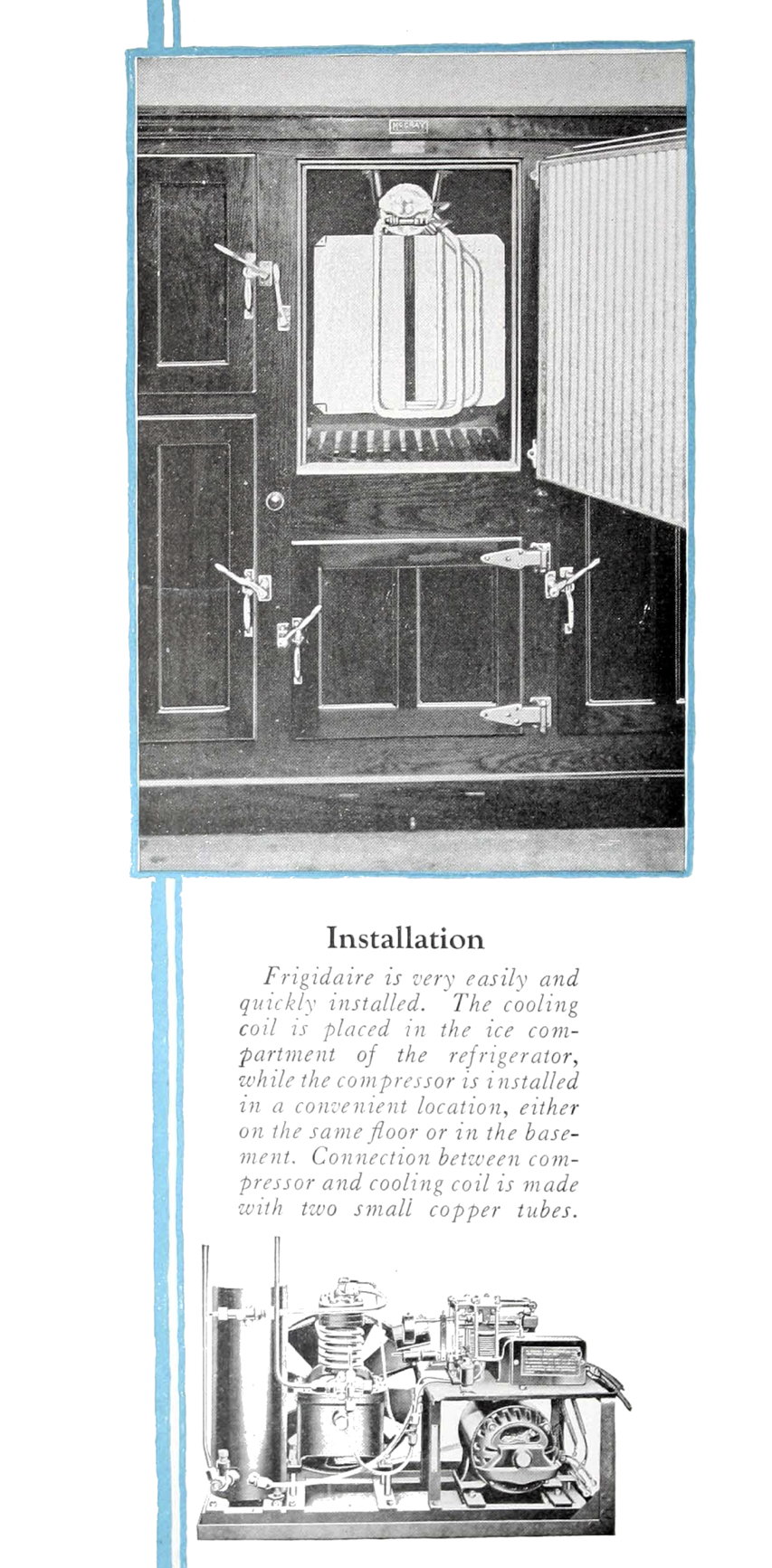
“…while the compressor is installed in a convenient location, either on the same floor or in the basement.”—Frigidaire Electric Refrigeration for the Market • Grocery • Delicatessen, May, 1926.
The home refrigeration design is pretty much the same as the design for a grocery store or restaurant. It’s not an accident that it was on the back page; their advertising rarely mentions it except insofar as what they leave out.
Make Your Ice-Box a FRIGIDAIRE
The Frigidaire unit will make a modern electric refrigerator of your own ice-box—quickly, easily. There are also many cabinet models of Frigidaire for all needs and all purses.
The Frigidaire “home” electric refrigerator was far from a modern device. The main unit went in the basement or outside, like an air conditioning compressor. In fact, it was an air conditioning compressor, controlling the refrigeration in a cabinet unit that could well have been a pre-refrigeration ice-filled ice-box. So while Frigidaire may have had cabinets for “all needs and all purses” they did not have refrigeration for all needs and all purses.
Part of what made the “monitor-top” different is that it was an all-in-one unit, including the refrigeration unit with the cabinet unit in an affordable single appliance. Frigidaire “refrigerators” looked like cabinets because they were cabinets. Frigidaire described the setup in more detail in their Model Kitchens, also from 1926:
When the Frigidaire units are installed in an ice-box of standard construction, the refrigerating coil is placed in the ice compartment, and either an air-cooled or water-cooled compressor is placed in the basement or other convenient location.
The competition that produced Model Kitchens specifically stated that the compressor must be “located in the basement or in another room.”
This was not something an apartment-dweller could easily install.
Another Frigidaire ad from 1927—ironically a few pages after one of General Electric’s first ads for their all-in-one unit—described the price for a Frigidaire as “surprisingly low. A small deposit puts it in your home. Then pay a little each month under the liberal G.M.A.C. terms.”
You paid for your refrigeration setup like you paid for a car—and in fact, Frigidaire was a General Motors company.1
One hundred years ago today, in other words, home refrigeration was any three of messy, complicated, expensive, and time consuming. The best of it in 1926 would have been the equivalent of having a home computer fifty years ago—1976—by installing a minicomputer in your basement and running wires up to a screen and keyboard in your home office.
Everything else… is just a toy.
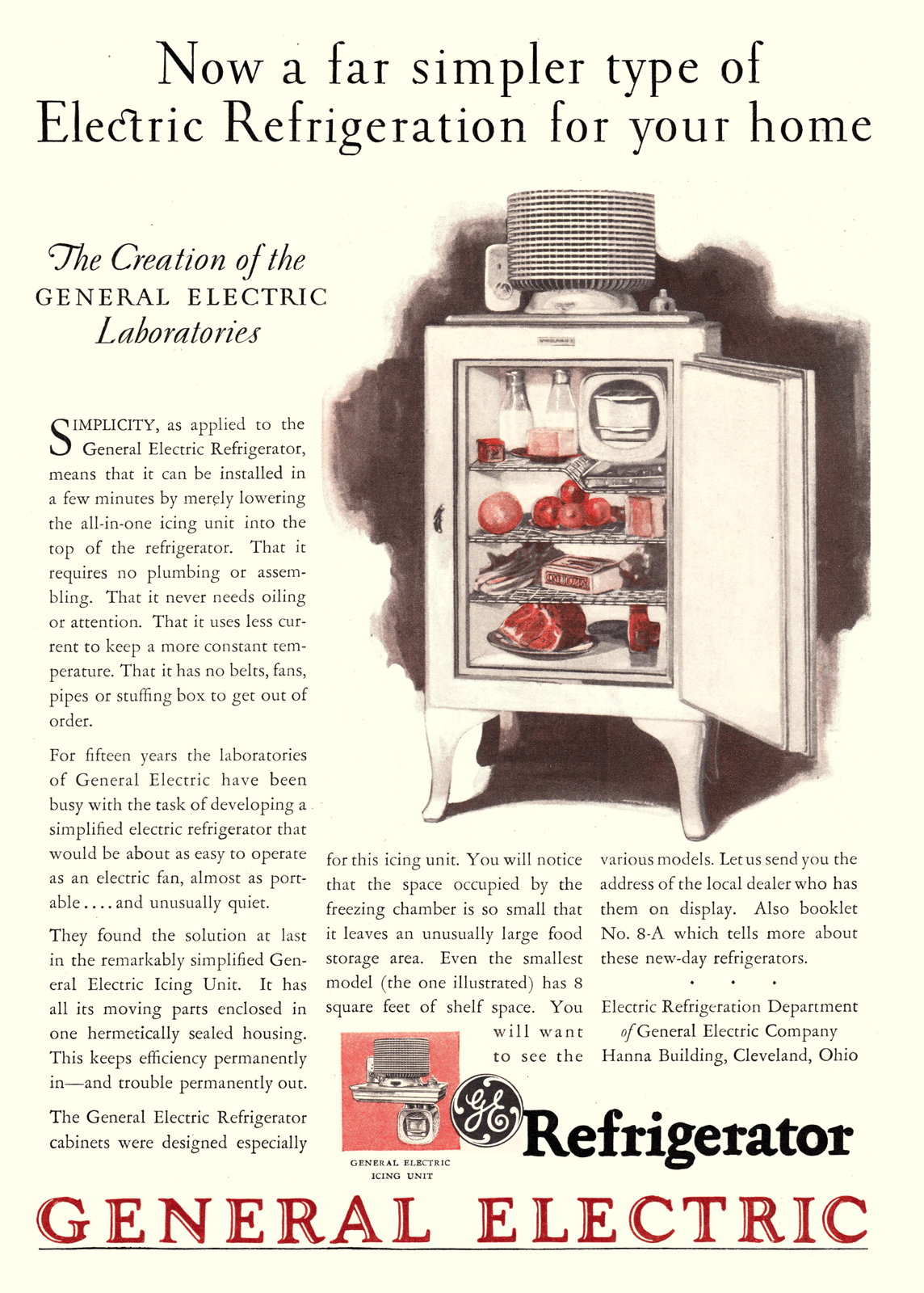
“Simplicity… means that it can be installed in a few minutes… [with] no plumbing or assembling… no belts, fans, pipes or stuffing box…” (American Magazine, August, 1927.)
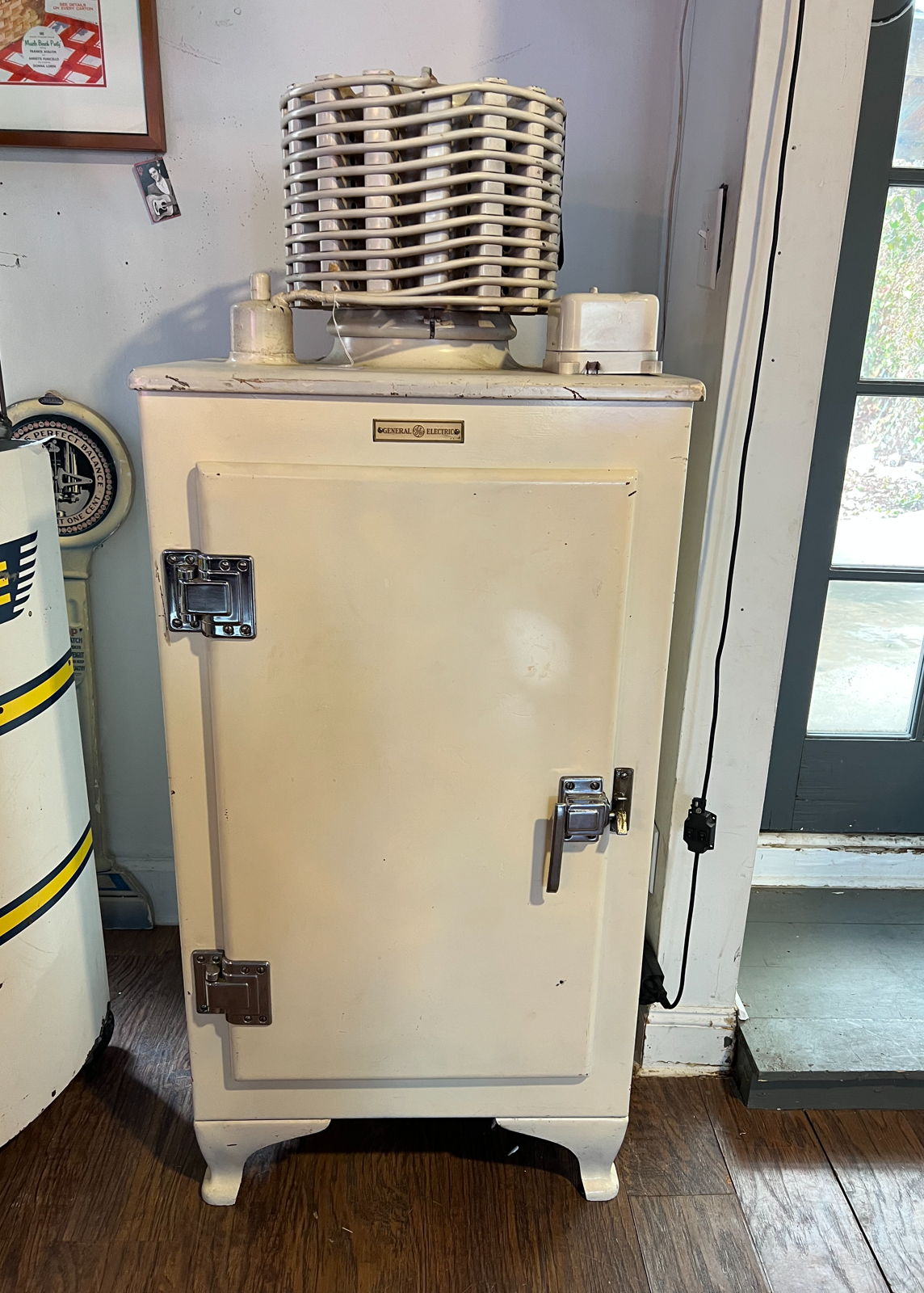
An actual Monitor Top—in working order—for sale at Flashback Funtiques in Boerne, Texas.
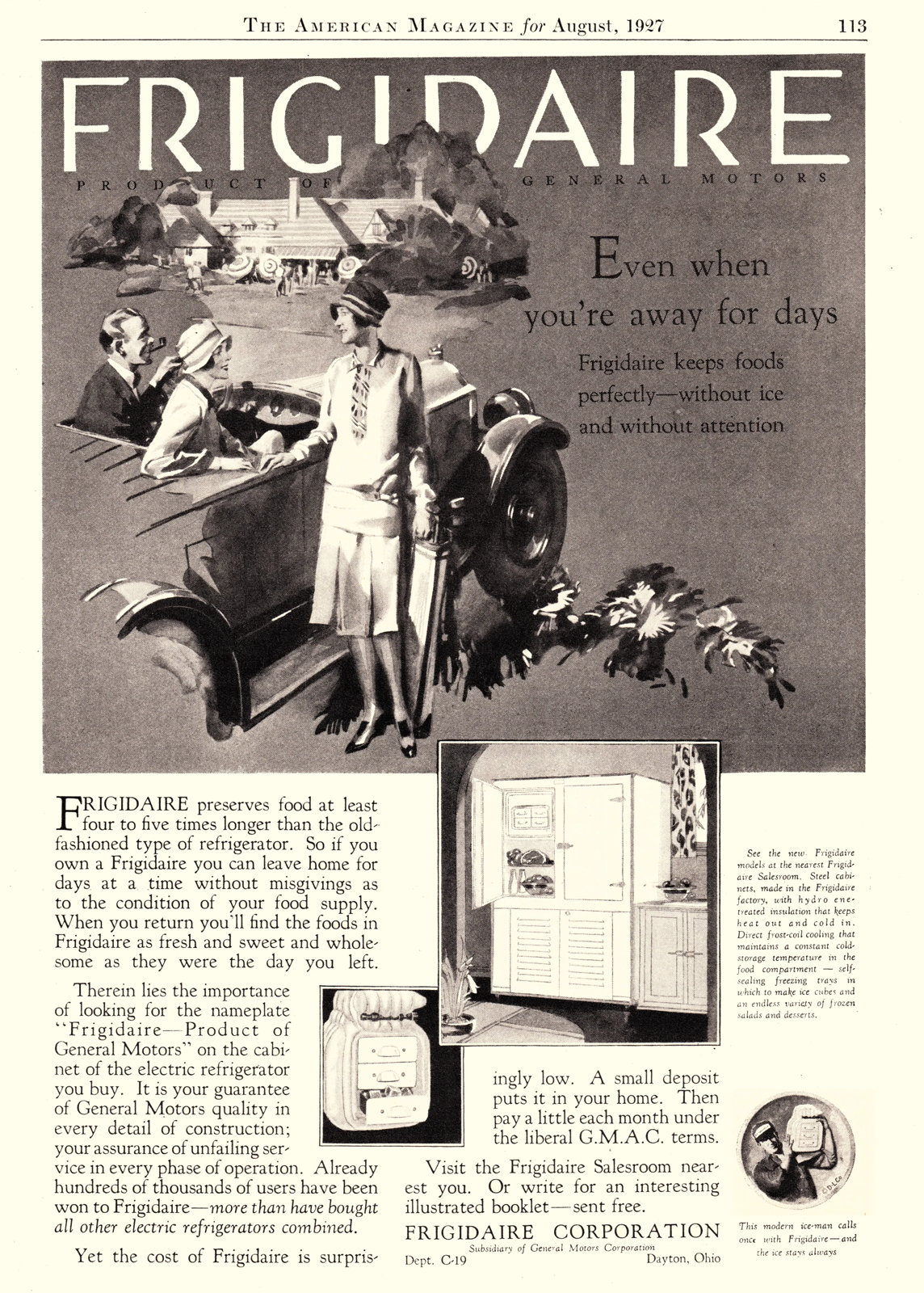
“Steel cabinets, made in the Frigidaire factory, with hydro ene-treated insulation that keeps heat out and cold in.” (American Magazine, August, 1927)
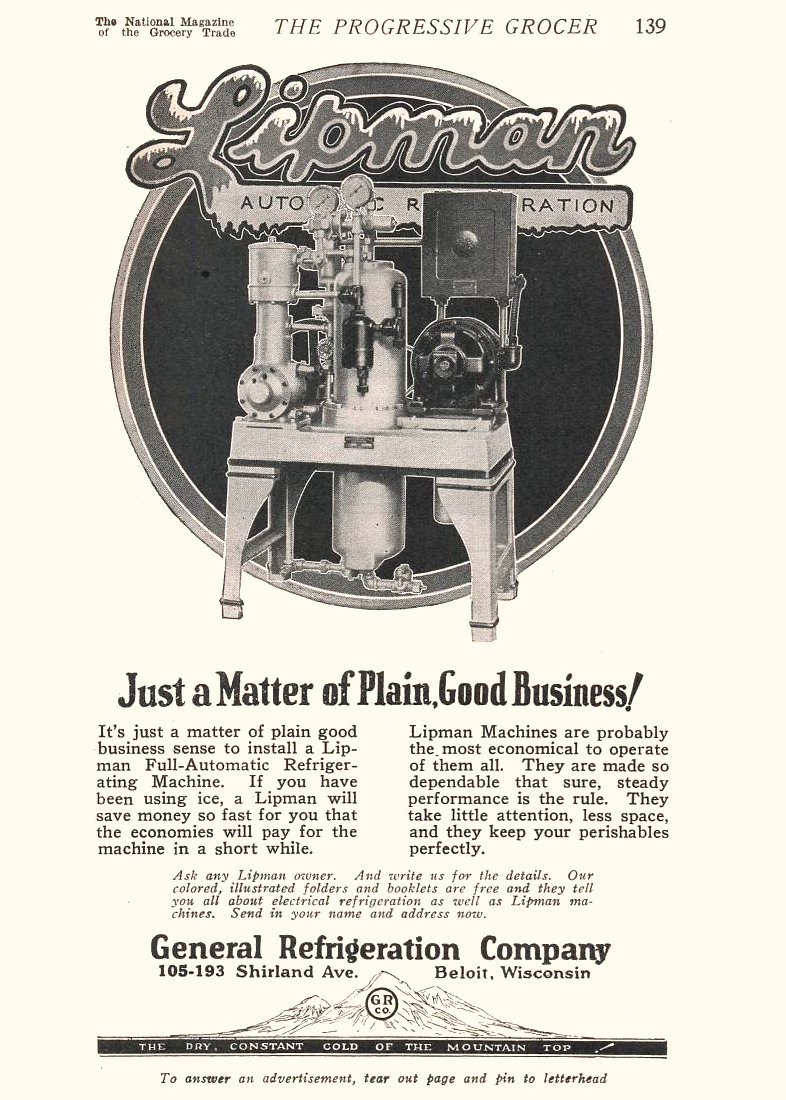
“The dry, constant cold of the mountain top.” (1926 General Refrigeration Company advertisement.)
In 1926, refrigerators were basically iceboxes with less mess and without having to manually refill on a regular basis, but taking up more space and requiring more complexity. If you already had electricity and you had the space, and you had the money for an installation and probable remodel, you’d likely want to get one. If you didn’t already have electricity, and if money was tight, or you didn’t feel like redesigning your home around a refrigerator, however, this kind of refrigeration probably didn’t offer enough advantages to go to the trouble of getting electricity.
After 1927, on the other hand, refrigerators very much were a reason to get electricity. They were one of the driving forces for the spread of electrical power lines. Once General Electric changed the refrigeration industry, you wanted a refrigerator. And to get a refrigerator you had to have electricity.2
My dad grew up in the thirties; their freezer rental probably ended, he says, about 1949, which matches up with the spread of electricity to rural areas. By 1949, more than 60% of farms had access to electricity. And the home refrigerator was one reason why.
For your enjoyment, here is the Peach and Nut Parfait from Delicious Recipes. It’s a lot easier to make today. Both canned peaches and fresh (as long as they’re ripe to softness) will work fine—no need to soak overnight! The period nuts would most likely be almonds or walnuts. But pecans are great, and I suspect macadamias or cashews would be wonderful as well. Depending on what you use and your own tastes, you may want to toast them before using them.

Peach and Nut Parfait
Servings: 12
Preparation Time: 45 minutes
Marion Harris Neil
Delicious Recipes (ebook, Internet Archive)
Ingredients
- 1 cup sugar
- 1 cup water
- 3 egg whites
- 1-½ cups chopped peaches
- 1 tsp almond extract
- 2 tsp vanilla extract
- 1 cup chopped nuts
- 2 cups whipping cream
Steps
- Beat egg whites to heavy froth.
- Cook sugar and water to about 230°.
- Pour syrup slowly over egg whites, beating continuously, until smooth.
- Beat in peaches, extracts, and nuts.
- Whip cream to soft peaks.
- Fold whipped cream into syrup.
- Freeze in chilled container overnight.
In response to Revolution: Home Refrigeration: Nasty, brutish, and short. Unreliable power is unreliable civilization. When advocates of unreliable energy say that Americans must learn to do without, they rarely say what we’re supposed to do without.
By 1927 General Motors was already selling Buick, Cadillac, Chevrolet, Oldsmobile, and Pontiac cars.
↑Gas-fueled refrigerators followed the monitor-top; they were designed to be hooked into the natural gas from a gas company. They took longer to cool and didn’t handle heavy loads as well, from what I can see. They also don’t appear to have been as reliable as electric and were generally a last resort if you had to have a refrigerator and couldn’t get electricity—but in that case, I suspect you often couldn’t get natural gas service either.
There were also safety concerns with natural gas, including fire and carbon monoxide poisoning, that had no equivalent in electric refrigerators.
↑
ice cream
- Delicious Recipes: Marion Harris Neil at Internet Archive (ebook)
- Delicious Recipes for Blue Ribbon (dried) Peaches, from the California Peach Growers, Inc. of Fresno, California.
- The domestication of frozen water
- Even the poorest people have ice today. Ice is given away free to dilute already-cheap sugary drinks. You can buy it in huge bags outside at gas stations and convenience stores, and when it melts you can get some more. In medieval times, you had no such luxury. Ice came in the winter and left in the summer. Storing it was time-consuming, expensive, and even dangerous.
- Four New Ices and an Ice Cream Cookery
- Philadelphia Ice Cream, Walnut Nougat, Lemon Cream Sherbet, and Cranberry Ice. Four more new no-churn ice creams and desserts for Summer 2025. And, a book collecting all my favorite no-churn ice creams if you’re interested!
- Love ice cream? You can thank Frigidaire for inventing the freezer!
- “The chilling coils are in the walls.”
refrigerators
- Hot ovens: Bakers were once the slaves of time
- We have chained time in our kitchens. Our refrigerators stop time from destroying food, and our ovens lash it to the oars for baking. And we have forgotten that it was ever any other way.
- Model Kitchens, as submitted, in the Frigidaire Competition at Internet Archive
- “Out of the many designs submitted, there are, in the opinion of the Jury from thirty to forty, outside of the prize designs, which should be published, since these designs illustrate many interesting and valuable suggestions worthy of general publicity for the purpose of encouraging the development of a more efficient working unit of the kitchen in the average American home.”
- Refrigeration in America: Oscar Edward Anderson, Jr. at Internet Archive
- “A history of a new technology and its impact.”
- Refrigerator Revolution Revisited: 1927 Electric Refrigerator Menus & Recipes
- The very first modern refrigerator/freezer came with a very revelatory cookbook that treated customers nearly the same way computer manuals would exactly fifty years later: as partners in a revolutionary new means of creativity.
More Frigidaire
- Refrigerator Revolution Reprinted: 1928 Frigidaire
- If you’d like to have a printed copy of the 1928 Frigidaire Recipes, here’s how you can get one. Also, a lot of new recipes tried.
More Refrigerator Evolution
- Refrigerator Revolution Revisited: 1928 Frigidaire
- The 1928 manual and cookbook, Frigidaire Recipes, assumes a lot about then-modern society that could not have been assumed a few decades earlier.
- Refrigerator Revolution Revisited: 1942 Cold Cooking
- Iceless refrigeration had come a long way in the fourteen years since Frigidaire Recipes. And so had gelatin!
- Refrigerator Revolution Revisited: 1947 Cold Cookery
- The 1947 Norge Cold Cookery and Recipe Digest reflects not just increased access to electricity but also the end of a second world war.
- Refrigerator Revolution Revisited: 1937 Kitchen-Proved
- Refrigerators started to take off during Prohibition, and became ubiquitous following World War II. This Westinghouse refrigerator manual and cookbook gives us a glimpse at home refrigerator/freezers in the Great Depression.
- Refrigerator Revolution Revisited: 1927 Electric Refrigerator Menus & Recipes
- The very first modern refrigerator/freezer came with a very revelatory cookbook that treated customers nearly the same way computer manuals would exactly fifty years later: as partners in a revolutionary new means of creativity.
- One more page with the topic Refrigerator Evolution, and other related pages
More twenties
- Refrigerator Revolution Reprinted: 1928 Frigidaire
- If you’d like to have a printed copy of the 1928 Frigidaire Recipes, here’s how you can get one. Also, a lot of new recipes tried.
- Refrigerator Revolution Revisited: 1928 Frigidaire
- The 1928 manual and cookbook, Frigidaire Recipes, assumes a lot about then-modern society that could not have been assumed a few decades earlier.