

Astro City: Tarnished Heroes, Local Villains
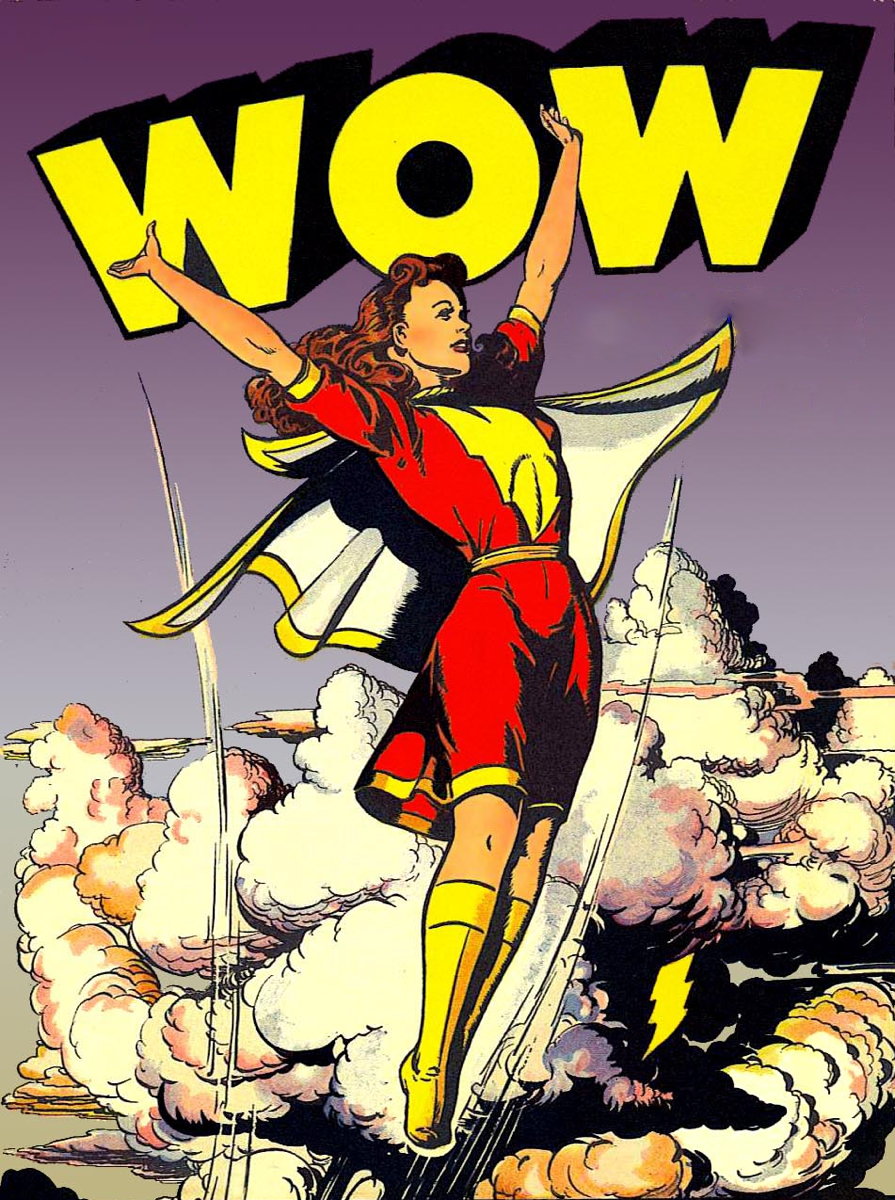
Mary Marvel demonstrates the joy of flight. This seems to be what Busiek was initially striving for, but gave up on.
Addressing the weird impossibilities in superheroes and superhero worlds deconstructively isn’t necessarily a bad idea, and some of the stories are in fact passably decent, with even better characterization than you normally get from deconstructive stories. Busiek’s a good writer. But the deconstructive stories he ended up writing were far easier than the reconstruction of the superhero that he set out to do. That failure is more disappointing than the stories are enjoyable.
Probably the worst and best example of this comes in Local Heroes, the fifth book in the series. The third book, Family Album, provided a brief respite of sorts. It took on a topic that superhero comics rarely do: family. On the other hand, it did the same for the family that the series had so far done to being a superhero or just living in a superhero world: it showed the insurmountable problems such a world creates for normal family life, foreshadowing the problems of justice in Local Heroes. In Busiek’s telling, even a golden-age world of superheroes is necessarily a world of existential loss.
The frame in Family Album followed a normal family moving to Astro City—and getting caught in the family dynamics of the gods themselves. The main story involved Jack-in-the-Box attempting to maintain a family life in a world not just of superheroes but of, again, time-spanning superheroics. It’s up-front about the fears of fatherhood, of what happens to your children when you’re gone, of how children embody multiple potentials. In a superhero world those infinite potentials are real, and they bring infinite pain.
The Junkman story in Family Album follows an old man who is unable to share his accomplishments: the Junkman had no family. In a normal world, this would be the story. In a superhero world, he creates a complicated scheme to ensure that someone will appreciate his life. A world of superheroes creates loss, and in a world of superheroes, loss creates more loss. The pebble rolls downhill and takes out a city.
Tarnished Angel is Jim Rockford meets Marvel. But unlike Rockford, Busiek’s protagonist really is a loser. He never amounts to anything, not even at the end. I’m sure that’s the point, and it was moderately enjoyable reading once and then again now as I’m going through my old comics. But even at its darkest, the explicit point of Astro City was the joy of it, like that old drawing of Mary Marvel flying into the sky with a heavenly smile. Not only does Tarnished Angel not have that joy, it doesn’t have anything to replace it with, either.
All of these problems come to a head when Local Heroes looks for reasons behind the classic, superficially fun and funny, superhero tropes. The series has now turned 180° from its stated reason for existing. The Lois Lane story literally requires that the characters never interact between panels, much like modern movies often require that characters literally never interact between scenes, no matter how much time passes, in order to keep the plot from resolving in a more sane manner.
The mafia storyline in Local Heroes is the pinnacle of this. A lawyer manages to win freedom for a mobster by showing that every member of the prosecution has been affected by Astro City’s weird villains. Mind control, time travel, alternate universes, this stuff is so incredibly common in Astro City that no one is unaffected.
The lawyer argued that this meant you couldn’t convict anybody. You could never trust your senses. You couldn’t even trust documentary evidence. Mind control, 100% impersonation, mass hallucination, resurrection, time travel, and alternate universes are so common that every expert witness had experienced at least one of them.
Busiek wrote the story as if this were a legal gimmick, but the lawyer was right. The existence of superheroes, magic, and aliens would make criminal trials impossible. Nothing is real, and everyone knows nothing is real. Busiek “solved” the problem by having Astro City law enforcement slightly modify how they collect evidence. But the solution is so obviously ill-matched to the problem that it is just as obviously not a solution at all. It doesn’t fix anything about the utter worthlessness of evidence in such a world.
In a world like Astro City—like any superhero world in the Marvel and DC style—there can be no justice beyond vigilantism because nothing is real. Even what is real is subject to the eddies of time, to timelines, to parallel evolution. Even to the whims of all-powerful yet humanly-flawed gods. There is no trust in such a world. There is no faith in an underlying reality.
And there is nothing that can replace that loss.
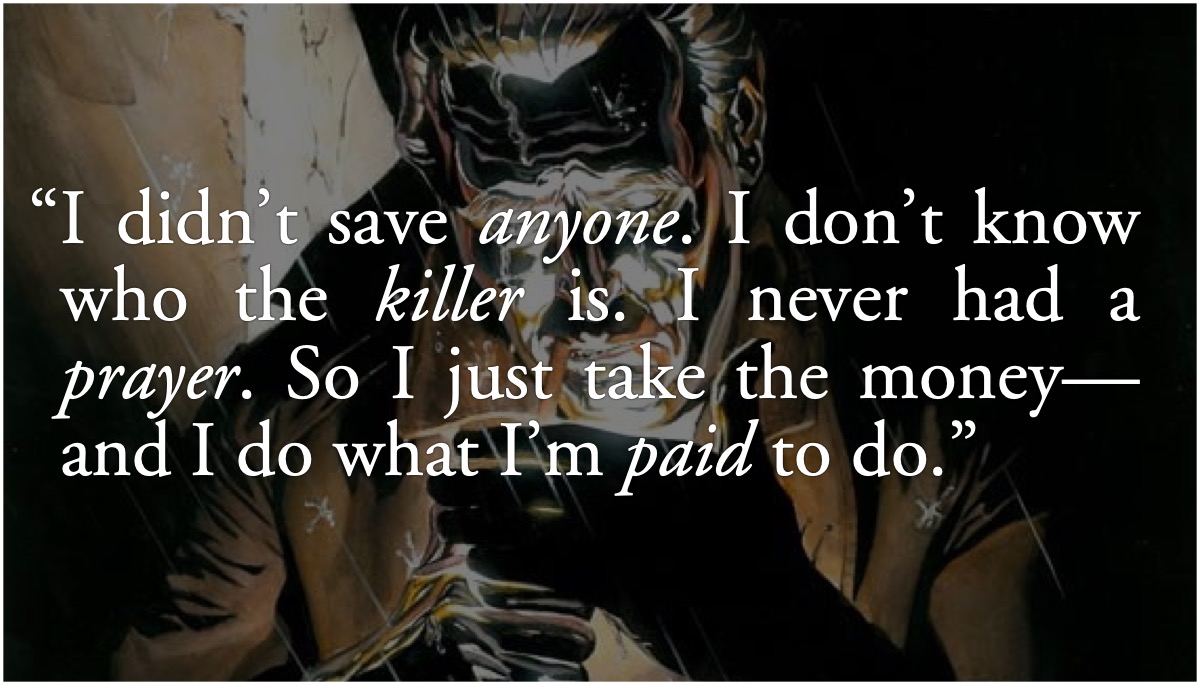
Mass tragedy in such a world will be pervasive and arbitrary. Is there a superhero nearby? In the world of comics as depicted in so many second-tier titles, first-tier heroes are often out saving the universe, giving a second-tier hero their time to shine. But what happens if the second-tier hero can’t handle it? In “Old Times”, Busiek gives Astro City that realistic treatment: Supersonic can’t handle it.
But by the same realism, a Supersonic deciding not to come out of retirement won’t mean that giant robots stay quiet. If Supersonic in “Old Times” had ignored the robot as the story says he should have, it would have meant death on a massive scale.
In a realistic world of star-spanning adventures, there would often not be any superheroes to stop such deaths. Mass murders beyond anything we can imagine in the real world would happen literally every few months.
Whenever superheroes are faced with saving the universe, they would also have to recognize that they’re leaving the Earth unprotected. Saving the universe would mean knowingly abandoning the planet to mass death. Choosing the planet would mean knowingly abandoning the universe to destruction.
The Local Heroes stories highlight how stupid the Astro City universe is, like any superhero universe is, in the final analysis. It’s ostensibly why the final analysis is what Astro City was explicitly created to avoid.
While Busiek was unable to live up to his goals even in the first collection, the excellent writing and the existence of the goal made up for it. By Local Heroes, he’s just given up. This is a horrible world.
Counterintuitively, Alan Moore’s Watchmen does a better job of ignoring consequences and reasons. Partly this is because Moore’s ultimate aim was not to deconstruct superheroes but to explain our own modern world. While he did give caped heroes a middle finger, for the most part his non-powered heroes got a pass. Even young women were safe wandering the city at night as long as they were in costume. He accepted the fiction that superheroes were possible and would work. Watchmen was less “what would the world be like if supers existed” and more “just how easily duped would an elite cadre of people be?”
Moore used superheroes as a stand-in for the self-made elite who want to run our real world. There’s nothing out of the ordinary about Adrian Veidt’s Mad Scientist. His friends were superheroes and faced with a choice his superhero friends, like political “friends” in the real world, gave him the benefit of the doubt and let him get away with murder.
In Astro City, however, what initially set out to be about how joyful comic book worlds should be, turned into a nightmare and an explicit catalogue of how unworkable they are.
In response to Astro City: Hope to Hopeless in the Big City: Kurt Busiek set himself a noble and desperately needed goal when he started Astro City, the reconstruction of the superhero.
- Cinematic roleplaying is an oxymoron
- Cinematic roleplaying always seems to be about reducing player choice. This is a direct result of trying to emulate an entertainment style that by necessity must elevate the director’s choice above character development. Even the best movies require the director to curtail the world in which the action and dialogue takes place.
- The Full Face of V: In Your Hands
- The real story in all of Moore’s books is what happens after the final page. This is most obvious in Watchmen, but every one of these books highlights an uncertain future.
- Our Cybernetic Future 1954: Entropy and Anti-Entropy
- In 1954, Norbert Wiener warned us about Twitter and other forms of social media, about the breakdown of the scientific method, and about the government funding capture of scientific progress.
- Review: Family Album: Jerry Stratton at Jerry@Goodreads
- A literal focus on family issues in Astro City and among superheroes—with all the pain and sorrow that Astro City is about to hit us with.
- Review: Local Heroes: Jerry Stratton at Jerry@Goodreads
- This is where it became obvious that Busiek had given up on his lofty goal to return to the joy of superheroes.
- Review: The Tarnished Angel: Jerry Stratton at Jerry@Goodreads
- An ex-con returns to the neighborhood to solve a mystery… imagine Jim Rockford in Astro City.
More Astro City
- Astro City: Hope to Hopeless in the Big City
- Kurt Busiek set himself a noble and desperately needed goal when he started Astro City, the reconstruction of the superhero.
More Kurt Busiek
- Astro City: Hope to Hopeless in the Big City
- Kurt Busiek set himself a noble and desperately needed goal when he started Astro City, the reconstruction of the superhero.