


This Food Can Death Destroy
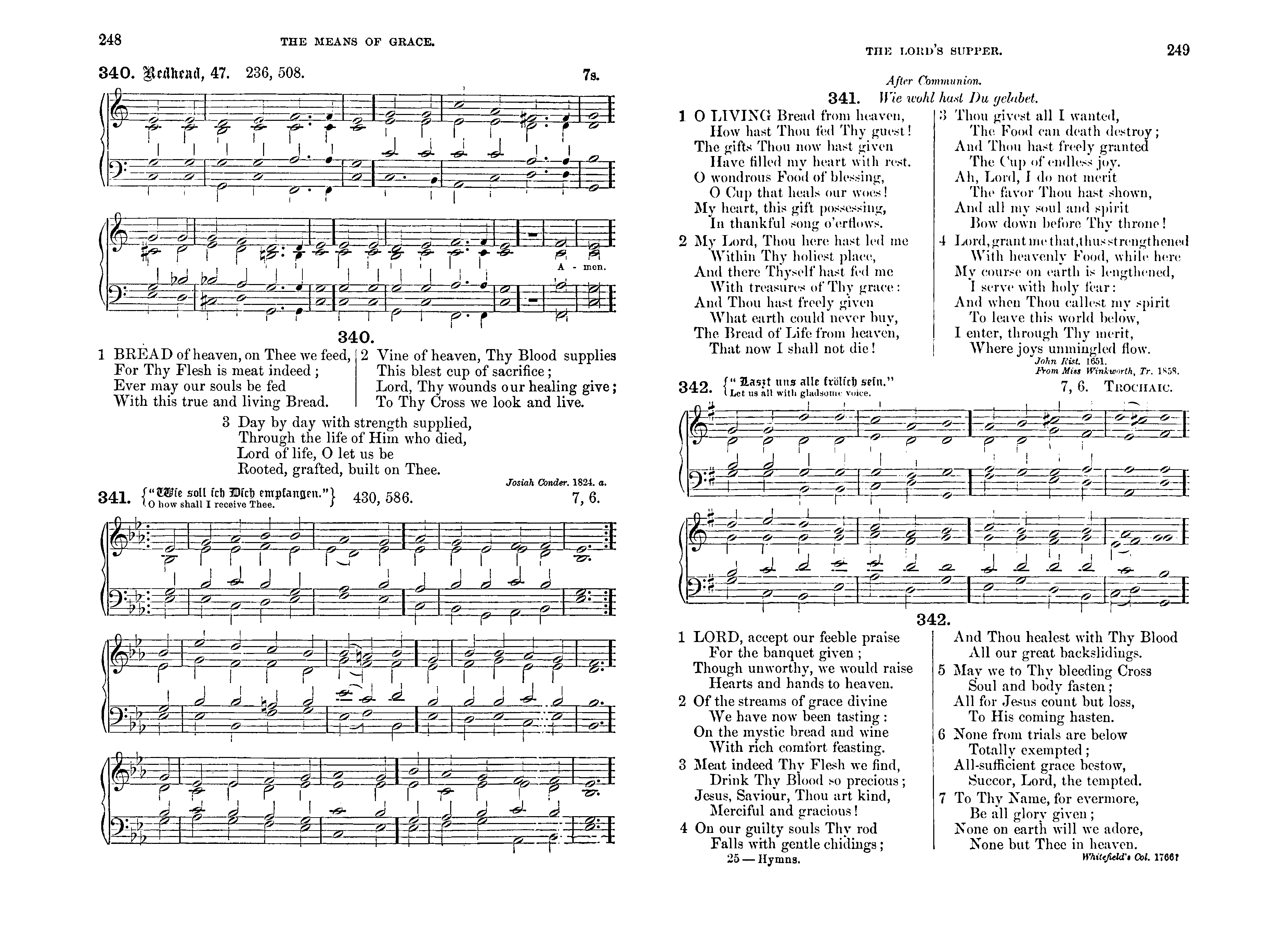
Lyrics for “O Living Bread from Heaven” ca. 1872.
Samuel Sebastian Wesley’s Aurelia is used as the melody for a hundred songs, literally, and more. Hymnary.org lists 188 songs that use this melody. They range from soaring (The Day of Resurrection) to vivid (No Seas Again Shall Sever) to timeless (O God, the Rock of Ages).
It rings in the new year with Another Year is Dawning, guides us through the years with The Sunday Bells are Calling, and sings the year (and mortal life) out with The Year is Swiftly Waning.
It’s all the more amazing because it is, for church music, relatively recent. Wesley wrote it in 1864. He wrote it for John Mason Neale’s 1849 Jerusalem the Golden, itself a wonderful song with a wonderful history. Jerusalem the Golden is a very loose translation of a relatively few lines from a much older and much longer Latin satire, Bernard of Cluny’s 12th century De contemptu mundi.
Here, for example, are what I think are Cluny’s Latin lines which inspired Neale’s second verse as reprinted in The Invalid’s Hymn-Book:
| John Mason Neale | Bernard of Cluny |
|---|---|
|
|
My very rudimentary Latin says that this is a very loose translation. It’s really more of an inspired by than a translated from.
That it was written for Jerusalem the Golden is why it’s called Aurelia. The word aurelia is derived from the Latin aureus. It means “golden” and was often used as a female name. Caesar’s mother, for example, was named Aurelia.
However, despite the popularity of Aurelia as a hymn melody, Jerusalem the Golden itself normally uses a different melody. The most famous song that does use Aurelia is probably The Church’s One Foundation (PNG, 133.5 KB), an absolutely beautiful hymn. Among my favorites is O Living Bread from Heaven (PNG, 245.8 KB). Its simple and straightforward lyrics perfectly match Aurelia’s soaring melody. It is one of three hymns in The St. Michael Hymnal that use Aurelia, the other, besides The Church’s One Foundation, being O Father, All-Creating.
Wesley isn’t particularly well-used as a composer beyond Aurelia. While Hymnary.org lists 139 tunes and five texts under his name, the older hymnals in my collection contain only The Church’s One Foundation. Even the modern St. Michael Hymnal contains only four hymns with his name on them—three of which are hymns that use Aurelia. The fourth is the melody for O Thou Who Camest From Above. That melody, Hereford, is a much less popular tune: Hymnary lists it only for eight hymns.
O Thou Who Camest was written by Charles Wesley, Samuel’s grandfather. Charles Wesley wrote many famous songs, but I suspect the most famous is Hark, the Herald Angels Sing, which I featured for Christmas in 2019. His Christ the Lord is Risen Today also remains a very popular Easter hymn.
The title “Hereford” of the tune for O Thou Who Camest almost certainly derives from Hereford Cathedral, where Samuel was an organist from 1832 to, I think, 1842, when he moved to Leeds Parish Church.
The lyrics for O Living Bread From Heaven were written by Johann Rist in 1651—in German, titled Wie wohl hast Du gelabet. It was translated into English by Catherine Winkworth in 1858.
I am not at all sure how the German title translates into the English one. I know no German, and the various online translators think it means something like “How well did you sleep?” or “How well did you live?” Google gives the latter translation, but if I put the whole first verse into it1 Google’s translation becomes the more likely “How wonderfully you have nourished, O dearest Jesus, your guest”.
Winkworth presented her translation in her Lyra Germanica. As you can see in the 1872 Lutheran Church Book2 her translation has been followed very closely and very loosely at the same time:
| Hymn | Lyra Germanica |
|---|---|
|
|
|
|
|
|
|
|
There are likely multiple versions of Winkworth’s translation, as she “was given to revising”, according to Father George William Rutler• in The Stories of Hymns•.
Modern versions of O Living Bread from Heaven tend to replace “Thy” and “hast” and “Thou” and so on with more modern equivalents. Further, they’re not always the obvious replacement. In the St. Michael Hymnal for example, “The Food can death destroy” has become “This Food can death destroy” which does have more of a punch to it. If it weren’t that “The” matches the beginning of “The Cup of endless joy”, I’d suspect a typo in the Lutheran Church Book.
In fact, it’s more likely just a side effect of altering Winkworth’s translation to fit the melody. If you look in the second column, Winkworth’s translation of that line is “The food whose power can death destroy”. The second line of each verse has been shortened because Wesley’s melody doesn’t support as much text as Winkworth’s poem has. In this stanza, the fit is made by removing “whose power” leaving “The food… can death destroy”.
Which, once you remove those middle words, makes a lot more sense with “this” than with “the”, but I can understand why some versions change it and some let it be. There’s always a tradeoff between faithfulness to the text and faithfulness to the meaning.
The rest of the edits are performed just as simply. Because each verse is longer than the melody’s verse, each of Winkworth’s verses is truncated where the melody ends! It’s surprising how well that works.
The only major change is to the final verse. The fourth line of the final verse is changed heavily, and its remaining lines are replaced with new ones.
There were extra verses in Winkworth’s version; I cut them so that the verses that were kept could be compared between Winkworth’s translated stanzas and the hymn’s verses. The jettisoned stanzas fall between the third and fourth (final) verses:
- O Love incomprehended!
- That wrought in Thee, my Saviour, thus
- That Thou shouldst have descended
- From highest heaven to dwell with us!
- Creator, that hath brought Thee
- To succor such as I,
- Who else had vainly sought Thee!
- Then grant me now to die
- To sin, and live alone to Thee,
- That when this time is o’er,
- Thy face, O Saviour, I may see
- In heaven for evermore.
- For as a shadow passes
- I pass, but Thou dost still endure;
- I wither like the grasses,
- But Thou art rich, though I am poor;
- Oh boundless is Thy kindness,
- And righteous is Thy power;
- And I in sinful blindness
- Am erring hour by hour,
- And yet Thou comest, dost not spurn
- A sinner, Lord like me!
- Ah how can I Thy love return,
- What gift have I for Thee?
- A heart that hath repented,
- And mourns for sin with bitter sighs,—
- Thou, Lord, art well-contented
- With this my only sacrifice.
- I know that in my weakness
- Thou wilt despise me not,
- But grant me in Thy meekness
- The favour I have sought;
- Yes, Thou wilt deign in grace to heed
- The song that now I raise,
- For meet and right is it indeed
- That I should sing Thy praise.
- Grant what I have partaken
- May through Thy grace so work in me,
- That sin be all forsaken,
- And I may cleave alone to Thee,
- And all my soul be heedful
- How she Thy love may know,
- For this alone is needful,
- Thy love should in me glow;
- And let no beauty please mine eyes,
- No Joy allure my heart,
- But what in Thee, my Saviour, lies,
- What Thou dost here impart.
If you want to add them back, it shouldn’t be too difficult to follow the same pattern: shorten the second and fourth lines and truncate everything after the eighth. The “For as a shadow passes” verse seems especially ripe for restoration.
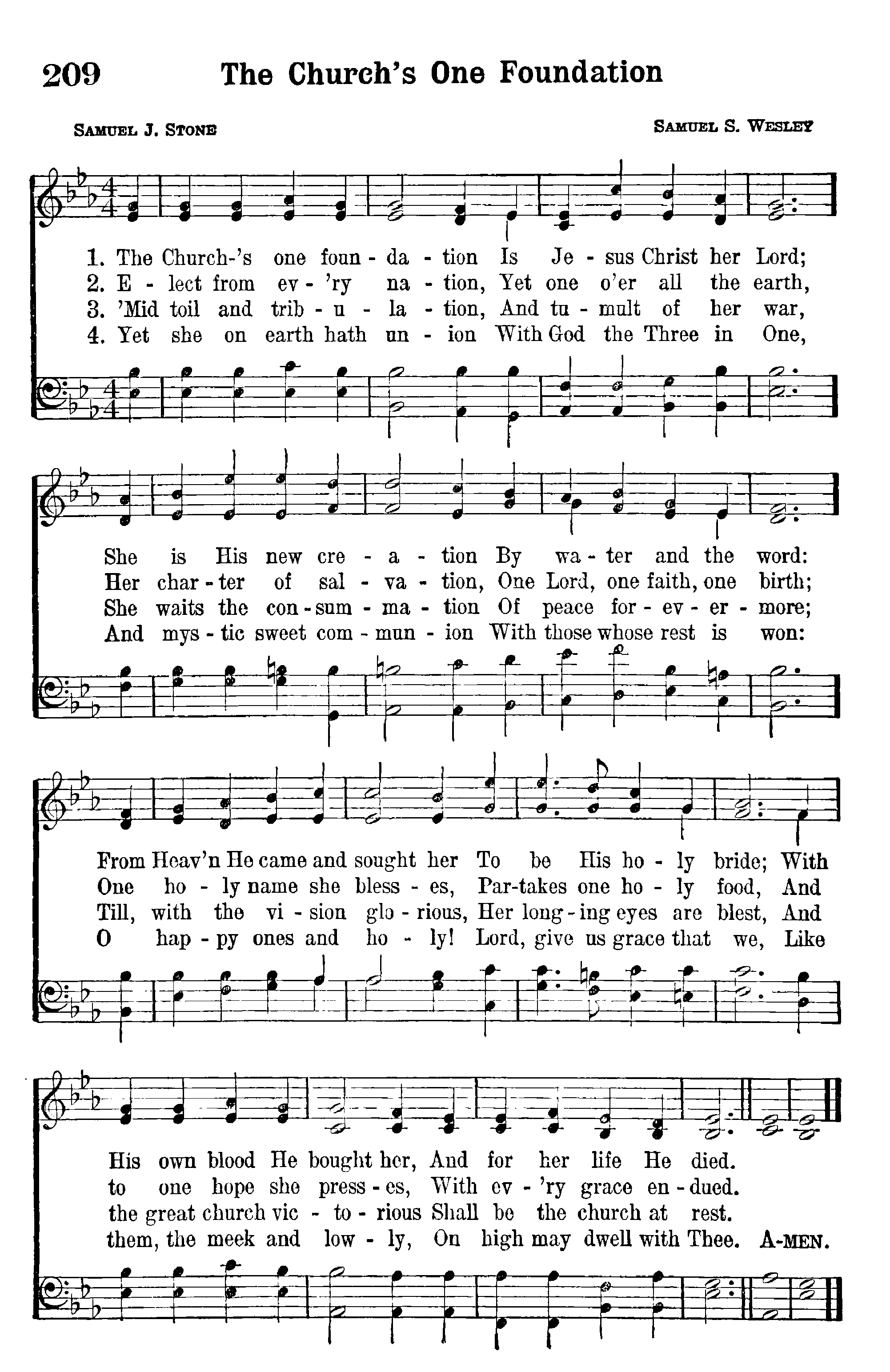
The Church’s One Foundation, to the tune of Aurelia, from the 1925 Hymns of Praise Number Two. This is the arrangement I used.
- Life as a shadow passes
- But Thou eternal be;
- I wither like the grasses,
- What gift have I for thee?
- Oh boundless is Thy kindness,
- And righteous is Thy power;
- And I in sinful blindness
- Am erring hour by hour,
That said, having given it a go myself I can see why that verse was dropped.
Winkworth specialized in English translations of German hymns and she was very prolific. The St. Michael Hymnal contains too many of her translations to list. You’re likely to recognize at least two, both of them wonderful: her translation of Martin Rinckart’s Now Thank We All Our God and of Joachim Neander’s Praise to the Lord, the Almighty, the King of creation, both of which deserve their own posts if not entire books.
Catherine Winkworth was born in London in 1827, lived for a time in Dresden, spent most of her life in England, and finally died in Geneva in 1878. Her death was not devoid of tributes.
She was a person of remarkable intellectual and social gifts, and very unusual attainments; but what specially distinguished her was her combination of rare ability and great knowledge with a certain tender and sympathetic refinement which constitutes the special charm of the true womanly character.—Dr. John Percival, Founder, Clifton College, Bristol Times and Mirror, July, 1878
But the greatest eulogy to Catherine Winkworth may have come from her sister Susanna. In the preface to Letters and memorials of Catherine Winkworth, a collection compiled for Catherine’s nieces and nephews, Susanna wrote:
You all loved your Aunt Kate, and can remember how fond you used to be of listening to her stories, when you were children, and how happy she used to make you whenever you were with her. But most of you were too young when we lost her, to understand the full beauty of her character and the power of her mind…
Hence I have thought that I could give you no better proof of my affection for you than by presenting you with what record I could frame of the outward events of her life; and of her character, thoughts and opinions as displayed in her letters.
To create an Aurelia melody file for my piano script from 42 Astounding Scripts, I used the sheet music for hymn 209 in Hymns of Praise Number Two, The Church’s One Foundation. It should work, possibly with minor alteration, for any of the many songs that use Aurelia for their melody.
You can download a zip file (Zip file, 4.4 MB) with all of the piano source files, resulting MIDI files, and audio files, as well as the sheet music I used for the source. As has become my custom, I’m providing separate files for the treble clef and the bass clef. This allows me to assign a different instrument to each in GarageBand. I’ve also included a separate file for the trailing Amen. If you’ve been following this series you should have a nice collection of Amen melodies suitable for use as a ring tone!
If you have the piano script, you can play the full song on the macOS command line using:
- ~/bin/piano [ bass.txt ] treble.txt amen.txt
Or just the “amen” using ~/piano amen.txt.
O Living Bread from Heaven (Aurelia)
In response to Hymns: Musings about hymns, and about modern bowdlerism as it applies to Christian, especially Catholic, lyrics.
Wie wohl hast du gelabet,
↑
O liebster Jesu, deinen Gast,
Ja mich so reich begabet,
Da ich jetzt fühle Freud' und Rast!
O wundersame Speise,
O süßer Lebenstrank!
O Lieb'smahl, das ich preise
Mit einem Lobgesang,
Indem es hat erquicket
Mein Leben, Herz und Mut!
Mein Geist, der hat erblicket
Das allerhöchste Gut.Church Book for… Evangelical Lutheran Congregations, page 341.
↑
Download
- Amen (Aurelia)
- Ringtone file for the “Amen” from Aurelia-based songs such as The Church’s One Foundation.
- O Living Bread from Heaven
- The melody for Johann Rist’s hymn, translated by Catherine Winkworth, to Samuel Sebastian Wesley’s Aurelia.
- O Living Bread from Heaven (Zip file, 4.4 MB)
- Piano files, audio, and sheet music for O Living Bread from Heaven and the tune Aurelia.
Catherine Winkworth
- Letters and Memorials of Catherine Winkworth: Susanna Winkworth at HathiTrust Digital Library
- Compiled for her nieces and nephews, “keeping my sister Catherine as the central figure, pourtraying the incidents of her life and the progress of her mind in full so far as I have the means of doing so, but inserting also letters from other members of the family which help to connect the thread of events.”
- Lyra Germanica: Catherine Winkworth at Internet Archive (ebook)
- “Hymns for the Sundays and chief festivals of the Christian year… translated from the German by Catherine Winkworth. New Edition. 1890.”
hymnals
- Church Book, for the use of Evangelical Lutheran Congregations: Harriet Reynolds Krauth at Internet Archive (ebook)
- “This book has grown out of a manuscript compilation… in the belief that congregational singing, led by a choir or precentor, is the best mode for public worship, and most in keeping with the Service of our Church.”
- Hymns of Praise: Number Two: F. G. Kingsbury at Internet Archive (ebook)
- “For the Church and Sunday School, Printed in round and shaped notes with orchestration.”
- The Invalid’s Hymn-Book: R. F. Littledale, LL.D. at Internet Archive (ebook)
- “Being a selection of hymns… drawn from different volumes of Sacred Poetry by the late Dr. Neale… appropriate to the sick-room, original or translated.”
- The St. Michael Hymnal
- “…the hymnal retains the traditional language of the hymns, with no politically driven language. The very few changes in texts are poetic or practical choices. … [it] is still the only Catholic hymnal in this country that includes substantially the entire contents of “Jubilate Deo,” the collection of Gregorian chants that Pope Paul VI sent to all bishops in 1976, asking that they be preserved.”
Hymns
- Aurelia at Hymnary.org
- “Composed by Samuel S. Wesley (PHH 206), AURELIA (meaning ‘golden’) was published as a setting for ‘Jerusalem the Golden’ in Selection of Psalms and Hymns, which was compiled by Charles Kemble and Wesley in 1864.”
- Hark! The Herald Angels Sing
- A glorious song for Christmas. And a glorious bug fixed.
- Hymnary.org
- “A comprehensive index of hymns and hymnals.”
- The Stories of Hymns•: Father George William Rutler (paperback)
- “The History Behind 100 of Christianity’s Greatest Hymns… The text and composition of each hymn is included, as well as inspiring accounts of their authors and composers… and notes on the significant contributions each one made to theology and music.”
miscellaneous
- 42 Astoundingly Useful Scripts and Automations for the Macintosh
- MacOS uses Perl, Python, AppleScript, and Automator and you can write scripts in all of these. Build a talking alarm. Roll dice. Preflight your social media comments. Play music and create ASCII art. Get your retro on and bring your Macintosh into the world of tomorrow with 42 Astoundingly Useful Scripts and Automations for the Macintosh!
- De contemptu mundi: Bernard of Cluny at Wikipedia
- From Bernardus Cluniacensis, or Bernard of Cluny, “a 3,000 verse poem of stinging satire directed against the secular and religious failings he observed in the world around him.”
music videos
- Jerusalem the Golden
- Sung by The Symphonials; Conducted by Emmanuel K. Ayi; with Organist Joel Boadi.
- Now thank we all our God Hymn—Westminster Abbey
- “The hymn ‘Now thank we all our God’ written by Martin Rinkart (1586-1649) and translated by Catherine Winkworth (1827 - 1878), set to the tune NUN DANKET by Johann Crüger (1800-1880). From the Commonwealth Day Service at Westminster Abbey on Monday 14 March 2022.”
- O Father, All Creating
- St. Peter Cathedral, Organist William Herring, Cantor Cathy Kerner.
- O Thou Who Camest From Above: Rochester Cathedral Choir
- “The choir of Rochester Cathedral sing the hymn O Thou Who Camest From Above. Charles Wesley’s wonderful words are sung to the lovely tune Hereford composed by Samuel Sebastian Wesley who was born in London in 1810 so this year is his 200th aniversary.”
- Praise to the Lord, the Almighty Hymn—Westminster Abbey Commonwealth Day Service 2020
- “The hymn, ‘Praise to the Lord, the Almighty, the King of creation’… set to the tune, LOBE DEN HERREN… This was sung at the Commonwealth Day Service 2020 at Westminster Abbey, on Monday 9th March 2020.”
More Astounding Scripts
- 42 Astoundingly Useful Scripts and Automations for the Macintosh
- MacOS uses Perl, Python, AppleScript, and Automator and you can write scripts in all of these. Build a talking alarm. Roll dice. Preflight your social media comments. Play music and create ASCII art. Get your retro on and bring your Macintosh into the world of tomorrow with 42 Astoundingly Useful Scripts and Automations for the Macintosh!
- Using version control with AppleScripts
- AppleScripts aren’t stored as text, which makes it impossible to track changes in AppleScript files using version control software such as Mercurial or Git.
- Play music faster in the Music App
- If you enjoy Marvin and the Chipmunks, you’ll love this AppleScript.
- Catalina: iTunes Library XML
- What does Catalina mean for 42 Astounding Scripts?
- 42 Astounding Scripts is live!
- Ready to get your retro on? Type in programs for your Macintosh and make it play music, roll dice, and talk to you? Customize your services menu? 42 Astoundingly Useful Scripts and Automations for the Macintosh is the book for you!
- One more page with the topic Astounding Scripts, and other related pages
More Hymns
- Save That Thou Art
- High King of heaven, when vict’ry is won/May I reach heaven’s joys, bright heaven’s Sun!/Heart of my heart, whatever befall,/Still be my vision, O Ruler of all.
- Light a candle for Christmas hymns
- While the holidays brought more examples of bowdlerized lyrics they also brought, at least to our church, a lit candle for the darkness, in the form of a new hymnal that retains sound Catholic theology.
- The Soul Felt It’s Worth
- “A thrill of hope, the weary world rejoices…” What is a soul worth? For God, a soul is worth his son.
- Our parental unit, who art, somewhere, maybe
- God’s Blessing Sends Us Forth; We Are the Light of the World; With a Shepherd’s Care. Is there room for God the Father in the modern church? Are the bowdlerizers creating a first-contact crisis?
- Let mortal tongues awake
- Samuel Francis Smith’s America—more commonly known as “My Country, ’Tis of Thee”— is short, direct, and a wonderful hymn to God as the soul of liberty. It’s a perfect hymn for the Fourth of July. It’s also very easy to play using the piano script from 42 Astounding Scripts.
- Six more pages with the topic Hymns, and other related pages