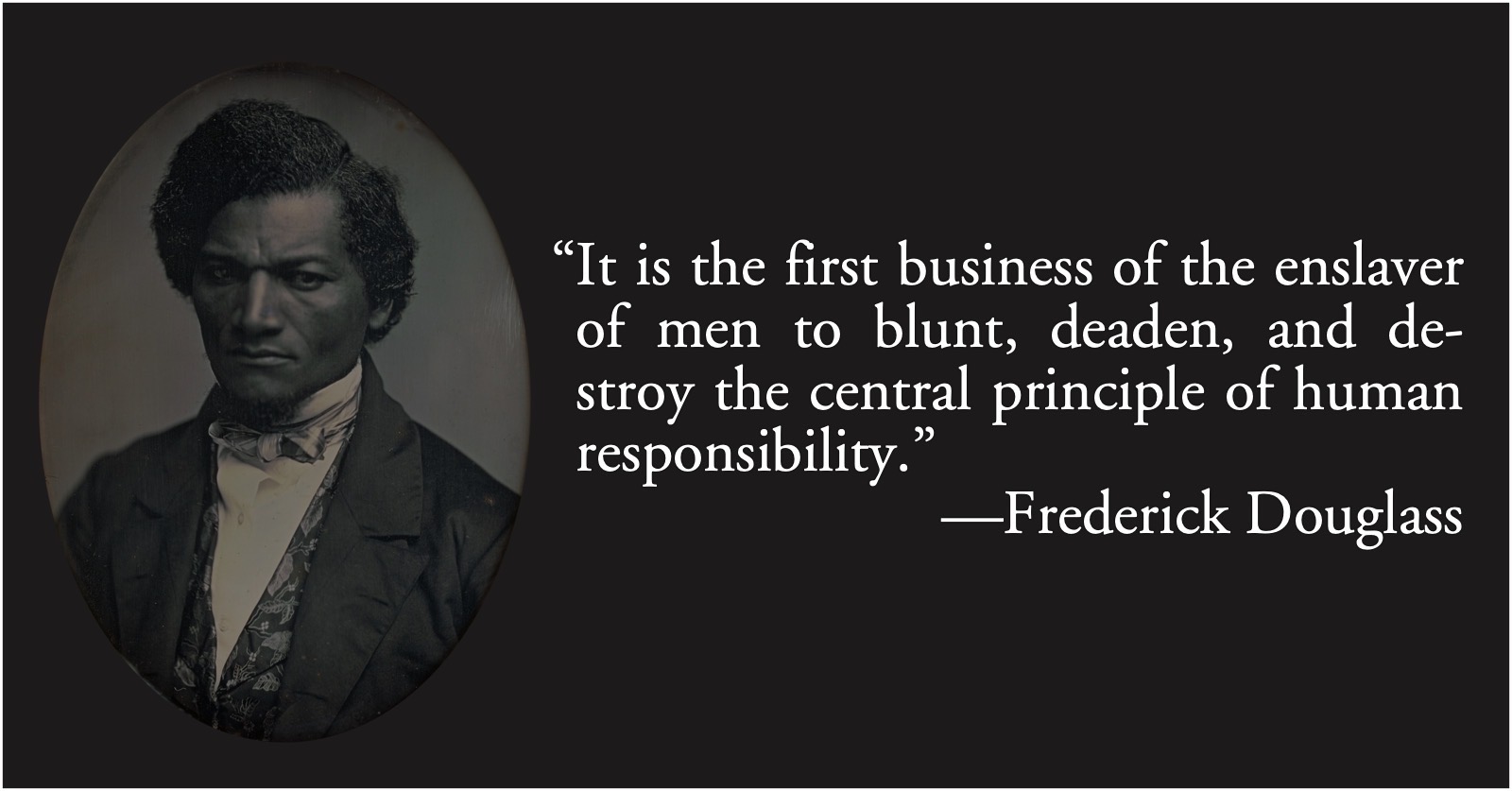
- Why does the Institutional Left hate Israel so much?—Wednesday, April 17th, 2024
-

If anything in modern life could be worse than the October 7 atrocities against Israelis, it would be the unalloyed support those atrocities have received from the institutional Left in America. Everywhere you turn in academia and even so-called “mainstream” news sites, there are people in power attempting to justify not just the invasion but the kidnappings, rape, and torture that was its entire point.
Why does the left hate Israel so much? While the institutional Left seems to hate just about everyone, here you have a nation of peoples who in other countries reliably vote far left, and whose country began explicitly communist and remains a very left-leaning country.
In my opinion that’s an explanation for the hate, not a contradiction. Israel may have a demonstrably left government, but it began even further left than it is now. Israelis quickly discovered that communes and kibbutzes do not work on a countrywide level. Rather than put up with famine and corruption, they changed. They learned from their mistakes.
This is anathema to the leftist elite. The institutional left deliberately never learns from that kind of mistake and especially never allows its constituents to learn from that kind of mistake. Instead, they blame an imaginary far right for their own failure and double down on failure.
That’s the whole point of creating crises, to use them to gain more power. Looking at a crisis and saying, hey, maybe we did something wrong to get here, is missing the entire point of their policies.
It is power and domination.
You’re a Black woman who turns against the left? You’re neither “a true Black” nor “a true woman”. They actually say this. If you’re a Hispanic who argues for individual liberty? You’re a race traitor. That’s not a phrase I made up. It’s a phrase of the left to describe people who are non-white and yet do not submit to the left.
The institutional Left see everything in terms of race, so it isn’t surprising that when an entire country of Jews turns against socialism even slightly, the Left doubles down on antisemitism.
- Trump and the January 6 defendants—Wednesday, January 10th, 2024
-

I recently read Cynthia Hughes’s Due Process Denied. She’s not a professional writer, and in a book like this that’s a benefit. Her story about how she became involved with the January 6 prisoners runs the gamut from emotional to rambling to prayerful to humorous.
This is the kind of book that we need more of: inexperienced writers telling a story they’re compelled to tell because they have a unique perspective on an important event. Hughes experienced January 6 through her nephew-from-another-family who, like many, was allowed into the Capitol by the Capitol Police and was then arrested for it.
Unlike Julie Kelly, who does great work as a professional journalist, Hughes really is just an American who happened to see evil happen to someone she loves and decided to do something about it. Her Patriot Freedom Project grew from a weekly support chat for families of those held without bail to a fund for helping them survive the loss of breadwinners and jobs, as well as a referral service for helping them find lawyers and therapists. Many people lost both friends and family after the arrests.
She is obviously someone who doesn’t understand what’s going on in her country yet who wants to make a difference anyway. And by most accounts, she is making a difference.
Sometimes, among the concerted efforts to make it seem like President Trump should abandon his supporters, it seems like there’s a concerted campaign on the conservative forums I follow to fool people into thinking Trump has abandoned his supporters. I see a small number of unfamiliar posters claiming that he’s abandoned the January 6 prisoners, for example, despite him introducing and praising people like Cynthia Hughes at his giant rallies for all the world to see, despite him calling out the prosecutions as the witch hunts they are.
“We all saw this a mile away,” they write, so why didn’t Trump? Why didn’t he pardon all of his supporters who attended his rally?
But the fact is, we didn’t see this a mile away. We certainly didn’t see it less than two weeks away, which is what would have been necessary for a blanket pardon between January 6 and January 20. And it would have had to have been a big blanket. It’s not like there were signups for people attending his rally.
Presidents have pardoned named individuals for unspecified crimes (President Ford, pardoning Richard Nixon). Presidents have pardoned specific groups for specified crimes (President Carter, pardoning people who avoided the draft by moving to Canada).
- Illinois Nazis and Lincoln’s Democrats—Wednesday, December 13th, 2023
-

He really did. He just had a different name for them.
I’ve quoted Thomas Sowell many times on this blog about the anointed, and how they believe that saying something is true is more important than whether it is true—that, in fact, saying it makes it true.
A few years ago in Illinois there was a Nazi running for office in a Democrat-dominated district. The district was pretty much one hundred percent Democrat, to the point where Republicans don’t even bother to run an opponent. So this guy told the State of Illinois that he was a Republican, in order to get on the ballot unopposed; Republicans pointed out that he was not, in fact, a Republican, but under Illinois election rules the Republican Party had no say in who ran as a Republican.
Illinois is also an open-primary state. This means that none of the people voting for this guy in his nearly 100% Democrat district were Republicans either.
In other words: this was not a Republican primary. This was not a Republican candidate. These were not Republican voters. And the candidate was not going to win in the general election against the official Democrat nominee anyway.
But the left wanted the Republican Party to take money from actual Republicans in Illinois to fight this guy. In order to fight an extreme Democrat in an extreme Democrat district, Democrats tried to force Republicans to spend money donated by Republicans to support the official Democrat against the unofficial Nazi, also supported by Democrats.
This is part of why we have such a dysfunctional political system, and why third parties have such a hard time taking hold. They have to defend themselves in venues they aren’t part of and have neither candidates nor voters in.
The Democrat’s plan was a win for hate. Either the Republicans raise a Nazi’s profile by competing against him, or the Democrats raise a Nazi’s profile by promoting him as a Republican.
When it was pointed out that raising his profile at all was a waste of money, because the guy wasn’t going to win, the Left claimed that there was money “earmarked for the Republican party’s race in that district”—a district and a contest that Republicans had never competed in before and hadn’t planned to compete in now—and that money would go to waste if it wasn’t used.
That’s a purely leftist notion: there is money in the air and we need to spend it now! Or it’s gone! There’s no reason to save it for a contest where it matters, or move it to a contest that matters. Effectiveness doesn’t matter, spending money is what matters. Money that isn’t spent doesn’t exist. Money that’s saved doesn’t exist.
- The Parable of the Soldered RAM—Wednesday, November 29th, 2023
-

Just looking at this brings back my very reasonable fear of static electricity.
I’m not a big fan of the continued miniaturization of computer parts, nor of the transformation of computers to appliances. These trends make weekend tinkering a thing of the past, much in the same way that modern cars make garage mechanics impossibly difficult. Surface mount devices are far more difficult to solder, and require special tools beyond merely a soldering gun.
But my dislike of them doesn’t change that they increase reliability and decrease cost. Everything in life is a trade-off. One of my long-standing complaints with tech bloggers, from the introduction of the iPod to the expectation that no-one has a computer more than a year or two old is an inability to see that time saved is a very important feature.
Last October, one of the bloggers I follow snark-announced the next Apple CPUs. His biggest complaint:
With all variants of Apple’s CPUs the memory is soldered onto the CPU module. You can’t upgrade it, ever.
Two days later, his Top Story was:
Seems to be a loose connection inside my laptop. That's why the problem is intermittent. It can probably be fixed, I think I’ll just turn it into a Linux server and stick it on a shelf, and take the other laptop (better screen and CPU but 16GB of soldered RAM) and use that as my Windows system.1
I’m not a big fan of soldered RAM either; but I’m comfortable—mostly, I still have an irrational fear of static electricity—opening up my computer and replacing user-replaceable parts. Most people are not, and for good reason: every time you open it up, you increase the chance of screwing something else up.
But everything is a trade-off, and soldered RAM is a good example of that. Loose connections have plagued home computing since the beginning, and soldered parts vastly increase connection reliability. This is especially true for any device that’s going to be dragged around a lot, such as a laptop. Soldered RAM that comes loose is a manufacturing defect that justifies a replacement computer. User-serviceable RAM that comes loose is… just what user-serviceable RAM does. That’s the whole point, that the RAM can be removed.
- The Destruction of Title IX—Wednesday, November 15th, 2023
-
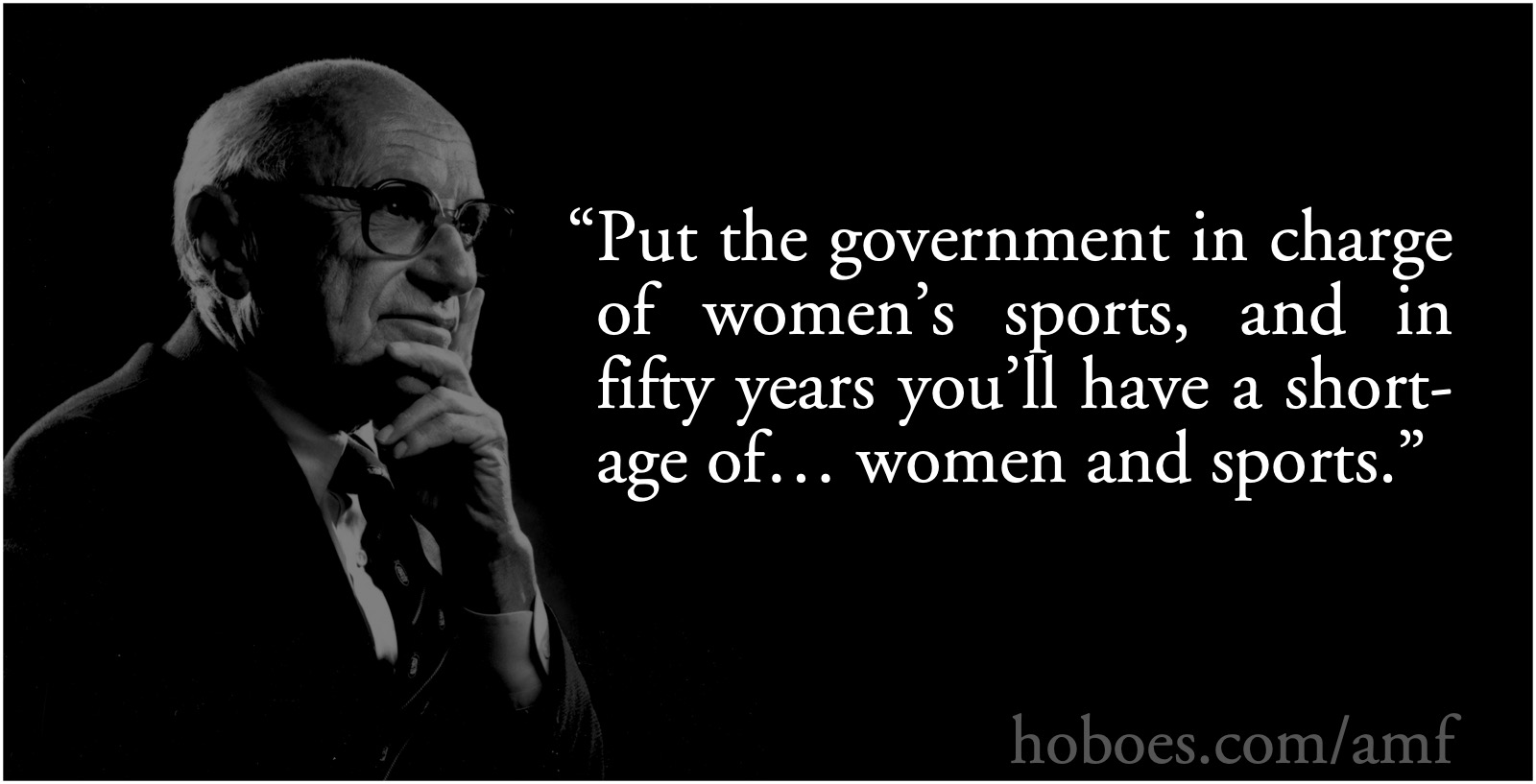
Milton Friedman is apocryphally thought to have said that if you put the government in charge of the desert, in fifty years you’d end up with a shortage of sand.
Title IX passed on June 23, 1972. Last year was its fiftieth anniversary. Friedman would not be surprised that a government program meant to protect the right of women to compete against each other in sports, now protects the right of men to dominate women.
Put the government in charge of women’s sports, and in fifty years you’ll have a shortage of… women and sports.
You’ll have government bureaucrats driving women out of women’s sports and replacing them with men. Forcing young women to accept men exposing themselves in women’s bathrooms and locker rooms. Injuring women and beating them in contact sports. Raping women in prisons.
These males are not even attempting to pass as females, and there’s a good reason for this. Puberty blockers don’t turn a boy into a girl (or a girl into a boy). They interfere with and even stop the natural processes that children must go through to remain healthy. They irreversibly stunt their natural development from children into adults. They mutilate children and create mutilated adults.
So, it’s obvious why, not required to take these drugs, the men pretending to be women don’t. They’re dangerous.
But more importantly—to the boys and men attempting to compete against women—these drugs would reduce their ability to dominate women. They would reduce their ability to win in these sports.
It’s so obvious what’s going on that its supporters have to resort to silencing everyone with an audience who points it out. From J.K. Rowling to Margaret Atwood, it doesn’t matter how reliably left you are, if you point out the “men who beat women up and the corporations that support them.”
Or ask, “why can’t we say ‘woman’ anymore?” instead of “pregnant person” or “people with uteruses”.
“Gender-affirming care” is one of those opposite words that the left uses so well. It’s not gender-affirming, it’s gender-destroying. And like all of their opposite words, when it fails and kills children, they blame it on someone else.
When they can’t blame it on someone else, they pretend it doesn’t happen. Despite all the evidence of our eyes, they pretend that men do not dominate in women’s contact sports, do not injure women when they take part in contact sports.
They deny that a program to protect women now exposes women, including minors, to abusers, in bathrooms, dressing rooms, and on the playing field.
- A one-hundred-percent rule for traffic laws—Wednesday, November 8th, 2023
-
If you ask people what laws most cause a disrespect for law, a lot of people would answer, our insane drug laws. Others might answer our laws that disarm the law-abiding, giving murderers free rein to kill. Aficionados of older media might answer copyright laws. Nobody who cares about older media follows copyright laws—you can see this all over even mainstream sites such as YouTube. Parents might point out that laws making it illegal for children to sell lemonade or hold bake sales teach even the very young that some laws are meant to be broken.
But the real answer is so ubiquitous it’s invisible. If there is one set of laws that most causes a disrespect for law, it is our traffic laws. All of my examples above were made with the expectation that people would actually follow them or that people would be arrested for not following them. There is no such expectation with traffic laws. Cities and states create laws that they expect everyone to break, and then set up their budgets so that if everyone followed those laws they’d go broke.
That’s the real kicker about these laws: if you look at city and state budgets, they very clearly need people to break traffic laws. That’s why you don’t go to jail for speeding. The government needs your fine, and it needs you to keep speeding to pay more fines.
Speed limits are not set for safety. The rule of thumb for setting safe speed limits is to set the speed limit at the 85% level. That is, where 85% of drivers are driving that speed or less in free-flowing conditions. Decades of studies show that the 85th percentile is far safer than slower speeds. For reasons beyond the scope of this post, most people naturally drive at the speed safe for any particular road.
Most roads don’t have the speed limits even as high as the safe 85% level. On most roads the speed limit is set so dangerously low that anyone traveling at the limit is at serious risk of causing an accident; police know this and only ticket less than one percent of violators, while still retaining the option of literally stopping anyone on the road.
Yes, even if you’re one of the very few who cause traffic accidents by driving under the speed limit, you can be stopped and ticketed. You’re guilty of violating the law against unsafe driving. Drivers can be stopped for “impeding traffic” when driving at, under, or over the limit.
- The Voters vs. the Party—Monday, August 21st, 2023
-
“I haven’t been reading a lot of Trump indictment analysis by Andrew McCarthy, Jonathan Turley, Alan Dershowitz… They’re all great legal minds, but how naïve do you have to be still to think that America has anything recognizable as a ‘justice’ system?”
“The point I always make is on the agreed line of ninety-nine per cent of American politicians, judges, bureaucrats and media experts—that, oh sure, they found a little bit of fraud but relax, it wasn’t enough to change the result.
“Not to go all Turleyesque on you, but what’s the evidentiary basis for that statement? In non-corrupt countries such as, say, Denmark, that’s not the standard: it’s not that there’s not enough fraud to change the result, it’s that there’s no fraud—period.
“…the base is trying to tell the worthless GOP establishment something important here:
We don’t think this is a normal election, and we can’t see the point of pretending that it is.
“…[while] the American right still talks about the justice system and the election campaign as if either term means what it does in functioning societies… in my experience of Third World crapholes, you don’t start criminalizing your political opposition unless you’ve already decided there aren’t going to be any election-night surprises.
…
“These are not normal times: in the years ahead, ever greater corruption… will be necessary to constrain the people’s choices to the shriveled offerings of the Uniparty. So, if you reckon it’s bad now, wait till next time. GOP primary voters seem to get that at least.”
- The Bedrock Belief of DEI—Wednesday, May 10th, 2023
-
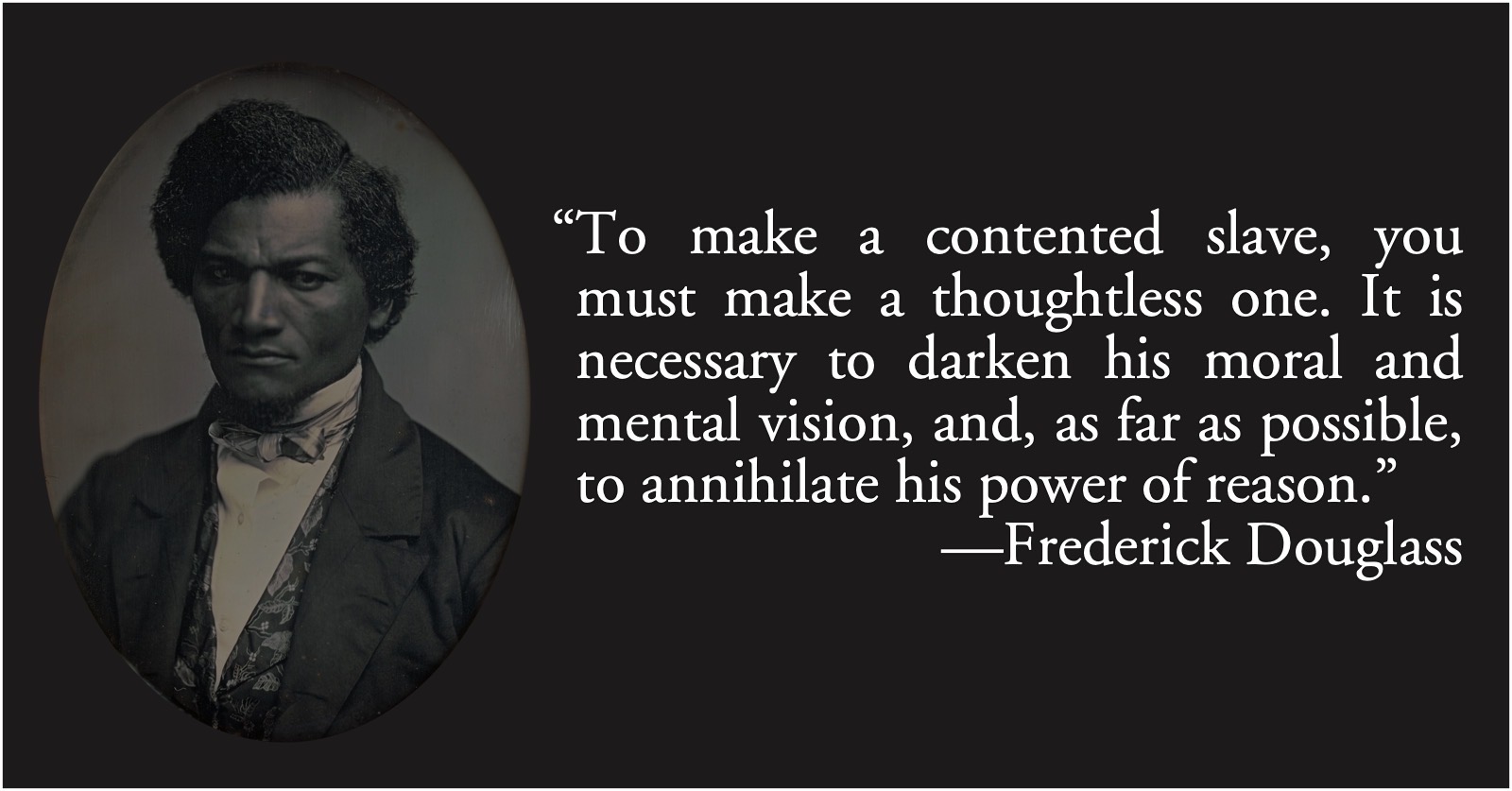
Frederick Douglass would recognize every argument of DEI.
I recently received an email from the Texas Public Policy Foundation decrying DEI as being anti-American. By all appearances TPPF is a good organization that does good work in Texas, but like many mainstream organizations they are afraid to speak the blunt truth about evil. While they are not alone in their refusal to face the reality of what DEI is, Monday morning’s email epitomized this blindness. Recognizing evil and calling it what it is has become embarrassing. No one wants to be mean; no one wants to lower the discourse.
And so we get statements like this, criticism in name only, that strive so hard to be reasonable that they forget what they are criticizing:
What to know: Chris Rufo, writing in City Journal, reports that the University of Texas at Austin’s College of Communication promotes the idea that “objectivity,” “individualism,” and “worship of the written word” were all “characteristics of white supremacy culture.”
The TPPF take: What is “diversity, equity and inclusion” (DEI), really?
“The bedrock belief of DEI is that racism is not an individual act of evil, it is a structural system, geared toward preserving white supremacy,” says TPPF’s Sherry Sylvester.
This is bullshit. The bedrock of DEI is that racism is right and that the racists of the past were right to segregate minorities and manage their affairs for them. They’re not even trying to hide it.

Mimsy Were the Borogoves
When faced with a problem you do not understand, do any part of it you do understand, then look at it again. — Robert A. Heinlein (The Moon is a Harsh Mistress•)