


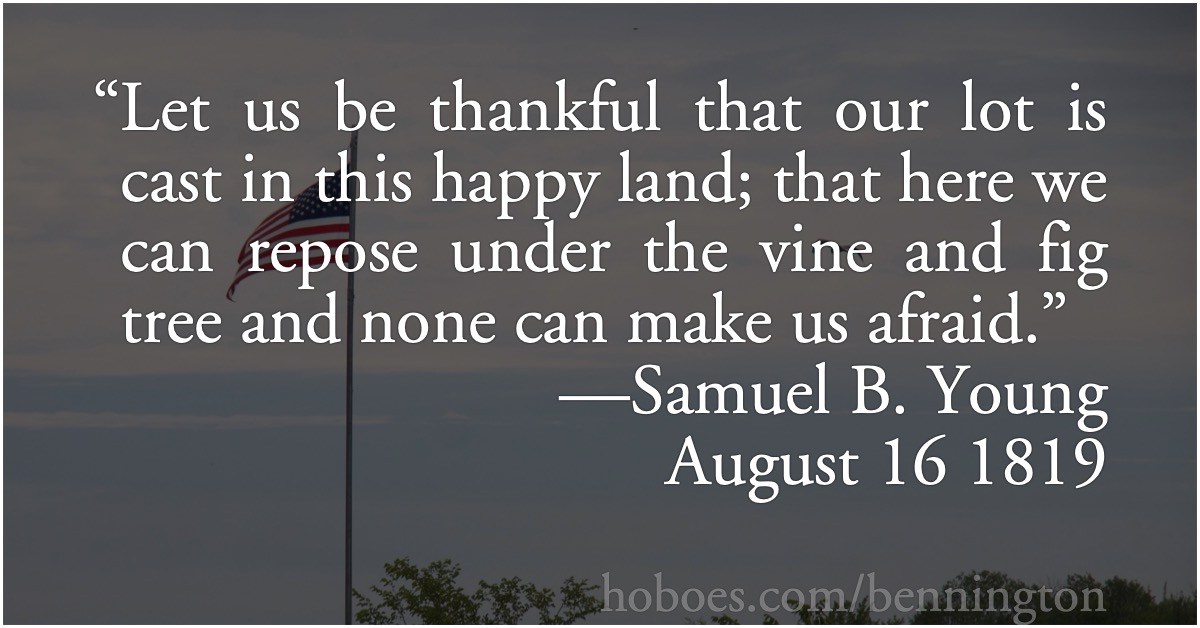
Our lot is cast in this happy land…
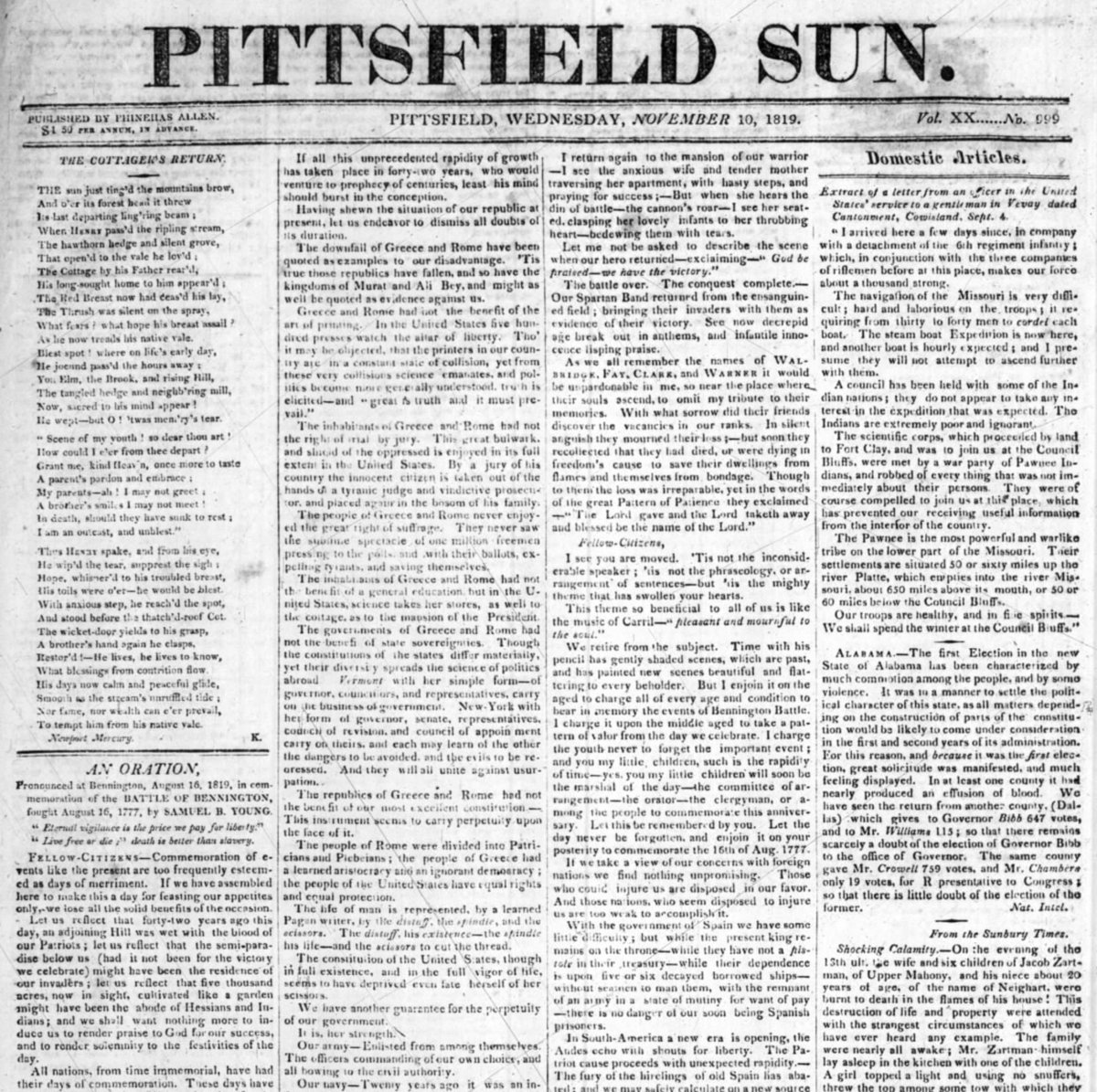
While researching the origin of The Rifleman’s Song of Bennington I ran across this 1819 speech on the occasion of the Battle of Bennington. It appeared in The Pittsfield Sun of Pittsfield, Massachusetts, November 10, 1819 and was given by Samuel B. Young on August 16 of the same year.
A Sestercentennial Year
- Battle of Bennington ⬅︎
- Upside Down Yorktown
- Cherry Valley Massacre
- Battle of the Kegs
- Sestercentennial Cookery
- The New Colossus
- Irish potato pie
Since Saturday is the anniversary of the battle, I thought I’d reproduce it here. It’s a fine argument for commemorating Independence Day as well as the sacrifices made for Independence.
An Oration
Pronounced at Bennington, August 16, 1819, in commemoration of the Battle of Bennington, fought August 16, 1777, by Samuel B. Young.
“Eternal vigilance is the price we pay for liberty.”
“Live free or die;” death is better than slavery.
Fellow-Citizens—Commemoration of events like the present are too frequently esteemed as days of merriment. If we have assembled here to make this a day for feasting our appetites only, we lose all the solid benefits of the occasion.
Let us reflect that forty-two years ago this day, an adjoining Hill was wet with the blood of our Patriots; let us reflect that the semi-paradise below us (had it not been for the victory we celebrate) might have been the residence of our invaders; let us reflect that five thousand acres, now in sight, cultivated like a garden might have been the abode of Hessians and Indians; and we shall want nothing more to induce us to render praise to God for our success, and to render solemnity to the festivities of the day.
All nations, from time immemorial, have had their days of commemoration. These days have marked the character of the nation itself. Among the Pagan nations they commemorate the birth day of some supposed God or Goddess—In Monarchies they commemorate the birthday of some favorite Prince or Princess. In Aristocracies they commemorate the birth day of some splendid Nobleman. But in the United States of America we commemorate the birth day of our Liberties.
The Fourth of July 1776 is a day never to be forgotten in the United States. And what a grand view it presents for contemplation! To see ten millions of people, in ten thousand different groups, and from Maine to New-Orleans, and in the same hour, paying their adorations to the Goddess of Liberty.
In different sections of the Union local events will be commemorated as having relation to that special place. Though the victory on the hills of Walloomsack was important to the nation at large, yet it more immediately affected the people of this vicinity.
Assembled then as we are, fellow-citizens, to celebrate the 16th of August, 1777, it may be well to compare our situation then as a people, to our situation now, as a nation.
We were then but with the shadow of government, with only three millions of population, at war with a powerful nation, and divided and shamefully distracted among ourselves. We have now the best government on earth, with ten millions of inhabitants, at peace with all the world, and united and happy.
We had then neither commerce of wealth. We have now our thousand ship, laden with our surplus riches, gliding in every sea—while the majestic steam boat travels through the interior.
In addition to all this we have added unnumbered acres to our territory. Religious and political education has become universal. We have a well organized army, and a victorious navy. The science of Ethics, Medicine and Geology are rapidly advancing towards perfection. Cities rise beyond cities in the west, and the wilderness bows to the axe of the villager.
If all this unprecedented rapidity of growth has taken place in forty-two years, who would venture to prophecy of centuries, least his mind should burst in the conception.
Having shewn the situation of our republic at present, let us endeavor to dismiss all doubts of its duration.
The downfall of Greece and Rome have been quoted as examples to our disadvantage. ’Tis true those republics have fallen, and so have the kingdoms of Murat and Ali Bey, and might as well be quoted as evidence against us.
Greece and Rome had not the benefit of the art of printing. In the United States five undred presses watch the altar of liberty. Tho’ it may be objected, that the printers in our country are in a constant state of collision, yet from these very collisions science emanates, and politics become more generally understood, truth is elicted—and “great is truth and it must prevail.”
The inhabitants of Greece and Rome had not the right of trial by jury. This great bulwark, and shield of the oppressed is enjoyed in its full extent in the United States. By a jury of his country the innocent citizen is taken out of the hands of a tyranic judge and vindictive prosecutor, and placed again in the bosom of his family.
The people of Greece and Rome never enjoyed the great right of suffrage. They never saw the sublime spectacle of one million freemen pressing to the polls and, with their ballots, expelling tyrants, and saving themselves.
The inhabitants of Greece and Rome had not the benefit of a general education, but in the United States, science takes her stores, as well to the cottage, as to the mansion of the President.
The governments of Greece and Rome had not the benefit of state sovereignties. Though the constitutions of the states differ materially, yet their diversity spreads the science of politics abroad. Vermont with her simple form—of governor, councilors, and representatives, carry on the business of government. New York with her form of governor, senate, representatives, council of revision, and council of appointment carry on theirs. and each may learn of the other the dangers to be avoided, and the evils to be repressed. And they will all unite against usurpation.
The republics of Greece and Rome had not the benefit of our most excellent constitution—this instrument seems to carry perpetuity upon the face of it.
The people of Rome were divided into Patricians and Plebeians; the people of Greece had a learned aristocracy and an ignorant democracy; the people of the United States have equal rights and equal protection.
The life of man is represented, by a learned Pagan writer, by the distaff, the spindle, and the scissors. The distaff, his existence—the spindle his life—and the scissors to cut the thread.
The constitution of the United States, though in full existence, and in the full vigor of life, seems to have deprived even fate herself of her scissors.
We have another guarantee for the perpetuity of our government.
It is, her strength.
Our army—Enlisted from among themselves. The officers commanding of our own choice, and all bowing to the civil authority.
Our navy—Twenty years ago it was an infant in its cradle, it has now leaped from its nurses’ arms, and walks abroad in all the majesty of manhood.
The militia—We have now in the Union one million of men capable of bearing arms. Notwithstanding our extensive territory yet our militia, on a threat of invasion, would make a curtain of bayonets on the frontier; and though the holy league of crowned heads in Europe should dare the opening, this curtain would never tremble.
We have another reason for the perpetuity of our government.
’Tis the price it cost.
The blood and treasure expended in the purchase will never be forgotten. Though the heroes, who paid for it may all be mouldering in the dust; yet enough of their blood will remain in their posterity to start into action, and save the republic when danger approaches.
One more reason and I will end this subject:
It is the affection of the people.
This government has been strictly watched—It has carried us through the storms and contention of powerful parties. It has carried us thro’ a war with the most powerful nation in Europe. It has protected us at all times in perils by sea, and in perils by land. The ship of state rides steadily, the crew disposed for peace; but the deck always cleared for action. This government has always been gaining upon the affections of the people, and the great Disposer of all nations will never suffer a nation like ours to be destroyed amid the affections, prayers and tears of weeping millions.
As to a full description of the events of August 16 1777 my pen and tongue refuse their office. I think however I can see the soldier seizing in haste his rough implements of war, and taking a hasty leave of his wife and family; their eyes following him until some rude hill hides him from their sight. I see with what a steady step and manly front the warrior met the foe—I see the bloody and the doubtful conflict—until an angel from heaven dropt a laurel on the head of Stark, then all shouted victory.
I return again to the mansion of our warrior—I see the anxious wife and tender mother traversing her apartment, with hasty steps, and praying for success;—But when she hears the din of battle—the cannon’s roar—I see her seated, clasping her lovely infants to her throbbing heart—bedewing them with tears.
Let me not be asked to describe the scene when our hero returned—exclaining—“God be praised—we have the victory.”
The battle over. The conquest complete.—Our Spartan Band returned from the ensanguined field; bringing their invaders with them as evidence of their victory. See now decrepid age break out in anthems, and infantile innocence lisping praise.
As we all remember the names of Walbridge, Fay, Clark, and Warner it would be unpardonable in me, so near the place where their souls ascend, to omit my tribute to their memories. With what sorrow did their friends discover the vacancies in our ranks. In silent anguish they mourned their loss;—but soon they recollected that they had died, or were dying in freedom’s cause to save their dwellings from flames and themselves from bondage. Though to them the loss was irreparable, yet in the words of the great Pattern of Patience they exclaimed—“The Lord gave and the Lord taketh away and blessed be the name of the Lord.”
Fellow-Citizens,
I see you are moved. ’Tis not the inconsiderable speaker; ’tis not the phraseology, or arrangement of sentences—but ’tis the mighty theme that has swollen your hearts.
This theme so beneficial to all of us is like the music of Carril—“pleasant and mournful to the soul.”
We retire from the subject. Time with his pencil has gently shaded scenes, which are past, and has painted new scenes beautiful and flattering to very beholder. But I enjoin it on the aged to charge all of every age and condition to bear in memory the events of Bennington Battle. I charge it upon the middle aged to take a pattern of valor from the day we celebrate. I charge the youth never to forget the important event; and you my little children, such is the rapidity of time—yes, you my little children will soon be the marshal of the day—the committee of arrangement—the orator—the clergyman, or among the people to commemorate this anniversary. Let this be remembered by you. Let the day never be forgotten, and enjoin it on your posterity to commemorate the 16th of August. 1777.
If we take a view of our concerns with foreign nations we find nothing unpromising. Those who could injure us are disposed in our favor. And those nations, who seem disposed to injure us are too weak to accomplish it.
With the government of Spain we have some little difficulty; but while the present king remains on the throne—while they have not a pistole in their treasury—while their dependence is upon five or six decayed borrowed ships—without seamen to man them, with the remnant of an army in a state of mutiny for want of pay—there is no danger of our soon being Spanish prisoners.
In South-America a new era is opening, the Andes echo with shouts for liberty. The Patriot cause proceeds with unexpected rapidity.—The fury of the hirelings of old Spain has abated; and we may safely calculate on a new source of riches by a free trade with the United States of South-America. This great and important part of the new world seems to be taking a new existence. The flame of Liberty blazes from one end of the provinces to the other; and we shall soon see the Eagle of the Allegany and the Eagle of the Andes watching the world.
Fellow-Citizens,
I sincerely congratulate you upon the present situation of our Republic. Agriculture flourishes equal to the most sanguine expectation.—The arts and sciences are in the road to perfectibility. The sails of the United States whiten every sea. Our flag is respected abroad and protected at home. Useful inventions are lessening manual labor. True piety and religious liberty prevail. Colleges, Academics, and Schools are increasing. Political science is studied and discussed; and man begins to understand himself. With this faint view of our blessings we perceive it is only necessary to our individual and national happiness, that we render praise to Him, who governs the whole, for all those felicities; and to ourselves, severally that we resolve to practice virtue, live with morality, and to cherish brotherly love.
And finally, brethren, let us be thankful that our lot is cast in this happy land; that here we can repose under the vine and fig tree and none can make us afraid. Protection of the nation is sure—protection of the individual is guaranteed by the laws. It would be treason against common sense, to disable such a government; it would be treason against ourselves not to be happy under it. Let us one and all unite in the resolve, to act equal to the solemn pledge we have made, to support the constitution of the United States. Let our prayers by day and night, and our last prayer to Heaven be for its perpetuity.
And may God in his infinite mercy grant that our republic may continue, until the Angel having one foot upon the sea, and the other upon the land shall lift his hand to heaven and swear by him, who liveth forever and ever that time shall be no longer.
In response to Battles of the Revolution: Sources from well-known and lesser-known battles of the American Revolution.
- The Rifle-Revolutionary Song
- The Rifle
- Riflemen of Bennington
- “Why come ye hither, Redcoats?” Performed by The Committee of Correspondence.
More American Revolution
- The Battle of the Kegs
- The Battle of the Kegs took place on January 5 or 6, 1778. Soon after, Francis Hopkinson wrote this wonderful account of the debacle, including very personal details about the British General in charge!
- Cherry Valley: A Massacre of the Revolution
- Mel Gibson’s The Patriot is disparaged for the ruthlessness it portrays among the British. But such barbarity certainly did exist. One massacre by British troops is still remembered by the residents of Cherry Valley, New York.
- The World Turned Upside Down
- The legend of the surrender of Lord Cornwallis to Washington at Yorktown says that the band played “The World Turned Upside Down”. It probably didn’t. But we’re going to print the legend anyway.
- Songs of the American Revolution
- Various songs, and the history of the songs, that made the Revolution—sometimes decades later.
- Battles of the Revolution
- Sources from well-known and lesser-known battles of the American Revolution.
More A Sestercentennial Year
- Irish mashed potato pie for Π Day and Saint Patrick’s Day
- In this sestercentennial year, here’s a great triple-celebration pie. It’s from about 1876 and it can fill in for both Pi Day and St. Patrick’s Day!
- The New Colossus Breathes Free
- There’s nothing wrong with The New Colossus except the way the institutional left has twisted it into meaning the opposite of what it actually says. Emma Lazarus wrote The New Colossus for the exiles of government-sponsored terror to escape their persecutors to a land of Freedom, not for letting their persecutors in to continue the persecution here.
- Padgett Sunday Supper Club Sestercentennial Cookery
- The Sestercentennial Cookery is a celebration of American home cooking for the 250th anniversary of America’s Declaration of Independence.
- The Battle of the Kegs
- The Battle of the Kegs took place on January 5 or 6, 1778. Soon after, Francis Hopkinson wrote this wonderful account of the debacle, including very personal details about the British General in charge!
- Cherry Valley: A Massacre of the Revolution
- Mel Gibson’s The Patriot is disparaged for the ruthlessness it portrays among the British. But such barbarity certainly did exist. One massacre by British troops is still remembered by the residents of Cherry Valley, New York.
- One more page with the topic A Sestercentennial Year, and other related pages