


Cherry Valley: A Massacre of the Revolution
Veteran’s Day, once Armistice Day, is this coming Tuesday. But the armistice that ended the Great War is not the only thing that happened on November 11 in our history. Among the most barbaric was the 1778 massacre by English troops at Cherry Valley, a village now in Otsego County, New York.
A Sestercentennial Year
- Battle of Bennington
- Upside Down Yorktown
- Cherry Valley Massacre ⬅︎
- Battle of the Kegs
- Sestercentennial Cookery
- The New Colossus
- Irish potato pie
The Cherry Valley massacre is an obscure part of the American Revolution to anyone but the residents of Cherry Valley, who remembered it at least up to the release of The Patriot in 2000.
The English employed Iroquois—in this location, Seneca and Mohawks—in their attempts to quell the American rebellion. The Iroquois were paid to attack under the direct command of British officers as well as to attack independently of English control. In response mostly to those independent raids, Continental soldiers had destroyed several Iroquois towns, hoping to end the many raids that had come from them earlier in the year. All accounts that I’ve seen say that the Continentals destroyed lodgings and provisions—not people. The direct antecedent to the massacre, the destruction of the Iroquois villages of Unadilla and Onaquaga, had by all accounts been empty at the time of the Continental raids.
But the Continentals may not have completely understood the culture of the Iroquois. There’s a lot of stuff written about how egalitarian the Iroquois were, but this neglects the facts on the ground. This was a culture that prized battle prowess above all else, that took slaves by kidnapping and by battle. Peel off the myth of the “noble savage” that academics separated by either time or space enjoy promoting, and Iroquois culture looks less like a modern civilization and more like the barbarism of the Spartans of ancient Greece.
Like the Iroquois, Spartan women “owned” property and managed all the finances of the family. But this was not because Spartans were egalitarian. It was because Spartans were a warrior race who also kept slaves. The Spartans subjugated an entire other race, the Helots, to be their slaves, and needed strong women at home to keep those slaves in line while the warriors were gone.
The role of women, in other words, was to free the men to go on raids and to produce and raise boys to be raiders. Women managed the family so that warriors could go to war, not because they were emancipated. And other people’s women? They were useful only as slaves—not just a form of property, but literally property.
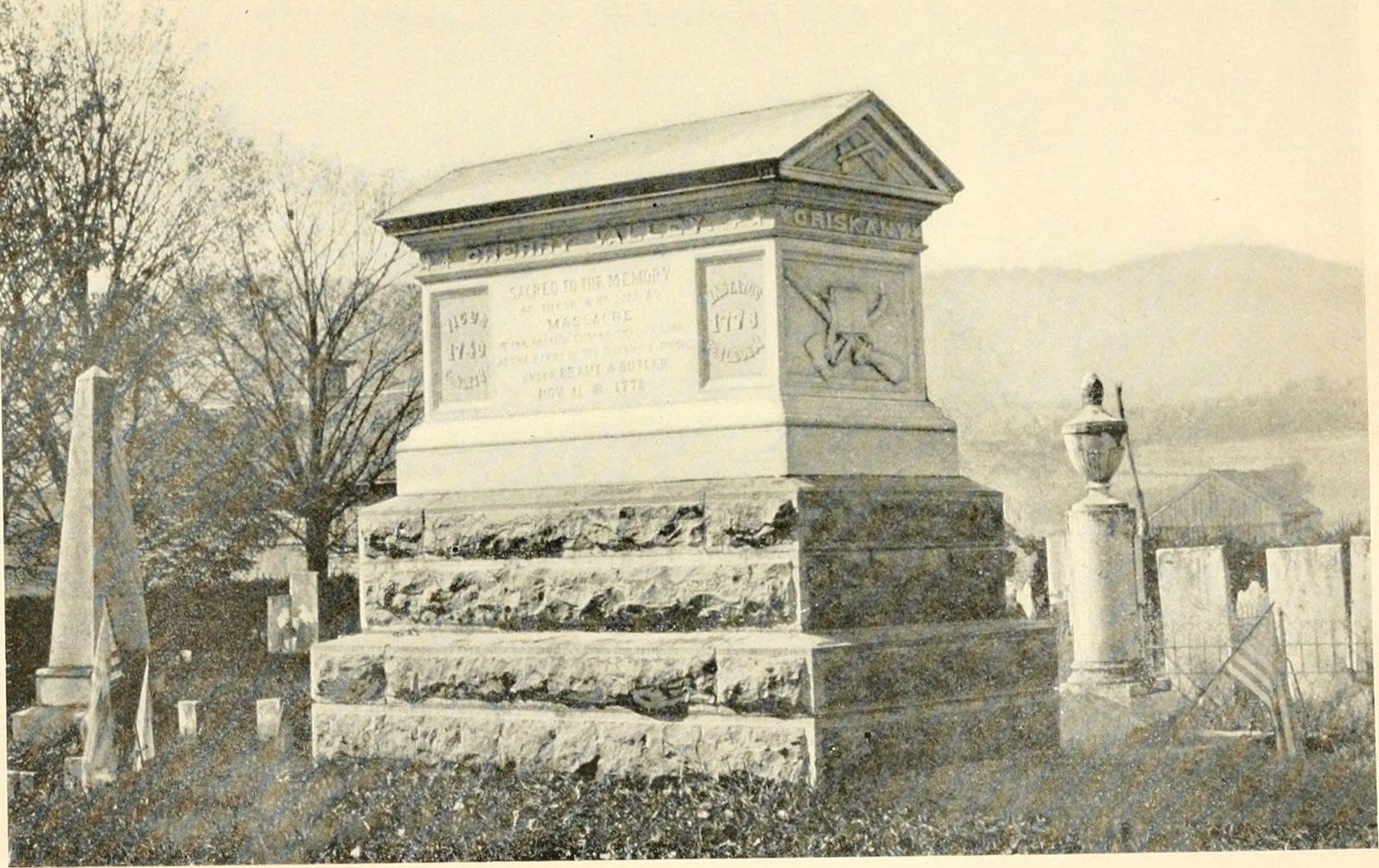
“Sacred to the Memory Of Those who Died by Massacre In the destruction of this village at the hands of the Indians & Tories under Brant & Butler, Nov. 11. AD. 1778.”
I suspect that the same was true of Iroquois “egalitarianism”.
Among the Northern Iroquoian… noncombatant war captives were turned into slaves, who were mainly children and women, and were tortured if they were not ritually killed. (History Reclaimed)
The concept was built right into their language:
The Cherokee and Iroquois word for “slave” was also used to refer to dogs, cats, or other nonhuman living things that were owned. (ebsco)
The Continental troops had destroyed property—buildings and food. So when the Iroquois, under the command of British Captain Walter Butler, attacked Cherry Valley, they retaliated by destroying American property—including women and children, both of which were, since they weren’t of the tribe, property.
A Mohawk chief, in justifying the action at Cherry Valley, wrote to an American officer that “you Burned our Houses, which makes us and our Brothers, the Seneca Indians angrey, so that we destroyed, men, women and Children at Chervalle.”
But what makes the Cherry Valley massacre truly egregious is that this was not an Iroquois raid being paid for by the British. This was an actual British attack, under the command of a British officer.
Under the command of British commander Walter Butler, a contingent of Seneca and Mohawk Indians, supported by about 50 English regulars, marauded across the valley, destroying farm buildings and homes, taking countless prisoners and, history records, killing 32 civilians, including women and children.
The inhabitants of Cherry Valley, of course, could not even fathom a mindset that put property, women, and children all in the same destroyable boat. That it was an official attack by the British government made it that much worse.
When The Patriot came out, and began to take flak for its portrayal of the bloodthirstiness of British officers, “the folk of Cherry Valley, New York” still felt strongly enough to speak out. In response to British complaints about how their officers were portrayed, local historian Sue Miller responded that what the movie’s Colonel William Tavington (based on the real-life Banastre Tarleton) did at the village church in The Patriot “is not much different from what Butler allowed to happen in these green rolling hills…”
“You weren’t nice, you weren’t nice at all,” Ms Miller said yesterday. “It was absolutely indiscriminate; babies, women, children were killed. It didn’t really matter. To hack the parts off a woman and throw them—arms and legs—into a tree, that’s not very nice. One of your most famous regulars did that here. It was gross. He was one of the most brutal men to serve in a British regiment.”
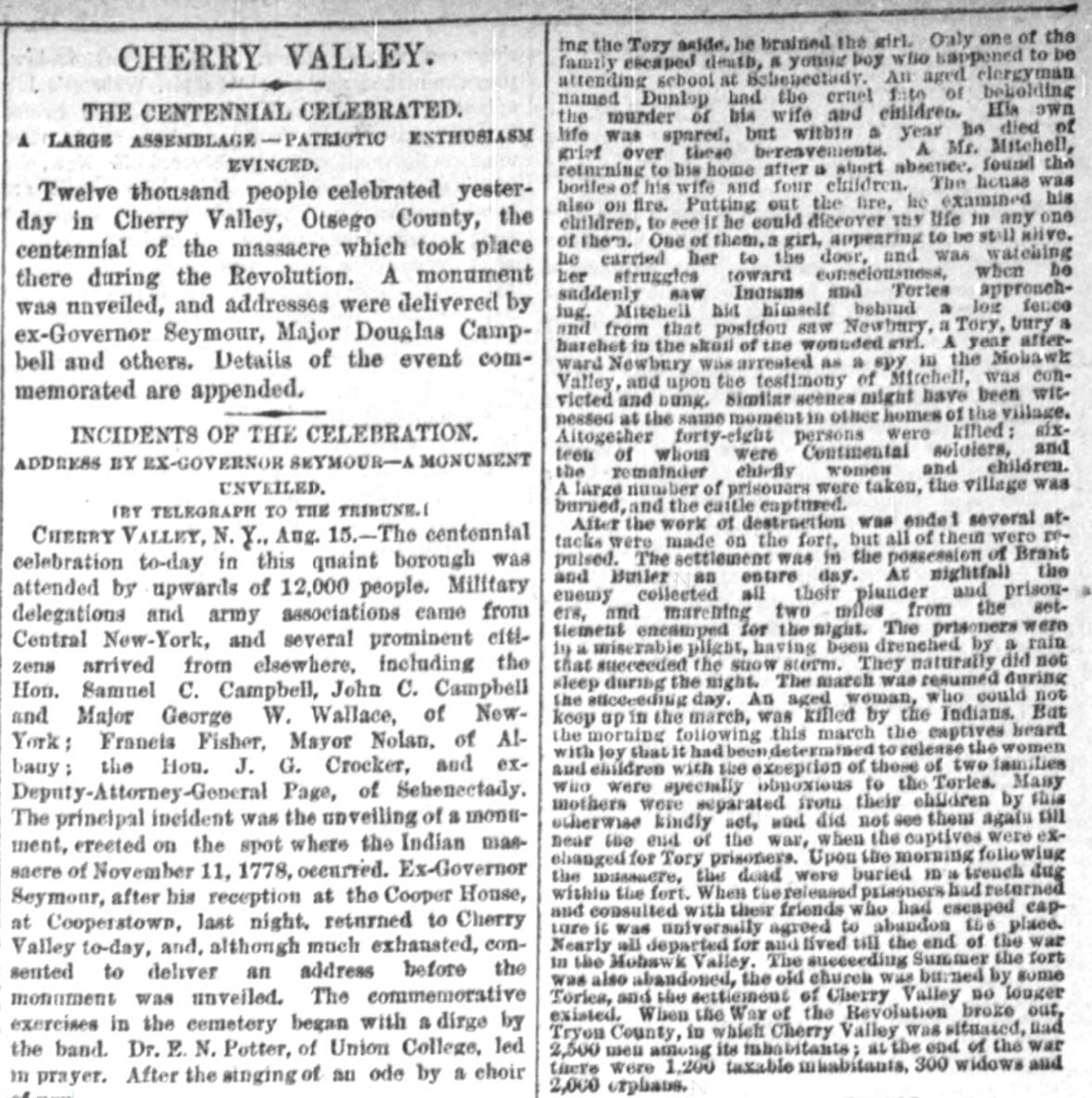
“Massacre of the Revolution”, at the dedication of the monument in the Cherry Valley cemetery. From the New York Tribune, New York, New York, Friday, August 16 1878. By telegraph!
Larry Thompson, a barber whose family lived in Cherry Valley at the time of the massacre, was no less blunt:
“If they don’t like it in England, they will have to get over it,” he said. “I will not apologise for it and I don’t think anyone else should apologise. I don’t have anything against the English today, but just look at the accounts of what happened here and there was nothing humane about it.”
That was 222 years removed from the massacre, and Thompson especially sounds as though he felt what Allied troops often felt, decades later, about atrocities committed by Japanese soldiers in the Pacific. That it was a betrayal of basic humanity.
Perhaps most egregiously, the article quoting them still has “the Mohawks… objecting to historians using the term ‘massacre’. They prefer to call it the ‘Cherry Valley raid’.”
Yipes.
There is a monument to the massacre in the Cherry Valley cemetery. It was unveiled on August 15, 1878, nearly a hundred years after “the massacre which took place there during the Revolution.” Newspapers far distant from Cherry Valley reported the unveiling matter-of-factly. The Spring Hill, Kansas, Western Progress subtitled their reprint of a New York Daily Tribune article “Historical Reminiscences of the Revolution”. That’s a “mostly harmless”-level rewrite of the Tribune’s subtitle:
A MASSACRE OF THE REVOLUTION (text)
A settlement in the wilderness—patriotism of the inhabitants—a murderous attack by Indians and Tories—Destruction of the Village—The men led away into captivity.
Interestingly, the New York account capitalized both “Indian” and “Tory”, but the Kansas account, while capitalizing “Indian”, reduced the Tories to lower case.
The account describes the massacre fairly graphically, including the brutality of both the “savages” and the supposedly not-savage British.
A Mr. Mitchell, returning to his home after a short absence, found the bodies of his wife and four children. The house was also on fire. Putting out the fire, he examined his children, to see if he could discover any life in any one of them. One of them, a girl, appearing to be still alive, he carried her to the door, and was watching her struggles toward consciousness, when he suddenly saw Indians and Tories approaching. Mitchell hid himself behind a log fence, and from that position saw Newbury, a Tory, bury a hatchet in the skull of the wounded girl. A year afterward Newbury was arrested as a spy in the Mohawk Valley, and upon the testimony of Mitchell, was convicted and hung. Similar scenes might have been witnessed at the same moment in other homes of the village. Read Full Article. (text)
The account even made it to England, albeit as a sidebar of a sidebar. From an “intelligence” column1 in the January 2, 1779, Leicester Journal:
New York, Nov 24. By accounts from the country we learn, that Capt. Joseph Brant, at the head of a strong party of loyalists and Indians, about the beginning of last week, attacked and defeated numerous body of Rebels near Cherry-valley, in Tryon county, and that he afterwards totally [unreadable half-line] the settlement. This has thrown [unreadable lines] the greatest consternations; and Captain Brant is carrying devastation along the western frontier, and daily is expected to pay a visit to the town of Goshen, in Orange county.
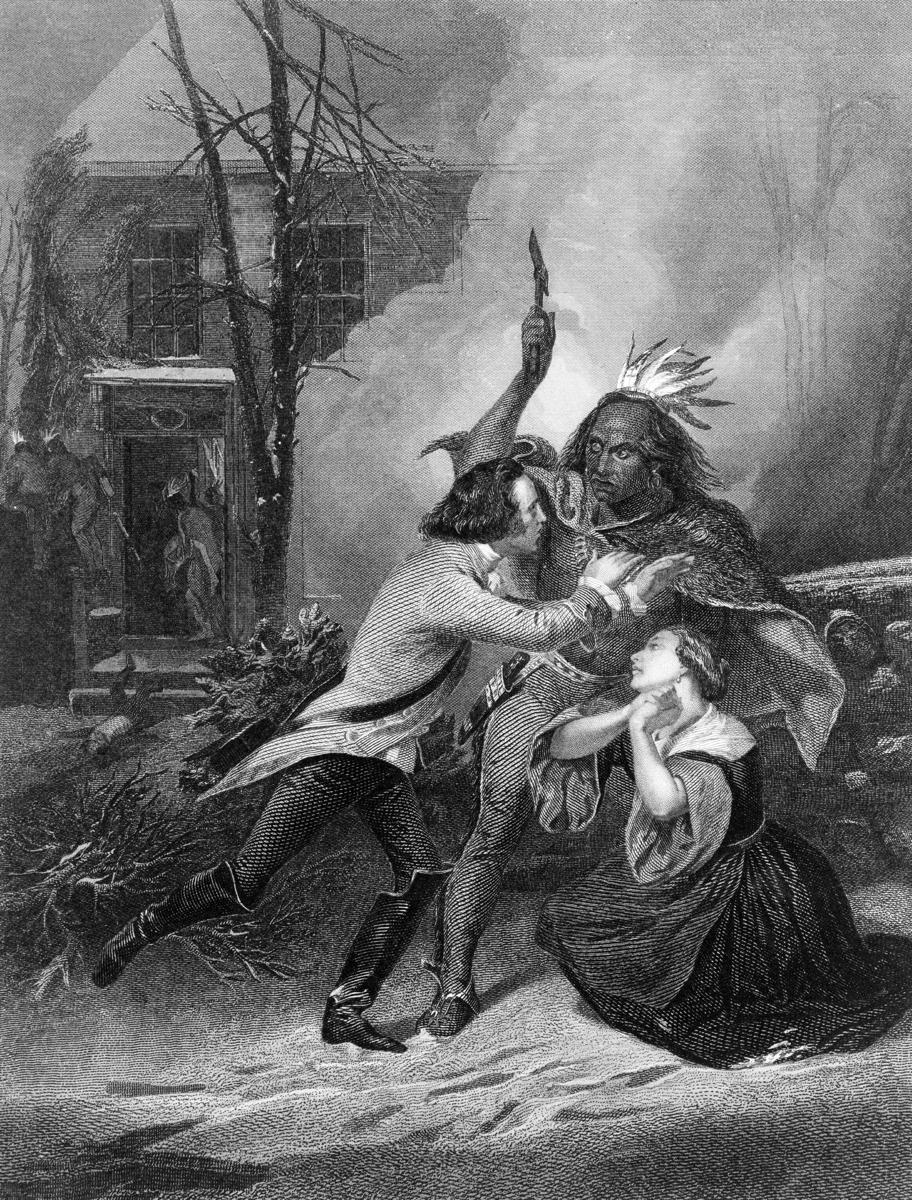
“Incident in Cherry Valley: The Fate of Jane Wells.” Thomas Phillibrown from Alonzo Chapel, 1856.
Captain Joseph Brant was himself a Mohawk, born Thayendanegea, who had been championed by the British. He had been to England and was appointed Captain in 1775.
While some accounts do note Brant’s connection to the Mohawk or Iroquois tribes, most simply (as here) treat him as just another brutal British officer.
Biographer Howard Thomas would agree with the modern residents of Cherry Valley that the fault was with the British. In his biography of Joseph Brant, he writes about the massacre that:
Joseph Brant got no thrill out of these events. Though he was a full-blood Indian, this brutality which white men had planned sickened him. His only desire was to save as many Tories as possible. He met Little Aaron, a Mohawk Chief who also had attended the Moor Charity School. Little Aaron told Joseph that he had hidden Mr. Dunlop, but that the Senecas had killed and scalped the preacher’s wife.
“Is this the civilization Dr. Wheelock used to preach?” asked Little Arron [sic], his lips turned down in disgust.
“The Butlers aren’t civilized,” retorted Brant.
The Senecas ignored the Tory attack on the fort. They ran from house to house, dragged out helpless victims, scalped and mutilated them. Brant made no attempt to stop them. Walter Butler was in charge. Let him handle the Senecas.
The massacre is shameful enough that both the Iroquois and the British blamed each other after the war, but whether it was by order or by negligence the Cherry Valley massacre lends credence to the portrayal of British brutality in The Patriot. Also, while Brant was a military leader by British appointment, he was not born into any leadership role among the Iroquois, and in any case he was Mohawk, not Seneca, so it’s not clear that he could have done as much to stop the massacre as Butler could have.
There’s a fascinating bit in the July 28, 1778, Hartford Courant, after an earlier battle, about warnings going awry on the American side:
Col. Dennison was seen surrounded by the enemy, and was doubtless murdered. Col. Zebulon Butler is supposed to be the only officer escaped.
It is said he had several times written to the Congress and Gen. Washington, acquainting them with the danger the settlement were in, and requesting assistance; but that he received no answer, except that HE HAD NO CAUSE TO FEAR, SINCE THE INDIANS WERE ALL FOR PEACE AND QUITE AVERSE TO WAR. However he lately received a letter from Capt. Spaulding, acquainting him that neither the Congress nor Gen. Washington had received any of his letters, which had been intercepted by the Pennsylvania tories, who in all probability acted in concert with these execrable miscreants, against Wyoming. It is reported that these wretches, after completing their horrid business at Wyoming, are going or gone to Cherry-Valley, and the parts adjacent.
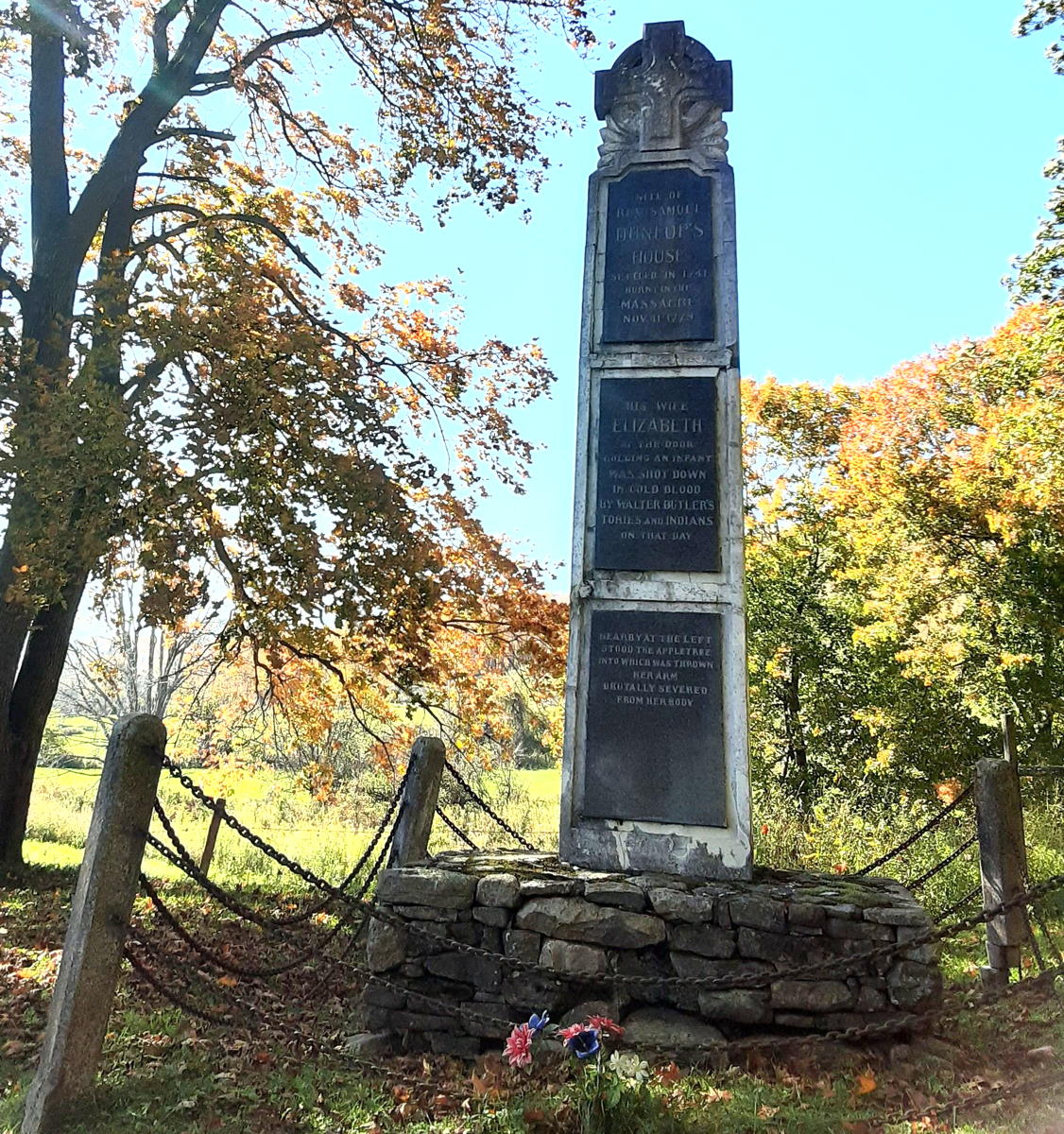
“Site of Rev. Samuel Dunlop’s House, settled in 1741, burned in the Massacre Nov. 11 1778. His wife Elizabeth at the door holding an infant was shot down in cold blood by Walter Butler’s Tories and Indians on that day. Nearby at the left stood the apple tree into which was thrown her arm brutally severed from her body.”
If true, that’s a decent bit of tradecraft on the part of the Loyalists.
It takes a long time for news to travel without modern communication, and longer in a war. The first account of the massacre that I found was also in the Hartford Courant, in the December 1, 1778, edition.
POUGHKEEPSIE, Nov. 23.
By accounts, though not circumstantial, from the northward, the enemy have struck us in that quarter, another blow, which they had long threatened, and we had reason to expect, but seem to have made no more advantage of the intimations, than if we had heard nothing at all of the matter. A body of the enemy, consisting of about 700 Savages and Tories, under the command of Brant and Butler, with a company of British soldiers, came down to Cherry Valley, which they entirely destroyed, massacred several of the inhabitants, men, women, and children indiscriminately; with Col. Alden of the Continental army, some officers and privates of his regiment; and made prisoners of Lieut. Col. Stacey (of the same regiment) with a number of the inhabitants, men and women, whom they carried off with them, after having invested2 and attacked Fort Alden (a small picket fort in Cherry-Valley) without effect.
The first detailed account (text) comes from the December 19, 1778, Poulson’s Daily Advertiser of Philadelphia, “from an officer who was in the fort at Cherry Valley, Nov. 11, when it was attacked”:
The enemy killed, scalp’d, and most barbarously murdered 32 inhabitants, chiefly women and children, also Col. Alden, and the following soldiers of his regiment, viz. Robert Henderson, Gideon Day, Thomas Sherridan, Pelletiah Adams, Simeon Hopkins, Benjamin Worcely, Thomas Holden, Daniel Dudley, Thomas Knowles and Oliver Deball… They committed the most inhuman barbarities on most of the dead. Robert Henderson’s head was cut off, his scull bone was cut out with the scalp—Mr. Willis’s sister was rip’t up, a child of Mr. Willis’s 2 months old, scalp’d and arm cut off—the clergyman’s wife’s leg and arm cut off, and many others as cruelly treated. Read Full Article. (text)
The Hartford Courant printed the same account three days later.
Walter Butler, who led the raid, took most of the blame for it and, according to the National Park Service’s entry for Butler, he “soon became the most hated man in the Mohawk valley.” He was killed in battle on October 30, 1781, a few weeks after Cornwallis’s surrender.
Word of the British surrender at Yorktown reached Albany at the same time as the news of Butler’s death. It is said that the report of Butler’s death caused even more rejoicing than the news of Yorktown.
Barbarism is contagious, especially in war. Whether it spread from the Seneca to the Mohawk to the British or, as Howard Thomas wrote, from the British to the Seneca is difficult to tell in the historical record. But spread it did. Such barbarism is difficult to forget for those on the receiving end.
In response to Battles of the Revolution: Sources from well-known and lesser-known battles of the American Revolution.
The full name of the Leicester Journal column is obscured by rips in the scanned article.
↑The writer is almost certainly using “invested” in the now archaic sense of “surround (a place) in order to besiege or blockade it”.
↑
American Revolution
- Cherry Valley massacre at Wikipedia
- “The Cherry Valley massacre was an attack by British and Iroquois forces on a fort and the town of Cherry Valley in central New York on November 11, 1778, during the American Revolutionary War. It has been described as one of the most horrific frontier massacres of the war.”
- The Cherry Valley Massacre: Tom Hand
- “The Spring and Summer of 1778 was terribly hard on the Mohawk Valley with partisan conflicts raging across much of New York state, and atrocities committed by both sides. Unfortunately, some of the worst mayhem was still to come.”
- The Cherry Valley Massacre: David Goodnough at Internet Archive
- “November 11, 1778: The frontier atrocity that shocked a young nation.”
- From an officer at Cherry Valley (text)
- “From an officer who was in the fort at Cherry Valley, Nov. 11th, when it was attacked, we have the following account…” From Poulson’s American Daily Advertiser, Philadelphia, Pennsylvania, Saturday, December 19, 1778, page 2.
- Raid on Unadilla and Onaquaga at Wikipedia
- “In early October 1778, more than 250 men under the command of Lieutenant Colonel William Butler of the 4th Pennsylvania Regiment descended on the two hastily abandoned towns and destroyed them, razing most of the buildings and taking or destroying provisions, including the inhabitants’ winter stores.”
British
- Joseph Brant (Thayendanegea): Howard Thomas at Internet Archive
- Joseph Brant was a Mohawk Indian chief who was born in Ohio about 1742 and died 24 November 1807. This story tells about his early boyhood years and his relationship with Sir William Johnson, who married Brant’s sister, Molly.”
- The Red Chief: Everett T. Tomlinson at Internet Archive
- “A Story of the Massacre of Cherry Valley.”
- Walter Butler at National Park Service
- “Walter Butler was born in 1752 in the Mohawk Valley. He studied law and entered into practice in Albany. Butler’s Father, John Butler had been a longtime friend of Sir William Johnson and served under him in the British Indian department.”
Cherry Valley, New York
- Cherry Valley Massacre at The Historical Marker Database
- “Sacred to the Memory Of Those who Died by Massacre In the destruction of this village at the hands of the Indians & Tories under Brant & Butler, Nov. 11. AD. 1778.”
- A Massacre of the Revolution (text)
- “A Settlement in the Wilderness—Patriotism of the Inhabitants—A Murderous Attack By Indians and Tories—Destruction of the Village—The Men Led Away Into Captivity.” From the New York Tribune, New York, New York, Friday, August 16 1878, page 5.
- Site of Rev. Samuel Dunlop’s house at The Historical Marker Database
- “Settled in 1741; Burnt in the Massacre Nov. 11 1778. His wife Elizabeth at the door holding an infant was shot down in cold blood by Walter Butler’s Tories and Indians on that day.”
- We won’t apologise for The Patriot, say the residents of Cherry Valley: David Usborne at Independent
- “The folk of Cherry Valley, New York, do not feel too terribly sorry for… the way we are portrayed in the Mel Gibson film… The Patriot. Nor are they minded to sympathise… with British critics who have railed against Hollywood for butchering history. Such indignation seems awfully misplaced for those here who are intimately familiar with the ‘Cherry Valley Massacre’ of 11 November 1778.”
Sparta
- Beyond the Battlefield: The Social and Legal Status of Women in Sparta: Kiera Clark
- “I argue that, regardless of their increased social mobility, physical exercise, and the right to inherit property, Spartan women were still ultimately confined to their roles as wives and mothers, and their upbringing was influenced by the desire to produce strong children who would be trained as Spartan warriors.”
- Spartan Women: Separating the truth from the myth: Jaclynn Joyce
- “The ancient Greeks were very aware that they were by no means culturally identical, but they almost all agreed that they had more in common with each other than not—with one exception: the Spartans.”
- This. Isn’t. Sparta. Part III: Spartan Women: Bret Devereaux
- “Sparta has a reputation—often aided and abetted by textbooks—of being a more gender-egalitarian society. Is that true—and more importantly, for whom is that true?”
More American Revolution
- The Battle of the Kegs
- The Battle of the Kegs took place on January 5 or 6, 1778. Soon after, Francis Hopkinson wrote this wonderful account of the debacle, including very personal details about the British General in charge!
- The World Turned Upside Down
- The legend of the surrender of Lord Cornwallis to Washington at Yorktown says that the band played “The World Turned Upside Down”. It probably didn’t. But we’re going to print the legend anyway.
- Songs of the American Revolution
- Various songs, and the history of the songs, that made the Revolution—sometimes decades later.
- Our lot is cast in this happy land…
- Samuel B. Young’s August 16, 1819, Oration to commemorate the 1777 Battle of Bennington.
- Battles of the Revolution
- Sources from well-known and lesser-known battles of the American Revolution.
More mass murder
- The media’s Trump hatred causes mass murder
- The media’s desperate need to link Trump to all crimes may be encouraging mass murder.
- Civil rights vs. showboat killers
- If we want to take away people’s civil rights to stop the showboat killers that seem to have proliferated since Columbine, is it worth it?
- Flying blind in Broward County
- The problem with not reporting when people commit crimes, is that it makes everyone else blind to the potential threat. And the federalization of law enforcement also means no one cares about how blind they are.
- The Vicious Cycle of Mass Murders
- We now know what went wrong. Let’s ignore the ghouls on Facebook and fix it.
- How do we keep this from happening again?
- Whenever there’s a tragedy, there is a small cadre of people who frantically push solutions that never worked in the past and wouldn’t have stopped the current tragedy. They’re in a hurry to act before the facts come out that would let us craft a real response. Real prevention means solving real problems. That means waiting for the facts.
- Six more pages with the topic mass murder, and other related pages
More A Sestercentennial Year
- Irish mashed potato pie for Π Day and Saint Patrick’s Day
- In this sestercentennial year, here’s a great triple-celebration pie. It’s from about 1876 and it can fill in for both Pi Day and St. Patrick’s Day!
- The New Colossus Breathes Free
- There’s nothing wrong with The New Colossus except the way the institutional left has twisted it into meaning the opposite of what it actually says. Emma Lazarus wrote The New Colossus for the exiles of government-sponsored terror to escape their persecutors to a land of Freedom, not for letting their persecutors in to continue the persecution here.
- Padgett Sunday Supper Club Sestercentennial Cookery
- The Sestercentennial Cookery is a celebration of American home cooking for the 250th anniversary of America’s Declaration of Independence.
- The Battle of the Kegs
- The Battle of the Kegs took place on January 5 or 6, 1778. Soon after, Francis Hopkinson wrote this wonderful account of the debacle, including very personal details about the British General in charge!
- The World Turned Upside Down
- The legend of the surrender of Lord Cornwallis to Washington at Yorktown says that the band played “The World Turned Upside Down”. It probably didn’t. But we’re going to print the legend anyway.
- One more page with the topic A Sestercentennial Year, and other related pages