- Peppermint Dessert with stale Easter Bread—Wednesday, March 25th, 2026
-
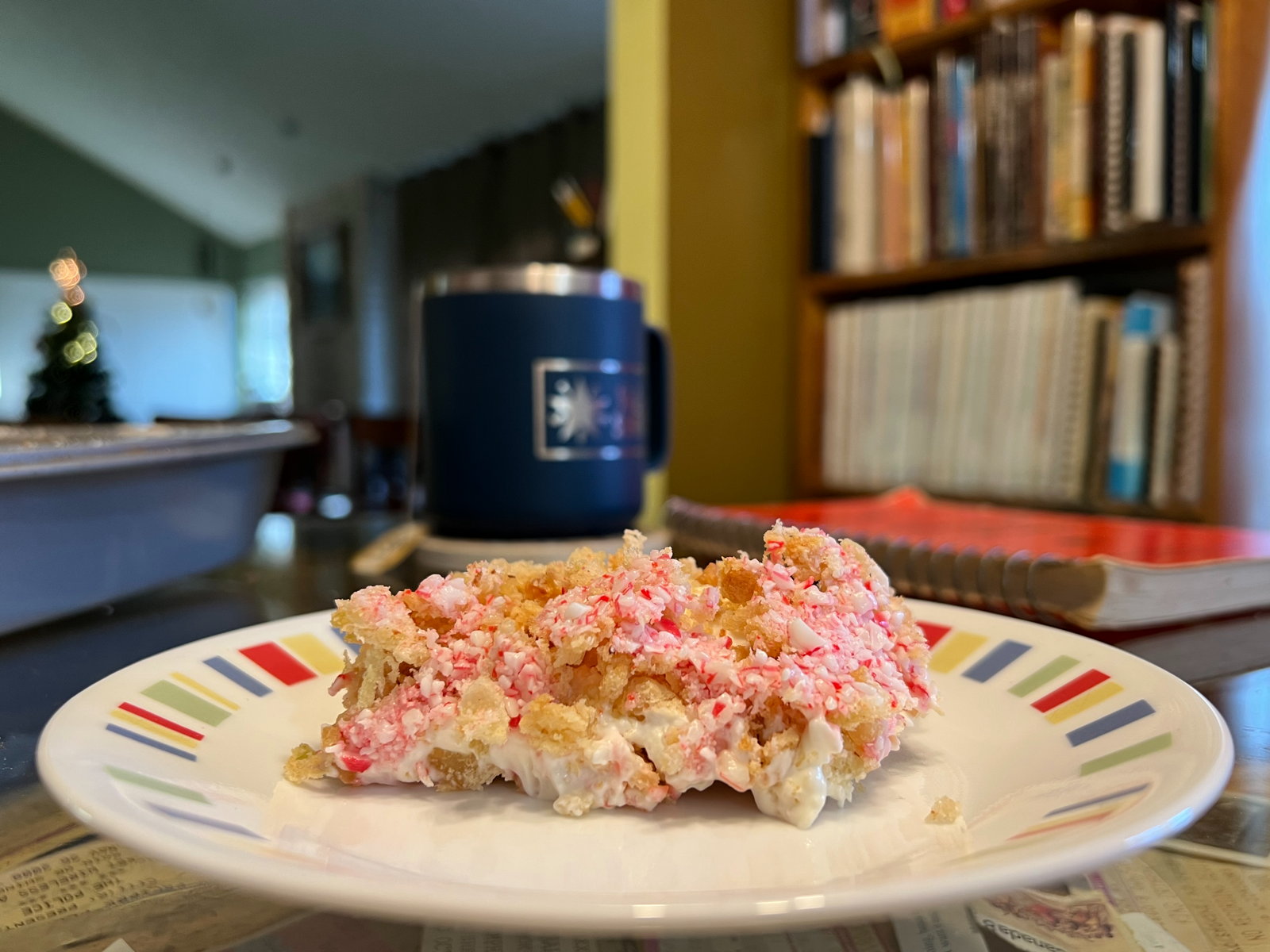
A beautiful and delicate Easter dessert.
This is a very simple dessert, with, technically, three ingredients: holiday bread, including stale holiday bread, candy canes, and stabilized whipped cream. And if you expect to finish the dessert in one sitting, you don’t even need to stabilize the whipped cream.
As regular readers of this blog know, I have a self-made tradition of using candy canes from my Christmas tree to make an Easter Sunday dessert. This recipe, however, did not start out as an Easter offering. When I first marked this recipe to try, after browsing through the Lakota, North Dakota, All Loved and Cherished Wonders, it was because I had a bag of pre-crushed Heath bar that I’d picked up on the discount shelf of the local grocery.
But, combined with having some makeshift Christmas bread that was about to go stale, I decided to holidize the recipe and switch out the chocolate wafers for toasted bread, and the crushed Heath bars for crushed candy canes. The original recipe ran:
Heath Bar Dessert
1 box chocolate wafers, crushed ¼ cup butter (melted) 10 Heath Bars (ground) 1 pint heavy whipping cream Combine crumbs and melted butter. Press half of crumbs into large cake pan, cover with half of layer of Heath bars. Spread with heavy whipped cream. Sprinkle with remaining crumbs and Heath bars.
Mrs. Pat Kuball
Right off the bat you can see some problems with this recipe, problems common with vintage recipes and the assumption of unchanging product sizes. The cook book is, by my estimate, from about 1964. What was a box of chocolate wafers in 1964? How big were Heath Bars?
- Irish mashed potato pie for Π Day and Saint Patrick’s Day—Wednesday, March 11th, 2026
-
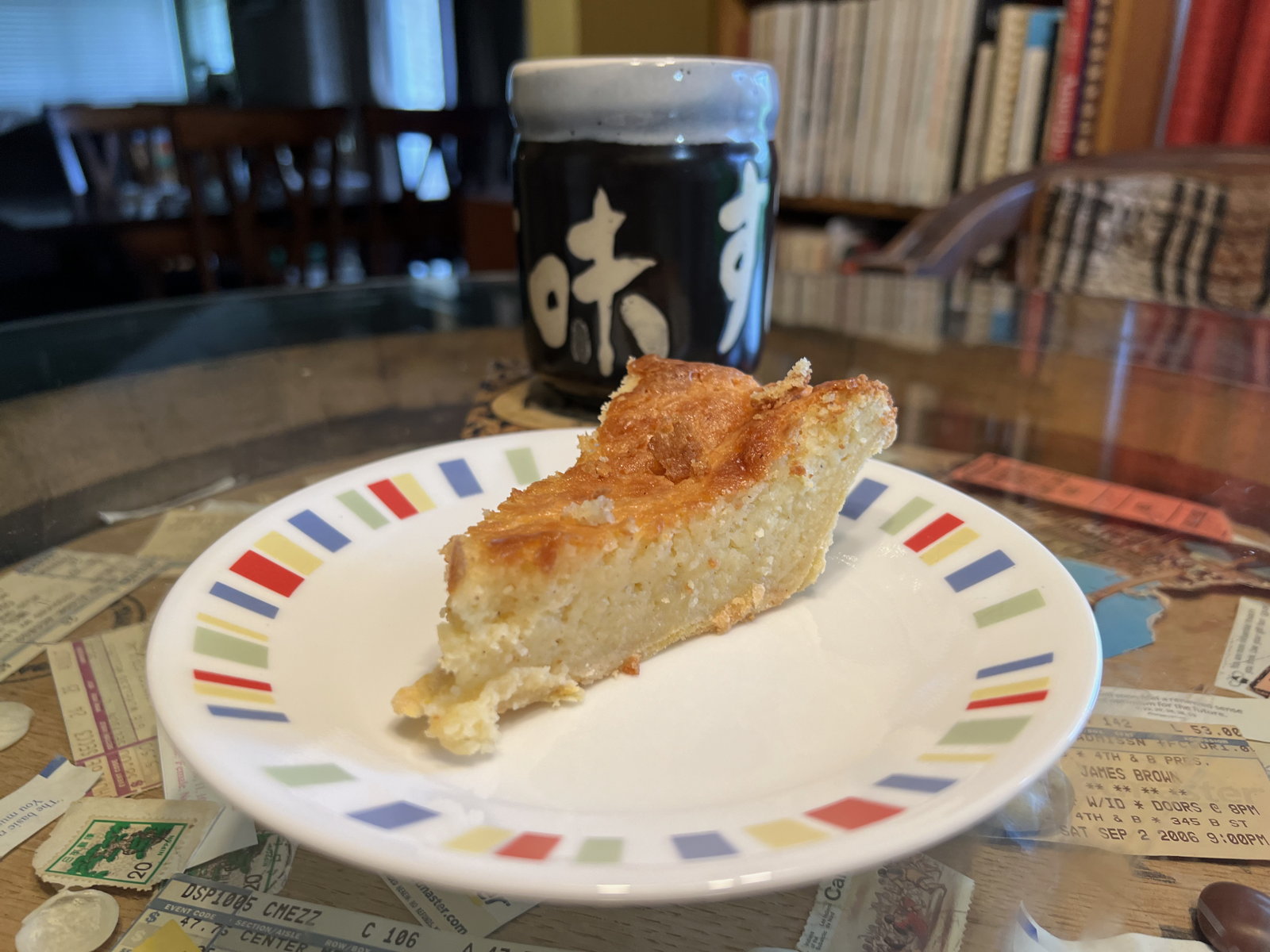
A wonderful pie from white potatoes instead of sweet potatoes.
Pi Day is this coming Saturday.
A few days after it, on Tuesday, is St. Patrick’s Day.
This year’s Independence Day will be the 250th anniversary of the signing of the Declaration of Independence.
So why not a pie this year celebrating all three of those? I found this pie in a Horsford Baking Powder cookbook that celebrated its product’s Centennial Award from the Centennial Exhibition in Philadelphia in 1876. That’s right: this pie was in a cookbook that took part in the centennial of the signing of the Declaration of Independence. The book itself probably didn’t come out in 1876, though it may have—the exhibition started in May of that year, leaving lots of time for a company that published as many iterations as Rumford did to add that award to their products. But I’m guessing 1877, for reasons I go into more detail about in my 2024 lead-up to the sestercentennial.
It’s a fascinating pie and one that appears to have fallen out of favor in favor of the sweet potato pie. This is a much lighter pie than sweet potato, and it allows the spices to shine. But it still exhibits some of the flavor of potato, and, to my mind, to great effect. But I come from a long line of potato aficionados.
I considered saving this recipe for National Potato Day, one of the other handful of food days I enjoy. But that’s in August, after Independence Day, so, given that this is the 250th anniversary of the signing of the Declaration of Independence, I decided to put it here.
Here’s the full recipe as it appears in the Rumford Chemical Works cookbook:
Irish Potato Pie.—One pound mashed potato, rubbed through a cullender, one-half pound butter creamed with the sugar, six eggs, whites and yolks beaten separately, one lemon squeezed into the potato while hot, one teaspoonful nutmeg, one teaspoonful mace, two cups white sugar. Mix and bake same as Sweet Potato Pie.
The “Sweet Potato Pie” appears directly above:
- Using ingredients to guess cookbook years—Wednesday, February 25th, 2026
-
The first reference to “homemade” granola in my collection.
Many recipes in community cookbooks call for ingredients by company and brand name. Eagle Brand Condensed Milk, for example, and Pet Evaporated Milk are very common ingredients. Not only are those names used in a generic manner—you’ll often see condensed milk called Eagle Milk and evaporated milk called Pet Milk, despite both companies producing the other product—a product name obviously won’t be used before the product was introduced to the market.
A brand name isn’t likely to be used in an ingredient list unless that one brand is the only such ingredient on the market, or it has had time to become the semi-generic term for the ingredient. Product debuts can thus provide a lower bound for the year of publication when a recipe calls for such a product.
Jell-O is a very good example of a brand name that has become a generic name or nearly so for the ingredient. A recipe after Jell-O’s rise in popularity is as likely to call for “jello” as it is to call for “gelatin”, especially if the gelatin called for is a flavored gelatin.
Sometimes, the way an ingredient is referred to can provide a hint to the age of the cookbook. In Favorite Recipes Prepared by Fremont Nursery, Inc. there is a great recipe for “Homemade granola” from Joy Dykman. Why would it be called “homemade” granola? One likely reason is that the first mass-market granola came out in 1972, and the recipe’s title contrasts itself with commercial granola. That narrows the range for the cookbook’s publication considerably. It almost certainly came out after 1972. While I can find granola recipes in cookbooks before 1972, none that I’ve seen call themselves “homemade”. Homemade was the only kind of granola before 1972 and didn’t need to be noted.
Here’s a list of products commonly found in community cookbooks, and their debuts under that name. This list is mainly ones that I’ve used or tried to use to help date cookbooks in my collection:
- Hot ovens: Bakers were once the slaves of time—Wednesday, February 18th, 2026
-
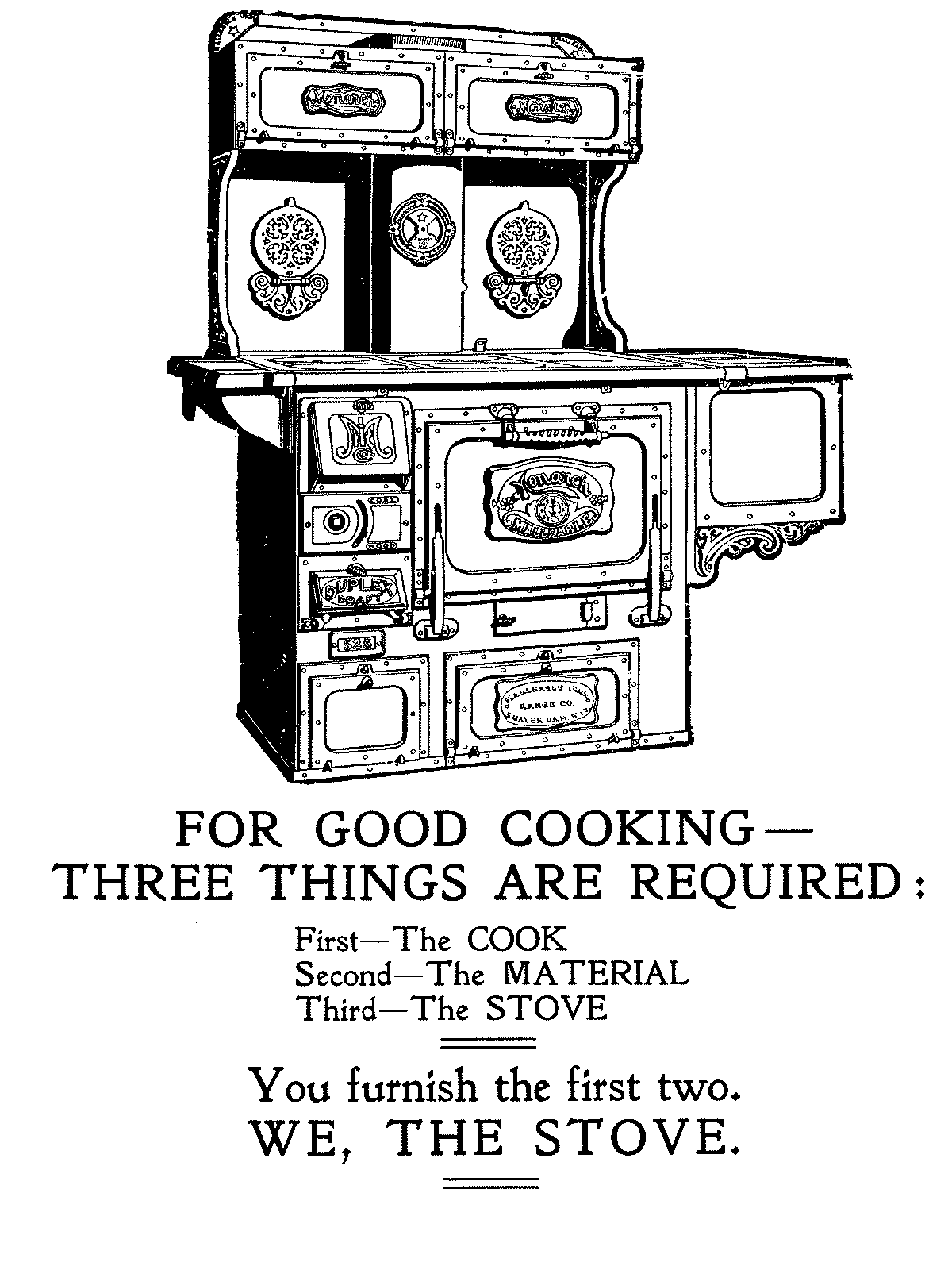
There are no set-and-forget dials and buttons on this state-of-the-art oven advertised in a 1916 Columbus, North Dakota, community cookbook.
I had an interesting sense of déjà vu watching Glen Powell of Glen and Friends use a 1914/1915 cake recipe recently. In my post about quiet ovens I wrote
The ability to trust a steady temperature in an oven isn’t just an improvement. It’s a paradigm shift. Their oven preparation process, and the terminology they used to describe it, was built around a process that simply doesn’t exist in modern kitchens.
Glen had trouble with a pre-self-regulating oven cake recipe in part because he treated his oven as a set-and-forget appliance—which, being a modern oven, it was—rather than a tool in a process, as the recipe assumed.
We have chained time in our kitchens. We have halted the decay of highly perishable foods and we have lashed baking to a schedule. We don’t have to worry about hot ovens and slack ovens and quick ovens and quiet ovens. We can literally set a temperature and a time and go do something else. And we increasingly forget that time once ruled us instead of us ruling time.
We can barely imagine the technology that inspired those old oven terms. So we make little charts corresponding oven terms to temperatures and shove our cakes into the darkness hoping for a correspondence.
Used as a rule of thumb, these charts make it possible to experiment with recipes from before modern kitchens. But when we forget that they are a rule of thumb, they instead make it more difficult to make recipes from books before the modern home refrigerator and oven. Glen’s burnt cake was a matter of running into this problem from multiple directions.
Glen recognizes that all those oven descriptor to temperature charts are inaccurate. In his 160-year-old Victorian pudding video, he said:
- Using archives to guess cookbook years—Wednesday, January 28th, 2026
-
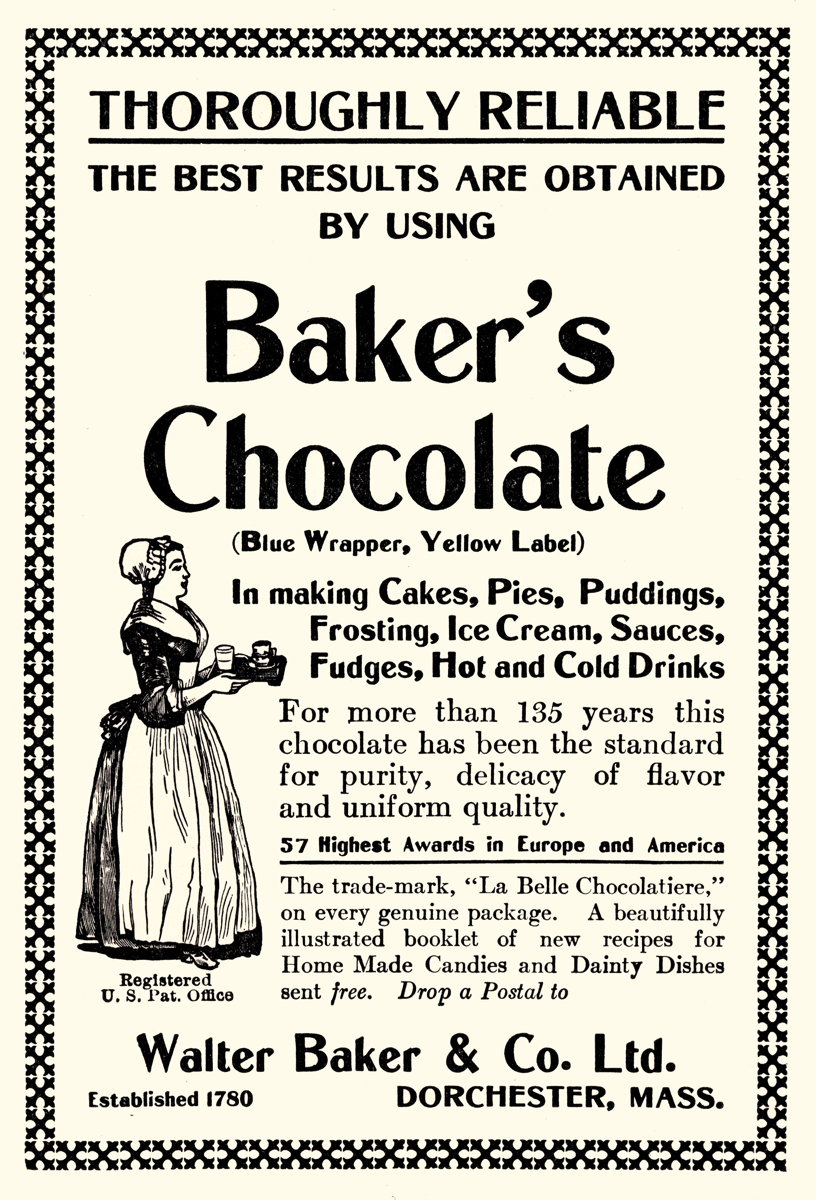
You can tell by the phrase “more than 135 years” that this ad was placed in 1916 or thereabouts. Walter Baker updated their ad copy every year.
While general searches can provide a lot of information about a cookbook, specialized newspaper and magazine archives will also be helpful. Many old periodicals aren’t indexed in general search engines. Check your local library to see if you have access to online newspaper and magazine archives. My library provides access to newspapers.com, so that’s what I use. The Internet Archive has many old magazines, such as Good Housekeeping, McCall’s Magazine, and The Ladies’ Home Journal. These are especially helpful for looking up old advertisements, in order to see product packaging or design1 and compare them to ads in the undated cookbook.
Advertising pamphlets regularly go through multiple printings and whether the year is included on a particular printing can seem completely random. This means that finding versions of a pamphlet on the Internet Archive can help you date that book even if your copy is not on the archive.
For example, The Quaker Oats Wholegrain Cookbook went through at least five printings. I have the fifth printing, listed as from 1979. The Internet Archive has two printings. One is labeled First Printing 1978 and the other has no printing number or year at all. That space on the back cover is blank. All three of the printings appear to be exactly the same other than that back cover line (or lack thereof).2
Why is there an undated version? Is the undated version at some point after the fifth printing when they decided they were never going to change it so why bother? Is it a zeroth printing, and the first printing is really a second printing? Or did they produce a printing after the first where they removed that line, and then added it back later?
The answer, of course, is “who knows?” But knowing that the first and fifth printings came out in 1978 and 1979 also means that the second through fourth printings came out in that range.
- My Year in Food: 2025—Wednesday, January 21st, 2026
-

I also rewatched Jacques Pépin’s wonderful Heart & Soul cooking show.
“I can’t advise you to start drinking heavily,” said Johnny Depp as John Belushi in Fear and Loathing on Saturday Night, “but it’s always worked for me.”
This year I started experimenting with old-school drinks from three sources. From matchbook covers I discovered the very nice Gin Rickey: ice, gin, lime juice, and soda water. At New Braunfels in October I picked up The ABC of Cocktails, a 1957 collection of similarly-abbreviated drink recipes, and discovered the Bee’s Knees: honey, lemon juice, gin, and ice. Both are marvelous, refreshing drinks. I recommend adding rosemary, but it’s wonderful either way.
From Barimetro, the sliding drink recipe card of the Hotel Las Brisas in Acapulco, I discovered the Bourbon and Vermouth Manhattan, flavored with bitters and a red cherry. As well as a very dry Martini: 1-½ ounces of gin with 1/16 ounce of dry Vermouth. Quite good with a good gin, such as The Pianist.
And therein lies a story. I’ve never been a fan of gin, but it is useful to keep on hand for certain drinks. Especially now that I’ve discovered the above three cocktails. Last year or the year before I discovered The Pianist, and it’s the first gin I’ve really liked. So, when I ran out at the end of the year—due mainly to discovering these three wonderful gin cocktails—I went to get more… and discovered it’s been discontinued.
Being as I am not a gin connoisseur I just bought the next interesting one on the shelf, Shiner gin. It’s not a bad gin and like The Pianist it’s from Texas. But it highlighted that I really do prefer The Pianist to random gins off the shelf. So I went back online and started searching area liquor store web sites to see if anyone still had it in stock.
- Padgett Sunday Supper Club Sestercentennial Cookery—Wednesday, January 7th, 2026
-
I hope you have great plans for this summer! This New Year marks a great milestone in American history: Independence Day 2026 will mark the 250th anniversary of the signing of the Declaration of Independence.
In celebration, for the next eight months, through the summer picnic and reunion season, The Padgett Sunday Supper Club will feature even more recipes from our 1976 and 1876 celebrations, and from 1796.
- Bicentennial meal
- Centennial Meal
- Vicennial Meal
- Sestercentennial Cookery ⬅︎
I have collected most of the recipes from my last three Independence Day posts into a small cookbook, The Padgett Sunday Supper Club Sestercentennial Cookery (PDF File, 7.0 MB). The book also includes a handful of recipes I’ve tested since those posts, and from the same sources. It collects bicentennial, centennial, and vicennial recipes, the latter from America’s first native cookbook, the 1796 American Cookery. That’s three centuries of American independence: the eighteenth, nineteenth, and twentieth centuries.
- Table and Kitchen: Baking Powder Battle—Wednesday, December 24th, 2025
-
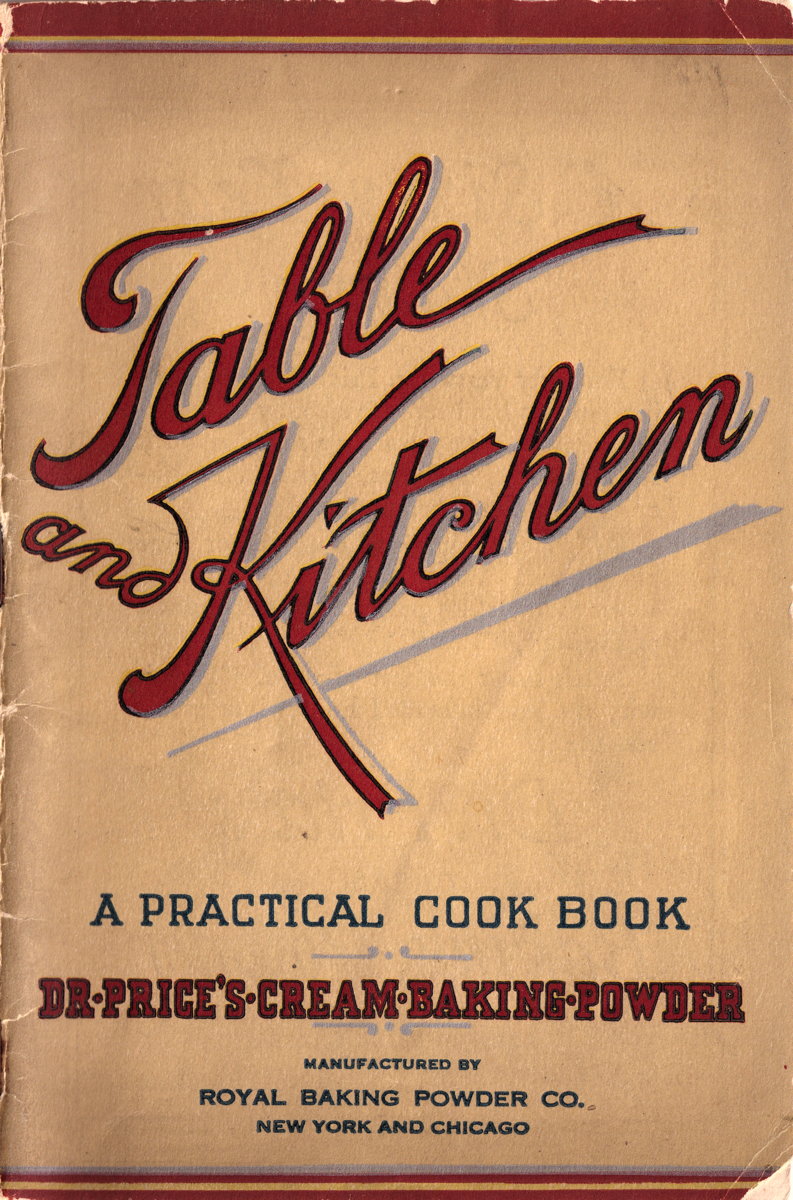
Also available in print.
Tomorrow is Christmas, and have I got a gift for you! I was driving across Missouri when I found this tiny little 1916 pamphlet/book in a library sale’s discount box. And by “discount”, I mean anything in the box was ten cents.
The full title is Table and Kitchen: A Practical Cook Book (PDF File, 15.3 MB). It’s an advertisement for the Royal Baking Powder Company’s “Dr. Price’s Cream Baking Powder”. Dr. Price’s was a single-action baking powder, that is, it did not contain alum. It used only cream of tartar as the acid.
While the cover is wonderful my initial thought was to leave it. I’m not a huge fan of how recipes were written in that era. I’ve seen other baking powder cookbooks, and have not been impressed by them. Further, there was practically no cell service in the area, so I couldn’t look up whether the book had been scanned online or not yet. But at ten cents I decided I couldn’t leave it: its next stop would certainly have been the recycling bin out back.
When I got to the hotel that night, I discovered that (a) it was not yet available anywhere, which meant I would at least get a good blog post out of it, and (b) there were a lot of very interesting, if sparsely-described, recipes inside.
One particular aspect of these old recipes that annoys me is a tendency to use what I call reverse Polish notation, or, as my gamer friends would say, Hastur he who must not be named oh shit. I wrote about the same writing “technique” in A Vicennial Meal for the Sestercentennial and Table and Kitchen’s eggnog recipe is a good example of the form:
Egg Nog. —Six eggs well beaten (white and yolks separately), one quart milk, one-half cup sugar, one cup brandy, nutmeg. Stir yolks into milk, with the sugar first beaten with yolks. Add brandy, then whites of eggs. Whip well.

Mimsy Were the Borogoves
Food: Recipes, cookbook reviews, food notes, and restaurant reviews. Unless otherwise noted, I have personally tried each recipe that gets its own page, but not necessarily recipes listed as part of a cookbook review.