


Padgett Sunday Supper Club Sestercentennial Cookery
I hope you have great plans for this summer! This New Year marks a great milestone in American history: Independence Day 2026 will mark the 250th anniversary of the signing of the Declaration of Independence.
In celebration, for the next eight months, through the summer picnic and reunion season, The Padgett Sunday Supper Club will feature even more recipes from our 1976 and 1876 celebrations, and from 1796.
- Bicentennial meal
- Centennial Meal
- Vicennial Meal
- Sestercentennial Cookery ⬅︎
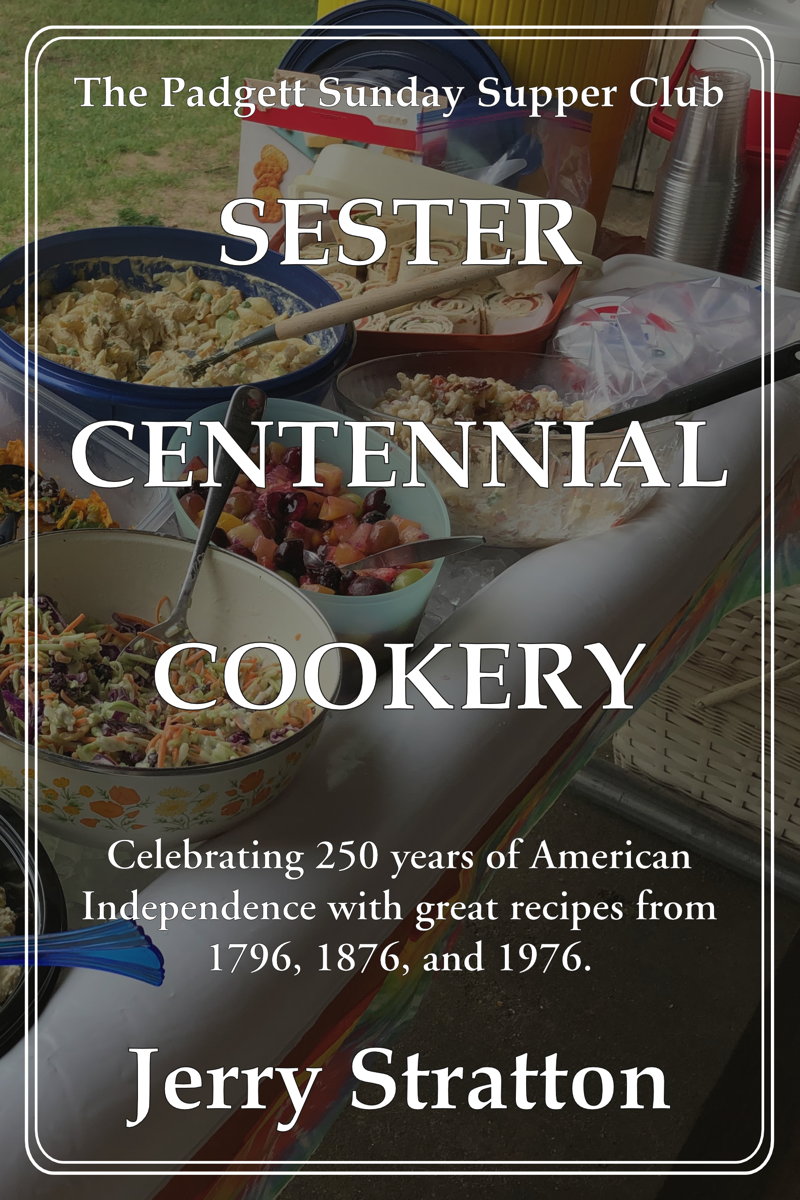
I have collected most of the recipes from my last three Independence Day posts into a small cookbook, The Padgett Sunday Supper Club Sestercentennial Cookery (PDF File, 7.0 MB). The book also includes a handful of recipes I’ve tested since those posts, and from the same sources. It collects bicentennial, centennial, and vicennial recipes, the latter from America’s first native cookbook, the 1796 American Cookery. That’s three centuries of American independence: the eighteenth, nineteenth, and twentieth centuries.
Each recipe includes a color photo; it’s the same format I used in my Ice Cream Cookery.
Like the Ice Cream Cookery, my Sestercentennial Cookery is a free download (PDF File, 7.0 MB). You can buy it in print from Lulu or from Amazon•. If you want to save on shipping when ordering from Lulu, I have a list of other books I’ve published in print.
Commemorating the Battle of Bennington in 1819, Samuel B. Young said of the Fourth of July:
All nations, from time immemorial, have had their days of commemoration. These days have marked the character of the nation itself. Among the Pagan nations they commemorate the birth day of some supposed God or Goddess—In Monarchies they commemorate the birthday of some favorite Prince or Princess. In Aristocracies they commemorate the birth day of some splendid Nobleman. But in the United States of America we commemorate the birth day of our Liberties.
I’ll be bookending my Sestercentennial posts with the Battle of Bennington, starting from last September’s Our lot is cast in this happy land… and ending with this coming September’s take on The Rifleman’s Song.
One of my favorite new recipes for this book is a cookie recipe from American Cookery. I sometimes call these “the first American cookies”. They obviously were not; cookies certainly existed, at least among the Dutch community, before 1796. But it is the first published recipe for cookies in an American book. They’re very similar to shortbread. They also use coriander, which is one of my favorite forgotten ingredients.
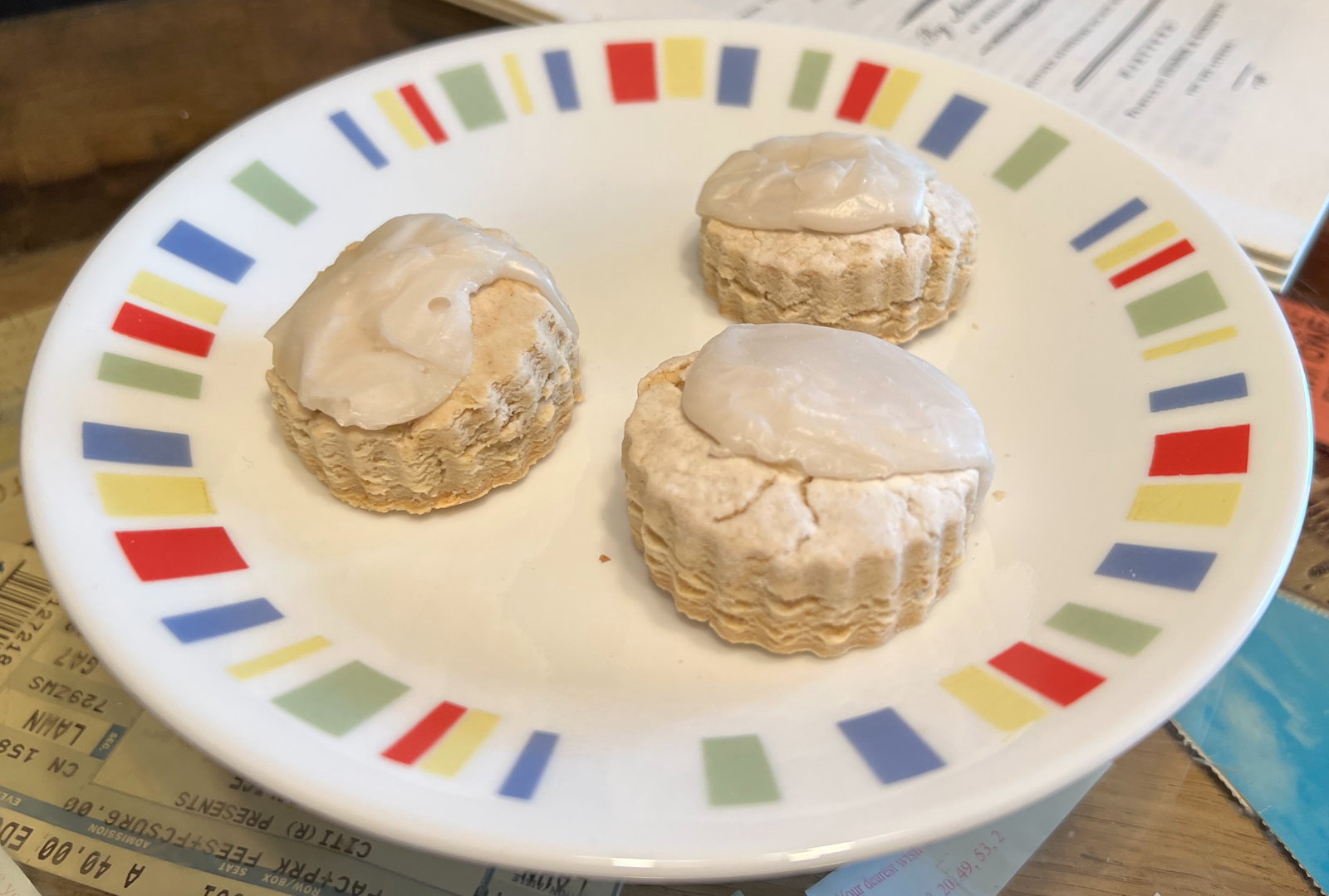
America’s First Cookie
Servings: 24
Preparation Time: 2 hours
Amelia Simmons
American Cookery (Internet Archive)
Ingredients
- Cookies
- 4 oz sugar
- ¼ cup water
- ½ tsp baking soda
- 1 tbsp milk
- 10 oz flour
- ½ tbsp coriander
- 1 oz butter
- Icing (optional)
- ¾ cup powdered sugar
- 3 tsp rose water
Steps
- Cookies
- Boil sugar in water at medium-low to 220° to make a syrup.
- Let cool.
- Mix baking soda into milk and then stir into the syrup.
- Sift flour and coriander into the syrup.
- Rub in the butter to make a dough.
- Flatten by hand to half an inch thickness.
- Cut into 1-½-inch rounds.
- Bake twenty to thirty minutes at 325°.
- Icing, if used
- Mix powdered sugar with rose water.
- Drop or spread onto warm cookies.
Chemical leavening was very rare in this period; Max Miller’s 1773 gingerbread is representative of the period—and a great look at an American patriot and baker. But the baking soda in these cookies is not an anachronism. This is among the first published recipes to include chemical leavening. In 1796, that leavening was pearl ash, a refinement on potash that made it more useful for baking.
Cookies
One pound sugar boiled slowly in half pint water, scum well and cool, add two tea spoons pearl ash dissolved in milk, then two and half pounds flour, rub in 4 ounces butter, and two large spoons of finely powdered coriander seed, wet with above; make roles half an inch thick and cut to the shape you please; bake fifteen or twenty minutes in a slack oven—good three weeks.
Except for the “slack oven” it’s a very modern recipe. And I’ve never tested whether these cookies are “good three weeks”.
I’ve interspersed The Sestercentennial Cookery (PDF File, 7.0 MB) with texts from early Independence Day celebrations and related commemorations. The book includes, for example, President Grant’s proclamation for the Centennial in 1876, and President Ford’s for the Bicentennial in 1976, back to back, right between the omelet snackers and a puff paste for pies and tarts.
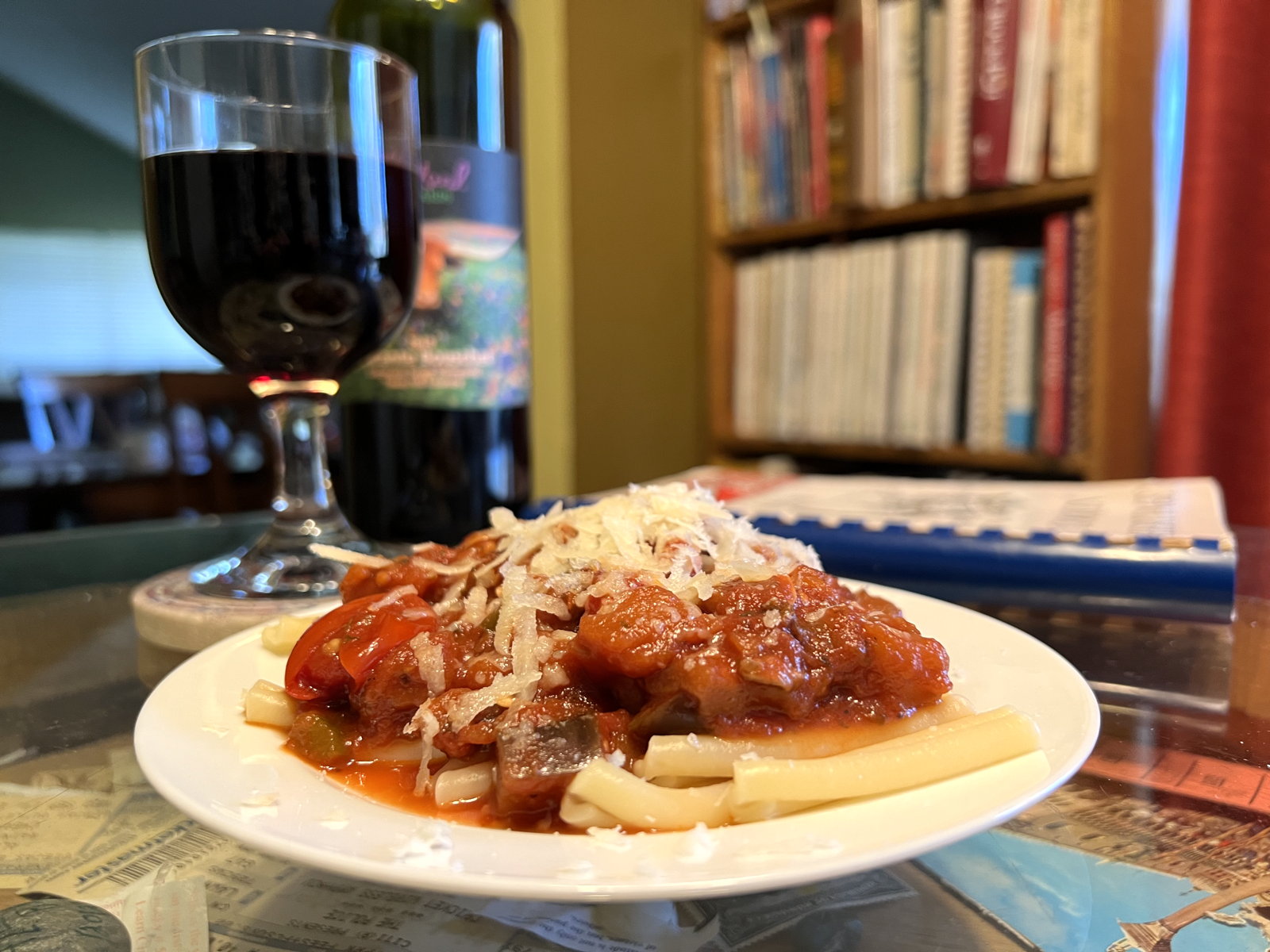
Another new recipe in the book is this very seventies pasta dish with eggplant, from Copperas Cove, Texas’s Bicentennial community cookbook.
One of the more fascinating Fourths was the fiftieth anniversary in 1826. It was marked, retroactively, by commemorations of the death of both John Adams and Thomas Jefferson. No one knew on July 4, 1826, that two of the most important founders would die within hours of each other. But once it happened it was impossible not to see it as something special. Future Massachusetts Governor and Senator Edward Everett, then a member of the House of Representatives, wrote an uncharacteristically short eulogy perfect for a book like mine. And a semi-attributed Poem By a Lady of Richmond also commemorates the event in print and in poetry.
That those two deaths occurred at the same time and on such a special day was often attributed to divine favor. It still is.
Frances Hopkinson’s 1788 Ode for the 4th of July is a wonderful find. I first heard it when Mark Steyn recited it in one of his musical Independence Day specials. You’ll need to be a subscriber to listen to his rendition of it, but if you enjoy music, history, and musical history, it’s well worth it.
Hopkinson wasn’t just a songwriter. He signed the Declaration of Independence as a delegate from New Jersey. And he was also a satirist. I covered his Battle of the Kegs last week.
One fascinating text I discovered is Daniel Webster’s 1802 Fourth of July oration. He was twenty years old at the time; it’s easy to see that this young man had a successful future ahead of him as a politician!
On the title page, I’ve given this anniversary two names. I’ve been calling it the sestercentennial since I started writing about it in 2023. It comes from the Latin for two-and-a-half (sester) and for a hundred (centennial). Two-and-a-half centennials is 250.
When we celebrated the hundredth anniversary, we called it the Centennial; when we celebrated the two hundredth anniversary, we called it the Bicentennial. There were three likely names for the 250th anniversary, and I chose the simplest and most similar to those names. The official name today is apparently semiquincentennial. The prefix quin is five and the prefix semi is half, so this is half of five hundred, which is, of course, also 250.
I predict that Semiquincentennial is going to engender as many jokes as serious uses. Centennial and Bicentennial are reasonable words and were common at each anniversary. Sestercentennial is close to them. But it could have been worse. Apparently “bisesquicentennial” was also in the running, which sounds like an alien underwater life form. The Latin’s a bit hard to understand, too, going by how every online source explains it. Even Google’s AI describes it as:
- “Bi”: Latin for “two”.
- “Sesqui”: Latin for “one and a half”.
- “Centennial”: Refers to a period of 100 years.
So, “bisesquicentennial” literally means “two and a half hundred years,” which equals 250 years.
I’m not entirely clear on why this isn’t “literally” 300 rather than 250. But, according to Cassell’s Latin Dictionary, Google’s AI is slightly wrong. Sesqui has (at least) two meanings:
sesquĭ, adv. (perhaps from semis/que), one half more, half as much again: sesqui major, Cic.
You have to squint to get the right meaning out of this, but it would seem to be considered as meaning two, plus one half, for two and one half and not two, plus half again as much. I’d be interested to see the reaction of an actual Roman faced with the term. It’s a lot of explanation for a word that sounds like it belongs in a Lovecraft tale.
But whether you call it the sestercentennial, the semiquincentennial, or eschew Latin in favor of calling it the 250th anniversary of America’s Declaration of Independence, 2026 marks an impressive milestone in American history. Throughout our history, we have celebrated such milestones with food—and specifically with cookbooks, as my 1876 and 1976 installments show.
Download the Sestercentennial Cookery for free (PDF File, 7.0 MB) or buy a full-color copy from Amazon• or Lulu. I hope you enjoy this sestercentennial sampling of our culinary history! It’s filled with great American recipes for potlucks, picnics, and just general snacking and dining as we celebrate this marvelous year.
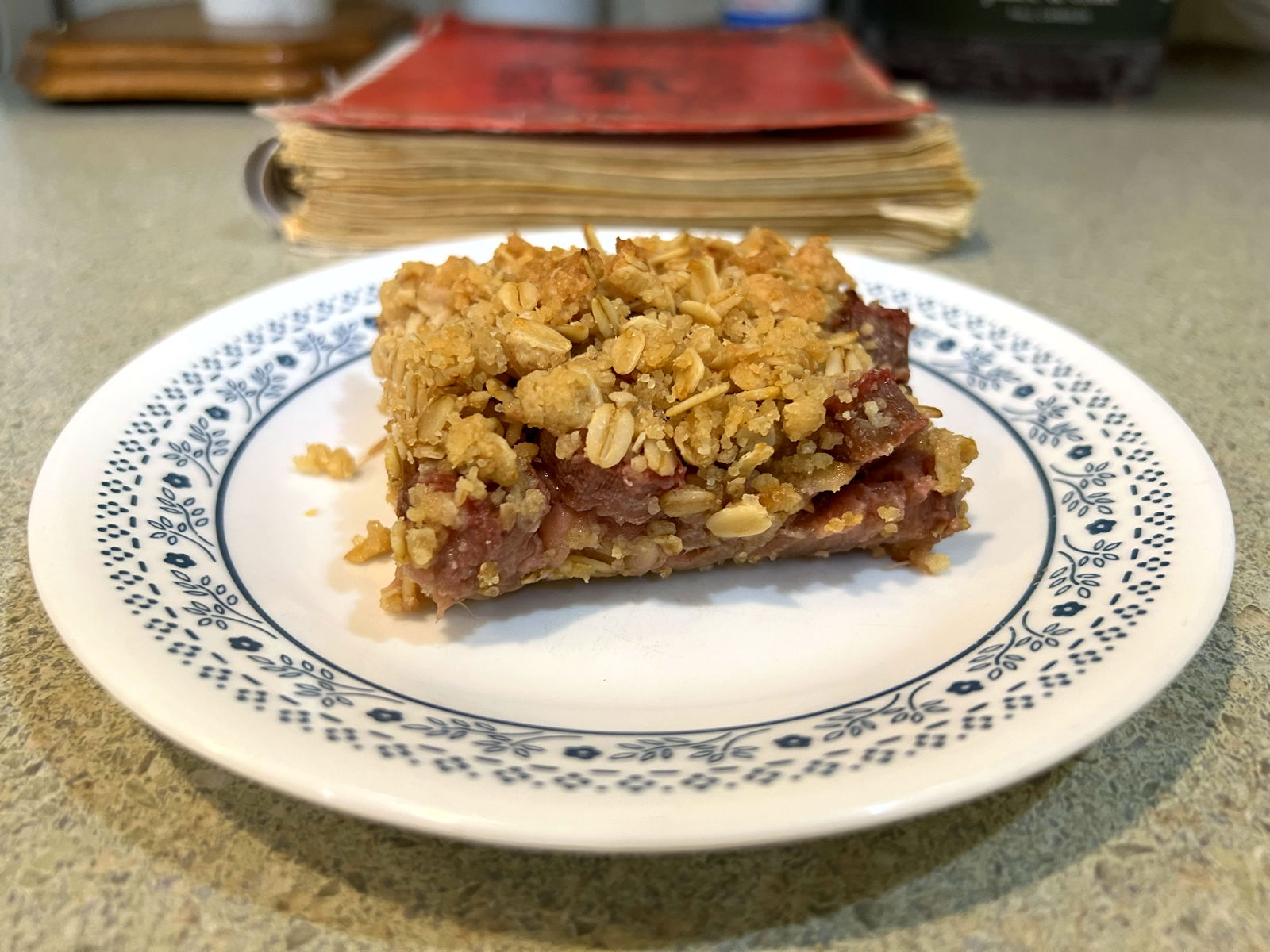
A wonderful rhubarb crumble.
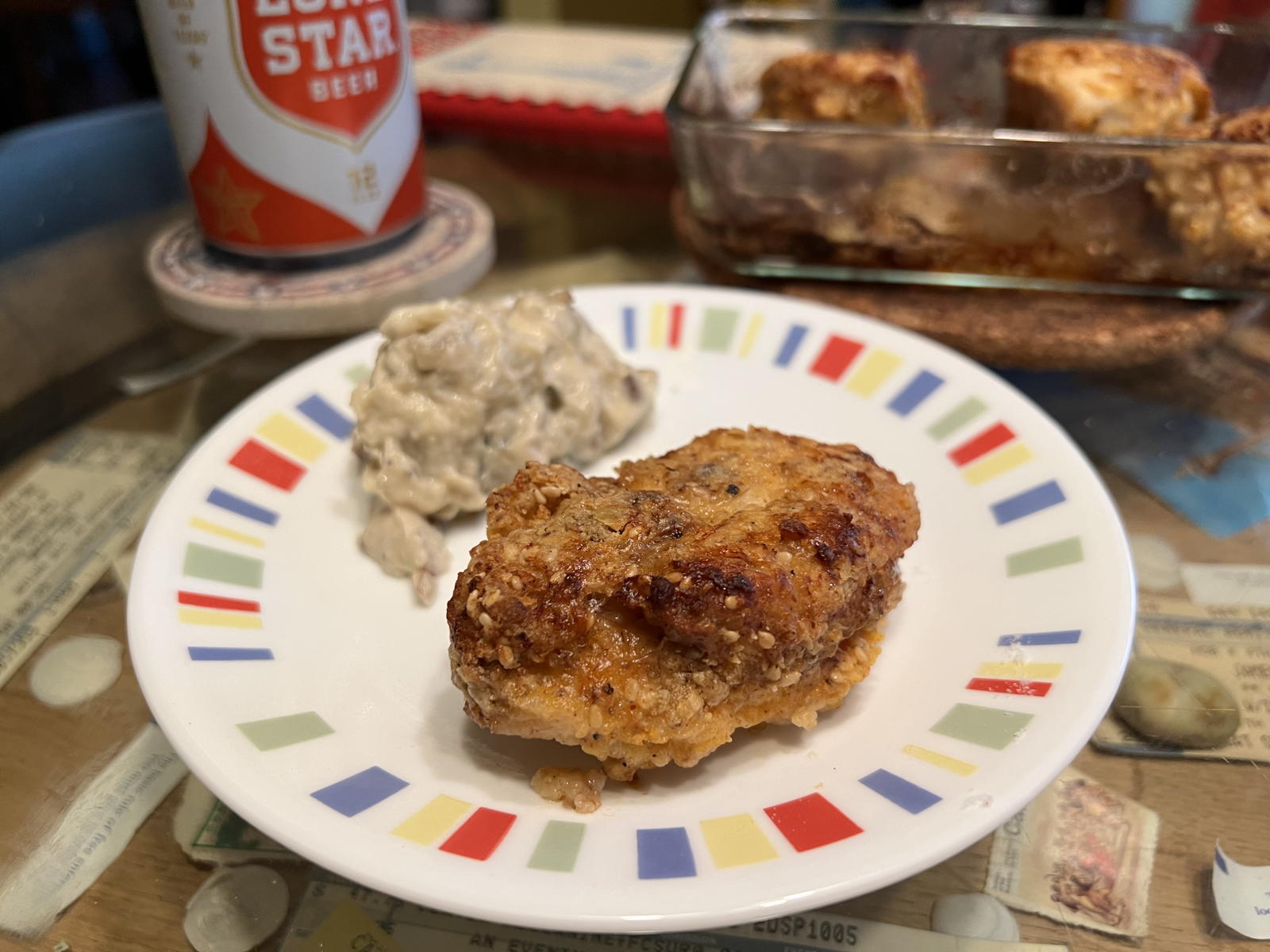
Some Texas fried chicken—with sesame!
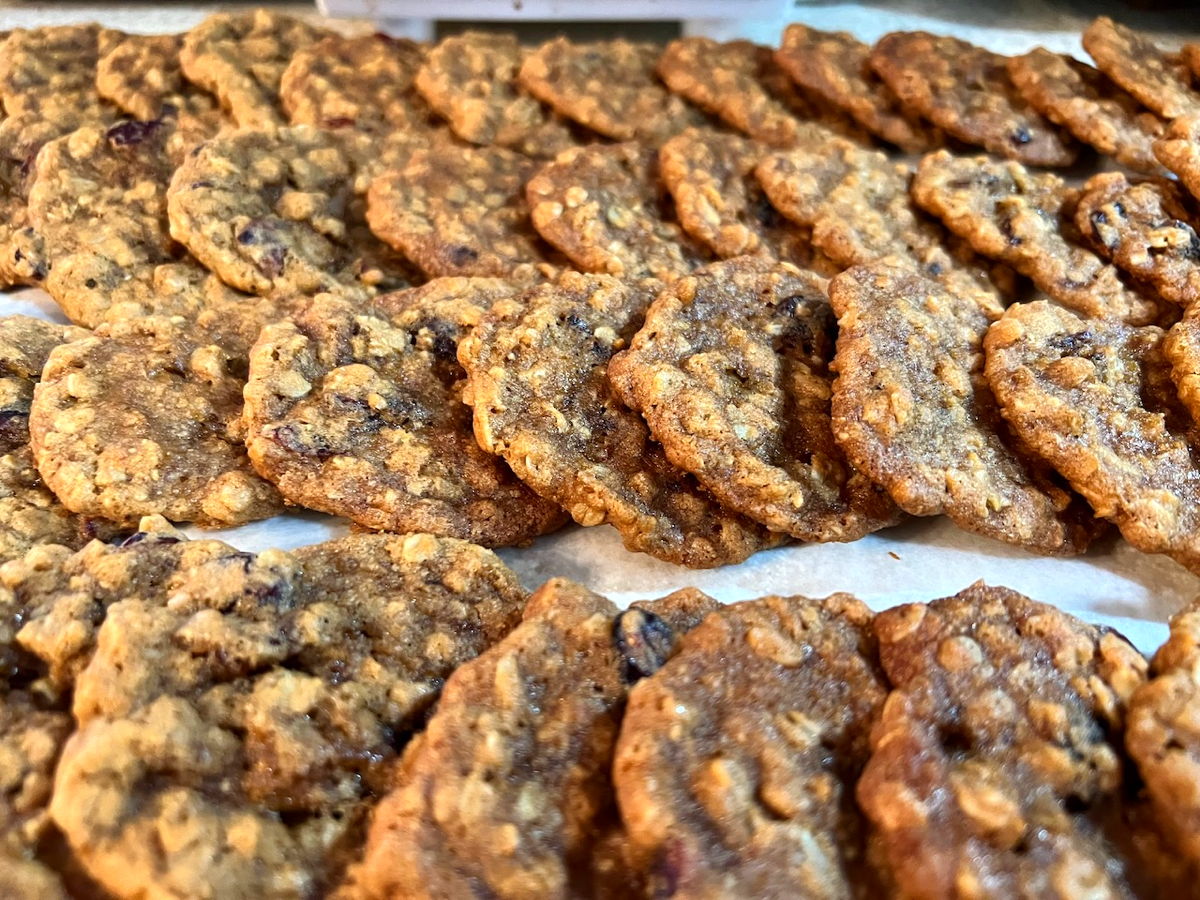
Very crispy cranberry-oatmeal cookies.
In response to A Bicentennial Meal for the Sestercentennial: Four community cookbooks celebrating the bicentennial. As we approach our sestercentennial in 2026, what makes a meal from 1976?
cookbooks
- The Padgett Sunday Supper Club Sestercentennial Cookery: Jerry Stratton at Lulu storefront (paperback)
- Celebrate 2026 with recipes from 1796, 1876 and 1976, as well as historical texts from Independence Days of yore.
- The Padgett Sunday Supper Club Sestercentennial Cookery•: Jerry Stratton at Jerry Stratton on Amazon.com (paperback)
- Celebrate 2026 with recipes from 1796, 1876 and 1976, as well as historical texts from Independence Days of yore.
- Sestercentennial Cookery (PDF File, 7.0 MB)
- The Padgett Sunday Supper Club Sestercentennial Cookery contains recipes from the bicentennial era, the centennial era, and the first American cookbook in 1796, as well as historical documents celebrating Independence Days past.
food history
- American Cookery: Amelia Simmons at Internet Archive
- “…the art of dressing viands, fish, poultry and vegetables, and the best modes of making pastes, puffs, pies, tarts, puddings, custards and preserves, and all kinds of cakes, from the imperial plumb to plain cake. Adapted to this country, and all grades of life.”
- A Bicentennial Meal for the Sestercentennial
- Four community cookbooks celebrating the bicentennial. As we approach our sestercentennial in 2026, what makes a meal from 1976?
- A Centennial Meal for the Sestercentennial
- How did Americans in 1876 celebrate the centennial culinarily? Some of their recipes are surprisingly modern, and some are unique flavors worthy of resurrecting.
- Gingerbread for Washington’s Army: Max Miller at Tasting History with Max Miller
- “Christopher Ludwick was a true hero of the American Revolution. A German immigrant, he made his fortune in part by baking gingerbread in Philadelphia, and then used his baking knowledge, patriotic spirit, and all of his fortune to aid the American cause.”
- Padgett Sunday Supper Club
- Dedicated to the preservation of vintage recipes.
- A Vicennial Meal for the Sestercentennial
- In 1776 we were too busy to write commemorative cookbooks. But in 1796 “Amelia Simmons, American Orphan” published the first known American cookbook. It’s a celebration of American foods, American values, and American economies.
Fourth of July
- Celebrating America’s 250th Birthday: President Donald Trump
- “It is the policy of the United States, and a purpose of this order, to provide a grand celebration worthy of the momentous occasion of the 250th anniversary of American Independence on July 4, 2026.”
- Constitutional Whig, Richmond, July 14, 1826 at Library of Congress
- “By Pleasants & Smith, Richmond, Virginia, Friday, July 14, 1826.”
- Edward Everett’s Eulogy of Thomas Jefferson and John Adams
- “The Jubilee of America is turned into mourning. Its joy is mingled with sadness; its silver trumpet breathes a mingled strain…”
- Favorite Fourths, 2025: Mark Steyn at Steyn Online
- “…this year's edition includes a brand new episode of The Hundred Years Ago Show with a snapshot of the national holiday a century ago, including a Fourth of July tragedy and some contrasting vignettes of US immigration at the start of a forty-year moratorium.”
- An ode for the 4th of July 1788 at Library of Congress
- By Francis Hopkinson and printed by Mathew Carey, 1788. From the Library of Congress’s Constitutional Convention Broadside Collection.
history
- The Battle of the Kegs
- The Battle of the Kegs took place on January 5 or 6, 1778. Soon after, Francis Hopkinson wrote this wonderful account of the debacle, including very personal details about the British General in charge!
- Our lot is cast in this happy land…
- Samuel B. Young’s August 16, 1819, Oration to commemorate the 1777 Battle of Bennington.
Other Cookbooks
- Cookbooks on Lulu and Amazon
- I have several books and reproductions available on Lulu, and a few books available on Amazon. On Lulu especially, it helps to buy more than one book at a time to reduce shipping costs per book.
- Four New Ices and an Ice Cream Cookery
- Philadelphia Ice Cream, Walnut Nougat, Lemon Cream Sherbet, and Cranberry Ice. Four more new no-churn ice creams and desserts for Summer 2025. And, a book collecting all my favorite no-churn ice creams if you’re interested!
More America’s Sestercentennial
- Irish mashed potato pie for Π Day and Saint Patrick’s Day
- In this sestercentennial year, here’s a great triple-celebration pie. It’s from about 1876 and it can fill in for both Pi Day and St. Patrick’s Day!
- The World Turned Upside Down
- The legend of the surrender of Lord Cornwallis to Washington at Yorktown says that the band played “The World Turned Upside Down”. It probably didn’t. But we’re going to print the legend anyway.
- A Vicennial Meal for the Sestercentennial
- In 1776 we were too busy to write commemorative cookbooks. But in 1796 “Amelia Simmons, American Orphan” published the first known American cookbook. It’s a celebration of American foods, American values, and American economies.
- A Centennial Meal for the Sestercentennial
- How did Americans in 1876 celebrate the centennial culinarily? Some of their recipes are surprisingly modern, and some are unique flavors worthy of resurrecting.
- A Bicentennial Meal for the Sestercentennial
- Four community cookbooks celebrating the bicentennial. As we approach our sestercentennial in 2026, what makes a meal from 1976?
More Club Padgett
- Four New Ices and an Ice Cream Cookery
- Philadelphia Ice Cream, Walnut Nougat, Lemon Cream Sherbet, and Cranberry Ice. Four more new no-churn ice creams and desserts for Summer 2025. And, a book collecting all my favorite no-churn ice creams if you’re interested!
- A Traveling Man’s Cookery Book
- A Traveling Man’s Cookery Book is a collection of recipes that I enjoy making while traveling, and in other people’s kitchens.
- Club recipe archive
- Every Sunday, the Padgett Sunday Supper Club features one special recipe. These are the recipes that have been featured on past Sundays.
- Padgett Sunday Supper Club
- Dedicated to the preservation of vintage recipes.
- Club Padgett Cookery Errata
- I’ve published several books under the banner of the Padgett Sunday Supper Club. As I discover errors and fix them, I’ll add or link to the fixes here.
More cookbooks
- Using ingredients to guess cookbook years
- Community cookbooks often call for brand name products and tools. That can provide a lower bound for what year a book was published, but rarely an upper bound.
- My Year in Food: 2025
- My year in food extended from 1776 to 2026, from San Diego to Barcelona, and from Texas to Michigan. I also made several vintage books available for you to download!
- Cookbook publication year estimates I have made
- When I acquire a cookbook without a publication or copyright year, I use the advertisements and contributors to make a stab at the likely year of publication. This page provides those guesses in case it helps you date your own books.
- Refrigerator Revolution Revisited: 1937 Kitchen-Proved
- Refrigerators started to take off during Prohibition, and became ubiquitous following World War II. This Westinghouse refrigerator manual and cookbook gives us a glimpse at home refrigerator/freezers in the Great Depression.
- Four New Ices and an Ice Cream Cookery
- Philadelphia Ice Cream, Walnut Nougat, Lemon Cream Sherbet, and Cranberry Ice. Four more new no-churn ice creams and desserts for Summer 2025. And, a book collecting all my favorite no-churn ice creams if you’re interested!
- 75 more pages with the topic cookbooks, and other related pages
More food history
- Using ingredients to guess cookbook years
- Community cookbooks often call for brand name products and tools. That can provide a lower bound for what year a book was published, but rarely an upper bound.
- Hot ovens: Bakers were once the slaves of time
- We have chained time in our kitchens. Our refrigerators stop time from destroying food, and our ovens lash it to the oars for baking. And we have forgotten that it was ever any other way.
- Using archives to guess cookbook years
- Many cookbooks, especially community cookbooks and often advertising pamphlets, leave off the year. Online newspaper and magazine archives can help to narrow down when the book was published.
- Table and Kitchen: Baking Powder Battle
- The Royal Baking Powder Co. was a very combative entrant in the baking powder wars. But that kind of competitive spirit can also mean great recipes.
- Using search engines to guess cookbook years
- Many cookbooks, especially community cookbooks and often advertising pamphlets, leave off the year. Often, however, there are solid clues in the text that narrow down when the book was published, through simple online searches.
- 28 more pages with the topic food history, and other related pages
More A Sestercentennial Year
- Irish mashed potato pie for Π Day and Saint Patrick’s Day
- In this sestercentennial year, here’s a great triple-celebration pie. It’s from about 1876 and it can fill in for both Pi Day and St. Patrick’s Day!
- The New Colossus Breathes Free
- There’s nothing wrong with The New Colossus except the way the institutional left has twisted it into meaning the opposite of what it actually says. Emma Lazarus wrote The New Colossus for the exiles of government-sponsored terror to escape their persecutors to a land of Freedom, not for letting their persecutors in to continue the persecution here.
- The Battle of the Kegs
- The Battle of the Kegs took place on January 5 or 6, 1778. Soon after, Francis Hopkinson wrote this wonderful account of the debacle, including very personal details about the British General in charge!
- Cherry Valley: A Massacre of the Revolution
- Mel Gibson’s The Patriot is disparaged for the ruthlessness it portrays among the British. But such barbarity certainly did exist. One massacre by British troops is still remembered by the residents of Cherry Valley, New York.
- The World Turned Upside Down
- The legend of the surrender of Lord Cornwallis to Washington at Yorktown says that the band played “The World Turned Upside Down”. It probably didn’t. But we’re going to print the legend anyway.
- One more page with the topic A Sestercentennial Year, and other related pages