


Using archives to guess cookbook years
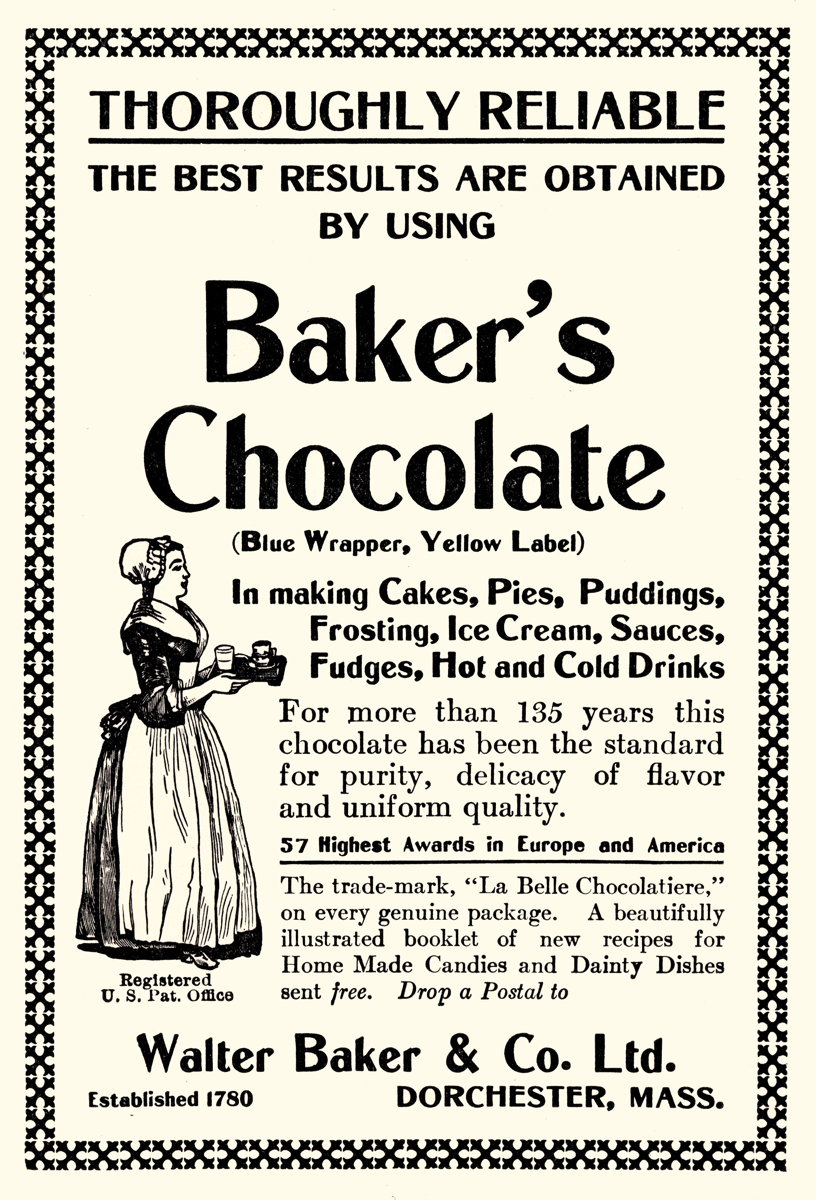
You can tell by the phrase “more than 135 years” that this ad was placed in 1916 or thereabouts. Walter Baker updated their ad copy every year.
While general searches can provide a lot of information about a cookbook, specialized newspaper and magazine archives will also be helpful. Many old periodicals aren’t indexed in general search engines. Check your local library to see if you have access to online newspaper and magazine archives. My library provides access to newspapers.com, so that’s what I use. The Internet Archive has many old magazines, such as Good Housekeeping, McCall’s Magazine, and The Ladies’ Home Journal. These are especially helpful for looking up old advertisements, in order to see product packaging or design1 and compare them to ads in the undated cookbook.
Advertising pamphlets regularly go through multiple printings and whether the year is included on a particular printing can seem completely random. This means that finding versions of a pamphlet on the Internet Archive can help you date that book even if your copy is not on the archive.
For example, The Quaker Oats Wholegrain Cookbook went through at least five printings. I have the fifth printing, listed as from 1979. The Internet Archive has two printings. One is labeled First Printing 1978 and the other has no printing number or year at all. That space on the back cover is blank. All three of the printings appear to be exactly the same other than that back cover line (or lack thereof).2
Why is there an undated version? Is the undated version at some point after the fifth printing when they decided they were never going to change it so why bother? Is it a zeroth printing, and the first printing is really a second printing? Or did they produce a printing after the first where they removed that line, and then added it back later?
The answer, of course, is “who knows?” But knowing that the first and fifth printings came out in 1978 and 1979 also means that the second through fourth printings came out in that range.
Titles of promotional and community cookbooks can easily be misconstrued. A “centennial” or “bicentennial” cookbook could be for the anniversary of a town, a state, and even a business, rather than marking an anniversary of American independence. Such a title could even come from a product line that has “centennial” in its name. The New Centennial Cook Book first appears in newspaper ads only in 1881. It’s a promotional item for purchasers of a Centennial Cake Pan. While the cake pan is possibly named after the American centennial in 1876, the book itself was almost certainly named after the line of baking pans.
Advertisements in community cookbooks can provide useful clues to the cookbook’s age. Some are bright and clear-cut. For example, Tried and Tested Recipes compiled by the Ladies of the Improvement League of Columbus, N.D., already has a date listed on their indicia page of 1916. But within the book is an ad for Baker’s Chocolate. According to Mary Barile in Cookbooks Worth Collecting, Walter Baker & Co. had a very standard ad copy that they used for community cookbook ads, which they updated every year.
For more than xxx years this chocolate has been the standard for purity, delicacy of flavor and uniform quality.
Baker’s Chocolate was introduced in 1780, so you can do the math if you see that ad in one of your books. In Tried and Tested Recipes, the number of years was 135. Add 135 to 1780 and you get 1915, plus 1 for “more than” and you’ve got the 1916 listed on the book’s indicia page. Obviously, depending on the time it took the organization to get the book to publication there may be some upward variation on this calculation. But a Baker’s Chocolate ad should provide a reasonable lower bound.
Most of the time, advertisements are not as precise as a Baker’s Chocolate ad. Few businesses provide a year, even obliquely, in their ads. Once or twice I’ve found either a car dealership or a television dealership advertising their models by year.
Usually, however, business ads look a lot like a business card: name, possibly a phone number, and address, and nothing else. But even these advertisements can still provide useful lower and upper bounds in other ways if you have access to a newspaper archive.
Mineola’s Town and Country Cook Book has several ads. One hard line for the upper bound is that the Knotty Pine Cafe burned down in 1954 and doesn’t appear to have been rebuilt. While there’s no note of them undergoing a catastrophe, a Tarter’s Service Station and a Frank Rholes Shoe Shop disappeared from newspaper ads after February, 1953. So it is unlikely that Mineola’s Town and Country Cook Book came out much later than 1953 or 1954.
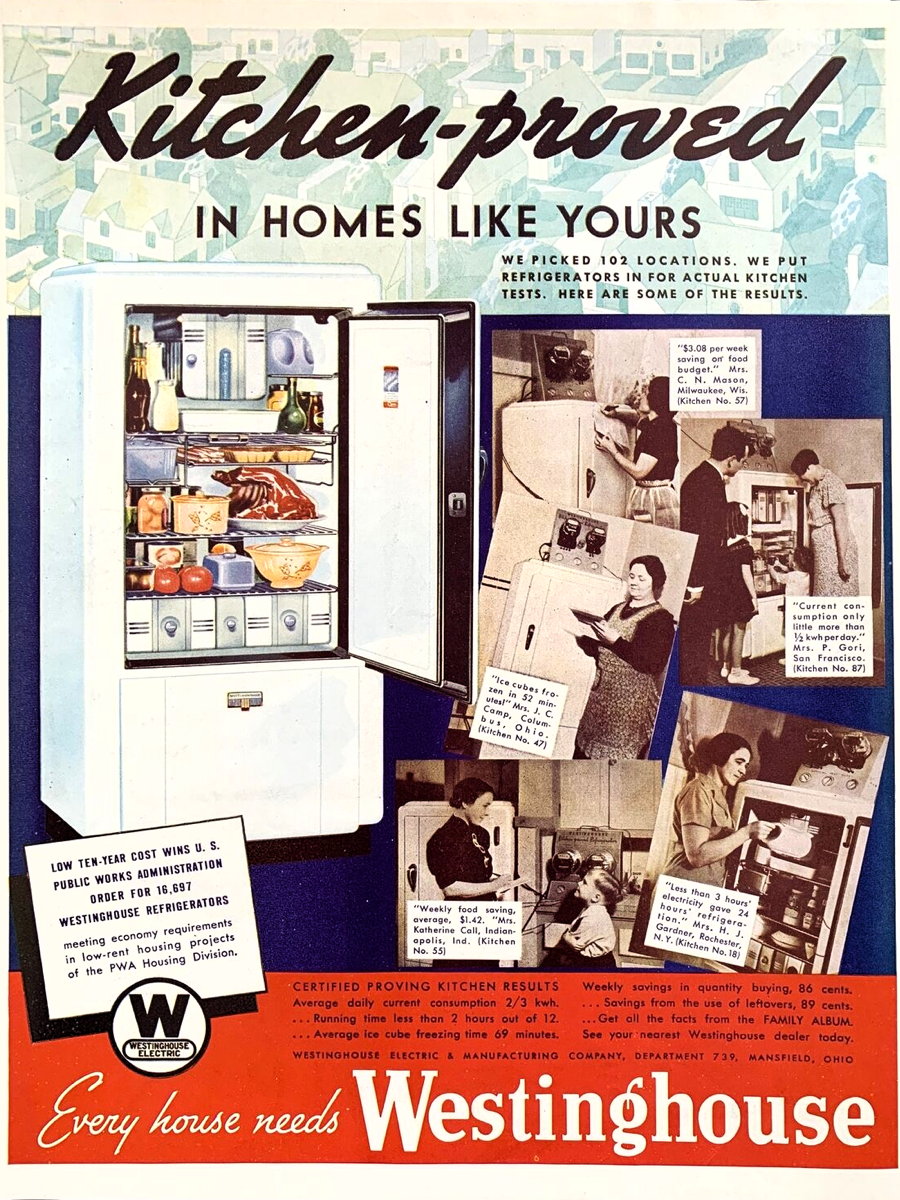
This refrigerator illustration from 1937 matches the refrigerator illustrations in the undated Westinghouse Kitchen-Proved Refrigerator Book.
Searching old newspapers on the organization name, combined with the word “cookbook”, can provide completely unexpected useful information about the date. Knowing that Treats from Arkansas Kitchens was dedicated to the organization’s president, I searched through newspapers.com for cookbooks by that organization. In the April 12, 1963, Camden News, I found this for an Arkansas garden club:
Each member of the club was asked to bring her favorite recipe to the May meeting to be used in compiling a cook book in honor of the state president of Garden clubs.
Since other searches had already indicated that Mrs. Robert Phillips was the state president in 1963, this is an announcement of the then-unnamed Treats. That puts this cookbook’s publication year sometime in 1963 or 1964, maybe 1965 at the outside, depending on how long it took them to compile and publish the book.
In a similar way, phone number styles have changed a couple of times in our history. First was their introduction: telephone service with numbers was introduced at different times in different places usually with a very simple three to four numbers. Later, phone numbers were often given a locale in front of that number, such as the infamous BR-549 or PE 6-5000. Eventually, all locations standardized on the current modern format.
Newspapers often have articles about the switchover; if you see old-style phone numbers, this can provide a soft upper bound to when the book was published, and if you see new-style phone numbers, a soft lower bound. Looking for more information about the Mineola, Texas, Town and Country Cook Book I found an ad in the Wood County Record of September 30, 1957, announcing that “Telephone numbers for Mineola’s new dial phone system will be assigned this week”. An article in the same issue warned that “the changeover is scheduled for December.”
Even into the modern era as populations grow locales have split into multiple area codes. My own home town switched from 616-xxx-xxxx to 231-xxx-xxxx in 1999. If business advertisements include the area code, this can help date the book.
Businesses, especially in their early years, often move to new locations as they grow. Their addresses and phone numbers will change, and smart businesses announce these changes in newspapers. You can correlate their advertisements in newspaper archive searches with their addresses in cookbook advertisements.
They even change their names. Mineola’s Harris Pharmacy changed its name to Ray Watts Pharmacy as of August 17, 1954 according to the Wood Country Record. Meanwhile, Mathews Pontiac announced their new name in the Mineola Monitor for the week of November 13, 1952, dating this book between 1952 and 1954.
Promotional pamphlets also often have photos of the product or its packaging so that their potential customers can recognize it. Product styles and packaging change over time. Correlating any illustrations or photos of a product with similar graphics in newspaper or magazine advertisements can date a book to within a couple of years.
Westinghouse did not include a year in their Westinghouse Kitchen-Proved Refrigerator Book. But they did include an illustration of the refrigerator it presumably accompanied.3 That refrigerator looks very different from their 1936 advertisements and their 1939 advertisements—and very, very close to their 1937 and early 1938 advertisements.
Dromedary, whose pamphlets are almost universally wonderful, changed the design of their coconut can around 1925 after using the same design since at least 1915. Their ads changed at the same time to reflect the new design.
For the ca. 1955 The Best in Cooking in Westfield I was helped by an appliance store advertisement for “this year’s televisions”. It included an illustration of the televisions in question. I was able to find a photograph of a television matching that illustration in a September, 1954, full-page newspaper ad for the “new 1955 Zenith” television.
A company’s promotional pamphlets will often show up in advertisements for the product it’s promoting. Borden appears to have offered their Magic Short-Cut Recipe Book for the Automatic Refrigerator from 1934 to 1940. The Brazil Nut Association seems to have offered their Brazil Nut Recipes first in 1939. They offered a different title in 1935. The Hills Brothers Company helpfully included a drawing of 40 Unique Dromedary Cocoanut Recipes in one of their 1915 ads. Their other 1915 ads are the first appearance of that title.
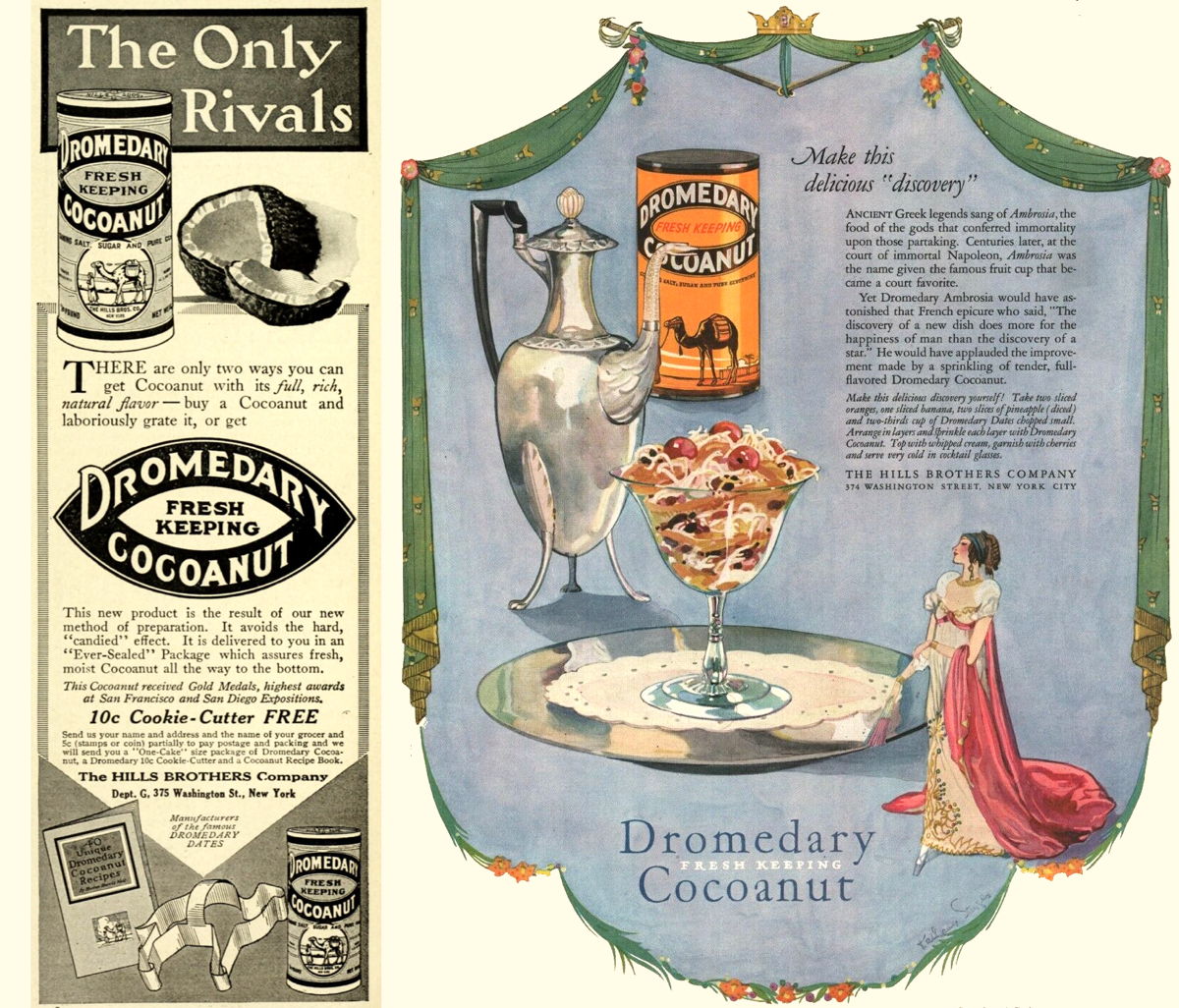
The ad on the left is from 1915. The ad on the right is from 1925. The design on the can has changed.
Weird recipe names can also provide hints, although this gets even further into dating voodoo.
There’s a “Whop-Over” in several Horsford cookbooks on the Internet Archive. It appears in the books dated 1880 and 1887, as well as one undated book. It does not appear in the copy I have, or in an 1895 book also on the archive. Very likely, those books that do include it are from a similar era. Those that do not are outside that era.
The Burns Treasure of Personal Recipes includes a recipe called Baked Lima Loafettes, which appears, word-for-word, in the September 13, 1953, Long Beach, California, Press-Telegram. That’s the only reference on newspapers.com to such a title.
It’s possible, of course, that the Press-Telegram’s Mildred K. Flanary got her Loafettes recipe from the Burns cookbook, but more likely it was the other way around. A lot of community cookbook recipes match recipes published in newspapers and promotional pamphlets, sometimes exactly. Generic titles make it difficult to search for most of them. But when a recipe has a potentially unique name, it can be worthwhile to try.
And in a completely offline search, don’t neglect the strange strings of text, often in a tiny font, on the front, back, or inside cover of promotional books. These codes often have a part that looks a lot like a year, and sometimes a month and a year. Rival Manufacturing Co. has codes like R05-96 and R6-89 on the back cover of two of their manuals.4 Given the style of the manuals, I’m pretty sure the two-digits after the dash are the year, and I wouldn’t be surprised if the first number is the month. I had a bit of personal knowledge here: I didn’t buy Rival’s R6-89 crockpot manual as a vintage manual. It came with the crockpot that I bought new, right around 1990.
Rumford, on their wonderful biscuit sliding cookbook, has the code Z99-1929 on the back. I am nearly certain that the code indicates a year of 1929 for the biscuit slider.
It’s up to you how much work you want to put into dating your cookbooks. I find it fun, and occasionally it even provides interesting stories about the people in the book.
- Cookbook publication year estimates I have made
- Using search engines to guess cookbook years
- Using archives to guess cookbook years ⬅︎
- Using ingredients to guess cookbook years
While I haven’t made Mildred’s Baked Lima Loafettes—I’m not a fan of Lima beans—I did make the wonderfully-titled Dago Dane from Mrs. C.H. Fosburg. I may write about that book’s intriguingly mistyped recipes later, but for now, here’s the Dago Dane.
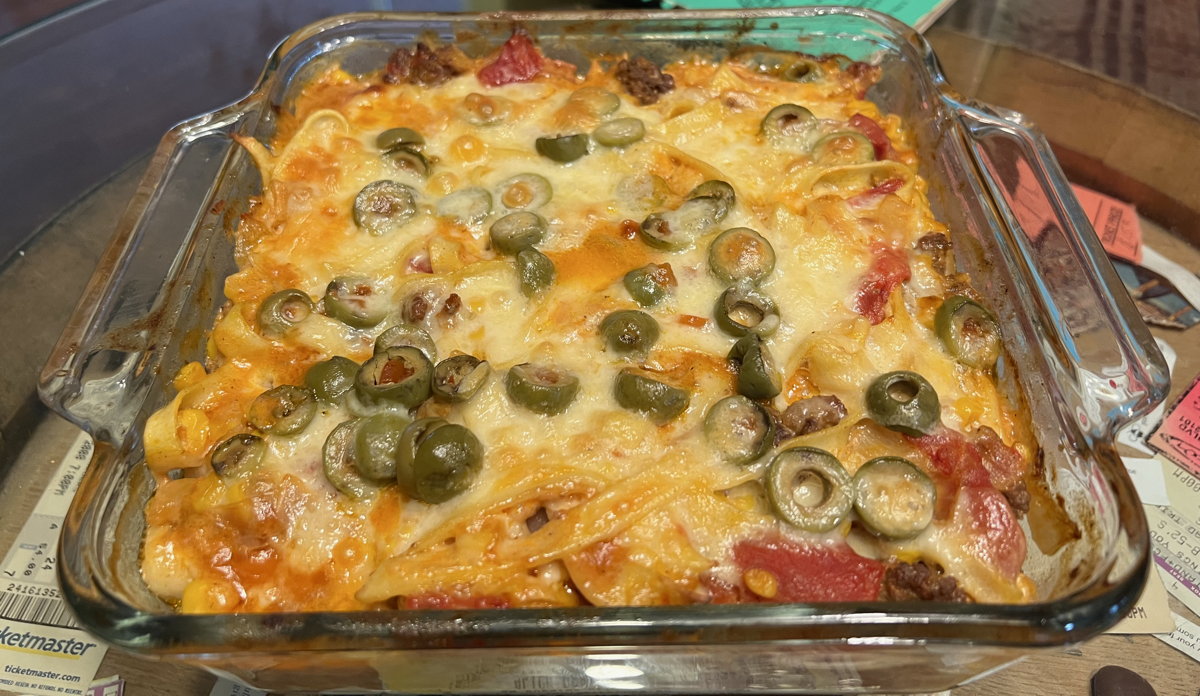
Dago Dane
Servings: 6
Preparation Time: 1 hour
Mrs. C.H. Fosburg
Review: Burns’ Treasure of Personal Recipes (Jerry@Goodreads)
Ingredients
- 1 large onion, sliced
- 2 tbsp fat
- 1 lb ground beef
- 28 oz chopped tomatoes
- 2 15 oz cans corn, drained
- 8 oz egg noodles, cooked
- 8 oz sour cream
- 1-½ tsp salt
- 1-½ tsp pepper
- ½ cup sliced olives
- 8 oz sliced cheese
Steps
- Fry onion slices in fat until limp.
- Add ground beef and stir-fry, mixing thoroughly.
- Add tomatoes and corn, and cook until corn is tender.
- Pour into a 9x13 baking dish.
- Mix in noodles, sour cream, salt, and pepper.
- Top with olives and cheese.
- Bake at 350° until cheese is melted and bubbling, about 30 minutes.
In response to Using search engines to guess cookbook years: Many cookbooks, especially community cookbooks and often advertising pamphlets, leave off the year. Often, however, there are solid clues in the text that narrow down when the book was published, through simple online searches.
The art in old advertisements can also be helpful to find a product’s size. On Dromedary package illustrations, for example, the illustrator often includes the number of ounces or fraction of a pound in the illustration.
↑Since I can’t download the Quaker Oats books that are on the Internet Archive as PDFs I can’t verify this as closely as I’d like with my own copy. Instead of flashing back and forth, I have to go page by page and look back and forth, which is not nearly as accurate.
↑And I use “presumably” guardedly. There’s no guarantee that a company is on the ball enough to make sure that their illustrations match their product. That said, it is a good bet.
↑The first Rival crockpot manual has no such code that I can see.
↑
- The New Centennial Cook Book
- Over 100 Valuable Receipts for Cakes, Pies, Puddings, etc.… borrowed verbatim from other cookbooks.
- The Quaker Oats Wholegrain Cookbook (First Printing) at Internet Archive
- “Welcome to the Wholesomeness and Pleasure of a Wholegrain.” First edition, 1978.
- The Quaker Oats Wholegrain Cookbook (Unknown) at Internet Archive
- “Welcome to the Wholesomeness and Pleasure of a Wholegrain.” Unknown printing, but probably not the 1970 provided by the Internet Archive.
- Refrigerator Revolution Revisited: 1937 Kitchen-Proved
- Refrigerators started to take off during Prohibition, and became ubiquitous following World War II. This Westinghouse refrigerator manual and cookbook gives us a glimpse at home refrigerator/freezers in the Great Depression.
- Review: Burns’ Treasure of Personal Recipes: Jerry Stratton at Jerry@Goodreads
- Pirate-infested islands illustrate this book of poorly-edited but fascinatingly-titled Oregon recipes ca. 1952.
- Review: Cookbooks Worth Collecting: Jerry Stratton at Jerry@Goodreads
- This is sadly a very dated book, making it less than useful for dating older cookbooks. It’s a somewhat haphazard scattering of vintage and antique books, and the advice on pricing predates the collapse in book sales—and thus prices—in the twenty-first century. It still contains fascinating historical info.
- Review: Tried and Tested Recipes of Columbus, ND: Jerry Stratton at Jerry@Goodreads
- From the Ladies of the Improvement League of Columbus, North Dakota, this is both a very nice cookbook and a wonderful look at life in a North Dakota city in 1916.
- Rumford Recipes Sliding Cookbooks
- One of the most interesting experiments in early twentieth century promotional baking pamphlets is this pair of sliding recipe cards from Rumford.
More estimating cookbook dates
- Using ingredients to guess cookbook years
- Community cookbooks often call for brand name products and tools. That can provide a lower bound for what year a book was published, but rarely an upper bound.
- Using search engines to guess cookbook years
- Many cookbooks, especially community cookbooks and often advertising pamphlets, leave off the year. Often, however, there are solid clues in the text that narrow down when the book was published, through simple online searches.
- Cookbook publication year estimates I have made
- When I acquire a cookbook without a publication or copyright year, I use the advertisements and contributors to make a stab at the likely year of publication. This page provides those guesses in case it helps you date your own books.
More food history
- Using ingredients to guess cookbook years
- Community cookbooks often call for brand name products and tools. That can provide a lower bound for what year a book was published, but rarely an upper bound.
- Hot ovens: Bakers were once the slaves of time
- We have chained time in our kitchens. Our refrigerators stop time from destroying food, and our ovens lash it to the oars for baking. And we have forgotten that it was ever any other way.
- Padgett Sunday Supper Club Sestercentennial Cookery
- The Sestercentennial Cookery is a celebration of American home cooking for the 250th anniversary of America’s Declaration of Independence.
- Table and Kitchen: Baking Powder Battle
- The Royal Baking Powder Co. was a very combative entrant in the baking powder wars. But that kind of competitive spirit can also mean great recipes.
- Using search engines to guess cookbook years
- Many cookbooks, especially community cookbooks and often advertising pamphlets, leave off the year. Often, however, there are solid clues in the text that narrow down when the book was published, through simple online searches.
- 28 more pages with the topic food history, and other related pages