


Using ingredients to guess cookbook years
The first reference to “homemade” granola in my collection.
Many recipes in community cookbooks call for ingredients by company and brand name. Eagle Brand Condensed Milk, for example, and Pet Evaporated Milk are very common ingredients. Not only are those names used in a generic manner—you’ll often see condensed milk called Eagle Milk and evaporated milk called Pet Milk, despite both companies producing the other product—a product name obviously won’t be used before the product was introduced to the market.
A brand name isn’t likely to be used in an ingredient list unless that one brand is the only such ingredient on the market, or it has had time to become the semi-generic term for the ingredient. Product debuts can thus provide a lower bound for the year of publication when a recipe calls for such a product.
Jell-O is a very good example of a brand name that has become a generic name or nearly so for the ingredient. A recipe after Jell-O’s rise in popularity is as likely to call for “jello” as it is to call for “gelatin”, especially if the gelatin called for is a flavored gelatin.
Sometimes, the way an ingredient is referred to can provide a hint to the age of the cookbook. In Favorite Recipes Prepared by Fremont Nursery, Inc. there is a great recipe for “Homemade granola” from Joy Dykman. Why would it be called “homemade” granola? One likely reason is that the first mass-market granola came out in 1972, and the recipe’s title contrasts itself with commercial granola. That narrows the range for the cookbook’s publication considerably. It almost certainly came out after 1972. While I can find granola recipes in cookbooks before 1972, none that I’ve seen call themselves “homemade”. Homemade was the only kind of granola before 1972 and didn’t need to be noted.
Here’s a list of products commonly found in community cookbooks, and their debuts under that name. This list is mainly ones that I’ve used or tried to use to help date cookbooks in my collection:
| Product or term | Year |
|---|---|
| 1-800 telephone numbers (expensive): | 1966 |
| 1-800 telephone numbers (less expensive): | 1984 |
| 1-800 telephone numbers (inexpensive): | 1994 |
| All-purpose flour: | 1928 (about) |
| Campbell’s Condensed Soups: | 1897 |
| Coca-Cola “King-Size” (10-12 oz) bottles: | 1955 |
| Chocolate Chips: | 1941 |
| Cool Whip: | 1966 |
| Cracker Barrel Cheddar: | 1954 |
| Crock-Pot: | 1970 |
| Daffodil Table Margarine: | 1949 |
| Dream Whip: | 1957 |
| Eagle Brand Condensed Milk: | 1858 |
| Electric Blender (Osterizer): | 1946 |
| Electric Blender (Osterizer, two-speed): | 1955 |
| Electric Blender (Waring): | 1937 |
| Granola (Heartland Natural Cereal): | 1972 |
| Hawaiian Punch cans: | 1934 |
| Hawaiian Punch 8-ounce cans: | 1973 |
| Hawaiian Punch powder: | 1976 |
| Heath Bars: | 1928 |
| Jell-O (popularized): | 1899 |
| Kellogg’s All-Bran: | 1916 |
| Kellogg’s Bran Flakes: | 1915 |
| Kellogg’s Corn Flakes: | 1906 |
| La Choy Food Products: | 1922 |
| Miracle Whip: | 1933 |
| Nestlé Quik: | 1948 |
| Pepperidge Farm herbed stuffing: | 1947 |
| Pet Milk Evaporated Milk: | 1895 |
| Raisin Bran: | 1926 |
| Rice Krispies: | 1928 |
| Saran Wrap: | 1949 |
| Special K: | 1955 |
| Tang | 1959 |
| Tupperware containers: | 1956 |
| Zip Codes and two-letter state abbreviations: | 1963 |
| Ziploc bags: | 1968 |
You can often find out when a product was introduced by searching for “PRODUCT NAME history” or “When was PRODUCT NAME introduced?”.
Sadly, many product names are poorly chosen for this sort of a search. If a product name is also a common phrase, that makes it very difficult to get information on it. “Thank You” pie fillings, for example, are a difficult search because “thank you” is a very common phrase. The aforementioned Fremont cookbook has one recipe that calls for “White Stars”. Judging from the context they’re some sort of chip for melting into candies. “White Stars” doesn’t appear to be a generic name, so it’s probably a brand name. But good luck finding them in a search engine!
Wikipedia has a list of years and the foods and drinks introduced during those years; you’ll probably want to follow up on their references to be sure that what they mean by an introduction is enough to date a recipe that uses the product. The list is also not formatted in a particularly useful manner: you have to follow the links by year rather than by product.
Remember that a “product” doesn’t have to mean an edible. The electric kitchen blender wasn’t introduced until 1937, mainly for drinks. There were blenders before that, but they were meant for soda fountains, not home kitchens. The two-speed Osterizer, which may have been the first multi-speed blender, didn’t come out until 1955. If a recipe’s instructions call for a blender, it probably came out after 1937. If it calls for blending at “high speed” or “low speed” it’s likely from after 1955.
While product names can reliably be used to place a lower bound on cookbook dates, it’s probably unreliable to use discontinued products for an upper bound. Product names that become a generic or semi-generic name for the ingredient can live beyond the brand’s discontinuation. If you still receive food shipments packed in “dry ice”, for example, you’re using the once-trademarked name for frozen carbon dioxide. As far as I can tell, the Dry Ice Corporation of America, which used that term for their product, is long gone. I expect that if Jell-O was removed from the market people would still use the name in recipes for years if not decades to come.
Granola is an interesting example because it was a trademark for a Grape-Nut-like cereal in the late 1800s. The product was discontinued, and, much later, the term was resurrected for a very different product that became the granola we know today.
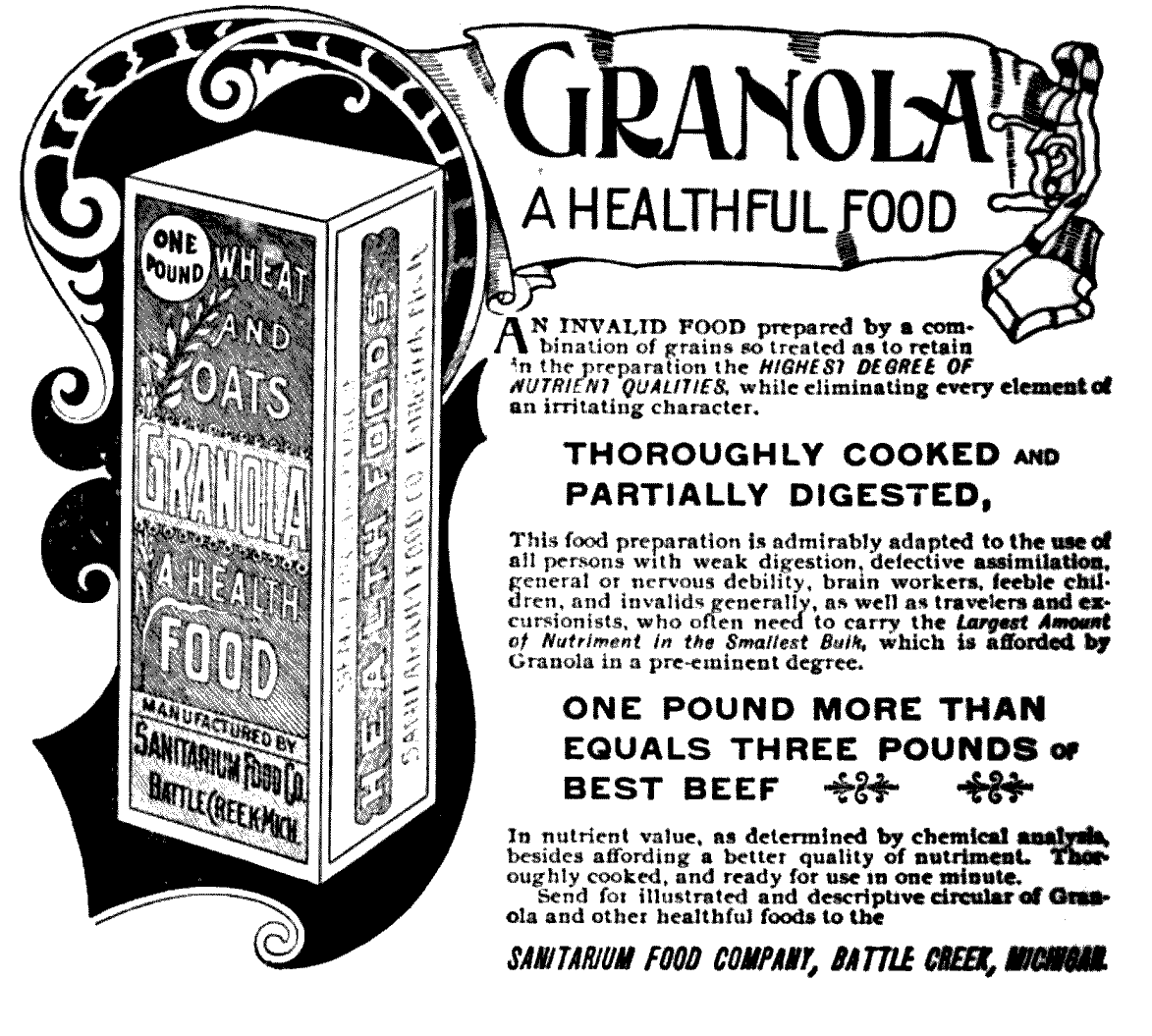
This 1893 granola was very different from what we think of as granola. It appears to have been more like Grape-Nuts.
All-purpose flour is also a term that has seen serious changes. While most sources say that the phrase “all purpose flour” was used throughout the nineteenth century, it appears to have meant something different in the nineteenth century than in the later twentieth century. In the 1800s it appears to have meant a less expensive flour still useful for all purposes. In fact, the term alternates, sometimes “an all purpose flour” or “an all purposes flour” or “the all purpose flour”, always after the brand name.
It doesn’t seem to mean a kind of flour but a grade of flour.
The first use of “all purpose flour” in an actual recipe that I could find searching newspapers.com and the Internet Archive was in the Los Angeles Evening Citizen News, for Burnt Sugar Cake, on July 13, 1928. However, take this with a grain of salt: to find it in a recipe, I did the search on “cups all purpose flour” and “cup all purpose flour”.1
After 1928, the term “all-purpose flour” became very common in recipes in newspapers. The first cookbook I have that calls for “all-purpose flour” is a Pet Milk book from 1940. The first community cookbook I have that does is an Arkansas book from about 1963.
Even sizes live beyond their life in the market. A recipe calling for a square of chocolate likely dates the book to after Baker’s Chocolate introduced chocolate bars that were pre-scored into one-ounce squares. But recipes today still call for “squares of chocolate” when they mean ounces, even though Baker’s has subdivided their ounces into half-ounces.
What I generally do when using recipe ingredients to help date a cookbook is to page through the book and note possibly-useful ingredients and instructions, and their page number. Then, I try to search each term, to get a decent lower bound for the book’s publication year. Some can quickly be tossed out when it turns out that the product was introduced well before the lower bounds of other clues to the book’s publication year.
These searches can become fascinating deep dives in themselves. Until I started using this technique, I had no idea how recently granola was introduced. I was similarly surprised by how recently chocolate chips were introduced! I happened to be reading through The Joy of Cooking recently and noticed this odd phrasing:
A specially prepared chocolate may be bought for use in cookies. Any semisweet chocolate may be substituted, cut into pea-sized pieces.
Chocolate chips as a commercial item, it turns out, date only back to 1941!2 Before 1941 you had to break the chocolate yourself, chipping off pieces as necessary. It was a common enough practice that Nestlé even supposedly started including a tool to help you break their chocolate bars into chips. When they realized how popular chocolate chip cookies were, Nestlé very quickly introduced their own pre-chipped chocolate. My copy of The Joy of Cooking is the 1946 edition, which is a slightly-updated version of the 1943 edition3. When Irma Rombauer wrote that note, chocolate chips were likely only two years old.
It had never occurred to me to use chocolate chips as a tool for dating cookbooks. But it seems to work. None of my pre-1938 cookbooks call for chocolate chips.
- Cookbook publication year estimates I have made
- Using search engines to guess cookbook years
- Using archives to guess cookbook years
- Using ingredients to guess cookbook years ⬅︎
Here’s the granola recipe that helped me date the Fremont Nursery cookbook. And if you happen to know when other product names and cooking terms were introduced, sound off in the comments or in the chat room!
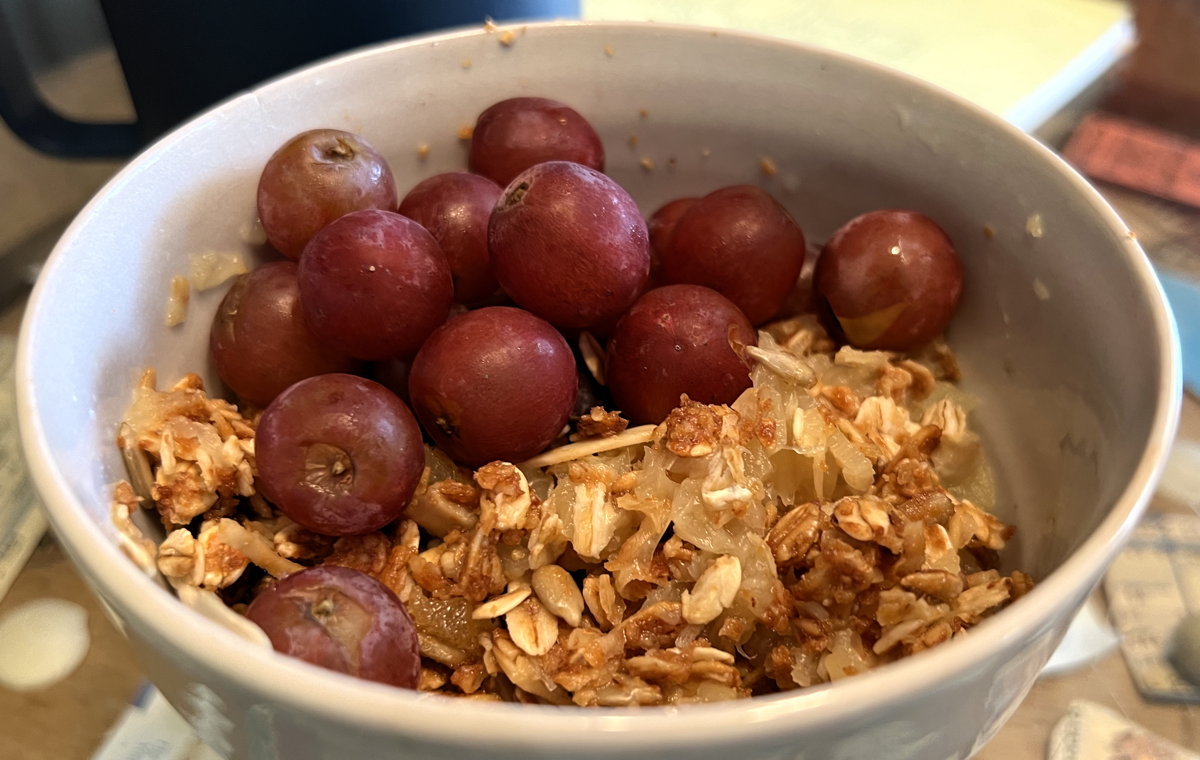
Fremont Homemade Granola
Servings: 12
Preparation Time: 45 minutes
Joy Dykman
Review: Favorite Recipes Prepared by Fremont Nurseries, Inc. (Jerry@Goodreads)
Ingredients
- 4 cups oatmeal
- 1 cup shredded coconut
- ½ cup slivered almonds
- ½ cup sunflower seeds
- ½ cup toasted wheat germ
- ½ cup powdered milk
- ½ cup honey
- ¼ cup cooking oil
Steps
- Combine the oatmeal, coconut, almonds, sunflower seeds, and wheat germ in a large bowl.
- Mix the honey and oil well.
- Stir honey and oil into the dry ingredients.
- Spread flat on a large, greased, cookie sheet.
- Bake for about 30 minutes at 325°, stirring every ten minutes or so.
- Remove from oven.
- Stir in any dried fruit—raisins, apricots, etc. that you desire.
- Let cool.
In response to Using search engines to guess cookbook years: Many cookbooks, especially community cookbooks and often advertising pamphlets, leave off the year. Often, however, there are solid clues in the text that narrow down when the book was published, through simple online searches.
For both newspapers.com and the Internet Archive, those two searches produced the same result. The change between singular and plural in “cup” made no difference. Also, this search was hampered by the Internet Archive having mis-yeared a lot of its documents. Every time I thought I’d found an earlier use of “all-purpose flour” in a recipe, it turned out to be much more recent than the Internet Archive had it listed as.
↑This is not exactly true. There was a commercial item called “Chocolate Chips” dating back at least to 1920 as a candy, and “Graham Chocolate Chip Cookies” to at least 1919. But they appear to have been only advertised sporadically and with no description of what was meant by the term. Nor were there any recipes for them in the newspapers I have access to—the first chocolate chip cookie recipes I know of appeared in 1938. I will have more about this later.
↑I’m pretty sure that the main update to the 1946 edition from the 1943 edition of The Joy of Cooking was to remove the wartime cooking section.
↑
- Club Padgett chat room
- The Padgett Sunday Supper Club chat room and group on MeWe.
- Food and drink by year of introduction at Wikipedia
- Food and drink debuts, by year of introduction.
- Post Office state abbreviations
- A list of state abbreviations since 1831.
- Review: Favorite Recipes Prepared by Fremont Nurseries, Inc.: Jerry Stratton at Jerry@Goodreads
- This Fremont, Michigan community cookbook features granola, pineapple crunch, beef and noodles, and Michigan-style Texas hash.
- Review: The Joy of Cooking: Jerry Stratton at Jerry@Goodreads
- This edition of Irma Rombauer’s influential book is old enough to be at the dawn of chocolate chips.
More cookbooks
- My Year in Food: 2025
- My year in food extended from 1776 to 2026, from San Diego to Barcelona, and from Texas to Michigan. I also made several vintage books available for you to download!
- Padgett Sunday Supper Club Sestercentennial Cookery
- The Sestercentennial Cookery is a celebration of American home cooking for the 250th anniversary of America’s Declaration of Independence.
- Cookbook publication year estimates I have made
- When I acquire a cookbook without a publication or copyright year, I use the advertisements and contributors to make a stab at the likely year of publication. This page provides those guesses in case it helps you date your own books.
- Refrigerator Revolution Revisited: 1937 Kitchen-Proved
- Refrigerators started to take off during Prohibition, and became ubiquitous following World War II. This Westinghouse refrigerator manual and cookbook gives us a glimpse at home refrigerator/freezers in the Great Depression.
- Four New Ices and an Ice Cream Cookery
- Philadelphia Ice Cream, Walnut Nougat, Lemon Cream Sherbet, and Cranberry Ice. Four more new no-churn ice creams and desserts for Summer 2025. And, a book collecting all my favorite no-churn ice creams if you’re interested!
- 75 more pages with the topic cookbooks, and other related pages
More estimating cookbook dates
- Using archives to guess cookbook years
- Many cookbooks, especially community cookbooks and often advertising pamphlets, leave off the year. Online newspaper and magazine archives can help to narrow down when the book was published.
- Using search engines to guess cookbook years
- Many cookbooks, especially community cookbooks and often advertising pamphlets, leave off the year. Often, however, there are solid clues in the text that narrow down when the book was published, through simple online searches.
- Cookbook publication year estimates I have made
- When I acquire a cookbook without a publication or copyright year, I use the advertisements and contributors to make a stab at the likely year of publication. This page provides those guesses in case it helps you date your own books.
More food history
- Hot ovens: Bakers were once the slaves of time
- We have chained time in our kitchens. Our refrigerators stop time from destroying food, and our ovens lash it to the oars for baking. And we have forgotten that it was ever any other way.
- Using archives to guess cookbook years
- Many cookbooks, especially community cookbooks and often advertising pamphlets, leave off the year. Online newspaper and magazine archives can help to narrow down when the book was published.
- Padgett Sunday Supper Club Sestercentennial Cookery
- The Sestercentennial Cookery is a celebration of American home cooking for the 250th anniversary of America’s Declaration of Independence.
- Table and Kitchen: Baking Powder Battle
- The Royal Baking Powder Co. was a very combative entrant in the baking powder wars. But that kind of competitive spirit can also mean great recipes.
- Using search engines to guess cookbook years
- Many cookbooks, especially community cookbooks and often advertising pamphlets, leave off the year. Often, however, there are solid clues in the text that narrow down when the book was published, through simple online searches.
- 28 more pages with the topic food history, and other related pages