


Songs of the American Revolution
- December 31, 2025: The Battle of the Kegs
-
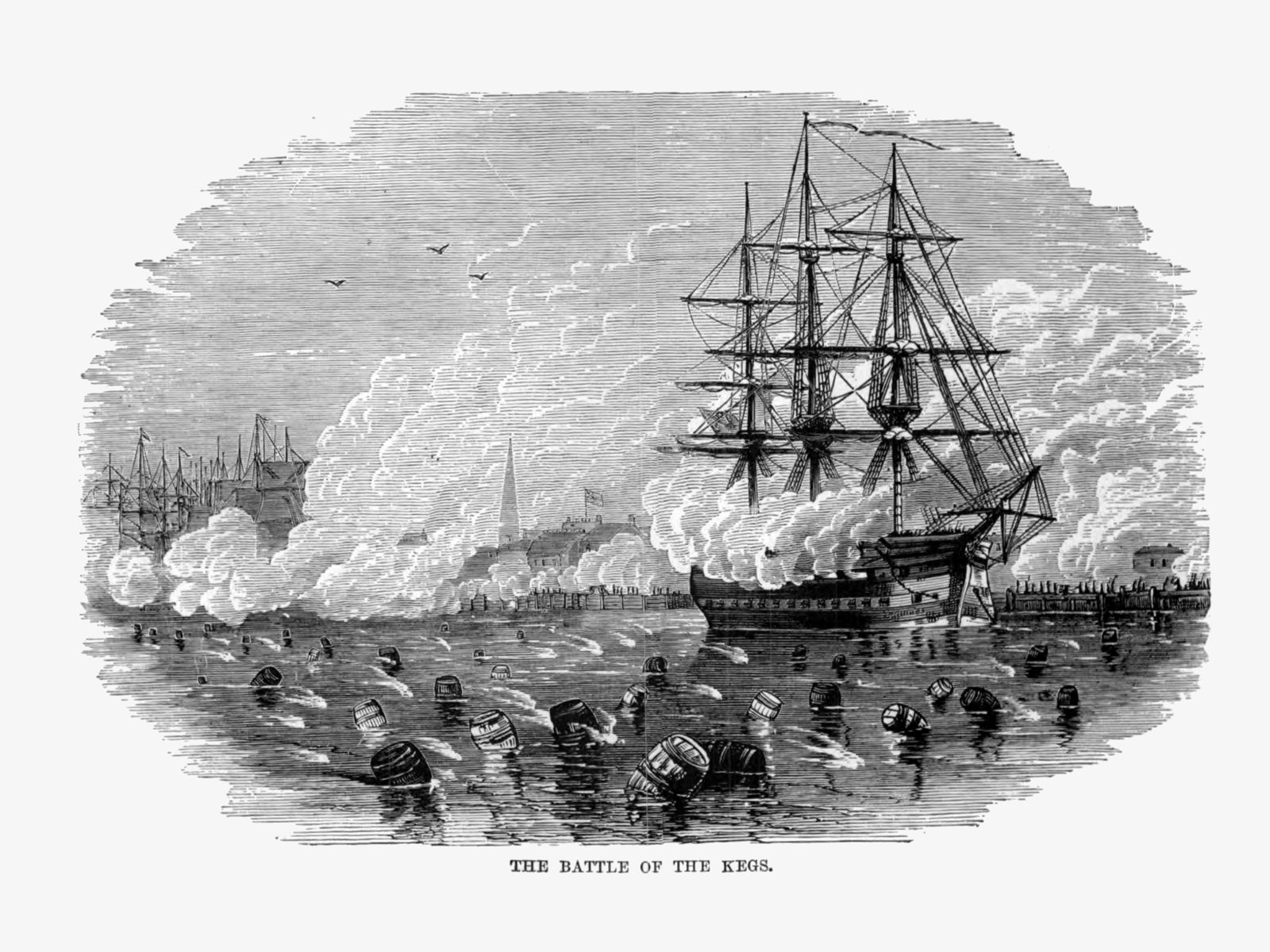
The Battle of the Kegs, as depicted in John Gilmary Shea’s 1872 A Child’s History of the United States.
You may know Francis Hopkinson as one of the less-prominent signers of the Declaration of Independence. But he was much more than a Founder. He was also a poet. I’ve included his wonderful “For a Muse of Fire” in The Padgett Sunday Supper Club Sestercentennial Cookery, which will be the next post in this series. And— he wasn’t just a poet: he was also a satirical poet. This Sunday, January 5, marks the 248th anniversary of the battle that provided him his finest hour as a writer. If there’s a second thing that Hopkinson is remembered for, it is his darkly humorous account of The Battle of the Kegs in rhyme.
Accounts differ in minor points, but sometime around January 5, 1778, David Bushnell—who had previously made the first combat submarine—released gunpowder-filled kegs onto the Delaware River near Bordentown, New Jersey. His hope was that the kegs would explode on contact with British ships patrolling the harbor.
Most sources say that the plan was performed with the knowledge and approval of General Washington. Presumably, then, there was more to the plan than “gunpowder-filled kegs randomly floating down the river”. The kegs are often described as “contact mines”. The few accounts that describe how the mines were to be ignited describe the fuse as a flintlock fuse.
- October 15, 2025: The World Turned Upside Down
-
And of course I used the piano script from 42 Astounding Scripts to create a MIDI file and then GarageBand to make a slideshow of the Revolution.
One of the most enduring stories about the American Revolution is that of Lord Cornwallis’s surrender to George Washington at Yorktown on October 19, 1781. It was the beginning of the end of the revolution; all that was left were long negotiations for a peace treaty. As the British Army left the field on October 19, their band showed their confusion and dejection at having been beaten by a bunch of wild colonial boys by playing the then-popular song “The World Turned Upside Down (PDF File, 560.9 KB)”.
A Sestercentennial Year
- Battle of Bennington
- Upside Down Yorktown ⬅︎
- Cherry Valley Massacre
- Battle of the Kegs
- Sestercentennial Cookery
- The New Colossus
- Irish potato pie
I thought it would be kind of cool to do the music for “The World Turned Upside Down” using the
pianoscript from 42 Astounding Scripts and Automations for the Macintosh. I didn’t know the song’s lyrics or its melody. All I knew was its title and the story of its use.
More American Revolution
- The Battle of the Kegs
- The Battle of the Kegs took place on January 5 or 6, 1778. Soon after, Francis Hopkinson wrote this wonderful account of the debacle, including very personal details about the British General in charge!
- Cherry Valley: A Massacre of the Revolution
- Mel Gibson’s The Patriot is disparaged for the ruthlessness it portrays among the British. But such barbarity certainly did exist. One massacre by British troops is still remembered by the residents of Cherry Valley, New York.
- The World Turned Upside Down
- The legend of the surrender of Lord Cornwallis to Washington at Yorktown says that the band played “The World Turned Upside Down”. It probably didn’t. But we’re going to print the legend anyway.
- Our lot is cast in this happy land…
- Samuel B. Young’s August 16, 1819, Oration to commemorate the 1777 Battle of Bennington.
- Battles of the Revolution
- Sources from well-known and lesser-known battles of the American Revolution.
More folk music
- The World Turned Upside Down
- The legend of the surrender of Lord Cornwallis to Washington at Yorktown says that the band played “The World Turned Upside Down”. It probably didn’t. But we’re going to print the legend anyway.
More music history
- Let mortal tongues awake
- Samuel Francis Smith’s America—more commonly known as “My Country, ’Tis of Thee”— is short, direct, and a wonderful hymn to God as the soul of liberty. It’s a perfect hymn for the Fourth of July. It’s also very easy to play using the piano script from 42 Astounding Scripts.