


The World Turned Upside Down
And of course I used the piano script from 42 Astounding Scripts to create a MIDI file and then GarageBand to make a slideshow of the Revolution.
One of the most enduring stories about the American Revolution is that of Lord Cornwallis’s surrender to George Washington at Yorktown on October 19, 1781. It was the beginning of the end of the revolution; all that was left were long negotiations for a peace treaty. As the British Army left the field on October 19, their band showed their confusion and dejection at having been beaten by a bunch of wild colonial boys by playing the then-popular song “The World Turned Upside Down (PDF File, 560.9 KB)”.
A Sestercentennial Year
- Battle of Bennington
- Upside Down Yorktown ⬅︎
- Cherry Valley Massacre
- Battle of the Kegs
- Sestercentennial Cookery
- The New Colossus
- Irish potato pie
I thought it would be kind of cool to do the music for “The World Turned Upside Down” using the piano script from 42 Astounding Scripts and Automations for the Macintosh. I didn’t know the song’s lyrics or its melody. All I knew was its title and the story of its use.
It turns out practically no one knows it. “The World Turned Upside Down” may be the most famous song in American history that practically no one knows. I’m not the only person who has noticed this. While I was searching for period sheet music, I ran across Dennis Montgomery’s similar observation on American Revolution.org:
Is there a song more famous that almost no one knows? Everyone is good for a couple of bars of “Oh, say can you see…,” or “Mine eyes have seen the glory…” Who do you know who can whistle a note of “The World Turned Upside Down?” Ever even heard “The World Turned Upside Down?”
I never did find any sheet music for it from the 1780s, nor even from around the 1700s. I couldn’t even find a period reference to the lyrics used for this supposedly then-popular song. I did the usual searches for old documents online: newspapers.com, the Internet Archive, government archives. Even googling it on general search engines to pick up other archives.
I was able to find a more recent version in Oscar Brand’s frustratingly wonderful pre-Bicentennial Songs of ’76. It’s a collection of songs supposedly from the actual time of the war. It’s frustrating because it comes with practically no references, and almost all of the songs are marked as “New music and edited text © 1972 by Oscar Brand”. Some have the same notice, with 1956 as the year. What edits? He rarely says. If you want to look up the original versions, you’re completely on your own.
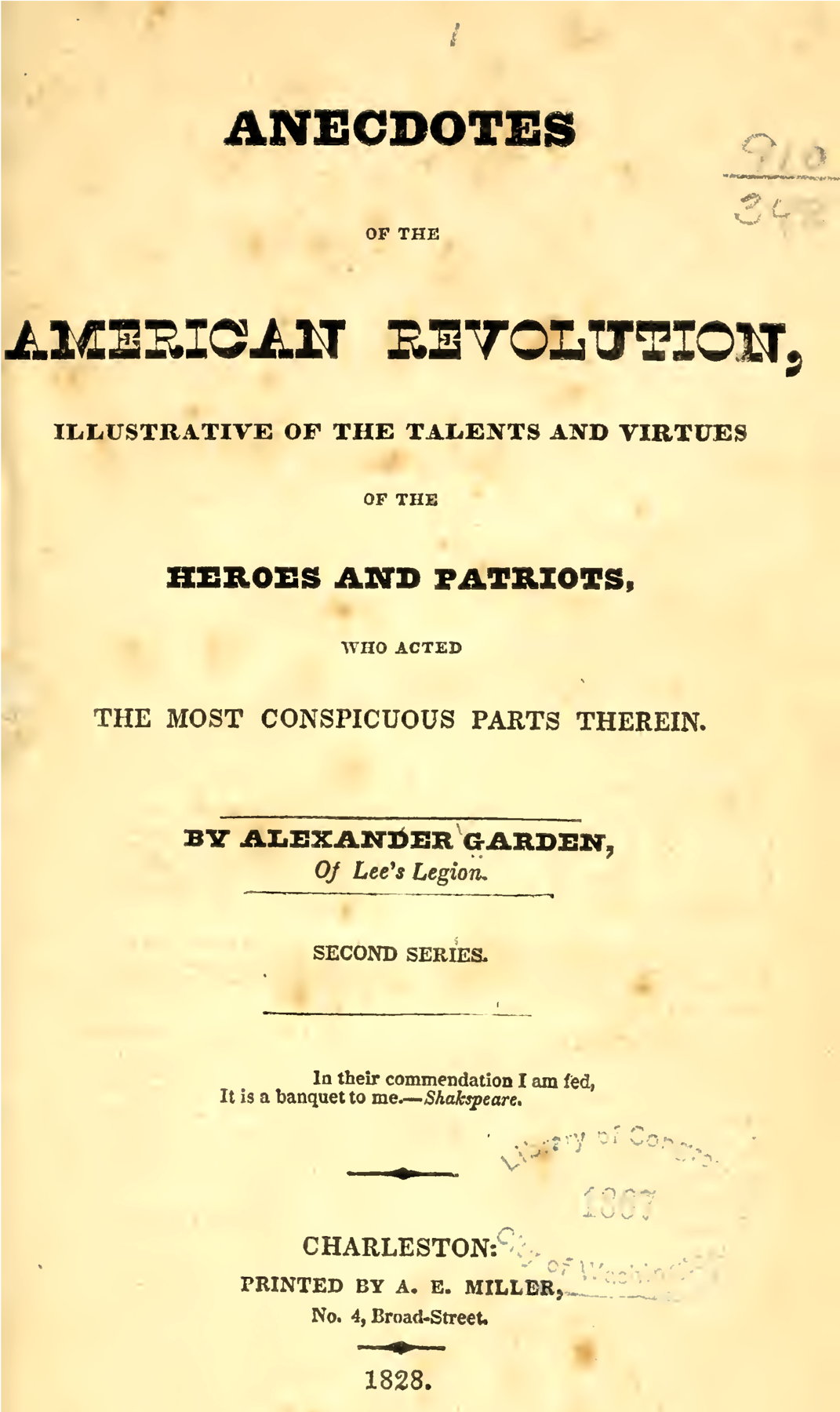
This 1828 book contains the first known reference to “The World Turned Upside Down” having been played at Cornwallis’s surrender.
Two of the songs, one of which is “The World Turned Upside Down”, are not marked with a “new edits” notice. I suspect that was a typo, and continued searching for an original so that I could be sure I had a version without edits. The original of a song played in 1781 would obviously be back in the public domain for public use, after all. And besides, I’d like to see the original.
But there’s nothing.
What I did find out is that there is very little evidence that the legend actually happened, that is, that the song was actually played at Yorktown. But even the doubters believed that it was a popular tune. It would have had to have been, to have been recognized as part of the legend. Or would it?
A song of that title was originally used to protest Parliament’s 1647 ban on traditional Christmas celebrations in favor of a more subdued observation deemed more appropriate in the Cromwell era.
- Listen to me and you shall hear,
- News hath not been this thousand year:
- Since Heros, Caesar, and many more,
- You never heard the like before.
- Holy-days are despis’d,
- New fashions are devis’d.
- Old Christmas is kickt out of Town.
- Yet let’s be content, and the times lament,
- You see the world turn’d upside down.
The phrase “the world upside down” supposedly comes from the Bible. Specifically, Acts 17:5-8 in the King James version that British subjects would have used at the time. The Apostle Paul has gone to Thessalonica, and has convinced many Jews and Greeks of the resurrection of Jesus, bringing them over to Christianity…
But the Jews which believed not, moved with envy, took unto them certain lewd fellows of the baser sort, and gathered a company, and set all the city on an uproar, and assaulted the house of Jason [where Paul was staying], and sought to bring them out to the people.
And when they found them not, they drew Jason and certain brethren unto the rulers of the city, crying, These that have turned the world upside down are come hither also;
Whom Jason hath received: and these all do contrary to the decrees of Caesar, saying that there is another king, one Jesus.
And they troubled the people and the rulers of the city, when they heard these things.
How that story applies to Parliament banning traditional English Christmas celebrations, I don’t know. Technically, attributing overturning the world to Parliament would be putting them on par with the Apostles, which isn’t much of an insult.
For the new Americans, and for us today, that’s the aspect of the song that made the legend famous. It rests entirely on the title. That phrase and its origin highlights what the Americans thought the British must have felt about losing to a ragtag mix of provincials and Frenchmen. “The world turned upside down” is such an evocative phrase that it’s been used for everything from historical novels to histories, to polemics, to at least one chapbook from the same era, and even a pub!
What lyrics we have for “The World Turned Upside Down” vary widely. And for all its supposed popularity in 1781 it’s very difficult to find period sheet music for it. It’s the title that everyone knows. The lyrics? The melody? They are obscure at best.
The entry in Songs of ’76 is the first time I’ve seen any lyrics for it. Oscar Brand doesn’t say where he got his melody, but according to some sources, the original melody comes from “When the King Enjoys His Own Again”, which if true is almost certainly part of the original’s dig at Parliament. On the other hand, another source puts “The World Is Turned Upside Down” first, and the King getting his melody from the upside down world.
Everything is upside down about this legendary song.
Others place the source of the melody as “Derry Down”, which has been used for a lot of lyrics. Which isn’t weird. Melodies got borrowed like crazy back then. Brand’s Songs of ’76 even has a couple of dueling parodies, where a melody would get used by rebels against loyalists, and then loyalists would use the same melody to lampoon rebels, and back and forth throughout the war.
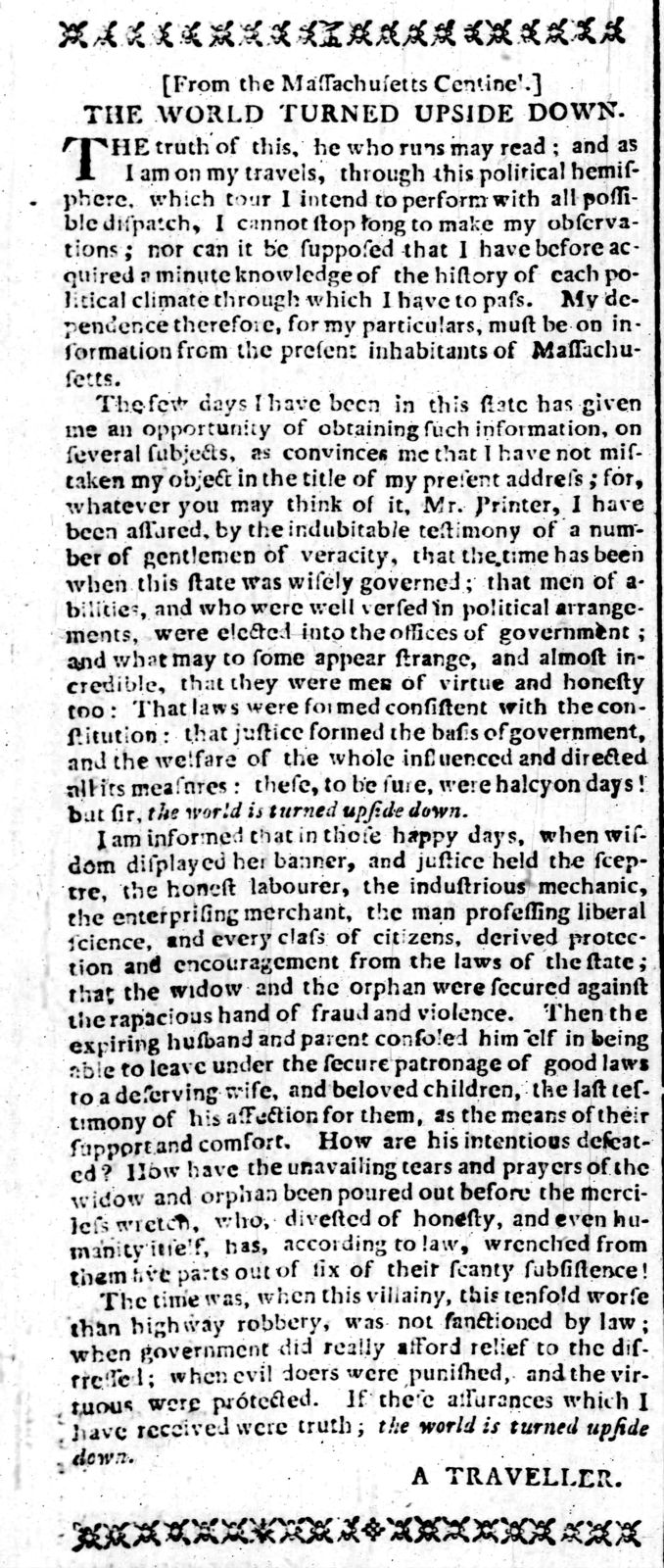
Is this 1787 letter to the editor of the Massachusetts Sentinel referencing the Bible, the song, the Cornwallis legend, or just the phrase itself?
The same melody could easily have three or four or five related lyrics in such a back-and-forth, let alone all of the unrelated lyrics preceding the parodies.
The earliest known reference to the song being played at Yorktown is from 1828, in Alexander Garden’s Anecdotes of the American Revolution. Which, at five decades after the event in question is getting a little long in the tooth for a memory that no one’s mentioned before.1 In Anecdotes, Garden describes the infamous surrender at the end of a section titled “Embassy of Lieut. Col. Laurens to France, in 1781.”
The British army marched out with colours cased, and drums beating a British or a German march. The march they chose was—“The world turned up side down.”
I haven’t heard When the King Enjoys His Own Again, but I don’t think anyone would describe Derry Down as a march. That said, a military band can probably turn anything into a march. But that brings up another important point: what would not have been part of that march?
Lyrics.
Military bands didn’t, and don’t, generally do lyrics. Even if the military band was just some soldiers, we have that in our mythology, too: Archibald M. Willard’s “Spirit of ’76” with its three bandaged soldiers. They have two drummers and a fife player.
They do not have a lead singer.
So now you’ve got several possible lyrics, some of which aren’t “The World Turned Upside Down”, and a ton of possible melodies that expand “several” possible lyrics to a pure mess of them. How would the listeners know which lyrics the band meant for the tune they played marching out?
And then go back up to the Bible quote again. Who was it that turned the world upside down? The Apostles who brought Christianity to Thessalonica. Is that a reference that British soldiers would use against the rebels they’ve just lost to?
Especially since “When the King Enjoys His Own Again” would itself be reasonably appropriate for the British to play.
- What Booker can prognosticate
- Concerning Kings or Kingdoms fate
- I think myself to be as wise
- As him that gameth on the skies
- My skill goes beyond the depths of a pond
- Or river in the greatest rain
- Whereby I tell all things will be well
- When the King enjoys his own again.
The final verse ends with “Else never rejoice till I hear the voice/That the King enjoys his own again.”
If the British musicians played a tune that could be one or the other of these two sets of lyrics, it seems more likely they would have meant it as a prediction that the colonists would come crawling back to the king rather than that the colonists turned the world upside down.
While I have my doubts about the popularity of “The World Turned Upside Down” given how difficult it was to find any actual period references, it does seem to have been popular enough, at least in 1828, for Alexander Garden to mention it without any explanation of where the song came from or what it was about. Or was it? Again, the legend endures, in my opinion, because of the title. The title is all that most people know about it. And it’s all they need to know about it to get the point of the legend.
The phrase itself was used in the States nearly back to the revolutionary period as a term to describe what we would call things going south, badly. The earliest that the phrase shows up on newspapers.com is as the title of a column in the May 19, 1787, Pittsburgh Weekly Gazette, reprinted “From the Massachusetts Centinel.”
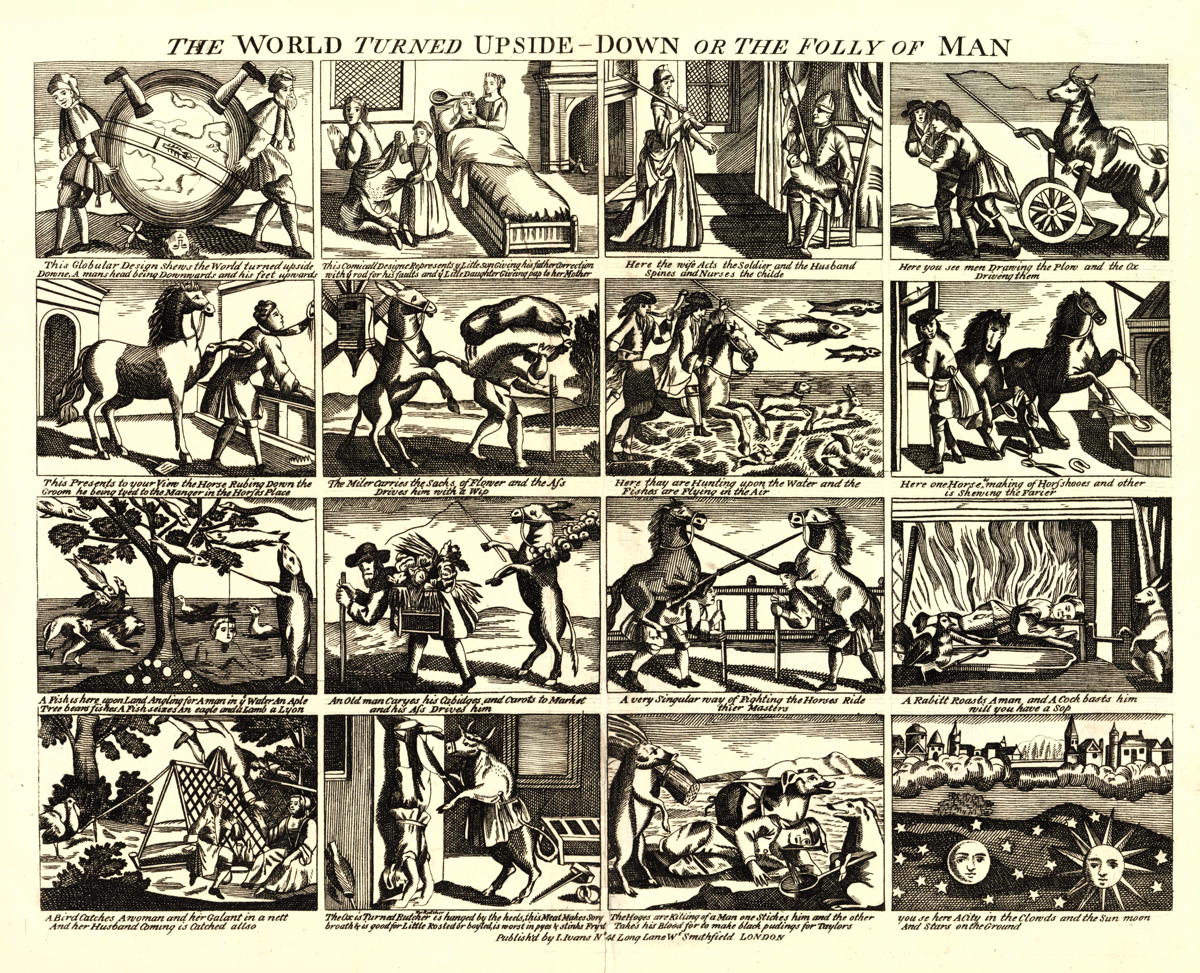
Ca. 1790 depiction of things similar to that depicted in the most commonly attributed song lyrics for “The World Turned Upside Down” played at the surrender of Cornwallis.
THE WORLD TURNED UPSIDE DOWN
THE truth of this, he who runs may read; and as I am on my travels, through this political hemisphere, which tour I intend to perform with all possible dispatch, I cannot stop long to make my observations; nor can it be supposed that I have before acquired a minute knowledge of the history of each political climate through which I have to pass. My dependence therefore, for my particulars, must be on information from the present inhabitants of Massachusetts.
The few days I have been in this state has given me an opportunity of obtaining such information, on several subjects, as convinces me that I have not mistaken my object in the title of my present address; for, whatever you may think of it, Mr. Printer, I have been assured, by the indubitable testimony of a number of gentlemen of veracity, that the time has been when this state was wisely governed; that men of abilities, and who were well versed in political arrangements, were elected into the offices of government; and what may to some appear strange, and almost incredible, that they were men of virtue and honesty too: That laws were formed consistent with the constitution: that justice formed the basis of government, and the welfare of the whole influenced and directed all its measures: these, to be sure, were halcyon days! but sir, the world is turned upside down.
I am informed that in those happy days, when wisdom displayed her banner, and justice held the sceptre, the honest labourer, the industrious mechanic, the enterprising merchant, the man professing liberal science, and every class of citizens, derived protection and encouragement from the laws of the state; that the widow and the orphan were secured against the rapacious hand of fraud and violence. Then the expiring husband and parent consoled himself in being able to leave under the secure patronage of good laws to a deserving wife, and beloved children, the last testimony of his affection for them, as the means of their support and comfort. How are his intentions defeated? How have the unavailing tears and prayers of the widow and orphan been poured out before the merciless wretch, who, divested of honesty, and even humanity itself, has, according to law, wrenched from them five parts out of six of their scanty subsistence!
The time was, when this villainy, this tenfold worse than highway robbery, was not sanctioned by law; when government did really afford relief to the distressed; when evil doers were punished, and the virtuous were protected. If these assurances which I have received were truth; the world is turned upside down.
A TRAVELLER
What’s really going to bake your noodle is, was that anonymous 1787 letter writer referencing the legend of Cornwallis and Yorktown and just assuming everyone got the joke?
Whether the legend happened or not, whether there even was a legend before 1828, once told, it seems to have struck a chord pretty quickly within the United States. My guess is that Garden’s Anecdotes did in fact use an existing legend, one that spoke directly to our gratefulness for success in that wild endeavor. How old that legend was in 1828 and how accurate I couldn’t begin to guess, but the legend itself is both a recognition of how unlikely that success was and how we thought it would have appeared to the outside world.
It perhaps also speaks to a little hubris, for having brought freedom to this land, as Paul had done in Thessalonica.
Regardless of what, if anything, was played, how, and what it meant, the legend of “The World Turned Upside Down” really is a great story and a great legend. So going forward with the legend, the most obvious choice of lyrics for the song are the nonsense ones with one or two verses depending on how you count them. I count them as two, at least if done to “Derry Down”.
- If buttercups buzz’d after the bee,
- If boats were on land, churches on sea,
- If ponies rode men and if grass ate the cows,
- And cats should be chased into holes by the mouse,
- Down, Down Upside Down
- If mamas sold their babies
- To the Gypsies for half a crown;
- If summer were spring and the other way round,
- Then all the world would be upside down.
- Down, Down Upside Down
I love nonsense songs, and this is a wonderful example from the genre that actually has an obvious reason for being nonsense—which makes it not a nonsense song at all. I’m using the lyrics from American Revolution; they match other lyrics out there as well as the lyrics in Oscar Brand’s book. For the melody, I’m using the “Derry Down” melody (PDF File, 560.9 KB) from Carl Sandburg’s 1927 The American Songbag. It fits well, assuming that some of the syllables are sung over multiple notes. And it has the advantage of being old enough to have returned to the public domain.
Like Brand I’m adding my own edits to the lyrics. I’ve added “Down, Down Upside Down” to the end of each verse. It appears to be needed to replace the “Down, Down Derry Down” of the original melody. It also highlights that those lyrics look like two verses to me, and adding a chorus turns it into the two verses I think it is.
I also added what I hope is a passable chord progression for guitarists who want to play along. If you know anything about constructing chord progressions from bass lines, you know more than me, so you’ll probably want to use your own.
You can also download the music files (Zip file, 1.3 MB) I used to create the MIDI files that I used to create the melody, using the piano script from 42 Astoundingly Useful Scripts and Automations for the Macintosh. The slideshow I created with the melody uses woodcuts and paintings depicting the events leading up to the war and through to its end. Some are even political cartoons from the era.
I hope you enjoyed the story, the story behind the story, and the sheet music (PDF File, 560.9 KB) I’ve made up as we head into our celebration of the 250th anniversary of the signing of our Declaration of Independence!
In response to Songs of the American Revolution: Various songs, and the history of the songs, that made the Revolution—sometimes decades later.
Alexander Garden’s 1828 Anecdotes of the American Revolution is often confused with his 1822 Anecdotes of the Revolutionary War in America. The latter is a series of character sketches where the former is a very similar but more event-oriented work, and presented as a “second series” of anecdotes. The two works appear to have been reprinted in 1865 as a two-volume Anecdotes of the American Revolution.
↑
Music downloads
- World Turned Upside Down
- A two-verse MP3 for The World Turned Upside Down, suing the melody from Derry Down.
- World Turned Upside Down piano files (Zip file, 1.3 MB)
- Files for use with the Astounding piano Script, which you can use to play directly or to create MIDI files and use them in GarageBand. MIDI files and an MP3 of the result are also included.
- The World Turned Upside Down sheet music (PDF File, 560.9 KB)
- Sheet music for “The World Turned Upside Down”, to the tune of Derry Down.
- Yorktown: The World Turned Upside Down: Jerry Stratton at Mimsy@YouTube
- An interpretation of “The World Turned Upside Down”, using Derry Down as the melody, over woodcuts and paintings depicting the American Revolution.
anecdotes
- Anecdotes of the American Revolution: Alexander Garden at Internet Archive (ebook)
- “Illustrative of the talents and virtues of the heroes and patriots who acted the most conspicuous parts therein.” From 1828.
- Anecdotes of the American Revolution Volume I: Alexander Garden at Internet Archive (ebook)
- Illustrative of the Talents and Virtues of the Heroes of the Revolution, who acted the most conspicuous parts therein.” Reprinted 1865.
- Anecdotes of the Revolutionary War in America: Alexander Garden at Internet Archive (ebook)
- “With sketches of character of persons the most distinguished, in the southern states, for civil and military service.” From 1822.
- Print the Legend
- From “The Man Who Shot Liberty Valance”. “When the legend becomes fact…” Not an axiom I subscribe to, and, given the heart wrenching tale of Tom Doniphon, I’m not sure the writer and director did either.
- The World Turned Upside Down Myth: Dennis Montgomery
- “On the academic hit parade of patriotic music ‘The World Turned Upside Down’ is up there in the top ten with the ‘Star Spangled Banner’ and the ‘Battle Hymn of the Republic.’ It’s so apropos for the historical event; the world’s most potent military power is trounced by a bunch of farmers, shopkeepers and overdressed Frenchmen in a battle that all but ends the Revolutionary War.”
music
- 42 Astoundingly Useful Scripts and Automations for the Macintosh
- MacOS uses Perl, Python, AppleScript, and Automator and you can write scripts in all of these. Build a talking alarm. Roll dice. Preflight your social media comments. Play music and create ASCII art. Get your retro on and bring your Macintosh into the world of tomorrow with 42 Astoundingly Useful Scripts and Automations for the Macintosh!
- The American Songbag: Carl Sandburg at Internet Archive (ebook)
- “The American Songbag is a ragbag of strips, stripes, and streaks of color from nearly all ends of the earth. The melodies and verses presented here are from diverse regions, from varied human characters and communities, and each is sung differently in different places.”
- The King Shall Enjoy His Own Again
- “The words adapted to the favourite air of the unsuccessful Party in our last great contest, appear to have varied with times, places, and circumstances; and in general to have possessed no other distinguishing quality than abuse of their adversaries.”
- Songs of ’76: Oscar Brand at Internet Archive (hardcover)
- “A Folksinger’s History of the Revolution… Being a compendium of music and verses, patriotic and treasonous, sung both by the Rebels and the adherents of His Royal Majesty George III.” “The World Turned Upside Down” appears on page 157-159.
- The World Turned Upside Down: John Renfro Davis
- “Tradition has it that when Cornwallis surrendered at Yorktown (1781) the British played this tune. There is some debate as to whether that is myth or fact.” Includes the Buttercups and the Goody Bull lyrics.
More American Revolution
- The Battle of the Kegs
- The Battle of the Kegs took place on January 5 or 6, 1778. Soon after, Francis Hopkinson wrote this wonderful account of the debacle, including very personal details about the British General in charge!
- Cherry Valley: A Massacre of the Revolution
- Mel Gibson’s The Patriot is disparaged for the ruthlessness it portrays among the British. But such barbarity certainly did exist. One massacre by British troops is still remembered by the residents of Cherry Valley, New York.
- Songs of the American Revolution
- Various songs, and the history of the songs, that made the Revolution—sometimes decades later.
- Our lot is cast in this happy land…
- Samuel B. Young’s August 16, 1819, Oration to commemorate the 1777 Battle of Bennington.
- Battles of the Revolution
- Sources from well-known and lesser-known battles of the American Revolution.
More America’s Sestercentennial
- Irish mashed potato pie for Π Day and Saint Patrick’s Day
- In this sestercentennial year, here’s a great triple-celebration pie. It’s from about 1876 and it can fill in for both Pi Day and St. Patrick’s Day!
- Padgett Sunday Supper Club Sestercentennial Cookery
- The Sestercentennial Cookery is a celebration of American home cooking for the 250th anniversary of America’s Declaration of Independence.
- A Vicennial Meal for the Sestercentennial
- In 1776 we were too busy to write commemorative cookbooks. But in 1796 “Amelia Simmons, American Orphan” published the first known American cookbook. It’s a celebration of American foods, American values, and American economies.
- A Centennial Meal for the Sestercentennial
- How did Americans in 1876 celebrate the centennial culinarily? Some of their recipes are surprisingly modern, and some are unique flavors worthy of resurrecting.
- A Bicentennial Meal for the Sestercentennial
- Four community cookbooks celebrating the bicentennial. As we approach our sestercentennial in 2026, what makes a meal from 1976?
More eighteenth century
- A Vicennial Meal for the Sestercentennial
- In 1776 we were too busy to write commemorative cookbooks. But in 1796 “Amelia Simmons, American Orphan” published the first known American cookbook. It’s a celebration of American foods, American values, and American economies.
More folk music
- Songs of the American Revolution
- Various songs, and the history of the songs, that made the Revolution—sometimes decades later.
More A Sestercentennial Year
- Irish mashed potato pie for Π Day and Saint Patrick’s Day
- In this sestercentennial year, here’s a great triple-celebration pie. It’s from about 1876 and it can fill in for both Pi Day and St. Patrick’s Day!
- The New Colossus Breathes Free
- There’s nothing wrong with The New Colossus except the way the institutional left has twisted it into meaning the opposite of what it actually says. Emma Lazarus wrote The New Colossus for the exiles of government-sponsored terror to escape their persecutors to a land of Freedom, not for letting their persecutors in to continue the persecution here.
- Padgett Sunday Supper Club Sestercentennial Cookery
- The Sestercentennial Cookery is a celebration of American home cooking for the 250th anniversary of America’s Declaration of Independence.
- The Battle of the Kegs
- The Battle of the Kegs took place on January 5 or 6, 1778. Soon after, Francis Hopkinson wrote this wonderful account of the debacle, including very personal details about the British General in charge!
- Cherry Valley: A Massacre of the Revolution
- Mel Gibson’s The Patriot is disparaged for the ruthlessness it portrays among the British. But such barbarity certainly did exist. One massacre by British troops is still remembered by the residents of Cherry Valley, New York.
- One more page with the topic A Sestercentennial Year, and other related pages