- Teacup Mountain—Wednesday, October 14th, 2026
-
We now come to the final marker I visited on the road to Junction, on U.S. Route 377 between State Highway 29 and Interstate 10. I think there’s another one on the road in Junction, or at least just on the outskirts, and I may have to try to stop there the next time I go. But for now this is the furthest south I get.
TEACUP MOUNTAIN
Named for its peculiar formation probably used as a lookout post by both Whites and Indians in Pioneer days. Near here occurred the Indian killing of pioneer James Bradberry, Sr., 1872; and the capture of a wanted man by Lt. N. O. Reynolds and four fellow Texas Rangers in 1878.
(1967)
This is the flattest, most nothing-to-look-at site on this route. If Teacup Mountain really is named “for its peculiar formation” I have a suspicion that someone was desperately in need of a cup of tea, or perhaps an entire carafe of coffee. Because I’m not seeing it. In fact, I didn’t see Teacup Mountain at all when I visited the marker. Or, more accurately, I didn’t recognize that I saw it. Once I found closeups of the mountain online, I was able to find it in my own photos. It still doesn’t look like a teacup.
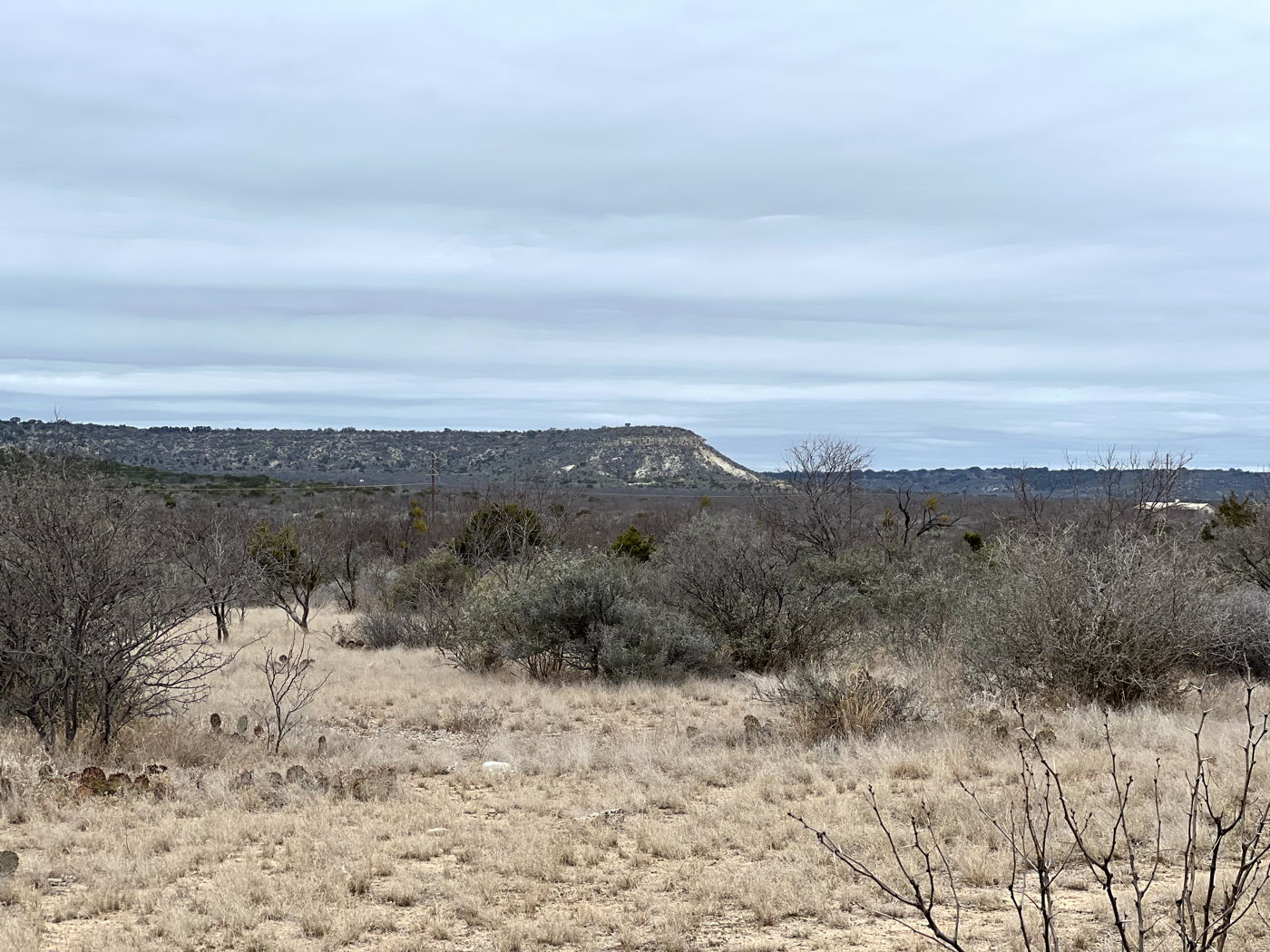
Looking NNE beyond the Teacup Mountain marker. This is obviously not the teacup.
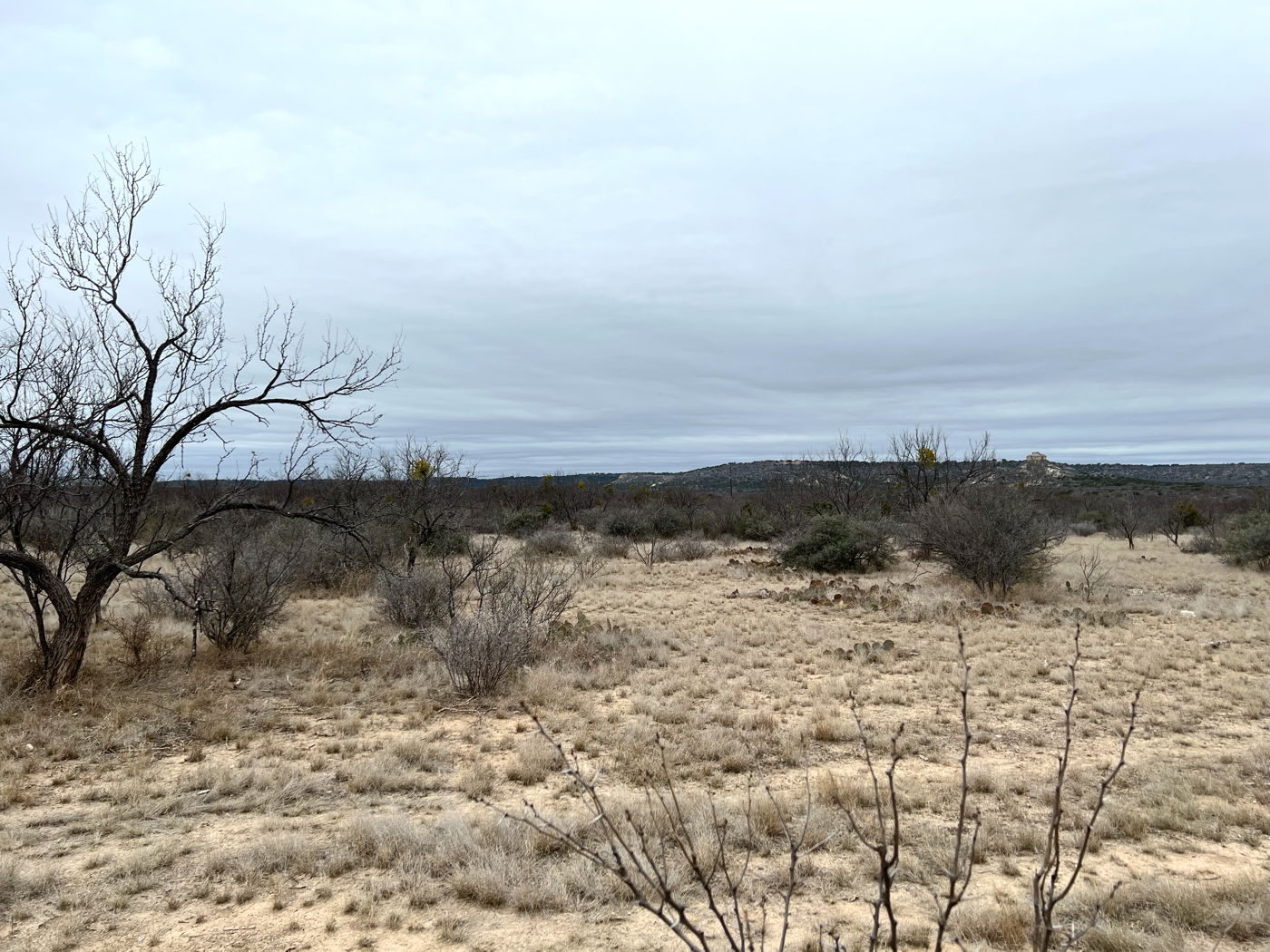
Looking NNW. Not much of a mountain in that direction. But if you look very closely at the right side of the image, you’ll see what might be Teacup Mountain. I should have brought binoculars!
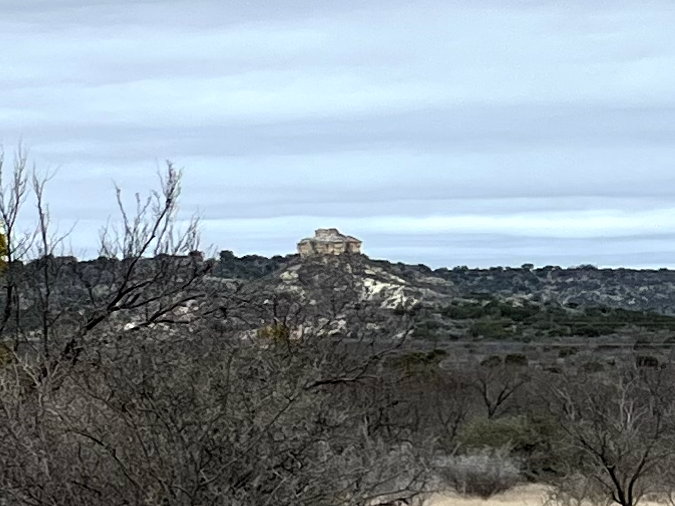
This closeup of my photo is what others online think Teacup Mountain is.
This is a very desolate place to die, and if you were lost here, you’d probably welcome capture.
The story goes that James Bradberry dismounted his horse, possibly to better fire his rifle, while well ahead of the rest of his party; but when the Indians began to overwhelm them he ordered a retreat. The others, who were both further back and mounted, were able to escape, but he was shot in the act of getting back on his horse and turning around. He was in his seventies when he died, and was buried under an oak tree by the Llano River.
No marker can be seen, time and the elements having erased any sign of the last resting place of that great and noble frontiersman.
You can’t get much more old west than that.
Bradberry had earlier lived in Williamson County, where this series began.
If the second incident on the marker—“the capture of a wanted man”—seems a bit vague and commonplace, it may have been included less because of the event than for the Ranger who took part. Texas Ranger Nelson Orcelus Reynolds was famous enough that he has his own marker in the Center Point Cemetery where he’s buried. He ended the Horrell-Higgins feud, and his name is mentioned on that marker as well.
He was responsible for the keeping of John Wesley Hardin until his trial in Comanche County, and also had John P. Ringo in custody at one time, a name western aficionados will recognize from the OK Corral.
- Does modern cosmology rest on infinite turtles?—Wednesday, October 7th, 2026
-

If you’re a regular reader, you’ve probably recognized that a lot of my posts are just me barfing up thoughts that I need to get out so that I can stop thinking about them. One such thought that has been bothering me for a long time is how much of modern science tends to look less like science than like trying to explain away inconvenient science. One of the strangest examples of this is explaining away the beginning of the universe—or even denying that there was a beginning to the universe.
It’s something I definitely want to get out of the way and stop thinking about because the entire concept of a beginning to the universe or not is eerie to me.
Listening to the Space Show’s December 5, 2025 discussion with science author Brian Clegg helped me focus just enough to finally get some of my thoughts on paper, so to speak. So much of modern cosmological theory resembles the old joke about turtles all the way down. And from an outsider’s perspective, it’s not because more turtles make better theories, but that the theorists are trying to avoid anything that looks like the description of the beginning of the universe that appears in Genesis.
An early version of the turtles tale was related by linguist John Robert Ross in the preface to his 1967 doctoral thesis, about the psychologist William James:
- Refrigerator Revolution Revisited: Your 1933 Frigidaire—Wednesday, September 30th, 2026
-

Available in print and as a free download (PDF File, 10.5 MB).
The very first refrigerator cookbook I covered in this series when I decided to start scanning and releasing them was the 1928 Frigidaire Recipes. That was only a year after the seminal General Electric book—and refrigerator—that started the home refrigeration revolution. Both were elegant hardcovers filled with elegant illustrations of the good life that comes from owning your own home refrigerator.
Both understood that what they were offering was not just another way to store food but a completely change in how food would be referred to and how we would interact with it. They recognized they were offering a completely change in lifestyle.
Revolution: Home Refrigeration
- Frigidaire, 1928
- Cold Cooking, 1942
- Cold Cookery, 1947
- Kitchen-Proved, 1937
- General Electric, 1927
- Refrigeration, 1926
- Frigidaire, 1933 ⬅︎
- Better Living
Your Frigidaire: Recipes and Other Helpful Information (PDF File, 10.5 MB) isn’t just from the same company as that 1928 book, it’s the same author. Verna L. Miller is listed as the director responsible for collecting and compiling the “facts which have accumulated during years of study and research by the Frigidaire Department of Home Economics.”
- Reichenau Gap—Wednesday, September 23rd, 2026
-
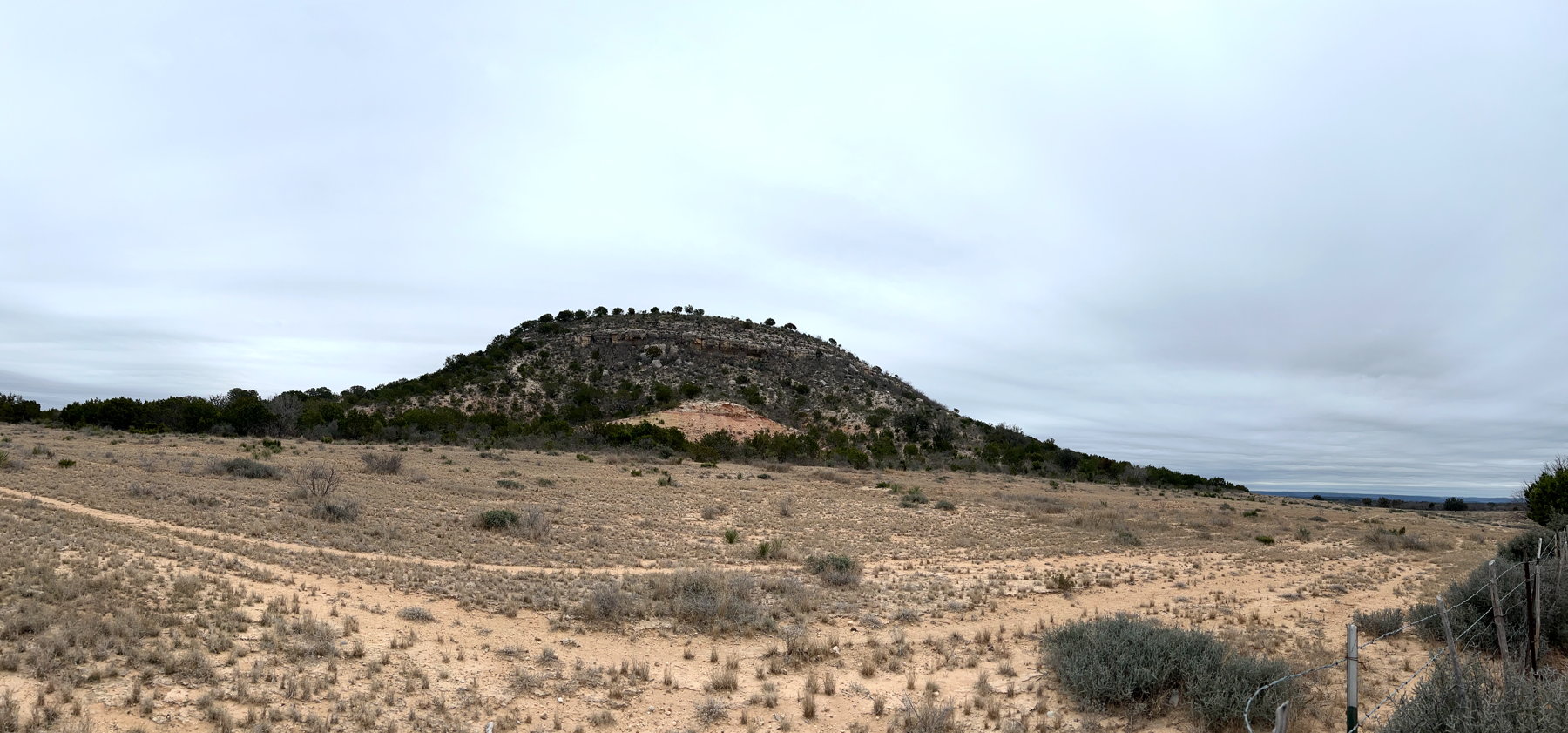
There aren’t even two vast and legless trunks of stone in this desolation.
As is often the case with geographical rather than architectural features, the Reichenau Gap marker is more interesting for what it invokes than for what it is. The Reichenau Gap marker is just past London on the way to Junction, and it’s a view of… hills. Whether the Gap is through the hills visible from the highway, or U.S. Route 377 itself was built where the Gap was, I don’t know. But it’s a desolate place now far from anything—much like London itself.
Reichenau Gap
For more than 100 years, travelers followed the road from Mason to Junction through this pass. The earliest known Anglo settlers in the area were the Frank Putman family, who settled approximately one mile northeast from Reichenau Gap. The geographic feature was named for Adolph A. Reichenau, a German emigrant who purchased the improved land from Frank Putman and settled in the Big Saline Valley in 1862. Reichenau moved from the area after losing over forty horses in three separate raids by Native Americans in 1868 and 1869. Reichenau lived the remainder of his life in the Simonsville community in Mason County, and is buried, along with his family, in the Reichenau Cemetery near his home there.
(1966, 2008)
One might guess from the wording that Route 377 does not follow Reichenau Gap, because if it did, travelers would still be following the road from Mason to Junction “through this pass.”
“The Big Saline Valley” is a wonderful name for a location that richly evokes the old west. The valley is defined by the Big Saline Creek (yes, there is also a Little Saline Creek in a nearby valley).
- This Boy Digs Deep: Eddie Doucette in TV Guide—Wednesday, September 16th, 2026
-
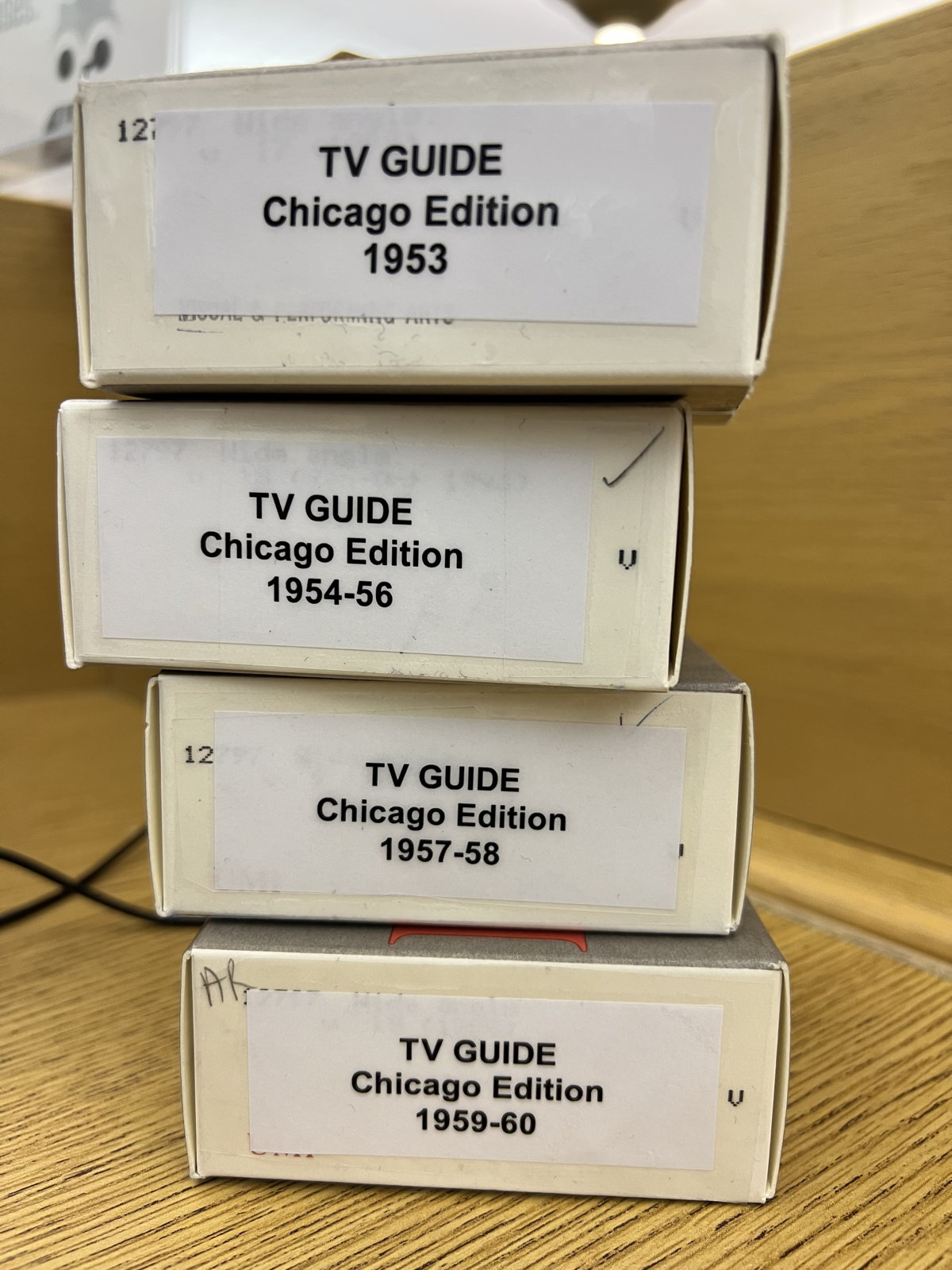
I only got through the 1953 and 1954-56 reels.
Eagle-eyed readers will have noticed that I removed the question marks from the Eddie Doucette Home Cooking episode guide back in February. Some friends invited me up to stay with them a short walk from the Chicago Public Library, so before enjoying Chicago’s wonderful food and drinks I spent a few hours each morning going through the library’s Chicago-edition TV Guide microfilm reels again. I was able to recheck all of the questionable entries and verify or correct my initial guesses.
Unfortunately, the library doesn’t have the TV Guide originals. I hope they still exist somewhere because the microfilms, while useful, are vintage scans that we would now consider to be very poor quality—which is why I needed to recheck them. My saved scans from the first session weren’t legible enough for a couple of the entries.
At one point the library’s computer system went down, so I tried to use the non-computer-based microfilm reader. It, or I using it, was unable to make the scans readable. They needed near-movie level “Computer: Enhance” in some cases. Mere optical, mechanical magnification wasn’t good enough.
Fortunately the computer system came back up by the time I gave up trying to make the older reader work.
The library’s TV Guide archives begin with April, 1953. While that obviously doesn’t cover the 1952 season, Eddie Doucette’s Home Cooking clearly was on the air in 1952. The Backstage Diary in the April 3, 1953, Guide included this snippet:
Look for Eddie Doucette to take his culinary show to another station, possibly WBBM-TV. Chef Eddie has been bombarded with letters and phone calls, all bemoaning his departure from channel 5.
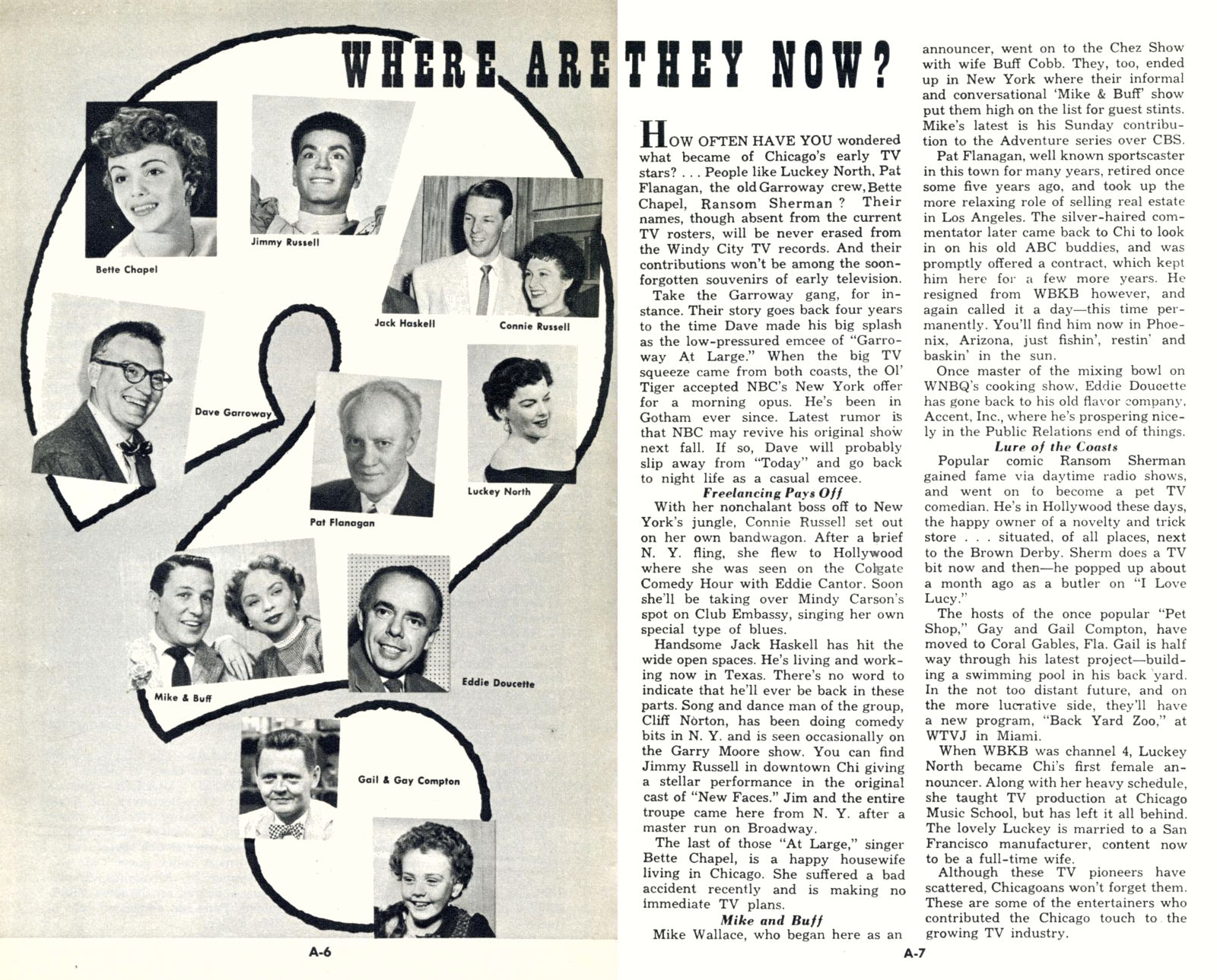
By the June 5 Guide, however, a Where are they now? (JPEG Image, 452.1 KB) spread wrote:
Once master of the mixing bowl on WNBQ’s cooking show, Eddie Doucette has gone back to his old flavor company, Accent, Inc., where he’s prospering nicely in the Public Relations end of things.
- Kothmann Homesite and Cemetery—Wednesday, September 2nd, 2026
-
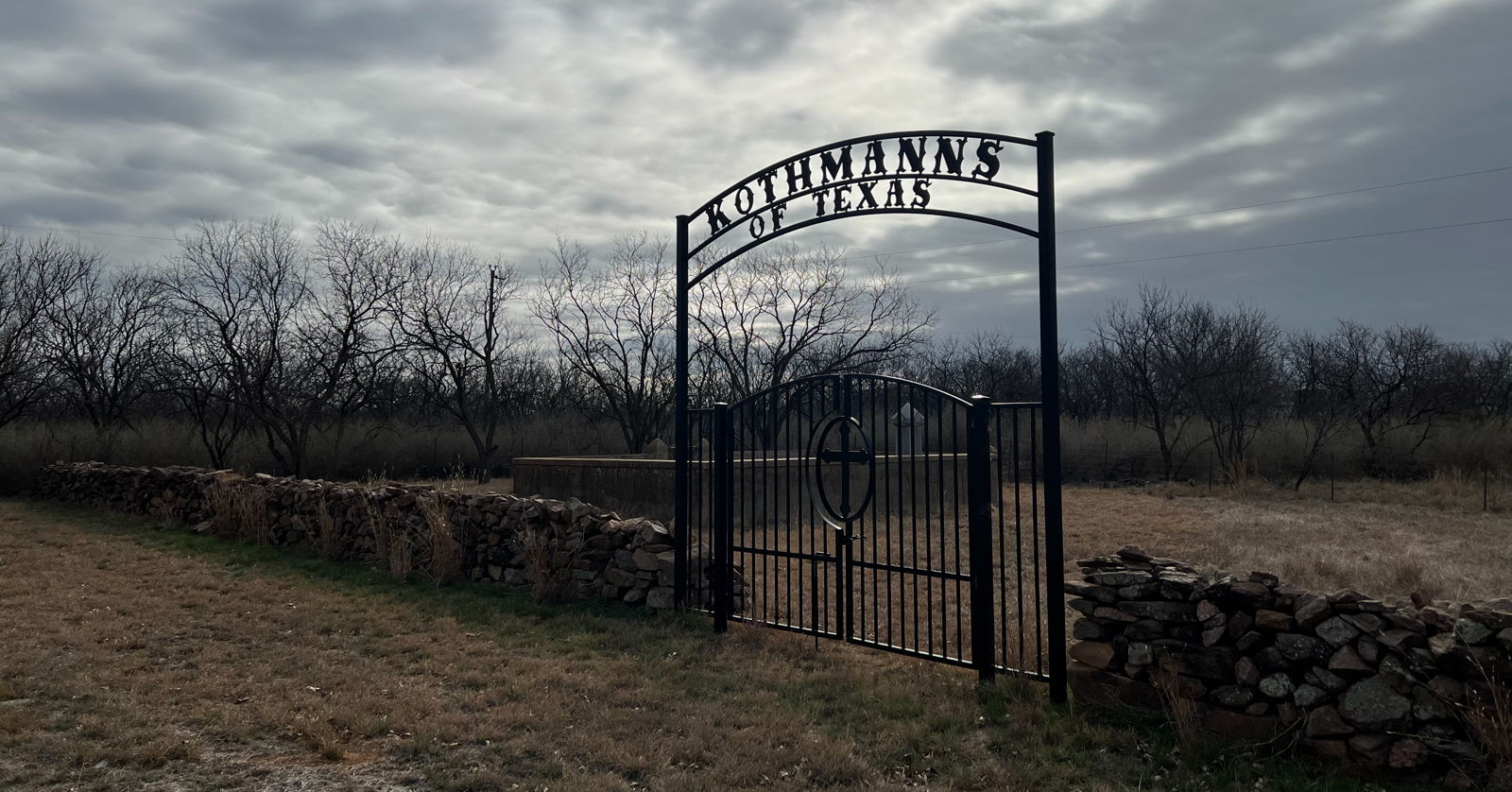
The map and the sign for the Kothmann Homesite both indicate that it’s in a place called Art. If there is any such place, the only evidence of it I saw was two businesses with “Art” in front of their name that don’t appear to ever be open. If you’re looking for a nearby town to help you get to this marker by way of navigation, it’s just before Mason when going west on Texas 29.
There are not a lot of opportunities to get lost in this part of Texas. State Highway 29 goes where it goes, and if you choose to go off of 29 you will know it immediately.
Kothmann Homesite is possibly the most fascinating of the sites I visited on this road trip. The Liberty Hill Cemetery is filled with old tomb markers, and somewhat overwhelming because of that. The Kothmann Homesite and Cemetery is a low stone fence and a tiny enclosed cemetery in the middle of nowhere (or, perhaps, the middle of Art) on a lonely stretch of road on the drive between U.S. Route 183 and Interstate 10. Bertram, Burnet, and Llano are far behind you, and the promised oasis of Mason is still ahead.
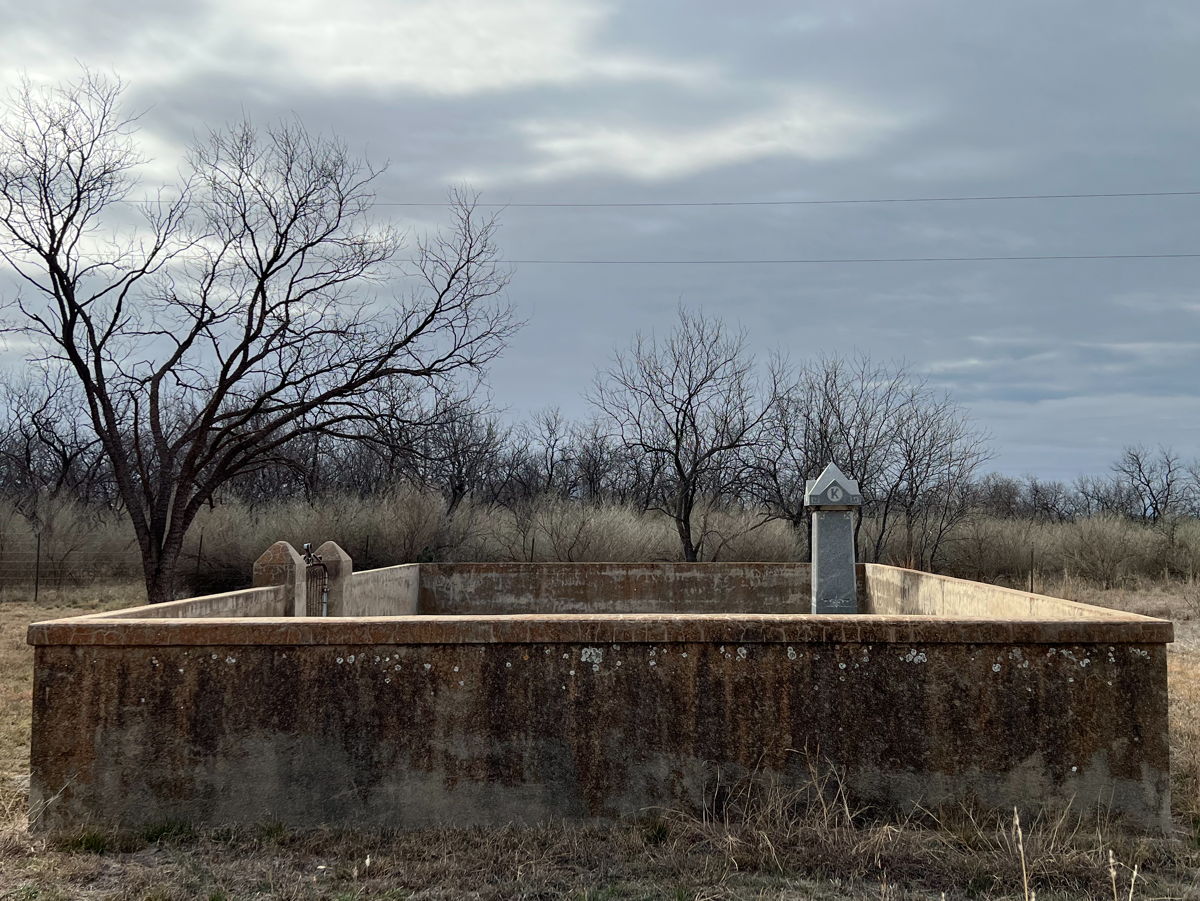
It’s a small cemetery surrounded by a low stone wall.
Kothmann Homesite and Cemetery
Heinrich Conrad Kothmann (1798-1881) and his wife Ilse Katherine Pahlmann (1810-1905) and their family sailed from Germany to Indianola, Texas in 1845. Among the first families to settle in Fredericksburg, the Kothmanns were issued a 640-acre land grant in Mason County in 1848. In 1856 they moved to Art and were among the first immigrant families in this area. A trained cabinetmaker and musician, Kothmann began ranching and acquired another 640-acre tract of land.
Located on their former homestead, the Kothmann Cemetery is all that remains of the original ranch site. Containing only five graves, all of Kothmann family members, the graveyard began with the burial of Heinrich Conrad Kothmann in 1881. His wife Ilse is buried beside him. Their son Karl, the first of their family born in Texas, is buried here along with his wife Katherine (Hoerster) Kothmann. A fifth unmarked grave is thought to be that of a grandchild.
There is a lot of story in those three paragraphs.
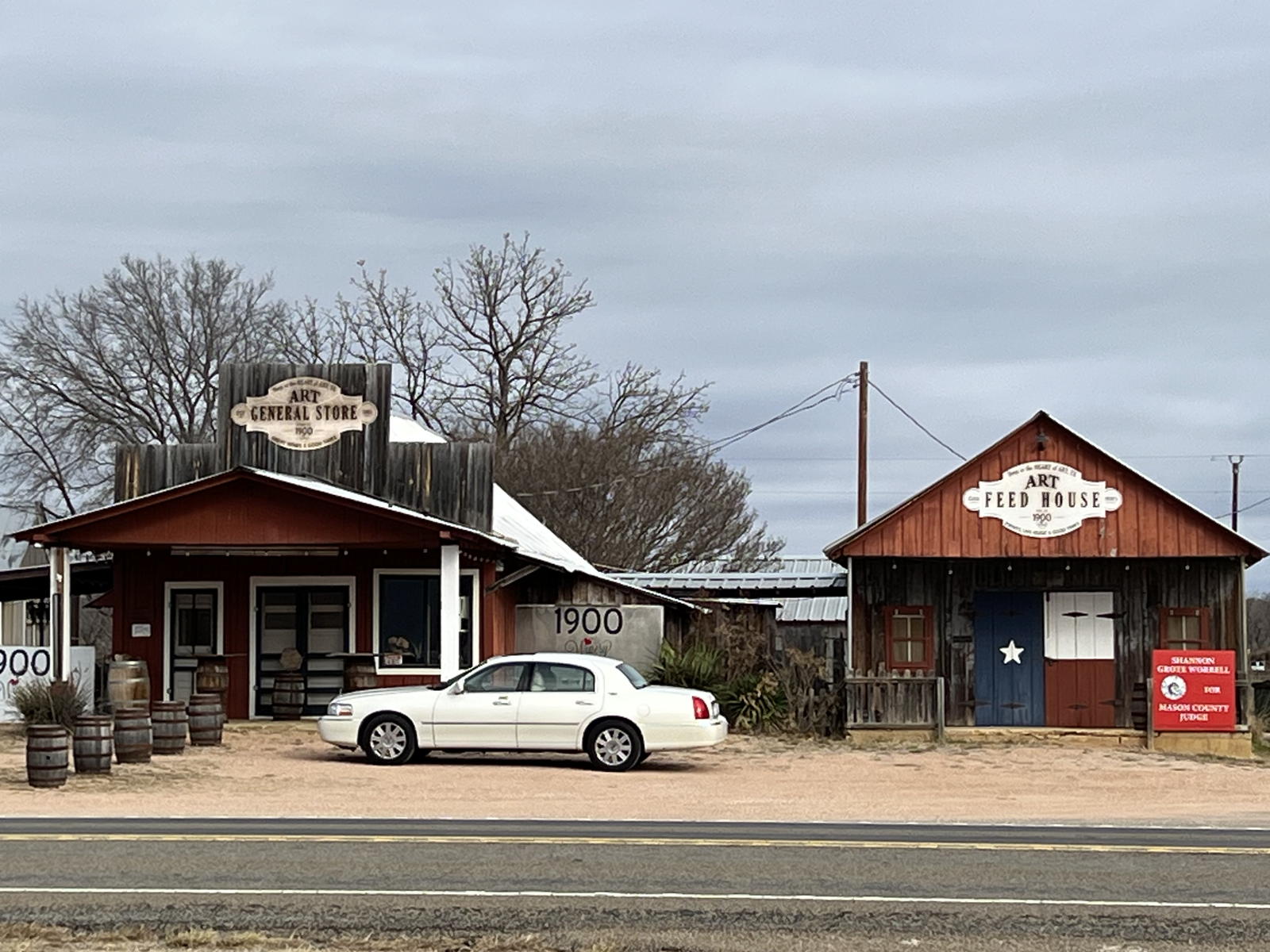
Is this Art?
The Kothmann family has, at least until recently, held regular or semi-regular reunions. These large reunions fascinated people outside of Texas at least as much as people inside Texas. The first mention of their reunions that I found was a very simple entry in the Richmond (Virginia) News Leader of July 19, 1929:
HUGE FAMILY REUNION.
MASON, Texas, July 19.—(AP)—If past gatherings are any criterion, the three-day family reunion of Heinrich Kothmann’s family will be a monster one. About 500 attended the last two reunions, during which the women slept in a barn and the men under a large tent.1
- On-the-fly data entry with Markdown and Perl—Wednesday, August 26th, 2026
-
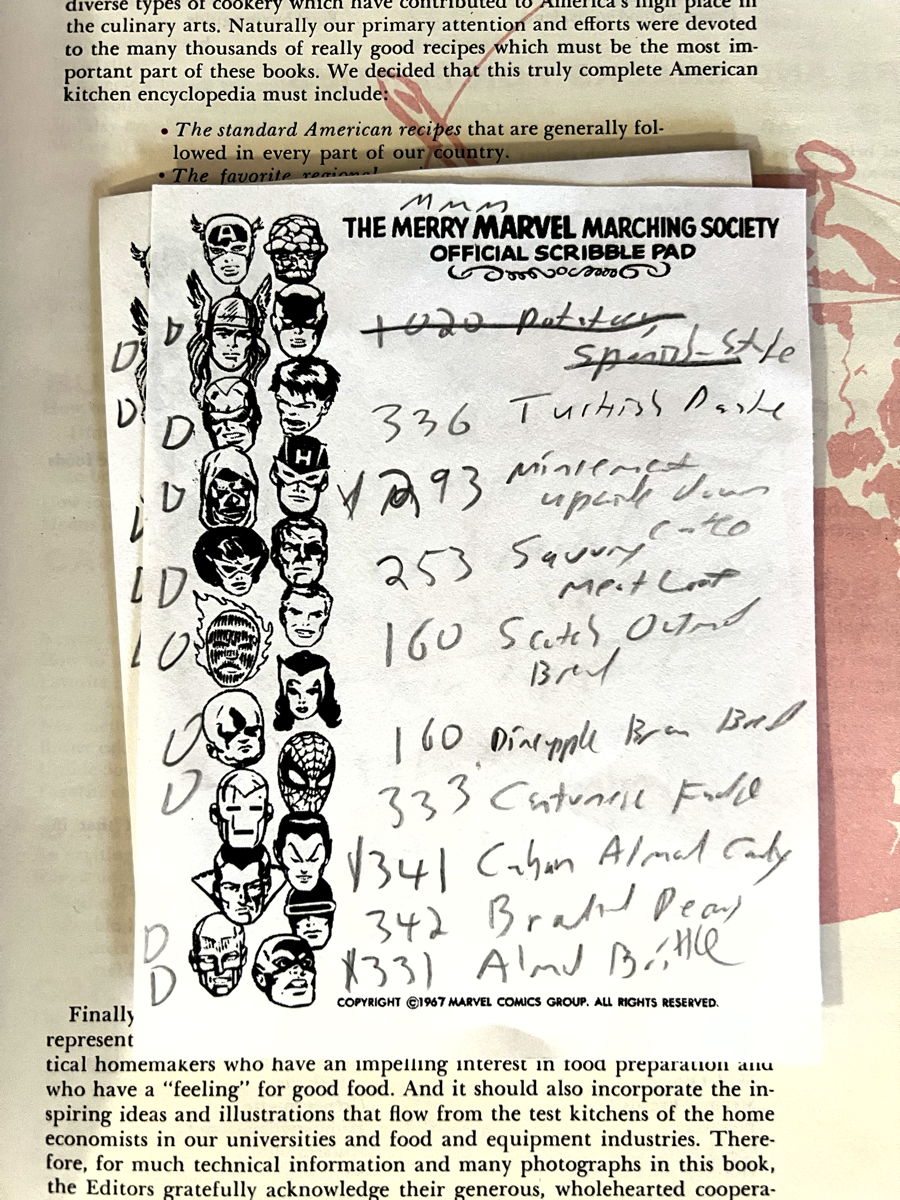
The problem with this is not that the handwriting is bad on this note (it is).
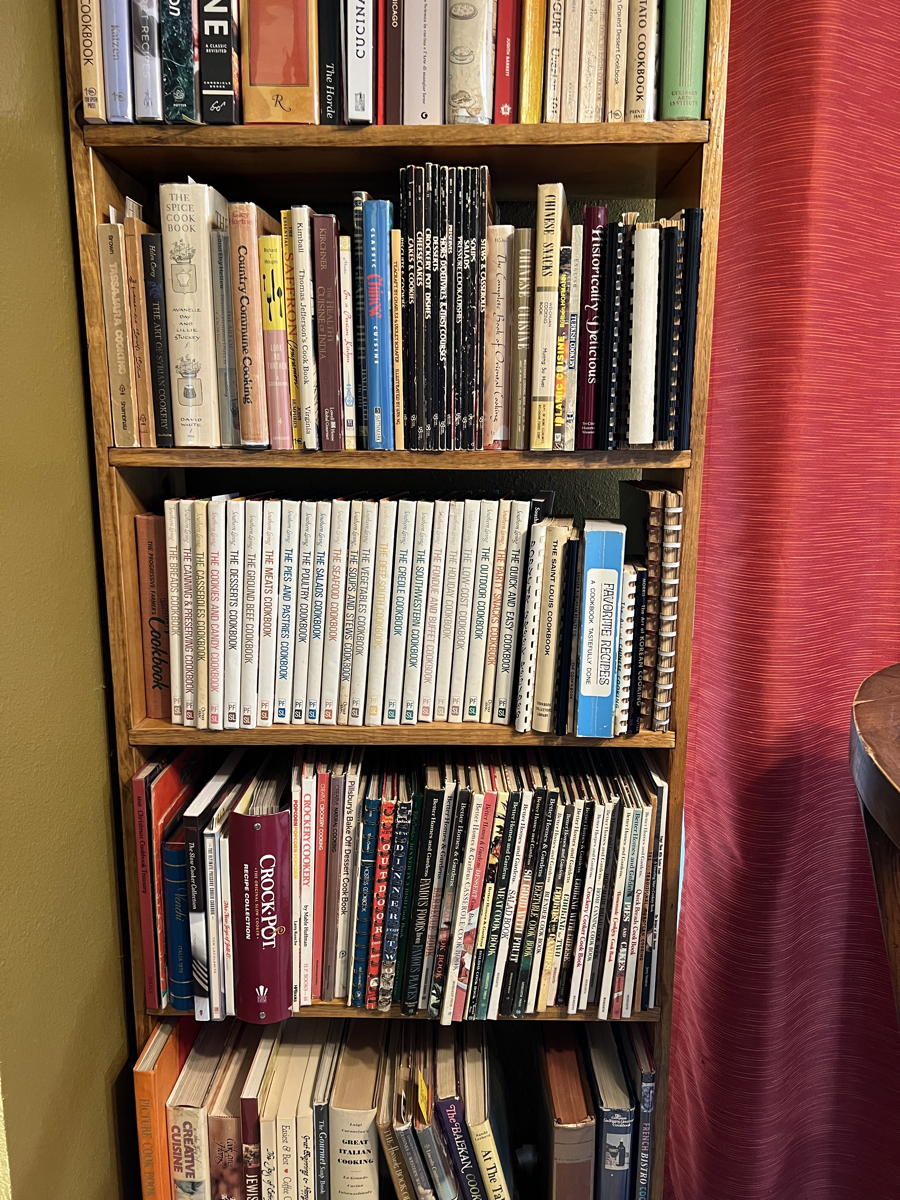
One of my resolutions this year was to start focusing on the cookbooks I already own rather than acquiring more. Whenever I buy a new cookbook, I make a note of the recipes I’d like to try most and put the list inside the front page. This means that most of my cookbooks have a postcard or notebook sheet listing the recipes I find interesting. When I want to try out a particular cookbook, I am easily reminded of what I thought was interesting about it when I bought it.
But if I want to look for a particular recipe among all of my cookbooks, that becomes an obviously more involved process. So, I decided to convert each of those paper lists into a single searchable file on my computer.
Typing that sort of thing into a database cell by cell is time consuming and annoying. It requires paying attention to the screen rather than just typing. I decided to use a faster format for typing desired recipes book by book, and then write a quick script to convert that fast format into a tab-delimited file for import into a database or spreadsheet.
As with most of my quickie text conversion scripts, that faster format looks a lot like Markdown.
Here’s what the source file ended up looking like:
- # Australia Jet Age Cookbook
- 1970
- *22 Caramel Squares (golden syrup)
- 23 Heavenly Slices
- *36 Ginger Beer
- 15 Fruit Salad Ice Cream
- # Mirro Dough Mixer & Bread Baking Kit
- 1975
- *16 Coconut Coffee Cake
- 14 Stollen
- 8 Oatmeal Bread
- *Cornmeal Bread
- 6 Health Bread
- 10 Kolaches
- *12 Hungarian Coffee Cake
- *Herb Rolls
- 15 Apple Cake
That is, I type the book title once, and the year the book was published; then, page numbers also only get typed once. Special recipes are marked with an asterisk at the start of the line. It’s very fast. I was able to do a full bookcase, a half bookcase, and the display shelf by the dinner table, all in just a few days by typing during my spare moments here and there.
The script turns that format into a file more readily readable by apps such as Google’s spreadsheet, or any database program.
- Garlic Dips and Sauces for Potatoes—Wednesday, August 19th, 2026
-
Today is National Potato Day. Why not have some potato chips or hash browns, and top them with one or both of these easy-to-make dips/sauces? They’re great on chips, on a baked potato, or in a potato salad—or with just about any vegetable or thick stew. I also like them on toasted bread, such as Eddie Doucette’s potato bread.
I’m winding down the Semiquincentennial posts, but if you’re not, consider Thomas Jefferson’s potato pie for this potato day as well.
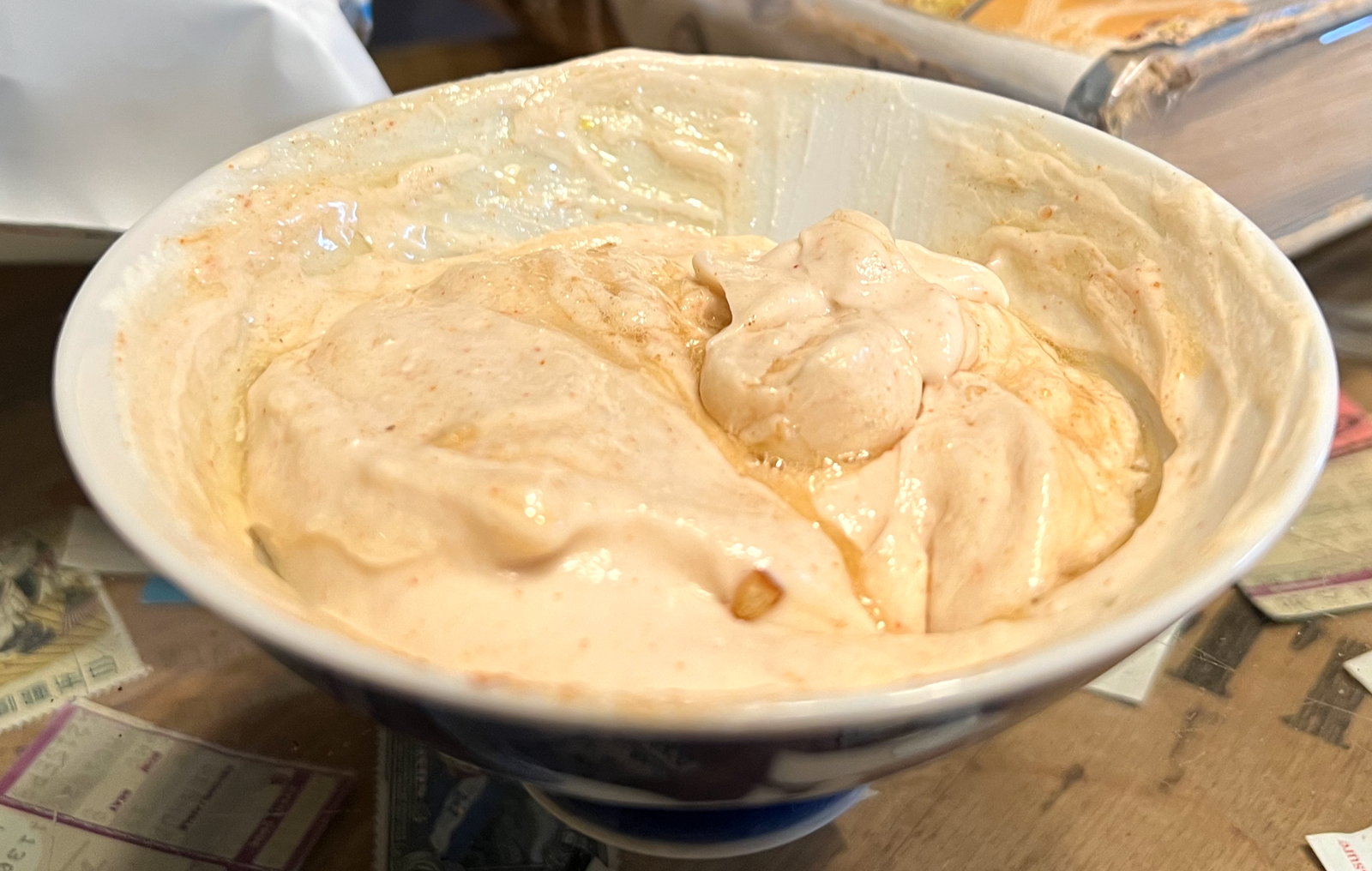
The Joy of Chips Dip
Servings: 8
Preparation Time: 10 minutes
Irma S. Rombauer
The Joy of Cooking (1943) (Internet Archive)Ingredients
- 8 oz yogurt
- 2 cloves garlic
- 2 tbsp butter
- ¼ tsp coarse salt
- ½ tsp smoked paprika
- 1 tbsp Worcestershire sauce
- 1-2 tbsp nutritional yeast (optional)
Steps
- Finely chop garlic.
- Fry garlic in hot butter over medium-low heat until golden brown.
- Pour into the yogurt and mix well.
- Add Worcestershire, paprika, yeast, and salt, mixing well each time.
Potato chips and chip dip are a lot like hot dogs and buns: there’s always one left when the other runs out. I’m the kind of person who runs out of dip long before I empty a bag of chips. What I need is a jar of endless dip! So I was overjoyed to find that Irma Rombauer’s chip dip in The Joy of Cooking isn’t just easily-made and easily-proratable but also very flavorful.
Work to a smooth paste:
Roquefort cheese or soft cream cheese
Season it with:
Worcestershire sauce
Paprika
Spread it on:
Crispy potato chips

Mimsy Were the Borogoves
A world without moral clarity… is a world in which those who dream of peace are willing to place a wolf and a lamb in the same cage and hope for the best—again and again. — Natan Sharansky (The Case for Democracy•)