


Latin in the Mass: Holy, Holy, Holy Lord
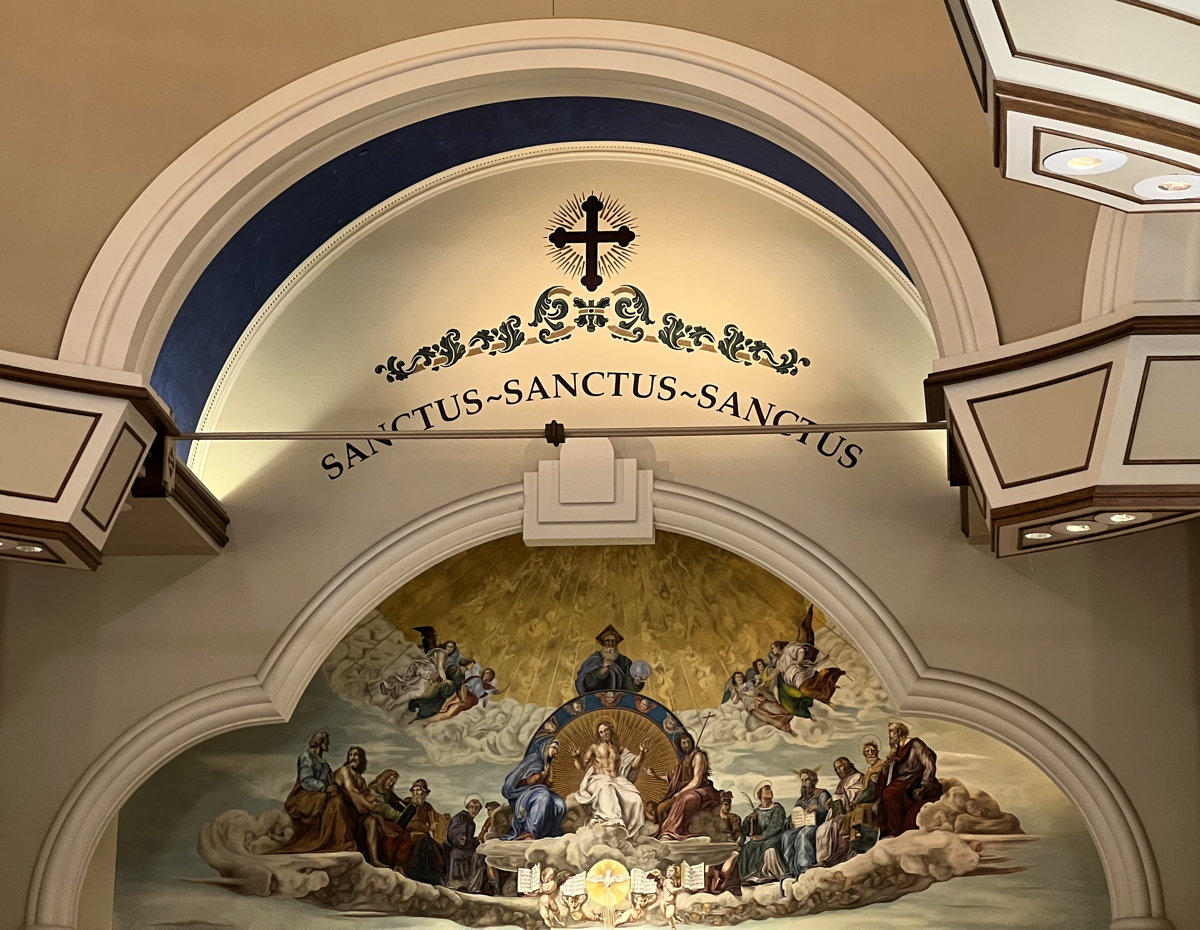
The first line is on the wall far above the altar at our local church.
In a recent issue of Benedictus—a word I’ll be talking about in this post, as it happens—I ran across the following question about Latin masses, quoted from the Tradivox Catholic Catechism Index vol. 14:
Why is the Mass said in Latin?
1) Because this language comes from Rome, whence we received our faith; 2) because, being a dead language, it does not change in the course of time like living languages, and 3) because thereby the unity and uniformity of the Church, even in her public service, is represented and preserved.
That was written back when most masses were celebrated in Latin. There’s a lot to be said for the unity and precision that comes with presenting the Mass worldwide in a single, unchanging language. In the modern era, the near-complete lack of comprehension of that language is probably an insurmountable obstacle.
- Agnus Dei
- Mysterium Fidei
- Sanctus, Sanctus ⬅︎
This installment, I’m going to decipher the Sanctus. That is, the Holy, Holy, Holy that comes at the start of the Eucharistic Prayer.
| Latin | English |
|---|---|
| Sanctus, Sanctus, Sanctus | Holy, Holy, Holy |
| Dominus Deus Sabaoth. | Lord, God of hosts |
| Pleni sunt caeli et terra gloria tua. | Heaven and earth are full of your glory. |
| Hosanna in excelsis. | Hosanna in the highest. |
| Benedictus qui venit in nomine Domini. | Blessed is he who comes in the name of the Lord. |
| Hosanna in excelsis. | Hosanna in the highest. |
Sanctus, sanctus, sanctus
It’s obvious enough from the identical repetition in both versions that sanctus means “holy”. How does it get there, however? Sanctus actually means a whole bunch of things in Latin, and several of them are likely play into the full meaning of the word in the prayer. Consecrated, sacred, divine, and just are all possible meanings along with holy.
Sanctus in this case is an adjective, and like most adjectives in Latin it has a masculine, feminine, and neuter form to be used along with masculine, feminine, and neuter nouns. Dominus is masculine singular, so its adjectives use the masculine singular form. Usually—as in this case—what this means is that an adjective will have the same ending as the noun it describes.
According to the Catholic Diocese of Pittsburgh web site, the repetition of sanctus (or “holy”) three times is a Hebraic superlative, the equivalent of, in English, “holiest”. That’s not unlikely, although I’d point out that such repetition is probably a superlative in many languages. It certainly is in English. When a cartoon character does something really stupid and screams out “stupid, stupid stupid!” the writer may not mean exactly “stupidest” but they certainly do mean a very superlative stupid. When Steve Martin in L.A. Story says “but all I could think was wonderful, wonderful, wonderful, wonderful, wonderful, and most wonderful and yet again, wonderful” he’s using the power of repetition to denote the superlative—and in this case, clearly does mean the surprisingly real English word “wonderfullest”.
| Lord | holy (masculine) | holy (feminine) | holy (neuter) | |
|---|---|---|---|---|
| nominative | Dominus | sanctus | sancta | sanctum |
| nom. plural | domini | sancti | sanctae | sancta |
Sanctus Dominus deus sabaoth
Dominus is “Lord”. As already covered in the first line, Sanctus Dominus is “Holy Lord” and “Divine Lord” and “Just Lord” all rolled into one wonderful Latin phrase—which, given the repetition, if the Catholic Diocese of Pittsburgh’s web etymology can be trusted,1 means “holiest, most divine, most just Lord”.
We’ve covered deus before, and we almost certainly will again, this being a series on Latin in the Catholic Mass. It means “God”.
But how in the world does sabaoth translate into “of hosts”? Obviously it must be the genitive. But not only does it not have a genitive ending, if you’ve read the other parts of this series you’re probably thinking it doesn’t resemble any of the Latin words we’ve covered. Give yourself a gold star if you said that out loud, because sabaoth isn’t Latin. It was imported into Latin from Greek. Because it’s an imported word, it doesn’t have any declinations. It’s always sabaoth in every use.
Modern Italian often does the same thing with words it imports from other languages, leading to odd-to-English-speaker-constructions like “il leader” for “the leader” and “i leader” for “the leaders”.2
But the story of “sabaoth” doesn’t end at the Greek. The Greek word is a transliteration of the Hebrew word “tzebhaoth”, or “armies”, often translated as “hosts”—the same meaning it has in Greek and in Latin.
If the word sabaoth has no separate forms for each declination, how are we supposed to know that this particular use is the genitive form? Context is always important in any language, and especially Latin, but especialliest—not yet a word, but it may be becoming one—imported words.
| God | army/host | |
|---|---|---|
| nominative | Deus | sabaoth |
| genitive (of) | Dei | sabaoth |
| nom. plural | dei | sabaoth |
| gen. plural | deorum | sabaoth |
Pleni sunt caeli et terra gloria tua
The Sanctus has two of the most mellifluous lines in the Latin Mass, and this is one of them. The direct translation is “Full are the heavens and the earth with your glory.” This is a good example of word order in Latin: adjective-verb-subject-indirect object.
The subject(s) of the sentence are caeli and terra. Caeli is the nominative plural of caelum or “sky, heaven”. Terra is the nominative singular for earth. The word et we’ve already covered: it’s “and”, most often encountered in the common Latin phrase et cetera.
Pleni is from the adjective plenus, meaning “full”. It is conjugated as the nominative masculine plural. Nominative, because it describes the subject, that is, the heavens and the earth. Plural, because there are two items. That one of them is also plural doesn’t matter: there are two of them, and two is plural. This is also why sunt is used. It’s the third-person plural of esse, “to be”.
| to be (esse) | |
|---|---|
| I | sum |
| you | es |
| he/she/it | est |
| we | sumus |
| you (plural) | estis |
| they | sunt |
| active imperative | es |
| passive imperative |
English does the same thing. John is full. Jane is full. John and Jane are full.
Why is plenus used in the masculine, though? Caelum is neuter and terra is feminine, but when there are mixed genders the default is to use the masculine for anything that needs to match a gender. Plenus est John. Plena est Jane. Pleni sunt John et Jane.
Gloria tua is an example of the ablative declination in Latin. As covered last time, Latin often subsumes prepositions into the form of the noun. The ablative is the equivalent of using “with” or “by” in English. Translated literally this line would be something like:
The heavens and the earth are full with your glory.
Or, as we commonly say it,
Heaven and Earth are full of your glory.
| heaven | glory | full (masc.) | full (fem.) | full (neut.) | earth | your | |
|---|---|---|---|---|---|---|---|
| nominative | caelum | gloria | plenus | plena | plenum | terra | tua |
| ablative (by/with) | caelo | gloria | pleno | plena | pleno | terra | tua |
| nom. plural | caeli | gloriae | pleni | plenae | plena | terrae | tuae |
| abl. plural | caelis | gloriis | plenis | plenis | plenis | terris | tuis |
Hosanna in excelsis
Excelsus is an adjective meaning “high, lofty”. In is one of those wonderful words that has pretty much retained its meaning since the days of the Romans.
Hosanna is another borrowed word, again from the Hebrew. And again, it got there by way of Greek. It’s not nearly as obviously borrowed as sabaoth but there’s a clue in the fact that it doesn’t get translated when the rest of the prayer is translated into English. According to the Bible, hosanna is what the Jews cried out as Jesus entered Jerusalem before his arrest and crucifixion. It’s not so much a cry of praise as a cry for help, for rescue, probably from the Romans and, given the miracles Jesus performed, from their own infirmities, both physical and spiritual.
Certainly, there has to be at least an element of praise in it, in that the people would not have cried out “save us” if they didn’t believe that Jesus had the power to save them. My guess is that as Christianity spread to the gentiles, the context of “save us” was lost and the more obvious aspect of “praise” was kept.
Excelsus uses the ablative form excelsis because the praises are in the heights, and may even be interpreted as ringing from the heights. When the word “in” signifies “rest in” or “motion from” then the noun that “in” refers to uses the ablative. And it’s the plural ablative even though hosanna looks like a feminine singular because, being a borrowed word, hosanna doesn’t change through Latin’s declinations. Its form stays the same, and its declination is deciphered from context.
In this case, the fact that hosanna is followed by in excelsis clues us in that hosanna is plural. It doesn’t tell us anything about whether hosanna is masculine, feminine, or neuter, because for -us adjectives all three forms end in -is for the ablative plural.
Thus, Hosanna in excelsis means something like “Praises in the heights” but, probably to not lose the full meaning of hosanna, it is translated with hosanna unchanged as “Hosanna in the Highest”.
Because “hosanna” has also been imported into English, it isn’t immediately obvious that it hasn’t been translated. But unlike Latin and Italian, when English imports foreign words it treats them as English words. One hosanna, two hosannas. Or, as the Palm Sunday hymn goes, “To Whom the lips of children/Made sweet Hosannas ring”. It is possible that there is a theological or even poetic reason for there being only one hosanna in the heights, but most likely it simply hasn’t been translated and thus doesn’t get a different declination for the plural.
| praise | height | |
|---|---|---|
| nominative | hosanna | excelsus |
| ablative (by/with) | hosanna | excelso |
| nom. plural | hosanna | excelsi |
| abl. plural | hosanna | excelsis |
Benedictus qui venit in nomine domini
Benedictus is an adjective meaning praiseworthy, or blessed.3
Qui is a pronoun, “who”. It can also mean “what”, “which”, and so on, which is still common today in Romance languages.
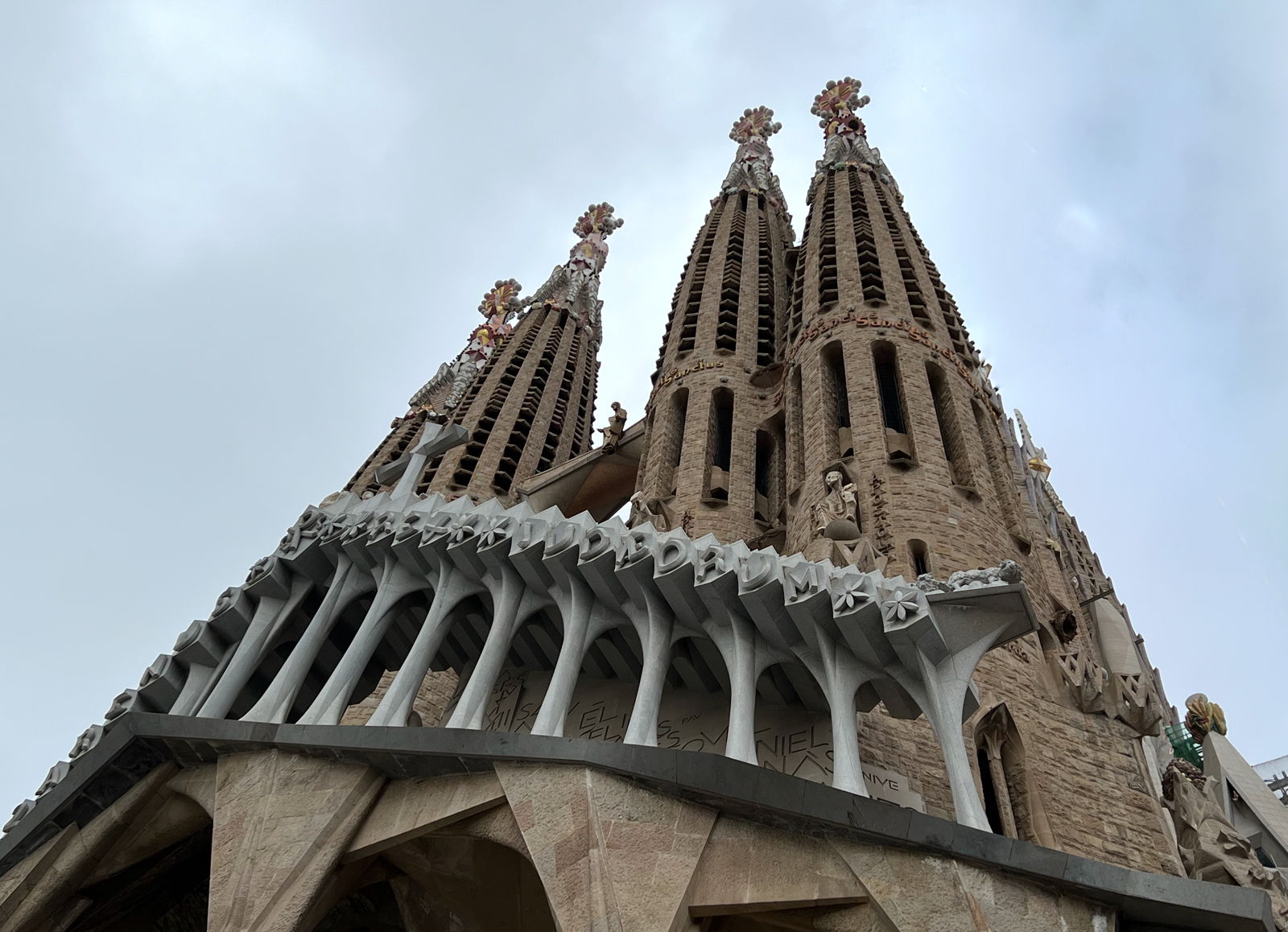
If you look closely, you can see the word “sanctus” repeated across these towers of La Sagrada Familia.
Venit is the third-person present indicative of the verb venire, meaning “to come”, or, in the third-person, “he comes.”
| to come (venire) | |
|---|---|
| I | venio |
| you | venis |
| he/she/it | venit |
| we | venimus |
| you (plural) | venitis |
| they | veniunt |
| active imperative | veni |
| passive imperative | venire |
And in nomine Domini is, again, the preposition in followed by an ablative noun. In this case, that noun is nomen, or “name”. And domini is the genitive singular of dominus, “lord”. The genitive is the “of” form so Domini is “of the Lord”. And that makes this three-word phrase “in the name/of the Lord.”
Benedictus, according to my Latin dictionary, is less a word itself than a combination of bene and dictus, so what it originally meant would have been something like “well spoken of” or “well appointed”.
The full phrase is exactly what it’s translated as, “blessed, he who comes in the name of the Lord”.
| blessed | name | who | Lord | |
|---|---|---|---|---|
| nominative | benedictus | nomen | qui | Dominus |
| ablative (by/with) | benedicto | nomine | quo | Domino |
| genitive (of) | benedicti | nominis | cuius | Domini |
| nom. plural | benedicti | nomina | qui | domini |
| abl. plural | benedictis | nominibus | quibus | dominis |
| gen. plural | benedictorum | nominum | quorum | dominorum |
Words learned
Here’s a more complete summary of the declinations and conjugations of the words in the Sanctus. Declinations, remember, are for nouns. When we alter a noun’s endings according to its purpose in the sentence we “decline” the noun. When we alter a verb according to who or what is acting, we “conjugate” the verb.
Nouns
| heaven | God | Lord | height | glory | name | earth | |
|---|---|---|---|---|---|---|---|
| nominative | caelum | Deus | Dominus | excelsus | gloria | nomen | terra |
| genitive (of) | caeli | Dei | Domini | excelsi | gloriae | nominis | terrae |
| dative (to/for) | caelo | Deo | Domino | excelso | gloriae | nomini | terrae |
| accusative | caelum | Deum | Dominum | excelsum | gloriam | nomen | terram |
| ablative (by/with) | caelo | Deo | Domino | excelso | gloria | nomine | terra |
| nom. plural | caeli | dei | domini | excelsi | gloriae | nomina | terrae |
| gen. plural | caelorum | deorum | dominorum | excelsorum | gloriarum | nominum | terrarum |
| dat. plural | caelis | deis | dominis | excelsis | gloriis | nominibus | terris |
| acc. plural | caelos | deos | dominos | excelsos | glorias | nomina | terras |
| abl. plural | caelis | deis | dominis | excelsis | gloriis | nominibus | terris |
Adjectives
| blessed | full | holy | |
|---|---|---|---|
| nominative | benedictus | plenus | sanctus |
| genitive (of) | benedicti | pleni | sancti |
| dative (to/for) | benedicto | pleno | sancto |
| accusative | benedictum | plenum | sanctum |
| ablative (by/with) | benedicto | pleno | sancto |
| nom. plural | benedicti | pleni | sancti |
| gen. plural | benedictorum | plenorum | sanctorum |
| dat. plural | benedictis | plenis | sanctis |
| acc. plural | benedictos | plenos | sanctos |
| abl. plural | benedictis | plenis | sanctis |
Pronouns
| who | your | |
|---|---|---|
| nominative | qui | tua |
| genitive (of) | cuius | tuae |
| dative (to/for) | cui | tuae |
| accusative | quem | tuam |
| ablative (by/with) | quo | tua |
| nom. plural | qui | tuae |
| gen. plural | quorum | tuarum |
| dat. plural | quibus | tuis |
| acc. plural | quos | tuas |
| abl. plural | quibus | tuis |
Verbs
| to be (esse) | to come (venire) | |
|---|---|---|
| I | sum | venio |
| you | es | venis |
| he/she/it | est | venit |
| we | sumus | venimus |
| you (plural) | estis | venitis |
| they | sunt | veniunt |
| active imperative | es | veni |
| passive imperative | venire |
In response to Agnus Dei: Latin in the Catholic Mass: Latin is fundamental to understanding Catholic Mass, scientific terminology, and the terminology of many other professions. It underlays so much of how we speak and what we speak about.
I’m not distrusting the Catholic Diocese of Pittsburgh here. I’m distrusting web etymologies. Which, admittedly, is a bit ironic given that you’re reading my Latin lesson on the web, too. I can only repeat—I’m only about a fifth of the way through my first-year Latin textbook.
↑The actual Italian word for “leader” is “capo”. The leader would be “il capo” and multiple leaders would be “i capi”. Thus the wonderful mafia title “il capo dei capi”, the boss of bosses.
↑It’s also the past participle; as in English, Romance languages often use past participles nearly exactly as if they were adjectives. Not being a linguist, I’m not going to get into that here, or likely ever.
↑
English
- L.A. Story
- Steve Martin and Victoria Tennant star in this story about quoting Shakespeare in a magical Los Angeles. Recommended only for dreamers and lovers. The DVD has the most involved menu I’ve yet seen on DVD. You can watch it in with English or Spanish subtitles.
- wonderfullest
- “superlative form of wonderful: most wonderful”
Latin
- Benedictus: The Traditional Catholic Companion
- “Pray the Traditional Latin Mass; Daily Mass companion; Morning and evening devotions; Daily meditations; Informative commentary; and several pages of superb Catholic prayers, proven over generations of pious use in Latin as well as English.”
- Cassell’s Latin Dictionary: D. P. Simpson, M.A. at Internet Archive (ebook)
- Cassell’s Latin Dictionary incorporates modern English idiom, current Latin spelling, general classical information, long and short vowels, irregular plural forms, ancient classical citations, and paraphrases from modern English.
- First Year Latin: Minnie L. Smith, Harold G. Thompson, and Charles Jenney, Jr. at Internet Archive (ebook)
- The 1958 edition of Smith and Thompson’s First Year Latin, revised by Charles Jenney, Jr. This is a very straightforward text that gets you into speaking useful Latin right from the start and quickly ramps you up into more complex forms.
- Sanctus, Sanctus, Sanctus—Holy, Holy, Holy: Bishop William Waltersheid
- “At the conclusion of the Preface at Mass, right before the Eucharistic Prayer, all present sing or say the Sanctus. We may think of it as simply an interlude from one part of the Sacred Liturgy to the next. Nothing could be farther from the truth.”
- Sanctus—Live from Basilica Di Santa Maria Sopra Minerva, Italy (1999)
- “Music video by Andrea Bocelli, Orchestra dell'Accademia Nazionale di Santa Cecilia, Myung-Whun Chung performing Sanctus.”
More Hebrew
- The First Language
- Scholars once believed that, or seriously discussed whether, Hebrew was the first language of mankind. In a fantasy game, there really can have been a first, holy language of the gods.
More Latin
- Mysterium Fidei: Mortem tuam annuntiamus, Domine
- Latin in the Catholic Mass II: The Mysterium Fidei, or Mortem Tuam, is one of the shortest bits of Latin in a partly Latin Mass. It highlights some interesting features of Latin and how it translates to English.
- Agnus Dei: Latin in the Catholic Mass
- Latin is fundamental to understanding Catholic Mass, scientific terminology, and the terminology of many other professions. It underlays so much of how we speak and what we speak about.
More Latin in the Catholic Mass
- Mysterium Fidei: Mortem tuam annuntiamus, Domine
- Latin in the Catholic Mass II: The Mysterium Fidei, or Mortem Tuam, is one of the shortest bits of Latin in a partly Latin Mass. It highlights some interesting features of Latin and how it translates to English.
- Agnus Dei: Latin in the Catholic Mass
- Latin is fundamental to understanding Catholic Mass, scientific terminology, and the terminology of many other professions. It underlays so much of how we speak and what we speak about.