


Irish mashed potato pie for Π Day and Saint Patrick’s Day
In this sestercentennial year, here’s a great triple-celebration pie. It’s from about 1876 and it can fill in for both Pi Day and St. Patrick’s Day!
Servings: 12
Preparation Time: 2 hours
The Horsford Cook-Book (PDF File, 4.7 MB)
Ingredients
- 13.5 oz mashed potato
- 6.5 oz butter
- 1-⅔ cup sugar
- 5 eggs, separated
- 1 lemon’s juice and zest
- 1 tsp nutmeg
- 1 tsp mace
- 1 unbaked 9-inch pie shell
Steps
- Rice the mashed potato through a colander or potato ricer.
- Stir the lemon juice into the mashed potato.
- Cream the butter and sugar together.
- Mix in the yolks one at a time.
- Mix in the lemon zest, nutmeg, and mace.
- Beat the mashed potato in slowly until light.
- Beat the egg whites to soft peaks and fold into the filling.
- Pour into the pie shell.
- Bake at 400° for 10 minutes.
- Reduce heat to 325° and continue baking until golden on top, about an hour.
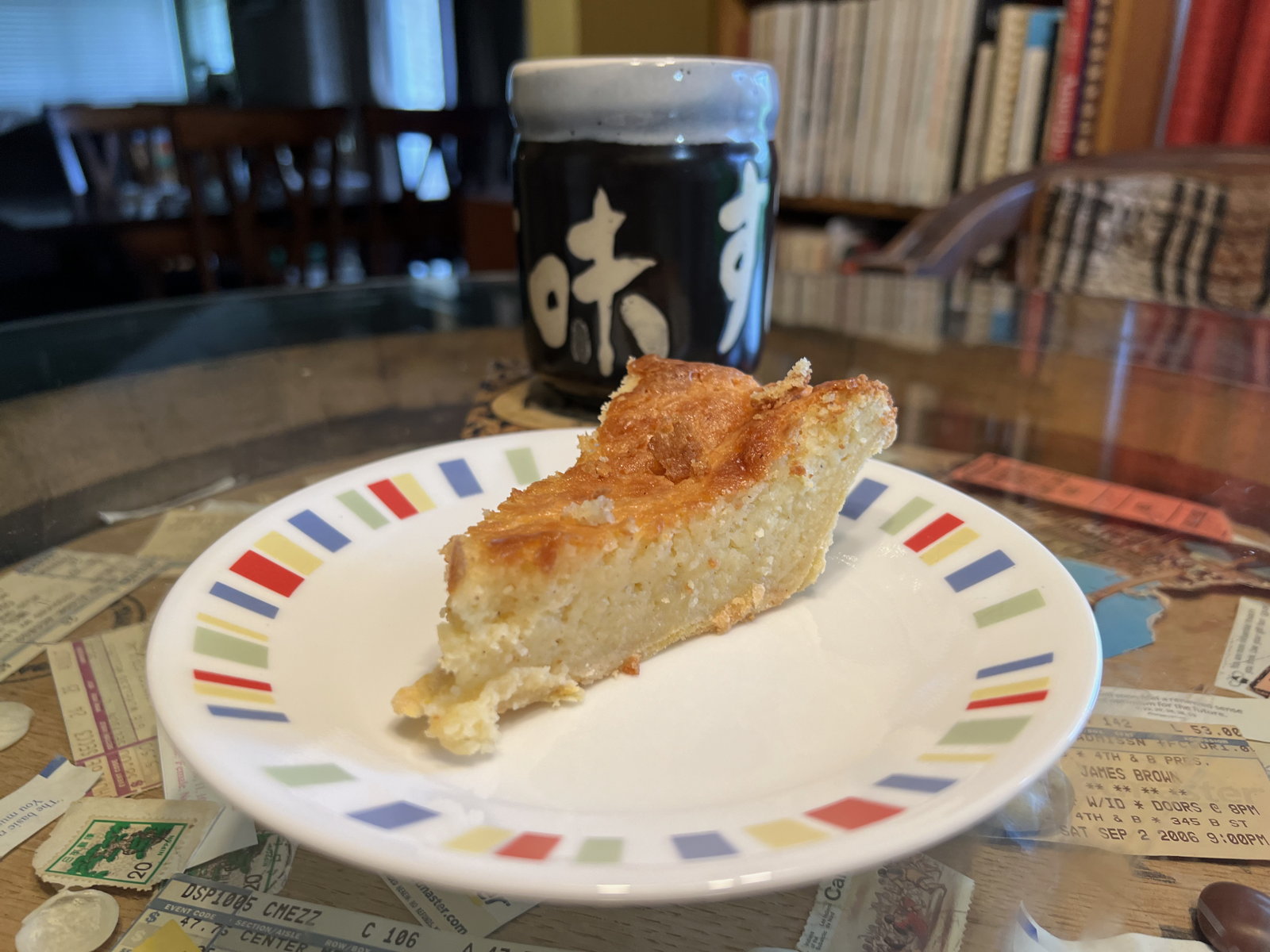
A wonderful pie from white potatoes instead of sweet potatoes.
Pi Day is this coming Saturday.
A few days after it, on Tuesday, is St. Patrick’s Day.
This year’s Independence Day will be the 250th anniversary of the signing of the Declaration of Independence.
So why not a pie this year celebrating all three of those? I found this pie in a Horsford Baking Powder cookbook that celebrated its product’s Centennial Award from the Centennial Exhibition in Philadelphia in 1876. That’s right: this pie was in a cookbook that took part in the centennial of the signing of the Declaration of Independence. The book itself probably didn’t come out in 1876, though it may have—the exhibition started in May of that year, leaving lots of time for a company that published as many iterations as Rumford did to add that award to their products. But I’m guessing 1877, for reasons I go into more detail about in my 2024 lead-up to the sestercentennial.
It’s a fascinating pie and one that appears to have fallen out of favor in favor of the sweet potato pie. This is a much lighter pie than sweet potato, and it allows the spices to shine. But it still exhibits some of the flavor of potato, and, to my mind, to great effect. But I come from a long line of potato aficionados.
I considered saving this recipe for National Potato Day, one of the other handful of food days I enjoy. But that’s in August, after Independence Day, so, given that this is the 250th anniversary of the signing of the Declaration of Independence, I decided to put it here.
Here’s the full recipe as it appears in the Rumford Chemical Works cookbook:
Irish Potato Pie.—One pound mashed potato, rubbed through a cullender, one-half pound butter creamed with the sugar, six eggs, whites and yolks beaten separately, one lemon squeezed into the potato while hot, one teaspoonful nutmeg, one teaspoonful mace, two cups white sugar. Mix and bake same as Sweet Potato Pie.
The “Sweet Potato Pie” appears directly above:
Sweet Potato Pie.—One pound mealy sweet potatoes, one-half cup butter, three-quarters cup white sugar, one tablespoonful cinnamon, one teaspoonful nutmeg, four eggs, whites and yolks beaten separately, one lemon, juice and rind, and a glass of brandy. Parboil the potatoes and grate when cold. Cream the butter and sugar, add the yolk, the spice and lemon. Beat the potatoes in by degrees and until all is light, then the brandy, and stir in the whites. Use no top crust.
A couple of things stand out for this recipe. The first is that that sweet potato pie recipe wouldn’t be seen as out of the ordinary (other than being very good) today.
The other is that the mashed potato recipe uses 50% more eggs, twice as much butter, and more than twice as much sugar. Even assuming that the eggs are what we would call medium eggs, that recipe as written makes a lot of pie filling. The first time I made it, I was making it on the road and used a pre-made pie crust that was probably about 7-½ inches, not even an 8-inch pie, and I had nearly enough left over for another entire pie.
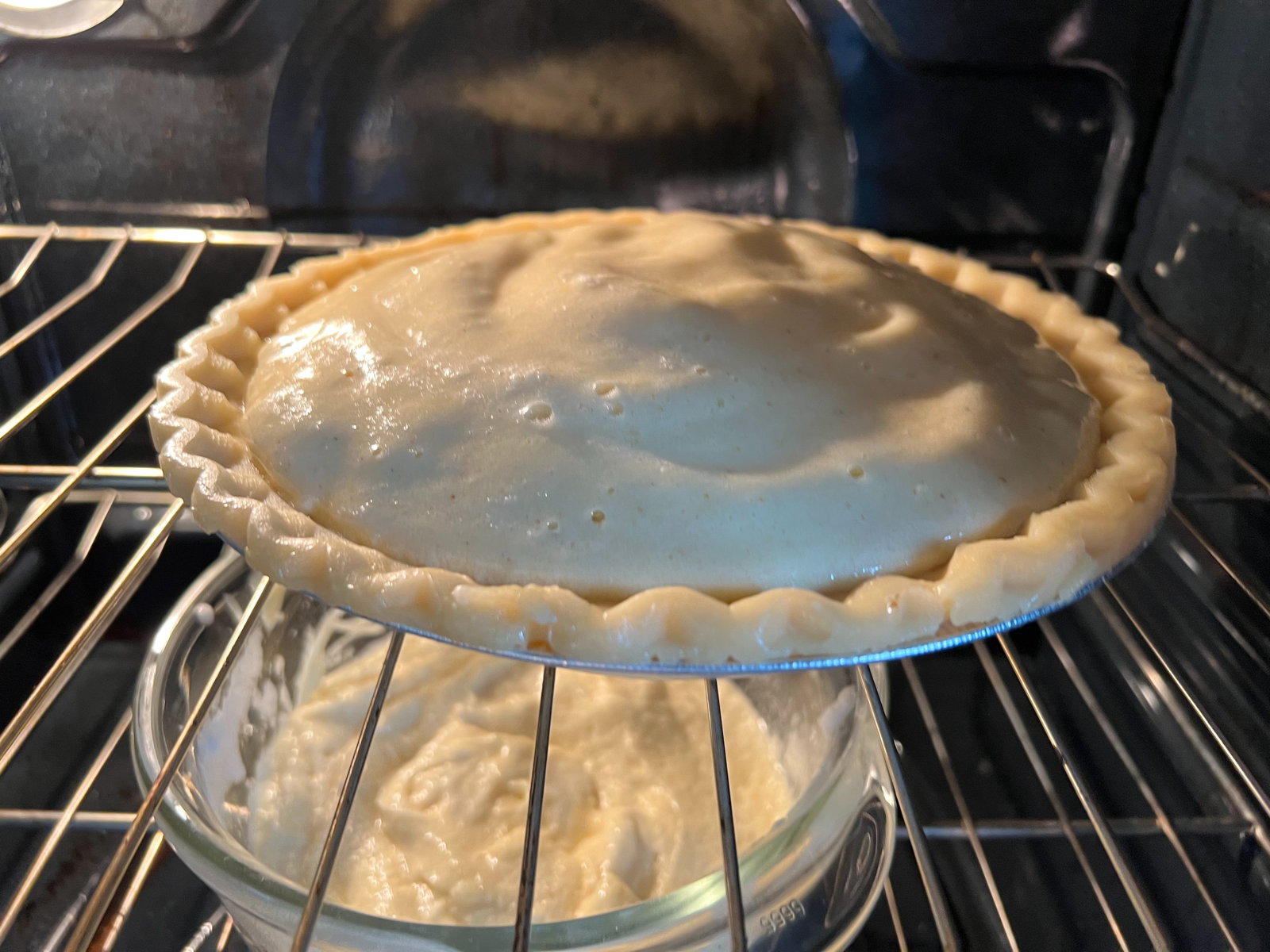
Even dropping it to a ⅚ recipe as I’ve done here it risks overflowing the dish. I always put it on a sheet. However, in this case it’s not that it’s too much filling but that it’s a high-rising filling that falls back when the pie cools, leaving just the right amount. I have a suspicion that they used ten- or even eleven-inch pie tins back then.
Finally, is this really an Irish pie? I’m guessing not. Recipes tended to be titled based on superficial characteristics back then (and to an extent still are). If it contained oatmeal, there’s a good chance it was going to be a Scottish recipe. If it produced round cookies with nuts in it that looked like sausage, it might be German, and so on. I have a 1933 Frigidaire cookbook that lists two kinds of potatoes: “Potatoes, Sweet”… and “Potatoes, Irish”. They used “Irish” to differentiate what we just call “potatoes” from sweet potatoes. That could well be what’s happening here. It isn’t the pie that’s Irish. It’s the potatoes.
From my Christmas post last year, the 1916 Table and Kitchen has a very similar pie called, simply, “Potato Pie”:
Potato Pie.—Boil and mash fine four potatoes, to which add three eggs and yolks of three others, with one cup butter; flavoring and sweetening to taste. Beat with sugar whites of the eggs left out and spread over pie, returning to oven until browned.
This differs mainly in that it doesn’t bother adding the yolks and white separately, but does reserve a few of the whites to use as a meringue topping.
It also doesn’t bother calling it “Irish” pie.
And back in the eighteenth or early nineteenth century, Thomas Jefferson had a very similar dessert. I can’t find the original, but in her 1938 Thomas Jefferson’s Cook Book Marie Kimball translated it into then-modern terms as:
GATEAU DE POMME DE TERRE
Peel 6 large potatoes, cut them up and place in a saucepan. Cover with water and boil until tender. Drain and press them through a colander. Add the well-beaten yolks of 3 eggs, and sugar to taste. Beat the whites of the eggs to a stiff froth and fold them into the first mixture. Butter a mould well and dust with bread crumbs. Pour in the pudding and bake in a moderate oven until set, from one-half to three-quarters of an hour.
It has more potatoes and less eggs, likely making it more like a cake (“gateau”) than a pie, but it’s obviously the same idea. This potato pie recipe is not just a centennial recipe but also traces back to probably our most food-oriented founder—who was a primary author of the Declaration of Independence that announced our freedom two hundred and fifty years ago this year!
In response to Bicentennial Pie for Pi Day: A pie and crust from 1976 for Pi Day. The crust is a coconut crust, and the pie is a whipped orange-gelatin filling. Top it all off with chopped macadamia nuts and you’ve got a pie fit for any holiday.
- Centennial Exhibition at Wikipedia
- “The Centennial International Exhibition, officially the International Exhibition of Arts, Manufactures, and Products of the Soil and Mine, was held in Philadelphia from May 10 to November 10, 1876. It was the first official world's fair to be held in the United States, and coincided with the centennial anniversary of the Declaration of Independence's adoption in Philadelphia on July 4, 1776.”
- A Centennial Meal for the Sestercentennial
- How did Americans in 1876 celebrate the centennial culinarily? Some of their recipes are surprisingly modern, and some are unique flavors worthy of resurrecting.
- Review: Thomas Jefferson’s Cook Book: Jerry Stratton at Jerry@Goodreads
- “While the recipes lack as much historical context as I’d prefer, this is a fascinating book. Kimball’s essay’s focus on Jefferson’s status as a gourmet and a food and wine expert is an early and probably still most reliable and detailed example of the genre.”
- Table and Kitchen: Baking Powder Battle
- The Royal Baking Powder Co. was a very combative entrant in the baking powder wars. But that kind of competitive spirit can also mean great recipes.
More America’s Centennial
- A Centennial Meal for the Sestercentennial
- How did Americans in 1876 celebrate the centennial culinarily? Some of their recipes are surprisingly modern, and some are unique flavors worthy of resurrecting.
More America’s Sestercentennial
- Padgett Sunday Supper Club Sestercentennial Cookery
- The Sestercentennial Cookery is a celebration of American home cooking for the 250th anniversary of America’s Declaration of Independence.
- The World Turned Upside Down
- The legend of the surrender of Lord Cornwallis to Washington at Yorktown says that the band played “The World Turned Upside Down”. It probably didn’t. But we’re going to print the legend anyway.
- A Vicennial Meal for the Sestercentennial
- In 1776 we were too busy to write commemorative cookbooks. But in 1796 “Amelia Simmons, American Orphan” published the first known American cookbook. It’s a celebration of American foods, American values, and American economies.
- A Centennial Meal for the Sestercentennial
- How did Americans in 1876 celebrate the centennial culinarily? Some of their recipes are surprisingly modern, and some are unique flavors worthy of resurrecting.
- A Bicentennial Meal for the Sestercentennial
- Four community cookbooks celebrating the bicentennial. As we approach our sestercentennial in 2026, what makes a meal from 1976?
More nineteenth century
- Mrs. Winslow’s Domestic Receipt Book for 1876
- If this is what people were eating in 1876, they were eating very well. From coconut pie to molasses gingerbread to tomato jam, these are great recipes—albeit requiring some serious interpretation.
- A Centennial Meal for the Sestercentennial
- How did Americans in 1876 celebrate the centennial culinarily? Some of their recipes are surprisingly modern, and some are unique flavors worthy of resurrecting.
More Pi Day
- Honey pecan pie for Π Day
- For Pi Day this year, consider a pecan pie flavored with honey instead of corn syrup or molasses. You can never have enough pie. And you can never have enough pecan pie. Put it in a whole wheat crust and you can even pretend it’s healthy!
- Vermont Boiled Cider Pi
- If you’ve got a bunch of cider, one of the ways to preserve it is to turn it into boiled cider. And one of the best ways to use boiled cider is to make a Vermont cider pie!
- Mango macadamia pie for π day
- This creamy mango pie with a macadamia nut topping is perfect for π day. Celebrate the impending end of winter with a bit of the tropics.
- Bicentennial Pie for Pi Day
- A pie and crust from 1976 for Pi Day. The crust is a coconut crust, and the pie is a whipped orange-gelatin filling. Top it all off with chopped macadamia nuts and you’ve got a pie fit for any holiday.
- Mark the date for π Day!
- Pi Day this year is a Sunday. Here’s a date-pecan pie to celebrate with your friends and family!
- Two more pages with the topic Pi Day, and other related pages
More pie
- Honey pecan pie for Π Day
- For Pi Day this year, consider a pecan pie flavored with honey instead of corn syrup or molasses. You can never have enough pie. And you can never have enough pecan pie. Put it in a whole wheat crust and you can even pretend it’s healthy!
- Texas Independence Fried Chicken and Pecan Pie
- Celebrate Texas’s Independence Day with sesame fried chicken and a very easy and very good no-bake pecan pie.
- Vermont Boiled Cider Pi
- If you’ve got a bunch of cider, one of the ways to preserve it is to turn it into boiled cider. And one of the best ways to use boiled cider is to make a Vermont cider pie!
- Mango macadamia pie for π day
- This creamy mango pie with a macadamia nut topping is perfect for π day. Celebrate the impending end of winter with a bit of the tropics.
- Bicentennial Pie for Pi Day
- A pie and crust from 1976 for Pi Day. The crust is a coconut crust, and the pie is a whipped orange-gelatin filling. Top it all off with chopped macadamia nuts and you’ve got a pie fit for any holiday.
- Four more pages with the topic pie, and other related pages
More potatoes
- Oktoberfest Sauerkraut for Potato Day
- This simple sauerkraut casserole turns into an amazing National Potato Day treat when topped with mashed potato.
- Paprikás Burgonya (Potato Paprika Stew)
- Friday is National Potato Day. Why not try this very easy potato-sausage stew from Hungary? You can make it in an hour on the stovetop, or start it up in the morning in a crockpot.
- Buttery foil-baked potatoes for National Potato Day
- National Potato Day is tomorrow. And it’s a great day to grill. Here’s a simple foil-wrapped potato and onion recipe for the grill or the oven.
- Mint-garlic potato salad
- How to make potato salad even better? Fry the potatoes instead of boiling them.
- Falafel-potato casserole
- This is an easy au-gratin-style potato dish topped with moderately spicy falafel “meatballs”.
- Two more pages with the topic potatoes, and other related pages
More A Sestercentennial Year
- The New Colossus Breathes Free
- There’s nothing wrong with The New Colossus except the way the institutional left has twisted it into meaning the opposite of what it actually says. Emma Lazarus wrote The New Colossus for the exiles of government-sponsored terror to escape their persecutors to a land of Freedom, not for letting their persecutors in to continue the persecution here.
- Padgett Sunday Supper Club Sestercentennial Cookery
- The Sestercentennial Cookery is a celebration of American home cooking for the 250th anniversary of America’s Declaration of Independence.
- The Battle of the Kegs
- The Battle of the Kegs took place on January 5 or 6, 1778. Soon after, Francis Hopkinson wrote this wonderful account of the debacle, including very personal details about the British General in charge!
- Cherry Valley: A Massacre of the Revolution
- Mel Gibson’s The Patriot is disparaged for the ruthlessness it portrays among the British. But such barbarity certainly did exist. One massacre by British troops is still remembered by the residents of Cherry Valley, New York.
- The World Turned Upside Down
- The legend of the surrender of Lord Cornwallis to Washington at Yorktown says that the band played “The World Turned Upside Down”. It probably didn’t. But we’re going to print the legend anyway.
- One more page with the topic A Sestercentennial Year, and other related pages