


- Trump should try harder to lie to his voters—Wednesday, December 10th, 2025
-
Voting reform has been an 80/20 issue—or higher—for decades. But it’s a 1/99 issue in the beltway.
Trump voters are not Republican voters. For several months after November, it seemed that beltway Republicans and even otherwise-smart bloggers chose to ignore this. They seemed to think that Trump’s victory was a new era for Republican dominance. I didn’t understand this. Not only was there no evidence for it, there was a lot of evidence in that election against it.
Now that it’s becoming more obvious that Trump voters are not Republican voters, people are starting to write about it. But they haven’t yet progressed to asking why. Why did voters who do not identify as Republican—and may even disdain Republican politicians—vote for Trump? Because I’m pretty sure that many of the voters who voted for Trump don’t see themselves or Trump as Republicans.
Instead, they blame Trump for not trying hard enough to convince his voters to also vote for Republicans.
And the problem continues to be that Trump attracted a lot of blue collar voters who, unfortunately, are not likely voters and who also do not show up to vote for other Republicans. They like Trump, seeing him as a different kind of Republican who appeals to union hall Democrats, but they do not like other Republicans, and Trump has never been able to convince them to vote for other Republicans.
I don’t think he tries hard enough. I think he has to make the case, in a major national campaign, that it is absolutely necessary for Trump’s personal political fortunes that he doesn’t have a Congress controlled by “lunatic left-wing Democrats” impeaching him every five minutes like he did from 2019-2020.
This is beltway-class advice, not worthy of Ace. Ace misses two very important points in this summation. First, and most importantly, Trump owns no voters. Those voters aren’t his to command. He is theirs. Trump is the voters’ candidate, not the other way around.
- Latin in the Mass: Holy, Holy, Holy Lord—Wednesday, November 26th, 2025
-
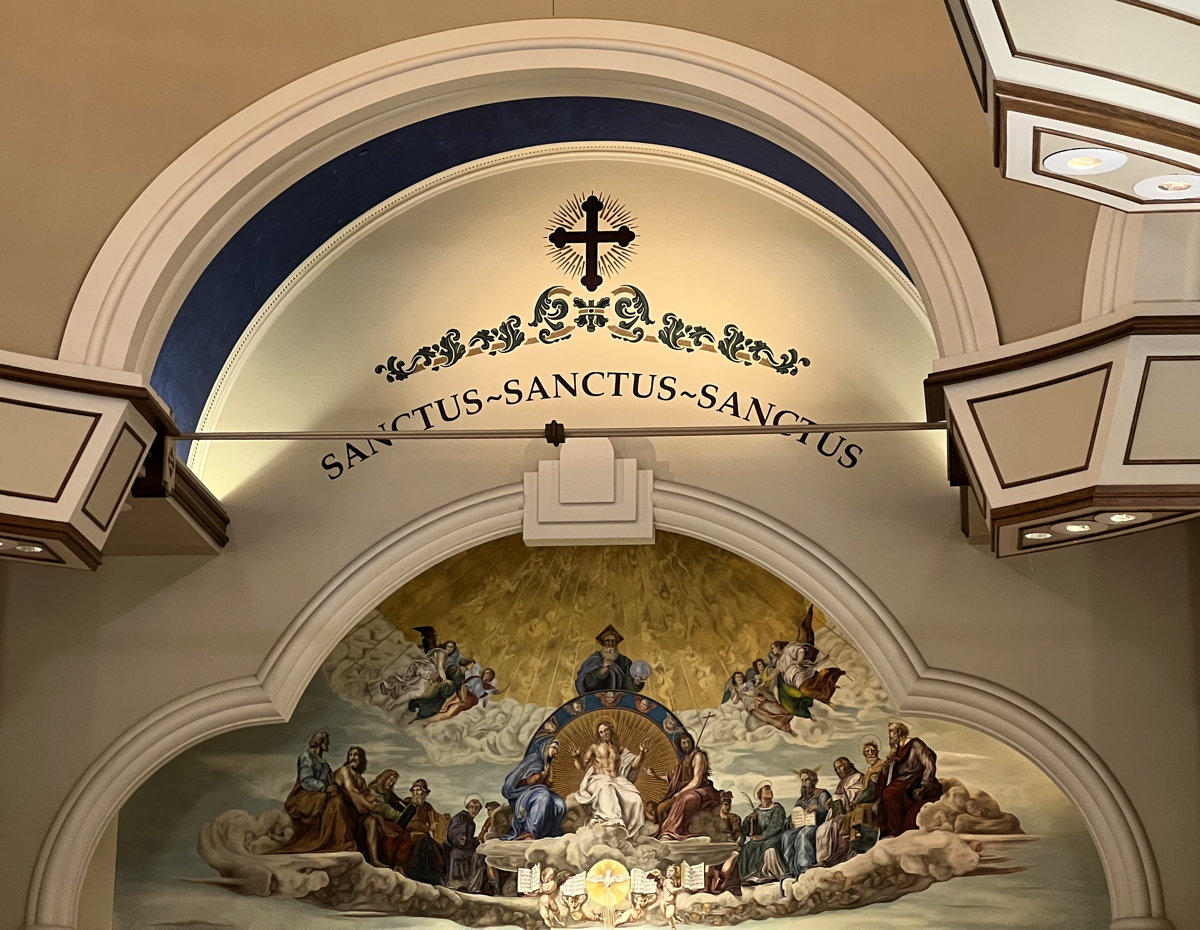
The first line is on the wall far above the altar at our local church.
In a recent issue of Benedictus—a word I’ll be talking about in this post, as it happens—I ran across the following question about Latin masses, quoted from the Tradivox Catholic Catechism Index vol. 14:
Why is the Mass said in Latin?
1) Because this language comes from Rome, whence we received our faith; 2) because, being a dead language, it does not change in the course of time like living languages, and 3) because thereby the unity and uniformity of the Church, even in her public service, is represented and preserved.
That was written back when most masses were celebrated in Latin. There’s a lot to be said for the unity and precision that comes with presenting the Mass worldwide in a single, unchanging language. In the modern era, the near-complete lack of comprehension of that language is probably an insurmountable obstacle.
- Agnus Dei
- Mysterium Fidei
- Sanctus, Sanctus ⬅︎
This installment, I’m going to decipher the Sanctus. That is, the Holy, Holy, Holy that comes at the start of the Eucharistic Prayer.
Latin English Sanctus, Sanctus, Sanctus Holy, Holy, Holy Dominus Deus Sabaoth. Lord, God of hosts Pleni sunt caeli et terra gloria tua. Heaven and earth are full of your glory. Hosanna in excelsis. Hosanna in the highest. Benedictus qui venit in nomine Domini. Blessed is he who comes in the name of the Lord. Hosanna in excelsis. Hosanna in the highest. Sanctus, sanctus, sanctus
It’s obvious enough from the identical repetition in both versions that sanctus means “holy”. How does it get there, however? Sanctus actually means a whole bunch of things in Latin, and several of them are likely play into the full meaning of the word in the prayer. Consecrated, sacred, divine, and just are all possible meanings along with holy.
- Magicare: The Quest for the Holy Bureaucrat—Wednesday, November 12th, 2025
-
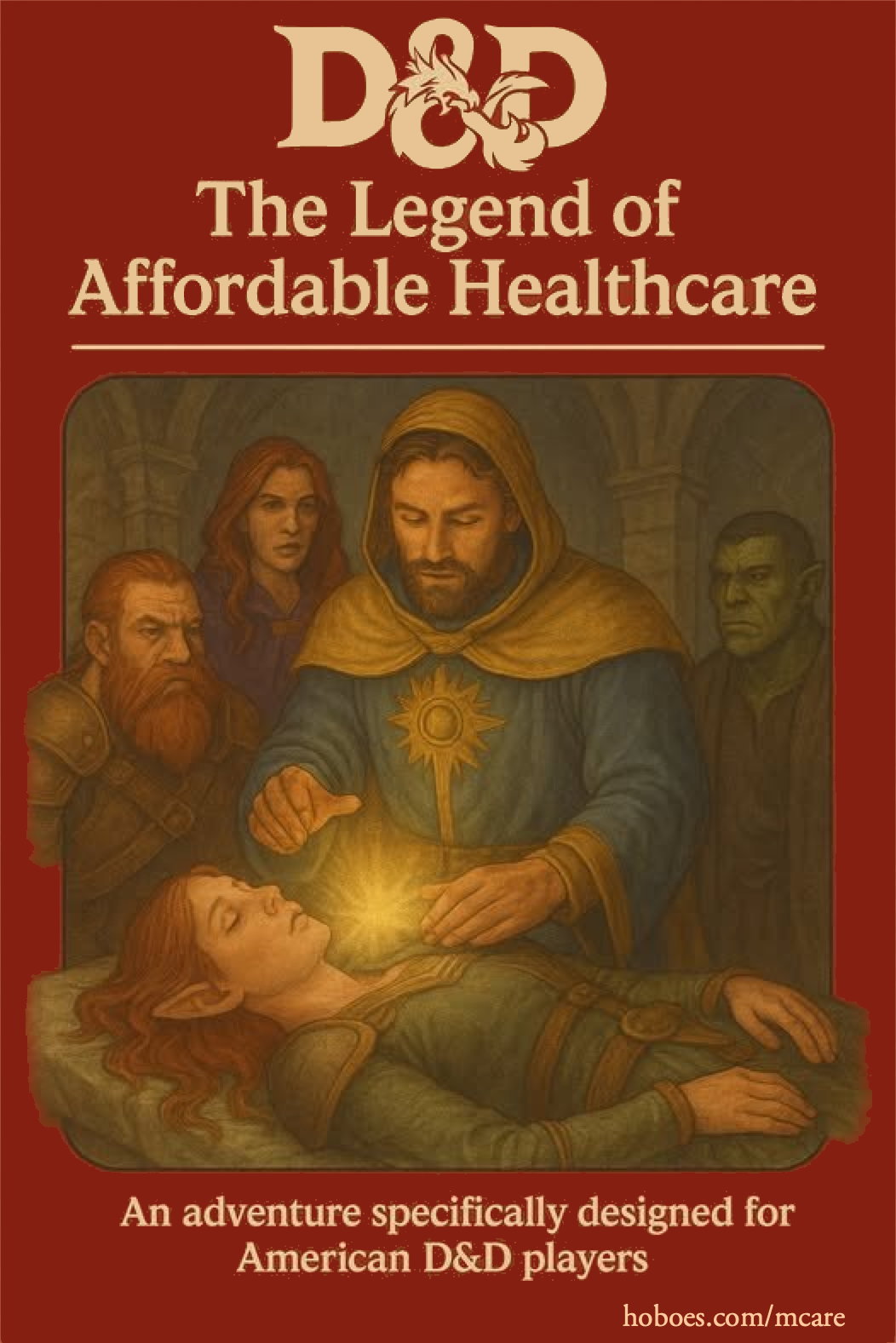
The Legend of Affordable Healthcare in America: If you want single payer, you must believe in magic.
I’ve written a lot about how science is becoming indistinguishable from magic in the minds of so much of the beltway crowd and the anointed—and not in the good science fiction way. Science is not something to be believed in, like religion, or voted on like politics. Science is the scientific method, nothing else. To paraphrase Feynman, if it disagrees with the scientific method it is wrong. That is the only key to science.
Science is not legislating the value of π or calling a council of the wise. That’s religion. Science is acknowledging the ignorance of experts, not their expertise. Every time you hear about science being “settled” or about a “consensus”, what you’re hearing is little more than a cargo cult religion wearing a cheap suit of scientific trappings and buzzwords.
One of the worst places for this substitution of magic for science is in medicine. Without the scientific method, medicine will kill both directly, through action, and indirectly by inaction. Nothing illustrates the cargo cult in medicine as clearly as this meme about health care that I ran across last year on a gaming group. The text specifically called out Americans:
The Legend of Affordable Healthcare: An adventure specifically designed for American D&D players.
To someone who both plays D&D and has done some thinking about health care and health insurance, the accompanying image is both profoundly weird and revelatory. For those not familiar with D&D’s iconography, the image pictured under the text “affordable healthcare” is of a priest—a “cleric” in D&D parlance—using magic to heal a sick or injured character.
Not a doctor. Not a scholar. A wielder of magic. This is neither an appeal to logic nor for better science. This is a religious tract.
It isn’t in any way necessary or even likely that a D&D-related affordable health care joke has to involve magic spells. D&D has had non-divine, completely non-magical medicine since at least the advent of its fifth edition, which was well over a decade ago. The skill “Medicine (Wis)” is literally on every character sheet. It’s on the character sheet of warriors and rogues as well as of wizards and priests.
A Wisdom (Medicine) check lets you try to stabilize a dying companion or diagnose an illness.
- Cherry Valley: A Massacre of the Revolution—Wednesday, November 5th, 2025
-
Veteran’s Day, once Armistice Day, is this coming Tuesday. But the armistice that ended the Great War is not the only thing that happened on November 11 in our history. Among the most barbaric was the 1778 massacre by English troops at Cherry Valley, a village now in Otsego County, New York.
A Sestercentennial Year
- Battle of Bennington
- Upside Down Yorktown
- Cherry Valley Massacre ⬅︎
- Battle of the Kegs
- Sestercentennial Cookery
- The New Colossus
The Cherry Valley massacre is an obscure part of the American Revolution to anyone but the residents of Cherry Valley, who remembered it at least up to the release of The Patriot in 2000.
The English employed Iroquois—in this location, Seneca and Mohawks—in their attempts to quell the American rebellion. The Iroquois were paid to attack under the direct command of British officers as well as to attack independently of English control. In response mostly to those independent raids, Continental soldiers had destroyed several Iroquois towns, hoping to end the many raids that had come from them earlier in the year. All accounts that I’ve seen say that the Continentals destroyed lodgings and provisions—not people. The direct antecedent to the massacre, the destruction of the Iroquois villages of Unadilla and Onaquaga, had by all accounts been empty at the time of the Continental raids.
- Music industry bludgeons musicians with DMCA attacks—Wednesday, August 27th, 2025
-
I haven’t written a whole lot on copyright issues lately; I’ve said most of what I needed to say in A Broken Contract with the Public and my series on my gaming site. It’s all nuts. From the DMCA’s privileging of spurious copyright claims to the retroactive extension of already-existing copyright terms without regard to what this means to people who licensed these works for a specific term, much of modern copyright law seems specifically designed to punish the individual artist and audience member and make it easier for faceless media conglomerates to crush both without consequence.
And these really are conglomerates. Rick Beato recently put out a heartfelt video on his YouTube channel about how Universal Music Group is blatantly abusing Digital Media Copyright Act copyright strikes in an effort to shut his video series down.
They’re literally flagging videos in which he interviews an artist and the artist sings or plays their own music as a copyright violation.
We’re using a small segment from an interview with him [Adam Duritz, Counting Crows] on a song he sang on!
…
I’ve hired a lawyer full time because it’s a full-time job. I’ve had probably four thousand claims over the last nine years from things that are fair use where I’m discussing songs. I’m doing interviews with people where I’m playing the music that they either wrote and recorded or they produced.
…
Since we’ve been fighting these things and never lost one they still keep coming in.
…
It’s ridiculous.
- Our lot is cast in this happy land…—Wednesday, August 13th, 2025
-
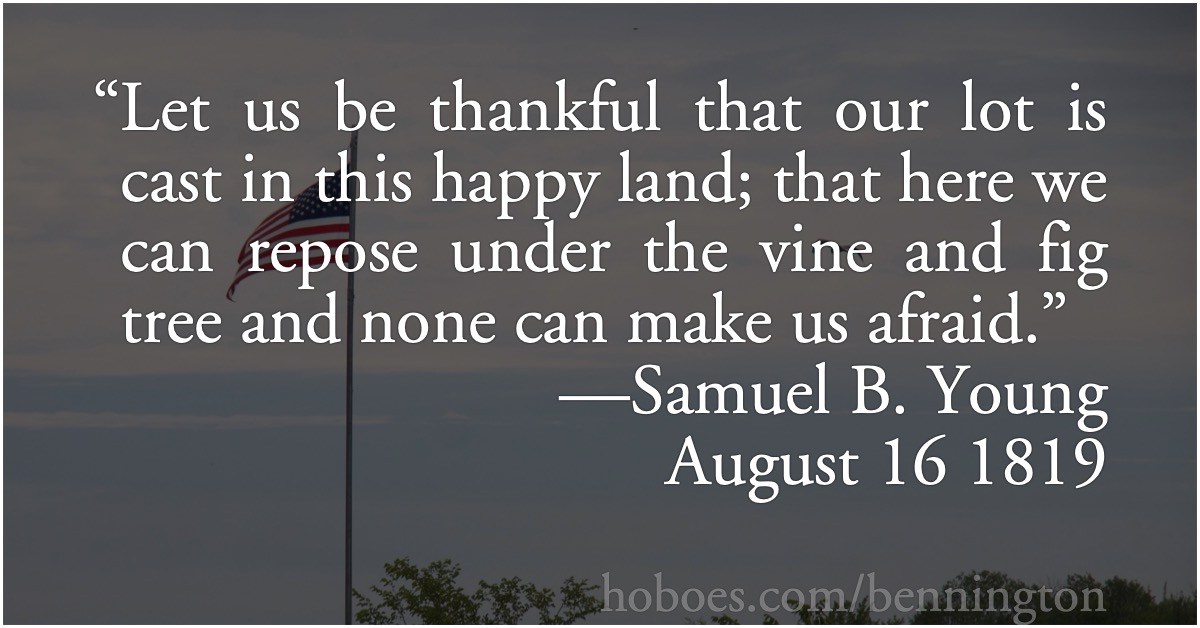
While researching the origin of The Rifleman’s Song of Bennington I ran across this 1819 speech on the occasion of the Battle of Bennington. It appeared in The Pittsfield Sun of Pittsfield, Massachusetts, November 10, 1819 and was given by Samuel B. Young on August 16 of the same year.
A Sestercentennial Year
- Battle of Bennington ⬅︎
- Upside Down Yorktown
- Cherry Valley Massacre
- Battle of the Kegs
- Sestercentennial Cookery
- The New Colossus
Since Saturday is the anniversary of the battle, I thought I’d reproduce it here. It’s a fine argument for commemorating Independence Day as well as the sacrifices made for Independence.
An Oration
Pronounced at Bennington, August 16, 1819, in commemoration of the Battle of Bennington, fought August 16, 1777, by Samuel B. Young.
“Eternal vigilance is the price we pay for liberty.”
“Live free or die;” death is better than slavery.
Fellow-Citizens—Commemoration of events like the present are too frequently esteemed as days of merriment. If we have assembled here to make this a day for feasting our appetites only, we lose all the solid benefits of the occasion.
Let us reflect that forty-two years ago this day, an adjoining Hill was wet with the blood of our Patriots; let us reflect that the semi-paradise below us (had it not been for the victory we celebrate) might have been the residence of our invaders; let us reflect that five thousand acres, now in sight, cultivated like a garden might have been the abode of Hessians and Indians; and we shall want nothing more to induce us to render praise to God for our success, and to render solemnity to the festivities of the day.
- Battles of the Revolution—Wednesday, August 13th, 2025
-
Sources from well-known and lesser-known battles of the American Revolution.
- Forgetting yesterday’s grace—Wednesday, July 16th, 2025
-
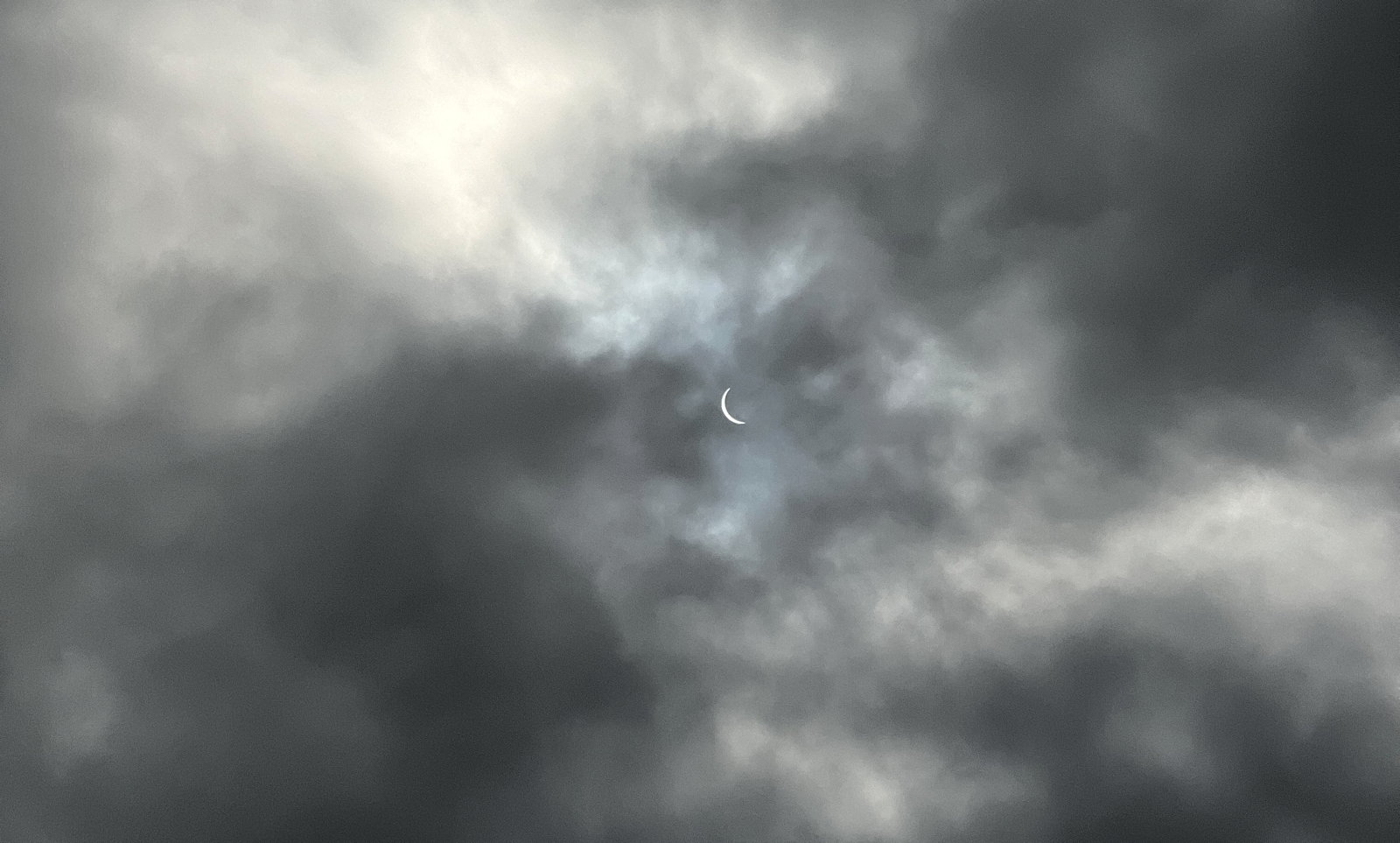
I doubt I could have gotten these photos without the cloud cover; I attempted to hold the solar filter over the iPhone’s camera lens, and it was a mess.
Being human means forgetting. We have almost as many names for forgetting as the mythical eskimo has for snow. The most commonly called-out form of amnesia among my somewhat geeky circle is named after a prominent physicist; Gell-Mann Amnesia is almost a kind of logical fallacy. We read something in the newspaper, or hear it on the news, and it happens to be something we’re familiar with. Perhaps it’s to do with our actual profession, or a dedicated hobby, or perhaps it’s to do with where we live or maybe even an event we took part in.
We listen to that news, recognize, perhaps angrily, that they not only got it wrong but that got it absolutely in reverse—Michael Crichton, in his famous explanation of Gell-Mann Amnesia called it “wet streets cause rain”—and then move on to news about something we’re not familiar with.
And then trust that they got it right. We completely forget how wrong they were ten seconds ago.
Another form of amnesia is the But what have you done for me lately amnesia. Just because someone’s been beneficial to us in the past, if they’re not being beneficial to us now we discount them. This can be a reasonable or unreasonable form of amnesia depending on the circumstances.
There’s another form of amnesia that is somewhat related to what have you done for me lately, a sort of in-the-moment amnesia bordering on ingratitude, where what’s happening now is perceived as unrelated to what happened in the past. We can thank God one moment and then forget all about Him minutes later.
The Monday, April 8, eclipse last year happened to go directly over my house at about lunchtime. I had about a three minute totality. About a week out from the eclipse the weather forecasts started coming in and even up to a few days beforehand the forecast was for full clouds and heavy rain on Monday and Tuesday. I suspect a lot of people canceled their trips or moved them to a different locale with better forecasts. I did not—part of the appeal of this eclipse was that I could literally see it from my backyard. So, I prayed for better weather and remained in the area.

Mimsy Were the Borogoves
To be relevant to our times, history must not be controlled by our times. Its integrity as a record of the past is what allows us to draw lessons from it. — Thomas Sowell (Black Rednecks and White Liberals•)