


Facebook is designed to kill relationships
Facebook’s algorithm is designed to break up families and friendships. Creating strife is literally what its algorithms do. It’s what they mean by the extremely euphemistic term “engagement”. Friends don’t have to stay engaged. Family doesn’t have to stay engaged. Friends and family don’t have to keep in constant touch to remain friends and family. Both can go for months, even years, with no contact, get together, and it’s as if they’ve never been apart. We’ve all seen it. We’ve all experienced it. And that would be death for Facebook.
Facebook’s business model requires constant engagement. Their designers have decided that the easiest way to get constant engagement is with constant arguments. Only enemies must remain engaged. It’s what being an enemy means. Enemies are also easier to manipulate, because despite their constant engagement they rarely communicate. Enemies are easier to keep staring at the screen, alert for the next offense, ready to loose the next scathing attack.
It’s a lot like what Norbert Wiener• talked about in The Human Use of Human Beings.
…when there is communication without need for communication, merely so that someone may earn the social and intellectual prestige of becoming a priest of communication, the quality and communicative value of the message drop like a plummet. — Norbert Wiener (The human use of human beings: Cybernetics and Society)
How often have you seen an event in your main feed, only to realize that it happened yesterday, or even last week, but Facebook is only showing it to you now? And yet day after day Facebook sorts the arguments and the nasty memes right to the top? Events don’t create online engagement. They create offline engagement.
It’s easier to keep eyeballs on ads when everyone is an online enemy. Much harder when they’re an offline friend.
I hesitated to write about this because if Facebook’s management realizes people are bypassing the algorithm, they’ll take that ability away. But I never enter Facebook by way of my main feed. I never enter by way of facebook.com with no path. As far as I can tell there’s no way to avoid the algorithm on the main feed.
So I only visit Facebook by directly bookmarking the groups I’m in. And before bookmarking them I sort them by most recent post. By bookmarking the sorted version I bypass the algorithm. When I enter Facebook, I’m only seeing a particular group’s posts and without the algorithm designed to cause strife. Newest posts come first—the ones that I need to see to know what that particular group is planning.
I wouldn’t even visit Facebook if groups still had dedicated web sites and forums. But many groups have abandoned their own web sites and even their own forums, leaving them far out of date. Oddly, even many businesses have out-of-date times and products on their web sites, relying solely on Facebook and its algorithm to communicate with their customers and potential customers.
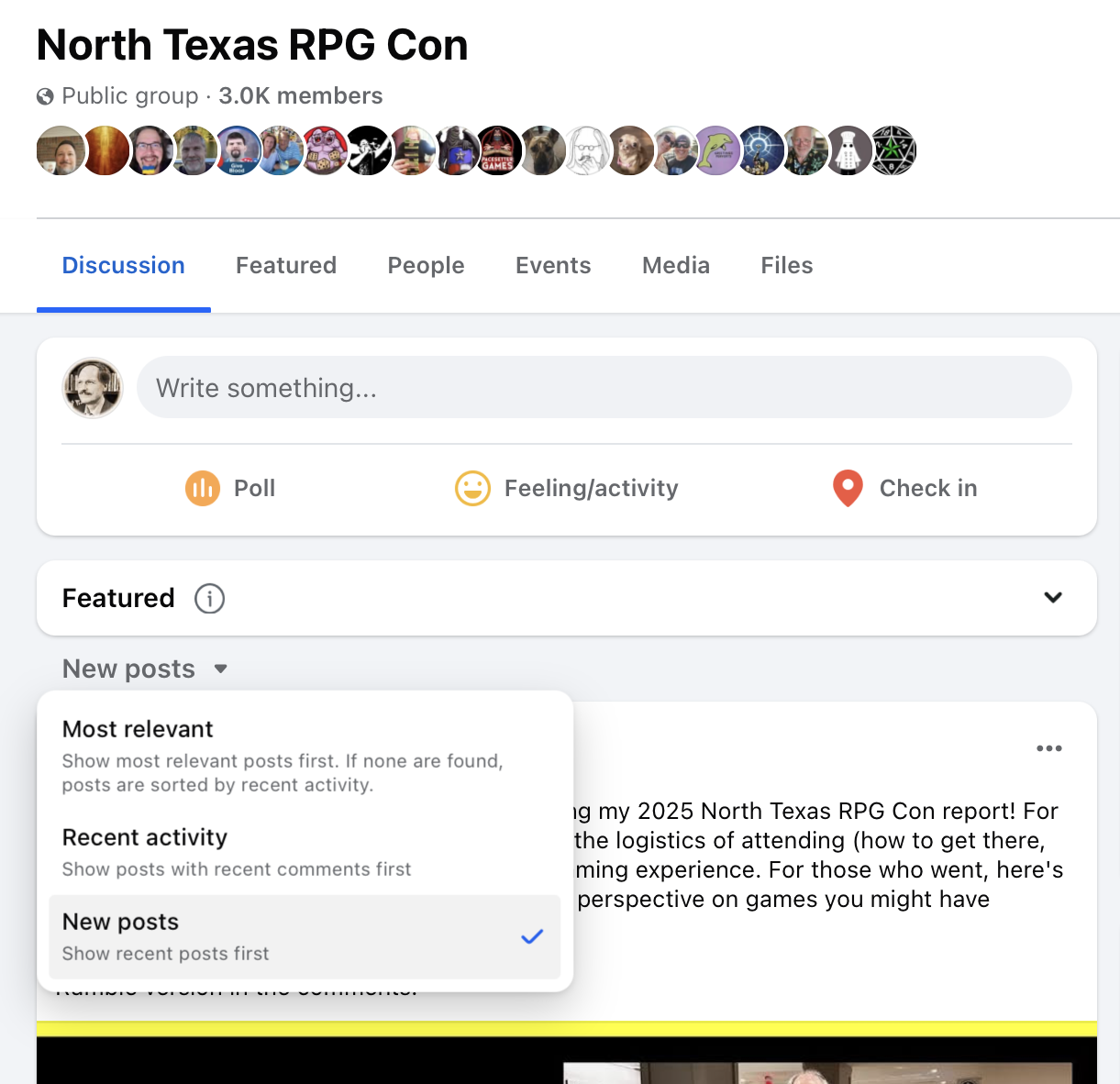
Sort by “New posts” to see only new posts.
This is, I suspect, counterproductive, because the algorithm’s destruction of relationships doesn’t distinguish between personal relationships and business relationships. The algorithm destroys them all.
While I accept friendship requests from people I am friends with, mainly to be able to contact them directly when necessary, I avoid the main feed. Because I want to keep the friendship.
Following the murder of Charlie Kirk, in response to what he called a “vile and rotten” campaign to make Kirk’s murder “more or less justifiable”, Italian journalist Francesco Costa included a very insightful description of this kind of social media in his weekly newsletter:
Ecco, questo sì che non è come prima, questo sì che non c’è sempre stato: il modo in cui i social media hanno messo il motore ai punti di vista più aberranti. Il modo in cui scavano dentro ogni debolezza umana, su tutti la vanità e il desiderio di affermazione di sé. Il modo in cui danno dignità a provocazioni ricattatorie e ragionamenti da assemblea d’istituto, a chi pensa che il mondo possa migliorare aumentando la rabbia in circolazione, a chi è completamente disinteressato a trovare soluzioni che non siano l’abbattimento del nemico. Il modo in cui tutto questo seduce le persone che vogliono avere un’opinione sulle cose—magari anche un’opinione notevole, altrimenti è dura farsi notare—senza fare troppo sforzo.
The next week, he went on to write:
Soltanto tre settimane fa, dopo che una ventitreenne trans aveva sparato durante la messa di una scuola cattolica a Minneapolis, vi raccontavo di come… quella radicalizzazione violenta non fosse un caso isolato nella sottocultura di chi usa esclusivamente i social media e i meme per farsi un’idea del mondo, e finisce così per venerare il caos.
My translation, with a little help from an Italian friend:
Look, this is not what has come before. It hasn’t always been this way, where social media amplifies the most aberrant ideologies. The way in which it digs into every human weakness, above all vanity and the desire for affirmation. The way in which it dignifies provocations and groupthink, to those who think that the world can be made better by increasing the anger around us, to those completely disinterested in finding solutions that don’t beat down their enemies. The way this seduces people who want to have an opinion on things—likely an outrageous opinion, otherwise it won’t be noticed—with little effort on their part.
…
Only three weeks ago, after a twenty-three-year-old trans woman [i.e., male] had fired during Mass at a Catholic school in Minneapolis, I told you how that violent radicalization was not an isolated case in the subculture of those who use only social media and memes to form their worldview, and so end by worshipping Chaos.
That is the Facebook algorithm. Exploit every human social weakness and make it worse. An acquaintance recently wrote that “The people I know in real life are all decent. I only encounter wicked people online.” If you want to see the decent side of your friends and family, stop following them on Facebook. Facebook amplifies hate, and hatred kills friendships.
- December 3, 2025: Farming hatred on social media
-
This is just a quick update on why “engagement algorithms” really mean farming anger: that is, what the financial stakes are that encourage artificially inflating engagement. Or at least, it started as a quick update. It quickly went off into the fields of effective advertising, and the ancient debate over eyeballs vs. sales.
Several social media sites reward people for delivering eyeballs—that is, for drawing in viewers and readers. Just as Facebook has discovered, one of the easiest ways to get eyeballs and to keep eyeballs is to encourage rage and hatred. The common term for this is “rage baiting”. It’s become such a common practice that it’s already progressed, language-wise, to a single-word contraction, “ragebaiting”.
This is what Facebook’s algorithm is designed to encourage, and this example (from X, not Facebook) is the first concrete example I’ve been blessed to find describing how much money is involved. I couldn’t find anything like this when I wrote Facebook is designed to kill relationships.
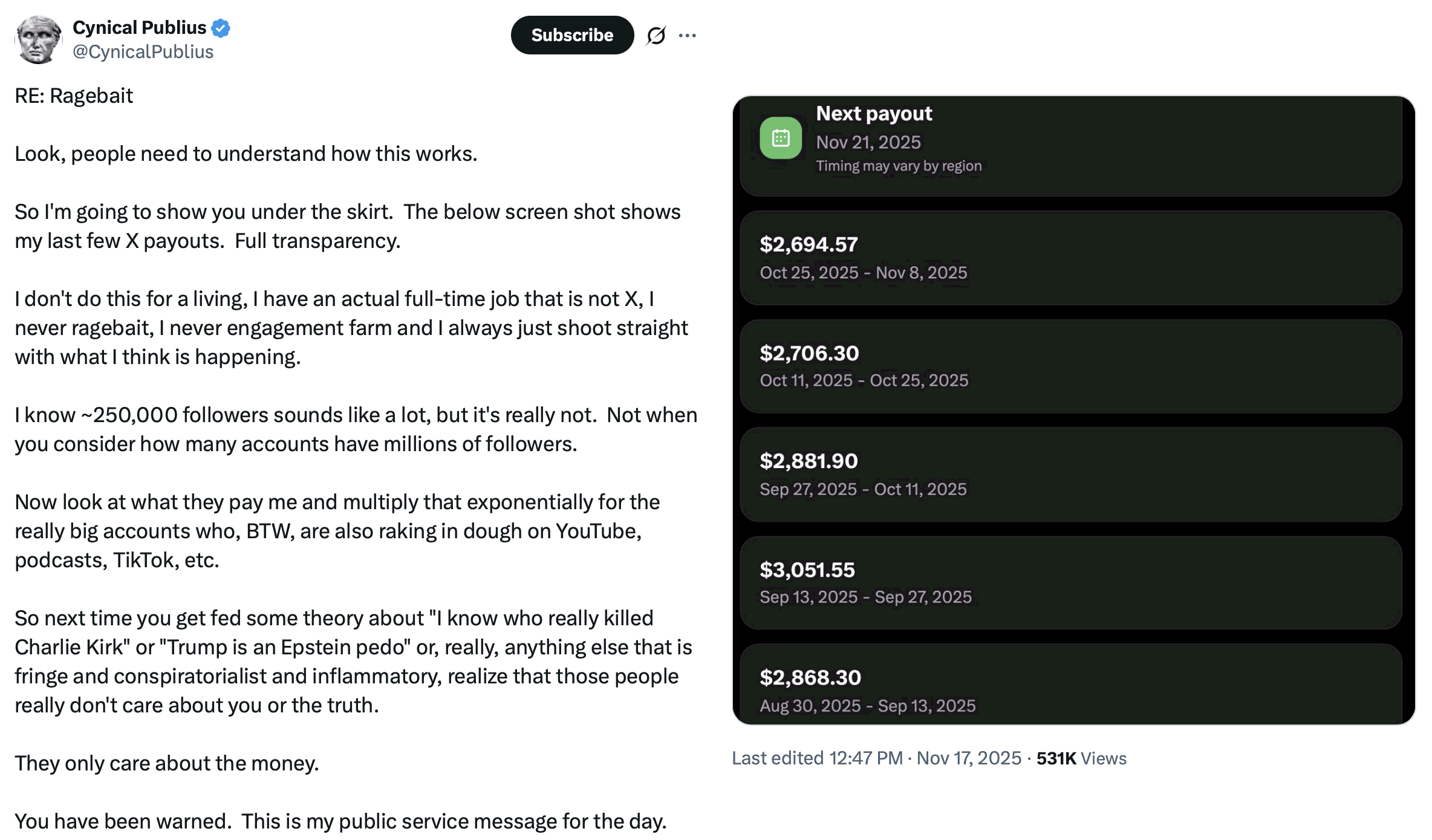
The wages of ragebait.
When you look at these numbers, remember that they are basically affiliate payments. When affiliates are linked directly to sales, such payments run from a fraction of a percent to, at the very high end, four percent, which would mean multiplying by anywhere from twenty-five up to two hundred to get the actual gross profits involved. But social media posts aren’t generally tied directly to sales, only indirectly as delivering eyeballs of potential sales.
Much as the purpose of television shows on broadcast television was to draw in viewers to watch television ads, the purpose of posts on social media is to draw in readers to watch Internet ads. Very few of the viewers or the readers actually convert into buyers. So you’d have to multiply again by two and probably much more for the actual figures involved on X’s side of the ledger.
- Doc_0 on X: John Hayward
- What’s with the superhero icon? “Last night, a government that destroys jobs at a blistering pace passed a bill that forces people to buy something. What could go wrong?”
- The human use of human beings: Cybernetics and Society•: Norbert Wiener
-
 There are works that come along once in an age and influence generations. Norbert Wiener’s Cybernetics is one of these works. Listen: “The dissemination of any scientific secret whatever is merely a matter of time. In this game a decade is a long time, and in the long run, there is no distinction between arming ourselves and arming our enemies.” Wiener shows a prophetic understanding of the nature of information, communication, and automated control of our environment. If you want a book that tells you about the future of the Internet, buy the one what was written in 1950.
- Is Social Media Driving Girls Insane?: Lawrence Person at Lawrence Person’s BattleSwarm Blog
- “Something weird happened in 2014. Greg Luciano, my friend who runs the Foundation for Individual Rights of Expression, he noticed it too, he came to talk to me. Something had changed among the students. There was a new kind of new morality driven by anxiety and fragility.”
- Our Cybernetic Future 1954: Entropy and Anti-Entropy
- In 1954, Norbert Wiener warned us about Twitter and other forms of social media, about the breakdown of the scientific method, and about the government funding capture of scientific progress.
- Review: The Human Use of Human Beings: Jerry Stratton at Jerry@Goodreads
- Entropy is a measure of disorganization; information is a measure of organization. Wiener saw that as something more and more difficult not just for children but for adults to grasp. And an inability to accept entropy means an inability to fight entropy.
More Facebook
- Only what Facebook wants you to see?
- To spread darkness, Facebook reduces the distribution of content they don’t want you to see, about news that is very important to a functioning democracy.
- Facebook thinks I’m Sarah Palin’s ghostwriter?
- Facebook Notes are whacked. Now they think I’m editing Sarah Palin’s notes.
More family
- Narrative of the life of Frederick Douglass, an American slave
- Not only does slavery make life worse for slaves, it doesn’t make life better for slave-owners. And the ultimate freedom is freedom to learn.
- What is the state’s role in marriage and the family?
- The family has been changing in the United States for decades, partially because of misguided government policies. Now, same-sex marriage changes the family fundamentally. State and federal legislators should take a serious look at the state’s role in marriage and family.