


Flowers o’er the Tory grave: Disney’s Francis Marion
Logo for Disney’s Swamp Fox miniseries on Walt Disney Presents. The background represents “Frontierland” at the newly-created Disneyland.
If poetry and music were the main pop culture mediums of the nineteenth century, television was the pop culture medium of the second half of the twentieth. Francis Marion was in on television from the beginning. He had a television series, sort of, in the fifties. Walt Disney Presents: The Swamp Fox was based on the Robert D. Bass book Swamp Fox: The life and campaigns of General Francis Marion.
The book was published in 1959 and Disney immediately made it into an eight episode miniseries for Walt Disney Presents. Francis Marion was played by Leslie Nielson, more famous today for his comedic roles. Marion’s girlfriend and later wife, Mary Videau, was initially played by Joy Page—more famous for a minor but pivotal role in the earlier Casablanca.
Disney meant the title of this show literally. Each episode of Walt Disney Presents was presented by Walt Disney. In The Swamp Fox he introduced each episode by giving an overview of the historical significance of the events of that episode. In his opening monologue for the first episode, “The Birth of the Swamp Fox”, he foreshadows what Dallas Corey would say on the record album I discussed in my earlier post. According to Walt,
In this darkest hour of his country’s need, the Swamp Fox had been born… To the American patriots who lived and fought throughout those uncertain days, Colonel Marion was a hero second only to George Washington… The result today is that there are seventeen counties, and twenty-nine cities and towns, scattered throughout the United States that proudly bear the name of Marion.
The series had a theme song composed by Buddy Baker and Lewis R. Foster. The main part, sometimes used as a verse and sometimes as a chorus, would seem to be inspired by the Scarlet Pimpernel:
- Swamp Fox! Swamp Fox!
- Tail on his hat.
- Nobody knows where the Swamp Fox’s at!
- Swamp Fox! Swamp Fox!
- Hiding in the glen.
- He runs away to fight again.
Compare this to Baroness Orczy’s bit of doggerel from The Scarlet Pimpernel:
- They seek him here.
- They seek him there.
- Those Frenchies seek him everywhere.
- Is he in heaven or is he in hell?
- That damned elusive Pimpernel!
The Swamp Fox theme differed from its time in that it varied across episodes and was often integrated into the actual story. In the first couple of episodes, the song was sung by Marion’s men as they rode away from whatever battle the episode ended with. It was first introduced by Oscar, one of the Marion family slaves and a prominent member of the group, during a conclave in the infamous swamp that gave Marion his nickname.
Oscar was played by Jordan “Smoki” Whitfield. Whitfield’s introduction of the song began with:1
- Got no cornpone, got no honey,
- All we’ve got is Continental money.
- Won’t buy bacon, hominy or grits,
- Roasting ears and possum is all we ever git.
Disney’s portrayal was correct: Marion was a slaveholder. Unlike, say, Thomas Jefferson, who bought and used slaves while vehemently opposing the institution of slavery, there is no record of Marion’s ever arguing against it. He appears to have been one of those of whom Lincoln said that they know slavery is wrong for themselves but who go no further.
But, slavery (say some) is good for some people!!! As a good thing, slavery is strikingly peculiar, in this, that it is the only good thing which no man ever seeks the good of, for himself. — Abraham Lincoln (Lincoln and the American Founding•)
Francis Marion was from South Carolina. Thomas Jefferson—like most of the slaveholders among the founders who opposed slavery—was from Virginia and further north.
Marion’s countrymen in the Continental Congress were the delegates who would have chosen to remain the slaves of King George if they weren’t allowed to keep slaves themselves. They were the men who refused to disparage slavery in 1776 in the Declaration of Independence; who refused to outlaw slavery in 1787 in the United States Constitution. Who forced compromises to the anti-slavery elements of the Constitution that would merely put slavery on the road to destruction rather than end it immediately.
They were willing to contemplate the end of slavery tomorrow, but never today; in their children’s time, not in their own. For all his faults, this is not something Jefferson fell prey to.
There’s a lot to be said for Disney keeping that aspect of Marion’s life intact. It wasn’t the only harsh aspect of this Disney series: they also kept the bloodiness of the war intact. People died in every episode, some of them very important characters.
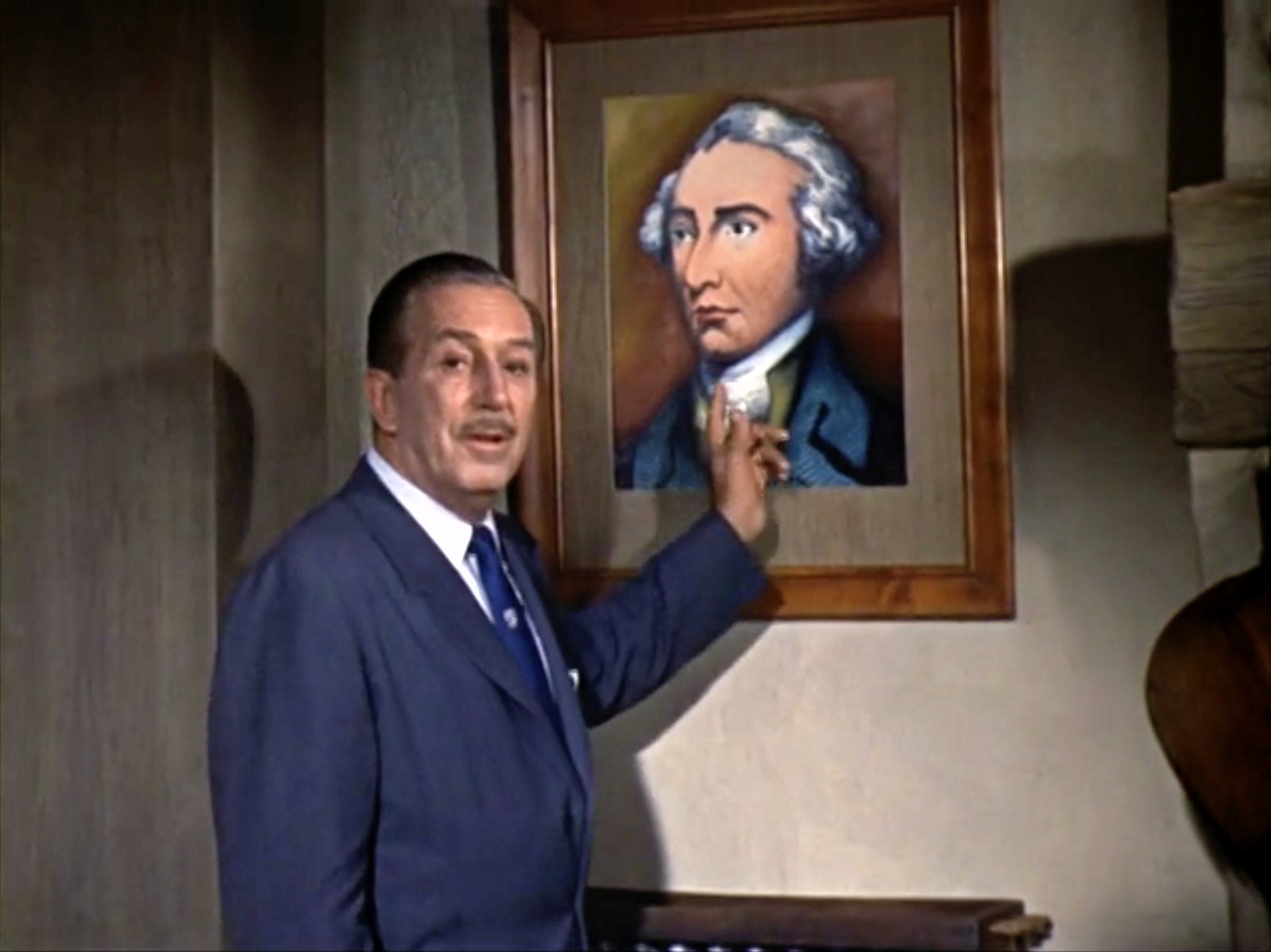
Walt Disney discusses the first episode of The Swamp Fox in front of a portrait of Francis Marion.
- Oh we’re riding with the Swamp Fox,
- There’s a price upon his head.
- Yes, we’re riding with the Swamp Fox,
- ’Til the end of me is dead.
As in the real life Revolution, neighbors and families were divided across Tory and Patriot lines. This was used for comic effect in the first episode, but much more seriously in the second, titled “Brother Against Brother”. This episode began with brothers literally burning each other’s homes and barns with people inside.
The first episode ended with Marion’s Men singing the “tail on his hat” verse as a chorus, with the first verse:
- We are short of men and powder,
- Always fight with an empty gun.
- Only makes us shout the louder,
- We are men of Marion.
And the second verse:
- Got no blanket, got no beds,
- Got no roof above our heads.
- Got no shelter when it rains,
- All we’ve got is Yankee brains!
The writers also included some on-the-fly verses to the tune of Yankee Doodle2, one of the most common tunes of the era.
- My father sent me down to camp
- To talk to Major Horry.3
- Almost got my head blown off,
- He thought I was a Tory!
- Yankee doodle, keep it up.
- Yankee doodle, dandy.
- Stick a feather in your hat
- And with the girls be handy.
- And there I saw a little keg
- Its head all made of leather
- They pounded it with little sticks
- To call the folks together.
- Yankee doodle, keep it up.
- Yankee doodle, dandy.
- Stick a feather in your hat
- And make yourself so handy.
I especially like that second verse because it isn’t very good; it’s exactly the sort of thing a non-musically-inclined soldier might come up with on the spur of the moment to amuse his friends.
In the second episode, Marion’s men managed to get a surplus of powder, and as they rode off to battle changed the first two lines of the theme’s first verse to “We got lead and we got powder, we don’t fight with an empty gun.”
The third episode, with a much more sombre ending, had no song at the end, but it does have children singing the song at school, at the start of the episode, play-acting at redcoats and patriots.4 It’s light-hearted and gives almost no warning about the dark turn the episode is about to take.
From the fourth episode through the sixth, it was “got no blankets…” followed by “tail on his hat” to a very similar, if not the same, clip of them riding away. The fifth episode features another two verses, as well as the first line of a third verse before Colonel Tarleton cuts Oscar off:5
- Seventeen hundred and seventy six
- Redcoats marched on Charleston.
- Colonists found themselves in a fix,
- Called on a man named Marion.
- Redcoats come from over the ocean,
- Far from home across the sea.
- Landed with some silly notions
- They’d chase us right up a tree.
- CHORUS
- Redcoats live on tea and—
There is at least one other, more Disney-ish, song, sung by Oscar; a song that might be called “Heaven ain’t here” or “Heaven is a feeling” is repeated at various down points in the series, usually at night. It has nothing to do with the war specifically; it’s almost a lullaby.
In the seventh episode there was an interesting historical cameo: Marion’s men take refuge for a few seconds in the rustic cabin of “the widow Jackson” and meet her son Andy. This Andy is a little younger than the future president Andrew Jackson—whose mother was also a widow—would have been. This Jackson, who appears to be an only child, looks more like the legend of Jackson than the reality. President Jackson was born and raised in South Carolina, but this Andy Jackson does not get slashed by a British officer: his mother convinces him to polish the officer’s boots.
One interesting twist on reality is that after the real Andrew Jackson recovered from his wounds for refusing to polish the British officer’s boots his real mother volunteered to act as a nurse to rebel prisoners on British prison ships in Charleston harbor. Disney’s version is almost an alternate reality telling: since in this episode Jackson isn’t wounded, his mother doesn’t become a prison ship nurse, and Mary Videau does instead!
The new recruits from the prison ship are from the Blue Ridge, and come in to Snow Island at the end of the episode singing their own song. Most of it is in the background—again, most of the music in this series is done in character, which makes it impossible to hear the entire song due to all of the other often noisy things going on in the foreground or background. Fortunately, they sing it again in an ill-advised tavern celebration in the eighth episode. Even then, however, I’m not completely sure about some of those place names. Except for Caesar’s Head I pretty much looked on a map of the Blue Ridge until I found something that sounded like what Marion’s men were singing.
“Blue Ridge Mountaineers” appears to be another work of the series’s team of Lew Foster and Buddy Baker. It sounds like a real folk song in part, but I can’t find these lyrics in any of the archives I have access to or on the wider web.
- Our home is high like the eagle’s nest
- In the Blue Ridge mountains way out west.
- Our band is few but tried and true
- And we always do what we set our minds to.
- The mountain woods are greener
- Where the Santee waters spring.
- The sky above is cleaner
- Where Catawba’s banks begin.
- From Caesar’s Head to Blowing Rock,
- From Tillery water clear,
- That’s where they raised a hearty stock
- Of Blue Ridge mountaineers.
- So let’s get the fightin’ done,
- Let’s start the redcoats runnin’.
- Let’s just be sure the war is won,
- And get back home to funnin’.
- He’ll say goodbye with a jug of rye
- A-resting on his shoulder
- And ¿find?6 a kiss to stop the sigh
- Of a mountain miss grown bolder.
- Without no pay he’ll ride away
- Across his lap his old squirrel gun.
- He won’t come back til the doggone day
- He’s won the war with Marion.
- So let’s get the fightin’ done.
- Let’s start the redcoats runnin’
- Let’s just be sure the war is won
- And get back home to funnin’.
- And get back home to funnin’.
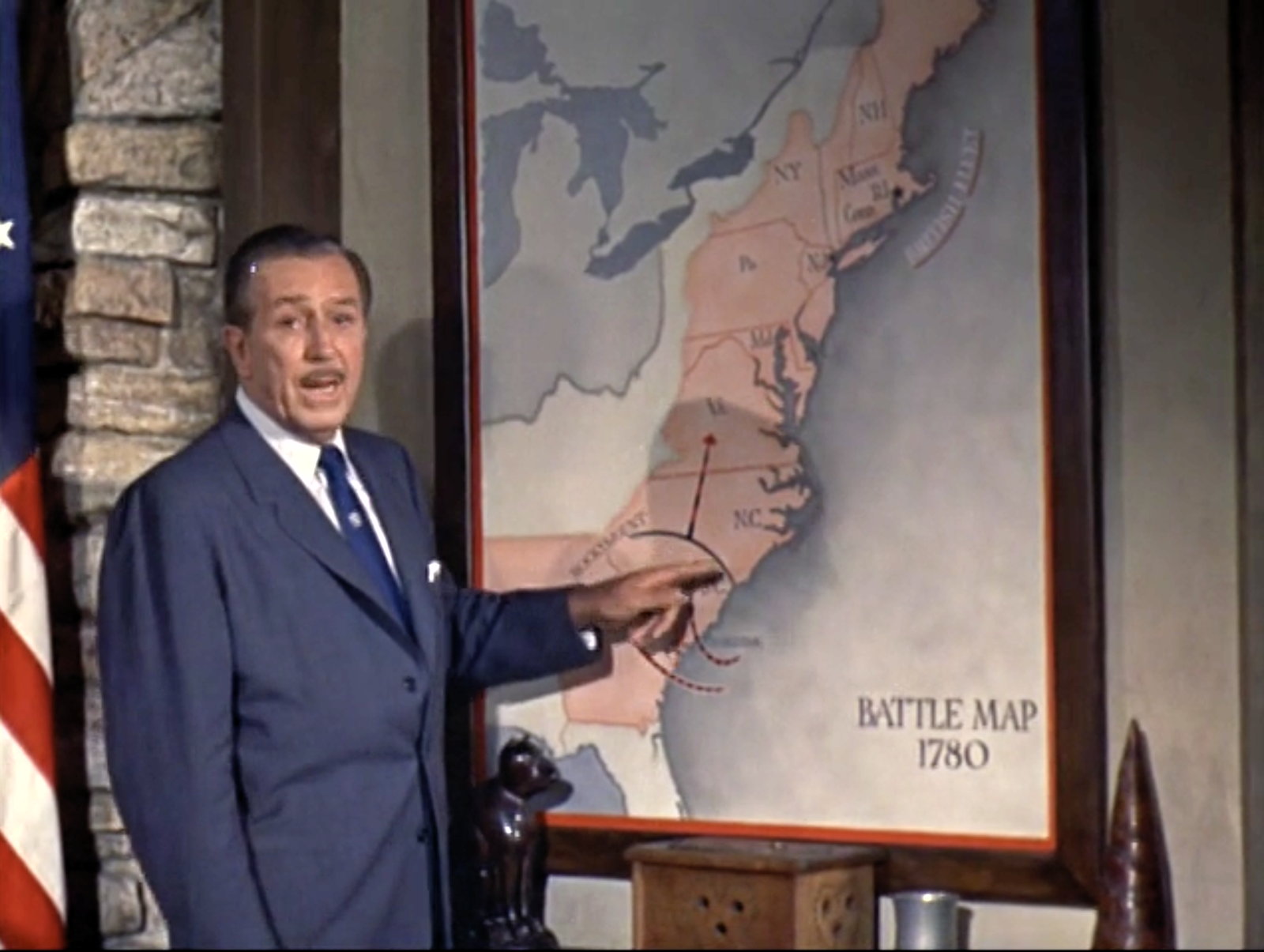
Walt Disney explains the British southern strategy to end the American revolution.
The melody is weirdly similar to the Rivendell welcome and the Mountain King’s Return in the Hobbit cartoon.
The final episode introduces a spiritual—again, an original spiritual as far as I can tell—from Oscar. The first line of “Roll the Clouds Away” is from Song of Songs 4:16, and the lyrics are peppered throughout with other Biblical references. The chorus’s first line, “Roll the clouds away”, is likely inspired by Revelation 6:14, And heaven receded, like a scroll being rolled up…. This is not a peace that will come easily: it’s the sixth seal, after the four horsemen are loosed and the martyrs cry from their graves.
- Let the north wind blow
- Where the cannons roar.
- Let the war pipes blow
- In the land no more.
- Let all God’s creatures
- Rise and stand.
- Let freedom ring
- Throughout the land.
- Let the flowers nod
- O’er the Tory grave.
- Where the soldiers trod
- Let the green grass wave.
- Let neighbors wash
- Their neighbors’ feet.
- And love abide
- When brothers meet.
- Roll the clouds away.
- Let the sun shine through.
- And let God’s love
- Descend on you.
- Let turmoil cease.
- Take your neighbor’s hand.
- Let the joy of peace
- Come o’er the land.
- Set the bondman free.
- See the poor to feed.
- Let the rich man see
- His brother’s need.
- Let the lamb abide
- Like the Good Book says
- By the lion’s side
- ’Til the end of days.
- Let the birds be free
- In a quiet land
- And no more be afraid
- Of man.
- Let the little fish in
- The lazy brook
- Be just as safe
- From the fishin’ hook.
- Roll the clouds away.
- Let the sun shine through,
- And let God’s love
- Descend on you.
- Let turmoil cease.
- Take your neighbor’s hand.
- Let the joy of peace
- Come o’er the land.
- Let peace come o’er the land!
This really is a very nice song and worth braving the low video quality of episode 8 on the various video sites that have it.
It’s fascinating that Disney seemed to be making an attempt to integrate the theme song into each episode, both by changing the lyrics to fit the episode, and by following Simms’s lead in having Marion’s men sing their Swamp Fox song.
It isn’t odd of course for a Disney movie to feature music, but it’s blended in so naturally that there’s never a full version suitable for a hit track on the radio.
Also of interest are the lines “hiding in the glen” and “He runs away to fight again.” This is hardly a heroic song. It makes the Monty Python skit about “brave, brave, Sir Robin” far less satirical. Walt Disney beat them to it by sixteen years!
It was that lack of conventional heroism that made Francis Marion stand out from an era of many heroes. His partially fictional legend made him as much of a superhero as the completely fictional Scarlet Pimpernel. And his nickname was a far better superhero name—though, as far as I can tell, there is no specific animal named a “swamp fox”.
Like the song I highlighted in The World Turned Upside Down, Francis Marion may be the best known hero of the revolution that no one knows. That’s became most famous incarnation of Francis Marion today isn’t the hero of the nineteenth century poems I wrote about earlier nor even the hero of Walt Disney’s television show. Benjamin Martin, the protagonist in Mel Gibson’s The Patriot, was partly—and probably mostly—based on Marion. Most viewers of The Patriot probably had no idea who Martin so obviously—to those of us aware of the legend—was based on. Even those who knew he was based on some guy with the nickname “Swamp Fox” would have been hard-pressed to give the Fox’s real name.
It’s a great movie, but even Walt Disney didn’t alter the story as much to turn it into family fare as Gibson’s team did. Most of the differences between the Benjamin Martin and Francis Marion were changes made to make the Fox’s private life more palatable to modern audiences. I love watching The Patriot, but after watching the Disney series I’m a little less impressed with the choices the film’s team made to modernize it.
Who was this guy with a name like a Marvel Comics superhero and a legend to rival and even exceed fictional heroes like Zorro and the Scarlet Pimpernel? How did he compare to his fictional counterpart?
Unlike the fictional Benjamin Martin, who employed free men—free men of color, an unlikely thing in South Carolina of 17767—at his farm, Francis Marion bought and used slaves, even in the Disney television series.
Like Benjamin Martin, Francis Marion’s house was burned in the war. In The Patriot, Martin’s house was burned by the British army. In Walt Disney Presents, Marion’s house was burned by his Tory neighbors.
Disney’s really is a harsher presentation of the legend.
Benjamin Martin was a widower who married his sister-in-law after the war; Francis Marion was unmarried until he married his cousin after the war. He had no children in 1776. Marion co-managed his multi-family plantation with his siblings and their families. Martin managed his own farm, possibly to pass it to his own children.
Martin had a son named Gabriel who died in the war. Marion had a nephew named Gabriel who died in the war.
Both Martin and Marion had been Indian fighters, and both recognized the usefulness of the tactics the Indians used. It allowed them to turn their own smaller numbers from a liability into an asset—what we would now call guerrilla tactics. Much of Francis Marion’s cinematic appeal comes from this. He was in a sense the Rambo of his era, albeit within a team of Rambos.
Unlike Martin, there is no record of Marion needing to be convinced to join the Patriot cause; Marion had neither wife nor children to hold him back. Marion could also expect the rest of his family to take care of the family farm.
The entire series is available on the Internet Archive and elsewhere, but not officially on any of the more traditional streaming sites. While the video quality drops precipitously after episode three, those first three episodes are well worth watching.
In response to Mock the Wind and Sing of Marion’s Men: “In Lexington, the center of revolt against the King…” One of the most modern figures of the American Revolution was a slaveholder and Indian fighter with a superhero name.
Oscar introduces the song at 38:10 in the Internet Archive version of the first episode, immediately following Oscar handing Francis Marion his signature hat with the foxtail on it.
↑Yankee Doodle is at about 35:55 in the version of the first episode on the Internet Archive, right after Oscar drives the birds into the air to signal a gathering.
↑I’n hearing “Ory” more than “Horry”. It could be that “Major Ory” was a name made up to rhyme with “Tory”. But there was a Major Peter Horry who was an old friend of Marion, so I’m going with that. Also, both spelling and pronunciation were a bit loose back then. According to the ever-reliable Google AI (that was sarcasm) there was also a “Major Joshua Orne” of Marblehead, Massachusetts whose name was alternately spelled “Oree”. I’m not seeing any reason for the AI to make this conclusion about Orne, nor for Marion’s Men to speak to the Marblehead Oree, not when they have a Horry closer to home.
↑There’s also a new actress for Mary Videau. The first two episodes were in one season, and the next episode in another season. Joy Page retired that year, requiring a new actress for episode three. It’s too bad; there’s nothing wrong with the new actress but she doesn’t fit the role nearly as well as Page did. Page looks like a Videau.
↑The “redcoats” verses come in at 26:00 on the YouTube episode five, as Oscar is trying to get thrown out of the house he’s being held in, which is more of a sitcom plot than a war adventure plot. (A similar sitcom-like situation comes out of nowhere in the sixth episode involving hay and a “forgotten” hay fever.)
↑I’m pretty sure it’s not “find” a kiss, but that’s what it sounds like to me, to the extent that it sounds like anything. It actually sounds more like “file” or “fay”.
↑How unlikely? It is very difficult to tell. We only had a census under the new Constitution in 1790, well after the Revolution. At that point, records indicate only 1,801 “other free persons” in South Carolina, which would have included more than free blacks. Further, the very concept of what makes a person free and what makes a person black had not yet been codified.
↑
General Francis Marion
- The Elusive Swamp Fox: George F. Scheer
- “Around Francis Marion there has sprung up an overgrowth of legend as tangled as the swamps he fought in.” “…he divided his seventy men and sent a party under his old friend, Major Peter Horry…”
- Swamp Fox: The Life and Campaigns of General Francis Marion: Robert D. Bass at Internet Archive
- “Bold and elusive, Colonel Marion was a haunting nemesis to the Tories, terrorizing them from White Marsh to Black Mingo. He was an armed will-o’-the-wisp to the British soldiers, a phantom exacting retribution and justice. With his volunteers in homespun, he cut the supply line between Charleston and Camden… To the Carolina partisans Francis Marion was a latter-day Robin Hood.”
movies
- Casablanca
- Ah, Play it, Sam! If this isn’t the most-quoted movie outside of Macbeth, you’re in the wrong country. This is a beautiful DVD. The movie is presented in the original full-screen format. Languages are French and English, both spoken and subtitled. It also includes a nice documentary hosted by Lauren Bacall.
- The Hobbit
- This enchanting version of Tolkien’s Hobbit is a fine movie, but a horrible DVD. Sound effects and dialogue have been removed for no apparent reason. I can’t see any reason to buy this unless you’d be just as happy watching it with the sound off.
- Walt Disney’s Swamp Fox—Complete Series at Internet Archive
- Some of these videos are great quality, some very poor quality, but they portray a fascinating historical television series from the late fifties.
music
- The Battle of the Kegs
- The Battle of the Kegs took place on January 5 or 6, 1778. Soon after, Francis Hopkinson wrote this wonderful account of the debacle, including very personal details about the British General in charge!
- Review: The Scarlet Pimpernel: Jerry Stratton at Jerry@Goodreads
- “A rich dandy, after a deeply wounding personal tragedy, dedicates his life to fighting injustice. He has special vehicles for getting to and from his adventures, he is a master of fighting, of disguise, and of escape… he keeps his true identity a secret, leading to a love triangle between the love of his life, himself, and his heroic identity.”
- The World Turned Upside Down
- The legend of the surrender of Lord Cornwallis to Washington at Yorktown says that the band played “The World Turned Upside Down”. It probably didn’t. But we’re going to print the legend anyway.
slavery
- Black Demographic Data, 1790-1860: A Sourcebook: Clayton Cramer at Clayton Cramer’s Web Page
- “It is my hope… that historians will find that the enclosed data provoke new questions about the status of blacks in antebellum America.” “Consider the Sumter Turks of South Carolina… While they insisted that they were white, whites of European origin in the region did not share this opinion, and the 1830 census recorded a number of them as free blacks.”
- Free and Slave Populations by State (1790)
- “All Numbers are as Reported in the 1790 Census.”
- Patriot Slave: Tina C. Jones at American Legion
- “Legend has it that Oscar and Francis Marion grew up on the same plantation in Berkeley County, S.C., and that they played together as childhood friends in the 1730s. Francis Marion's family owned the plantation. Oscar was a slave. They were probably about the same age, or at least of the same generation. In time, these childhood playmates would mature and, as adults, find fame as patriotic heroes and fierce guerrilla fighters in the Revolutionary War.”
More American Revolution
- Mock the Wind and Sing of Marion’s Men
- “In Lexington, the center of revolt against the King…” One of the most modern figures of the American Revolution was a slaveholder and Indian fighter with a superhero name.
- The Battle of the Kegs
- The Battle of the Kegs took place on January 5 or 6, 1778. Soon after, Francis Hopkinson wrote this wonderful account of the debacle, including very personal details about the British General in charge!
- Cherry Valley: A Massacre of the Revolution
- Mel Gibson’s The Patriot is disparaged for the ruthlessness it portrays among the British. But such barbarity certainly did exist. One massacre by British troops is still remembered by the residents of Cherry Valley, New York.
- The World Turned Upside Down
- The legend of the surrender of Lord Cornwallis to Washington at Yorktown says that the band played “The World Turned Upside Down”. It probably didn’t. But we’re going to print the legend anyway.
- Songs of the American Revolution
- Various songs, and the history of the songs, that made the Revolution—sometimes decades later.
- Two more pages with the topic American Revolution, and other related pages
More General Francis Marion
- Mock the Wind and Sing of Marion’s Men
- “In Lexington, the center of revolt against the King…” One of the most modern figures of the American Revolution was a slaveholder and Indian fighter with a superhero name.
More A Sestercentennial Year
- The Rifleman at Bennington to the British Granadiers
- The British Grenadiers provides an interesting period melody for The Rifleman’s Song at Bennington; also, the original 1837 Rifleman’s Song lyrics from The New-York Mirror.
- News on the Deaths of Adams and Jefferson
- “Such men need no trophies; they ask no splendid mausoleum. We are their Monument: their mausoleum is their Country.” John Adams and Thomas Jefferson’s death on the same day, 50 years to the day from the first July 4, was an inspiration to a young nation.
- No Common Spirits: Jefferson and Adams survive
- Adams and Jefferson both dying on the Jubilee was hailed as “a most singular coincidence… A more signal and impressive combination of circumstances is not to be found… Nothing so sublime could have been conceived by human thought… Who does not envy such a death after such a life?”
- A Monticello Meal for Independence Day
- Marie Kimball’s Thomas Jefferson’s Cook Book provides several pot-luck friendly dishes for your Fourth of July celebration this Semiquincentennial.
- Mock the Wind and Sing of Marion’s Men
- “In Lexington, the center of revolt against the King…” One of the most modern figures of the American Revolution was a slaveholder and Indian fighter with a superhero name.
- Seven more pages with the topic A Sestercentennial Year, and other related pages
More television show
- This Boy Digs Deep: Eddie Doucette in TV Guide
- Eddie Doucette returned to NBC television in 1954 after a year-long hiatus in favor of the Pope family.
- Yes Minister: The Complete Collection
- If I had to subtitle this eighties political sitcom, I’d call it “Screwtape Politics”.