


President Donald Trump and the Zero-Dimensional Gardeners
Beltway pundits like to ridicule Trump supporters for thinking he’s playing some sort of four dimensional chess when he clearly isn’t. Whether it’s the fight with Musk or ending Iran’s nuclear program, it’s all the same complaint: not only does President Trump not understand what he’s doing, his supporters think there’s a plan when there isn’t one, confusing random flailing with multi-dimensional strategy.
In fact, though, that’s not what I see most Trump supporters celebrating in Trump’s actions. Most Trump supporters appear to be grateful that the President plays mere two-dimensional or one-dimensional chess.1
Most politicians and beltway pundits seem to be stuck in zero dimensional chess. When Trump announces some action in pursuance of some policy, such as that he’s going to raise tariffs against a country until that country decides to negotiate to reduce their tariffs against the United States, the beltway class yells that this is crazy.
And then when the President rolls those tariffs back when the country announces they’ll negotiate, the same crowd crows that Trump is walking back his actions, not that the actions resulted in the consequences the President desired.
The same thing happened only last week with Iran. Trump threatened Iran with specific consequences unless the Islamic leadership in Iran started negotiating, starting with a ceasefire in the Strait of Hormuz. The beltway class yelled that he’s crazy. Iranian leaders came to the table, so he stopped the threats that he explicitly said were meant to bring about this result and the beltway class crowed that he was chickening out. They didn’t argue that he shouldn’t trust the Iranian leadership—or that he shouldn’t trust the Pentagon—or that the starting point of negotiations offered was a bad one or even that the ceasefire was likely to be measured in hours rather than days. For that you need to go to someone on the right, someone who has actually supported Trump, such as Mark Steyn. No, they argued that he was chickening out when he did what he said he would do.
It’s literal zero-dimensional thinking. There is no sense that policies have goals and that reaching those goals will affect policy. When a politician literally announces the goal of an action, and the goal is met and so the action is ended, this is crazy and incomprehensible to beltway “thinkers”. Who, to paraphrase Edgar Rice Burroughs, “do more talking than thinking”.
Most people throw around the term n-dimensional or one dimensional as a generic, vague term for unthinking, but there is a way of thinking about such terms more concretely. Zero dimensions consist of only one point. Zero dimensional thinking, then, would consist of only one step: action. Results not only don’t matter for zero-dimensional thinking, they don’t even register. The only response of a zero dimensional thinker is action again, harder. But despite silly motivational posters action is never better than inaction. The way that zero dimensional thinking works is that action is inaction. It is action in the service of nothing because there is no sense that the action is for something.
It isn’t just that when the action fails to produce results, the action is still the response of zero-dimensional thinkers. Even if pure chance results in the action solving the problem the action must continue to be repeated. Actions so outlive the problems they solve that they become problems in themselves.
One dimension in geometry has two points; for any two points, there is a line defined by those points. One dimensional thinking adds another step: an expected result. If the action does not elicit the desired result, a different action is required. One dimensional thinking will still be scattershot because there is no measurement, no attempt to discern what form a better action might take. But it does at least connect a goal to the action.
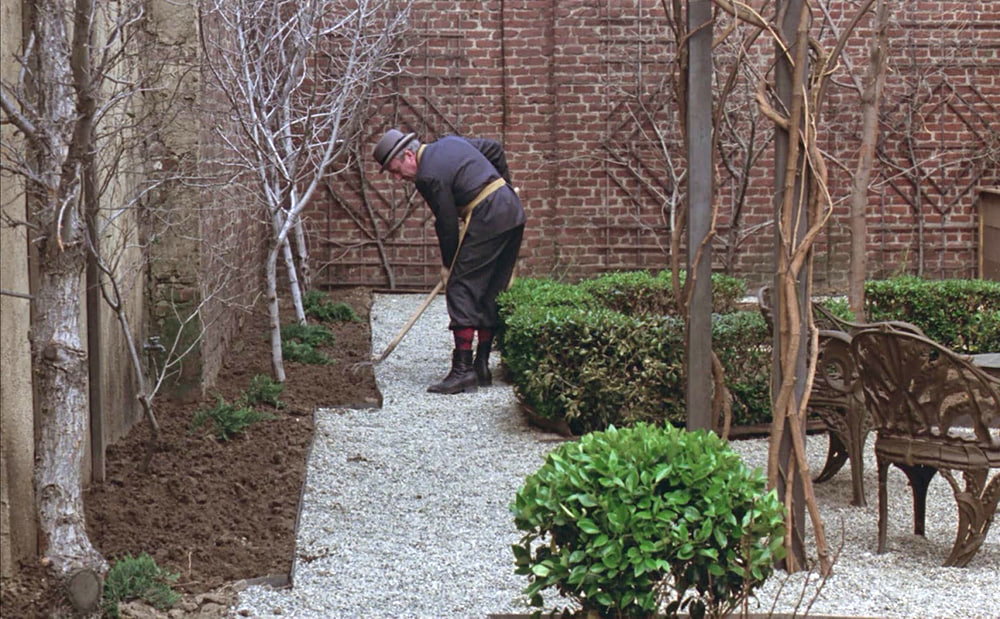
Chance understood the effect that different policies had on gardening.
Two dimensional thinking adds the very important third step of a reasoned reaction. The steps become action, measured result, and reasoned reaction. This is how success is achieved. And it is alien to the beltway.
The concept of taking action to reach desired goals is completely beyond their capacity to understand. They are at best zero-dimensional thinkers.
Traditionally, when politicians pass a tax or start a program, tying that tax or program to a goal, it not only never occurs to them to drop the tax or program when the goal is reached, it doesn’t even occur to them to drop the tax or program if it’s counterproductive and distances them further from that goal.
I wrote a few years ago about the hypocrisy of telling people who can’t find jobs in small towns that they should move out of their hometown. The lack of jobs is a policy issue but the zero dimensional thinkers who fill Washington don’t make that connection. No job in your small town? Move to the city. Now the bad policies in New York City are driving rents up and the advice is, move somewhere cheaper. The zero dimensional thinker doesn’t make the connection between policy and results. They don’t even see the contradiction between those two bits of advice.
For a perfect example of the zero-dimensional thinking of Washington, DC and the beltway crowd, consider the invasion of Ukraine by Russia. Very few people outside of Russia want Russia to gain from the war that they started. But very few people outside of Trump consider the costs of attaining that goal. You can see this every time the Trump administration tries to broker an end to the killing: the complaints by the beltway crowd are that the peace deal rewards Putin.
The complainers never say how many lives they’re willing to spend for a more perfect deal. You can see how different President Trump is from the rest of the beltway in this issue alone: every time he talks about the war, he is clearly acutely aware of how many lives are being lost in that war. It isn’t that Trump is willing to spend fewer lives than proponents of the war are willing to spend; it’s that proponents of the war don’t seem to understand that people are dying. They have no sense that this war costs the lives of people who are not them.
No one ever says “Trump is only willing to spend x lives. I’m willing to spend x+y lives.” No one ever says “Trump is only counting the cost in lives. Those lives should be balanced against these other costs of not continuing the war.”
Costs and tradeoffs don’t even figure into their thinking. They’re not even playing one-dimensional chess.
Consider that two-dimensional chess understands that every action can have multiple consequences and planning beyond those consequences. Playing one-dimensional chess means merely understanding (or pretending) only one consequence in reaction to any action. But it does understand that actions are connected to consequences.
The beltway class is playing zero dimensional and negative dimensional chess. They see a problem, they announce a policy, and they do not connect the problem getting worse with the policy that made it worse. They act as if it never occurs to them that the action might in fact have consequences that affect that goal.
It never occurs to them that the goal is more important than the policy. For them, it very probably isn’t. The goal was announced merely to make the policy palatable to voters until it’s an unrepealable fait accompli.
Thus, very often when a policy appears to be counterproductive to a goal, the beltway class chooses to double down on that policy. The evidence of failure is not only not seen, it is treated as evidence that the failing policy is even more strongly necessary.
It reminds me very strongly of two cult classics that I’ve watched recently with my dad. Both featured non-geniuses among the Washington, DC, elite. In both Being There and Idiocracy the protagonists weren’t smart. Chauncey Gardiner in Being There was at the least very slow, and possibly clinically impaired. But compared to the rest of the DC crowd of the movie he was an Einstein. Because of his background in growing plants, he understood that actions and policies have consequences. He understood cause and effect.

Joe Bauers didn’t know why Brawndo killed the crops. He just knew that the policy was failing, and changed it. The beltway almost killed him for that.
And even if you interpret everything he said as stupid, he never said anything as stupid as “Death is a state of mind.” This is even clearer in the book, which doesn’t have the movie’s semi-religious ending.
The Joe Bauers of Idiocracy wasn’t stupid, but he wasn’t a genius, either. He was completely average. Still, he understood that when a policy results in a further degrading of what it was supposed to improve, that policy should be rescinded. This was beyond the capacity of the Washington, DC crowd he found himself among.
Sarah Hoyt has complained about Idiocracy that “evolution doesn’t work that way”, which is true—when stupidity is rewarded, as in the movie, it doesn’t create more actual stupidity. It creates more incentive for acting stupid. And it will be the most cunning who react to those incentives—anyone actually stupid will be left behind. At a superficial level I would argue that much of what Bauers saw was people incentivized to act stupid, not actual stupidity… until he went to Washington, DC. Then he found real stupid.
But at a deeper level, I’d argue that arguing genetics is missing the point.2 Like most satire, from A Connecticut Yankee in King Arthur’s Court to 1984, from The Flintstones to The Jetsons, Idiocracy isn’t about the future. It isn’t a satire about genetics. It’s a satire about today, and it’s about just those incentives.
When politicians claim to prioritize larger crimes by letting smaller crimes go, and then become overwhelmed by larger crimes, they see no connection, and actively deny any connection when confronted with the possibility.
The policies now in place supposedly to help people “unable to work” benefit most those who are able to work very hard, who choose to work toward getting those benefits. Maximizing government benefits is a full-time job, and the further from the community those benefits come from, the easier they are to game by unscrupulous actors willing to work at it. This leaves those who need the aid unhelped. But suggest this and the beltway crowd will immediately deride you as stupid and uncaring.
Not just denying a connection between policy and failure: not even considering a connection as a possibility. Real zero-dimensional thinking.
Joe especially was treated in much the same way Trump is. He was treated literally as a criminal for speaking the truth, given no time to show that his policy was in fact working, instead put on trial for his life in a vastly unfair system.
Trump’s policies have objectives. He was and is willing to retire a policy once it reaches its objective and is no longer useful. He’s even willing to end a policy if it turns out to be counterproductive to its objective.
This is incomprehensible to most of the beltway crowd today. It simply doesn’t register.
That Trump’s policies are often “merely” two-dimensional still puts them well beyond the zero-dimensional policies of everyone around him in the beltway. To continue the movie analogies, it’s as if everyone else is Khan in Star Trek II: The Wrath of Khan, and Trump is Kirk. Everyone else thinks they’re so much smarter, but it’s Trump that somehow keeps winning. Like Khan, they seem completely unfamiliar with the concept of dimensions, of height, width, and depth.
Or worse: that basic geometry even exists. Unlike Khan, they don’t even think linearly from A to B.
In response to The Bureaucracy Event Horizon: Government bureaucracy is the ultimate broken window.
In popular parlance, the phrase “nth-dimensional” or “multidimensional” when applied to politics usually means complicated, usually beyond the normal three dimensions and definitely more than two.
↑I would agree that framing Idiocracy in terms of genetics has a tendency to let policy makers off the hook because it makes the process seem like the inevitable result of a society caring for its weakest members when it’s really the inevitable result of zero-dimensional thinking by policy makers.
↑
fiction
- Being There
- Peter Sellers’ last and in my opinion best work, based on the story by Jerzy Kosinski (and with a screenplay written by him). This is a quietly funny, provocative, and touching film about “down to earth” philosophies.
- Review: 1984: Jerry Stratton at Jerry@Goodreads
- “We shall meet in the place where there is no darkness.” It is fashionable to compare Orwell unfavorably to Huxley nowadays, but that’s mostly because Orwell’s message of voluntary repression is a much more difficult one than Huxley’s drug-induced repression.
- Review: Being There: Jerry Stratton at Jerry@Goodreads
- “The movie follows the book fairly accurately; the book is written very much like a children’s story and is very short, straightforwardly moving from scene to scene, all of which you’ll be familiar with if you’ve seen the movie.”
- Review: The Moon Maid: Jerry Stratton at Jerry@Goodreads
- “Burroughs excels at creating very alien races and cultures that still allow him to comment on human failings, and this may feature the most weirdly horrific yet, where intelligent races literally eat other intelligent races.”
- Second look at Chance the gardener
- Is President Obama really a mentally-challenged private gardener who has never left his DC townhouse?
reality
- About the Handbasket: Sarah Hoyt at According To Hoyt
- “It is an accepted truism that we’re going to hell in a handbasket. The ‘We’ varies, but if you consider it ‘the US’ or ‘The West’ or ‘Human civilization’ it still applies.”
- MGM Resorts & Panera Bread Learn that Reducing Quality and Gouging Customers Is Not a Viable Long-Term Strategy: Buck Throckmorton at Ace of Spades HQ
- “Panera saved money but loyal customers were lost. Who could have ever predicted that?”
- Resetting the Reset: Mark Steyn at Steyn Online
- “So is it, as my old friend Pete Hegseth says, a stunning military victory? Or is it, as I have argued more or less from the get-go, a profound Suez-sized strategic defeat? Or are concepts such as ‘winning’ and ‘losing’ now obsolescent and it is more accurate to speak of the ‘world’s most powerful reset’?”
- Small towns, big government
- Should people have to leave small towns in order to go where the jobs are? Or is that response hypocrisy masquerading as compassion?
- Trump games Schumer: Don Surber
- “He passed the legislation despite paper-thin majorities in the the House and Senate without any help from Democrats. That rendered them as useless as a pellet gun against a bear wearing an eye shield.”
- Trump, Iran agree to two-week ceasefire: Robert Stacy McCain at The Other McCain
- “During Tuesday’s liberal freakout, Democrats were denouncing President Trump as a genocidal maniac because of his threats to destroy Iran. Then, about an hour before the 8 p.m. deadline he’d given the Iranian regime, Trump announced that a deal had been reached for a ceasefire.”
More beltway class
- The left’s hatred of business is a lie
- The left doesn’t hate business. They hate you and me.
- Who is Trump running against?
- If Trump runs against Biden, he’ll lose, just like he did in 2020: by getting more votes but fewer ballots. It looks like Trump understands that. He’s not running against Biden. He’s running against the Democrats and Republicans who put Biden in power.
- The January 6 witch-hunt
- If there’s a witch-hunt starting, I’ve decided it’s best to identify as a witch.
- Better for being ridden: the eternal lie of the anointed
- Whenever there’s a crisis, politicians and the media always tell us that if we do what they say, we’ll be all right. This is always a lie. And however often they fail and however many die from their ministrations, their wabbling fingers always return to the mire.
- Toward a permanent political class
- If politics has become so complicated that only a political class can manage it, then Democracy is dead. Citizens should not be allowed to become politicians, nor should they be allowed to vote for which politicians take office.
- Two more pages with the topic beltway class, and other related pages
More President Donald Trump
- Trump should try harder to lie to his voters
- Trump cannot convince his voters to vote for Republicans. Only Republican lawmakers can do that. Because they aren’t his voters. He is their candidate. Republican lawmakers must choose to be their candidate.
- Tariff panic: Competing visions of America
- One of the amazing things missed in all the Trump tariff talks is that Trump seems to genuinely believe that Americans can compete on a level playing field. That’s very rare among the political class. As we head into the Sestercentennial it would be nice to believe in American workers again.
- Trump, tariffs, and the war on American workers
- Why do so many American workers support Trump so strongly against the wishes of their union leadership? Partly because only Trump recognizes that we’re in a war targeting American workers.
- Walk toward the fire
- Trump reassures crowd after assassination attempt fails.
- Trump and the January 6 defendants
- There appears to be a concerted effort on conservative forums to blame Trump for not doing anything for the January 6 prisoners and defendants. Is it true?
- 33 more pages with the topic President Donald Trump, and other related pages