


Mock the Wind and Sing of Marion’s Men
May 12, Tuesday, is the anniversary of the capture of Fort Motte by Patriot forces under General Francis Marion and Lieutenant Colonel “Light-Horse” Harry Lee in 1781. “Fort” Motte was in fact a plantation mansion commandeered by the British a year earlier. The siege, which began on May 8, is famous not for the siege itself nor for the famous military figures who took part but for the patriotism of its real owner, Mrs. Rebecca Brewton Motte. Mrs. Motte famously supplied the exotic arrows used to set the mansion on fire and drive the British out.
The siege was otherwise a fairly standard military operation, not at all the backwoods guerrilla warfare that General Marion was famous for. I’ve been fascinated by Marion ever since hearing a song about him in a library record back during the celebration surrounding the Bicentennial. We lived a few blocks from the local library, and I checked out Dallas Corey’s 1973 The History of the American Revolution several times to listen to it on our record player.
Corey’s album is a combination of short introductions and epilogues about the American Revolution, surrounding songs that highlighted various people and events. One of the songs on the album is The Swamp Fox. The name is evocative—and similar to that of the Marvel Comics superheroes I’d recently started reading about from the local grocery store’s spinning racks.
I didn’t yet own a cassette recorder, so I never recorded the album. I just kept checking it out whenever I felt like listening to it again, until I couldn’t find it anymore. It took almost fifty years to acquire a copy of my own. It is a marvelous album.
- In Lexington
- The center of revolt against the King
- The colonists were trying hard to bring
- An independent way of life to this, their promised land
- It was there, in Lexington, they made their stand.
“The American war for Independence had begun.”
Corey sings of Lexington, and then of Bunker Hill, on into both the signing that we’re celebrating this year and the entire campaign of 1776, two hundred and fifty years ago. Then it’s off to Brandywine and Saratoga and into The Swamp Fox before Corey wraps up the Revolution by counting the cost.
In Corey’s telling, the Swamp Fox stands at the pivot of the Revolution.
The Southern colonies would more than likely have been completely destroyed, had it not been for American antagonists such as Gates, Nathanael Greene, Lafayette, Sumter, and the notorious Francis Marion: the Swamp Fox!
There’s a lot to be said for that view, that it was unorthodox warriors like Francis Marion as much as men like George Washington who kept the American Revolution alive in its darkest years. Men like Francis Marion in the south, and John Stark (who took part in the Battle of Bennington) in the north, leaders who acted independently of the Continental Army’s main command. Men with the freedom to choose their own victories and thus keep public morale up.
Men who make but little noise, men who always hit the mark.
Francis Marion’s life and tactics have only become more perfect for popular media over the years. Besides the obscure Dallas Corey song telling the story of his life, fans of obscure folk music may recall the moderately more popular song “Marion’s Men”. The version I’m most familiar with is by Gil Robbins, on an album of “Songs of Rebels and Redcoats”.
“Marion’s Men” also appears in Oscar Brand’s Songs of ’76, so it’s likely he’s performed the song as well:
Possibly the most skillful of all was Marion, “The Swamp Fox.” His base of operations seemed to be in the muddy wasteland between the Black and Pedee rivers, but Cornwallis’ frequent searches never found their quarry. When Marion wished, he would crash out of the swamps with his hard-riding frontiersmen, sometimes up to the very gates of Charleston, and leave a path of devastation worthy of a marauding army instead of a few Rebel roughnecks. Swiftly returning to their hideaway, they would drink vinegar, swear mightily, and sing lustily through the misty nights.
In Brand’s telling, this was a song that they sang themselves! As unlikely as that sounds, it is repeated multiple times by multiple authors. These were happy warriors, singing to and from their battles.
- We follow where the Swamp Fox guides.
- His friends and merry men are we,
- And when the Tory Legions ride
- We burrow in the cypress trees.
- The gloomy swampland is our bed,
- Our home is in the red deer’s den.
- Our roof, the tree-top overhead,
- For we are wild and hunted men.
The song “Marion’s Men” comes from William Gilmore Simms’s 1835 poem of the same name but somewhat different lyrics. Simms is among those who claim—at least in his tale The Partisan—that Marion’s Men themselves sang this song:
They will tell you of his conduct and his coolness; of his ability, with small means, to consummate leading objects—the best proof of military talent; and of his wonderful command of his men; how they would do his will, though it led to the most perilous adventure, with as much alacrity as if they were going to a banquet. Of the men themselves, though in rags, almost starving, and exposed to all changes of the weather, how cheerfully, in the fastnesses of the swamp, they would sing their rude song about the capacity of their leader and their devotion to his person, in some such strain as that which follows…
The “They” who tell these stories, however, are “the old housewives… of the Carolinians”, making this literally an old wives’ tale.
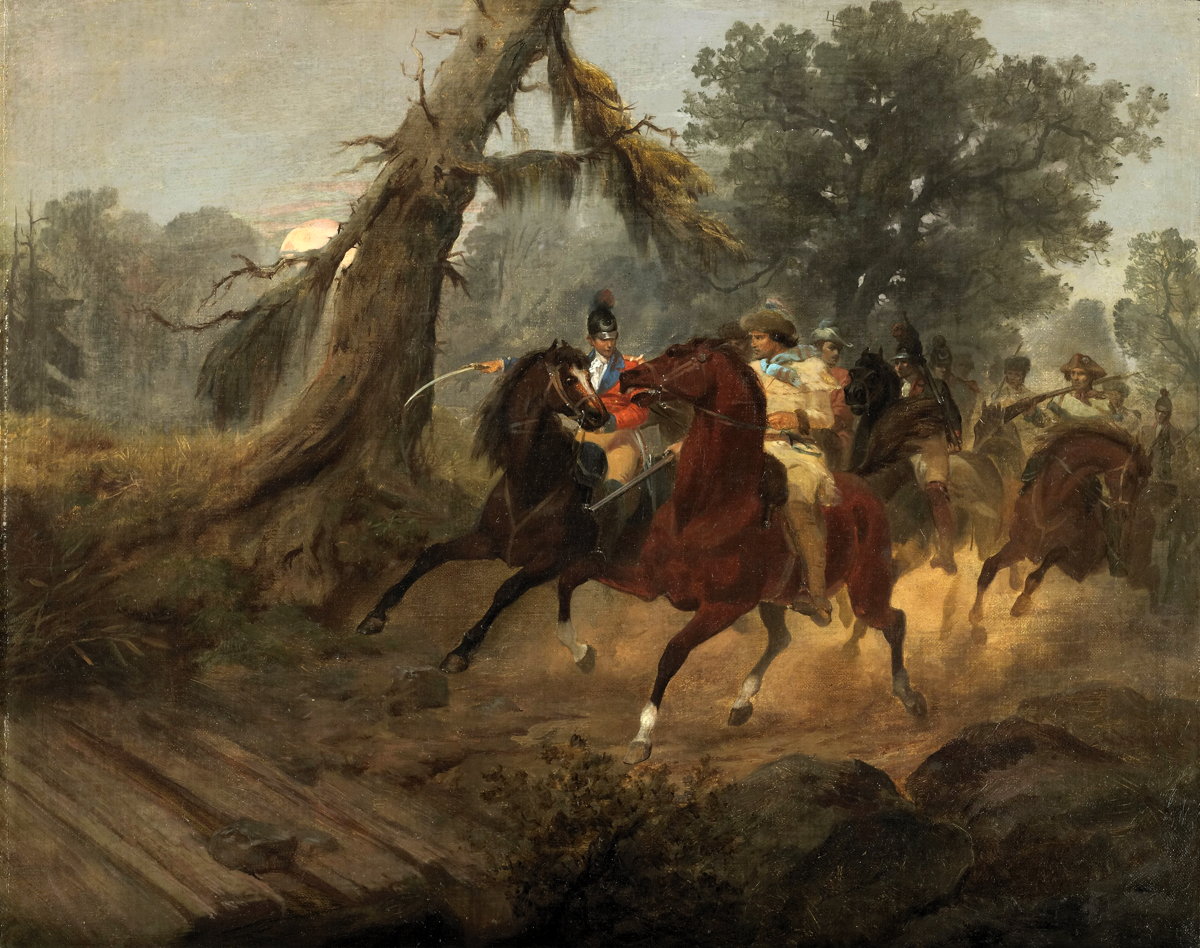
“The Ride of General Marion’s Men”, Alonzo Chappel, ca. 1850.
Marion’s Men
William Gilmore Simms, 1835
- We follow where the Swamp Fox guides,
- His friends and merry men are we,
- And when the troop of Tarleton rides,
- We burrow in the cypress tree.
- The turfy hummock is our bed,
- Our home is in the red deer’s den,
- Our roof, the treetop overhead,
- For we are wild and hunted men.
- We fly by day and shun its light,
- But, prompt to strike the sudden blow,
- We mount and start with early night,
- And through the forest track our foe.
- And soon he hears our chargers leap,
- The flashing saber blinds his eyes,
- And, ere he drives away his sleep
- And rushes from his camp, he dies.
- Free bridle bit, good gallant steed,
- That will not ask a kind caress,
- To swim the Santee at our need,
- When on his heels the foemen press,—
- The true heart and the ready hand,
- The spirit stubborn to be free,
- The trusted bore, the smiting brand,—
- And we are Marion’s men, you see.
- Now light the fire and cook the meal,
- The last perhaps that we shall taste;
- I hear the Swamp Fox round us steal,
- And that’s a sign we move in haste.
- He whistles to the scouts, and hark!
- You hear his order calm and low,
- Come, wave your torch across the dark,
- And let us see the boys that go.
- Now pile the brush and roll the log—
- Hard pillow, but a soldier’s head
- That’s half the time in brake and bog
- Must never think of softer bed.
- The owl is hooting to the night,
- The cooter crawling o’er the bank,
- And in that pond the flashing light
- Tells where the alligator sank.
- What! ’tis the signal! start so soon?
- And through the Santee swamps so deep,
- Without the aid of friendly moon,
- And we, Heaven help us! half asleep?
- But courage, comrades! Marion leads,
- The Swamp Fox takes us out to-night;
- So clear your swords and spur your steeds,
- There’s goodly chance, I think, of fight.
- We follow where the Swamp Fox guides,
- We leave the swamp and cypress tree,
- Our spurs are in our coursers’ sides,
- And ready for the strife are we.
- The Tory’s camp is now in sight,
- And there he cowers within his den;
- He hears our shouts, he dreads the fight,
- He fears, and flies from Marion’s men.
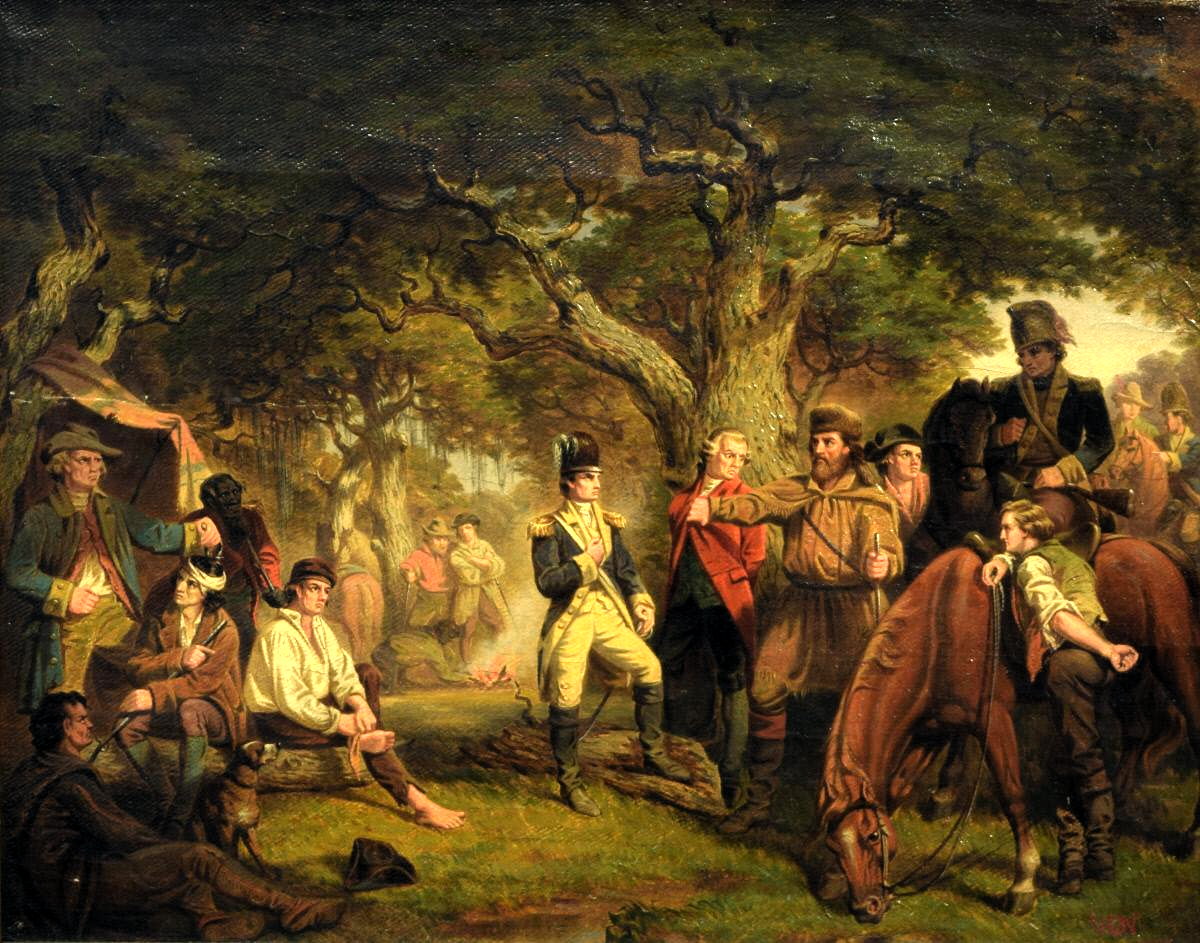
William D. Washington’s “General Marion and His Men in Pee Dee Swamp”, 1858.
Simms’s poem may have been inspired by William Cullen Bryant’s 1831 Song of Marion’s Men. Certainly, a lot of similar ground is covered in Bryant’s lyrics, resulting in some strong similarities.
- Our fortress is the good greenwood,
- Our tent the cypress-tree;
- We know the forest round us,
- As seamen know the sea;
- We know its walks of thorny vines,
- Its glades of reedy grass,
- Its safe and silent islands
- Within the dark morass.
I chose these lines out of the whole to show the similarity with Simms’s poem, but I’m not the only one who noticed how evocative these particular lines were. The first four were used by “J.W. Ervin” in 1854 to open his story “Michael Allscot or The Shot in Time. A Story of Marion’s Men”.
Michael Allscot won its author, John Witherspoon Ervin, $100 in a contest for the best original story by a South Carolinian. That’s about $4,000 today.
Old songbooks and ballad collections almost never include melodies to accompany their lyrics. The line between lyric and poem was a thin one, but prospective singers were expected to find their own melody. If you take a look at William Cullen Bryant’s Song of Marion’s Men, it can be force-fitted to Yankee Doodle. William Gilmore Simms’s Marion’s Men absolutely cannot. Simms’s poem can be fitted to “Greensleeves”, but that’s hardly a rousing ramble—especially without the chorus.
Deeds of Marion’s Men fits neither melody. “Marion’s Men” and “Deeds of Marion’s Men” are rarely if ever collected in early collections, and only “Marion’s Men” gets collected nowadays, mostly after the folk resurgence of the fifties.
Various tales of Marion’s men have been popular throughout the history of the United States. Joseph J. Matthias had “The Night-Riders: A Tale of Marion’s Men” published at least as early as 1851, in the Wellsboro (Pennsylvania) Tioga Eagle. He, also, prefaced his story with lines from Bryant’s poem, but started from “Woe to the English soldiery…”.
Song of Marion’s Men seems to have first appeared around November 19, 1831, and was reprinted many times in the weeks that followed. It is always attributed to “the New York Mirror” in the initial reprints. My copy comes from the November 19, 1831, Philadelphia Inquirer.
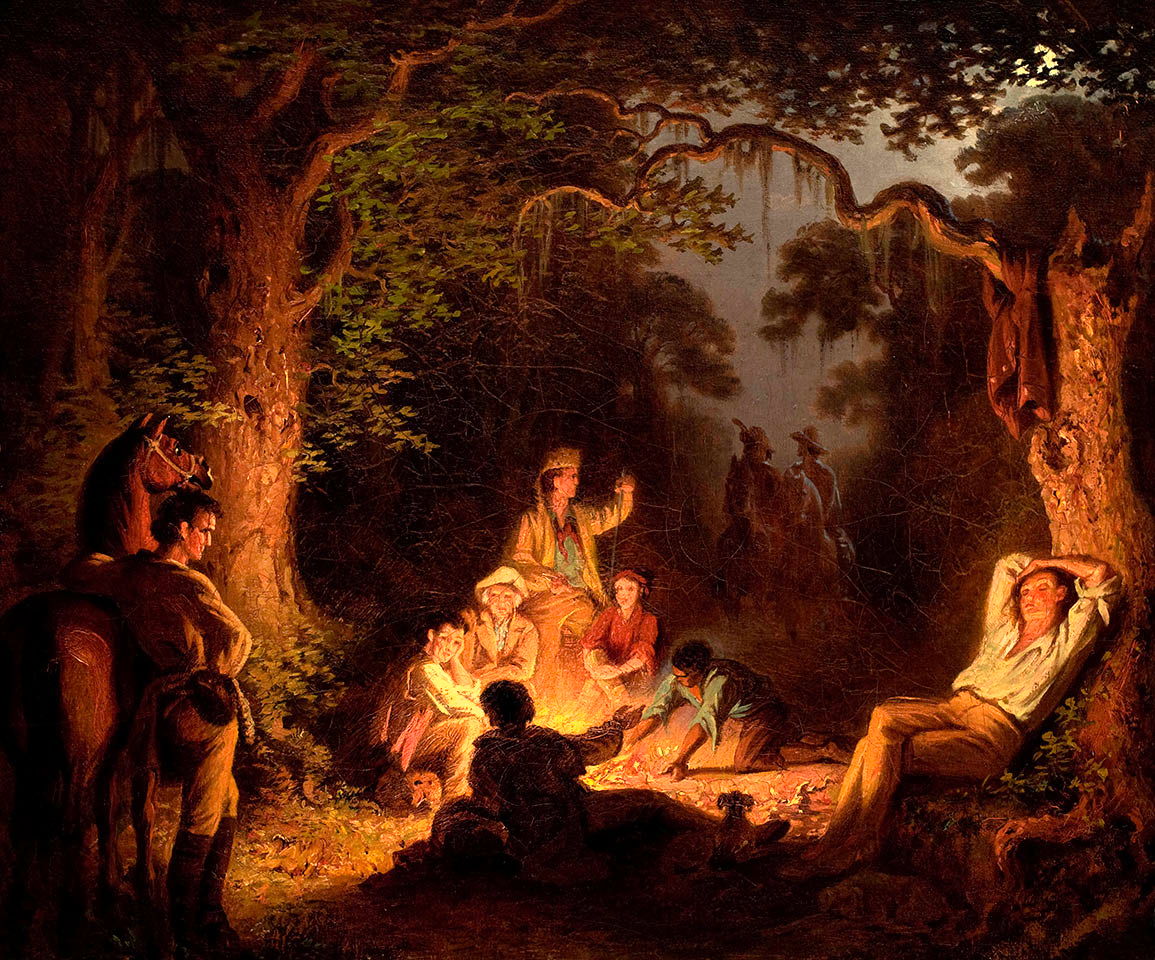
William D. Washington’s “Study for Marion and His Men in the Swamp”, ca. 1865.
Song of Marion’s Men
William Cullen Bryant, 1831
The exploits of General Francis Marion, the famous partisan warrior of South Carolina, form an interesting portion of the annals of the American revolution. The British troops were so harassed by the irregular warfare which he kept up at the head of a few daring followers, that they sent an officer to remonstrate with him for not coming into the open field and fighting, to use their expression, “like a gentleman and a christian.”
- Our band is few, but true and tried,
- Our leader frank and bold;
- The British soldier trembles
- When Marion’s name is told.
- Our fortress is the good greenwood,
- Our tent the cypress tree;
- We know the forest round us,
- As seamen know the sea.
- We know its walls of thorny vines,
- Its glades of reedy grass,
- Its safe and silent islands
- Within the dark morass.
- Wo to the English soldiery
- That little dread us near!
- On them shall light, at midnight,
- A strange and sudden fear:
- When waking to their tents on fire
- They grasp their arms in vain,
- And they who stand to face us
- Are beat to earth again;
- And they who fly in terror, deem
- A mighty host behind,
- And hear the tramp of thousands
- Upon the hollow wind.
- Then sweet the hour that brings release
- From danger and from toil:
- We talk the battle over,
- And share the battle’s spoil.
- The woodland rings with laugh and shout,
- As if a hunt were up,
- And woodland flowers are gathered,
- To crown the soldier’s cup.
- With merry songs we mock the wind
- That in the pine-top grieves;
- And slumber long and sweetly,
- On beds of oaken leaves.
- Well knows the fair and friendly moon
- The band that Marion leads—
- The glitter of their rifles,
- The scampering of their steeds.
- ’Tis life our fiery barbs to guide
- Across the moonlit plains;
- ’Tis life to feel the night-wind
- That lifts their tossing manes.
- A moment in the British camp—
- A moment—and away
- Back to the pathless forest,
- Before the peep of day.
- Grave men there are by broad Santee,
- Grave men with hoary hairs;
- Their hearts are all with Marion,
- For Marion are their prayers.
- And lovely ladies greet our band,
- With kindliest welcoming,
- With smiles like those of summer,
- And tears like those of spring.
- For them we wear these trusty arms,
- And lay them down no more
- Till we have driven the Briton,
- Forever, from our shore.
Most of those strong similarities between the two poems are the things that make Francis Marion’s story so compelling: the swamp, the cypress trees, the pathless forests and the broad Santee. Even if one had never read the other, those similarities are likely to have existed.
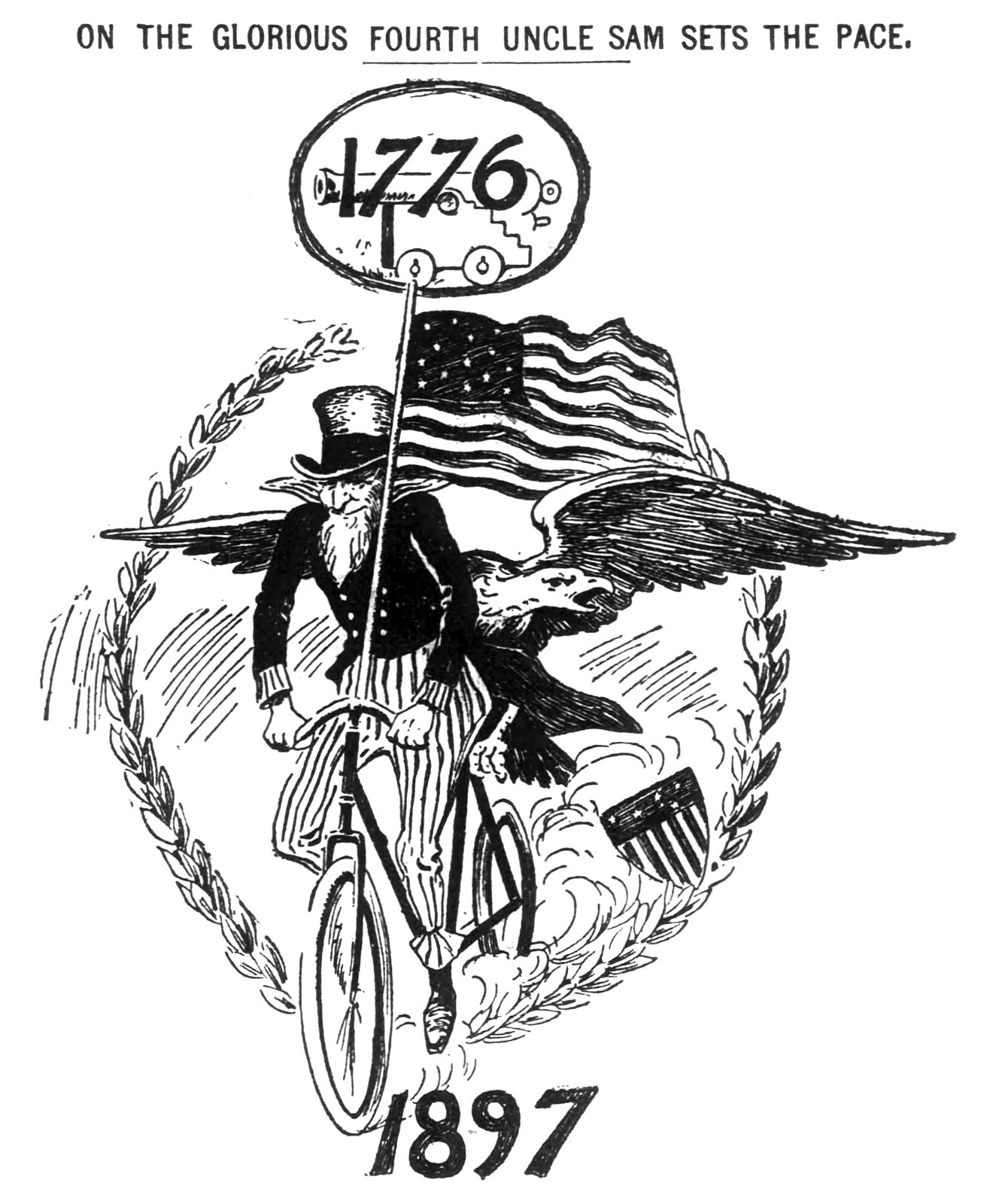
This intriguing image graced several front pages in the runup to July 4, 1897 that also included “A Deed of Marion’s Men”.
In 1859, another poem, this one by R. B. Rhett, Jr., and attributed as “From the N.Y. Home Journal” began to appear.
The Deeds of Marion’s Men—A Song of the South
R.B. Rhett, Jr., 1859
- Our poets may sing of the lives that fling
- Their light o’er a world sublime,
- And sages may tell of the names that dwell
- Like stars o’er the clouds of time:
- But among the deeds that are sung or told,
- In the legions of now or then,
- There are none more bright, there are none more bold,
- Than the deeds of Marion’s men.
- In the gloomiest strife of our country’s life,
- When her dawning was darkened by night;
- When tyrants were found on her holiest ground,
- And her friends were scattered in flight;
- When the best of her children, unarmed, and unfed,
- Were hunted through cavern and glen,—
- The red ranks of Albion trembled with dread
- At the deeds of Marion’s men.
- Ah! the emblems we raise to acknowledge their praise
- Will not crumble in tempest or wave;
- Their monuments stand thro’ the length of the land,
- In the hearts of the noble and brave:
- For their mem’ry will shine, and their glory will last,
- Giving light to the days that have been;
- And long shall our freemen be proud of the past,
- And the deeds of Marion’s men.
- Whenever a gun in the glad morning’s sun;
- When the stars of our banner unfurled,
- Proclaim the great day whose beautiful ray
- Gave freedom’s first hope to the world;
- When the shouts for our heros like deep thunders roll
- From ocean to mountain top—then
- Then remember the grandeur of Marion’s soul,
- And the deeds of Marion’s men.
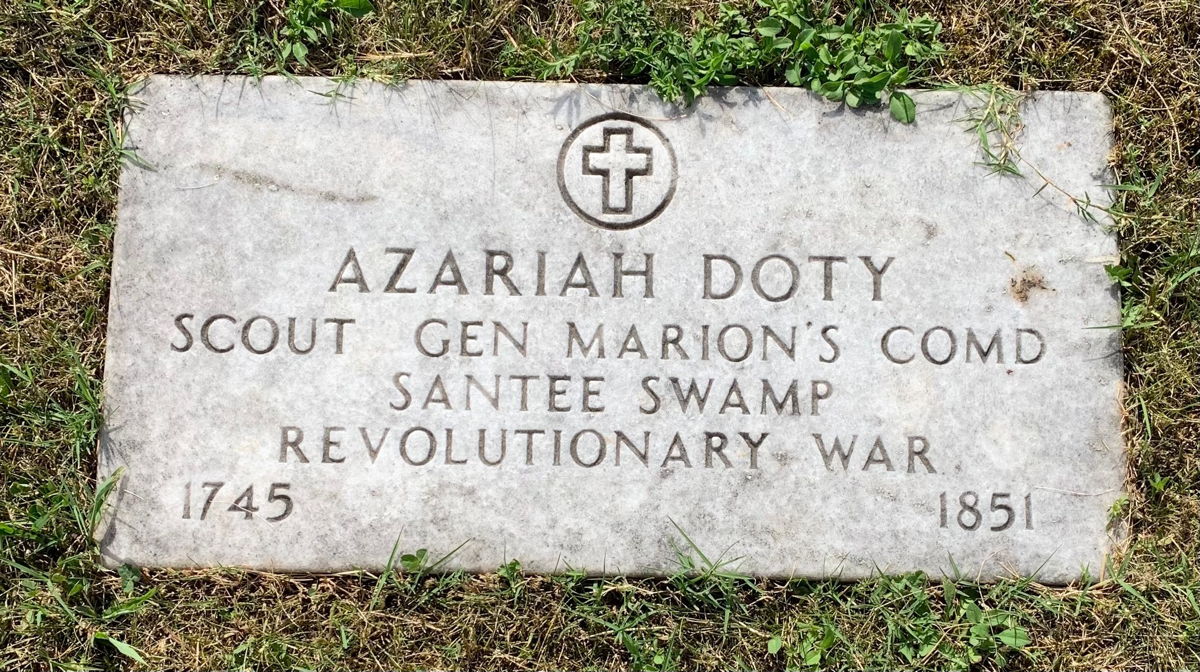
“Scout, Gen. Marion’s Comd.”
As might be expected from the titles of the various poems and songs, the legend of Francis Marion extended to Marion’s men. When a Marion Man died, the fact that he was a Marion’s man often made the newspapers.
- Died. At Savannah, on the 3d instant, in the 77th year of his age, Elias Bollough, a native of Christ Church Paris, S. C, but for the last seven years past, a resident of that city. In the revolutionary struggle, at the early age of 17, in May, 1780, at the time that the British were besieging Charleston, he volunteered as a private in Marion’s Legion, and served in the same until the close of the war. (The Philadelphia Inquirer, October 12, 1840)
- Death of one of Gen. Marion’s men.— In the Charleston Courier we find an obituary of Mr. Archibald McLellan, who was one of General Marion’s troops. Mr. McLelland died on the 3rd of November, at his residence in St. James, Santee, in the 83rd year of his age. Although very young in the Revolutionary war, he participated in some of its stirring scenes. He was with General Marion, when he made an extraordinary forced march, and surprized a detachment of the British near Parker’s Ferry. He was also at the affair near Quinby bridge, and continued under his command till the termination of the war. (Edgefield Advertiser, November 18, 1846)
- Death of One of Marion’s Men,— The Charleston papers announce the decease of Francis Gottier de Liesseline, a native of that state, and one of Marion’s brigade in his partizan warfare during the revolution. He entered the army at the age of fourteen and was distinguished for his bravery. (Gettysburg Compiler, April 30, 1849)
- We learn from the Cynthiana (Harrison county) News, of the 14th, that on the 10th inst. Phillip Roberts, aged about 90 years, one of “Marion’s Merry Men,” died near that place. The News says he was a soldier in the Marion war, in South Carolina. (Eaton Democrat, January 4, 1855)
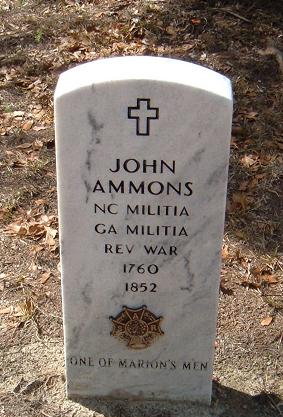
“One of Marion’s Men.”
Marion man Azariah Doty appeared in several blurbs before his death in 1851. At a hundred and five, it was news that he was still alive—and it was also news that this ancient had been one of Marion’s men.
Azariah Doty, who resides nine miles North of Greeneville, is one hundred and five years old. He served in the revolutionary war under Gen. Marion, and is the oldest relic of those immortal times, we know of in E. Tennessee. He enjoys fine health, and a remarkable degree of spirits. Only one heavy misfortune has attended his age, and that is, the entire loss of the power of vision. Otherwise he is an active, sprightly monument of other generations.—Greenville Spy. (Republican Banner, October 9, 1850)
He died a year later, “from a rattlesnake bite.”
That a man was a Marion’s man didn’t just appear in their obituary. It isn’t hard to find simple grave markers with little text beyond date of birth and death that also include something along the lines of “One of Marion’s Men.” It’s all very reminiscent of Henry V’s famous Shakespearean speech at Agincourt—which is probably another reason the legend persists to be freshly remember’d anew for each generation.
…blood was shed, and lives were lost, the colonies, they paid the cost.—Dallas Corey, “Battle of Bunker Hill”.
In response to Songs of the American Revolution: Various songs, and the history of the songs, that made the Revolution—sometimes decades later.
- May 20, 2026: Flowers o’er the Tory grave: Disney’s Francis Marion
-

Logo for Disney’s Swamp Fox miniseries on Walt Disney Presents. The background represents “Frontierland” at the newly-created Disneyland.
If poetry and music were the main pop culture mediums of the nineteenth century, television was the pop culture medium of the second half of the twentieth. Francis Marion was in on television from the beginning. He had a television series, sort of, in the fifties. Walt Disney Presents: The Swamp Fox was based on the Robert D. Bass book Swamp Fox: The life and campaigns of General Francis Marion.
Marion’s Men
- Azariah Doty (1745-1851) at Find a Grave
- “Azariah served in the Revolution… Scout Gen. Marion's Comd.; Santee Swamp; Revolutionary War”
- Capt Peter DuBose (1755-1846) at Find a Grave
- “There is a historical marker on the west side of Hwy 15 going N out of Bishopville just before crossing the river. The marker says ‘After serving in the militia under General Francis Marion during the Revolutionary War, this planter and patriot lived near here and operated a ferry, known as DuBose’s Crossing.’”
- Capt Stephen Godbold (1764-1845) at Find a Grave
- “Marion’ S.C. Mil.”
- Daniel Parker (1750-1848) at Find a Grave
- “Daniel Parker, having returned to the Terrell family who lived in the Pee Dee River area of South Carolina, then joined the small band of Militia organized by Francis Marion.”
- Gabriel Marion Historical Marker at The Historical Marker Database
- “When Capt. John Nelson, sent by Gen. Marion, Jan., 1781, to the Sampit Road to reconnoitre, met Capt. Barfield and his Tories near White’s Bridge, a sharp fight ensued. Lieut. Gabriel Marion, nephew of Gen. Marion, was captured and inhumanely shot about a quarter mile north of here. His name was fatal to him.”
- John Ammons (1750-1852) at Find a Grave
- NC militia; GA militia; Rev war; 1760; 1852; One of Marion's Men.”
- John Cox (1760-1830) at Find a Grave
- “Revolutionary War veteran. One of ‘Marion’s Men’”
- Maj. Isaac McFadden (1753-1820) at Find a Grave
- “Served in General Thomas Sumter’s Brigade, in Captain Mill’s Regiment of ‘Light Dragoons’ under Col. Henry Hampton. Listed as one of ‘Marion’s Men’ while serving under General Francis Marion.”
- Pvt James Jordan (1755-1835) at Find a Grave
- “He served in the Revolutionary War as a private in the South Carolina Regiment under Col. Marion (the Swamp Fox)and was pensioned.”
- Richard Ellis (1760-1804) at Find a Grave
- “Richard Ellis was an early planter in what was then St. Helen and St. Luke's Parishes, Beaufort District, South Carolina. He served during the American Revolution as one of General Francis Marion's men and later as a Continental Line officer.”
- Richardson Roundtree (1735-1819) at Find a Grave
- “Richardson was a Revolutionary War soldier who served as one of Francis Marion's men (The Swamp Fox).”
- Samuel Montgomery (1754-1819) at Find a Grave
- “Samuel Montgomery made and provided boots and shoes for General Francis Marion's men during the Revolutionary War. He also served 94 days in the militia under Gen. Marion.”
- William McIntosh (1764-1843) at Find a Grave
- “Sacred to the Memory of William McIntosh, born 7th April 1764, died 24th June 1872. In the Revolutionary War At the age of 16 he joined Cap't Marion’s little band Of Patriots.”
- William Richardson at Find a Grave
- “William joined the army five times during the Revolutionary War and he was captured at both battles of Camden. He escaped from Charleston after he was captured the second time and joined Francis Marion's troops. After the war, he settled in the area.”
books
- Marion’s Men: A Romance of the Revolution: Anonymous
- By the author of “The old Loyalist,” “The southern Whig,” etc. Published in 1846 also under the title: Marion and his men, about Francis Marion and the American Revolution. Fifty-six pages.
- The Partisan: A Romance of the Revolution (New and Revised): W. Gilmore Simms at Internet Archive (ebook)
- “The rock which has wrecked us once should become the beacon for those who follow.”
- The Partisan: A Tale of the Revolution (Volume I): W. Gilmore Simms at Internet Archive (ebook)
- “Our narrative begins in South Carolina, during the summer of 1780. The arms of the British were at that time triumphant throughout the colony.”
- The Partisan: A Tale of the Revolution (Volume II): W. Gilmore Simms at Internet Archive (ebook)
- “The clouds were gathering fast—the waters were troubled—and the approaching tumult and disquiet of all things in Carolina, clearly indicated the coming of that strife, so soon to overcast the scene—so long to keep it darkened—so deeply to impurple it with blood.”
- The Swamp Steed; or The Days of Marion and His Merry Men: Anonymous at Internet Archive (ebook)
- “In the middle of the afternoon of a fine, sunny day in the early part of April, in the year of grace one thousand seven hundred and seventy-five, a young man dressed in the rough garb of a hunter, with a rifle thrown carelessly over his right shoulder, might have been seen making his way, with a calm, thoughtful air, through a thick wood which rose gradually till it reached the top of a high hill that overlooked the surrounding country, and whose brow jutted over the winding waters of South Carolina’s noblest river—the Santee.”
General Francis Marion
- Francis Marion (1732-1795) at Find a Grave
- “Upon the outbreak of hostilities against the British, he was made a Captain in the 2nd South Carolina Regiment… After Gates’ defeat, Francis Marion and his men set up a guerrilla movement to harass and destroy the British, giving rise to the legend of ‘Swamp Fox.’”
- Francis Marion: The Swamp Fox at American Battlefield Trust
- “Francis Marion was born around 1732 in Berkeley County, South Carolina—the youngest of six children born to Gabriel and Charlotte Marion.”
- The Revolutionary War’s “Swamp Fox”: Bob Ruggiero
- “At 5’2" and weighing 110 pounds, the taciturn Marion was a giant of the war, called by many ‘The Washington of the South.’”
history
- The Battle of the Kegs
- The Battle of the Kegs took place on January 5 or 6, 1778. Soon after, Francis Hopkinson wrote this wonderful account of the debacle, including very personal details about the British General in charge!
- Our lot is cast in this happy land…
- Samuel B. Young’s August 16, 1819, Oration to commemorate the 1777 Battle of Bennington.
- The Rifleman at Bennington to the British Granadiers
- The British Grenadiers provides an interesting period melody for The Rifleman’s Song at Bennington; also, the original 1837 Rifleman’s Song lyrics from The New-York Mirror.
Legacy
- Swamp Foxes at Marion Military Institute
- “Swamp Foxes originated here at the Marion Military Institute in 1963. This organization was named after the Revolutionary War hero Francis Marion, whose nick- name was ‘Swamp Fox.’ He was called this due to the daring exploits of his small and poorly equipped forces which harassed the Loyalists along the Peedee and the Santee rivers.”
music
- The Swamp Fox: Dallas Corey
- “The Swamp Fox”, Dallas Corey, The History Of The American Revolution.
- Gil Robbins: Marion’s Men From “Songs Of Rebels and Redcoats” 1976
- “During the Bicentennial in 1976 several albums of patriotic music were released. This song is from an album released by the National Geographic Society. This song is a tribute to Col Franc Marion (AKA The Swamp Fox) who fought the British in a guerrilla campaign in South Carolina.”
- Flowers o’er the Tory grave: Disney’s Francis Marion
- Walt Disney’s The Swamp Fox was an influential take on Francis Marion’s life—very possibly an influence on Mel Gibson’s The Patriot, too.
- Songs of ’76: Oscar Brand at Internet Archive (hardcover)
- “A Folksinger’s History of the Revolution… Being a compendium of music and verses, patriotic and treasonous, sung both by the Rebels and the adherents of His Royal Majesty George III.” “Marion’s Men” is on pages 142-145.
More American Revolution
- Flowers o’er the Tory grave: Disney’s Francis Marion
- Walt Disney’s The Swamp Fox was an influential take on Francis Marion’s life—very possibly an influence on Mel Gibson’s The Patriot, too.
- The Battle of the Kegs
- The Battle of the Kegs took place on January 5 or 6, 1778. Soon after, Francis Hopkinson wrote this wonderful account of the debacle, including very personal details about the British General in charge!
- Cherry Valley: A Massacre of the Revolution
- Mel Gibson’s The Patriot is disparaged for the ruthlessness it portrays among the British. But such barbarity certainly did exist. One massacre by British troops is still remembered by the residents of Cherry Valley, New York.
- The World Turned Upside Down
- The legend of the surrender of Lord Cornwallis to Washington at Yorktown says that the band played “The World Turned Upside Down”. It probably didn’t. But we’re going to print the legend anyway.
- Songs of the American Revolution
- Various songs, and the history of the songs, that made the Revolution—sometimes decades later.
- Two more pages with the topic American Revolution, and other related pages
More General Francis Marion
- Flowers o’er the Tory grave: Disney’s Francis Marion
- Walt Disney’s The Swamp Fox was an influential take on Francis Marion’s life—very possibly an influence on Mel Gibson’s The Patriot, too.
More A Sestercentennial Year
- The Rifleman at Bennington to the British Granadiers
- The British Grenadiers provides an interesting period melody for The Rifleman’s Song at Bennington; also, the original 1837 Rifleman’s Song lyrics from The New-York Mirror.
- News on the Deaths of Adams and Jefferson
- “Such men need no trophies; they ask no splendid mausoleum. We are their Monument: their mausoleum is their Country.” John Adams and Thomas Jefferson’s death on the same day, 50 years to the day from the first July 4, was an inspiration to a young nation.
- No Common Spirits: Jefferson and Adams survive
- Adams and Jefferson both dying on the Jubilee was hailed as “a most singular coincidence… A more signal and impressive combination of circumstances is not to be found… Nothing so sublime could have been conceived by human thought… Who does not envy such a death after such a life?”
- A Monticello Meal for Independence Day
- Marie Kimball’s Thomas Jefferson’s Cook Book provides several pot-luck friendly dishes for your Fourth of July celebration this Semiquincentennial.
- Flowers o’er the Tory grave: Disney’s Francis Marion
- Walt Disney’s The Swamp Fox was an influential take on Francis Marion’s life—very possibly an influence on Mel Gibson’s The Patriot, too.
- Seven more pages with the topic A Sestercentennial Year, and other related pages