


Political Correctness and “Gay Diseases” in 1981
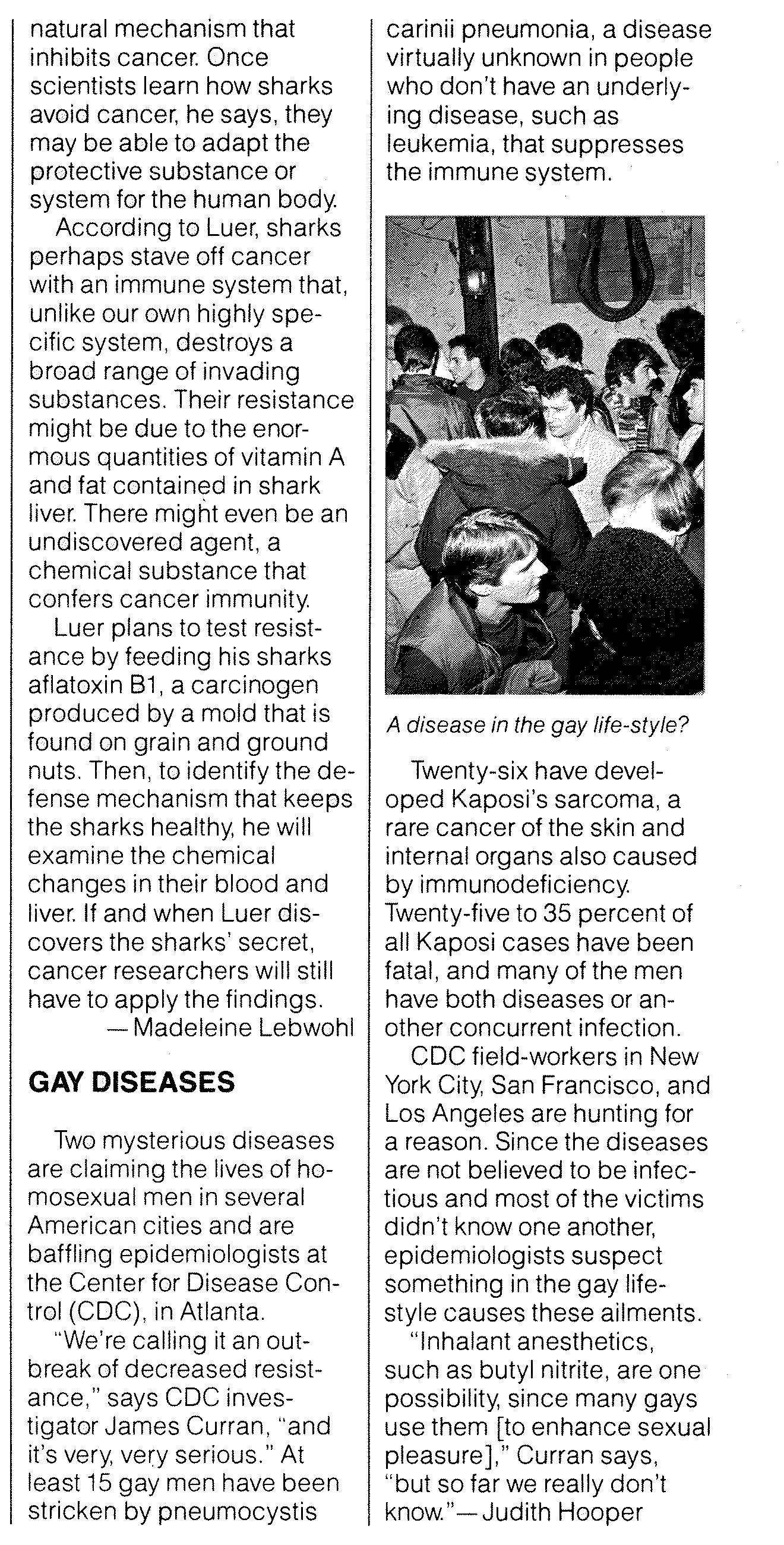
The article on the left is about sharks not getting cancer. This is Omni, after all.
As I go through old Omni magazines, I am struck by George Eliot’s dictum that history is adept at changing costume while remaining the same.1
One of those “changes in costume” is how political correctness doesn’t just shape a conversation, it shapes policy. And like most forms of censorship, it shapes policy out of dangerous ignorance.
In today’s world of men beating up women and calling it “sports” there’s an argument about “who does it hurt” on one side and “now it’s turned deadly” on the other. But political correctness hasn’t just turned deadly today. Political correctness has always been deadly and often, just as it is today, it’s been deadly to the people it was supposed to help.
Political correctness will always be deadly, because it is specifically a form of speech control that denies reality. It reaches into scientific research and denies effective research. It bars some data from the scientific conversation—and these are, by their nature, usually going to be the most relevant data.
I recently ran across a darkly humorous news item in the November 1981 Omni:2
Gay Diseases
Two mysterious diseases are claiming the lives of homosexual men in several American cities and are baffling epidemiologists at the Center for Disease Control (CDC) in Atlanta.
“We’re calling it an outbreak of decreased resistance,” says CDC investigator James Curran, “and it’s very, very serious.”
…
CDC field-workers in New York City, San Francisco, and Los Angeles are hunting for a reason. Since the diseases are not believed to be infectious and most of the victims don’t know one another, epidemiologists suspect something in the gay lifestyle causes these ailments.
“Inhalant anesthetics, such as butyl nitrate, are one possibility, since many gays use them [to enhance sexual pleasure],” Curran says, “but so far we really don’t know.”
“Since the diseases are not believed to be infectious” partly due to it “claiming the lives of homosexual men [who] don’t know one another” scientists were looking to non-infectious modes of transmission. They were looking at things in “the gay life-style” rather than behavior. Things like “inhalant anesthetics”.
The elephant in the room was that not knowing each other, in the gay community of the seventies in those cities, did not in any way rule out infection as a transmission method.
It’s easy to treat as a dark joke that the researchers were ignorant of gay culture and so missed the very likely, obvious, and remediable sexual transmission of HIV and thus AIDS. But this is very probably not how their denial worked. It is unreasonable to believe that none of them had any inkling that the affected population had—and still has—regular sex with partners they don’t know.
It would be interesting to know if anyone wrote in to correct that article and those researchers, but had their letters rejected. Because this was not exactly hidden knowledge. I’ve also recently re-read Armistead Maupin’s Tales of the City. While it reads like a period piece, it was written during the era it takes place in. That is, 1978, three years before this issue of Omni and these deliberately clueless researchers. Maupin makes no attempt at hiding the extreme promiscuity among gays “in New York City, San Francisco, and Los Angeles”. Especially San Francisco, where the story takes place.
That behavior was obvious then. It remained obvious in the early part of this century when I lived in Hillcrest in San Diego. It is likely that most, if not all, of the researchers knew that gay culture, especially in San Francisco, thrived on regular sex with unknown, even anonymous, partners. They refused to use that knowledge; they were deliberately clueless. They didn’t use that knowledge because they had been trained to never, ever, acknowledge it in an official capacity—especially not as behavior with unwelcome consequences.
That is, rather than being a bias of knowledge, this literal ignorance was almost certainly a bias of political correctness. The anonymous promiscuity of gay culture was (and remains) one of those things virtuous people don’t talk about. If you’re truly adept at politically correct virtuosity, you don’t even think about it. It went against the narrative, a narrative so laughable that Maupin made his name skewering it, that gay romance was different in any way from heterosexual romance.
This deliberate ignorance meant thousands of gay men dying a lingering and painful death from AIDS when all that was needed to prevent their deaths was an acknowledgement that their behavior was dangerous.
It’s a lesson we still haven’t learned. Only a few years ago, researchers tried hard to ignore the obvious data about the so-called mpox or monkeypox virus. The initial response to mpox, as it is now called, wasn’t to target the behavior that was spreading it in specific communities, but to treat it as an international public health emergency applicable to everyone.
Targeting everyone means targeting no one. How many gay men died because the medical and political establishments pretended that mpox was not primarily spread through unprotected gay sex? How many died because research time and funding dollars went as much to destigmatizing the name—changing monkeypox to mpox—as to keeping people safe?
It isn’t just pretending that men and women are interchangeable in sports. It’s pretending that men and women are so much the same that medical research can treat results between them interchangeably, or pretending that violent behavior is just their culture if it happens between minorities.
It’s pretending that obvious disease vectors do not exist because that would be a value judgement. Even today, you have to read the official sites carefully to realize what behaviors to avoid to not catch mpox.
Censorship kills. Political correctness is censorship. It is the worst kind of censorship, self-censorship. Self-censorship is almost impossible to recover from. We still haven’t recovered from the political correctness of the eighties, let alone from the new lies of the new century.
In response to The plexiglass highway: Government bureaucracies can cause anything to fail, even progress.
History, we know, is apt to repeat herself, and to foist very old incidents upon us with only a slight change of costume. — George Eliot (Scenes of Clerical Life)
↑Note that if Omni had a standard lead time, this would have been prepared for publication around August or September 1981.
↑
gay culture
- Omni, November 1981 at Internet Archive (magazine)
- “Arthur C. Clarke, James A. Michener, Ray Bradbury, Carl Sagan, Erica Jong, Norman Cousins, Robert Silverberg, et al, on blimps, explorers, magnetic people, and transsexual reincarnation.”
- Review: 28 Barbary Lane: Jerry Stratton at Jerry@Goodreads
- This is a weirdly nostalgic look at San Francisco and hook-up culture, especially gay hook-up culture, in the seventies.
Monkeypox
- Monkeypox Is The Left’s ‘Don’t Say Gay’: Eddie Scarry at The Federalist
- “Right now the CDC’s website describes monkeypox, another flu-like illness that comes with a bonus rash, in a way that suggests almost everyone will be infected at one point or another.”
- Mpox at World Health Organization
- “WHO fact sheet on mpox: includes key facts, definition, outbreaks, transmission, symptoms, diagnosis, treatment, prevention, WHO response.”
- Nearly 50% of participants in ‘Monkeypox in women’ study were biological men: Mia Ashton
- “A study on monkeypox in women was published in The Lancet recently in which almost half of the cohort being studied were males who identify as women.” (Hat tip to Ace at Ace of Spades HQ)
- San Francisco AIDS Foundation: Even If You Think You Have Monkeypox, Have Sex With Random Pickups Anyway: Ace at Ace of Spades HQ
- “When the guy comes in asking if the sores on his anus might be monkeypox, it’s too late to give him the ‘Secret Message For the Gays’ you’ve withheld from him.”
racism
- The Destruction of Title IX
- If you put the government in charge of a desert, in fifty years you’ll have a shortage of sand. If you put the government in charge of protecting women, in fifty years you’ll have government-sponsored violence against women.
- How ‘anti-racist’ ideology hurt the students it was supposed to help: Joanne Jacobs
- “‘Anti-racism’ is the Lord Voldemort—he who must not be named—of academia in 2025. DEI is like Bruno in Encanto. We don’t talk about DEI, no, no, no. Not if we want federal funding.” (Hat tip to Charlie Martin at According To Hoyt)
- Innovation in a state of fear: the unintended? consequences of political correctness
- Is political correctness poised to literally kill minorities as it may already have killed women, because scientists avoid critical research in order to avoid social media mobs?
- Our Cybernetic Future 2023: Entropy in Action
- Studying the past, we can improve the future. Studying the futurists of the past, we can learn the tools to improve the future.
More censorship
- The definitional war on satire
- What is satire if it isn’t about current, hotly-debated events and puncturing overblown narratives?
- Twisted censorship from France
- “I abhor censorship of every kind… unless it goes against the narrative.”
More extraordinary delusions
- The Modern Lobotomy: Whitewashing Child Mutilation
- Child mutilation in the service of gender quackery is something that future generations will look back on in horror, much as we today look back on the lobotomy.
- It’s a mad, mad, mad, psychotic world
- It was once a sign of witchcraft to deny that witches exist. Today, it is a sign of madness to point out the madness of our COVID dogma.
- COVID Lessons: Journalistic Delusions and the Madness of Politicians
- COVID-19 was real. The crisis surrounding it was entirely manufactured. Everything we did took a manageable disease and turned it into a killer. And the very worst was believing a media we knew was lying.
- COVID Lessons: The Health Care Shutdown
- It’s fortunate that COVID-19 was not as bad as the experts said, because our response was almost entirely to make the problem worse. We shut down everything that could help, including health care for co-morbidities. We locked the healthy and the sick together, and cut people off from routine care. Most of the deaths “from” COVID-19 were probably due more to our response than to the virus itself.
More OMNI Magazine
- Omni welcomes the eighties
- The issues of Omni straddling 1979 and 1980 are a fascinating look at how the United States was changing as computer technology heated up—and space missions cooled down.
- Power Play 2020
- Frederik Pohl shows why science fiction authors aren’t any better at being futurists than anyone else. Hubris is a powerful drug.
- Better for being ridden: the eternal lie of the anointed
- Whenever there’s a crisis, politicians and the media always tell us that if we do what they say, we’ll be all right. This is always a lie. And however often they fail and however many die from their ministrations, their wabbling fingers always return to the mire.
- The Best of Omni Science Fiction No. 2
- I always enjoyed Omni, but, unlike its sister publication, I enjoyed it for its photos more than for the stories. Its best, however, was not too bad, at least from 1978-1980.
- Omni’s Jobs of the Future from 1985
- What Omni’s popular science writers saw as the jobs of tomorrow thirty years ago.
More political correctness
- How the left transformed vulgarity into courage and elected Donald Trump
- When you lose to Donald Trump, look inward, because it isn’t Donald Trump’s fault. The establishment left, especially the media, attacked Donald Trump just like he was Joe the Plumber. But Donald Trump has the platform to attack back. Doing so took courage, and the Plumbers of America recognized that.
- But the rhetoric’s so much better here under the tragedy!
- Want to stop domestic terrorism? Take seriously those who say they want to kill. Want to stop the oppression of women and the gay community? Take seriously those who say they want to literally enslave women and kill gays.