


A Monticello Meal for Independence Day
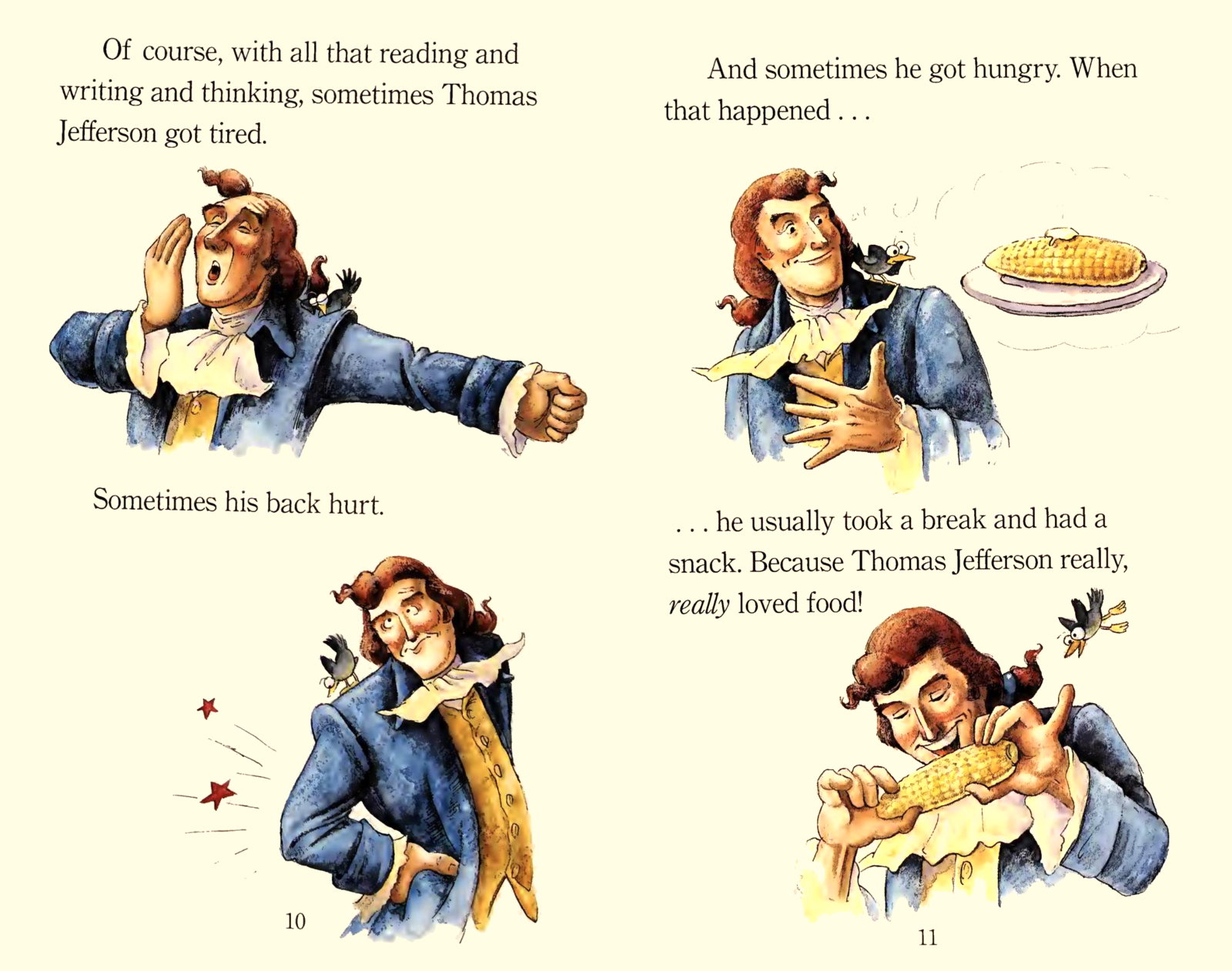
There’s even a children’s book about how much of a foodie Jefferson was.
The Fourth of July celebrates the signing of the Declaration of Independence. The Declaration was drafted by Thomas Jefferson. Why not add a couple of Jefferson’s or his family’s recipes to your celebration?
- Bicentennial meal
- Centennial Meal
- Vicennial Meal
- Sestercentennial Cookery
- Monticello Meal ⬅︎
- Great Anniversary Food
If there were a patron of American foodies, it would be Thomas Jefferson. He famously designed and possibly built his own pasta machine after enjoying pasta on an overseas trip to Italy. He is credited with introducing such varied foodie delights to America as waffles, macaroni & cheese, and vanilla pods.
His ice cream recipe from his time in France is widely copied and possibly the most common example of the foods he popularized. As reproduced by the Thomas Jefferson Foundation’s web site for Monticello, it is simple and likely very good, using cream, separated eggs, and sugar. It is churned using a “sabottiere”, which appears to be an early form of ice cream churn, a “sorbetière” in modern French.
And Jefferson didn’t just bring foreign foods to America. He also brought American foods to foreign lands. He considered the apples of France “vastly inferior to his prized Newtown Pippin from Virginia. So began a five-year mission to introduce his French colleagues to the great delicacies of his homeland.”
He wasn’t alone among the Founders in feeling that way about American apples. When Benjamin Franklin was in England, he also longed for the Pippins of home. He joyously thanked his wife for them when they appeared in her care packages, feared they would spoil when a shipment was late, and was clearly despondent when a shipment lacked them.
Goodeys I now and then get a few; but roasting Apples seldom, I wish you had sent me some; and I wonder how you, that us’d to think of every thing, came to forget it. Newton Pippins would have been the most acceptable…
Like many people today, Jefferson appears to have used gardening, especially vegetable and fruit gardening, as a means of relieving stress. He kept a careful “garden book” logging the origins of each seed, when they were planted, and when they were ready for harvest.
According to Helen D. Bullock in the opening essay of Thomas Jefferson’s Cook Book, when he was in France Jefferson “delighted guests by serving Indian corn on the cob which he had grown in his Paris garden.”
As President, Jefferson even changed how food was handled in the White House. Instead of hosting big open houses as Presidents Washington and Adams had done, he instead hosted small dinners of specially chosen guests specifically for the conversations this would encourage.
Jefferson limited each guest list to roughly a dozen. Federalists came one night and Republicans1 another. Jefferson forbade any talk of politics until the lawmakers cleaned their plates. Taking a cue from the French, Jefferson figured that if his colleagues could learn to be civil with each other while discussing art or religion or agriculture over a delicious meal, they would be more likely to agree with each other at the Capitol the following day.
Bullock quoted a Presidential guest that “Never before had such dinners been given in the President’s house… In his entertainments republican simplicity was united with epicuran delicacy”.
Sadly, few of the recipes in his famous collection are available in their original form outside of museums. However, Marie Kimball’s Thomas Jefferson’s Cook Book, which was originally published in 1938 and occasionally reprinted since, does have updated versions of many of the recipes used by Jefferson and his family.
My copy is a University of Virginia reprint from 1976, likely for the Bicentennial. The University of Virginia was famously founded by Jefferson and was on the short list of the accomplishments he was most proud of to the end of his life.
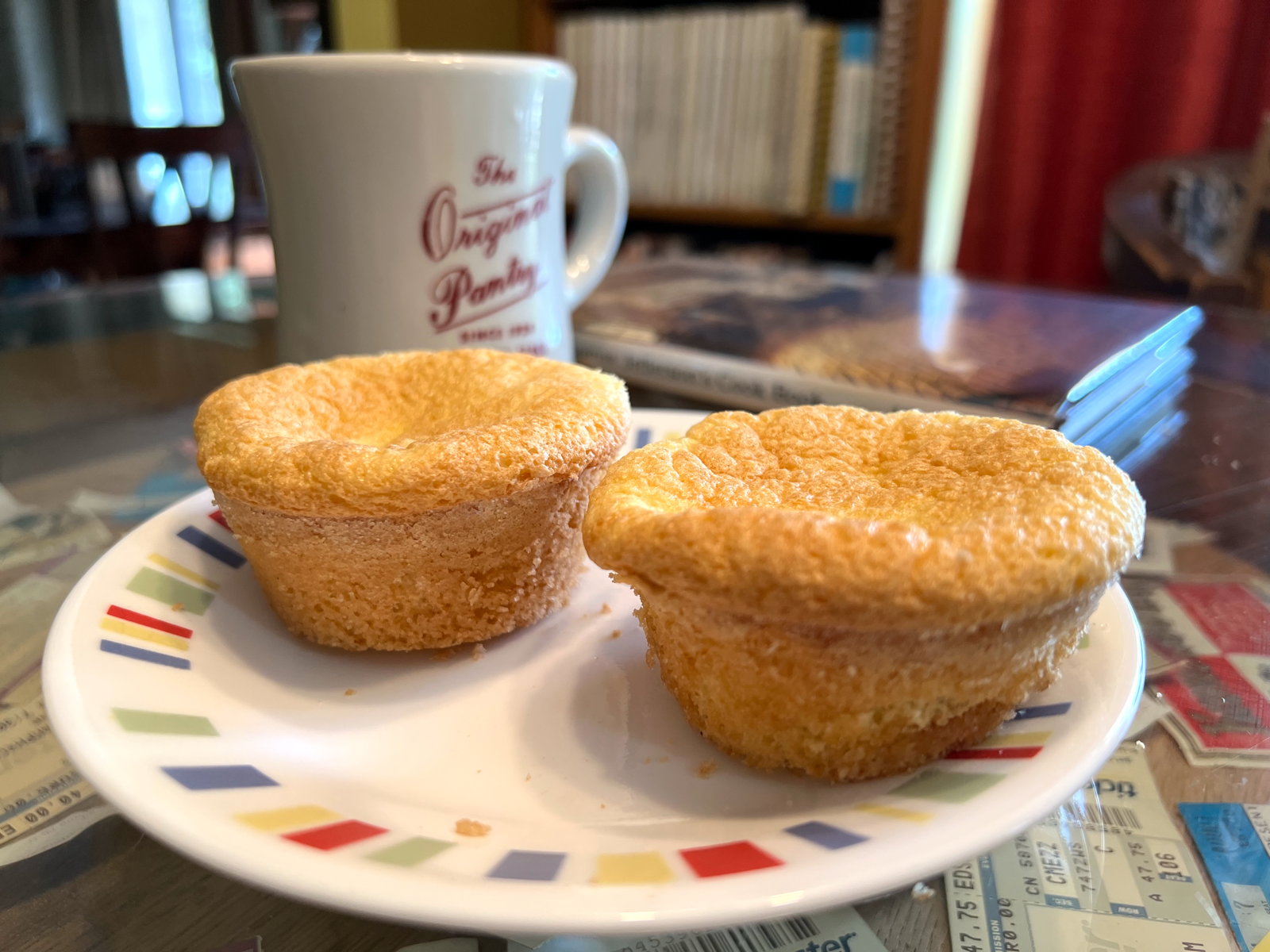
The Biscuit de Savoye are flavorful and fluffy on their own without any topping.
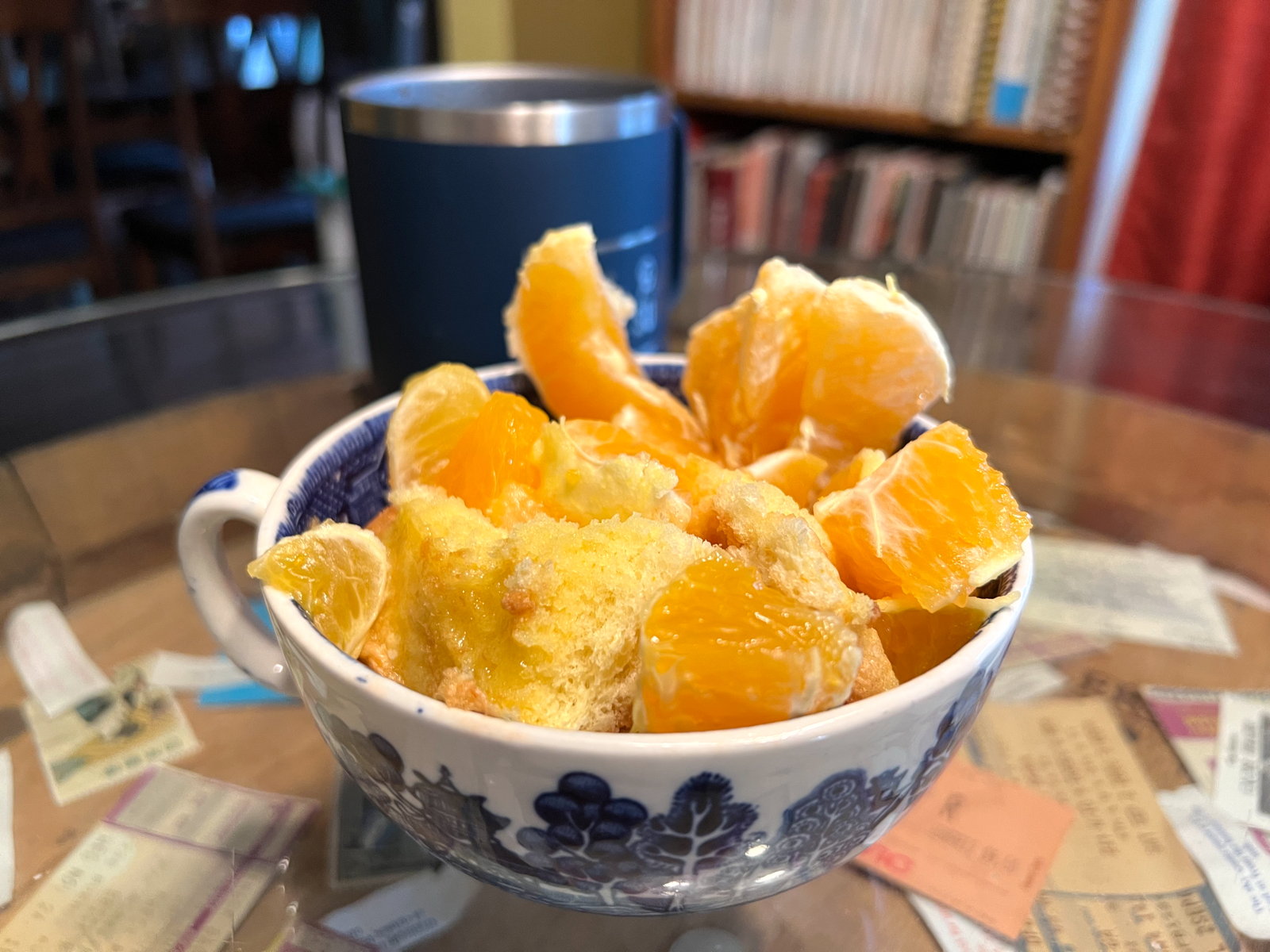
They’re also perfect for topping with chopped fresh fruit.
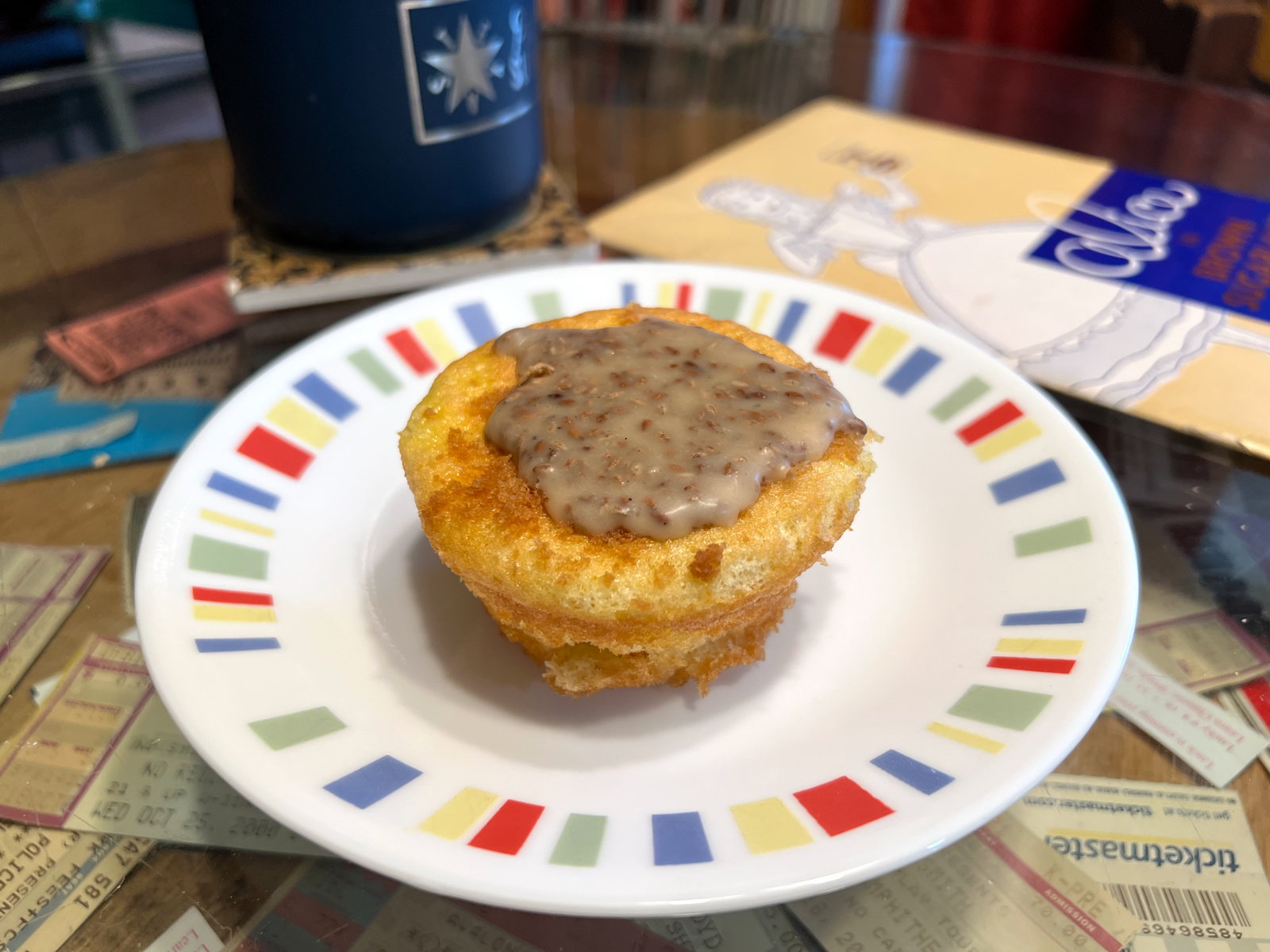
And were good with sesame seed frosting. Jefferson was a proponent of sesame seeds, especially sesame oil.
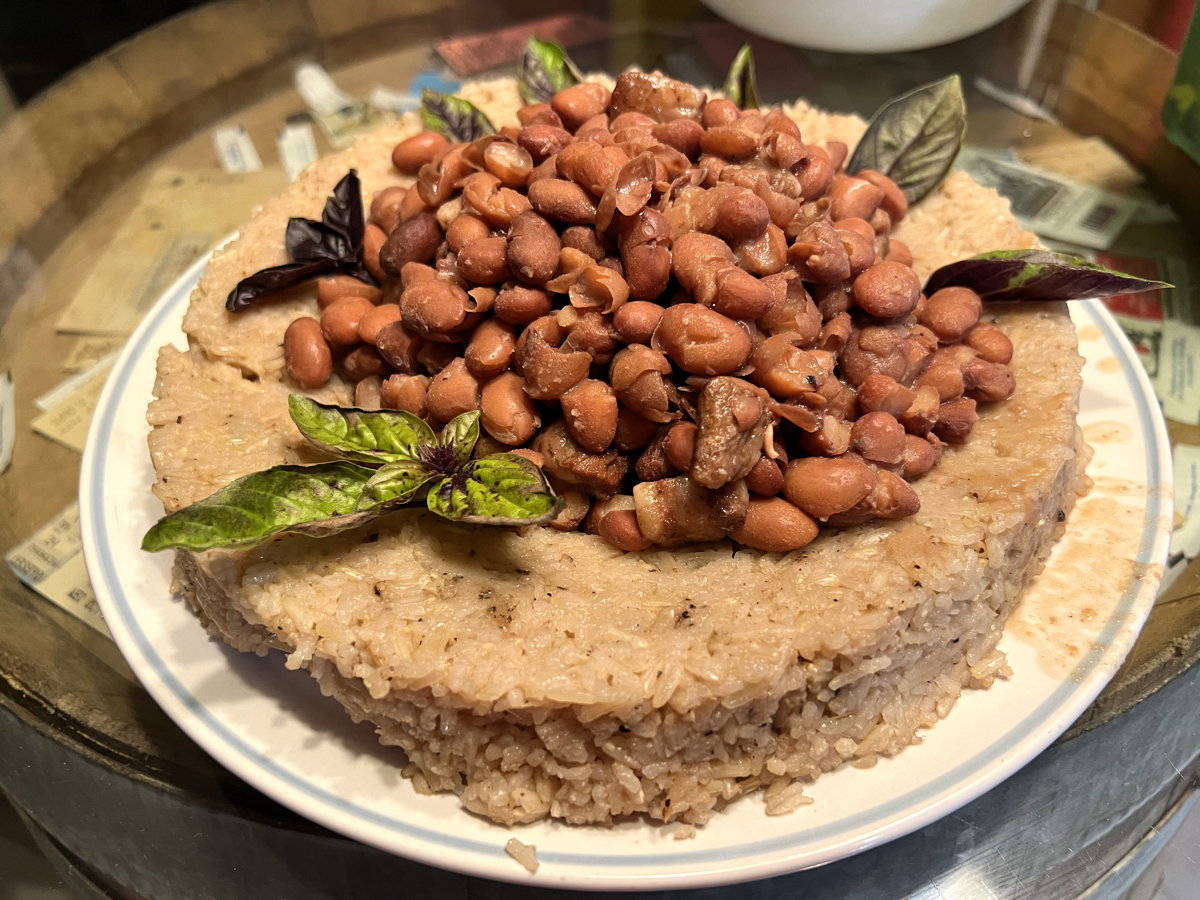
Whoever the Baron de Brise is, he shares rice and beans. He’s a good friend.
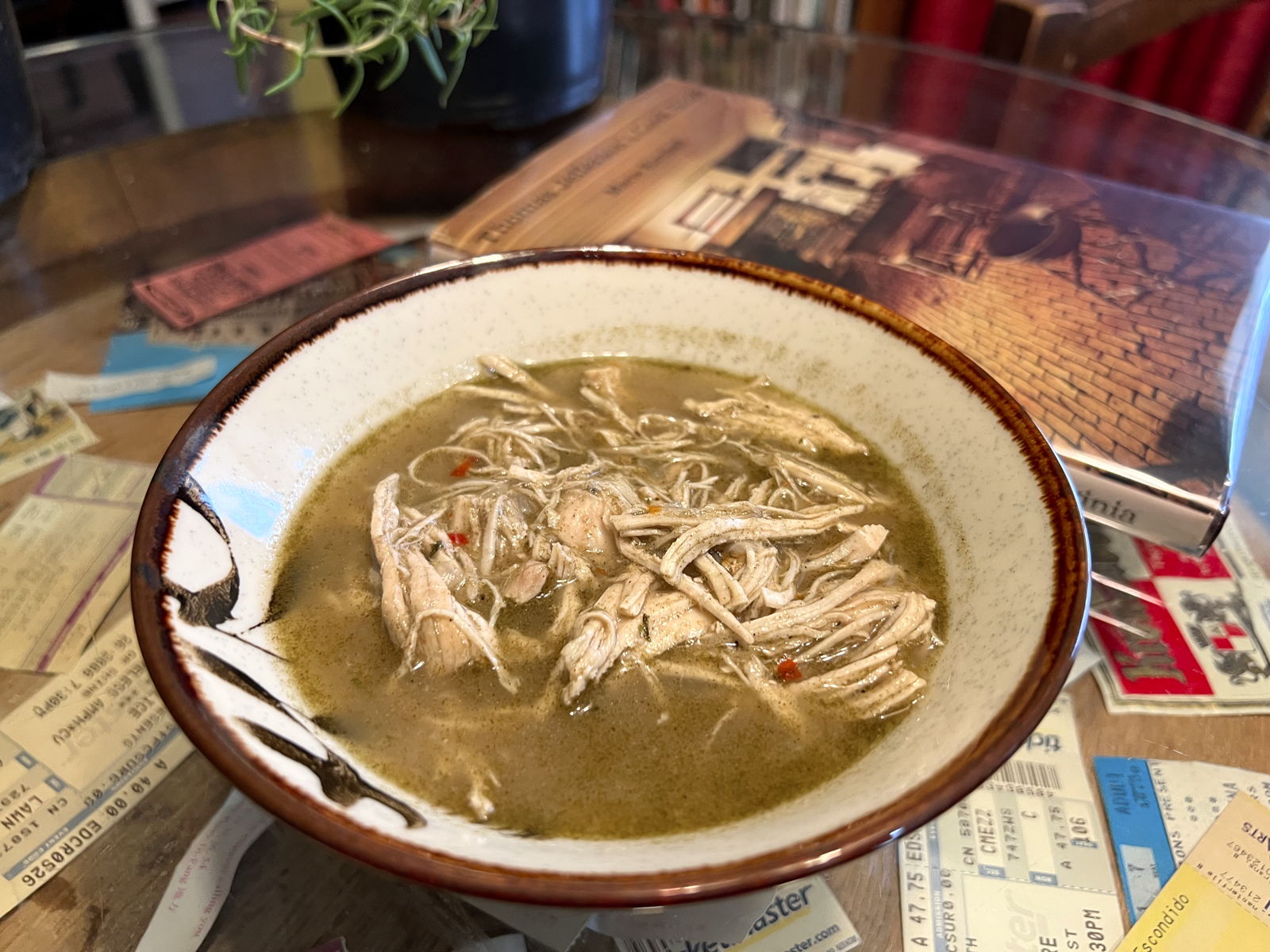
Any diplomatic mission that sends back gumbo is a successful mission.
The caveat on these updated recipes is that they’ve been updated for 1938. We’re basically seeing 1770 and beyond recipes through 1938 and before eyes. Kimball’s updated recipes use oven terminology instead of temperatures, for example. The recipes don’t even assume you have an electric refrigerator, though the ice cream recipe does acknowledge the possibility.
The strangest instruction has to be the line for the Brandied Peaches where you are instructed to measure the heat of sugar by dipping fingers in hot sugar and seeing if they stick together.
Make a syrup of sugar and a little water, using one pound of sugar to four pounds of peaches. Boil until, when you dip two fingers into it, they will stick together. Let cool. Add the peaches and let stand while you go to a doctor to attend to your third-degree burns.
I may have modified everything after “let stand”. I was unable to find the original of this recipe, and I’d love to see what the original instructions were. Assuming that this isn’t a typo of some sort, there is probably some thirties cultural knowledge I’m missing, or possibly a strange interaction between the original recipe’s instructions and the update.
In his autobiography, Jacques Pépin mentions, in passing, using his fingers to test the doneness of syrup—and also describes how his brother saw him doing it, and screamed when he tried it himself. The technique obviously exists, but neither Kimball nor Pépin describe how it works.
Despite all of that, one of the amazing things about Kimball’s book is how good and how easy the recipes are. I have so far tried six recipes from the book; every one of them has gone into my rotation with a star.
They’re also wide-ranging. The recipes I tried were a gumbo, a beans and rice, a French sponge cake, a pumpkin soup, an apple pie, and a fish-and-potato pie. Add some barbecue and cut the soup and you’ve got a pretty good spread for an Independence Day blowout!
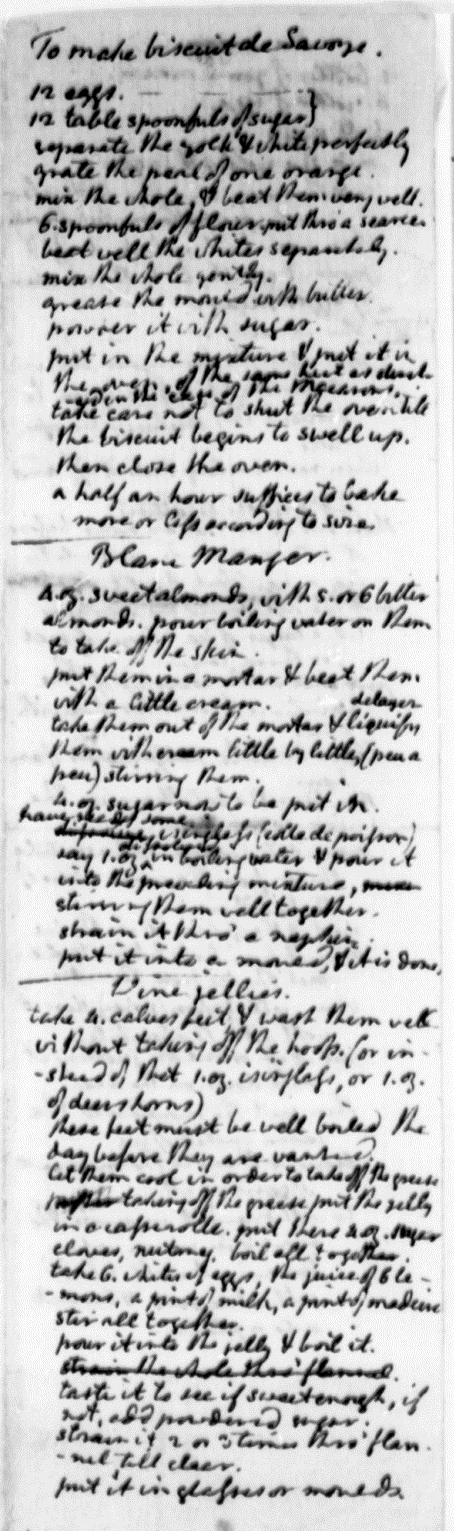
This recipe is in Jefferson’s handwriting. He wrote it down while in France.
If you compare this book with with, say, The Martha Washington Cook Book, also as interpreted by Marie Kimball, Thomas Jefferson’s Cook Book is very modern. The former book is filled with the dishes we expect of the era: meat pies, fish stews, lots of sweet breads and feet and wild game, and heavy sauces. Kimball even resorts, in the sauces section of Martha Washington, to providing several “modern” sauces to accompany the roast meats rather than requiring the reader to use Washington’s eighteenth century sauces.
In two or three cases a modern sauce has been suggested as making a dish more palatable.
The most modern recipes in the Martha Washington book would probably be the fritters and pancakes, and some of the pies and cakes. But Kimball updated the latter to use ingredients such as baking powder, despite acknowledging that “there was, of course no baking powder, and the lightness of the cake depended on the thoroughness of the beating”.
The Biscuit de Savoye from her Thomas Jefferson book contains no baking powder and is more of a mere cleanup of the original recipe’s haphazard format than a complete reworking of it for modern kitchens. Marie Kimball translated it to then-modern 1938 as:
Separate 6 eggs. Beat the yolks until lemon colored and light. Add 6 tablespoonfuls of sugar and the grated rind of one orange. Beat well; add 6 tablespoonfuls of sifted flour mixed with ⅛ teaspoonful of salt. Beat the egg whites until stiff and dry. Fold into the first mixture. Butter a cake mould and dust with sugar. Turn the mixture into this and set in a slow oven. Bake from thirty to forty minutes, or until cake shrinks from edge of pan.
Kimball is explicit in the introduction that she’s adjusted recipes “to our current practice of a formula for serving six persons” and she does that here, dropping the recipe in half from a twelve-egg recipe to a six-egg recipe. She also explicitly added a very small amount of salt—which might, possibly, have been present in the original as part of the flour.
Jefferson’s original is otherwise pretty much the same recipe. And this recipe is from Jefferson: the original is in Jefferson’s own handwriting, from his time in France.
- To make biscuit de Savoye.
- 12 eggs.
- 12 tablespoonfuls of sugar
- separate the yolk & white perfectly
- grate the peel of one orange.
- mix the whole & beat them very well.
- 6 spoonfuls of flour put thru a seaves.
- beat well the whites separately.
- mix the whole gently.
- grease the mould with butter.
- powder it with sugar.
- put in the mixture & put it in the oven
- [Additional note in even worse handwriting that may say something like, of the same heat as already given for the recipe of the macarons]
- take care not to shut the oven while
- the biscuit begins to swell up.
- then close the oven.
- a half an hour suffices to bake
- more or less according to size.
The main difference between Jefferson’s recipe and Kimball’s rewrite, besides the halving of the recipe, is the difference in ovens between Jefferson’s era and 1938. Kimball might or might not have increased the amount of flour. The original reads “spoonfuls”, not “tablespoonfuls” but does say “tablespoonfuls” of sugar, so it’s possible that the former is different from, and larger than, the latter.
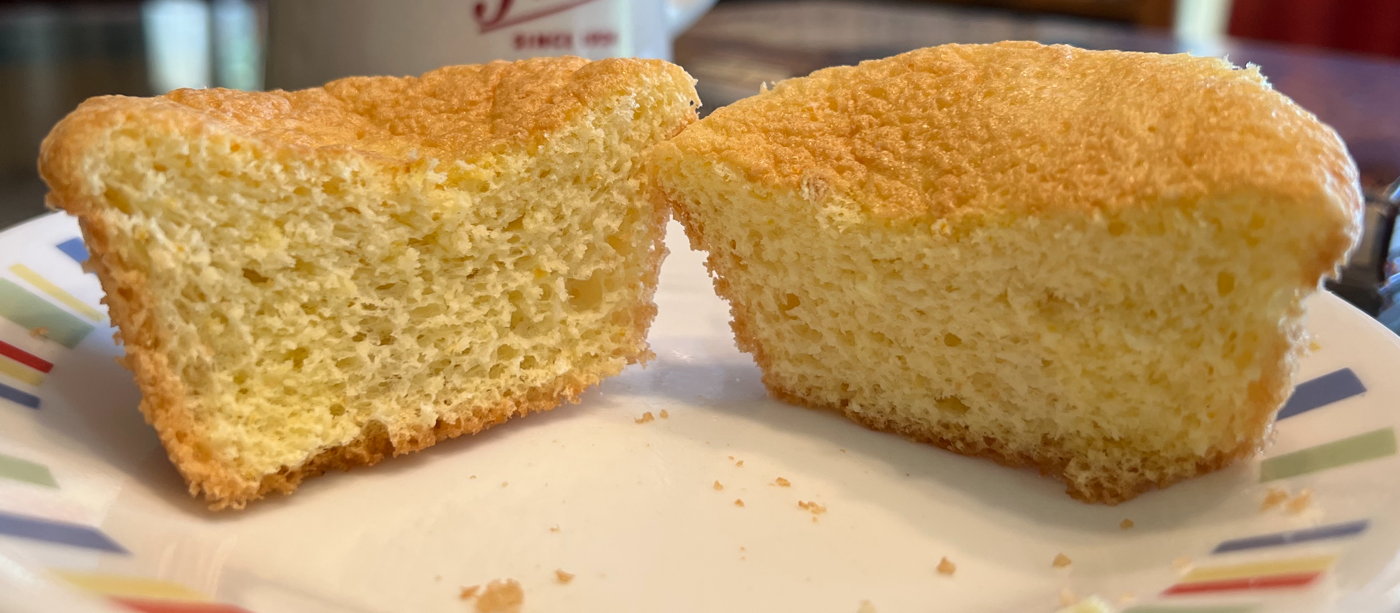
Tortini Monticello (Monticello Cupcakes)
Servings: 12
Preparation Time: 1 hour
Marie Kimball and Thomas Jefferson
Review: Thomas Jefferson’s Cook Book (Jerry@Goodreads)
Thomas Jefferson’s Cook Book (Internet Archive)
Ingredients
- 6 egg yolks
- 6 egg whites
- 6 tbsp sugar
- 6 tbsp flour
- ⅛ tsp salt
- zest of one orange
Steps
- Beat the yolks until lemon-colored.
- Mix the sugar and zest together.
- Beat sugar slowly into yolks.
- Mix flour and salt together.
- Beat slowly into batter.
- Beat egg whites to stiff peaks.
- Fold whites into batter.
- Butter a twelve-cupcake muffin tin and dust with sugar.
- Fill each cupcake mold with about three tablespoons of batter.
- Bake at 300° for 20 to 30 minutes until golden brown and a toothpick comes out clean.
- Cool in pan and remove.
While both the original and the rewrite call for a cake pan, I made them as cupcakes. Kimball’s halved version is perfect for twelve cupcakes. The little cakes are good on their own or as a nice base for a fruit shortcake—such as segments of the orange that were zested for the batter.
This recipe’s title is an indication that the word for cake and cookie was as related in French as it was in Dutch. Nowadays, a “biscuit” in French would be what we would consider to be a cookie; here, it is definitely a cake. The word itself is actually a description of the process of baking rather than a description of the result. In the original Latin, “biscuit” meant “twice baked”.
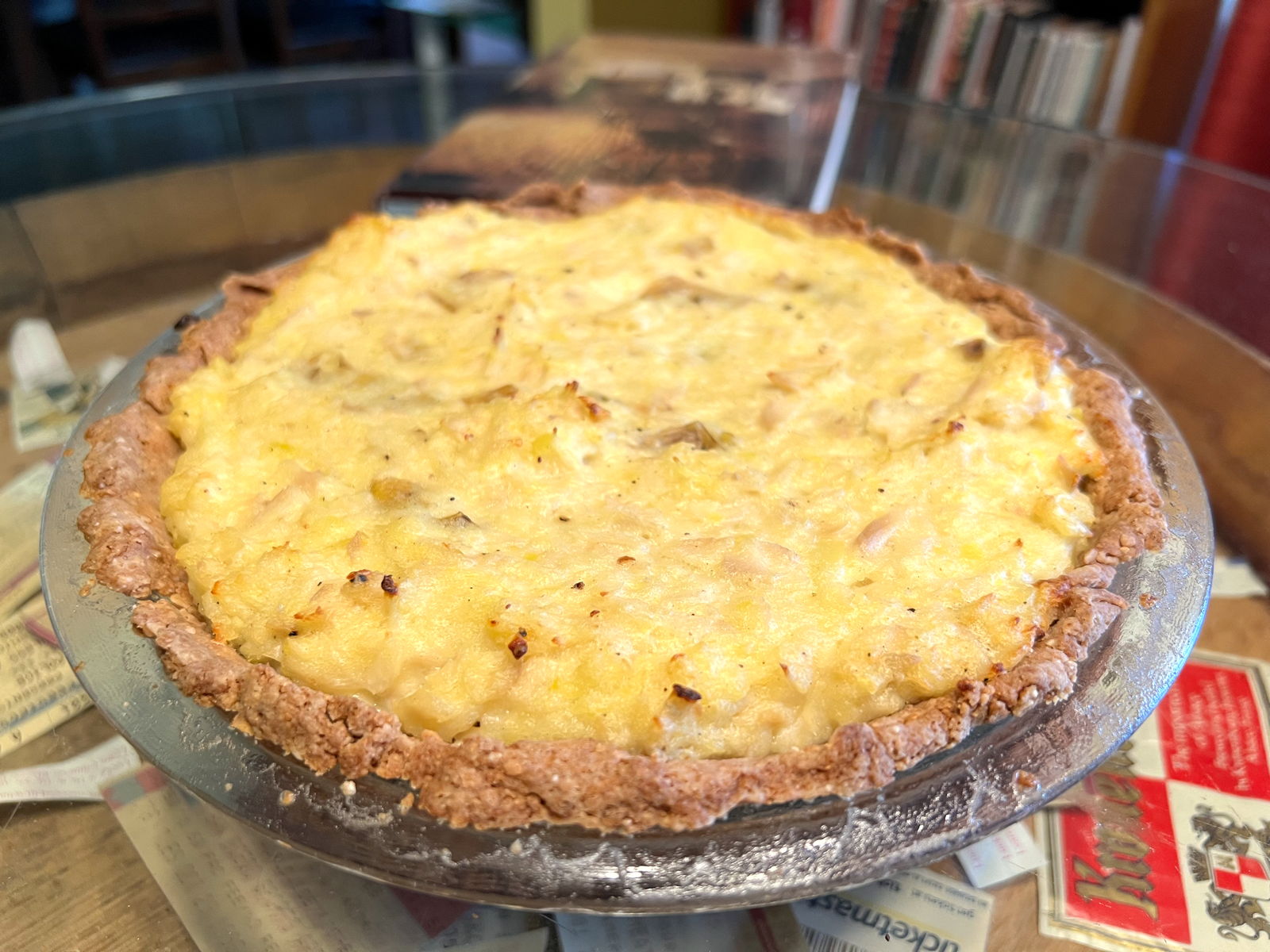
Mashed potatoes in a pie crust. Mixed with flaky fish. That’s almost all I have to say about that…
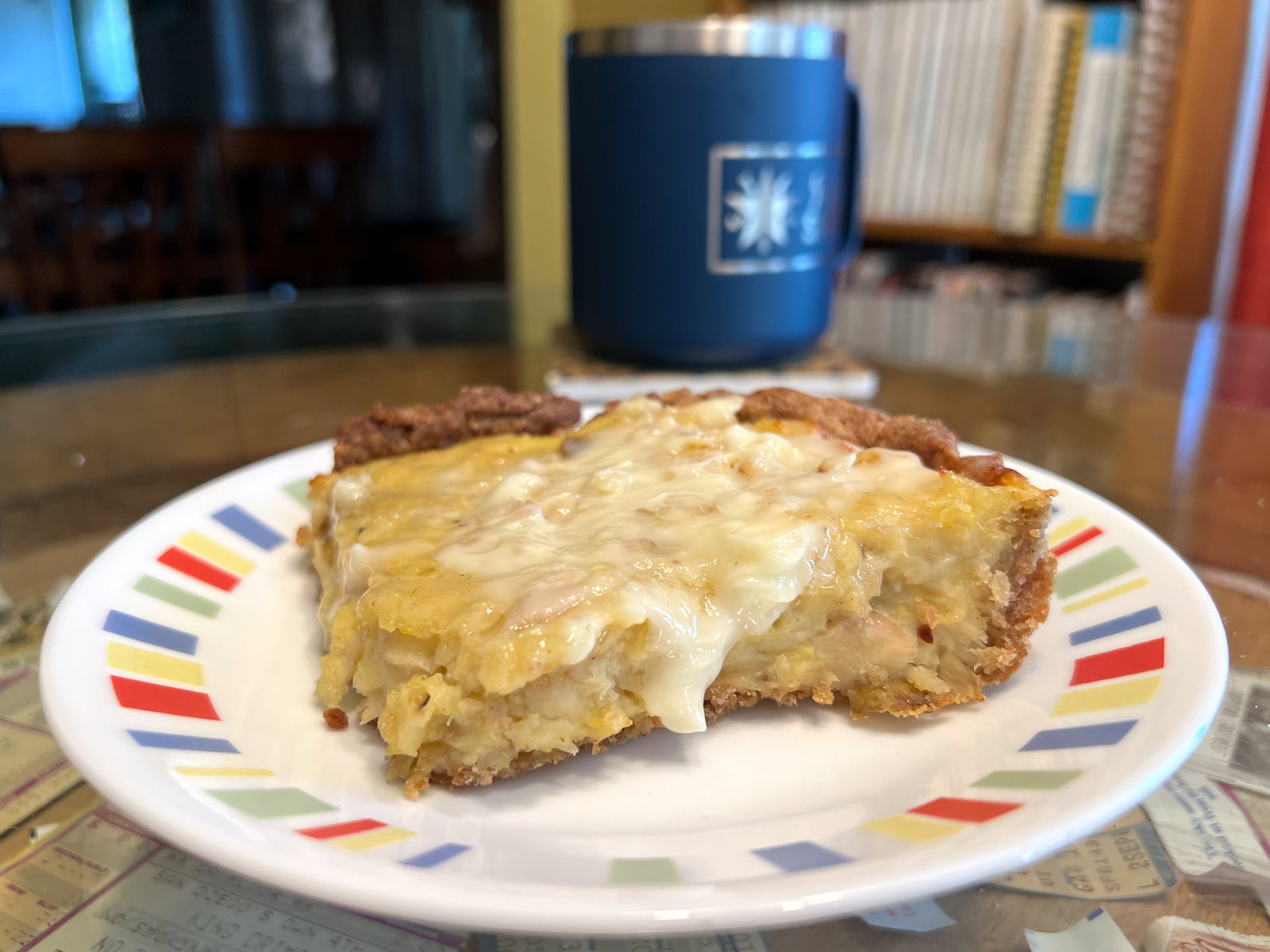
…except that mashed potato pie is even better with gravy or with butter.
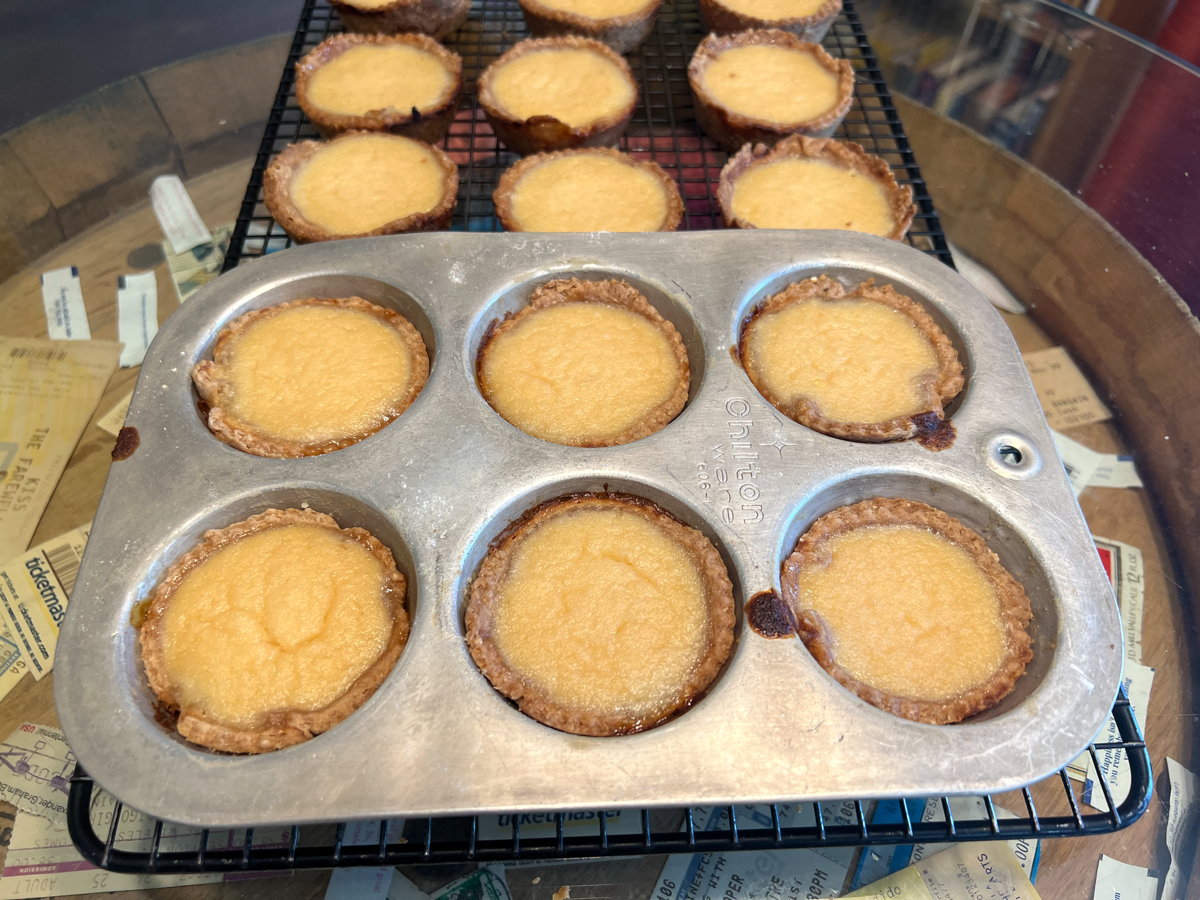
The Apple Pudding recipe makes enough filling for eighteen muffin-tin-sized pies…
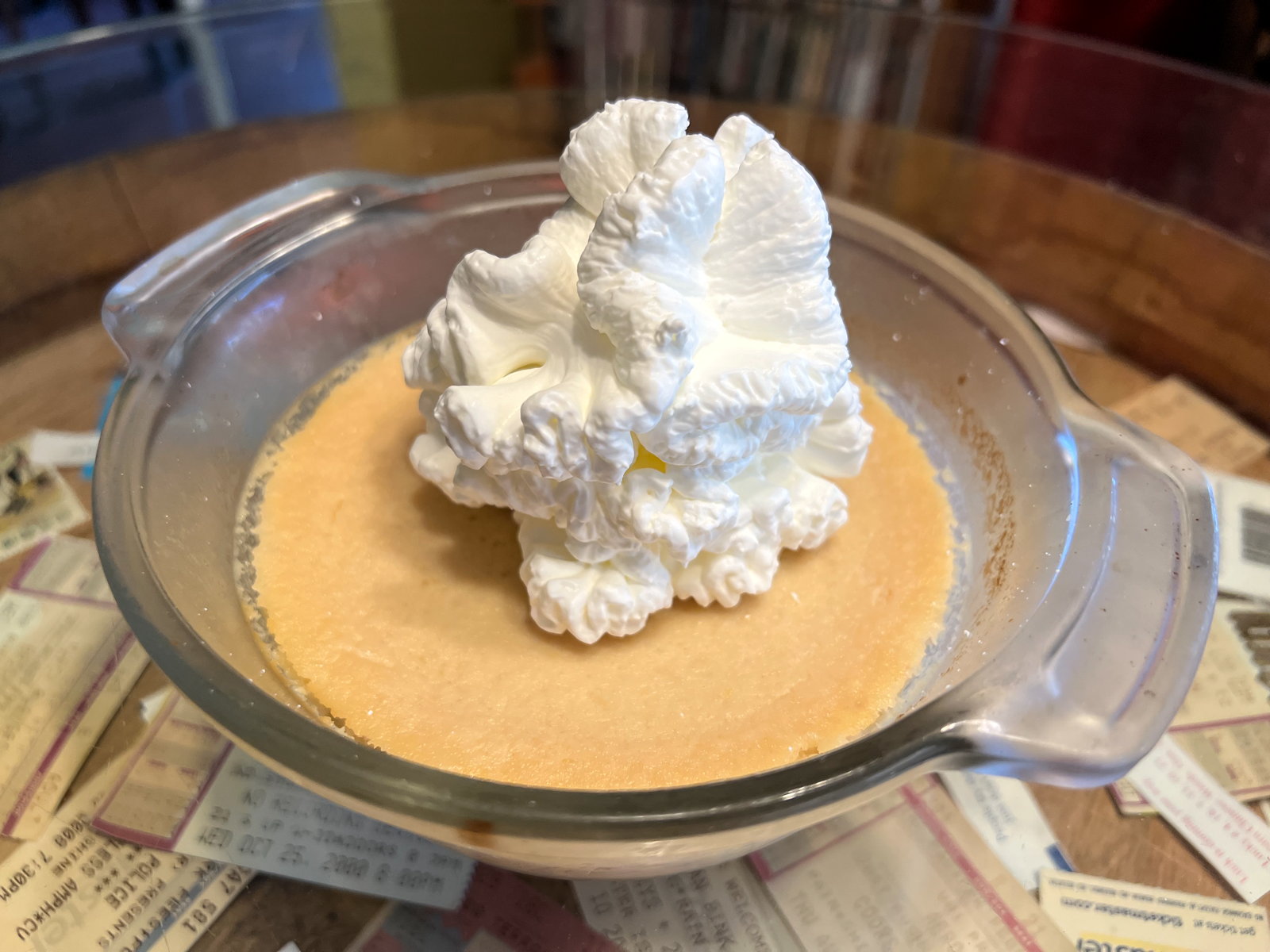
…with just enough left over for one bowl of pudding with whipped cream!
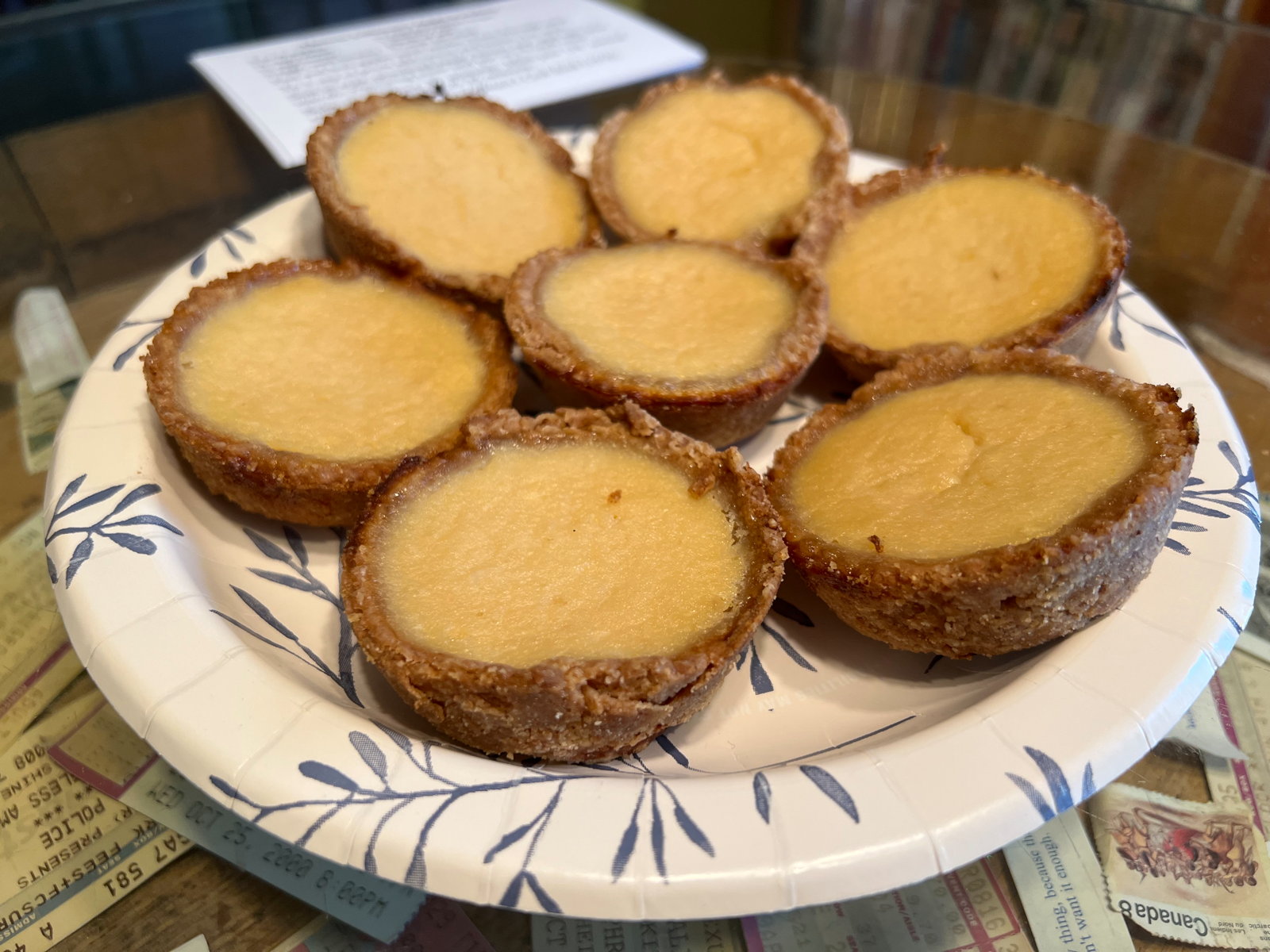
Muffin-tin-sized Apple Pudding Pies were perfect for a church potluck!
The most frustrating thing about Kimball’s book is that she is very lax about sources. Kimball’s sources are not an eighteenth century or early nineteenth century Jefferson-era book or collection. If I’m reading Kimball and her attributions correctly these recipes span from the original days of Thomas Jefferson well into the 1800s of his descendants.
Kimball appears to have taken most or all of her recipes from the copies made by Jefferson’s granddaughter Virginia Jefferson Trist. Trist’s collection, however, contains recipes from well after Jefferson died.
This is not itself a bad thing. It makes this book a nice spread of recipes from throughout the early years of this country and across one family’s generations. But it would be nice to know both how the recipes were originally worded and which recipes came from when and where.
In her defense, Kimball does maintain at least some attributions. Martha Jefferson Randolph, whose Fish Potato Pie I tried, would have been Thomas Jefferson’s daughter. I’ve always enjoyed planked fish, and this is a great variation on it. I steamed the fish just enough to make it flaky, so that it could be mixed with the mashed potatoes before baking in a pie crust.
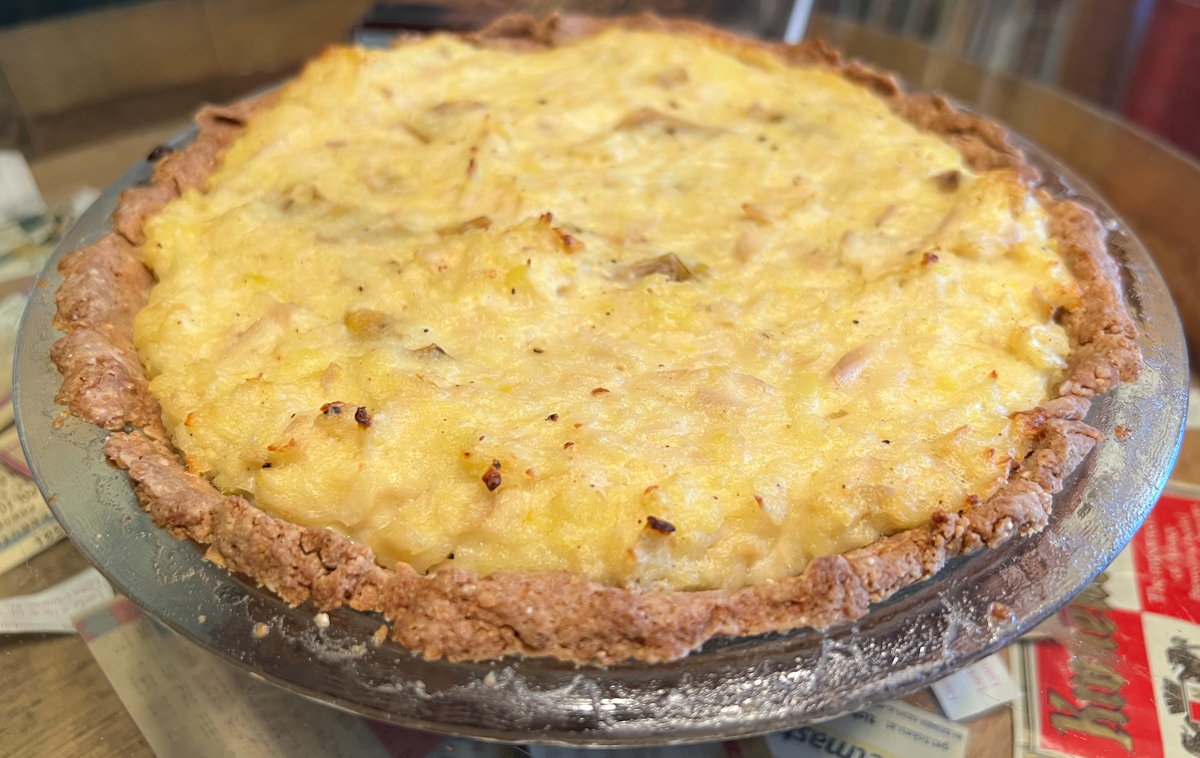
Martha Jefferson Randolph’s Fish Potato Pie
Servings: 8
Preparation Time: 1 hour
Marie Kimball and Martha Jefferson Randolph
Thomas Jefferson’s Cook Book (Internet Archive)
Ingredients
- 1 lb trout or whitefish
- 1 lb mashed potatoes
- 2 tbsp butter
- ¼ tsp nutmeg
- ⅛ tsp pepper
- ½ tsp salt
- 2 tbsp brandy
- cream or milk
- 9-inch pie shell
Steps
- Steam fish just enough to shred.
- Mix with mashed potatoes made normally.
- Mix in butter, nutmeg, pepper, salt, and brandy.
- If too stiff, thin with cream or milk.
- Turn into pie shell and bake at 375° for about thirty minutes, until set.
I made this as about a two-thirds recipe to go into a 7-½-inch pie dish. Although given the instructions it’s difficult to say what a whole recipe is.
Boil and shred your fish. Have ready some mashed potatoes. Mix them, in equal quantities, with 2 tablespoonfuls of butter, ¼ teaspoonful of grated nutmeg, ⅛ teaspoonful of pepper, ½ teaspoonful of salt, and 2 tablespoonfuls of brandy. Beat well. If too stiff, add more cream or milk. Turn into a dish lined with piecrust and bake until set.
I find it fascinating that the reader is left on their own for the fish and potato amounts, but given specific measures for the flavorings!
For my two-thirds pie I used nine ounces of potatoes and the same amount of trout, mainly because that’s how much trout I had on hand. For the potatoes, I made very simple mashed potatoes using milk, butter, and salt; this pie would of course be a perfect use for leftover mashed potatoes.
This is a beautiful savory pie for the potluck table. The spices—and the brandy—give it a little more elegance and old-school flavor. This pie could also be made in individual pies as I did with Miss Martin’s Apple Pudding.
I’m far less certain about who “Miss Martin” is than about all of my other guesses. She may have been Elizabeth A. Martin Randolph, who married Meriwether Lewis Randolph in 1835. Meriwether was one of Martha Jefferson Randolph’s sons, which would make him one of Thomas Jefferson’s grandsons. If Miss Martin was his wife, this recipe was written well beyond Thomas Jefferson’s death in 1826.
We would call this Apple Pudding an Apple Pie, or perhaps (as I do here) an Apple Pudding Pie. The pudding is “put in a crust” and baked for half an hour.
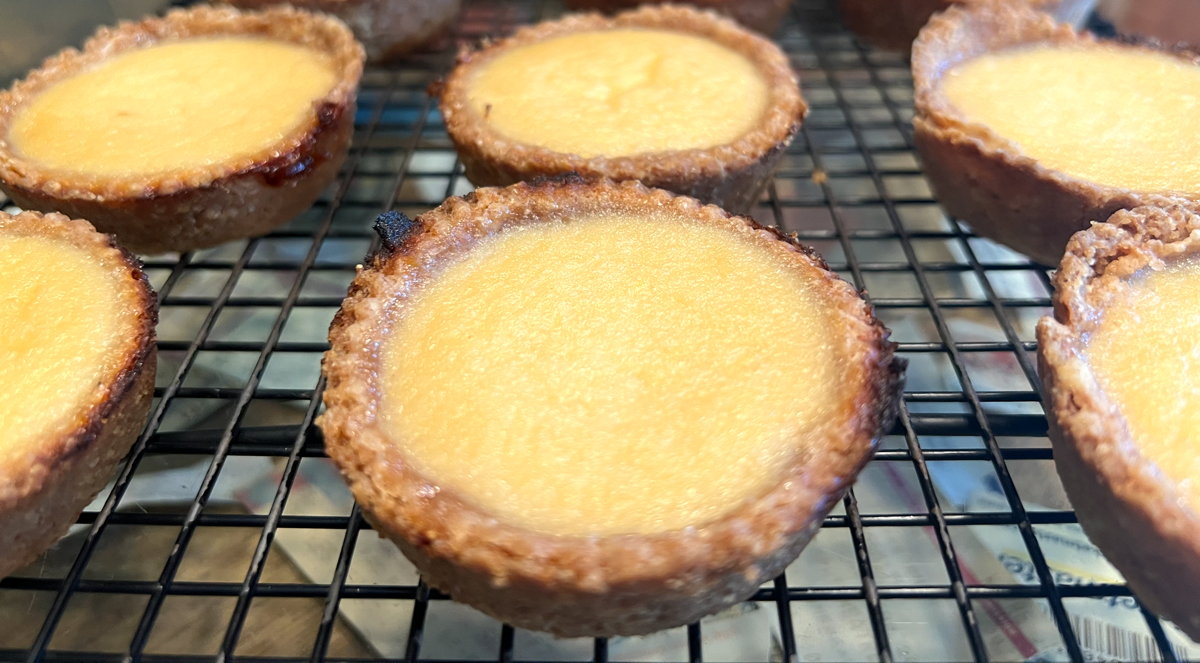
Miss Martin’s Apple Pudding Pie
Servings: 8
Preparation Time: 1 hour, 15 minutes
Marie Kimball
Thomas Jefferson’s Cook Book (Internet Archive)
Ingredients
- 3 or 4 apples
- ¼ cup cream
- ¼ cup butter
- 3 eggs, well-beaten
- ½ cup powdered sugar
- 1 lemon’s zest
- pinch of salt
- 9-inch pie shell
Steps
- Peel and boil apples until tender.
- Press through sieve.
- To one cup of purée add cream and butter.
- Let cool.
- Beat in eggs, powdered sugar, lemon zest, and salt.
- Mix into the remaining purée.
- Put in a 9-inch crust.
- Bake at 400° for 30 minutes, or 20-25 minutes for 18 mini-pies..
I made this pie for a church gathering, so I made it in individual servings. The recipe makes enough for at least eighteen muffin-sized pies. I had enough left over to use as what we really would call a pudding, that is, the filling without any pastry.
Mrs. Rosella Trist, whose Gumbo I enjoyed, is probably a relation of Virginia Jefferson Trist, given the shared last name. She may have been the wife of Hore Browse Trist, whose father was appointed by Jefferson to a customs post in the Mississippi Territory. The father died, but the son remained in the Louisiana area and corresponded with the Trists who remained in Virginia.
Depending on when Browse married Rosella, Jefferson might well have enjoyed this modern staple of Southern tables via a recipe straight from Louisiana!
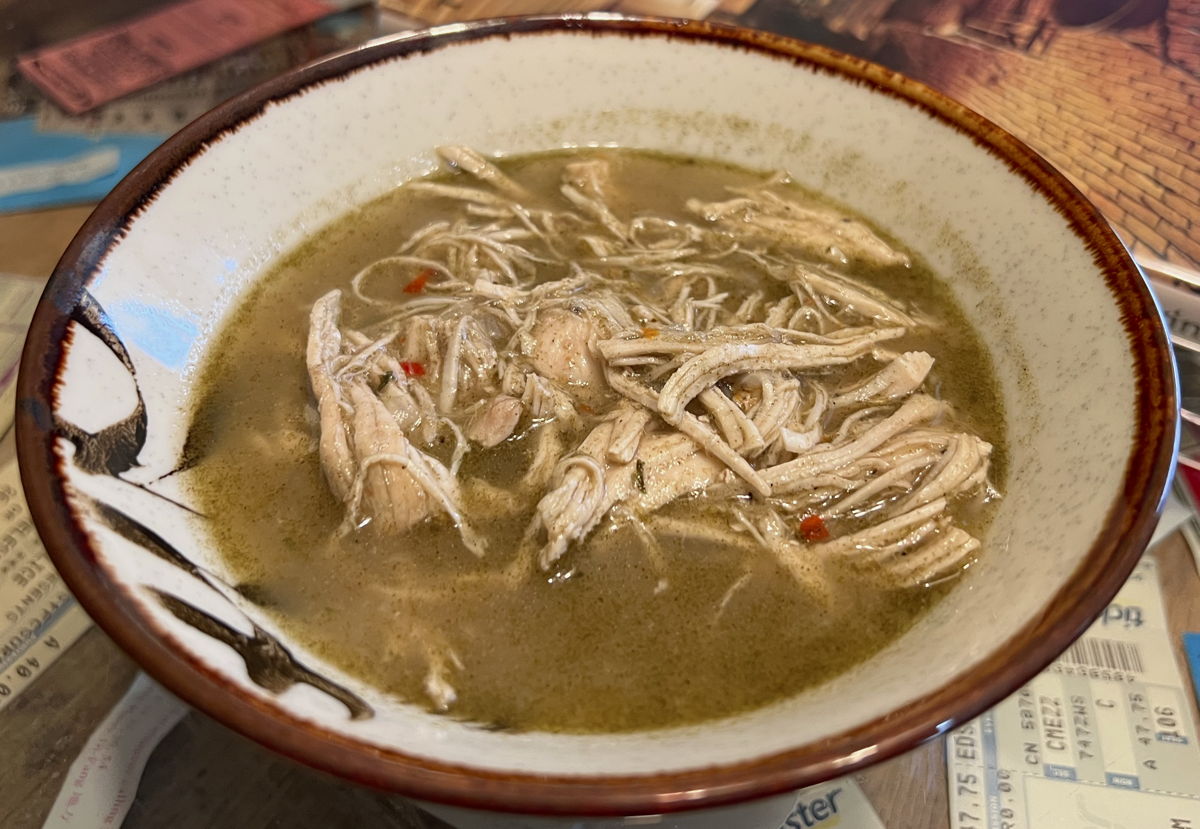
Mrs. Rosella Trist’s Gumbo
Servings: 4
Preparation Time: 2 hours
Marie Kimball and Mrs. Rosella Trist
Thomas Jefferson’s Cook Book (Internet Archive)
Ingredients
- 2 tbsp butter or lard
- 1 tbsp flour
- 1 tsp chopped parsley
- ½ onion minced fine
- 3-4 lbs chicken parts
- 2 quarts water
- salt
- black pepper
- red pepper
- 2-3 tbsp sassafras powder
Steps
- Melt fat in a large pot.
- Gradually stir in flour, parsley, and onion until flour is brown.
- Add chicken and let brown.
- Add water.
- Season to taste with salt, black and red pepper, and boil gently for 90 minutes.
- Reduce heat and stir in sassafras, stirring constantly without boiling.
This gumbo is a chicken stew simply flavored with onion, salt, black and red pepper, and, of course, sassafras, that is, gumbo. It’s easy to make, though it does take time—but not as much cooking time as similar soups took in the era.
Like the Fish Potato Pie, this is a marvelous dish very unlike its modern namesakes. Serving it at a potluck, of course, you could mix it with rice to soak up the juices and so not require serving in a bowl.
The Baron de Brise who contributed the Podrilla à la Creole is the most obscure of the attributions among these recipes. The Boeuf Bouilli à l’Oddette (rich beef bouillon) in the book is also attributed to the Baron, but other sources attribute that recipe to Étienne Lemaire, “Jefferson’s faithful maítre d’hôtel during his presidency”.
There are surprisingly few references to a “Baron de Brise” available in online searches. Morton Gill Clark, in French-American Cooking from New Orleans to Quebec, writing about the “good, but basically informal” dishes of “thrifty French housewives in this country”, included this recipe with the preface:
Such a dish was Podrilla à la Créole, a great favorite of Thomas Jefferson, the recipe for which he got from his friend the Baron de Brise.
This is cookbook history of course, so take it with a giant grain of salt. II would have expected a Baronial “friend of Thomas Jefferson” who left one of his “great favorite” dishes to have left more of a mark in historical documents. But if true it does make this recipe contemporaneous with Jefferson.
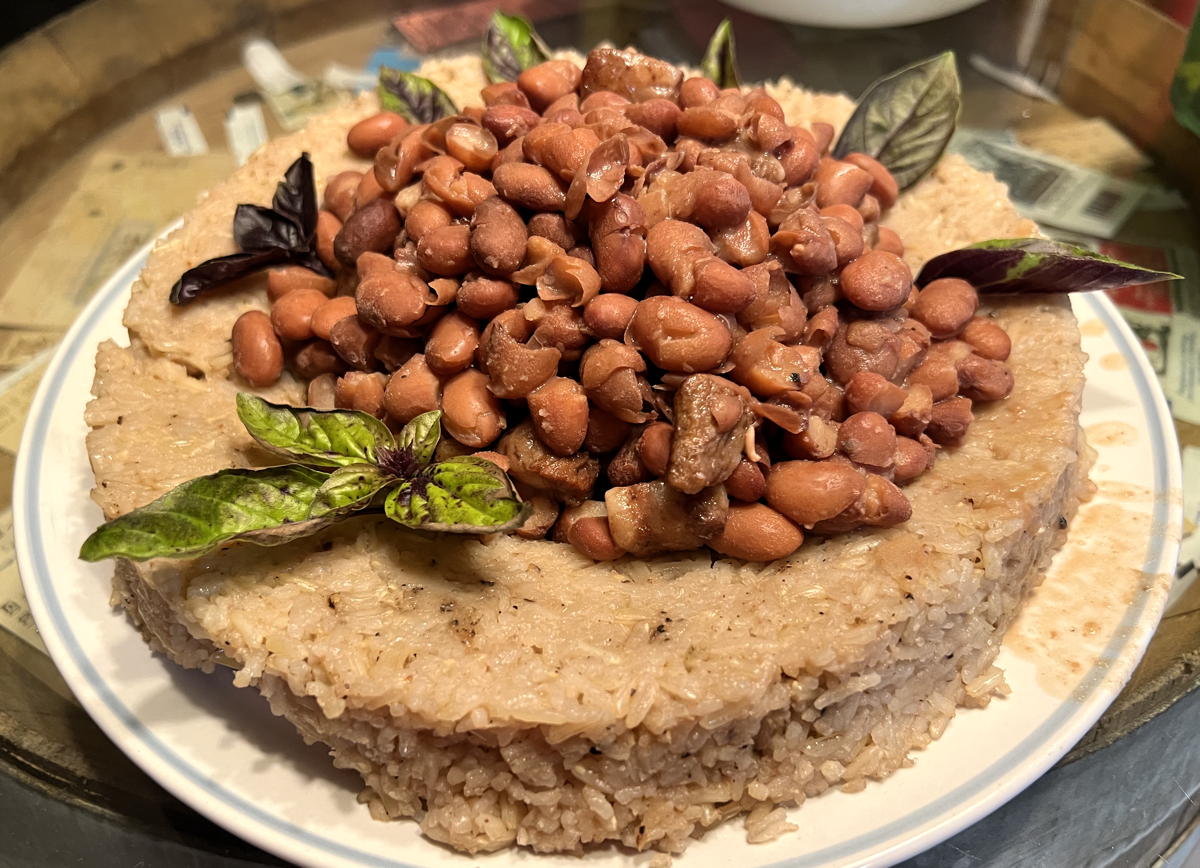
Whoever he was, the Baron’s red beans and salt pork flavored with “herbs” and served with rice is a very early example of one of my favorite comfort foods. It’s basically a gussied up beans and rice.
Podrilla à la Creole
Servings: 4
Preparation Time: 2 hours
Marie Kimball
Thomas Jefferson’s Cook Book (Internet Archive)
Ingredients
- Beans
- 2 cups red beans
- water
- ¼ lb salt pork
- salt and pepper
- a bunch of herbs
- Rice
- 1 cup rice
- 2 tbsp butter
- salt
- pepper
- water
Steps
- Beans
- Soak beans overnight in lots of water.
- Drain and cover with fresh water.
- Add pork, salt and pepper to taste, and herbs.
- Bring to a boil and simmer gently until tender.
- Drain and remove herbs.
- Rice
- Boil rice in salted water until light and tender.
- Add butter, and salt and pepper to taste.
- Press into a ring mould
- Bake at 350° for ten minutes.
- Turn rice out and fill with beans,
I used basil for the unspecified “bunch of herbs” only because that’s what I happened to have on hand from the garden. Using whatever herbs are on hand makes for a very seasonal dish. But what makes this beans and rice different from the modern example is how deliberately elegant it is. The beans and the rice aren’t mixed together. The rice is baked in a ring mold, and then filled with the cooked beans.
Which is in fact a marvelous way of presenting beans and rice! I used it for our game night Christmas dinner, and had very little leftover for my own use.
Because of the attribution problem, none of these recipes are in my Sestercentennial Cookery. But they’re still a great option as we celebrate the semiquincentennial of the very document that Thomas Jefferson wrote.
Buon appetito!
In response to A Bicentennial Meal for the Sestercentennial: Four community cookbooks celebrating the bicentennial. As we approach our sestercentennial in 2026, what makes a meal from 1976?
The name of Jefferson’s party was the Democrat-Republicans. It later split into the Democrats and Whigs of pre-Civil War politics, while the Federalist party mentioned here collapsed and faded from the American political scene.
↑
Benjamin Franklin
- Benjamin Franklin to Deborah Franklin, 21 December 1768: Benjamin Franklin at National Archives
- “I have now before me your Favours of Oct. 1. 18, 23, 30, and Nov. 5. which I shall answer in order.”
- Benjamin Franklin to Deborah Franklin, 28 January 1772: Benjamin Franklin at National Archives
- “I have written several short Letters to you lately just to let you know of my Welfare, and promising to write more fully by Capt. Falconer, which I now sit down to do, with a Number of your Favours before me.”
- Benjamin Franklin to Deborah Franklin, January 1758: Benjamin Franklin at National Archives
- “It was an unlucky Mistake, that of putting your Letter under Cover to Mr. Colden, as it occasion’d a Week’s Delay in your receiving it.”
books
- French American Cooking: Morton Gill Clark at Internet Archive
- “From New Orleans to Quebec.”
- The Martha Washington Cook Book: Marie Kimball at Internet Archive
- “Here is a fine cook book which is also rare and amusing Americana. Prepared from the original manuscript given by Frances Parke Custis to Martha Washington…”
- Review: The Apprentice: My Life in the Kitchen: Jerry Stratton at Jerry@Goodreads
- Jacques Pépin’s autobiography captures the joy that makes his television shows so worth watching.
- Review: Thomas Jefferson’s Cook Book: Jerry Stratton at Jerry@Goodreads
- “While the recipes lack as much historical context as I’d prefer, this is a fascinating book. Kimball’s essay’s focus on Jefferson’s status as a gourmet and a food and wine expert is an early and probably still most reliable and detailed example of the genre.”
- Thomas Jefferson’s Cook Book: Marie Kimball at Internet Archive
- This is a 2007 reprint of the 1938 edition, which doesn’t have the completely unnecessary Helen D. Bullock essay that prefaces the 1976 edition.
- Thomas Jefferson’s Feast: Frank Murphy and Richard Walz at Internet Archive (ebook)
- “Long ago, before your great-great-grandparents were born, there lived a man named Thomas Jefferson.”
recipes
- Ice Cream at Monticello: Thomas Jefferson’s Home
- Thomas Jefferson can be credited with the first known recipe for ice cream recorded by an American and likely helped to popularize it in this country.
- Jefferson’s Savoy Cakes: Patricia Bixler Reber
- “President Thomas Jefferson actually wrote this recipe… Although the Library of Congress site gives no date, it may have been written while he lived in Paris from 1784-1789.”
- Monticello Recipe Sources at Monticello: Thomas Jefferson’s Home
- “A list of all known manuscript sources for recipes associated with Thomas Jefferson and his enslaved chefs at Monticello and in DC and New York City.”
- Padgett Sunday Supper Club Sestercentennial Cookery
- The Sestercentennial Cookery is a celebration of American home cooking for the 250th anniversary of America’s Declaration of Independence.
- Thomas Jefferson, no date, Biscuit de Savoy Recipe: Thomas Jefferson at Library of Congress
- Scanned image of Biscuit de Savoy in Thomas Jefferson’s handwriting.
Thomas Jefferson
- Hore Browse Trist at Monticello: Thomas Jefferson’s Home
- “Hore Browse Trist (1802–1856) was the second son of Hore Browse Trist and the grandson of Elizabeth House Trist.”
- Meriwether Lewis Randolph at Monticello: Thomas Jefferson’s Home
- “Meriwether Lewis Randolph was the tenth child of Martha Jefferson Randolph and Thomas Mann Randolph and was named for the explorer Meriwether Lewis.”
- No Common Spirits: Jefferson and Adams survive
- Adams and Jefferson both dying on the Jubilee was hailed as “a most singular coincidence… A more signal and impressive combination of circumstances is not to be found… Nothing so sublime could have been conceived by human thought… Who does not envy such a death after such a life?”
- A Taste of History: The Monticello Wine Experiment
- “Thomas Jefferson’s passion for politics is well-known. But his passion for wine helped create the wine industry in America.” (Season 9, Episode 8)
- Thomas Jefferson: A Man of the Pasta: Neely Tucker at Library of Congress
- “Thomas Jefferson, future president, designed a macaroni-making machine, one of his many inventions drawn and described in his papers at the Library of Congress.”
- Thomas Jefferson: Founding Foodie: Kristin Hinman at HistoryNet
- “The new French stove is installed. The dumbwaiters are operational. house-made cider, beer and French wine fill the cellar at Monticello in anticipation of Thomas Jefferson’s homecoming.”
More America’s Sestercentennial
- Food for the Great Anniversary Festival (AccordingToHoyt.com)
- I have a post on According to Hoyt that combines and condenses all of my Sestercentennial Meals posts. Please read!
- Irish mashed potato pie for Π Day and Saint Patrick’s Day
- In this sestercentennial year, here’s a great triple-celebration pie. It’s from about 1876 and it can fill in for both Pi Day and St. Patrick’s Day!
- Padgett Sunday Supper Club Sestercentennial Cookery
- The Sestercentennial Cookery is a celebration of American home cooking for the 250th anniversary of America’s Declaration of Independence.
- The World Turned Upside Down
- The legend of the surrender of Lord Cornwallis to Washington at Yorktown says that the band played “The World Turned Upside Down”. It probably didn’t. But we’re going to print the legend anyway.
- A Vicennial Meal for the Sestercentennial
- In 1776 we were too busy to write commemorative cookbooks. But in 1796 “Amelia Simmons, American Orphan” published the first known American cookbook. It’s a celebration of American foods, American values, and American economies.
- Two more pages with the topic America’s Sestercentennial, and other related pages
More eighteenth century
- The World Turned Upside Down
- The legend of the surrender of Lord Cornwallis to Washington at Yorktown says that the band played “The World Turned Upside Down”. It probably didn’t. But we’re going to print the legend anyway.
- A Vicennial Meal for the Sestercentennial
- In 1776 we were too busy to write commemorative cookbooks. But in 1796 “Amelia Simmons, American Orphan” published the first known American cookbook. It’s a celebration of American foods, American values, and American economies.
More nineteenth century
- Kothmann Homesite and Cemetery
- “Pay homage to the plucky emigrant from Hanover who had, indeed, planted his roots deep in Texas soil—the land of his choice.”
- Historical Markers of Texas State Highway 29
- Between U.S. 183 and Interstate 10 on Texas State Highway 29 and U.S. Route 377 there are five historical markers. There are also wonderful kolaches and some decent antiquing.
- Irish mashed potato pie for Π Day and Saint Patrick’s Day
- In this sestercentennial year, here’s a great triple-celebration pie. It’s from about 1876 and it can fill in for both Pi Day and St. Patrick’s Day!
- Mrs. Winslow’s Domestic Receipt Book for 1876
- If this is what people were eating in 1876, they were eating very well. From coconut pie to molasses gingerbread to tomato jam, these are great recipes—albeit requiring some serious interpretation.
- A Centennial Meal for the Sestercentennial
- How did Americans in 1876 celebrate the centennial culinarily? Some of their recipes are surprisingly modern, and some are unique flavors worthy of resurrecting.
More A Sestercentennial Year
- The Rifleman at Bennington to the British Granadiers
- The British Grenadiers provides an interesting period melody for The Rifleman’s Song at Bennington; also, the original 1837 Rifleman’s Song lyrics from The New-York Mirror.
- News on the Deaths of Adams and Jefferson
- “Such men need no trophies; they ask no splendid mausoleum. We are their Monument: their mausoleum is their Country.” John Adams and Thomas Jefferson’s death on the same day, 50 years to the day from the first July 4, was an inspiration to a young nation.
- No Common Spirits: Jefferson and Adams survive
- Adams and Jefferson both dying on the Jubilee was hailed as “a most singular coincidence… A more signal and impressive combination of circumstances is not to be found… Nothing so sublime could have been conceived by human thought… Who does not envy such a death after such a life?”
- Flowers o’er the Tory grave: Disney’s Francis Marion
- Walt Disney’s The Swamp Fox was an influential take on Francis Marion’s life—very possibly an influence on Mel Gibson’s The Patriot, too.
- Mock the Wind and Sing of Marion’s Men
- “In Lexington, the center of revolt against the King…” One of the most modern figures of the American Revolution was a slaveholder and Indian fighter with a superhero name.
- Seven more pages with the topic A Sestercentennial Year, and other related pages
More Thomas Jefferson
- News on the Deaths of Adams and Jefferson
- “Such men need no trophies; they ask no splendid mausoleum. We are their Monument: their mausoleum is their Country.” John Adams and Thomas Jefferson’s death on the same day, 50 years to the day from the first July 4, was an inspiration to a young nation.
- No Common Spirits: Jefferson and Adams survive
- Adams and Jefferson both dying on the Jubilee was hailed as “a most singular coincidence… A more signal and impressive combination of circumstances is not to be found… Nothing so sublime could have been conceived by human thought… Who does not envy such a death after such a life?”
- Sources from the American Jubilee
- On July 4, 1826, as the country celebrated the 50th anniversary of the Declaration of Independence, John Adams and Thomas Jefferson died, sparking a long period of essays, orations, and exclamations about that “singular coincidence”.
- First, CNN came for InfoWars
- “When the speech condemns a free press, you are hearing the words of a tyrant.”
- Let our dissensions be buried in their graves
- From the Pittsfield Sun of Pittsfield, Massachusetts, August 31, 1826, a eulogy to Adams and Jefferson by judge of the New York Supreme Court William Alexander Duer (1780-1858), delivered on July 31 and reprinted from the Albany Argus of August 15.
- Four more pages with the topic Thomas Jefferson, and other related pages