


No Common Spirits: Jefferson and Adams survive
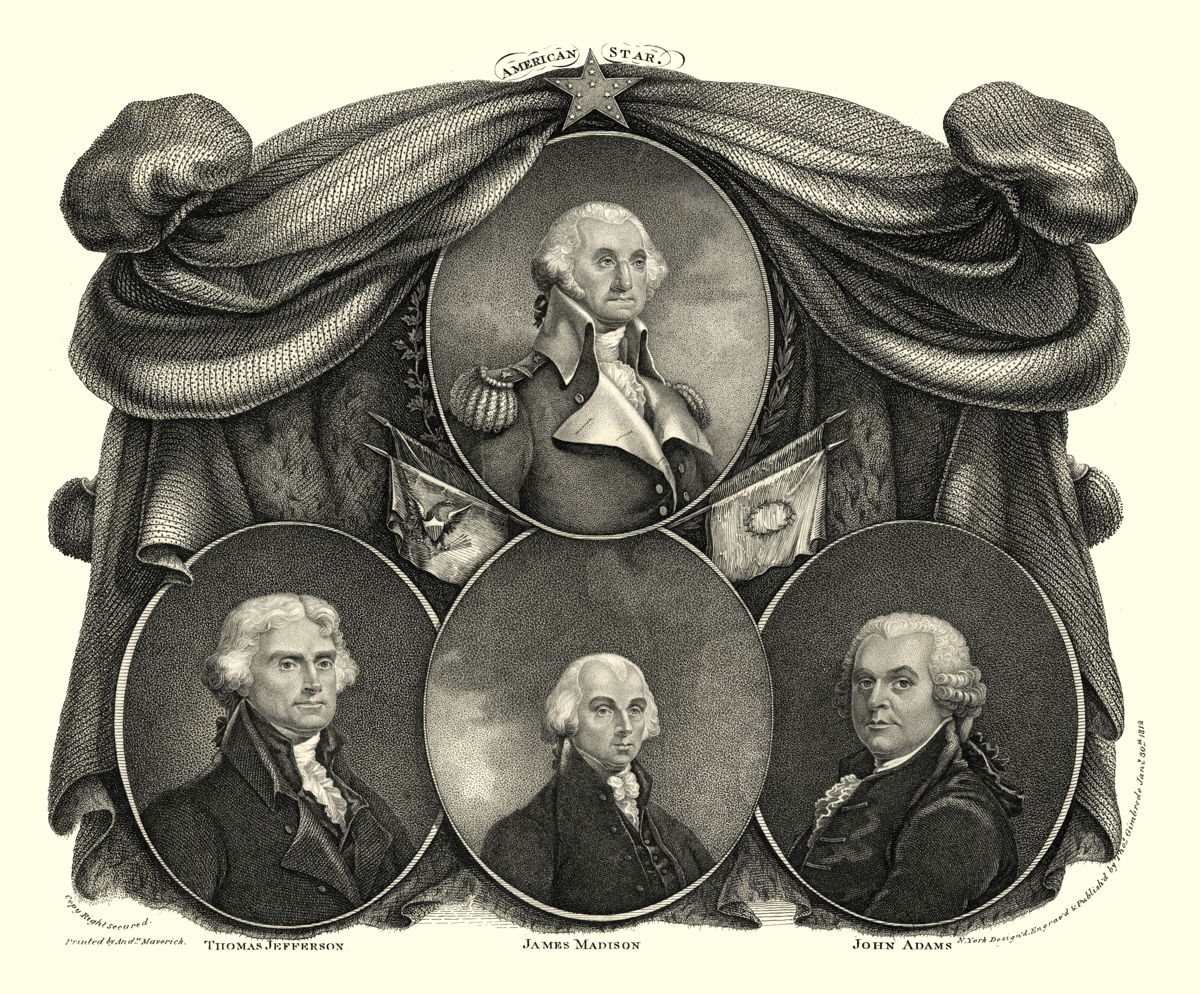
The first four presidents. Two of them died on the Jubilee of the Declaration of Independence, July 4, 1826.
On July 4 we celebrate the Semiquincentennial anniversary of the Declaration of our Independence from Great Britain. Two hundred and fifty years have passed since the Declaration was adopted. John Adams predicted it would be celebrated with wild abandon… if it proved successful.
The 4th of July, 1776, will be a memorable epoch in the history of America. I am apt to believe it will be celebrated by succeeding generations, as the GREAT ANNIVERSARY FESTIVAL! It ought to be commemorated as the day of deliverance, by solemn acts of devotion to the Almighty God. It ought to be solemnized with pomp, shows, games, sports, guns, bells, bonfires and illuminations—from one end of the continent to the other, from this time forever!1
Exactly two hundred years ago, fifty years after the Declaration, another momentous event rocked the country. Thomas Jefferson died in the afternoon, and John Adams in the evening. On the fiftieth anniversary, the Jubilee, of the document they had created, both died within hours of each other.
There were probably more orations after Independence Day than on the day itself, due to that amazing coincidence. As the news spread throughout our then-small country there were eulogies, commemorations, and the beginnings of legends. There were enough joint eulogies that at least one publisher announced a book collecting them. I collected two of them in A Sestercentennial Cookery: Edward Everett’s eulogy of August 1, 1826, and the semi-anonymous “Lady of Richmond’s” July 14 Lines on the Deaths of Thomas Jefferson and John Adams.
The coincidence of their deaths was widely perceived as a form of divine influence. During the lead-up to the 50th anniversary of the Declaration there remained three signatories alive: John Adams (Massachusetts), Charles Carroll (Maryland), and Thomas Jefferson (Virginia). They were in high demand as speakers, of course, but age and health prevented at least Adams and Jefferson from attending them.
Famously, their letters declining an invitation to Washington, DC, have been preserved. They were widely reprinted during the July 4 celebration that year and even more as the news of their deaths spread throughout the country. Here is how the letters appeared in the July 6, 1826, Alexandria Gazette:
| John Adams | Thomas Jefferson | Charles Carrol |
|---|---|---|
| Quincy, June 22d, 1826 Sir: Col. House, of the U. States army, now stationed at Fort Independence, in my neighborhood, has favored me with a call, and communicated your very polite letter, desiring him to offer me an escort to Washington, in order to celebrate with you the approaching fiftieth anniversary of our national independence. I feel very grateful for this mark of distinguished and respectful attention on the part of the citizens of the city of Washington, which the present state of my health forbids me to indulge the hope of participating, only with my best wishes for the increasing prosperity of your city, and the constant health of its inhabitants. I am, sir, with much respect, your friend and humble servant, J. Adams | Monticello, June 24, 1826 Respected Sir: The kind invitation I received from you on the part of the citizens of the city of Washington, to be present with them at their celebration of the fiftieth anniversary of American Independence, as one of the surviving signers of an instrument pregnant with our own, and the fate of the world, is most flattering to myself, and heightened by the honorable accompaniment proposed for the comfort of such a journey. It adds sensibly to the sufferings of sickness, to be deprived by it of a personal participation in the rejoicings of that day, but acquiesence is a duty, under circumstances not placed among those we are permitted to control. I should, indeed, with peculiar delight, have met and exchanged there, congratulations personally, with the small band, the remnant of that host of worthies, who joined with us, on that day, in the bold and doubtful election we were to make for our country, between submission and the sword; and to have enjoyed with them the consolatory fact that our fellow-citizens, after half a century of experience and prosperity, continue to approve the choice we made. May it be to the world, what I believe it will be, (to some parts sooner, to others later, but finally to all,) the signal of arousing men to burst the chains under which monkish ignorance and superstition had persuaded them to bind themselves, and to assume the blessings and security of self-government. The form which we have substituted restores the free right to the unbounded exercise of reason, and freedom of opinion. All eyes are opened, or opening, to the rights of man. The general spread of the lights of science has already laid open to every view the palpable truth that the mass of mankind has not been born with saddles on their backs, nor a favored few booted and spurred, ready to ride them legitimately, by the grace of God. These are grounds of hope for others—for ourselves, let the annual return of this day forever refresh our recollections of these rights, and an undiminished devotion to them. I will ask permission here to express the pleasure with which I should have met my ancient neighbors of the city of Washington and its vicinities, with whom I passed so many years of a pleasing social intercourse; an intercourse which so much relieved the anxieties of the public cares, and left impressions so deeply engraved in my affections, as never to be forgotten. With my regret that ill health forbids me the gratification of an acceptance, be pleased to receive for yourself, and those for whom you write, the assurance of my highest respect and friendly attachments. Thomas Jefferson | Doughoragen Manor, June 17th, 1826. Sir: I was this day favored with your letter of the 14th inst. I am much obliged to the Committee for their invitation to attend on the fourth of next month the celebration of the 50th Anniversary of American Independence in the Metropolis of the United States. Having received a similar invitation from the city of New-York, and having declined it, I cannot with propriety attend the celebration at Washington. Accept, sir, my thanks for the sentiments you have expressed towards me in your letter. I remain, with great respect, sir, your most humble servant. Ch. Carroll, of Carrollton. |
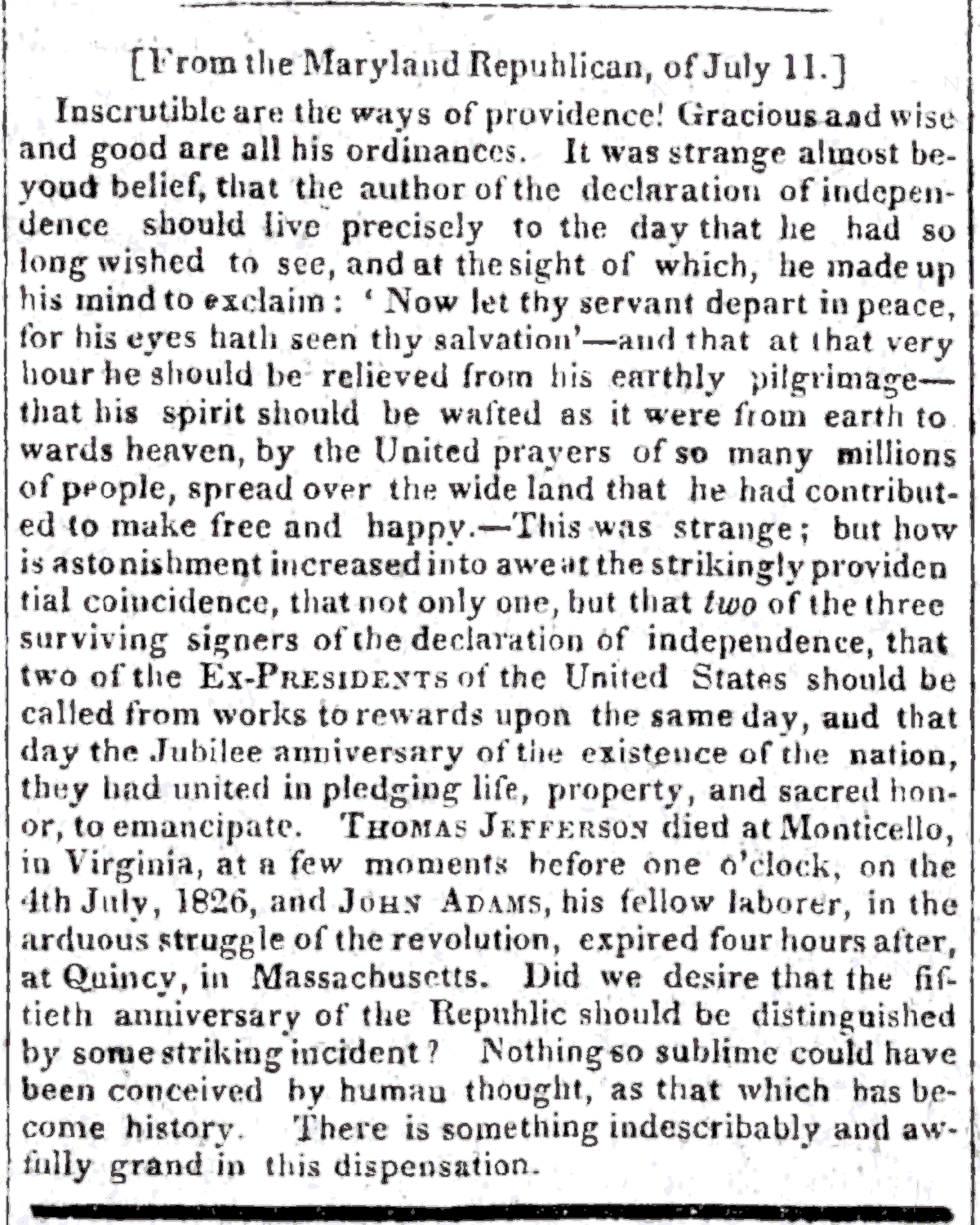
“Inscrutable are the ways of providence!… something indescribably and awfully grand in this dispensation.”
Letters declining the invitation were also reprinted from James Madison and James Monroe, two founders who were not signatories to the Declaration. A couple of things stand out from these letters. The most obvious is that, as ever throughout his life, Jefferson was a writer and took the letter as an opportunity to write. His letter is more than double the size of the other two combined.2
Second, I’m pretty certain he was invoking Shakespeare’s Henry V when he wrote “the small band, the remnant of that host of worthies, who joined with us, on that day, in the bold and doubtful election we were to make for our country,”
Third, Jefferson deliberately took the 50th anniversary of the Declaration to remind his fellow Americans that “the mass of mankind has not been born with saddles on their backs, nor a favored few booted and spurred, ready to ride them legitimately”. Abraham Lincoln was clearly paraphrasing Jefferson when he wrote that:
They are the arguments that kings have made for enslaving the people in all ages of the world. You will find that all the arguments in favor of kingcraft were of this class; they always bestrode the necks of the people—not that they wanted to do it, but because the people were better off for being ridden. — Abraham Lincoln (The Life and Writings of Abraham Lincoln)
Looked at on maps today, the America of 1826 looks small. But it still took time for the news to spread, and different papers received the news of each death at different times. There were attempts to invoke coincidence even before learning that two signatories had died that day. The Richmond, Virginia Constitutional Whig reported Thomas Jefferson’s death on Friday morning, July 7:
Mr. Jefferson expired on the Fourth of July, the day, and it is believed the very hour, on which fifty years before, the Declaration of Independence appeared to an admiring World! In this most singular coincidence, the finger of Providence is plainly visible! It hallows the Declaration of Independence as the Word of God, and is the bow in the Heavens, that promises its principles shall be eternal, and their dissemination universal over the Earth!
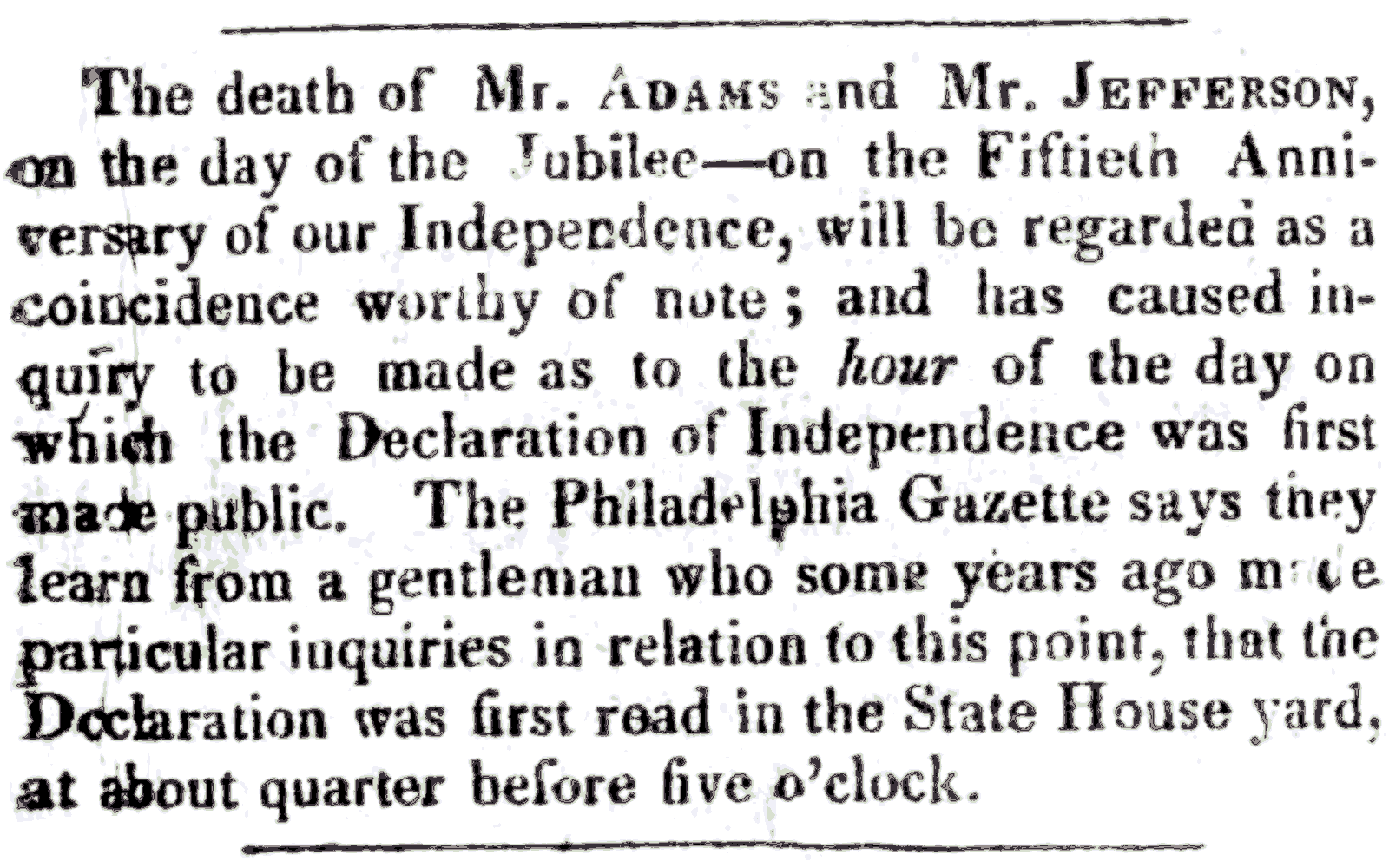
“Some guy who made inquiries to someone else who heard the Declaration read at the 31 Flavors last night. I guess it’s pretty serious.”
Other letters in that newspaper noted that “The Declaration Of Independence was reading in Charlottesville at the minute of his dissolution, and no doubt at many other places.” Multiple letters noted that “He died at 10 minutes before 1 o’clock; this day and hour too, on which the Declaration of Independence was read.”
We don’t actually know what time of day the Declaration was adopted on July 4, 1776. Various sources give anything from daylight hours, to late morning, to the afternoon. It’s certainly possible that it was adopted, then, at 12:50 pm. However, it’s interesting that the letters do not corroborate the editorial’s assertion that Jefferson died “the very hour, on which fifty years before, the Declaration of Independence appeared to an admiring World!” One could be interpreted that way, but one explicitly reads, and the others are more easily interpreted as merely saying, that he died when the Declaration was being read that very moment in nearby Charlottesville.
In any case, the time of day was soon to be relegated to secondary import… once it was discovered that two signatories had died, at different times. The July 10 Daily National Journal, of Washington, DC, noted:
It seems to have been written, in the decrees of Providence, that the Fiftieth Anniversary of our National Freedom should be distinguished by extraordinary events, which will make it for ever conspicuous among the celebrated festivals of time. Scarcely had we determined on the funeral honors to be paid to Thomas Jefferson, when the news has reached us of the decease of his co-patriot and co-laborer in the cause of freedom, John Adams… Two of those sages who signed the Declaration have thus consummated their mortal destiny, at the moment when the glorious issue of their labours was announced, for the fiftieth time, by the acclamations of grateful millions.
The Journal quoted “the Commercial Advertiser of Saturday” that:
Towards noon he [Adams] became ill, grew gradually worse, and at 6 o’clock “fell asleep.”
The Journal reprinted a bit from the New-York American that referenced Adams’s famous prediction of fireworks as a July 4 celebration:
On the 4th of July, 1826, after the revolution of fifty years, and amidst the “bells, bonfires, and illuminations” which he had predicted would mark, in all time to come, the anniversary of that day, this patriot statesman breathed his last. Who does not envy such a death after such a life?
The Journal also quoted another invocation of “the Being to whom he owed his existence”, from the New-York Statesman and its response to John Adams’s death:
His death, on the jubilee anniversary of that Independence, which, fifty years before, nearly at the same moment of time that this spirit left its earthly tenement, he pledged his fortune, honor, and life, to support, is one of the most remarkable coincidences in the history of man. Had he been permitted by the Being to whom he owed his existence, who endowed him with great talents, and kept him in that course of irreproachable virtue and honor which has rendered his memory immortal, to select the time when his disembodied spirit should take its flight, he would probably have chosen the very moment when a whole nation were employed in celebrating the glorious result of patriotism, when his name, and those of his compatriots, was upon the lips of ten millions of people, and the voice of gratitude and joy was resounding throughout the whole of the American Republic.
It wasn’t until the next day, July 11, that I started seeing editorialists put the two deaths together. From the July 11 Daily National Journal:
To them Heaven has extended this choicest boon, to close their lives with a lustre equal to that which has, at any period, distinguished their career of active usefulness… Surpassing the fictions of poetry, this extraordinary coincidence of events must be handed down by the historian accompanied by the strongest evidence, to rescue it from the skepticism of distant ages, and give to it the indisputable character of truth.
Because the two events were beginning to be connected, it became more important to know with certainty the hour of the adoption. The July 11 Daily National Journal included a sadly unattributed second-hand note from the Philadelphia Gazette that the Declaration was “first read in the State House yard, at about quarter before five o’clock.” That edition also included an oddly-worded invocation of “Divine Providence”, quoted from “the National Gazette”:
The dissolution of two of the three survivors of the magnanimous men who raised the perpetual standard of American sovereignty, within the same day, being that which closed the fiftieth year since their glorious deed, makes a coincidence so striking that it has immediately affected every person, and in a former age would have been deemed ominous, or at least a special dispensation of Divine Providence.
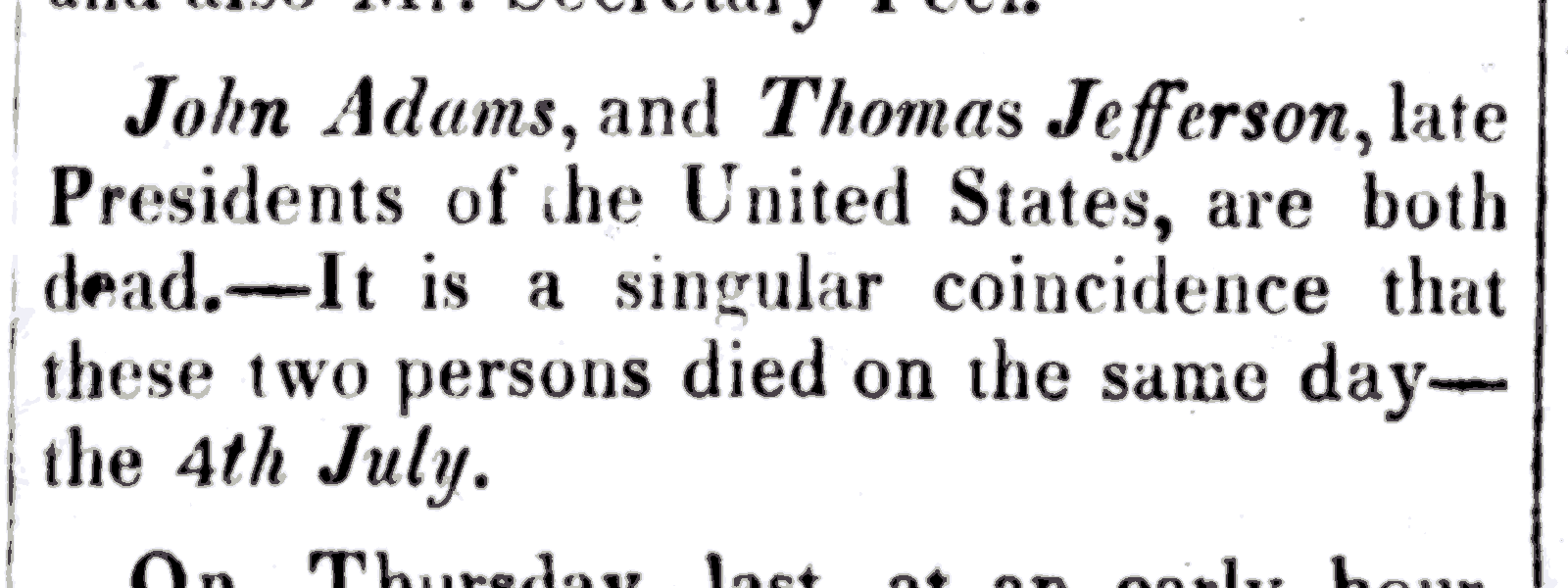
“A singular coincidence.”
“A special dispensation” was echoed in the July 13 Delaware Advertiser:
A more signal and impressive combination of circumstances is not to be found in the annals of any nation, than this; and it requires no stretch of credulity to regard it as a special dispensation of Providence, testifying his approbation of the labors of the deceased, and of the course they had espoused, by the privilege granted to them of terminating their meritorious career on that day, which of all others, would bring with it, to them, the noblest and happiest recollections.
Further north, the Rutland Weekly Herald still hadn’t heard the news of Jefferson’s death in their July 11 paper. In their obituary for John Adams, they added:
Truly it may be said, “A great man hath fallen in Israel.” There now remains only two of the signers of the Declaration of our Independence—Thomas Jefferson, and Charles Carroll.
The phrase “Another great man hath fallen in Israel” must have been a common allusion of the time. It was also used to refer to Jefferson’s death by the Philadelphia Aurora, as quoted in the July 11 United States Telegraph.
“Another great man hath fallen in Israel.” Great! if human greatness consist in conferring imperishable benefits upon mankind… perhaps at the same hour in which the instrument declaring us free was promulgated fifty years ago in the Hall of Congress, he cast off the bondage of his earthly state to join the jubilee… at an hour a grateful nation’s heart was overflowing with rejoicing, and while a thousand tongues pronounced the palladium of our rights, the work of his mighty mind. Whose death was ever graced by such a funeral oration, thus delivered!
The adulation only continued to rise as the full weight of coincidence fell on the country’s writers. The first full essay that I could find appeared in the July 12, 1826, Alexandria Gazette, reprinted from “the Phenix Gazette” and attributed to “Fenelon”.
Laden with honors and the love and admiration of mankind, their pure spirits quitted their earthly tenements on the birth day of our liberty, which they had created and consecrated. The interval of their departure was short. Those illustrious men winged their flight to brighter skies within a few hours of each other. What a singular coincidence! What an astonishing concurrence of events!
“What a singular coincidence!” The concept had already begun forming, but it was now in full flower with Fenelon’s ode.
One legend of the day hadn’t yet spread. Fenelon ended his description of the angel of death coming to Adams:
The angel also informed him, that his Great Co-patriot was now on his journey to the mansions of everlasting tranquility; that he had bid a final adieu to this world of tribulation, and that they would be soon re-united by a bond of unspeakable friendship in the company of Washington, Franklin, Hancock, and the rest of that glorious band of divine souls. The Patriarch received the news of the death of his copatriot with profound grief.
That Adams thought Jefferson still lived hadn’t yet spread, but I’ll get to that later, because that’s not always how Adams’s legendary dying words were reported or interpreted.
The transition from strange coincidence—one such Founder dying on the Jubilee of the Declaration—to Providential concurrence was explicit in a piece from the July 11 Maryland Republican, as reprinted in the Daily National Journal on July 13:
It was strange almost beyond belief, that the author of the declaration of independence should live precisely to the day that he had so long wished to see… but how is astonishment increased into awe at the strikingly providential coincidence, that not only one, but that two of the three surviving signers of the declaration of independence, that two of the Ex-Presidents of the United States should be called from works to rewards upon the same day, and that day the Jubilee anniversary of the existence of the nation…
Did we desire that the fiftieth anniversary of the Republic should be distinguished by some striking incident? Nothing so sublime could have been conceived by human thought, as that which has become history. There is something indescribably and awfully grand in this dispensation.
The recipients of that dispensation weren’t yet decided on. It could just as easily be applied to the two Founders as to the nation they founded. From either the New York Morning Chronicle or the New York Gazette, and as reprinted in the Hagerstown, Maryland, Torch Light and Public Advertiser of July 13:
It will be recollected, that Mr. Adams was one of the Committee appointed with Mr. Jefferson, to draft the Declaration of Independence… the two individuals to whose patriotism and talents, America is indebted for the present form of that brilliant manifesto of human rights… should then, full of years and full of honors depart as it were together; as if it was the will of HIM who worketh all things for our good, that as their deeds in the establishment of our liberty were equally glorious, they should not be separated in death.
The Daily National Journal of July 15 made the same connection:
I fear I detect a bit of exasperation here. Yet another coincidence…
In noticing the extraordinary coincidence in the deaths of Thomas Jefferson and John Adams, on the day of our Jubilee, there appears to us to have been scarcely stress enough laid on the fact, that these two patriarchs were more especially identified with the Declaration of Independence, than all the rest of its signers and advocates; because they constituted, entirely and exclusively, the subcommittee to whom the composition of that most important of all state papers, since the creation of man, was assigned… it certainly renders the extraordinary character of the sublime departure of both, on that memorable day, still more conspicuous… that these co-fathers of our great national charter… should have been permitted to expire almost at the same moment, while the act which proceeded from them, and which has clothed them with the immortality of a glorious fame, was still vibrating in our ears from a thousand different readers.
The coincidence was noted at least as far as Toronto, though of course with far less verbiage. The U.E. Loyalist (Toronto, Ontario, Canada) of July 15 merely noted:
John Adams, and Thomas Jefferson, late Presidents of the United States, are both dead.—It is a singular coincidence that these two persons died on the same day—the 4th July.
I’ve had to cut down many of the quotes in this post, but not that one. It is the entire notice in the Loyalist. That such a terse notice should mention the coincidence is a strong indication of how powerful it was.
“We cannot find language adequate to express our feelings” is how the Patriot & State Gazette put it on July 18:
It appears, as if the Almighty had, in very deed, intended to make a second REVELATION to man of his approbation of that struggle for freedom, in which these distinguished patriots and statesmen afforded such efficient aid… Their contemporaneous departure from earth to heaven, and the coincidence of that event with the nation’s birth-day, excites an inexpressible sensation, and fills the mind with solemn awe.
Divine Providence was explicitly invoked in a letter from “the citizens of Bent Creek” to the Richmond Enquirer of August 1:
We, the citizens of Bent Creek and its neighborhood, view with poignant regret, the dispensation of Divine Providence, which has numbered with the dead our beloved countryman, Thomas Jefferson, the Philanthropist, the Statesman, the Philosopher, the Writer of the Declaration of Independence, and John Adams, who with his co-worker and compatriot, Jefferson, acted in drawing and warmly supporting the Declaration Of Independence… when in obedience to the special invitation of Heaven, on the day of their country’s Jubilee; on the day when the heart of every patriot throbbed high with emotions of joy, they as it were, hand in hand, bade adieu to ten millions of their legatees, and gently glided into the mansions of rest.
There were many such preambles to resolutions of mourning and commemoration. Another particularly well-spoken one comes from the “citizens of Hampshire county”, by way of the August 8 Richmond Enquirer:
The recent removal from this world of those two distinguished fathers of our country, Thomas Jefferson and John Adams, is no common event; that they should die on the same day, and that day should be the birth day of the nation; a day which has so long been, and we hope is so long to be, celebrated for the most brilliant achievement which adorns the lives of these patriots. That it should not only be the birth day, but the jubilee of the nation’s existence, constitutes an occurrence, which, not to regard with solemn feelings and sublime emotions, would show a culpable insensibility to the indications of that overruling Providence, which has so benignantly directed us, cherished and protected us, and whose hand has been so often signally extended in our behalf. Do not these circumstances speak to us as with a voice from on high, proclaiming to us that the Almighty for some purpose calls upon us to observe them?… The Jubilee of American Independence, its Fiftieth Anniversary, completed the circle in the Heavens which formed the bright halo through which they took their flight as in a chariot of fire. Like two stars of the first magnitude, they arose above our horizon together in years that are past, and although they came upon the meridian in seeming opposition, they ascended in conjunction and united in one blaze of departing glory.
It was an inescapable confluence of coincidences, as William Alexander Duer ably noted in the August 15 Albany Argus, as reprinted in the August 31 Pittsfield Sun:
Had either of these great and venerable men been summoned to the world of spirits, on the day that both departed; or had they, on any other day, expired together; it would, in either case, have seemed sufficient to excite our wonder.—By some, it would have been hailed as an omen of good fortune; and received by others, as a demonstration of divine regard. But is there one amongst us, who, when he heard it rumored, that the two most conspicuous of the three remaining signers of the Declaration of Independence, and the last survivors of those deputed to prepare it; that Adams and Jefferson had both died on the jubilee anniversary of the day that declaration issued; Is there one, I ask, who did not distrust the rumor as too marvellous to be true? And when the report was in every minute particular confirmed, is there one here, who believed these combined occurrences to be the effect of chance… The coldest sceptic must have ceased to doubt, and the daring infidel must have begun to fear, that there is an eternal, self-existent God, who, with wisdom inscrutable, and immeasurable power, controls the fate of individuals, and overrules the destiny of nations.
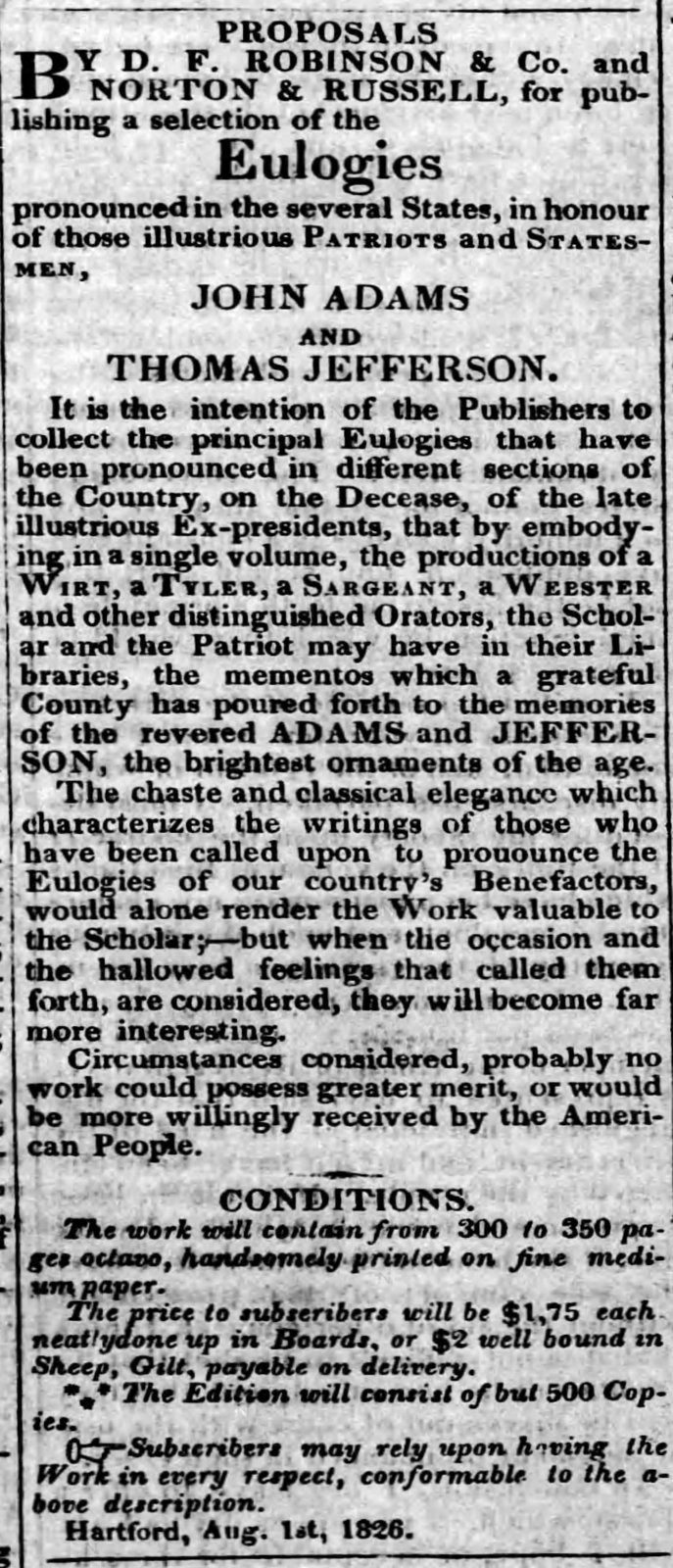
Yes, this book did get printed, and you can find it on the Internet Archive.
The speech of William T. Barry in the September 8 Kentucky Gazette continued the evolution.3 Barry not only praised Adams and Jefferson as immortals, but Jefferson’s daughter as “now the daughter of the republic, the beloved sister, of grateful, warm-hearted, & generous Americans.”
He went on to quote the English poet Richard Glover’s ode to Leonidas:
- “To live with fame
- The Gods allow to many, but to die,
- With equal lustre is a blessing heaven
- Selects from all the choicest boons of fate,
- And with a sparing hand on few bestows.
This sentiment so truely expressed in allusion to the death of the immortal band of Leonidas, has received a new and beautiful illustration in the deaths of Adams and Jefferson. It has capped the climax of their fame—Immortal destiny; had the horses and chariot of fire descended to take up these patriarchs, it might have been more wonderful but not more glorious. The cannon of twenty-four states saluted their spirits as they passed from time to eternity; and the swell of a nation’s gratitude was the last sound that broke upon their dying ears!
There are many legends of that day. The July 26 Philadelphia Inquirer is the first reference I can find to one that contradicts—perhaps—Fenelon’s vision of angels informing Adams that Jefferson “was now on his journey to the mansions of everlasting tranquility”.
In the morning, when asked if he knew “what day it was,” [Adams] answered—“yes—a good—a great day.” During the morning he was unable to speak except in tremulous and indistinct whispers, though every sentence shewed his mind to be as clear and vigilant as ever. That he was perfectly conscious of his situation, appeared from his parental benedictions and from the frequent broken accents of prayer. At some minutes after twelve o’clock, he made a great effort to utter these words—“Thomas Jefferson survives.”
Nearly this exact text was used in succeeding essays and articles about Adams and Jefferson, often as a stinger toward the end. Today—and often to those quoting this particular text—this was an example of Adams being wrong: Jefferson had already died. As the August 19 Daily National Intelligencer and Washington Express put it,
He recalls to mind the leader of the Congress of ’76, the companion of his early toils for his country, the respected and esteemed rival of his political greatness, the friend of his old age. He would, he seems to say, the words die upon his lips, “Thomas Jefferson survives.” The meridian sun of that “good, glorious day,” had shed its lustre upon the departing spirit of the sage of Monticello. Already Jefferson had gone!
And the September 20 Daily National Journal:
The thrilling word of Independence, which, fifty years before, in the ardor of his manly strength, he had sounded out to the nations, at the head of his country’s councils, was now among the last that dwelt on his quivering lips; and when, toward the hour of noon, he felt his noble heart growing cold within him, the last emotion which warmed it was, ‘that Jefferson still survives.’ But he survives not; he is gone.
Ignorance was not how everyone interpreted Adams’s statement in the weeks following the twin deaths, and the seed is in the latter quote: “toward the hour of noon”. The August 15 Lancaster Intelligencer, reprinting from an undated Albany Daily Advertiser, told the story this way:
Among the last words which John Adams pronounced, were “Thomas Jefferson survives!!” This exclamation was made a few minutes after twelve o’clock: it was made after a great effort. Whether it was dictated by any thing which passed in the course of conversation, or was the result of the train of thoughts in his own mind, is not stated. But singular to tell, about that very moment Thomas Jefferson was breathing his last. There was an astonishing concurrence in all the events of that memorable day!
That is, when Adams made this apocryphal statement, he was correct. The Republican Banner of August 26 made the point explicitly after telling essentially the same story as the Albany Daily Advertiser:
It was deemed sufficiently remarkable by our community, that he should have died on the fiftieth anniversary; but it completes the wonder to know, that his illustrious colleague bore him company to the world of spirits; and that he should have announced to his family between twelve and one o’clock, that “Thomas Jefferson survives,” as though it was the last hour when it could be said with truth… Ages shall roll away, and a coincidence like this be looked for in vain. Let us say then with emphasis, that heaven, in thus taking them above, has left its own signature on what they did below.
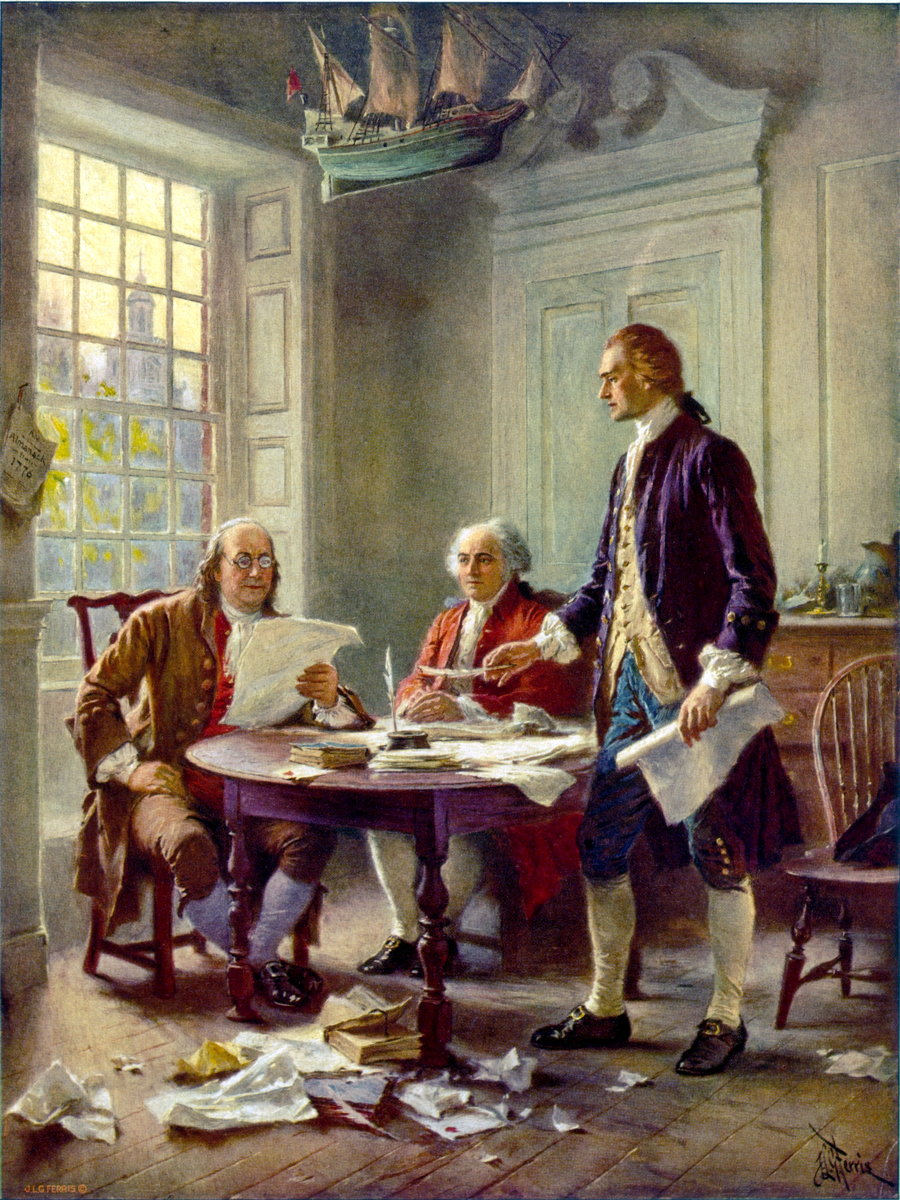
A circa 1921 interpretation of Franklin, Jefferson, and Adams drafting the Declaration.
And there was a third interpretation less of the supernatural and more of patriotic good feeling. Many of the eulogies mentioned, in passing if not directly, the years of party conflict between Jefferson and Adams. That Jefferson was in his thoughts at the end was proof that Americans can esteem each other without regard to party. The August 15 Niles Weekly Register footnoted it this way:
Though these two great men were separated by the conflicts of parties, for a few years, perhaps, no two persons ever entertained, in general, a more perfectly good opinion of one another. Mr. Jefferson always spoke of Mr. Adams as having been the chief pillar that supported the Declaration of Independence; and even at the time when the latter was president of the United States, and party feeling was at its utmost height, called him, “the Ajax Telamon of our revolution:” and one of the last expressions of Mr. Adams was, “Jefferson survives.” For about twenty years past, the communications between the patriarchs were of the most kind and affectionate character—filled with expressions of mutual esteem, and abounding with patriotic maxims and effusions—some of which will long have more than oracular force with a republican community.
To still others, it was simply another in the affirmations of the divine that day. An often reprinted letter “from a Lady in Quincy” to “a friend in Alexandria” spoke of the day as one of signs, as, here, from the July 28 Alexandria Gazette:
There had been a thunder storm; and the moment the great, the good man breathed his last, there appeared, in front of his chamber windows, an uncommonly perfect and brilliant rainbow. It seemed as if all nature gave witness that no common spirit was traveling the fields of air to its high abode. There is every thing in the life and death of this benefactor of our race, to give energy to the pen of the historian, warmth to the language of the orator, and to encourage the boldest flight of the poet. He had been sinking for weeks. In the morning he noticed the day—said it was a great and good day; and was heard to say “Jefferson survives!”
Not all of the legends printed in those months took hold. The August 23 Alexandria Gazette reported, for example:
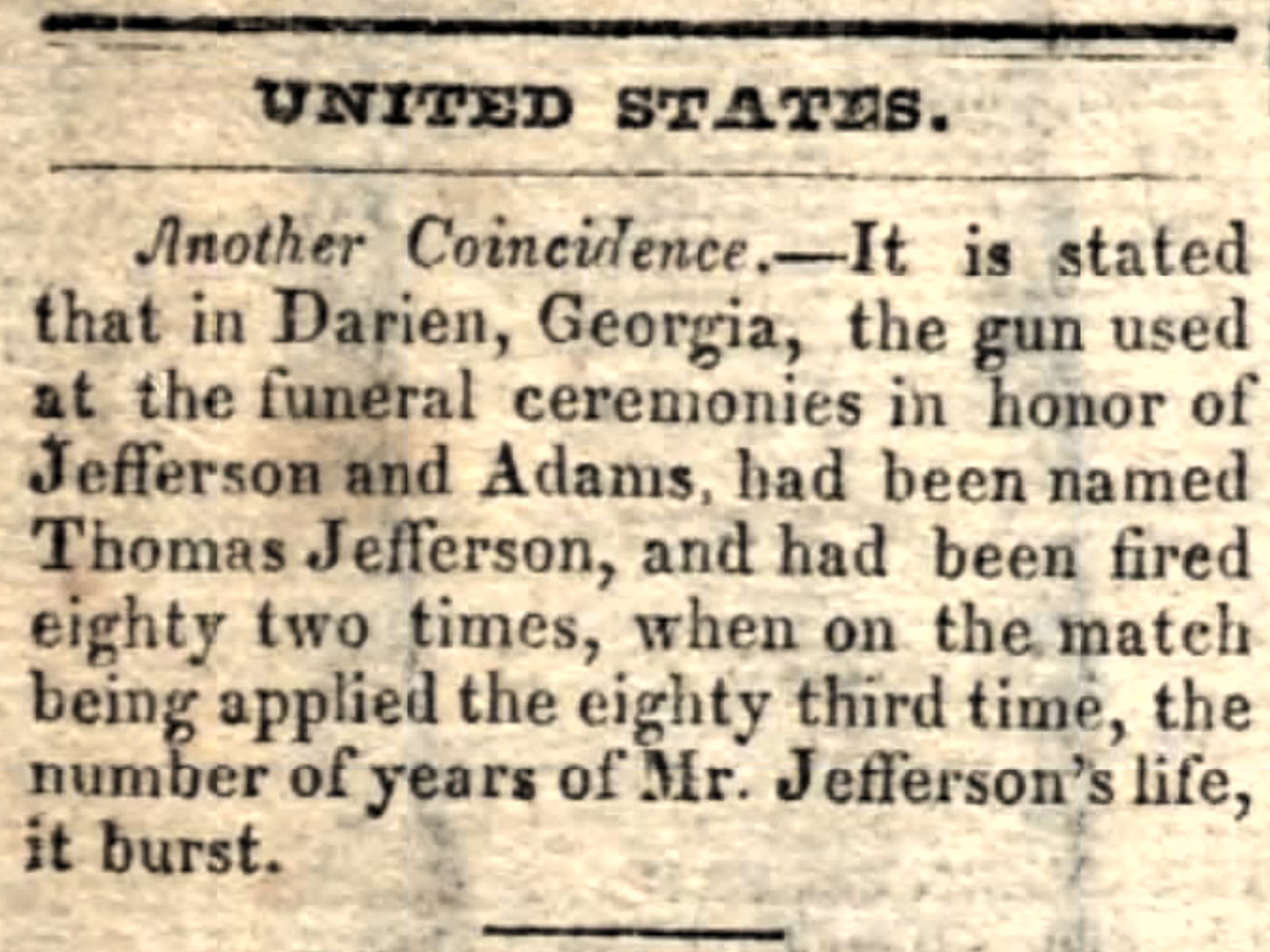
It is said that in Darien, Georgia, the gun used at the funeral ceremonies in honor of Jefferson and Adams, had been named Thomas Jefferson, and had been fired eighty-two times, when, on the match being applied the eighty-third time, the number of years of Mr. Jefferson’s life, it burst.
This story is reprinted verbatim four times in other newspapers on newspapers.com between August 31 and September 9, making it all the way up to Nova Scotia (with the further preface “Another Coincidence”, as if exasperated by their continual appearance) before disappearing.
A couple of newspapers, in their wonder at two Founders dying on the Fourth, mentioned a third Founder I was unaware of. “If the fourth of July was the birth day of our nation, it has witnessed the death of three of our nation’s glorious sons, John Adams, Thomas Jefferson and Fisher Ames…”
Ames had died on July 4, 1808, nearly two decades earlier. Only eighteen at the adoption of the Declaration, he was not part of the Convention. But he was part of the Massachusetts convention that approved the Constitution in 1788—and was responsible for crafting the freedom of religion clause in the First Amendment. He was also elected to the first Congress, beating out none other than Samuel Adams.
James Monroe, often considered the last of the Founders because of his journey from young Continental Army war hero to fifth President of the United States, also would die on July 4, five years later in 1831. Three of the first five presidents died on Independence Day.
Among the letters reprinted in the July 7 Constitutional Whig, one noted that:
During his illness he [Jefferson] constantly expressed a wish to live to see another 4th of July; and though he has been speechless ever since yesterday evening he intimated by signs great satisfaction at being permitted to do so.
Finger of Providence or not, the Founders deeply believed in the significance of the Declaration of Independence. They cherished both its creation and their part in the success of the nation it founded. People at the precipice of death will cling to life to witness the birth of a child, to achieve a significant birthday, to await the arrival of a loved one… and four of the Founders, two of them Declaration signatories, held on to reach the Declaration’s anniversary in their final days.
Such men need no trophies; they ask no splendid mausoleum. We are their Monument: their mausoleum is their Country.—Major General Jacob Jennings Brown, Commanding General of the United States Army
In response to Stories of the Revolution: Sources from well-known and lesser-known tales of the American Revolution, the Founders, and its influence on the American legend.
- July 22, 2026: News on the Deaths of Adams and Jefferson
-
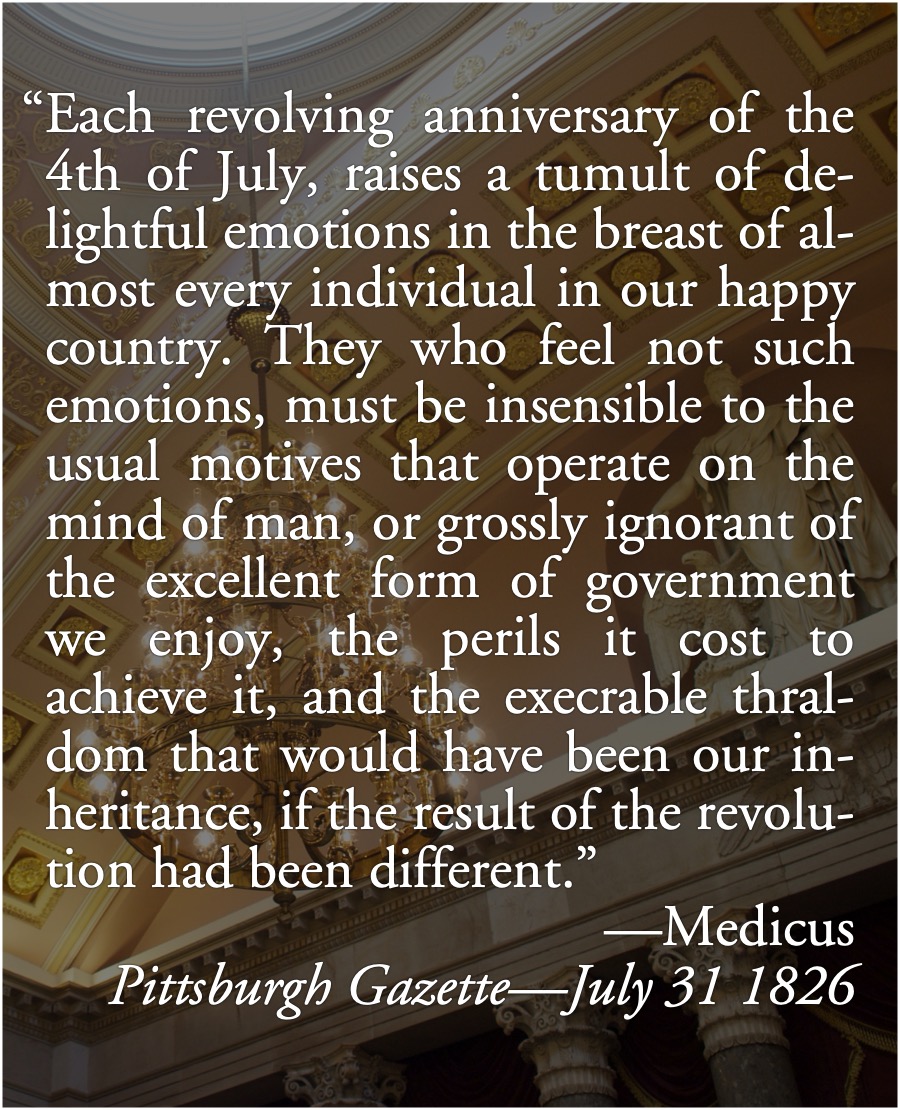
During the 2024 Presidential campaign, when President Trump survived an assassination attempt by no more than a glance at a computer screen for data, turning his head just enough to avoid a bullet to the brain, there was a lot of talk about Divine Providence. President Trump’s miraculous survival is not, however, the first time that the nation buzzed with the talk of Divine intervention in the lives of former presidents.
This quote is from the Morning Chronicle of July 13, 1826; it’s a slight misquote. Adams wrote this on July 3, and thought the day of celebration would be July 2, when the Continental Congress voted in favor of independence, rather than July 4, when it adopted the Declaration.
↑I broke Jefferson’s first paragraph into smaller paragraphs, because some browsers have trouble rendering that comparison given all of that text!
↑Barry’s speech actually began in the August 25 Gazette but that portion of the speech was entirely on the subject of former Kentucky governor Isaac Shelby, who died on July 18.
↑
Fourth of July
- Died on the 4th of July: Fisher Ames, Founding Father: Stephen B. Tippins, Jr.
- “Much can be learned from the life of Fisher Ames. He displayed more promise than perhaps any of our other great statesmen, and he personified two of conservatism’s most indelible tenets: Life is fragile, and all is vanity. But he was also quick to see how American citizens embraced their ‘liberty,’ and he did not like what he saw…”
- Padgett Sunday Supper Club Sestercentennial Cookery
- The Sestercentennial Cookery is a celebration of American home cooking for the 250th anniversary of America’s Declaration of Independence.
- Thomas Jefferson and John Adams celebrate their last Fourth of July: Christopher Flannery at The American Mind
- “The highest attainment of all future American generations would be to understand and live up to the greatness of the Revolution.”
history
- Abraham Lincoln’s conservative principles
- Reading Lincoln, it seems that both conservative thought and anti-conservative thought really hasn’t changed much in a century and a half. Though less racist for his time, he was still racist. But his adherence to conservative principles enabled him to overcome his prejudices while his contemporaries who were not conservative sank deeper into racism.
- Constitutional Whig, Richmond, July 14, 1826 at Library of Congress
- “By Pleasants & Smith, Richmond, Virginia, Friday, July 14, 1826.”
- Thomas Jefferson Selected as the Author Because Richard H. Lee Was Absent
- “The day of their death, July 4, 1826, was the fiftieth anniversary of the memorable Fourth of July. It was the most remarkable coincidence ever recorded in American history.” Text from the July 1st, 1917 New York Times.
newspapers
- Another Patriot Gone!
- From The Torch Light and Public Advertiser (Hagerstown, Maryland), Thursday, July 13, 1826, Page 2, from the Morning Chronicle of the same day.
- Beloved while living, and revered now dead
- From the Alexandria Gazette (Alexandria, Virginia), Wednesday, July 12, 1826, Page 2, and attributed to “Fenelon”.
- A day most signally marked…
- From the the August 8, 1826, Richmond Enquirer of Richmond, Virginia. “A day most signally marked… of events which will be remembered while liberty has a votary…”
- General orders of mourning
- From the Daily National Intelligencer and Washington Express (Washington, District of Columbia), Thursday, July 13, 1826, Page 3.
- Hear, O Heavens! Give Ear, O Earth!
- From the July 18, 1926, Vermont Patriot, Montpelier, Vermont, pages 2 and 3, including a wide selection of news items from other newspapers.
- In the Course of Providence
- From the Richmond Enquirer of Richmond, Virginia, August 1, 1826, page 3.
- Inscrutable are the ways of providence!
- From the Daily National Journal, Washington, District of Columbia, Thursday, July 13, page 3, and attributed to the July 11 Maryland Republican.
- Let our dissensions be buried in their graves
- From the Pittsfield Sun of Pittsfield, Massachusetts, August 31, 1826, a eulogy to Adams and Jefferson by judge of the New York Supreme Court William Alexander Duer (1780-1858), delivered on July 31 and reprinted from the Albany Argus of August 15.
- The Lights of Truth and Unerring Experience
- From the August 25 and September 8, 1826 Kentucky Gazette, a speech by William T. Barry (1784-1835), delivered on August 15 in Lexington, on the deaths of John Adams and Thomas Jefferson (July 4) and Isaac Shelby, the first (and fifth) Governor of Kentucky under the new Constitution (July 18).
- Lines on the Deaths of Thomas Jefferson and John Adams
- For the Richmond, Virginia Constitutional Whig of July 14, 1826; By A Lady of Richmond, E.L.S.
- The Venerable Carroll
- The Daily National Journal, Washington, District of Columbia, Saturday, July 15, 1826, page 3.
oratory
- Daniel Webster: Adams and Jefferson: Daniel Webster
- “Daniel Webster delivered this speech at Faneuil Hall, Boston, Massachusetts on August 2, 1826, commemorating the lives and services of John Adams and Thomas Jefferson, less than a month after both of them died on July 4, 1826, exactly fifty years after the Declaration of Independence was signed.”
- Edward Everett’s Eulogy of Thomas Jefferson and John Adams
- “The Jubilee of America is turned into mourning. Its joy is mingled with sadness; its silver trumpet breathes a mingled strain…”
- Henry V: Saint Crispin’s Day
- “Henry V (Kenneth Branagh) gives an inspirational speech to his men as they go forth into battle on St. Crispin's Day.”
- John A. Shaw’s Eulogy on John Adams and Thomas Jefferson: John A. Shaw at HathiTrust Digital Library
- Delivered August 2, 1826, by request of the Inhabitants of Bridgewater.
- Orations and Speeches: Edward Everett at Internet Archive (ebook)
- “Orations and Speeches on Various Occasions. By Edward Everett. Vol. I. 1865.”
- A selection of Eulogies in Honor of John Adams and Thomas Jefferson at Internet Archive (ebook)
-
 “A selection of eulogies, pronounced in the several states, in honor of those illustrious patriots and statesmen, John Adams and Thomas Jefferson.” 1826.
- William Alexander Duer’s An eulogy on John Adams, and Thomas Jefferson: William Alexander Duer at Library of Congress
- “An eulogy on John Adams, and Thomas Jefferson; pronounced by request of the Common council of Albany, at the public commemoration of their deaths, held in that city on Monday 31st of July, 1826.”
More American Semicentennial
- News on the Deaths of Adams and Jefferson
- “Such men need no trophies; they ask no splendid mausoleum. We are their Monument: their mausoleum is their Country.” John Adams and Thomas Jefferson’s death on the same day, 50 years to the day from the first July 4, was an inspiration to a young nation.
- Sources from the American Jubilee
- On July 4, 1826, as the country celebrated the 50th anniversary of the Declaration of Independence, John Adams and Thomas Jefferson died, sparking a long period of essays, orations, and exclamations about that “singular coincidence”.
More Fourth of July
- A Bicentennial Meal for the Sestercentennial
- Four community cookbooks celebrating the bicentennial. As we approach our sestercentennial in 2026, what makes a meal from 1976?
- Let mortal tongues awake
- Samuel Francis Smith’s America—more commonly known as “My Country, ’Tis of Thee”— is short, direct, and a wonderful hymn to God as the soul of liberty. It’s a perfect hymn for the Fourth of July. It’s also very easy to play using the piano script from 42 Astounding Scripts.
- The Star-Spangled Banner in MIDI
- What could be more appropriate for the fireworks of the Fourth of July than a song about bombs bursting in air, illuminating a great flag rippling defiantly to a hostile world?
- Commemorate Patriot Day with Betsy Ross
- The Declaration of Independence overlaid on the Betsy Ross flag.
More John Adams
- News on the Deaths of Adams and Jefferson
- “Such men need no trophies; they ask no splendid mausoleum. We are their Monument: their mausoleum is their Country.” John Adams and Thomas Jefferson’s death on the same day, 50 years to the day from the first July 4, was an inspiration to a young nation.
- Sources from the American Jubilee
- On July 4, 1826, as the country celebrated the 50th anniversary of the Declaration of Independence, John Adams and Thomas Jefferson died, sparking a long period of essays, orations, and exclamations about that “singular coincidence”.
- Let our dissensions be buried in their graves
- From the Pittsfield Sun of Pittsfield, Massachusetts, August 31, 1826, a eulogy to Adams and Jefferson by judge of the New York Supreme Court William Alexander Duer (1780-1858), delivered on July 31 and reprinted from the Albany Argus of August 15.
- Jefferson to Adams, on the death of Abigail
- From the August 30 edition of the Philadelphia Inquirer, page 2, a letter from Jefferson to Adams on the death of Adams’s wife, and used by J. E. Sprague in his “interesting Eulogy”.
- The Lights of Truth and Unerring Experience
- From the August 25 and September 8, 1826 Kentucky Gazette, a speech by William T. Barry (1784-1835), delivered on August 15 in Lexington, on the deaths of John Adams and Thomas Jefferson (July 4) and Isaac Shelby, the first (and fifth) Governor of Kentucky under the new Constitution (July 18).
- Two more pages with the topic John Adams, and other related pages
More A Sestercentennial Year
- The Rifleman at Bennington to the British Granadiers
- The British Grenadiers provides an interesting period melody for The Rifleman’s Song at Bennington; also, the original 1837 Rifleman’s Song lyrics from The New-York Mirror.
- News on the Deaths of Adams and Jefferson
- “Such men need no trophies; they ask no splendid mausoleum. We are their Monument: their mausoleum is their Country.” John Adams and Thomas Jefferson’s death on the same day, 50 years to the day from the first July 4, was an inspiration to a young nation.
- A Monticello Meal for Independence Day
- Marie Kimball’s Thomas Jefferson’s Cook Book provides several pot-luck friendly dishes for your Fourth of July celebration this Semiquincentennial.
- Flowers o’er the Tory grave: Disney’s Francis Marion
- Walt Disney’s The Swamp Fox was an influential take on Francis Marion’s life—very possibly an influence on Mel Gibson’s The Patriot, too.
- Mock the Wind and Sing of Marion’s Men
- “In Lexington, the center of revolt against the King…” One of the most modern figures of the American Revolution was a slaveholder and Indian fighter with a superhero name.
- Seven more pages with the topic A Sestercentennial Year, and other related pages
More Thomas Jefferson
- News on the Deaths of Adams and Jefferson
- “Such men need no trophies; they ask no splendid mausoleum. We are their Monument: their mausoleum is their Country.” John Adams and Thomas Jefferson’s death on the same day, 50 years to the day from the first July 4, was an inspiration to a young nation.
- Sources from the American Jubilee
- On July 4, 1826, as the country celebrated the 50th anniversary of the Declaration of Independence, John Adams and Thomas Jefferson died, sparking a long period of essays, orations, and exclamations about that “singular coincidence”.
- A Monticello Meal for Independence Day
- Marie Kimball’s Thomas Jefferson’s Cook Book provides several pot-luck friendly dishes for your Fourth of July celebration this Semiquincentennial.
- First, CNN came for InfoWars
- “When the speech condemns a free press, you are hearing the words of a tyrant.”
- Let our dissensions be buried in their graves
- From the Pittsfield Sun of Pittsfield, Massachusetts, August 31, 1826, a eulogy to Adams and Jefferson by judge of the New York Supreme Court William Alexander Duer (1780-1858), delivered on July 31 and reprinted from the Albany Argus of August 15.
- Four more pages with the topic Thomas Jefferson, and other related pages