


News on the Deaths of Adams and Jefferson
During the 2024 Presidential campaign, when President Trump survived an assassination attempt by no more than a glance at a computer screen for data, turning his head just enough to avoid a bullet to the brain, there was a lot of talk about Divine Providence. President Trump’s miraculous survival is not, however, the first time that the nation buzzed with the talk of Divine intervention in the lives of former presidents.
Along with my July 4 post about the response to Jefferson and Adams dying on the Jubilee I also published a history site with several newspaper essays, poems, and orations from the months that followed, and that I’d used for that post. In fact I found several more articles that I didn’t use for that post, and I’ve finally gotten around to typing them up, too.
My main post focused on the inescapable evidence of Divine Providence that so many writers saw in the death of both Jefferson and Adams on the Jubilee of the Declaration. But there were a lot more interesting things in the various notices, preambles, and orations that trickled in as the news spread.
And it was a slow spread. It is almost, if not completely, inconceivable to us today just how slowly news spread in 1826. The articles in response to the deaths spread out at least into September. Perhaps the most famous of the eulogies was Daniel Webster’s, delivered on August 2, almost a month after Adams and Jefferson died. The second most popular was Edward Everett’s. Everett’s was “delivered with great effect and graceful eloquence” a day before Webster’s, on August 1, in Charlestown, South Carolina.
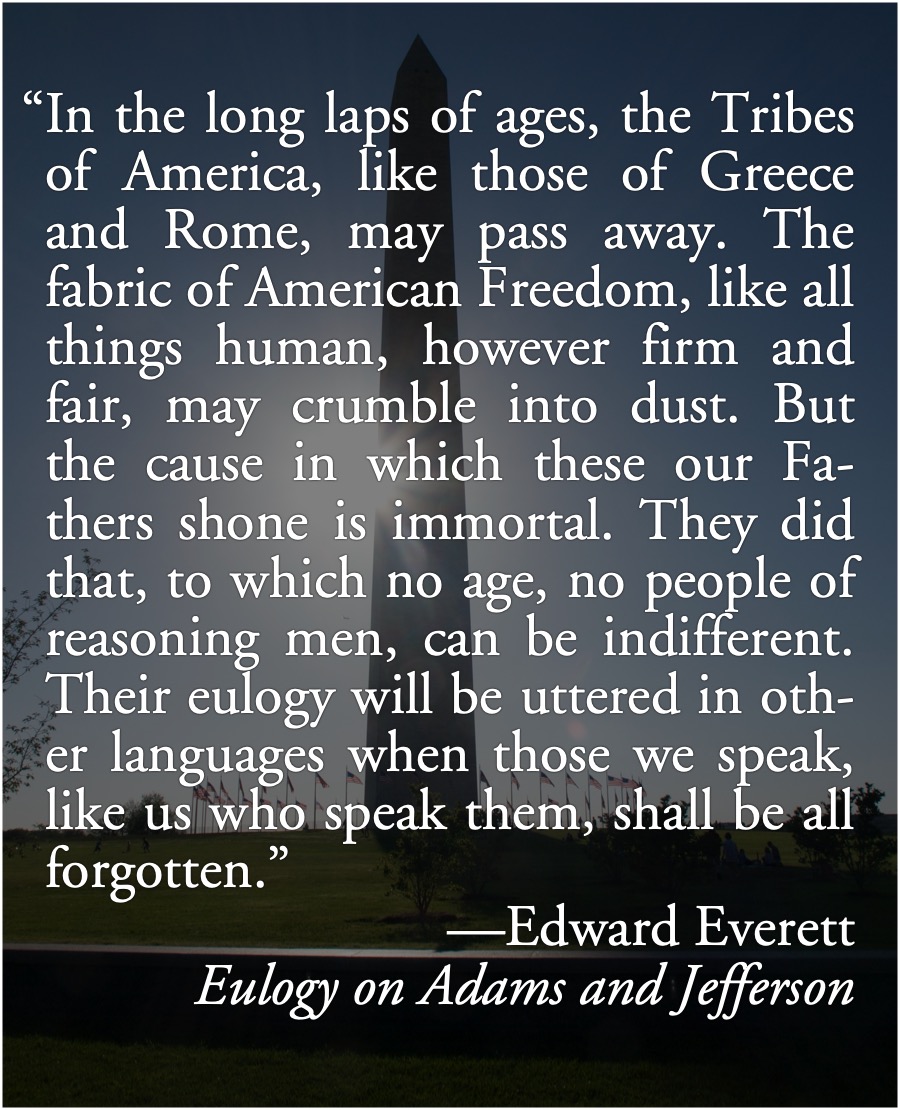
I don’t know where specifically the Edward Everett excerpt I reprinted in A Sestercentennial Cookery came from. At the time I was fairly certain it was an excerpt simply because it was so short. I found two more excerpts, one of which includes some of the same text and is almost but not quite a superset of the version I printed.
Everett made an interesting point in his eulogy:
The fourth of July was before a day of unshaded triumph, exultation, and national pride; but the angel of death has mingled in the all-glorious pageant, to teach us we are men. Had our venerated fathers left us on any other day, the day of the united departure of two such men would henceforward have been remembered but as a day of mourning.
This is a good point. Had their simultaneous deaths not happened on the Fourth of July we would very likely have a Founders Day on whatever day they did die, or have had a Presidents Day well before we combined Washington’s and Lincoln’s birthdays (February 22 and February 12, respectively) into one holiday.
Everett also made a point about the fate of political leaders in our new system. In 1826 it was still a novelty that our leaders weren’t replaced, like kings or tyrants, by killing or overthrowing them, or at their own death. They simply retired or went into some other business.
The declining period of their lives presents their own characters, in the most delightful aspect, and furnishes the happiest illustration of the perfection of our political system. We behold a new spectacle of moral sublimity; the peaceful old age of the retired chiefs of the republic; an evening of learned, useful, and honored leisure following upon a youth of hazard, a manhood of service, a whole life of alternate trial and success.
Our leaders were available, if we wanted them, to be respected elders from whom we could receive the wisdom of experience without the taint of power. They could continue in politics if they wished, or they could exit it completely. We had, in emulation of Washington, become a nation of Cincinnatuses.
Webster, too, had some interesting points. His eulogy ranged from Rome to modern science. The August 29 Philadelphia Inquirer included this in their excerpt:
One wish, one hope—if it were not presumptuous—beat in his [Jefferson’s] fainting breast. Could it be so—might it please God—he would desire—once more—to see the sun—once more to look abroad on the scene around him, on the great day of liberty. Heaven, in its mercy, fulfilled that prayer. He saw that sun—he enjoyed its sacred light—he thanked God, for this mercy, and bowed his aged head to the grave. ‘Felix, non vitæ tantum claritate, sed etiam opportunitate mortis.’
The Latin is a paraphrase of Tacitus, from his biography Agricola:
Tu vero felix, Agricola, non vitæ tantum claritate sed etiam opportunitate mortis.
Which is a sentiment almost but not quite universally held, that the timing of their deaths was a fortunate one, one “which they who loved them best could have wished they might die”. It translates as something on the order of:
Fortunate, not merely for the great renown of their life but also for the fitness of their death.
Webster also, as quoted in the Constitutional Whig of September 8, spoke about the two founders as stars sinking below the horizon. But he didn’t quite word it that way:
Like the mariner, whom the ocean and the winds carry along, till he sees the stars which have directed his course, and lighted his pathless way, descend, one by one, beneath the rising horizon, we should have felt that the stream of time had borne us onward, till another great luminary, whose light had cheered us, and whose guidance we had followed, had sunk away from our sight.
It is the Earth turning that causes the stars to appear to descend. That is, it isn’t the stars descending, but the horizon rising, that causes the stars to appear to move.
One would expect that the news of Adams’s death would at least have reached DC pretty quickly. His son, after all, was President at the time. But it’s not clear it had reached everyone at the Daily National Intelligencer and Washington Express, even by July 10. A note in the lower left reads:
Information having reached this city on Saturday, of the severe illness of his venerable Father, the President left this city yesterday morning, on a hasty journey to Massachusetts.
Saturday would have been July 8, four days after John Adams’s death!
There’s a postscript “from the Boston Gazette, of July 5” in that July 10 National Intelligencer, titled “Death of John Adams”. It further invokes heavenly gratitude along with the coincidence and a very odd allusion or typo:
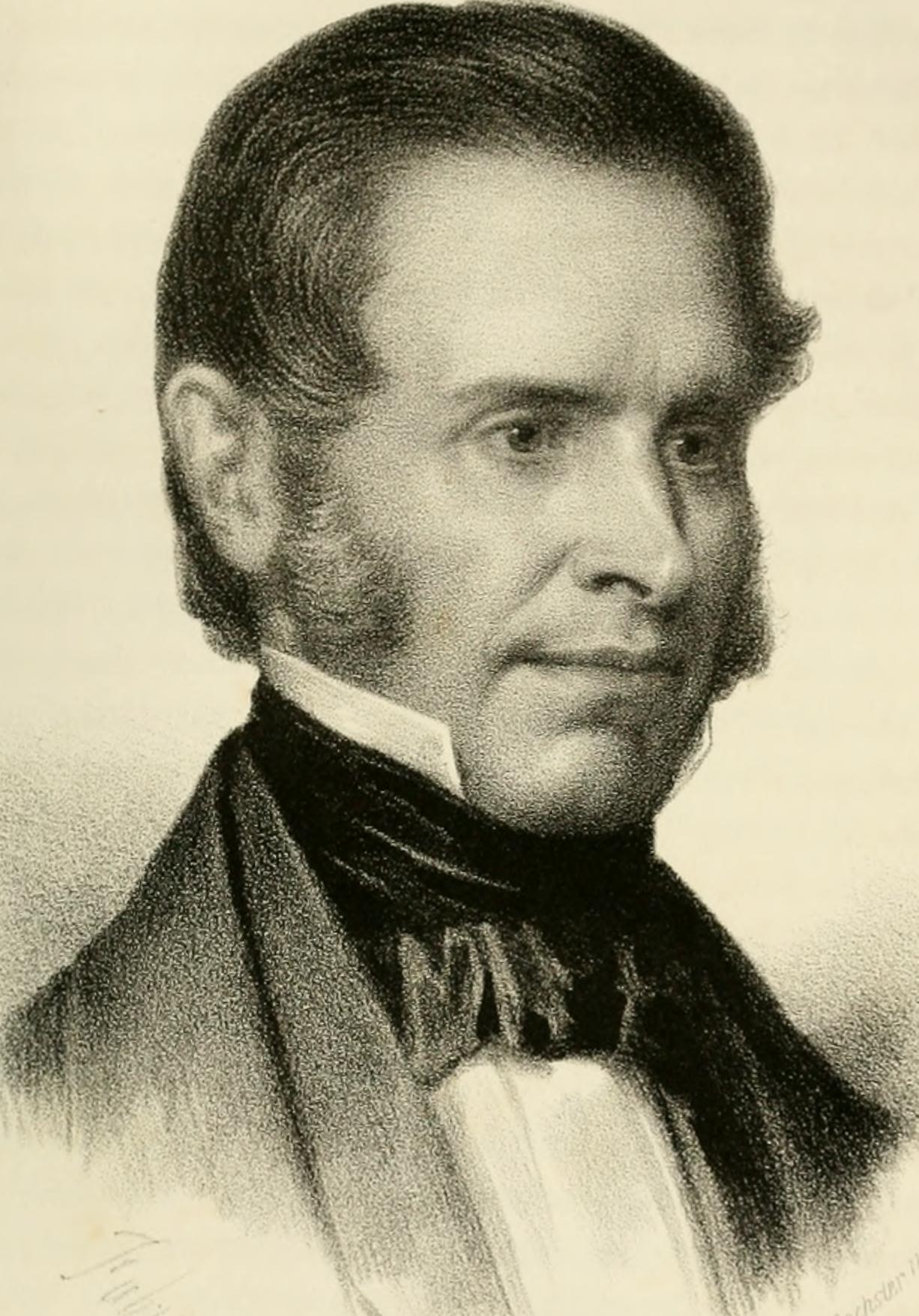
Peleg Sprague, circa 1844.
There is no tear to be shed at his exit: for the gratitude to heaven for preserving him so long, and that he died at such a moment, has drank it ere it fell. Had the horace and the chariot of fire descended to take up the patriarch, it might have been more wonderful, but not more glorious.
I’m pretty sure they’re quoting another eulogy or article here, or perhaps just making a biblical reference that several others also made, such as William T. Barry , Peleg Sprague, Medicus, and Mr. Naylor of the citizens of Hampshire County who each made the chariot reference at various times; and that the word should have been “horse” instead of “horace”. It’s such an odd way for a typo to happen, however, that I can’t lose the suspicion that “horace” was a deliberate invocation of a classical reference I’m completely missing.
You can find most of these eulogies printed in either A selection of Eulogies in Honor of John Adams and Thomas Jefferson or in an individual’s own collection, such as Edward Everett’s Orations and Speeches. Both are wonderful documents. But one of the things that I was interested in was what the newspapers chose to reprint, and that’s why I chose the admittedly odd format that I did. As the editor(s) of the Charleston Courier wrote when reprinting excepts from John Sergeant’s oration,
We would that we could afford room for all these touching memorials of public gratitude—these grateful tributes of respect for public services. But that is impossible.—From the capitol to the cottage—from Independence Square to the village-green—the voice of an united People has hymned the anthem of applause and benediction to the spirits of the departed sages. There is no numbering the discourses which have been, and are to be, delivered on the occasion—much less can any extracts from them be made, sufficient to give a general idea of their merits.
Given the necessity of truncating these eulogies for print—some of these newspapers were only four pages long—different newspapers chose different excerpts to reprint, choices that reflect the spirit of the times and the editorial policies of those papers.
Another interesting aspect is that, as I noted in passing in No Common Spirits, there were three Declaration signatories alive on the morning of July 4, 1826. The third was Charles Carroll, who would survive another six years. Some of the essayists, such as Timoleon, seem to have simply forgotten—or not known—about Carroll, and thought that only Adams and Jefferson had remained of the Declaration’s signatories.
All the signers of the Declaration of Independence who were present at its discussion and adoption, excepting only Jefferson and Adams, had gone home.
Whether Carroll preferred to be forgotten or remembered, though, may have depended on who was writing. The July 11 Daily National Journal remembered Charles Carroll in words that must have been a bit much even for the time, and certainly for Carroll if he ever read it:
A single signer of the Declaration of Independence now only remains to connect that glorious band with posterity. A short time, and he must follow his compatriots. Would that his sun may also go down in equal glory! He stands among us majestic in his loneliness; a sublime relic of the virtue and patriotism of a past age, spared by time, that we may yet gaze on his venerable form a little longer, before we are called on to lay him with his brother sages in the tomb. Then we may gather the bones of all these patriarchs into one grave, and erect over it a mausoleum, on which might be written a challenge to all ages and climates of the world, to produce its rival in moral grandeur—to exhibit a tomb more pregnant with instruction in all the duties which render man estimable and useful to his fellow-men.
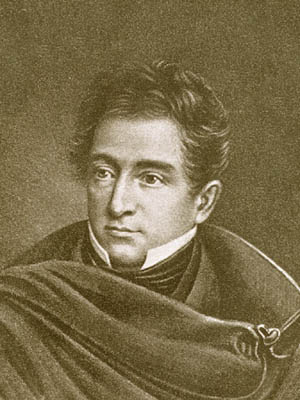
Pierre Derbigny.
It sounds a lot like “hurry up and dy, old man!” It would be interesting to know what Carroll’s reaction to that paragraph was. The same paper on July 15 wrote about Carroll that “Every expression—every fragment of a phrase from such a man… is like the voice of a departed age—an echo still lingering among the ruins of antiquity.”
“To enumerate their services, would be to write a history of the Republic…” wrote the Richmond Enquirer of August 1. But that history was already being forgotten. The importance of July 4 is that it is the day the Declaration was adopted. Once adopted, it needed to be printed before it could be signed; the signing began on August 2.
Nowadays it is very common to read about Independence Day being an anniversary of the “signing” of the Declaration. But even in 1826 people were beginning to confuse the adoption with the signing. The Enquirer added:
On that day, fifty years from the day on which they together signed our Declaration of Independence, they breathed their last…
I did not include it, but I think Jefferson, at least, would have been gratified that after all of the preambles and resolutions included in that August 1 Enquirer the column went right into a discussion on “a particular method of curing Clover”.
Another bit of history that seems, if not forgotten, not truly grokked today, is that having, less than fifty years earlier, fought a war with England for our independence, there were still a lot of people who held a grudge. There was still resentment in 2000! The Richmond Enquirer on August 8 reprinted a preamble from the Literary Society of Romney that discussed how we might handle a future in which “those who were ‘enemies in war’ have become ‘in peace friends’”, even brothers:
Oh yes! when some future orator of our country, on some succeeding anniversary of our nation’s birth shall have roused his audience to the highest pitch of indignation by the recital of our Fathers’ oppressions, under the dominion of “a Prince whose character was marked by every act which may define a tyrant”—if now that those wrongs have been atoned for, and those who were “enemies in war” have become “in peace friends;” if moved by these considerations, and the remembrance that we “be brethren,” he would abate that feeling of antipathy, which the record of our colonial oppressions might naturally cherish, he need but omitting the causes, refer to the events of the Revolution—forgetting the characters of our British brethren then in power—dwell but on the achievements of our own country’s worthies, to call up every nobler aspiration for glory, and excite ever the enthusiasm of patriotism, and if anxious to strike a yet deeper chord of yet tenderer feeling, let him but refer to the events of the jubilee of our emancipation, to the scenes of the 4th of July, 1826, and every heart will vibrate to the touch, and every emotion be calmed down to those of grateful remembrance and sublime contemplation.
“But our feelings have carried us beyond our purpose, which was but to communicate the events of that day.” What a fascinating digression. Oh beautiful, for patriot’s dream, that sees beyond the years!
That particular preamble ended with:
All the stores and places of business were closed, and all seemed cordially to unite in those demonstrations of regret and esteem: Party spirit had long ceased to exist among us, and on that day it seemed to be forgotten that it ever had existed.
There was indeed a writer and a dreamer among that Literary Society!
Several of the essays were printed under Latin/Roman pseudonyms: Fenelon, Medicus, and Timoleon. I can definitely understand why the latter chose to write anonymously! He is not among those who was able to forget party at these deaths, and was not happy that this coincidence of deaths would link Jefferson and Adams together for eternity. Like many writers, he envisioned a heavenly messenger; but his messenger told him that Adams was consigned to purgatory for a year “for the errors of his political life subsequent to the revolution, for his writings in favor of monarchy, and his approval of the Alien and Sedition acts”.
I was also surprised at the similarity in spelling between 1826 and 2026. There are a few cases where “-ou-” instead of “-o-” are used in words like “honour” and even “glourious”; where a single “-l” is used where we would use a double “-ll”; and even an occasional use of “-c-” instead of “-t-” in words like “negociating”. United States English still retains words like this, for example, “associating”. But for the most part even the weirdest spellings, like “neighborhood” and “wrought”, and a word I’m constantly misspelling, “contemporaneous”, are in their modern form.
Even where the older forms are used, the very same writer may use both the modern and the older form in the same text.
This is part of why I haven’t “fixed” what seem to me obvious spelling errors, unless they are very obviously typos: spelling was different, and many of these errors might well have been deliberate.
There were one or two words where I was moderately surprised we don’t still use those spellings. For example, “corespondence”, once seen, is obviously the correct term! Unless, of course, you’re familiar with Latin—and most of these writers and speakers assumed that their readers and listeners were.
Another interesting bit is that we were already borrowing from the French, perhaps influenced by their help in the revolution. Pierre Derbigny spoke his eulogy, in New Orleans, in French—there would still have been a lot of French speakers in Jefferson’s French territories, after all. But when the Louisiana Advertiser of August 19 translated Derbigny’s speech into English, they wrote:
Before we bid him an eternal adieu…
Apparently, “adieu” was already an English word in America and didn’t need translation!
The Wyoming Herald, in reprinting Peleg Sprague’s eulogy, has a fascinating typo: “arrvice” instead “service”. The two incorrect letters are each right next to their corresponding correct letter on a typewriter, albeit each in the opposite direction—but this was well before the typewriter existed! Was there a relationship between how the first typewriters were designed, to how newspaper printers stored letters?
Peleg Sprague also seemed to allude to Percy Bysshe Shelley’s eight-year-old Ozymandias when he wrote:
Our country has been sometimes reproached for not erecting monuments and statues to her departed worthies. But what avails the monument of brass and stone? Sink its foundations deep; raise it as high as human ken; when the rolling years press on—it falls—they sweep over it, and leave not a trace of its gloomy grandeur. Erect the statue of marble; it is cold and lifeless—Time clasps it—and it becomes dust in his hands.
William Alexander Duer, as reprinted in the August 31 Pittsfield Sun, inadvertently recalled a musical selection from nearly a century and a half later:
…an amicable contest ensued between them; in which they pressed upon each other, the honorable task of drawing up the document. Adams finally prevailed; and thus the duty of composing it, devolved on Jefferson.
I love 1776, the Musical•, but you can generally assume that if something appeared in that movie it didn’t happen in real life. However, apparently the pen-passing scene was either real, or already part of the legend in 1826.
Duer ended by recalling the partisanship that most of the writers mentioned at least in passing:
And whilst thus studious to suppress the germs of rising animosities, let the remembrance of our past dissensions be buried in the graves of ADAMS and of JEFFERSON.
Which is as good a place as any to end on!
In response to No Common Spirits: Jefferson and Adams survive: Adams and Jefferson both dying on the Jubilee was hailed as “a most singular coincidence… A more signal and impressive combination of circumstances is not to be found… Nothing so sublime could have been conceived by human thought… Who does not envy such a death after such a life?”
American Founders
- 1776•: Sherman Edwards, Peter Stone, and Peter H. Hunt (DVD)
- A fun musical with long interludes of politics.
- How to Think About the American Revolution: Christopher Flannery at Imprimis
- “How should we think about the American Revolution on the 250th anniversary of the Declaration of Independence? The American revolutionaries can help us answer this question.”
- Orations and Speeches: Edward Everett at Internet Archive (ebook)
- “Orations and Speeches on Various Occasions. By Edward Everett. Vol. I. 1865.”
- A selection of Eulogies in Honor of John Adams and Thomas Jefferson at Internet Archive (ebook)
-
 “A selection of eulogies, pronounced in the several states, in honor of those illustrious patriots and statesmen, John Adams and Thomas Jefferson.” 1826.
Negative Space
- Cherry Valley: A Massacre of the Revolution
- Mel Gibson’s The Patriot is disparaged for the ruthlessness it portrays among the British. But such barbarity certainly did exist. One massacre by British troops is still remembered by the residents of Cherry Valley, New York.
- Padgett Sunday Supper Club Sestercentennial Cookery
- The Sestercentennial Cookery is a celebration of American home cooking for the 250th anniversary of America’s Declaration of Independence.
- Sources from the American Jubilee
- On July 4, 1826, as the country celebrated the 50th anniversary of the Declaration of Independence, John Adams and Thomas Jefferson died, sparking a long period of essays, orations, and exclamations about that “singular coincidence”.
- Trump, destiny, and the flood
- Is it God’s plan that Trump will win and make America better, or is it God’s plan to warn us about what we can do to make America better?
newspapers
- The closing of the year
- From the September 22 and 29, 1826, Wyoming Herald of Wilkes-Barre, Pennsylvania, page 4 in each installment. An oration by Peleg Sprague (1793-1880) in Hallowell, Maine, in July, 1826. Sprague was, at the time, U.S. House Representative from Maine’s 4th district.
- A day most signally marked…
- From the the August 8, 1826, Richmond Enquirer of Richmond, Virginia. “A day most signally marked… of events which will be remembered while liberty has a votary…”
- Every manly and virtuous resolution
- From the August 21, 1826, Charleston Courier of Charleston, South Carolina, page 1. Excerpts from an oration by John Sergeant (1779-1852), in Philadelphia on July 24, 1826.
- In the Course of Providence
- From the Richmond Enquirer of Richmond, Virginia, August 1, 1826, page 3.
- A joy which feeble nature could not sustain
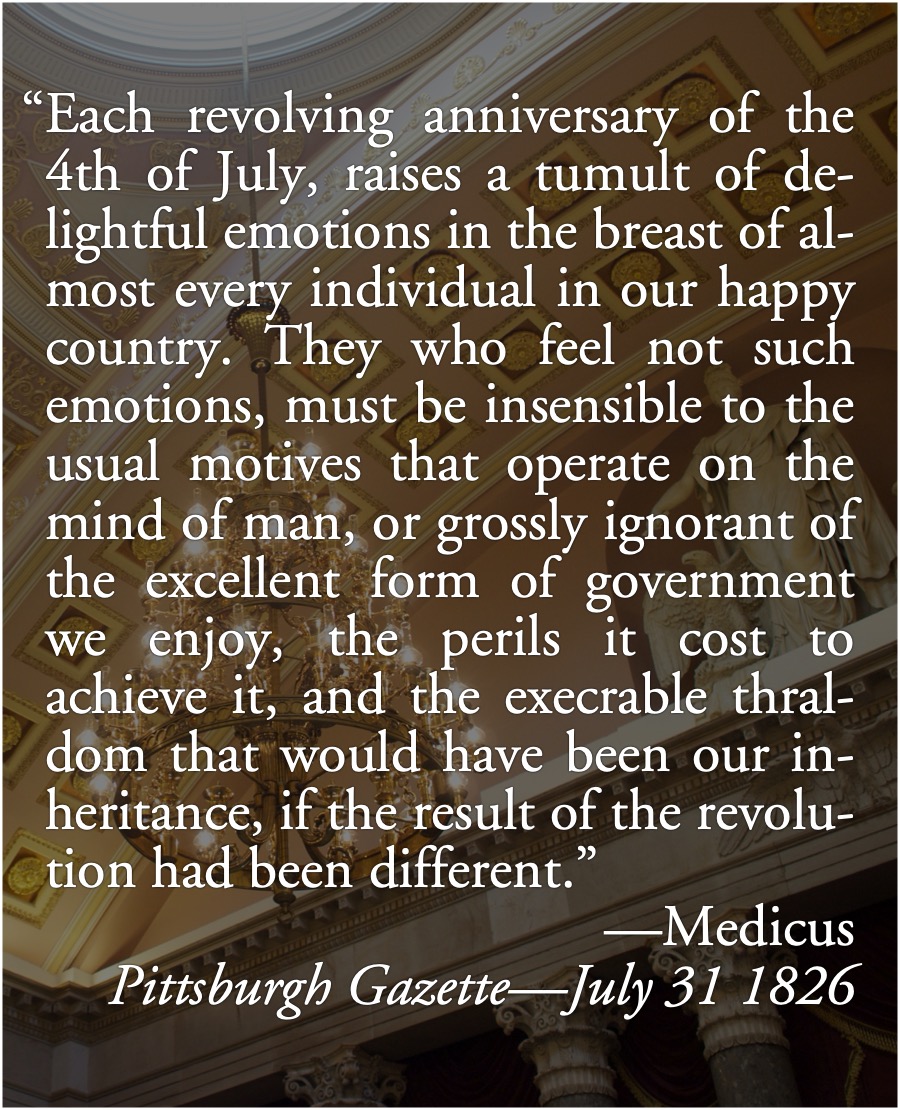
- From the August 19, 1826, Louisiana Advertiser, page 2, a reprint of a July 31 article in the Pittsburgh Gazette by “Medicus”.
- Let our dissensions be buried in their graves
- From the Pittsfield Sun of Pittsfield, Massachusetts, August 31, 1826, a eulogy to Adams and Jefferson by judge of the New York Supreme Court William Alexander Duer (1780-1858), delivered on July 31 and reprinted from the Albany Argus of August 15.
- The Lights of Truth and Unerring Experience
- From the August 25 and September 8, 1826 Kentucky Gazette, a speech by William T. Barry (1784-1835), delivered on August 15 in Lexington, on the deaths of John Adams and Thomas Jefferson (July 4) and Isaac Shelby, the first (and fifth) Governor of Kentucky under the new Constitution (July 18).
- Passages of the happiest eloquence
- From the August 29 edition of the Philadelphia Inquirer, page 2, an excerpt from an oration by Daniel Webster at Faneuil Hall August 2, 1826, and focusing mostly on Webster’s recounting of Jefferson’s political life.
- The soul’s dark cottage
- From the September 9, 1826, United States Telegraph of Washington, DC, page 2, an essay on the deaths of Jefferson and Adams by “Timoleon”.
- Their lives were the gifts of Providence
- From the September 8, 1826, edition of the Constitution Whig of Richmond, Virginia, pages 1 and 2. Comments on and excerpts of an oration by Daniel Webster and reprinted from the National Journal.
- What made these men cannot die
- From the September 20, 1826, Daily National Journal, a set of excerpts from the August 1 eulogy by “Professor Everett” in Charlestown, Massachusetts.
- Wounds on the hydra of tyranny
- From the August 19, 1826, Louisiana Advertiser of New Orleans, page 1. A translation from the French of Louisiana Secretary of State Pierre Derbigny’s eulogium to John Adams and Thomas Jefferson.
poetry
- Ozymandias: Mark Steyn at Steyn Online
-
“1818 was a golden year in poetry… one of the most enduring works of that golden year was published as a literary competition entry in The Examiner… on Sunday, January 11, 1818.”
More American Semicentennial
- No Common Spirits: Jefferson and Adams survive
- Adams and Jefferson both dying on the Jubilee was hailed as “a most singular coincidence… A more signal and impressive combination of circumstances is not to be found… Nothing so sublime could have been conceived by human thought… Who does not envy such a death after such a life?”
- Sources from the American Jubilee
- On July 4, 1826, as the country celebrated the 50th anniversary of the Declaration of Independence, John Adams and Thomas Jefferson died, sparking a long period of essays, orations, and exclamations about that “singular coincidence”.
More Daniel Webster
- The heavens beam with new light
- From the August 28, 29, and 30 editions of the Evening Post of New York City, page 2 in each case. Comments on and excerpts of an oration by Daniel Webster at Faneuil Hall August 2, 1826.
More Edward Everett
- What made these men cannot die
- From the September 20, 1826, Daily National Journal, a set of excerpts from the August 1 eulogy by “Professor Everett” in Charlestown, Massachusetts.
More John Adams
- No Common Spirits: Jefferson and Adams survive
- Adams and Jefferson both dying on the Jubilee was hailed as “a most singular coincidence… A more signal and impressive combination of circumstances is not to be found… Nothing so sublime could have been conceived by human thought… Who does not envy such a death after such a life?”
- Sources from the American Jubilee
- On July 4, 1826, as the country celebrated the 50th anniversary of the Declaration of Independence, John Adams and Thomas Jefferson died, sparking a long period of essays, orations, and exclamations about that “singular coincidence”.
- Let our dissensions be buried in their graves
- From the Pittsfield Sun of Pittsfield, Massachusetts, August 31, 1826, a eulogy to Adams and Jefferson by judge of the New York Supreme Court William Alexander Duer (1780-1858), delivered on July 31 and reprinted from the Albany Argus of August 15.
- Jefferson to Adams, on the death of Abigail
- From the August 30 edition of the Philadelphia Inquirer, page 2, a letter from Jefferson to Adams on the death of Adams’s wife, and used by J. E. Sprague in his “interesting Eulogy”.
- The Lights of Truth and Unerring Experience
- From the August 25 and September 8, 1826 Kentucky Gazette, a speech by William T. Barry (1784-1835), delivered on August 15 in Lexington, on the deaths of John Adams and Thomas Jefferson (July 4) and Isaac Shelby, the first (and fifth) Governor of Kentucky under the new Constitution (July 18).
- Two more pages with the topic John Adams, and other related pages
More A Sestercentennial Year
- The Rifleman at Bennington to the British Granadiers
- The British Grenadiers provides an interesting period melody for The Rifleman’s Song at Bennington; also, the original 1837 Rifleman’s Song lyrics from The New-York Mirror.
- No Common Spirits: Jefferson and Adams survive
- Adams and Jefferson both dying on the Jubilee was hailed as “a most singular coincidence… A more signal and impressive combination of circumstances is not to be found… Nothing so sublime could have been conceived by human thought… Who does not envy such a death after such a life?”
- A Monticello Meal for Independence Day
- Marie Kimball’s Thomas Jefferson’s Cook Book provides several pot-luck friendly dishes for your Fourth of July celebration this Semiquincentennial.
- Flowers o’er the Tory grave: Disney’s Francis Marion
- Walt Disney’s The Swamp Fox was an influential take on Francis Marion’s life—very possibly an influence on Mel Gibson’s The Patriot, too.
- Mock the Wind and Sing of Marion’s Men
- “In Lexington, the center of revolt against the King…” One of the most modern figures of the American Revolution was a slaveholder and Indian fighter with a superhero name.
- Seven more pages with the topic A Sestercentennial Year, and other related pages
More Thomas Jefferson
- No Common Spirits: Jefferson and Adams survive
- Adams and Jefferson both dying on the Jubilee was hailed as “a most singular coincidence… A more signal and impressive combination of circumstances is not to be found… Nothing so sublime could have been conceived by human thought… Who does not envy such a death after such a life?”
- Sources from the American Jubilee
- On July 4, 1826, as the country celebrated the 50th anniversary of the Declaration of Independence, John Adams and Thomas Jefferson died, sparking a long period of essays, orations, and exclamations about that “singular coincidence”.
- A Monticello Meal for Independence Day
- Marie Kimball’s Thomas Jefferson’s Cook Book provides several pot-luck friendly dishes for your Fourth of July celebration this Semiquincentennial.
- First, CNN came for InfoWars
- “When the speech condemns a free press, you are hearing the words of a tyrant.”
- Let our dissensions be buried in their graves
- From the Pittsfield Sun of Pittsfield, Massachusetts, August 31, 1826, a eulogy to Adams and Jefferson by judge of the New York Supreme Court William Alexander Duer (1780-1858), delivered on July 31 and reprinted from the Albany Argus of August 15.
- Four more pages with the topic Thomas Jefferson, and other related pages