


This Boy Digs Deep: Eddie Doucette in TV Guide
I only got through the 1953 and 1954-56 reels.
Eagle-eyed readers will have noticed that I removed the question marks from the Eddie Doucette Home Cooking episode guide back in February. Some friends invited me up to stay with them a short walk from the Chicago Public Library, so before enjoying Chicago’s wonderful food and drinks I spent a few hours each morning going through the library’s Chicago-edition TV Guide microfilm reels again. I was able to recheck all of the questionable entries and verify or correct my initial guesses.
Unfortunately, the library doesn’t have the TV Guide originals. I hope they still exist somewhere because the microfilms, while useful, are vintage scans that we would now consider to be very poor quality—which is why I needed to recheck them. My saved scans from the first session weren’t legible enough for a couple of the entries.
At one point the library’s computer system went down, so I tried to use the non-computer-based microfilm reader. It, or I using it, was unable to make the scans readable. They needed near-movie level “Computer: Enhance” in some cases. Mere optical, mechanical magnification wasn’t good enough.
Fortunately the computer system came back up by the time I gave up trying to make the older reader work.
The library’s TV Guide archives begin with April, 1953. While that obviously doesn’t cover the 1952 season, Eddie Doucette’s Home Cooking clearly was on the air in 1952. The Backstage Diary in the April 3, 1953, Guide included this snippet:
Look for Eddie Doucette to take his culinary show to another station, possibly WBBM-TV. Chef Eddie has been bombarded with letters and phone calls, all bemoaning his departure from channel 5.
By the June 5 Guide, however, a Where are they now? (JPEG Image, 452.1 KB) spread wrote:
Once master of the mixing bowl on WNBQ’s cooking show, Eddie Doucette has gone back to his old flavor company, Accent, Inc., where he’s prospering nicely in the Public Relations end of things.
Chicago had at least two cooking shows during this period. WGN-TV (CBS) on Channel 9 had a show called “A to Z of Cookery”. It ran from 10 to 11 in the morning and starred Alida Drake and John Zenker. “Francois Pope and his two sons” had “Creative Cookery” from 11 to noon on NBC’s WNBQ Channel 5. Channel 5 is where Eddie Doucette’s show had been in the previous season, and where it would return in the next season.
Eddie Doucette returned to NBC’s WNBQ in 1954 when the Popes’ show moved to ABC’s WBKB. From the Chicago Dateline in the August 7, 1954, Guide:
Advance Tips on Shows: Eddie Doucette, WNBQ’s chef B.F.P. (Before Francois Pope) returns to his old stamping grounds Aug. 30 when Francois moves to WBKB. Eddie’s Home Cooking will be viewed from 1 to 1:30 P.M. weekdays with Wed Howard and his Melody Magazine following him.
Eddie Doucette did a full media blitz in the run-up to August 30. He appeared on Close-Up on Monday, August 23. He guested on Melody Magazine on Tuesday, Herbie Mintz on Thursday, and Bob and Kay on Friday. All four of these were NBC Channel 5 shows, so the station was clearly hyping his return.
It’s interesting that of those four shows, only Bob and Kay was listed as a variety show. The other three are listed as musical shows. Did he show off his musical poetry skills on these appearances?
If I’m reading these blurbs correctly, two of these shows had the same band: Bob & Kay shared the Art Van Damme Quintette with Close-Up.
Bob & Kay were a relatively new show for NBC. In 1953, Bob & Kay had moved to WNBQ 5 from ABC’s WBKB 7. Besides meaning that they were included in Doucette’s pre-week media blitz, Bob & Kay’s move to NBC also allowed Eddie Doucette to merge his cooking show into their variety show after the 1954 season.
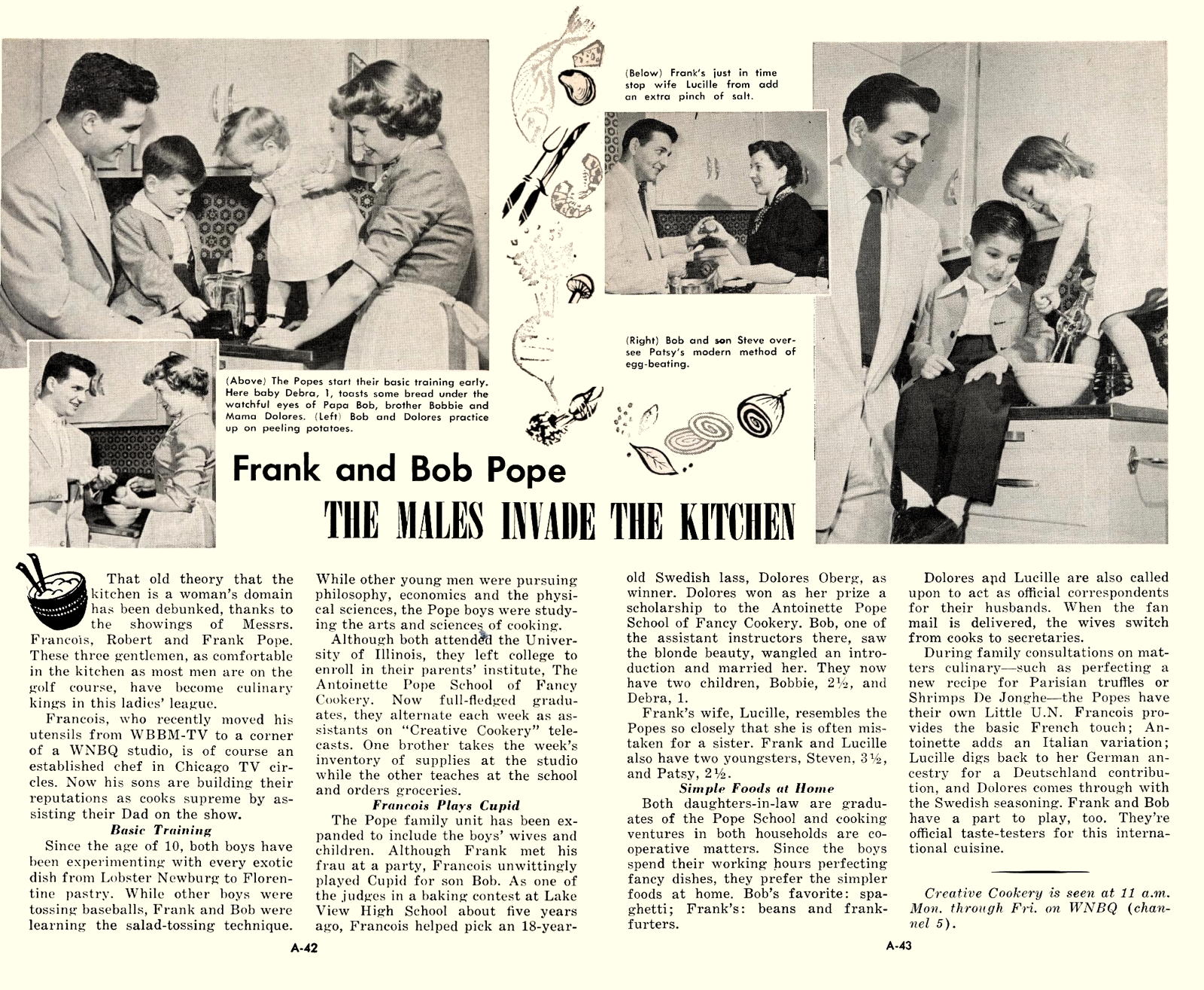
The family of Francois Pope took over from Eddie Doucette during the 1953-1954 season with “Creative Cookery”.
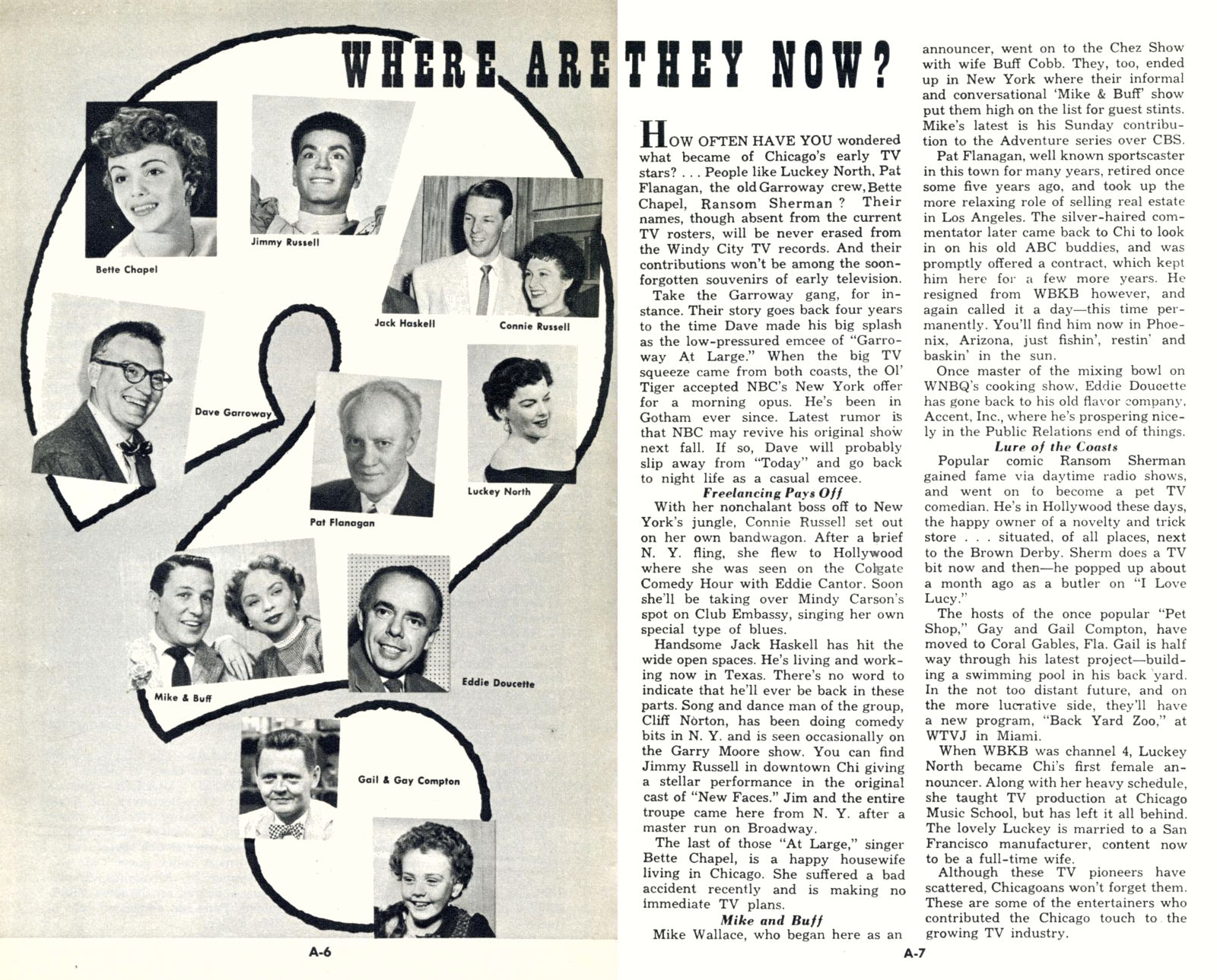
Other than Eddie Doucette, the only name I recognize here is Mike Wallace.
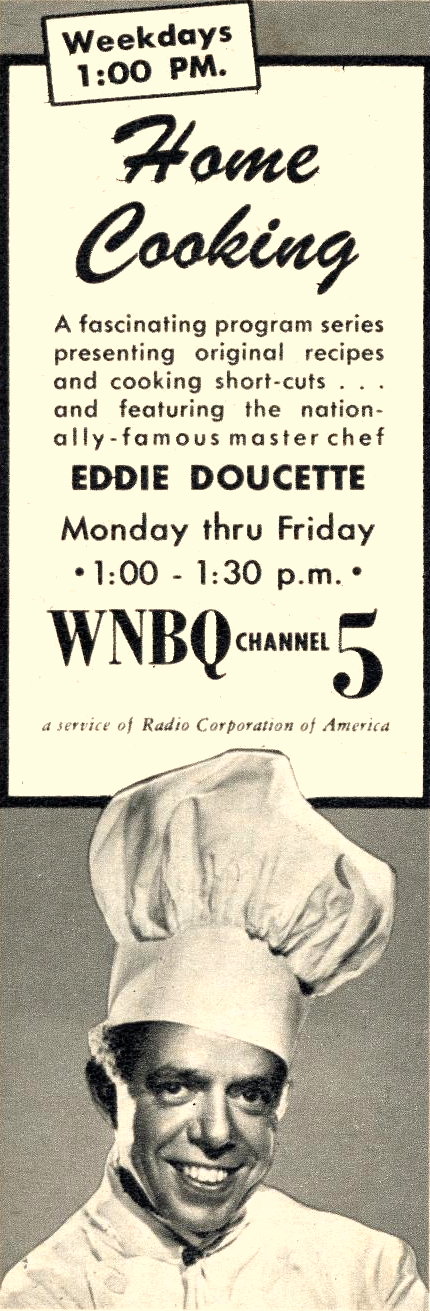
“Home cooking… featuring the nationally-famous master chef Eddie Doucette.” Sidebar ad in the October 10-22 1954 Chicago edition of the TV Guide.
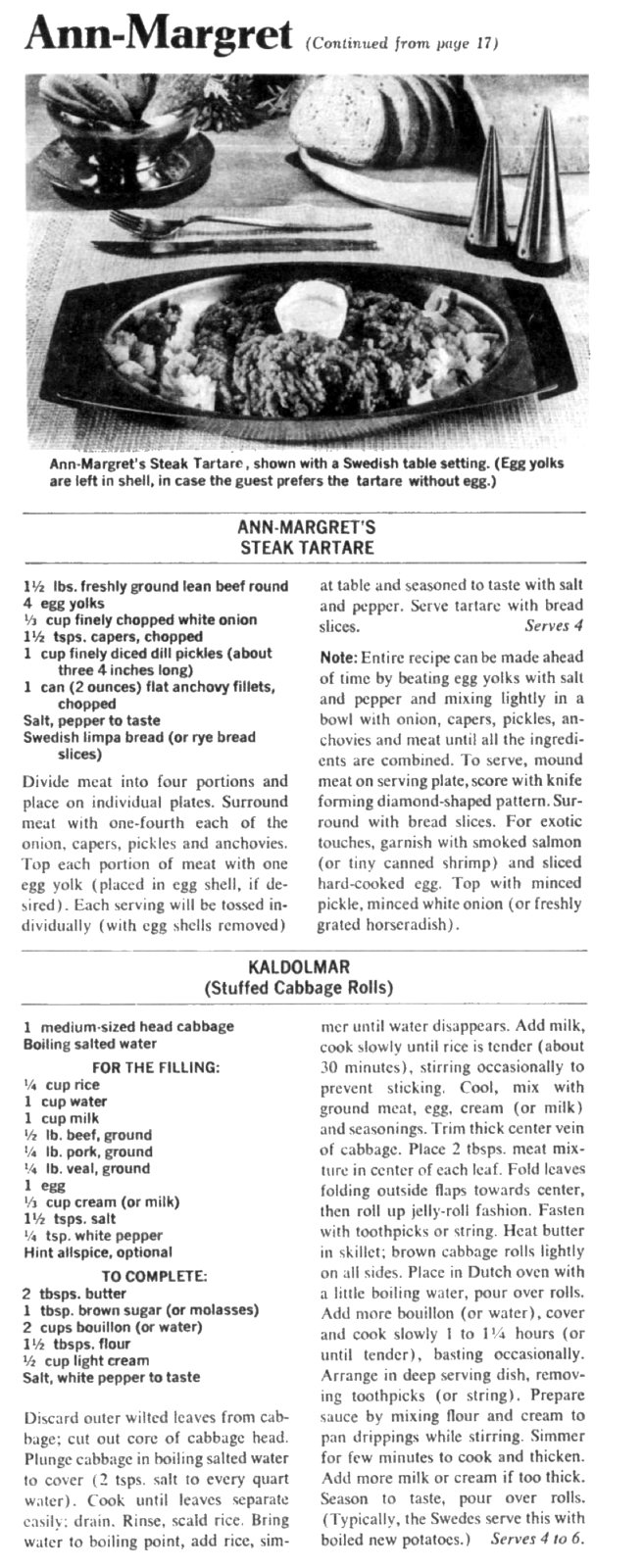
Kaldomar, like Ann-Margret, is a Swedish dish.
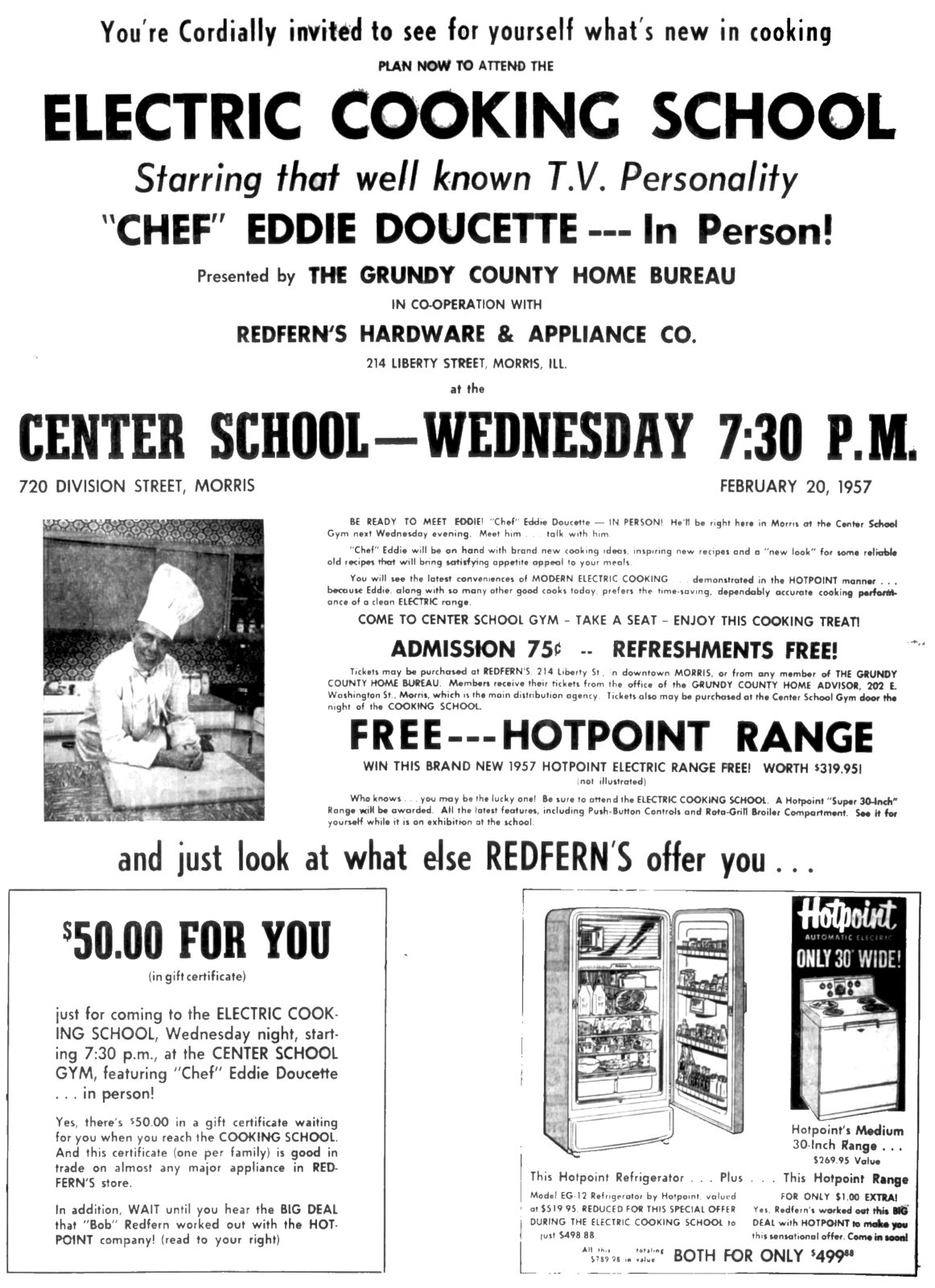
By 1957, Eddie Doucette had also begun doing pop-up cooking “schools” sponsored by appliance retailers and electric companies… and could charge for it.
By premiering the first show of his return on August 30, Eddie Doucette just missed being featured in the two-page-spread of chefs in the August 21 Guide.
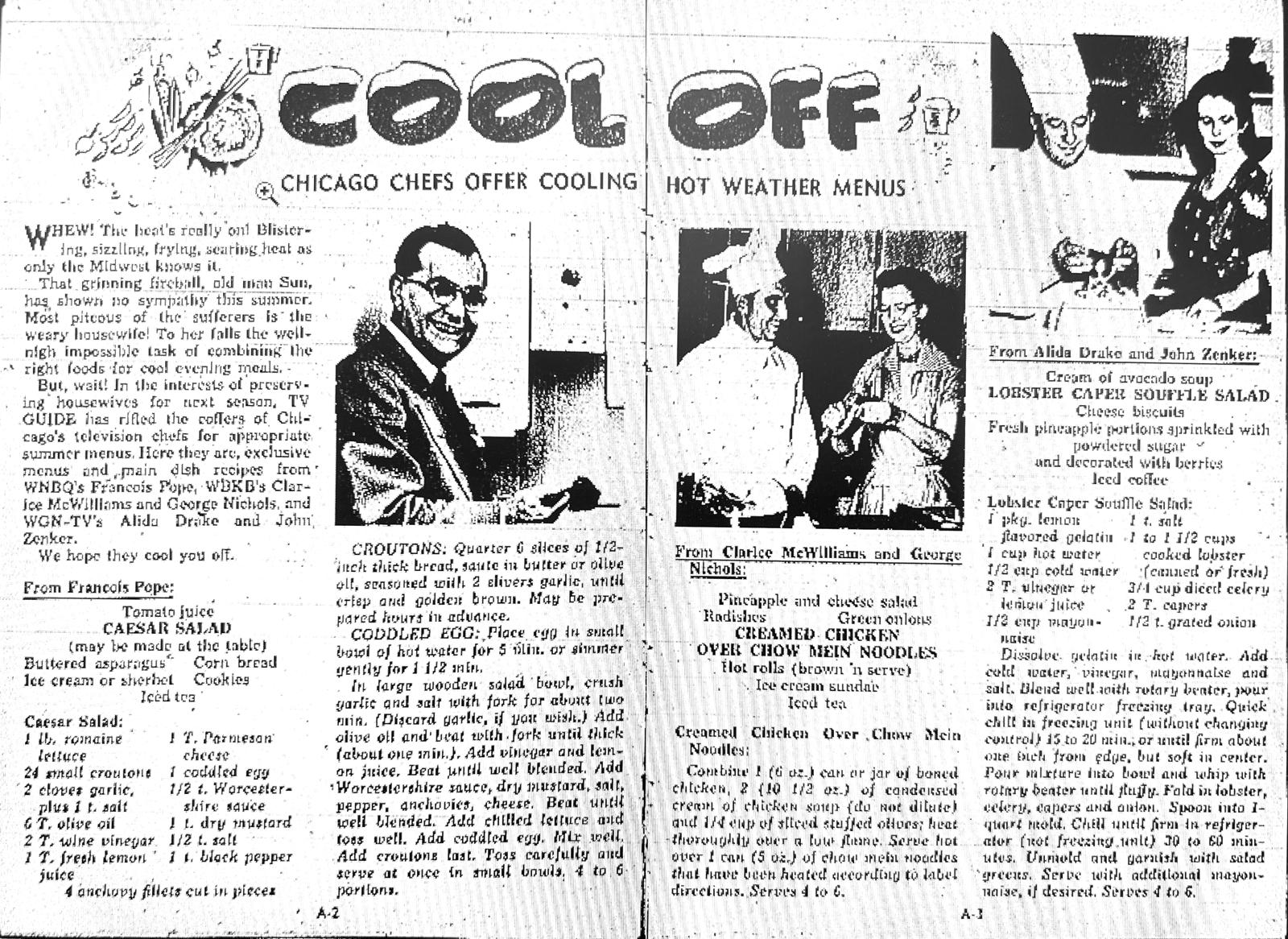
These “cooling hot weather menus” appeared the week before Home Cooking’s return to NBC. And this is not typical of the scan quality of the Library’s microfilm. This is better.
Eddie Doucette’s first 1954 show was listed as:
5 Home Cooking—Recipes
RETURN Eddie Doucette returns to his post as mentor, with easily followed recipes. Eddie considers costs as well as glamor, and uses clever touches to meals. Today: Chicken that’s different; peach meringue torte.
While we don’t have any of his recipes specifically from the 1954-55 Home Cooking season, many recipes with the same name do appear later in IGA advertisements and other IGA sources. For example, his premier “Chicken that’s different” recipe appeared during his later IGA career in an IGA matchbook. It’s one of the new recipes in my third printing of Tempt Them with Tastier Foods.
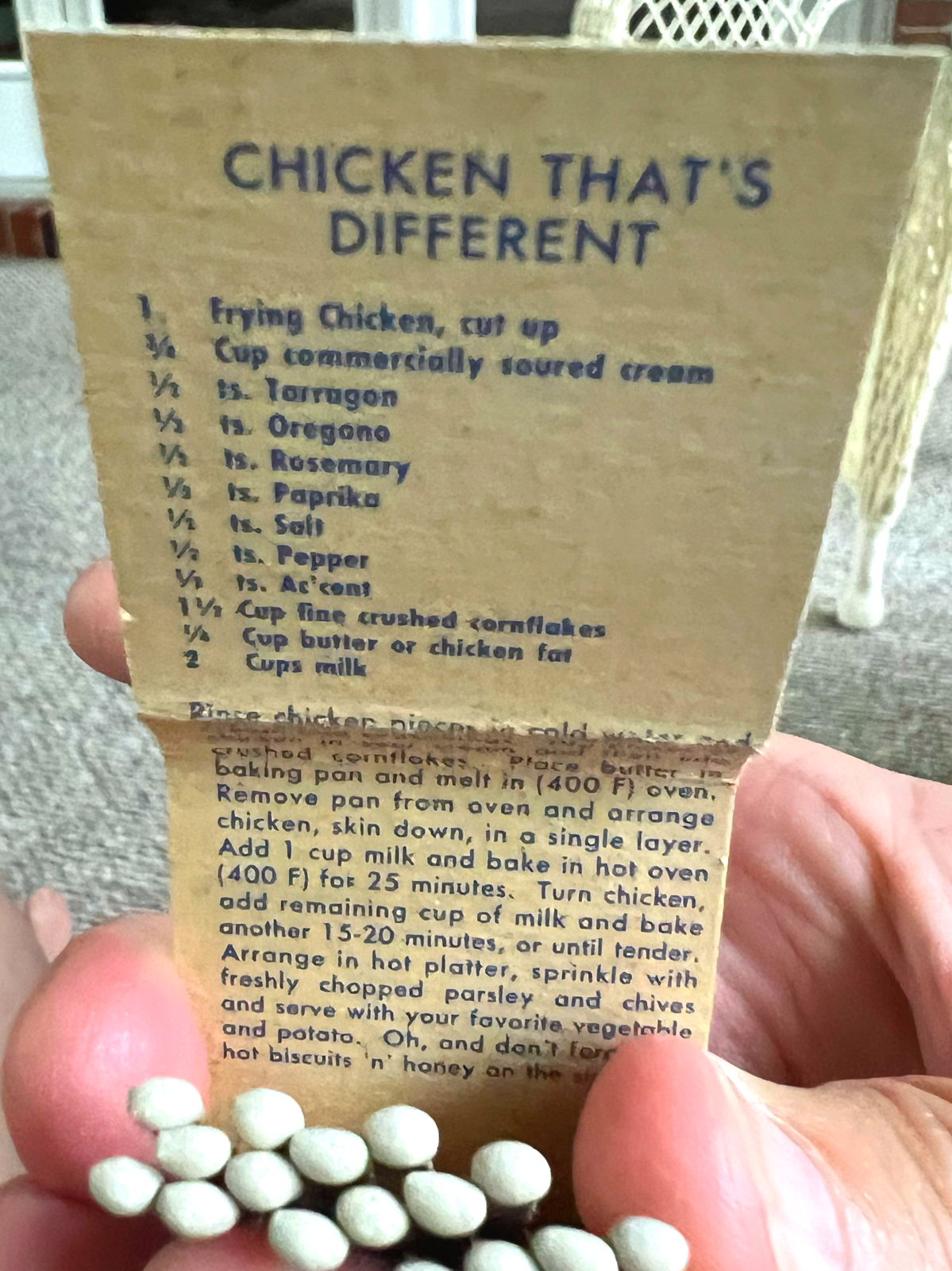
It’s cool that the matchbook came with the matches intact, but that does make it difficult to scan.
This chicken really is different. Anyone writing a cornflake-based chicken today would likely make it a crunchy fried chicken. Eddie’s is more of a casserole. While there will be some crispiness on top, most of the coating will be soft because of the milk poured in both initially and after flipping the chicken over. The cornflakes are there for flavoring as much as for texture.
It’s not a frugal dish either. The milk that the chicken is cooked in is, as far as I can tell, thrown out. The chicken is removed from the casserole to a platter, leaving all of the gunk at the bottom.
I wouldn’t be surprised if that gunk makes a very tasty quickbread, however.
The red flannel hash from October 12, 1954 “was a favorite supper of the 1600’s”. I’m occasionally surprised at how old the concept of vintage cooking was in the past. Eddie Doucette’s featuring of a seventeenth-century recipe was interesting enough to garner a mention in the September 9, 1954, “Chicago Dateline” feature of the Guide:
Eddie Doucette offered a true vintage recipe recently on WNBQ’s Home Cooking. It was a 300-year-old formula culled from Eddie’s vast library of cookbooks. This boy really digs deep.
While the TV show referenced in that comment appears to be lost, Eddie Doucette did present a red flannel hash during his IGA career as well:
Red Flannel Hash
A tasty, unusual suggestion for utilizing leftover ham. Through a coarse meat-grinder put 2 cups of left over cooked TableRite Ham, 2 cups peeled-cooked, medium-size potatoes, one No. 2½ size can beets (drained) and one medium onion grated. Add and blend in 2 tbsp. Crescent parsley, ½ tsp. salt, ½ tsp. Crescent MSG, ¼ tsp. Crescent pepper. This may be served family style or formed into patties and served individual—hash may be browned in skillet with 2 tsp. Sno-Kreem shortening in hot oven or under broiler.
Is this the same recipe? The adjective “unusual” hints that this is an uncommon recipe, which fits with it being from the 1600s.
After his 1954-55 season, Eddie Doucette merged with Bob Murphy and Kay Westfall for Bob and Kay with Eddie Doucette. It’s possible that he occasionally guested on Bob and Kay before the 1954 season. The show’s listing didn’t list guests until August 13, 1954, so if he appeared as a guest before then we wouldn’t know. However, since Bob and Kay were on a different channel before April 17, 1953, any appearance there before his return would have most likely been after that date.
Eddie Doucette appears to have undergone surgery in 1955 necessitating a sabbatical from Bob and Kay. The November-October 1955 issue of NBC Chimes has this blurb:
Eddie Doucette, chef on the “Bob and Kay With Eddie Doucette” TV show, has returned to the show following surgery…
That’s the entire blurb. The ellipses are in the original.
Chicken that’s Different in pan
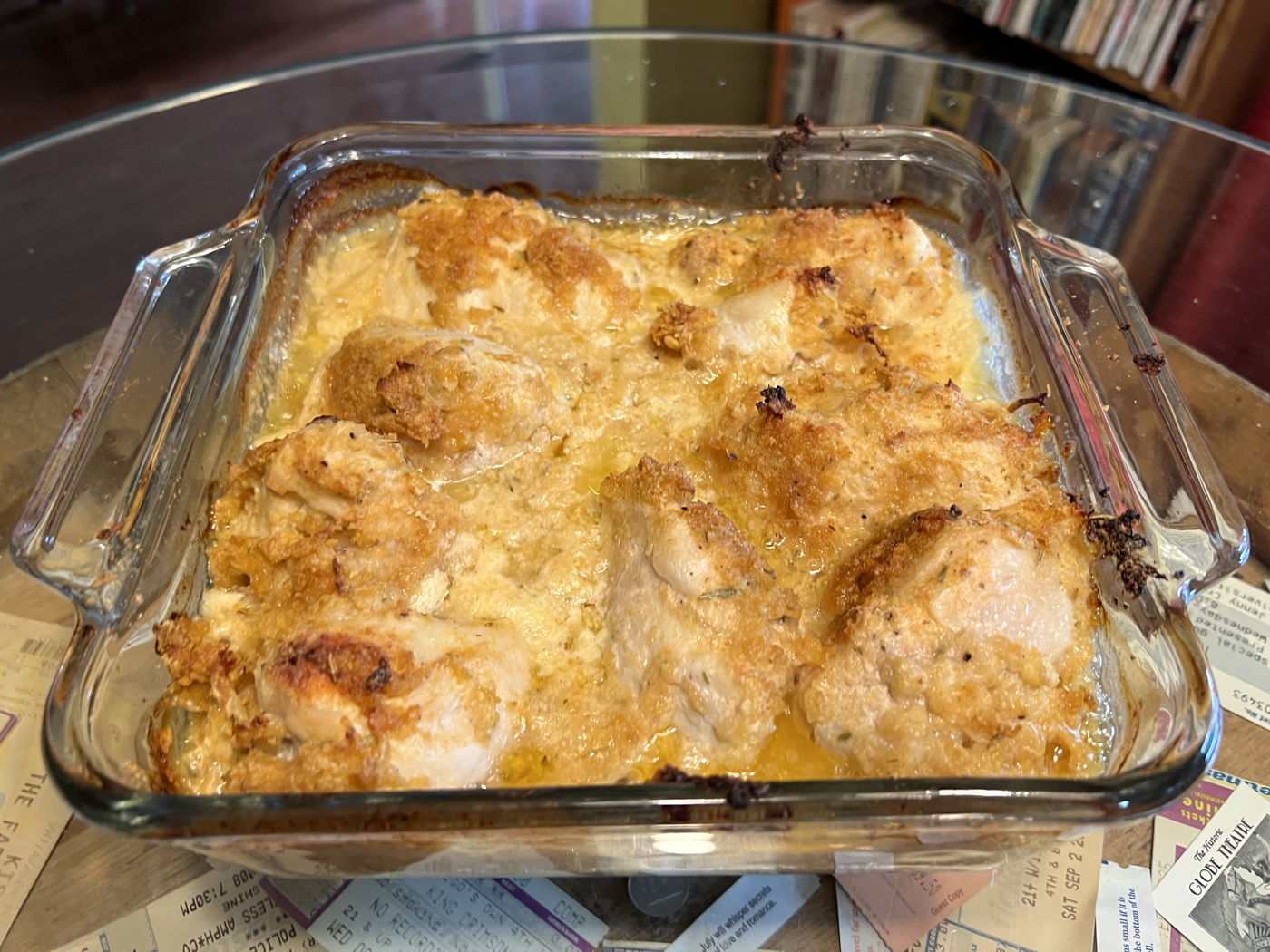
I made a ⅔ recipe and this 8x8 dish was a bit tight; for the full recipe I’d recommend 8x12 or 9x13.
Chicken that’s Different
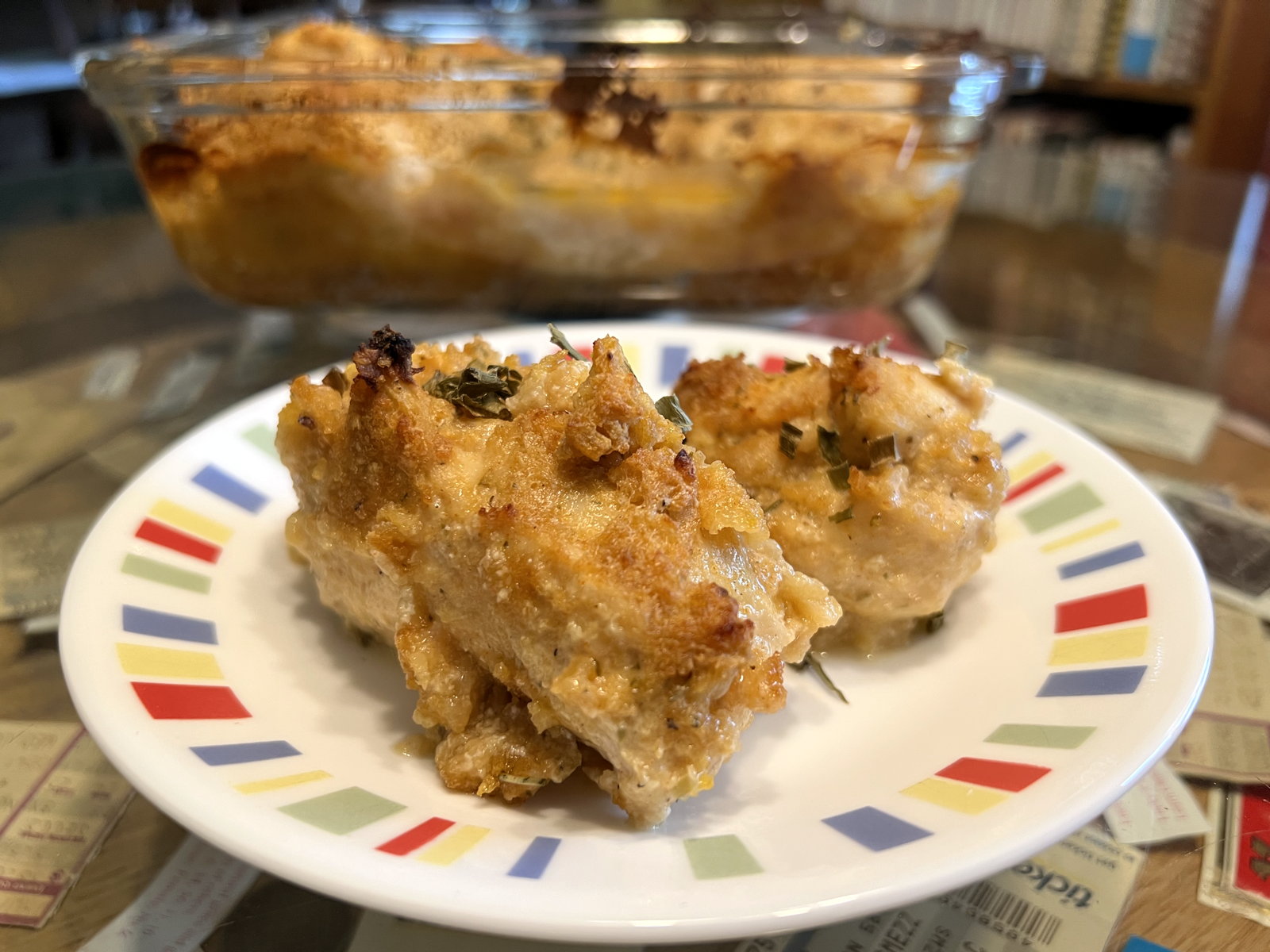
Somewhere between fried chicken and a casserole, it looks crunchier than it is. But it is tasty!
Buttered Cornflakes and Garlic
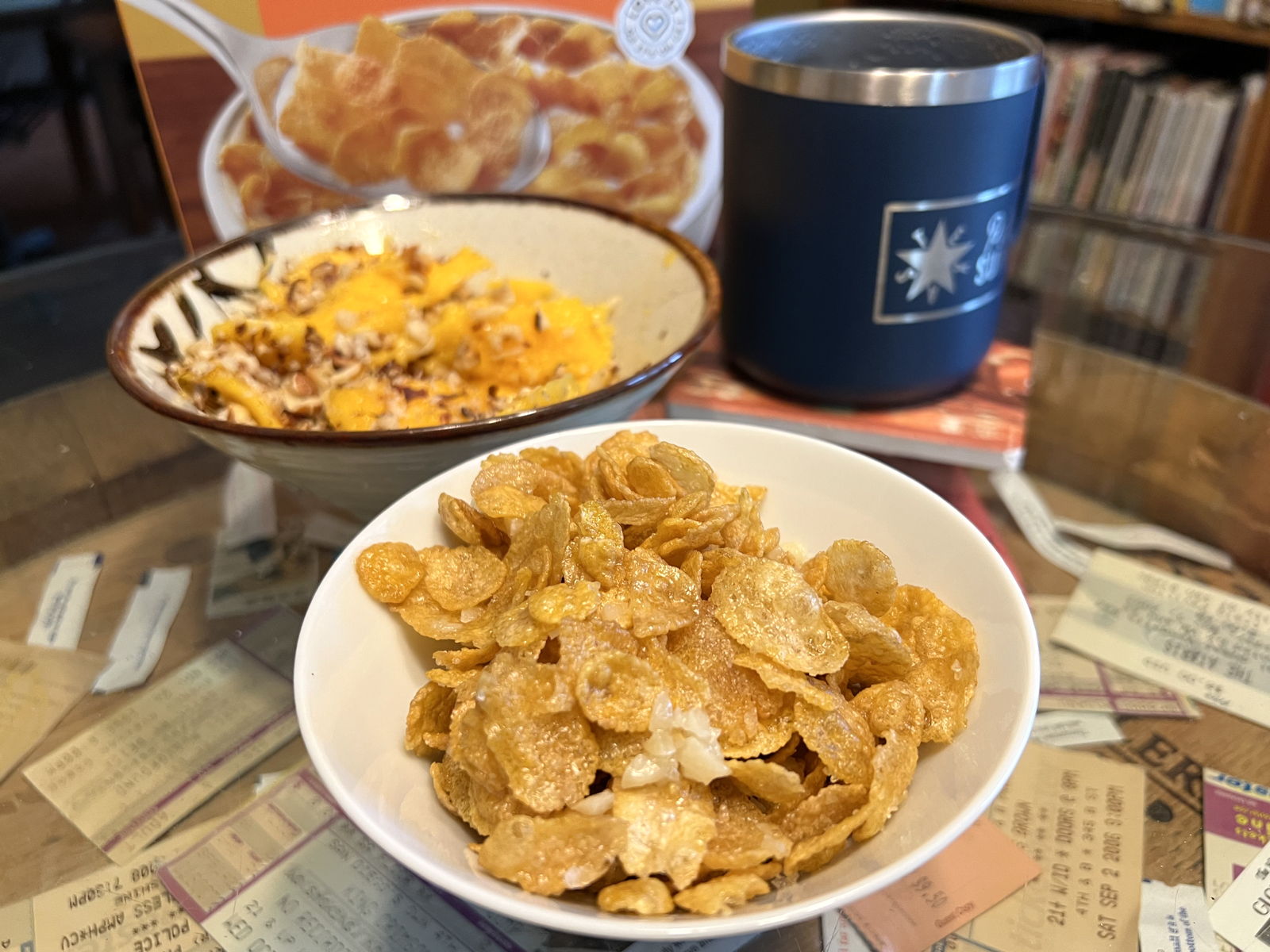
I haven’t thought about this dish in a long, long time. But it’s just as good as I remember it as a child. A fine breakfast with mango and hazelnut!
Crêpe with Orange Sauce
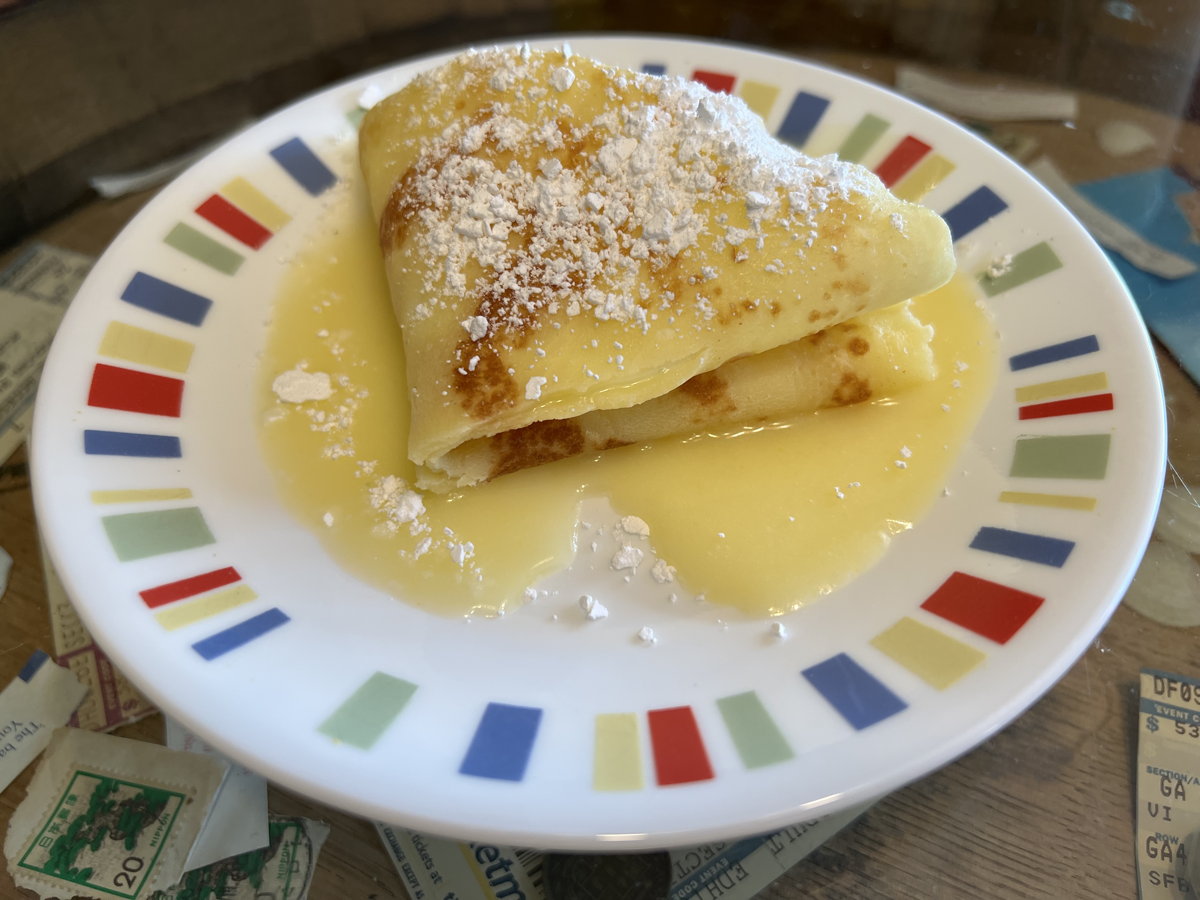
I still haven’t found the episode featuring these wonderful crêpes!
I’ve yet to find any Chicago-area TV Guides from the 1952-53 season of Home Cooking. And none of the blurbs for Bob and Kay with Eddie Doucette list recipes. This means that there are a lot of recipes in his television era that are not in my Home Cooking Episode Guide. Basically, anything not in the 1954-55 season, I don’t know about.
I suspect, however, that the typewritten pages that inspired my Eddie Doucette deep dive are from one of those two sources.
Sadly, unless these videos or their scripts were saved somewhere, these recipes probably never will be collected even if I can uncover their titles. This was a different television era. As I discovered while going through these Guides, the era of widespread syndication was only just beginning, with Bing Crosby’s videotape system still in development but making a lot of news. This article appeared in the May 8, 1953, TV Guide:
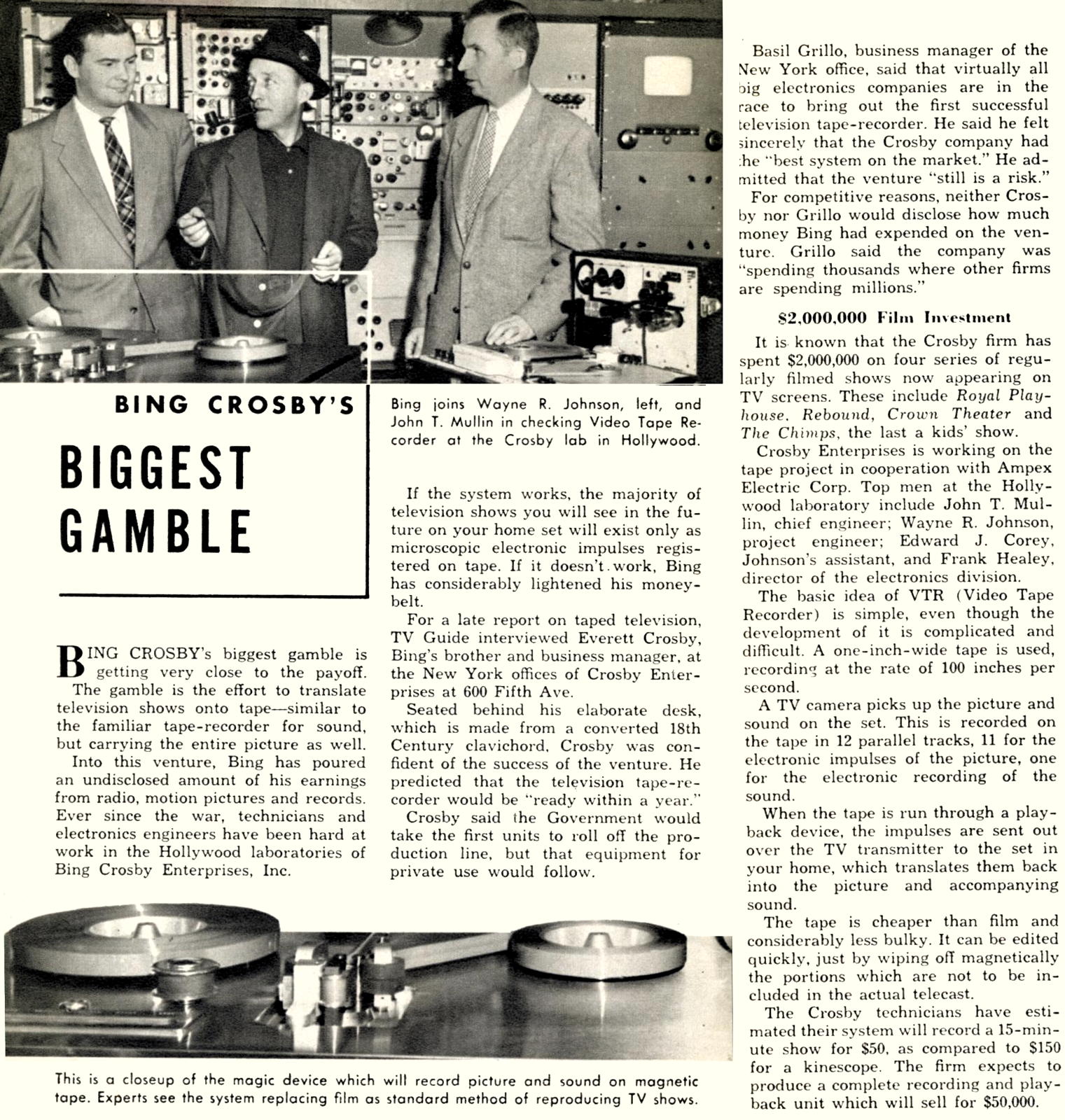
Bing Crosby was among the people trying to bring television to tape, making it easier to syndicate.
Bing Crosby’s BIGGEST GAMBLE
BING CROSBY’S biggest gamble is getting very close to the payoff.
The gamble is the effort to translate television shows onto tape—similar to the familiar tape-recorder for sound, but carrying the entire picture as well.
…
If the system works, the majority of television shows you will see in the future on your home set will exist only as microscopic electronic impulses registered on tape. If it doesn’t work, Bing has considerably lightened his money belt.
Prior to the advent of tape-recorded video, shows were either broadcast live, or recorded onto more expensive film. Only more lucrative shows were kept for rebroadcast later; Desi Arnaz and Lucille Ball did this for I Love Lucy, but that was the most popular show of the era and its reruns easily recouped the costs.
Eddie Doucette continued doing his traveling shows for various concerns between his television era and his IGA era. I ran across one ad for a one-day “Electric Cooking School” by The Grundy County Home Bureau in the Morris (Illinois) Herald-News of February 18, 1957.
BE READY TO MEET EDDIE! “Chef” Eddie Doucette—IN PERSON! He’ll be right here in Morris at the Center School Gym next Wednesday evening. Meet him… talk with him.
“Chef” Eddie will be on hand with brand new cooking ideas, inspiring new recipes and a “new look” for some reliable old recipes that will bring satisfying appetite appeal to your meals.
“Appetite appeal”, “taste appeal”, and “eye appeal” were all phrases he continued to use into the sixties.
One of the more interesting discoveries I made during my revisit to the library is that my question-marked January 20, 1955, dish, “kildolma” really is “kildolma” in the Guide. I’m wondering if this might not be Swedish cabbage rolls, or kåldolmar. Cabbage rolls were once a common dish, at least among my extended family and community growing up across the lake from Chicago in Michigan.
Kaldolmar itself appears to be a moderately uncommon recipe title pre-Internet. The “kildolma” spelling is even more uncommon. Newspapers.com has literally no matches for “kildolma” and only fifteen matches for “kaldolma”, ranging from 1891 to 1915. All of the ones that include what looks like a recipe are in foreign language newspapers; references in English are from restaurant or dinner menus, without recipes or even descriptions.
Kaldolmar shows up all of 152 times, starting with 1899 in Ludlow, England and through 1978 in San Bernardino, California. The most recent recipe comes by way of Ann-Margret in several newspapers all on the weekend of November 13-14, 1971. It was a feature article in Family Weekly, “The Timeless Art of Swedish Cooking”, by Ann-Margret “As told to Helen Dorsey”. It appeared the same weekend throughout the United States because Family Weekly was a national insert of the sort that newspapers used on their big weekend newspaper; usually Sunday1 but sometimes, apparently, Saturday.
I’ve never been a fan of stuffed cabbage or cabbage rolls. I was afraid I was going to have to try this variation for this post to see what it looked like. Fortunately Max Miller got to it before I did.
Here is the full list of recipes featured in Home Cooking with Eddie Doucette blurbs that have similarly-titled recipes in Tempt Them with Tastier Food:
| Anadama Bread | Colcannon | Raisin Cinnamon Bread | Steak Strips with Soy Sauce, Chinese Style |
| Baked Pork Chops, Florentine | English Muffins | Red Flannel Hash | Stuffed Green Peppers |
| Bourguignonne | Holiday Gumdrop Cookie Strips | Refrigerator Rolls | Yorkshire Chicken |
| Cape Cod Cranberry Bread | Hungarian Goulash | Roast Turkey | |
| Chicken That’s Different | Italian Pizza | Schaum Torte |
Besides the Chicken That’s Different, I’ve also made the Cape Cod Cranberry Bread featured (by title, at least) on November 11, 1954. It’s very good, too.
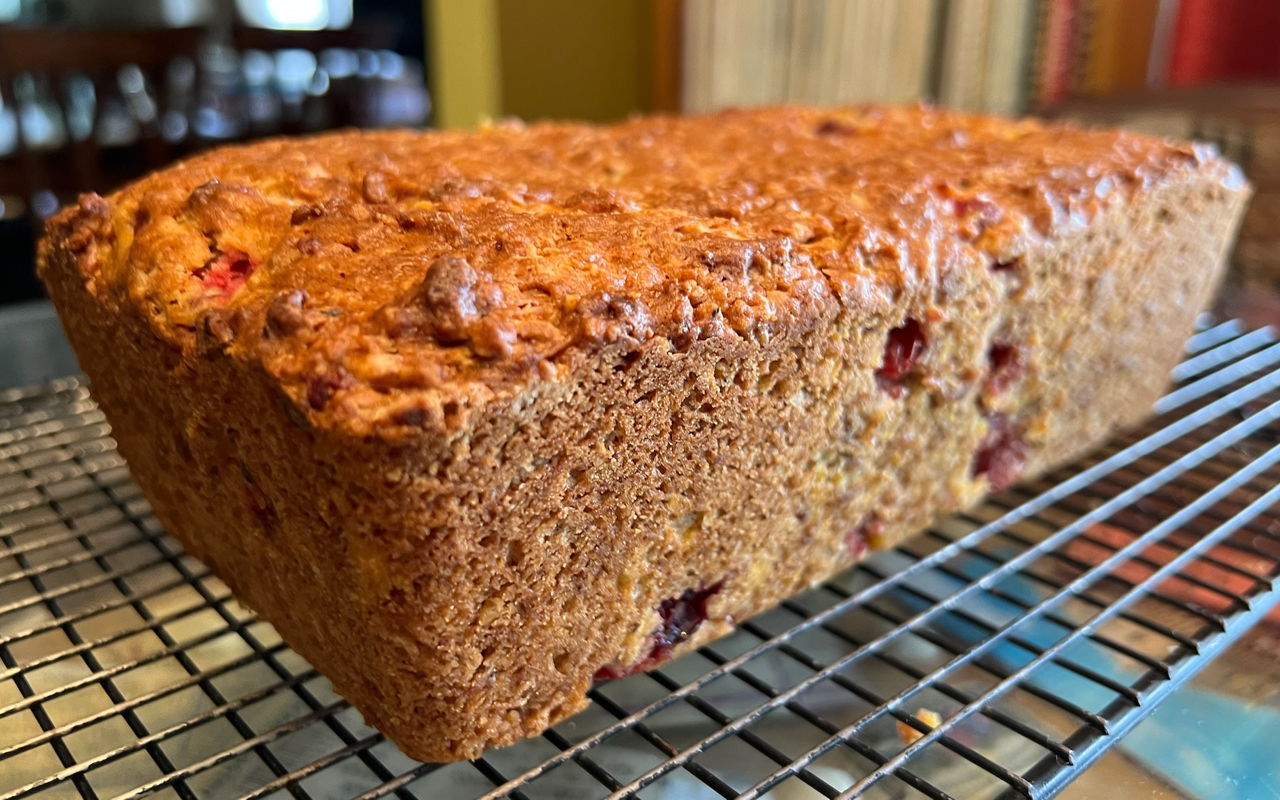
Cape Cod Cranberry Bread
Servings: 24
Preparation Time: 2 hours
Valerie Ohanian
Tempt Them with Tastier Foods: An Eddie Doucette Recipe Collection
Ingredients
- 1 small orange
- hot water
- 1-½ cups fresh cranberries
- 1 cup sugar
- 1 egg, well-beaten
- 2 cups flour
- 1-½ tsp baking powder
- 1 tsp salt
- ½ tsp baking soda
- 1 tsp cinnamon
- ¼ cup shortening
- ½ cup walnuts, chopped
Steps
- Cut small orange in eighths, discard seeds, and work the rind and flesh through the finest blade of a food chopper.
- Place in a measuring cup and add enough hot water to make one cup.
- Run the cranberries through the food chopper.
- Combine the orange, cranberries, sugar, and egg. Let stand.
- Meanwhile, sift the flour, baking powder, salt, soda, and cinnamon together.
- Cut the shortening into the flour with a pastry blender until the mixture resembles cornmeal.
- Pour in the cranberry mixture and stir the batter until the ingredients are just mixed. Do not beat.
- Fold in the chopped nuts.
- Spoon the batter into a greased 9x5x3 loaf pan.
- Let stand for 20 minutes.
- Bake in a 350° oven for 55-60 minutes or until tests done with pick.
- May be frozen.
I made Valerie Ohanian’s December 16, 1974, “North Coast… Kitchens” variation, which substitutes an orange run through a food chopper for Eddie Doucette’s orange juice and zest.
Since that recipe is a repeat, here’s a special recipe from my own childhood. Having all of these cornflakes left over from the Chicken That’s Different reminded me of a snack my mother used to make back in the early seventies. I don’t have a recipe; all I know is that there was butter, garlic, and salt in it (and possibly the garlic and salt were garlic salt). We ate it from paper cups.
If you crush the cornflakes first, this would make a great fried chicken coating. It would also make a great topping for a casserole. It’s possible that as kids we got this as leftovers from a coating mix she was making for that purpose. Or it’s possible she was just making us a great treat. Mom’s are nice that way sometimes.
For us, she always left the cornflakes whole. Since trying to recreate the recipe myself, I’ve eaten it with the cornflakes both crushed and whole; it’s great either way.
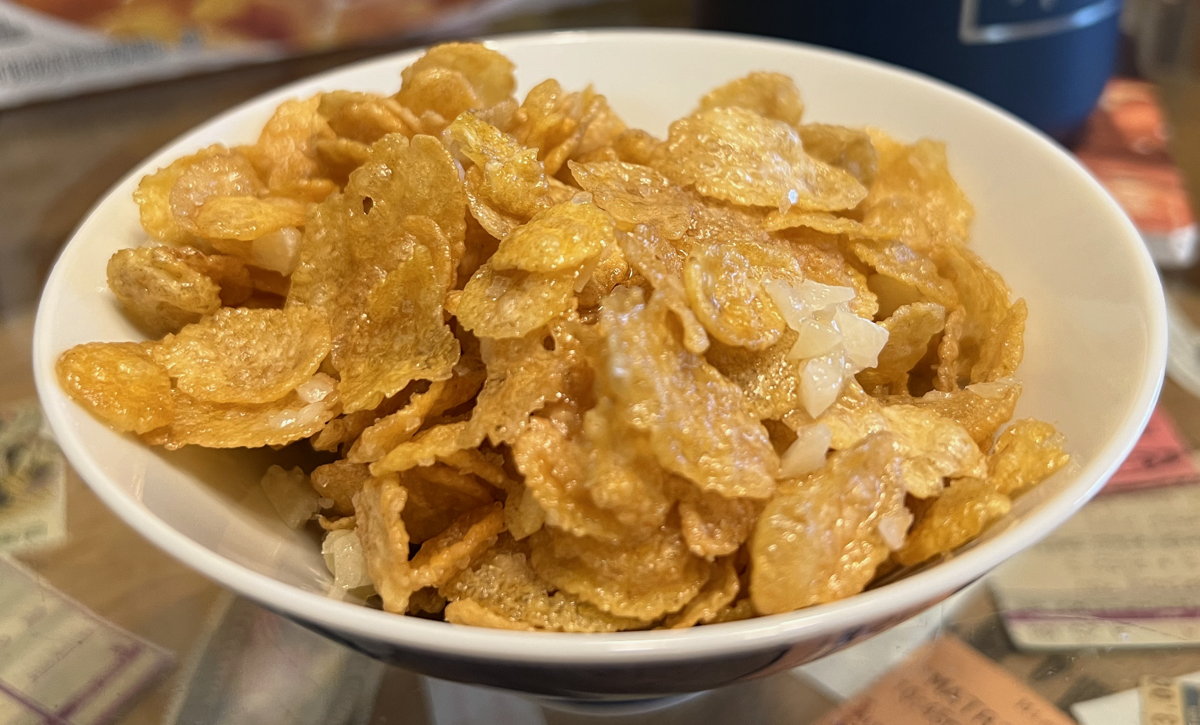
Garlic Cornflake Snack
Servings: 1
Preparation Time: 5 minutes
Kathy Stratton
Ingredients
- 1 oz (about 1 cup) cornflakes; crush if desired
- 1 tbsp butter
- 1 large clove garlic (about 0.20-0.25 oz)
- salt to taste
- pepper to taste (optional)
Steps
- Layer cornflakes, butter, and garlic in microwavable cup or bowl.
- Microwave about 30 seconds until butter is fully melted.
- Mix, salting (and optionally peppering) to taste.
- Serve hot.
If you like corn and you like garlic, it’s a wonderful snack—and very quick to make. So if you need a way to get rid of the box of cornflakes you bought for the chicken, consider this as an alternative to all of those (admittedly wonderful) cornflake candies and chocolates that also proliferated in the fifties and sixties.
In response to A home-cooking handful from Eddie Doucette: A glimpse at a long-lost 1952 or 1954 Chicagoland television cooking show, including recipes. They were typed by a viewer, so some of them require creative interpretation.
These inserts were common, and there were several in various markets, probably both geographically and by kind of periodical. In the Muskegon Chronicle that my family subscribed to, the insert was called Parade.
↑
- Eddie Doucette’s “Home Cooking” episode guide
- Home cooking episode guide gleaned from 1954 and 1955 Chicago-area TV Guides.
- A home-cooking handful from Eddie Doucette
- A glimpse at a long-lost 1952 or 1954 Chicagoland television cooking show, including recipes. They were typed by a viewer, so some of them require creative interpretation.
- Sweden’s Stuffed Cabbages from the Ottoman Empire: Max Miller at Tasting History with Max Miller
- Max prepares a stuffed cabbage—kaldolmar—imported to Sweden from the Ottomans, and describes how it got there along with its etymology.
- Tempt Them with Tastier Foods: Third Printing
- The third printing of my Eddie Doucette recipe collection features several new matchbook recipes, more recipes from his All-American Hot Dog pamphlet, and Chicken Dinner with a French Accent, among many more general recipes.
More Eddie Doucette
- Tempt Them with Tastier Foods: Third Printing
- The third printing of my Eddie Doucette recipe collection features several new matchbook recipes, more recipes from his All-American Hot Dog pamphlet, and Chicken Dinner with a French Accent, among many more general recipes.
- “He Was the Chef”: Remembering Eddie Doucette, Jr.
- Eddie Doucette grew up in New England. He learned his trade in his mother’s diner, in the summer schools of New England, and in better and better restaurants throughout Vermont and Massachusetts. Then he moved to Chicago to pioneer television cooking, which is how I discovered him.
- Tempt Them with Tastier Foods: Second Printing
- The second printing of Tempt Them with Tastier Foods contains several newly-discovered Eddie Doucette recipes, as well as an interview with the chef’s son, Eddie Doucette III.
- Eddie Doucette’s Potato Bread
- This is an amazing bread for breakfast or sandwiches, easily made in a bread machine. It’s a great choice for National Sandwich Day this Friday.
- Oktoberfest Sauerkraut for Potato Day
- This simple sauerkraut casserole turns into an amazing National Potato Day treat when topped with mashed potato.
- Four more pages with the topic Eddie Doucette, and other related pages
More television show
- Flowers o’er the Tory grave: Disney’s Francis Marion
- Walt Disney’s The Swamp Fox was an influential take on Francis Marion’s life—very possibly an influence on Mel Gibson’s The Patriot, too.
- Yes Minister: The Complete Collection
- If I had to subtitle this eighties political sitcom, I’d call it “Screwtape Politics”.