


The Rifleman at Bennington to the British Granadiers
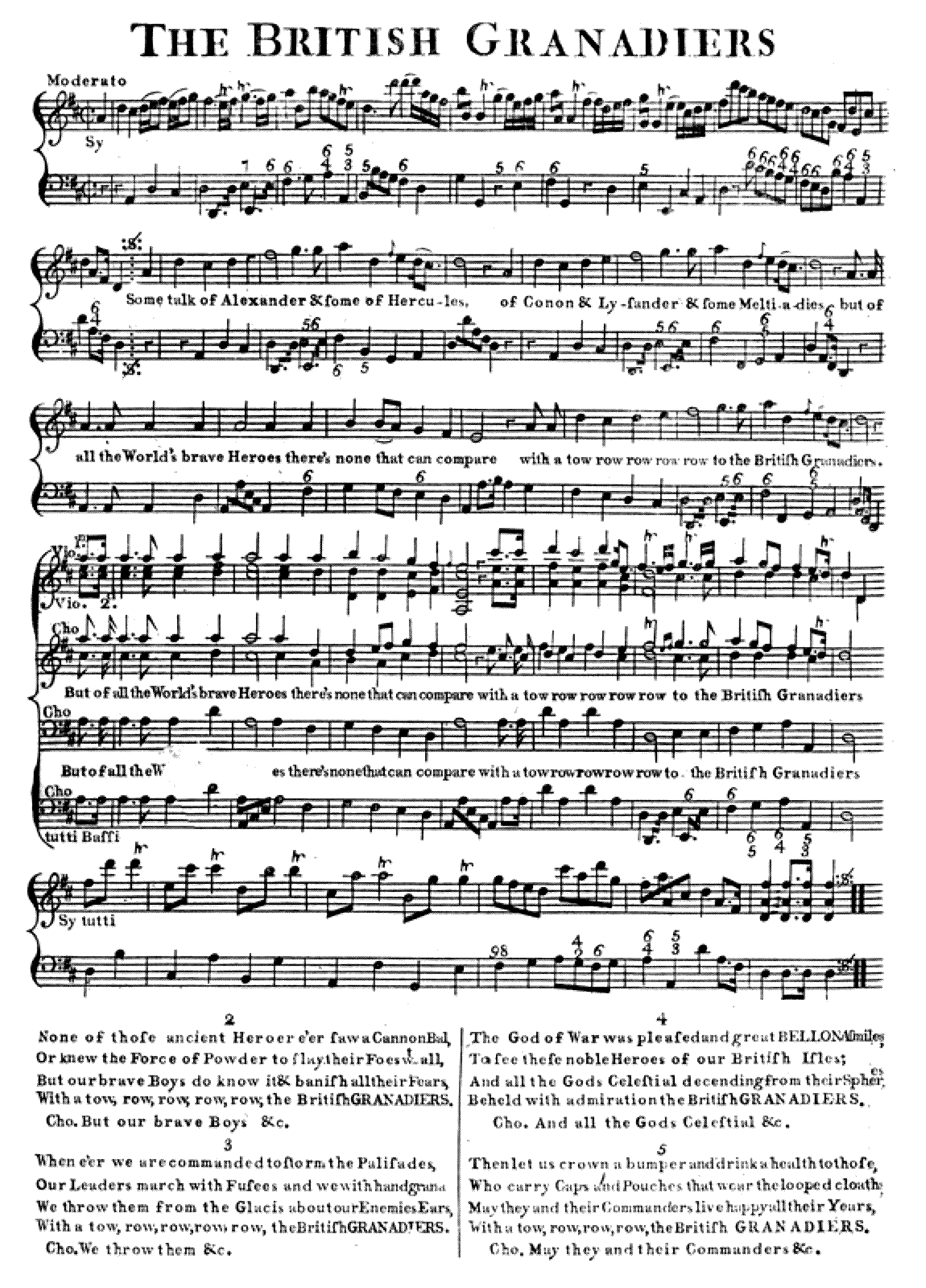
You can use this popular melody for The Rifleman’s Song at Bennington.
Sunday is the 199th anniversary of the 1777 Battle of Bennington. I marked the 198th last year, in the run-up to 2026, with Samuel B. Young’s 1819 commemoration speech. I first ran across the battle, however, unknowingly: from a song called “The Rifle” in Jerry Silverman’s How to Play the Guitar. It’s a rousing song and a striking demonstration of how Americans have always celebrated new technologies. And that’s what I meant to write about last year, before I discovered that the song was more commonly attributed to the Battle of Bennington.
So for me, at least, it’s fitting to bookend my Sestercentennial Year with Bennington, by finally getting a period melody down for this wonderful song. This is the end of the Sestercentennial celebrations on my blog, although not in my personal life.
This is also the official end of the Padgett Sunday Supper Club’s centennial-ish recipes. Some will continue throughout the year, and beyond. There are so many wonderful recipes in those centennial and bicentennial books, as well as in American Cookery and Thomas Jefferson’s Cook Book. But they’ll be there because they’re great recipes, not because they’re great centennial recipes.
Some of the founders were very much techies. I already wrote about how Jefferson incorporated technology into his kitchen. But one of the most relevant new technologies during the revolution was the rifle. Rifled barrels had much greater range than smoothbore muskets, at least twice—and up to three times—the range of older long guns. The rifle’s precision shooting was very suited to the tactics of America’s Indian-style wilderness fighters such as Francis Marion.
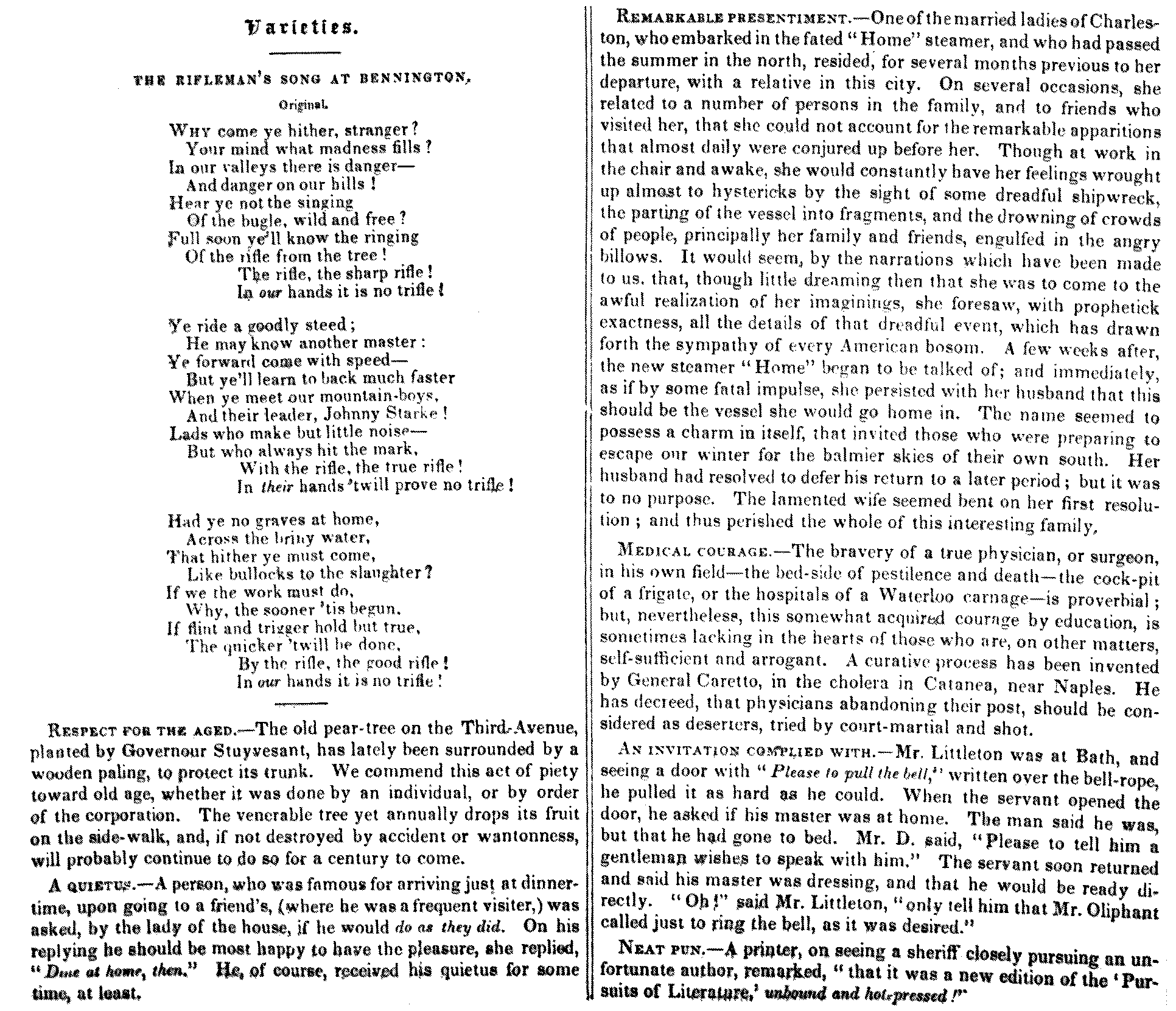
The original Rifleman’s Song, from the December 9, 1837, New-York Mirror.
Americans appear to have considered the rifle one of their advantages over the British from the start. Oscar Brand quoted, in Songs of ’76, the patriot Freeman’s Journal on its report of the British hiring mercenaries:
[The British government had] sent over to Germany to engage troops for American service, and succeeded in raising a legion of Jagers, people brought up in the use of the rifle-barrel guns, in boar hunting. They are amazingly expert, and the ministry plume themselves much in the thought of their being a complete match for the American riflemen.1
Was the British government worried about a rifle gap with the Americans? If that account is true, some Americans thought they were!
Perhaps the greatest example of praise for the rifle is The Rifleman’s Song at Bennington, alternately known, as I discovered it, as “The Rifle” and also as “The Riflemen of Bennington”. The lyrics are commonly attributed to William McCarty’s 1842 Songs, Odes, and Other Poems, on National Subjects. McCarty attributes them not to a Bennington, Vermont source but to The New York Mirror.
The earliest reference to the lyrics I can find on newspapers.com is in the December 19, 1837, Vermont Gazette. They also attribute it to the Mirror. The lyrics/poem then appeared in several newspapers through January 1838, with one straggler in June.
| New-York Mirror | New York, New York | December 9, 1837 |
| Vermont Gazette | Bennington, Vermont | December 19, 1837 |
| The Enterprise and Vermonter | Vergennes, Vermont | December 27, 1837 |
| The Madisonian | Washington, DC | January 3, 1838 |
| Richmond Enquirer | Richmond, Virginia | January 6, 1838 |
| The Weekly Standard | Raleigh, North Carolina | January 17, 1838 |
| Burlington Sentinel | Burlington, Vermont | June 25, 1838 |
The actual first publication seems to be the December 9, 1837, New-York Mirror, “A Weekly Journal, Devoted to Literature and the Fine Arts”. It appears on page 192 of the annual or biennial collection.
The Mirror, the Gazette, and all of the newspapers of 1837-1838 title it “The Rifleman’s Song at Bennington” with no year; the Mirror labels it “Original”, and the rest label it as from the New York Mirror. McCarty’s “1777” is likely a reference added by McCarty to the year of the battle, which was in 1777.
While the Mirror labels their poem as “original”, it doesn’t say who wrote it. So while it probably originated around that time, it might have been older, or older in a different form. It sounds like a folk song, like something that could have been made up on the march by a band of riflemen in the hills. That probably helps explain its popularity. The Rifleman’s Song at Bennington is the kind of song that could well have been sung long before it was printed.
| The New-York Mirror, 1837 | Vermont Gazette, 1837 | The Enterprise and Vermonter, 1837 | William McCarty, 1842 |
|---|---|---|---|
| THE RIFLEMAN’S SONG AT BENNINGTON. Original. Why come ye hither, stranger? Your mind what madness fills? In our valleys there is danger— And danger on our hills! Hear ye not the singing Of the bugle, wild and free? Full soon ye’ll know the ringing Of the rifle from the tree! The rifle, the sharp rifle! In our hands it is no trifle! Ye ride a goodly steed; He may know another master: Ye forward come with speed— But ye’ll learn to back much faster When ye meet our mountain-boys, And their leader, Johnny Starke! Lads who make but little noise— But who always hit the mark, With the rifle, the true rifle! In their hands ’twill prove no trifle! Had ye no graves at home, Across the briny water, That hither ye must come, Like bullocks to the slaughter? If we the work must do, Why, the sooner ’tis begun, If flint and trigger hold but true, The quicker ’twill be done, By the rifle, the good rifle! In our hands it is no trifle! | THE RIFLEMAN’S SONG at BENNINGTON New York Mirror. Why come ye hither, stranger? Your mind what madness fills? In our valleys there is danger— And danger on our hills! Hear ye not the singing missing line missing line Of the rifle from the tree! The rifle, the sharp rifle! In our hands it is no trifle! Ye ride a goodly steed; He may know another master: Ye forward come with speed— But ye’ill learn to back much faster When ye meet our mountain boys, And their leader, Johnny Starke! Lads who make but little noise— But always hit the mark, With the rifle, the true rifle! In their hands ’twill prove no trifle! Had ye no graves at home, Across the briny water, That hither ye must come, Like bullocks to the slaughter? If we the work must do, Why, the sooner ’tis begun, If flint and trigger hold but true, The quicker ’twill be done, By the rifle, the good rifle! In our hands it is no trifle! | From the New York Mirror THE RIFLEMAN’S SONG AT BENNINGTON Why come ye hither, stranger? Your mind what madness fills? In our valleys there is danger, And danger on our hills! Hear ye not the singing Of the bugle, wild and free? Full soon ye’ll know the ringing Of the rifle from the tree! The rifle, the sharp rifle! In our hands it is no trifle! Ye ride a goodly steed— He may know another master: Ye forward come with speed, But you’ll learn to back much faster When ye meet our mountain boys, And their leader, Johnny Starke! Lads who make but little noise, But who always hit the mark With the rifle, the true rifle! In their hands ’twill prove no trifle! Had ye no graves at home, Across the briny water, That hither ye must come, Like bullocks to the slaughter? If we the work must do, Why the sooner ’tis begun, If flint and trigger hold but true, The quicker ’twill be done By the rifle, the good rifle! In our hands it is no trifle! | From the New York Mirror. THE RIFLEMAN’S SONG AT BENNINGTON.—1777 Why come ye hither, stranger? Your mind what madness fills? In our valleys there is danger, And danger on our hills! Hear ye not the singing Of the bugle, wild and free? Full soon ye’ll know the ringing Of the rifle from the tree! The rifle, the sharp rifle! In our hands it is no trifle! Ye ride a goodly steed; He may know another master: Ye forward come with speed, But ye’ll learn to back much faster, When ye meet our mountain boys And their leader, Johnny Starke! Lads who make but little noise, But who always hit the mark With the rifle, the true rifle! In their hands will prove no trifle! Had ye no graves at home Across the briny water, That hither ye must come, Like bullocks to the slaughter? If we the work must do, Why, the sooner ’tis begun, If flint and trigger hold but true, The quicker ’twill be done By the rifle, the good rifle! In our hands it is no trifle! |
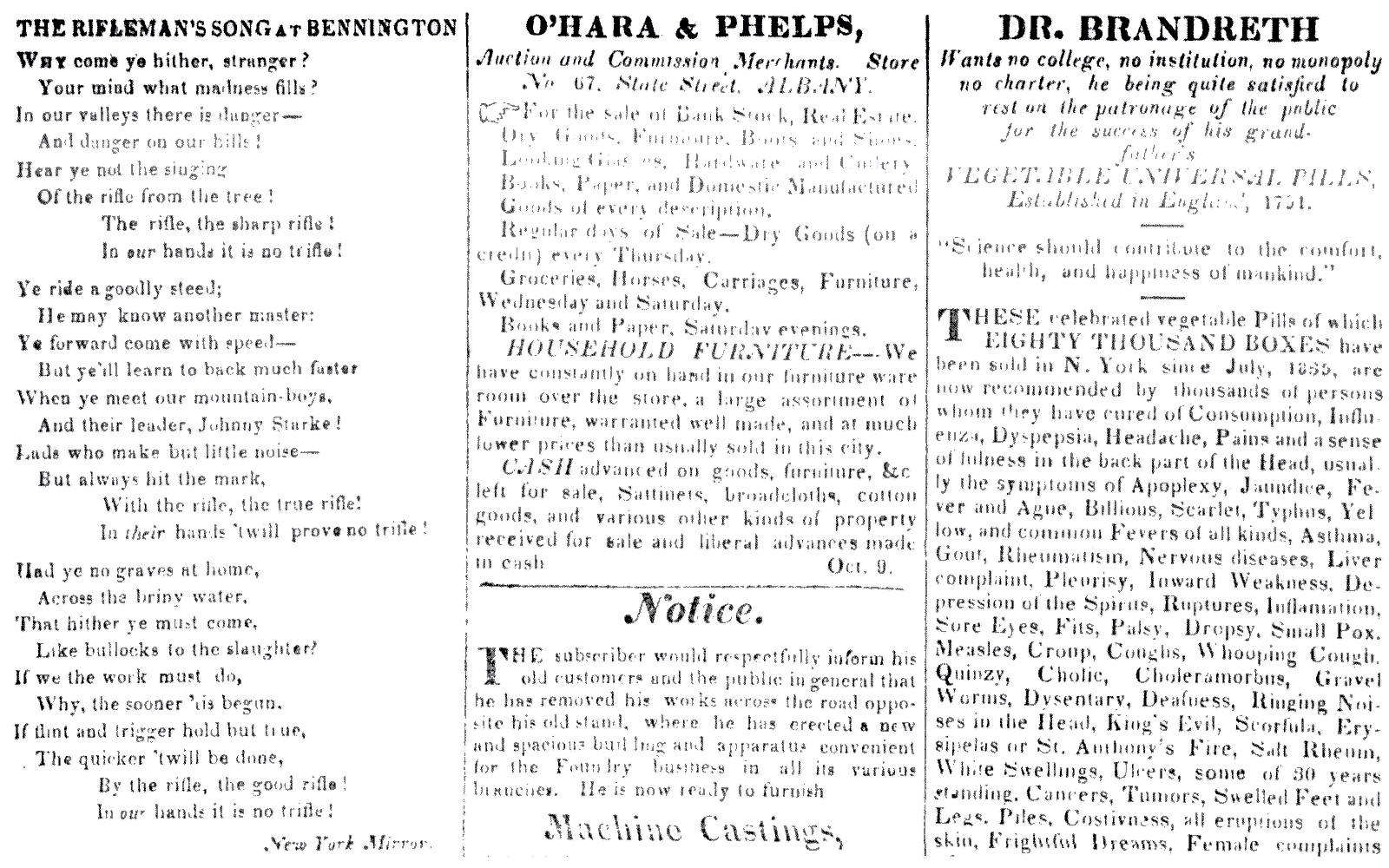
The first reprinting that I could find, with two lines missing. From the Vermont Gazette, December 19, 1837.
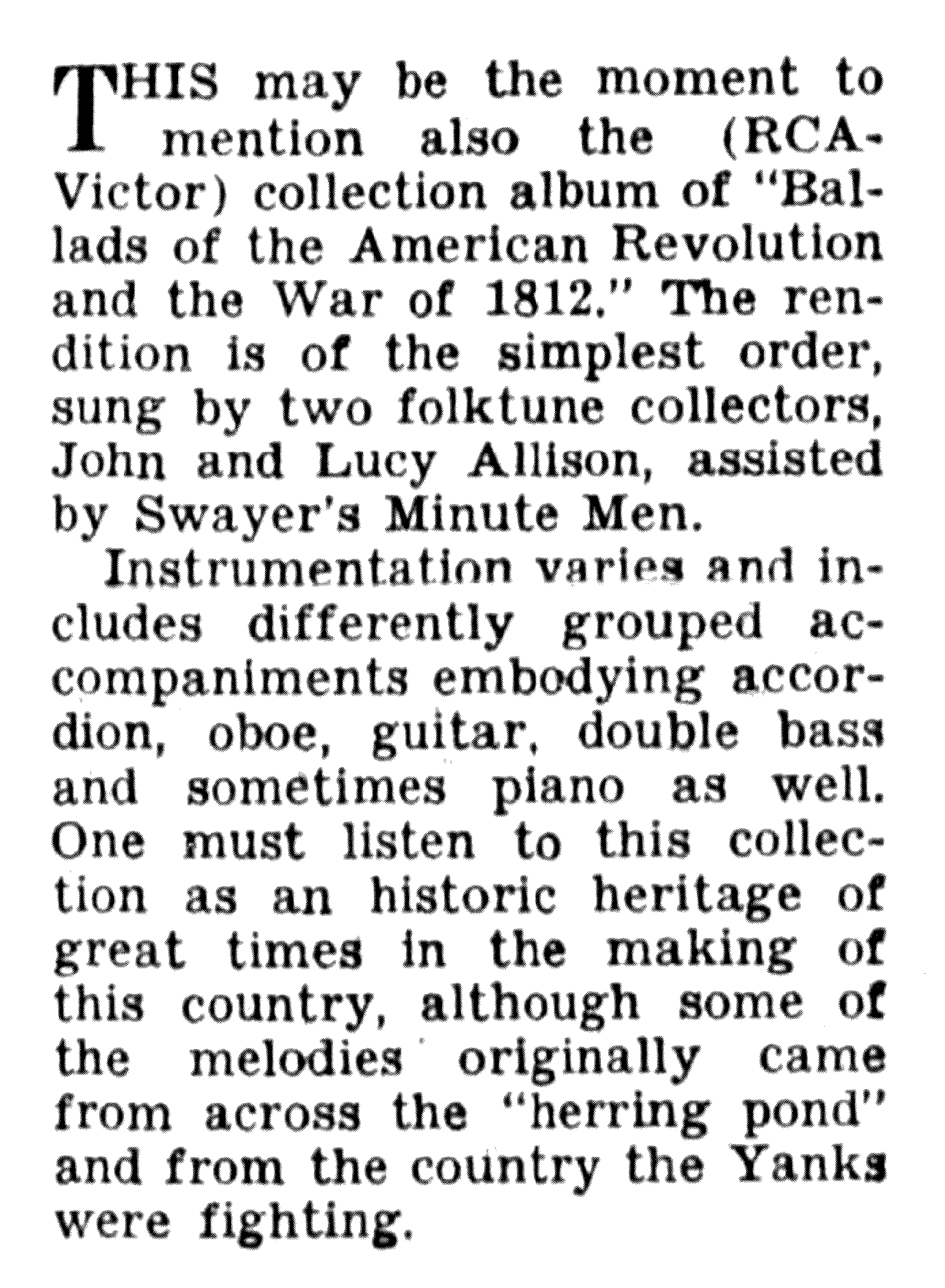
From the April 25, 1940, “Stage and Screen” section of the Los Angeles Daily News, this is a very rare album.
Except for bits of punctuation and emphasis, there is practically no difference in these four lyrics. The Vermont Gazette uses “ye’ill” instead of “ye”, but I suspect a typesetter’s error. The Enterprise and Vermonter, oddly, used “you’ll”, despite keeping “ye” for all of the non-contractions. Possibly more deliberately, McCarty changed “’twill” to “will” in “’twill prove no trifle”, but kept it in “the quicker ’twill be done”.
The Vermont Gazette also leaves out “who” in “But who always hit the mark”, and again I’m suspecting an exuberant typesetter more than a deliberate change. Both of the Gazette’s errors indicate that later sources weren’t copying from the Vermont Gazette but from The New-York Mirror itself.
Also interesting are some of the changes over the years. These changes extend even to the title. Silverman titled the song merely “The Rifle”, which is why I had no idea it was specific to Bennington until writing last year’s post. Others pluralize Rifleman to Riflemen.
The modern versions of the lyrics appear to have come from John Allison in 1940 or so with the album Ballads of the American Revolution and the War of 1812. However, I have not been able to find a copy or archive of that album.
In the newer versions, instead of singing to an individual “stranger” the song is sung to a mass of “Redcoats”. The original is certainly an interesting variation on insult! Calling them “stranger” specifically says, you don’t belong here, go away! But the change from singular to plural in the modern version is also interesting.
Other changes include “in our hills” instead of “on our hills”. The latter conjures up images of mountaineers, where the former, to me at least, merely hilly forests.
And more weirdly, modern versions change “Ye ride a goodly steed; He may know another master…” to “Ye may know another master.” Was the original poet making the point that their horses and equipment were all owned by the Crown, instead of being the property of the individual?
The modern lyrics also get rid of the variations in the refrain.
The modern version of The Rifleman’s Song is accompanied by a wonderful tune; as I noted earlier I first ran across it in Jerry Silverman’s guitar tutorial. It’s available in other places as well, all of them using the melody that appeared with John Allison’s version.2 This melody appears to be a creation of Allison. I don’t know if this song was actually sung in 1837 (and found no evidence it was older than 1837) but if it was, it doesn’t seem to have been with that tune.
Because I hadn’t yet found the original version in the Mirror, I chose the version from the Vergennes Enterprise and Vermonter and the Bennington Vermont Gazette for A Sestercentennial Cookery. Both papers introduced potential typos, so I combined them into one non-typoed version. For this post, however, I assumed the New-York Mirror version when searching for a melody.
And finding a period-appropriate melody, whether for 1777 or 1837, was difficult. Some writers cite Allison or McCarty as the author of the lyrics with the melody as traditional; this is backward. The lyrics definitely appeared by 1837, over a century before Allison’s version. While it’s possible that Allison used an existing “traditional” melody, I can’t find any reference to one before him. All melodies seem to be both (a) from after 1939 and (b) variations on Allison’s melody.
I am convinced that there had to be a melody from the start. While the lyrics are often listed under poetry in the early newspaper incarnations, from its earliest printing in the New-York Mirror it is very clearly a song. It has a repeated refrain and the kinds of repetitions elsewhere that only make sense in songs.
Songs were often printed without melodies in the seventeenth and eighteenth centuries, especially songs like this. Go onto the Internet Archive and there are hundreds of old “song” books and even “melody” books that contain no actual music.
Sadly, the lyrics don’t fit the ubiquitous Yankee Doodle Dandy.
I even resorted to using AI. The AI Overview on Google kept giving ridiculously off-topic “answers” to my attempts at searching, so I decided to give it an actual question and see if it could respond usefully. It suggested, as period-appropriate melodies: “The Cruel War is Raging”; “The Girl I Left Behind Me”, and “Yankee Doodle Dandy”.
Ignoring the obvious that the AI didn’t appear to know that melodies of that era had their own names (it probably doesn’t know what an era or period is either), I already knew that “Yankee Doodle” is laughably bad for these lyrics. “The Cruel War is Raging” might well work, but I can’t find any period melody for it either—all of the melodies for “The Cruel War is Raging” that I’ve been able to find appear to be from the folk music era of the sixties.
There’s a melody for “The Girl I Left Behind Me” dated to 1894 that itself suggests a 1760 origin, though this may be for the lyrics. The melody actually does sort of fit, from a metrical standpoint. In fact, if you ignore the meaning of the words, and the chorus, it fits The Rifleman’s Song quite well. It has nowhere near the appropriate spirit of Allison’s melody. “The Girl I Left Behind Me” is a plaintive love song. That is not what The Rifleman’s Song at Bennington needs.
So I pulled out Oscar Brand’s Songs of ’76. He doesn’t include The Rifleman’s Song but what I did was go through and sing, to Allison’s modern melody, each of the songs in the book. Most of the time the lyrics didn’t fit at all, and I’d go on to the next. But I ended up with a short list of songs that could fit Allison’s melody. I then looked up period melodies for the Brand songs that fit, hoping that the reverse would also be true, that The Rifleman’s Song would fit any melody whose lyrics fit the modern Rifleman’s Song melody.
The obvious choice came from the very first song in Brand’s book: American Taxation. American Taxation was, in its time, very likely sung to the same melody as that used for the popular British Grenadiers. That melody actually started as a tune for “All You That Love Good Fellows”, but it was through the popularity of Grenadiers that “the tune quickly became widely known in Britain and America, a staple as a march and a melody for topical song lyrics.”
I found two pieces of sheet music for British Grenadiers, one attributed to “ca. 1775” by the Isaiah Thomas Broadside Ballads Project, and one from the late 1800s published by the W. Marshall & Co. of London. The latter is undated, but the “popular songs and ballads” listed for purchase on the back include some from 1866 (Arabian Love Song, by the pseudonymous Julian Mount) and 1872 (Close the Shutters, Willie’s Dead, a wonderful title).
Either of those arrangements of “British Grenadiers” do in fact fit The Rifleman’s Song easily. Since The Rifleman’s Song must be from somewhere between 1777 (when the battle took place) to 1837 (its original appearance in the Mirror), I chose the earlier one (PNG, 348.5 KB). It’s also a livelier arrangement, which is both more appropriate for the lyrics and more fun to do up in GarageBand with my piano script.
Probably the biggest difference between the British Grenadiers melody and the modern Rifleman melody is that Grenadiers is a much more joyful tune.
As with the modern versions of the song, at least the one I learned from Silverman’s book, the chorus is sung twice. Those are the final two lines of each verse; they differ slightly in the original poem, but only slightly:
- The rifle, the sharp rifle!
- In our hands it is no trifle!
- With the rifle, the true rifle!
- In their hands ’twill prove no trifle!
- By the rifle, the good rifle!
- In our hands it is no trifle!
For the slideshow, I chose to go with American riflemen over the years, mostly the World Wars. The two photos under the outro are modern tributes to soldiers of World War II. The intro begins with rifle-wielding patriots at Long Island, then Bennington, then a portrait of “Johnny Stark” himself.
I created the slideshow in iMovie, which is not really designed for longer slideshows—it requires adjusting the length of each photo individually. The music, as usual, I created by using my piano script from 42 Astounding Scripts. I generated separate MIDI files for the treble and clef staves of each of the intro, verse, and outro. I pulled the MIDI files into GarageBand and assigned musical instruments to each.
| File | Treble | Bass |
|---|---|---|
| Intro | French Horns | Tuba |
| Verses | Saxophone | Harp |
| Outro | Steinway Grand | Steinway Grand |
I would’ve really liked to go with a fiddle, fife, and maybe even some drums, but not only does GarageBand not have a fiddle, it doesn’t even really have a violin, just a violin combo. Still, I like the way it turned out, and the Isaiah Thomas arrangement isn’t meant for simple instruments anyway.
The MP3 of the tune is just the verse, to make it easier to match the words with the melody. Note that there are still some flourishes in the melody, so you may have to experiment to get it to match exactly for singing. The archive (Zip file, 4.0 MB) contains the piano files, the MIDI files, the sheet music, and the melody for the verse, as well as the original 1837 lyrics.
Enjoy (Zip file, 4.0 MB), and I hope you’ve been having and continue to have a wonderful 250th celebration summer!
In response to Songs of the American Revolution: Various songs, and the history of the songs, that made the Revolution—sometimes decades later.
Songs of ’76, page 62. Brand describes the Freeman’s Journal merely as “a Rebel publication”. There have been multiple publications with that name, at least one even in Ireland. I trust music book histories about as much as I trust cookbook histories, which is to say, not at all. I was unable to find an original for this. However, there is a matching quote attributed to The Constitutional Gazette of April 19, 1776, in Danske Dandridge’s 1910 American Prisoners of the Revolution. See page 95.
↑Or at least, all modern versions with an attribution attribute the melody to Allison. But as I wrote, I have not heard Allison’s version, only subsequent ones.
↑
downloads
- The British Grenadiers sheet music (PNG, 348.5 KB)
- Sheet music for The British Grenadiers, with lyrics.
- The Rifleman’s Song at Bennington (The British Grenadiers): Jerry Stratton at Mimsy@YouTube
- “The British Grenadiers works well as a melody for The Rifleman’s Song at Bennington, and would be period appropriate assuming an 1837 or so origin date for the lyrics.”
- The Rifleman’s Song at Bennington MIDI and piano files (Zip file, 4.0 MB)
-
The
pianofiles for The Rifleman’s Song, and the MIDI files they created, along with an mp3 of the verse, the sheet music, and the 1837 lyrics. - The Rifleman’s Song melody (verse only)
- The verse of the British Grenadiers, for the Rifleman’s Song at Bennington.
American Revolution
- American Prisoners of the Revolution at Internet Archive (ebook)
- “It is for the sake of the martyrs of the prisons themselves that this work has been executed. It is because we, as a people, ought to know what was endured…”
- The Battle of the Kegs
- The Battle of the Kegs took place on January 5 or 6, 1778. Soon after, Francis Hopkinson wrote this wonderful account of the debacle, including very personal details about the British General in charge!
- Mock the Wind and Sing of Marion’s Men
- “In Lexington, the center of revolt against the King…” One of the most modern figures of the American Revolution was a slaveholder and Indian fighter with a superhero name.
- Our lot is cast in this happy land…
- Samuel B. Young’s August 16, 1819, Oration to commemorate the 1777 Battle of Bennington.
firearms
- Muskets & Rifles of the American Revolution: Difference and Tactics: Harry Schenawolf
- “In 18th century warfare, there were two types of weapons carried into battle: the smooth-bore musket and the grove-bore rifle. Both had their strengths and weaknesses.”
- Rifle vs. Musket—19th Century Military History: Matt Easton at Schola Gladiatoria
- “Looking specifically at the P1853 Rifle vs the East India Company Model F smoothbore musket here, but considering the wider implications of gun development in the middle of the 19th century.”
music
- 42 Astoundingly Useful Scripts and Automations for the Macintosh
- MacOS uses Perl, Python, AppleScript, and Automator and you can write scripts in all of these. Build a talking alarm. Roll dice. Preflight your social media comments. Play music and create ASCII art. Get your retro on and bring your Macintosh into the world of tomorrow with 42 Astoundingly Useful Scripts and Automations for the Macintosh!
- American taxation: a song of seventy-nine at Isaiah Thomas Broadside Ballads Project
- “While parts of this song might have been written in the 1760s when taxation was the major issue, this version of the text probably dates from 1779, as the subtitle suggests.”
- American War Ballads and Lyrics: George Cary Eggleston at Internet Archive (ebook)
- “A collection of the songs and ballads of the Colonial Wars, the Revolution, the War of 1812-15, the War with Mexico and the Civil War. Volume 1. 1889.”
- Songs and Ballads of the American Revolution: Frank Moore at Internet Archive (ebook)
- “With notes and illustrations, 1856.”
- Songs of the Revolution: Samuel Eben Barney at Internet Archive (ebook)
- “A paper read before the General David Humphreys Branch of the Connecticut Society of the Sons of the American Revolution. May Twenty-Ninth, 1893.”
- Songs of ’76: Oscar Brand at Internet Archive (hardcover)
- “A Folksinger’s History of the Revolution… Being a compendium of music and verses, patriotic and treasonous, sung both by the Rebels and the adherents of His Royal Majesty George III.”
- Songs, Odes, and Other Poems, on National Subjects: William McCarty at Internet Archive (ebook)
- “Compiled from various sources, Part Third—Military. 1842.”
Rifleman’s Song
- Original Rifleman’s Song at Bennington (PNG, 149.2 KB)
- From the December 9, 1837 New-York Mirror.
- How to play the guitar: Jerry Silverman at Internet Archive
-
 “A self-teaching book for anyone who wants to learn to play the guitar—folk, blues, calypso, and flamenco styles.”
- The New-York Mirror Volume XV 1837 at HathiTrust Digital Library
- “A Weekly Journal Devoted to Literature and the Fine Arts. Embellished with Engravings and Music. Volume XV. 1837.”
- Rifleman’s Song of Bennington
- “…by John and Lucy Allison with Sawyer’s Minute Men. First recorded on: December 11, 1939. Released on: Ballads of the American Revolution and the War of 1812.”
- Riflemen of Bennington
- “Why come ye hither, Redcoats?” Performed by The Committee of Correspondence.
- Sheet Music for “The British Granadiers” at Isaiah Thomas Broadside Ballads Project
- “The British Granadiers ([London: ca. 1775]). Courtesy Marshall Collection, Houghton Library, Harvard University.”
food
- A Monticello Meal for Independence Day
- Marie Kimball’s Thomas Jefferson’s Cook Book provides several pot-luck friendly dishes for your Fourth of July celebration this Semiquincentennial.
- Padgett Sunday Supper Club
- Dedicated to the preservation of vintage recipes.
- Padgett Sunday Supper Club Sestercentennial Cookery
- The Sestercentennial Cookery is a celebration of American home cooking for the 250th anniversary of America’s Declaration of Independence.
- A Vicennial Meal for the Sestercentennial
- In 1776 we were too busy to write commemorative cookbooks. But in 1796 “Amelia Simmons, American Orphan” published the first known American cookbook. It’s a celebration of American foods, American values, and American economies.
More Battle of Bennington
- Our lot is cast in this happy land…
- Samuel B. Young’s August 16, 1819, Oration to commemorate the 1777 Battle of Bennington.
More music
- The music industry vs. itself
- Yet again, music industry executives are complaining that Apple, by making the iPod easy to use and by complying with the industry’s demand for restricting music, is standing in the way of progress.
- M-Audio FireWire Audiophile
- M-Audio’s FireWire Audiophile is a neat little device that adds high quality audio in and out via FireWire.
- Importing vinyl into iTunes
- This script takes songs split by marker from SoundStudio and converts them directly into iTunes, setting track number, track total, and album name along with the song title.
- Napster on owning music vs. renting music
- Napster president Brad Duea says that owning music isn’t the point, we should just be happy for the experience of being around music.
- iTunes Alarm
- Set up iTunes to start playing at a specified time, but to not play if you are on vacation and want to sleep in.
- Two more pages with the topic music, and other related pages
More A Sestercentennial Year
- News on the Deaths of Adams and Jefferson
- “Such men need no trophies; they ask no splendid mausoleum. We are their Monument: their mausoleum is their Country.” John Adams and Thomas Jefferson’s death on the same day, 50 years to the day from the first July 4, was an inspiration to a young nation.
- No Common Spirits: Jefferson and Adams survive
- Adams and Jefferson both dying on the Jubilee was hailed as “a most singular coincidence… A more signal and impressive combination of circumstances is not to be found… Nothing so sublime could have been conceived by human thought… Who does not envy such a death after such a life?”
- A Monticello Meal for Independence Day
- Marie Kimball’s Thomas Jefferson’s Cook Book provides several pot-luck friendly dishes for your Fourth of July celebration this Semiquincentennial.
- Flowers o’er the Tory grave: Disney’s Francis Marion
- Walt Disney’s The Swamp Fox was an influential take on Francis Marion’s life—very possibly an influence on Mel Gibson’s The Patriot, too.
- Mock the Wind and Sing of Marion’s Men
- “In Lexington, the center of revolt against the King…” One of the most modern figures of the American Revolution was a slaveholder and Indian fighter with a superhero name.
- Seven more pages with the topic A Sestercentennial Year, and other related pages