


Punishing low-tax states
Internet sales tax proposals are a penalty against states that have lower sales taxes. They are meant to reduce the desirability for a state to end sales tax and to reduce the incentive for keeping taxes simple. Further, they are an anti-competitive measure meant to reduce the growth of competition.
An Internet sales tax levied according to the buyer’s location is a disincentive for states to lower or simplify their sales taxes in order to attract businesses. Under the current system, a business can easily cut their legal costs by setting up in a state that has no sales tax or that has a simple tax. But with an Internet tax that requires every Internet business to collect taxes according to the location of the buyer, any business that does any Internet sales will still have to pay accountants to keep them in line with sales taxes in the other 49 states.
For as long as I can remember, high-tax states have complained about the “mail order loophole” that allows consumers to bypass state taxes. I have a suspicion that the complaint isn’t so much about lost revenue, but about wanting to punish states that have lower sales taxes and are thus more desirable for mail-order businesses.
Before the Internet, such jealousy was low-key, because mail order, while a big business, wasn’t nearly as big as it is now. Today, though, that desire for punishment is growing stronger.
Established retailers like sales taxes
One of the reasons that a company like Amazon could make it big on the Internet without hiring lots of lawyers is that they set up in Oregon, a state with no sales tax. Young Amazon didn’t have to worry about Oregon sales tax because Oregon doesn’t have any, and they didn’t have to worry about other sales taxes because that wasn’t their responsibility. Making it their responsibility is a way of keeping businesses out of Oregon. But it’s also
One of the reasons that a company like Amazon could make it big on the Internet without hiring lots of lawyers is that they set up in a single state. Young Amazon didn’t have to worry about sales taxes in 49 states or thousands of municipalities because that wasn’t their responsibility. Making it their responsibility is a way of protecting bigger companies from upstarts such as Amazon once was. Having to take into account fifty sales taxes—or, worse, thousands of municipalities—instead of one or none makes it more complicated to create a small business. This means that the consumer loses. The consumer loses not just because of having to pay taxes, but because there is less competition and less innovation.
I doubt that larger retailers care one way or another about an Internet sales tax. Some probably welcome it, precisely because it will increase the expense of competing with them. The price Wal-Mart will have to pay to conform with dozens of local sales taxes will be a small percentage of their business, but it will be money well spent if it discourages another Amazon from starting up. Wal-Mart may well have to handle them anyway because of its physical presence in most states.
Yet another privacy issue
Once the federal government starts collecting a sales tax for distribution to states, they will also want to be able to verify, later, that sales taxes were correctly collected. This will mean keeping track of who buys what from whom. Companies will be required by law to not only keep sales records, but to show them to tax agents with no warrant and no accountability.
Even if an Internet sales tax is inevitable, if it is to protect innovation it must be kept simple and it must allow for competition. If it is to protect the consumer, it must protect privacy.
One reason for the complexity of Internet sales tax proposals is that everyone assumes that an Internet sales tax must be based on the purchaser’s location. This is great for punishing low-tax states and for restricting competition, but the best solution is the simple solution: tax based on the seller’s location rather than the buyer’s. Every new business will know exactly what sales tax they need to charge for any sale: whatever sales tax they charge for their local customers.
Once a month, they’ll bundle up all of their sales taxes with a list of zip codes and amounts and send that to their state’s sales tax force. One sales tax to collect, one place to send it.
Each state’s sales tax force will, once a month, aggregate all of the out-of-state taxes they’ve collected with all of the zip code lists and send them to the appropriate states. There should be no direct contact between the seller and the state or local government of the place they’re sending to. No one in zip code 92103 need know that I purchased an inflatable Miss Piggy doll. They won’t even know that anyone in their zip code purchased anything from Inflated Piggies Limited. All they’ll know is that someone or some ones in their zip code paid some sales taxes to New York companies.
States with no sales tax will have it easy. They won’t have to collect anything. States with lots of sales tax will do what they always did: collect money and pass it around. Startups will not need to pay license fees and tax professionals in order to stay abreast of taxes around the country.
We’ll maintain the free market in economies that encourages innovation in the United States. We’ll maintain privacy. And we won’t discourage individuals and small businesses from competing with larger companies.
- April 1, 2020: Origin vs. Destination sales taxes: where should Internet taxes go?
-
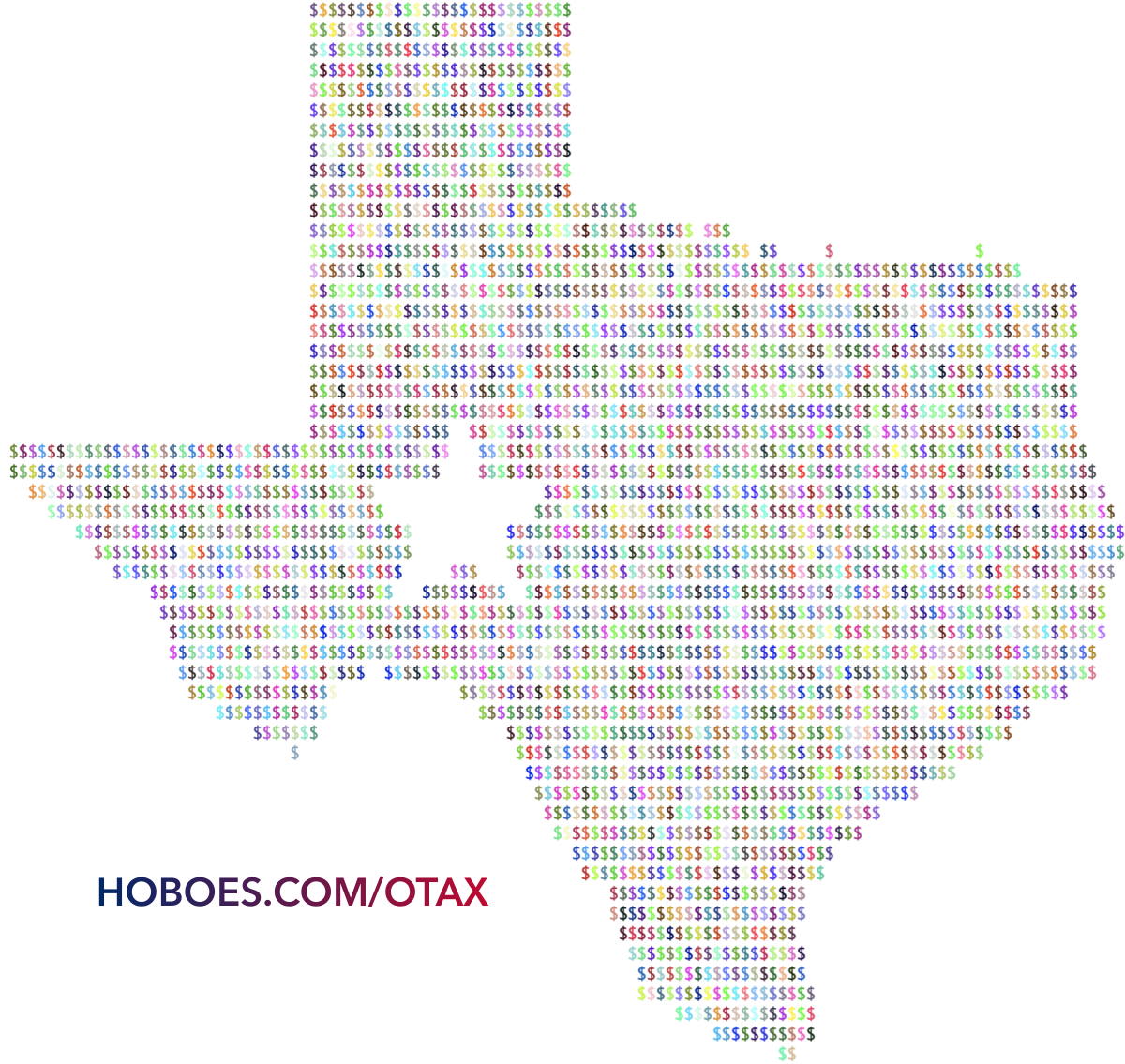
Destination-based sales tax means knowing the exact color of every dollar sign, or face fines, court costs, even imprisonment.
I’m still discovering amazing ways that Texas does things right, such as zero-based budgeting. It uses the remarkably sane, for politicians, rubric of starting a budget with how much money you have, not how much you want to spend. Recently, I discovered that Texas also uses what are called origin-based sales taxes instead of destination-based.
I didn’t know anyone was using this when I wrote in Punishing low-tax states back in 2006 that the obvious solution for Internet taxes was levying sales taxes based on the seller’s location rather than the buyer’s. It’s great to hear that my home state uses the simpler, more intelligent system.1
An origin-based sales tax is simpler to calculate, harder to pass the buck on, and more protective of our privacy. So, of course, politicians hate it. Texas Comptroller Glenn Hegar wants Texas to change to the more complicated system:
…as e-commerce continues to grow, more and more taxpayers will begin to ask why they are paying local sales taxes that are not going to their local communities and instead are going to some far away city.
This makes no sense. When someone drives from Round Rock to Burnet to buy something, they are not confused about where the sales tax goes. The same should be true of buying something from a Burnet seller online.
According to the article, “Texas is an origin-sourced sales state, meaning taxes are remitted where the seller is located.” That’s the natural way to assume that sales taxes work. Making taxes go to where the purchaser lives rather than where the seller lives is the confusing policy. It makes no sense, it complicates the otherwise simple process of multiplying one number by one other number.
- November 29, 2014: National Review supports seller-location-based sales tax
-
I am no longer the lone wilderness voice crying for sales tax based on the seller’s location rather than the buyer’s. From the December 8, 2014 issue of National Review’s non-bylined The Week on John Boehner’s decision not to fast-track an Internet sales tax bill:
They say it’s only fair, since brick-and-mortar stores charge sales taxes. Those stores want to make it easier to tax Internet sales too. And the federal government should act. But it should make sales taxes follow the seller’s location rather than the buyer’s. That way competitive pressure will moderate tax levels: A state that wants the next Amazon to locate in its borders will have an incentive to keep sales taxes low.
I’m thinking the right way to do it would be to let state governments opt in. If the state legislature acts to opt in, then that state’s businesses must collect sales taxes from the residents of all other opt-in states; if the state has not opted in, its residents and its sellers are free from Internet sales taxes.
- April 23, 2013: Senate about to pass Marketplace Unfairness
-

Sinking further into the Bureaucracy Event Horizon.
A long time ago, I wrote that I expected Amazon to come around in favor of forced collection of state and county sales taxes pretty much as soon as they realized they were big enough to handle the added expense and time—because it would help block competitors from starting up.
And that politicians like the proposal because it “levels the playing field” for high-tax, high-red-tape states, who would no longer have to compete as hard for businesses with no-tax states or states that enact simpler tax codes.
The Senate has just begun debate on The Marketplace Fairness Act, which is anything but fair. It’s most likely to pass now that it’s entered debate, because Democrats control the Senate and the one thing they don’t like is the ability of businesses and consumers to choose what tax system they’re burdened with.
We know that’s the case, because, unlike previous versions of this bill, the so-called “fairness” act specifically removed any requirement that states simplify their taxes:
Eight years ago, Sens. Mike Enzi, R-Wyo., and Byron Dorgan, D-N.D., introduced legislation that would have allowed Internet sales taxes to be collected—but only after states simplified and standardized their tax systems…
The current version of S.743, however, lacks those protections. Small sellers with no profits could be subject to audits in dozens of states. Each of the nearly 10,000 local tax jurisdictions could specify a different tax rate. Businesses would also have to figure out how to handle the complexity of integrating as many as 46 state government-supplied software packages into Web ordering systems.
- June 30, 2011: California threatens Amazon, kills affiliate programs
-
Everyone is out blaming Amazon for doing what California asked them to do under threat. If you think Amazon should have started charging sales taxes in California rather than just end the affiliate program that California used as a hook to get them, I’ve got a deal for you, but first, you must:
- Hire a tax lawyer who understands California tax law
- Hire an accountant who understands California tax law
- Buy special, expensive software to handle all of your sales, but still be liable when that software is wrong
- Be ready to open your home and records at any time to California tax compliance specialists
If every state can bring an out-of-state company under their tax authority, then every state can force that company to waste time and money at any moment. Think about what you would go through and the waste of time and expense you’d incur if your state government decided to audit you today. Then multiply this and all of the above expenses by the size of Amazon compared to you and by 50 because Amazon sends to every state—or more if cities and counties get into the act. Amazon would be crazy not to respond to California‘s threat by doing what California asked them to do—end the affiliate program or be subject to California tax laws in addition to the laws of Amazon’s own state.
People seem to think that Amazon is ending the affiliate program in California as a retaliation. They’re doing it because California asked them to do it. California said, “Hey, Amazon! If you keep the affiliate program in California, you will need to hire tax experts across multiple fields and have someone ready to talk to our agents any time we want to inspect your records. If you don’t want that, end the affiliate program.”
California threatened Amazon if Amazon kept the affiliate program, and Amazon complied by removing the affiliate program. Regulations cost money and they cost more than what companies like Amazon and Overstock get from having an affiliate program. Having to deal with tax regulations for all fifty states, or, worse, all of thousands of municipalities, is an obvious resource drain, and worse, it will severely hurt startups and small businesses. Affiliate programs cost money, and aren’t really worth that kind of trouble.
I really hate this idea that when the government threatens some person or company, and that person/company backs down in the face of the threats, that that person/company is somehow at fault for doing what the government obviously wants them to do.
- June 11, 2011: Regulations cost money
-
I just do not understand politicians sometimes. They pass a law that says, hey, if you share your profits with people in our state then you have to deal with all of our regulations on sales taxes. Then, they act surprised when companies like Amazon stop sharing their profits.
What is the big deal? Collect the tax. It’s not a big deal. I’m at a loss to understand why Amazon and why Overstock have dug in their heels.
That’s from State Revenue Services Commissioner Kevin Sullivan. Not a big deal? Do they really believe that regulations are free?
I doubt that Amazon’s affiliate program brings Amazon much money. I can’t remember the last time, if ever, that I’ve bought something on Amazon solely because of an affiliate link. At best, I might buy something a little earlier than I otherwise would have.
Weigh that against having to maintain tax expertise in each of the states with these requirements and be open to regular tax audits from those states, and I not only can’t blame Amazon for ending the affiliate programs, I want them to do it. Keeping the program would just mean strengthening the make-work support industries involved in navigating government regulations, and pushing us closer to the bureaucracy event horizon.
If states really want to collect sales taxes in other states, they need to do it right: tax based on the seller’s location, not the buyer’s. Otherwise, you’re building a regulatory maze that will block innovative new companies from starting up and raise prices due to the costs of regulatory compliance.
- Should Policymakers Apply a Depression-Era Tax System to the Economy of the 21st Century?
- “With approximately 30,000 taxing jurisdictions, compliance becomes a significant obstacle. Double taxation would be inevitable because the borderless nature of the Internet makes taxation very tricky. If we simply required that merchants collect the relevant tax for the jurisdiction into which the product is being delivered, such legislation would produce a world that is anything but simple.” But Orson Swindle?
- Taxware
- “Whether you’re running a global corporation, or a small to midsize business, there has never been a more challenging time to run a tax department. Sarbanes-Oxley legislation, the Streamlined Sales Tax Initiative (SSTI), tax audits, multiple Enterprise Resource Planning (ERP), Customer Relationship Management (CRM), and financial systems--these issues, and more on the horizon, add a whole new layer of complexity to tax calculation and compliance.”
- Streamlined Sales Tax Project
- Welcome to the world of “taxability matrices”. Clue: if you have to call something a matrix, it probably isn’t streamlined.
- Collecting e-commerce sales tax no easy task
- Compliance using Taxware costs at least five cents per transaction simply to access the software; that doesn’t include personnel and training on the client end.
- Sales tax program seeks to level playing field
- “The software then sends a record of the purchase to the particular taxing jurisdiction.”
More taxes
- Growth does not pay for itself
- Growth that doesn’t pay for itself is cancerous growth. It isn’t the growth of population that gets more expensive, but the expanding grasp of government.
- Tax me to the church on time
- The left wants to take the policies that are consolidating small businesses into larger ones, and use them to consolidate small churches into larger ones. They want to leverage milker bills and rent-seeking in religion.
- How did Donald Trump qualify for a middle-class tax break?
- Trump qualifies for tax breaks because we have a complex tax system that encourages anyone who can afford to, to hire tax lawyers. Big government needs a complex tax system to survive.
- Income tax vs. national sales tax
- There is no such thing as a fair tax. All we can do is try for the simplest, most unobstructive tax we can find.
- Twelve cookies on a plate
- There are twelve cookies on a plate. The left says that they can feed the poor by taking that rich guy’s cookies away, and leaving yours alone.
- 26 more pages with the topic taxes, and other related pages
April 21 2009: Crossed out the paragraph about Amazon.com starting in Oregon, which has no sales tax; they started in Washington, which does. This doesn’t change the fact that it’s a lot simpler for startups to compete if they only have to worry about one sales tax instead of fifty, hundreds, or thousands.