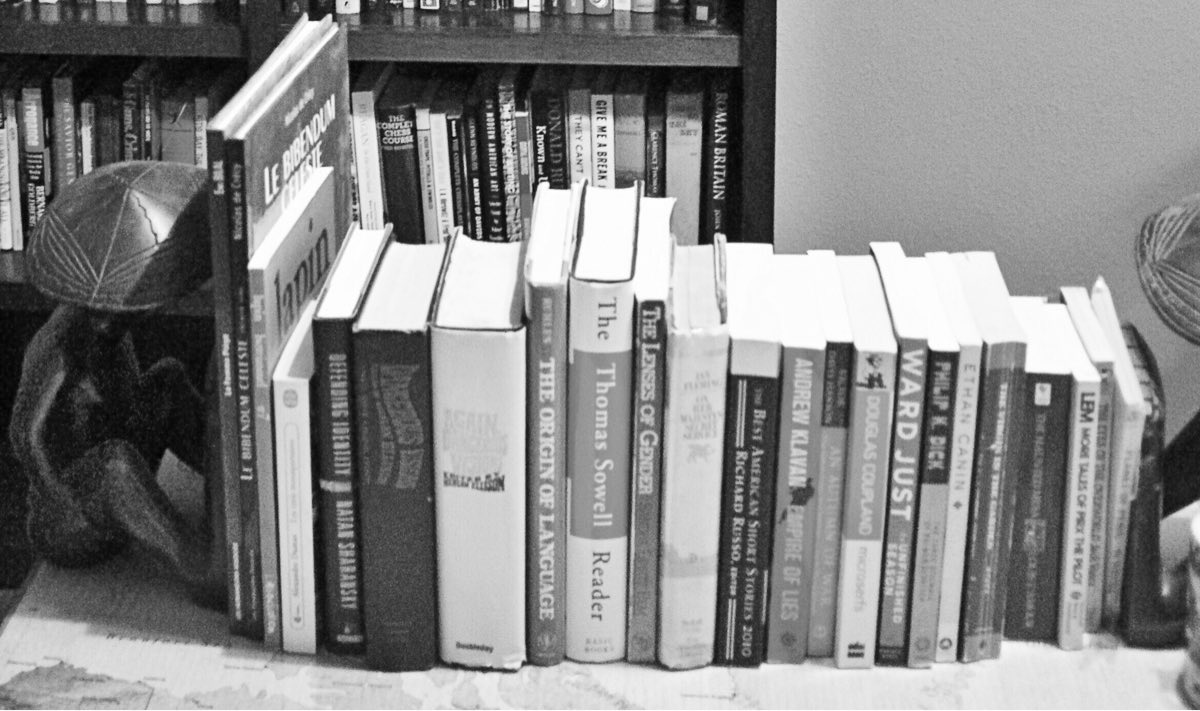


My Year in Books: 2025
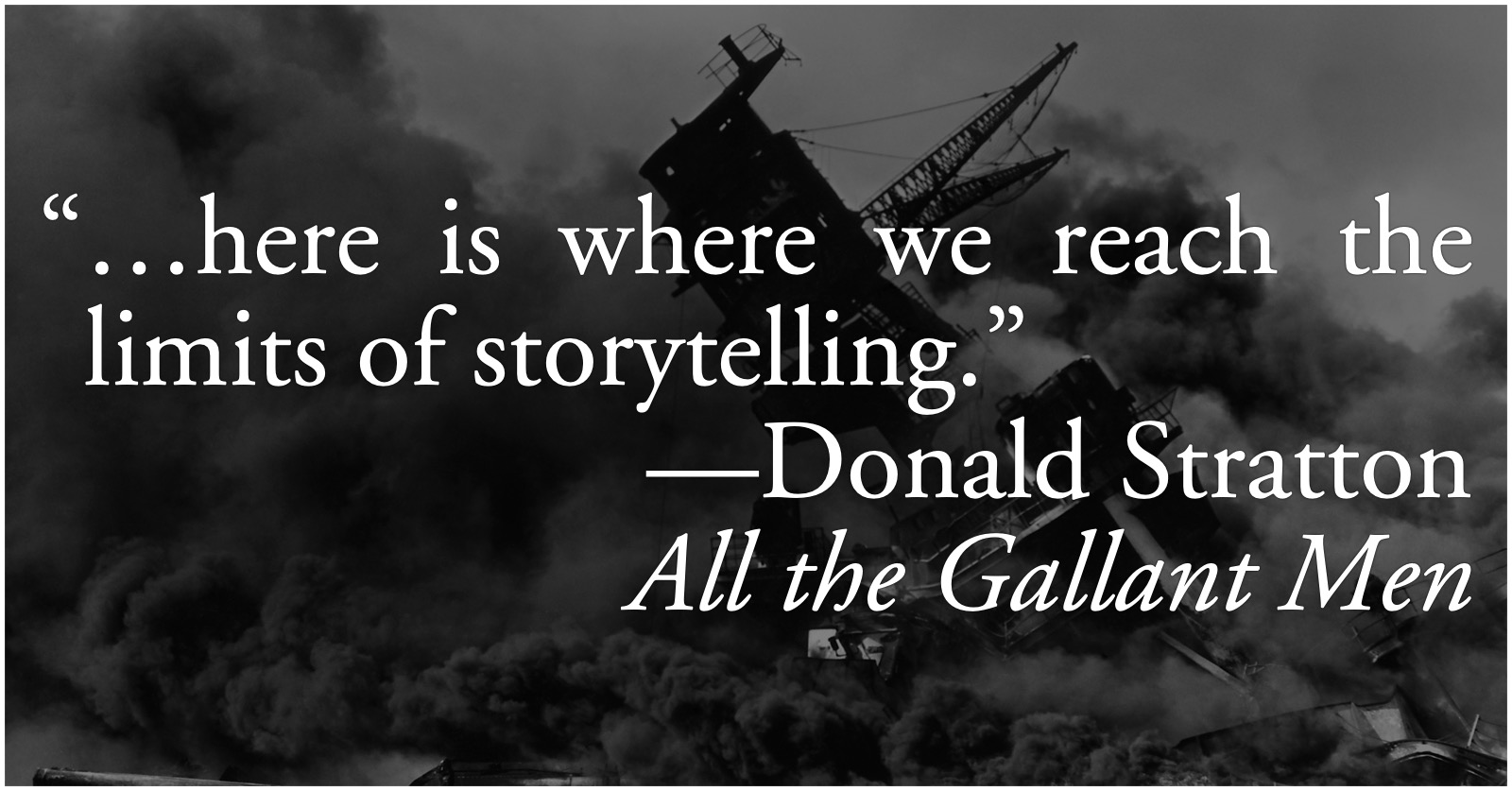
The book year for me began in earnest over Valentine’s Day travel in San Diego—and on the way to it. Driving through west Texas and El Paso I listened to Mike Rowe’s interview with Nikki Stratton about her grandfather, Donald Stratton, and the book he wrote with Ken Gire about being on the USS Arizona during the Japanese attack on Pearl Harbor.
I’ve long been aware of a Stratton on board the Arizona. While I’m pretty sure we’re not related it did of course interest me. So, when I happened to see Don Stratton’s All the Gallant Men a few hours later at Coas Books in Las Cruces, I couldn’t resist buying it.
To Donald Stratton, the attack on Pearl Harbor mirrored the September 11 attacks, and he lamented that the lessons we learned on December 7 are being forgotten. One of those lessons is a question: “Am I worth dying for?”
To paraphrase Kevin Smith, the Arizona wasn’t even supposed to be there that day. It had been involved in an accident and stayed in place for minor repairs. It accounted for “nearly half of all the Americans who died that day”.
We were so young, those of us who enlisted—eighteen, nineteen, twenty years old… If we were not quite men on December 6, by midmorning of the 7th we were.
It’s an incredible story. He covers not just the morning of December 7, but also his recuperation back home in mid-America and his return to the United States Navy to finish out the war.
Though I may have left Pearl Harbor on a stretcher, I had returned on a Destroyer. I had recovered my strength, as had my country.
While in San Diego I picked up a book at the big monthly University Heights Public Library sale that was to occupy my time on and off literally up to the end of the year. I began reading Giuseppe Ungaretti’s Il Dolore in March while traveling in and around Barcelona. I finished it this morning as I write this post, New Year’s Eve, 2025, making it my “last review of the year” according to Goodreads.
This collection of poetry grew into grief (il dolore) over a lost son, his nine-year-old Antonietto, in 1939; it ended with grief over the loss of hundreds of thousands in World War II, and the desolation of Italy.
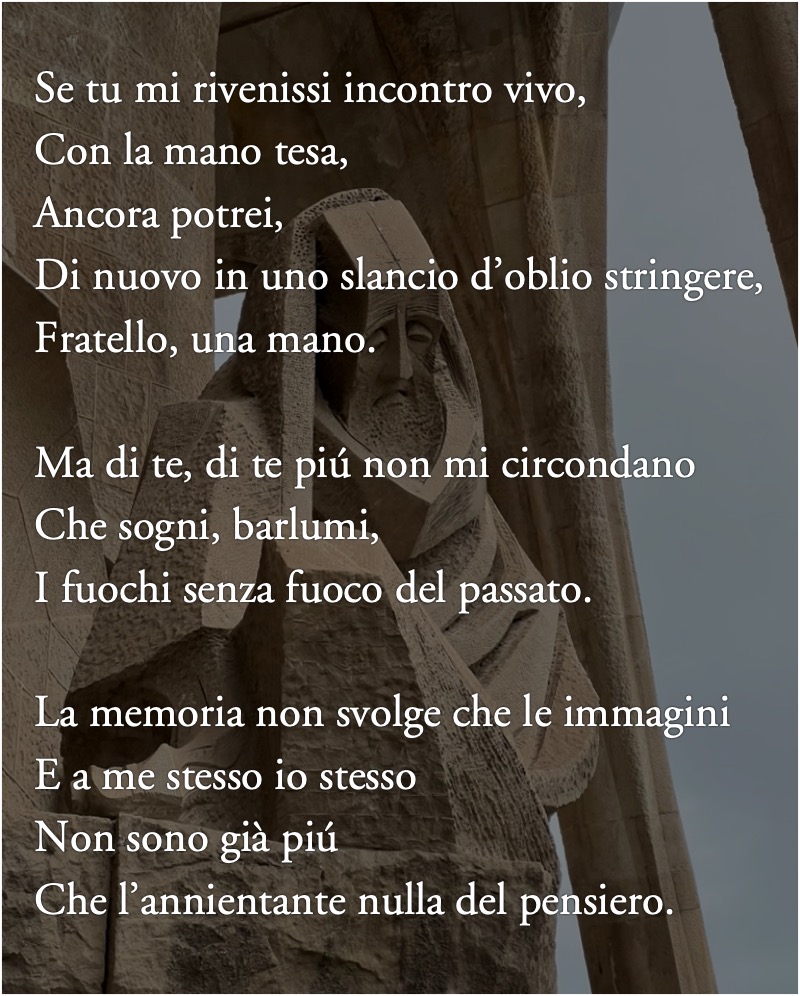
| Hanno l’impercettibile susurro, | They whisper imperceptibly |
| Non fanno piú rumore | Making no more noise |
| Del crescere dell’erba, | Than the growing of the grass |
| Lieta dove non passa l’uomo. | Happy where no man steps. |
While in Barcelona I picked up another Italian book, which I’ll be talking about more in The Year in Food.
A series of science fiction and gaming conventions in June and July netted several classic works of science fiction. I came home from the North Texas RPG Convention with A. Merritt’s The Moon Pool, Poul Anderson’s Trader to the Stars, and John Wyndham’s Out of the Deeps. Trader to the Stars is pure Traveler and, in fact, I received it from the GM of a Traveler game session.
Wyndham’s Out of the Deeps is a take on War of the Worlds that puts the aliens underwater, and from Jupiter instead of Mars. Wyndham added two twists to Wells’s alien invasion: what if the aliens were so alien that understanding between them and us is literally impossible? And what if the invasion had come in modern times when politicians have no faith in their own culture, and so dither completely about when and even whether to fight back against invasion?
I’m a reliable witness, you’re a reliable witness, practically all of God’s children are reliable witnesses in their own estimation, which makes it funny how such different ideas of the same affair get about.
I also re-read War of the Worlds itself, something I’ve been wanting to do since hearing Mark Steyn read The Time Machine and re-reading that Wells book. War of the Worlds is fascinating for what it has and for what it does not say. It may feature the first use of what we’d recognize as a modern science fiction ray gun, used on humans that for the most part still got around by walking or by horse.
It even ties back to All the Gallant Men. Something most film interpretations tend to lose is the strong implication by Wells that the Martians’ real advantage lay not in their technology but, as Donald Stratton also feared, in mankind’s complacency.
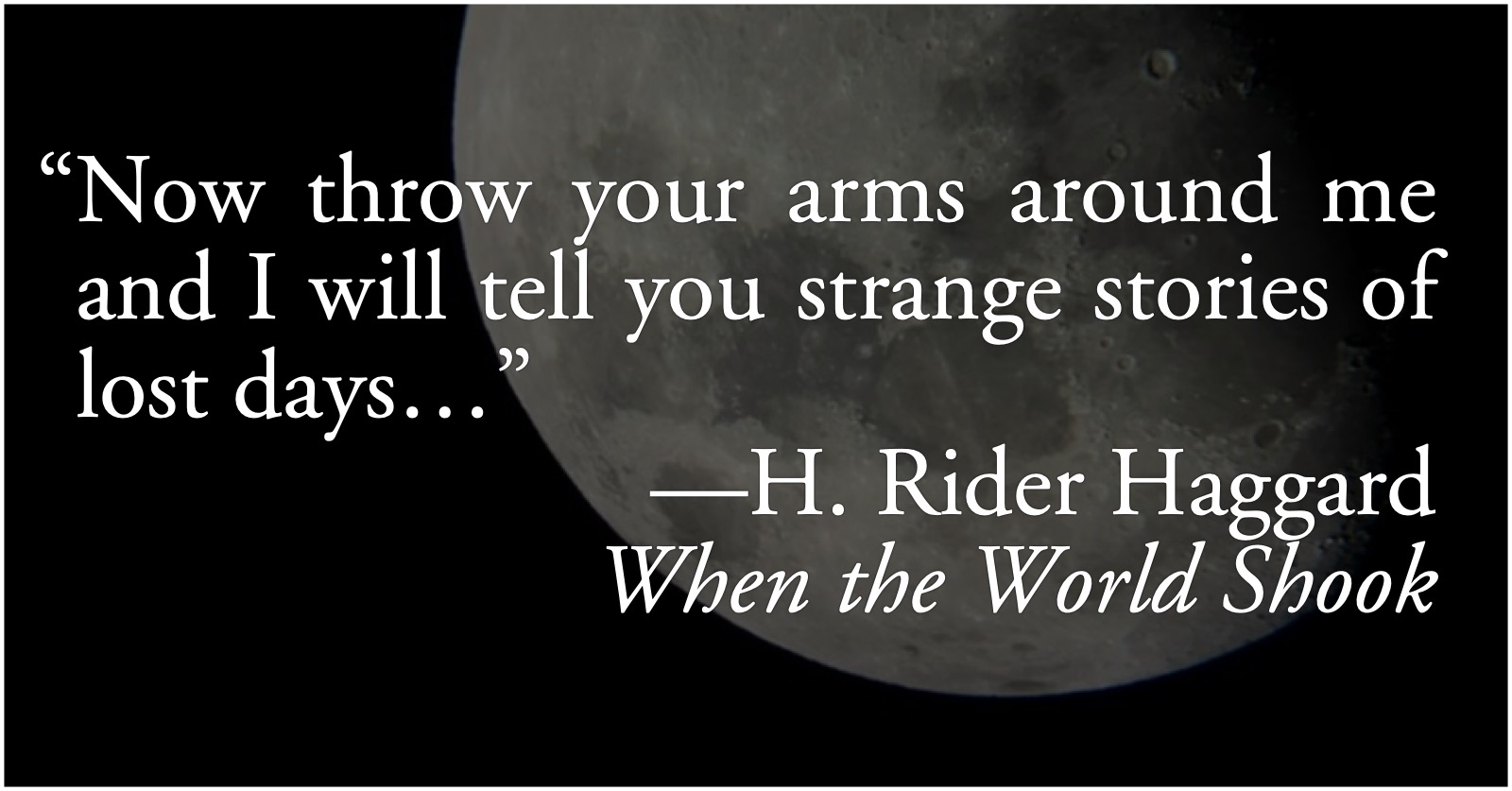
A trip to Chattanooga for LibertyCon, and up north and back to Texas, resulted in two H. Rider Haggard books. Every time I read another Haggard story I’m more impressed by him. The People of the Mist is a wonderfully weird adventure story, over the top even for Haggard. Everyone at the end is just slightly confused as to their place in the universe and as to what really just happened.
But When the World Shook is the real highlight of this year’s Haggard. It is, superficially at least, very similar to Merritt’s equally amazing The Moon Pool. Both take place in the south seas, both take place just after the Great War, both postulate ancient civilizations living deep underground and about to return to the surface and wreak havoc, whose technology is indistinguishable from magic.
Both would make for great D&D-style campaign worlds.
Now throw your arms around me and I will tell you strange stories of lost days…
If you want strange stories of lost days, no one does this better than Edgar Rice Burroughs. At the New Braunsfels library sale I picked up the latest attempt at a Tarzan movie, with Tarzan played by Alexander Skarsgard. While well-acted, it was a weird, mopey take on the Lord of the Jungle. It was also a mashup of The Return of Tarzan and The Jewels of Opar, the latter of which I hadn’t yet read despite it being in my to-read room for over a decade.
So I remedied that.
The Jewels of Opar highlights exactly what the movie was missing: an internally consistent very weird world of hidden treasures, lost civilizations, and the conflict between civilization and barbarism. It’s a focus on individuals. Even Jane Clayton is on her own for most of the book. Despite finding herself in more and more desperate situations, it’s up to her to extricate herself from them. All the while Tarzan must extricate himself from a prison he doesn’t even know exists, even as their Belgian tormentor slowly realizes that he’s imprisoned himself with walls of greed and hatred.
It’s one of the best books in the Tarzan series I’ve read so far.
Continuing the high adventure theme into space, I ran Flashing Blades! a second time at North Texas, this time mashing up the golden age of sail with the golden age of evil Trek.
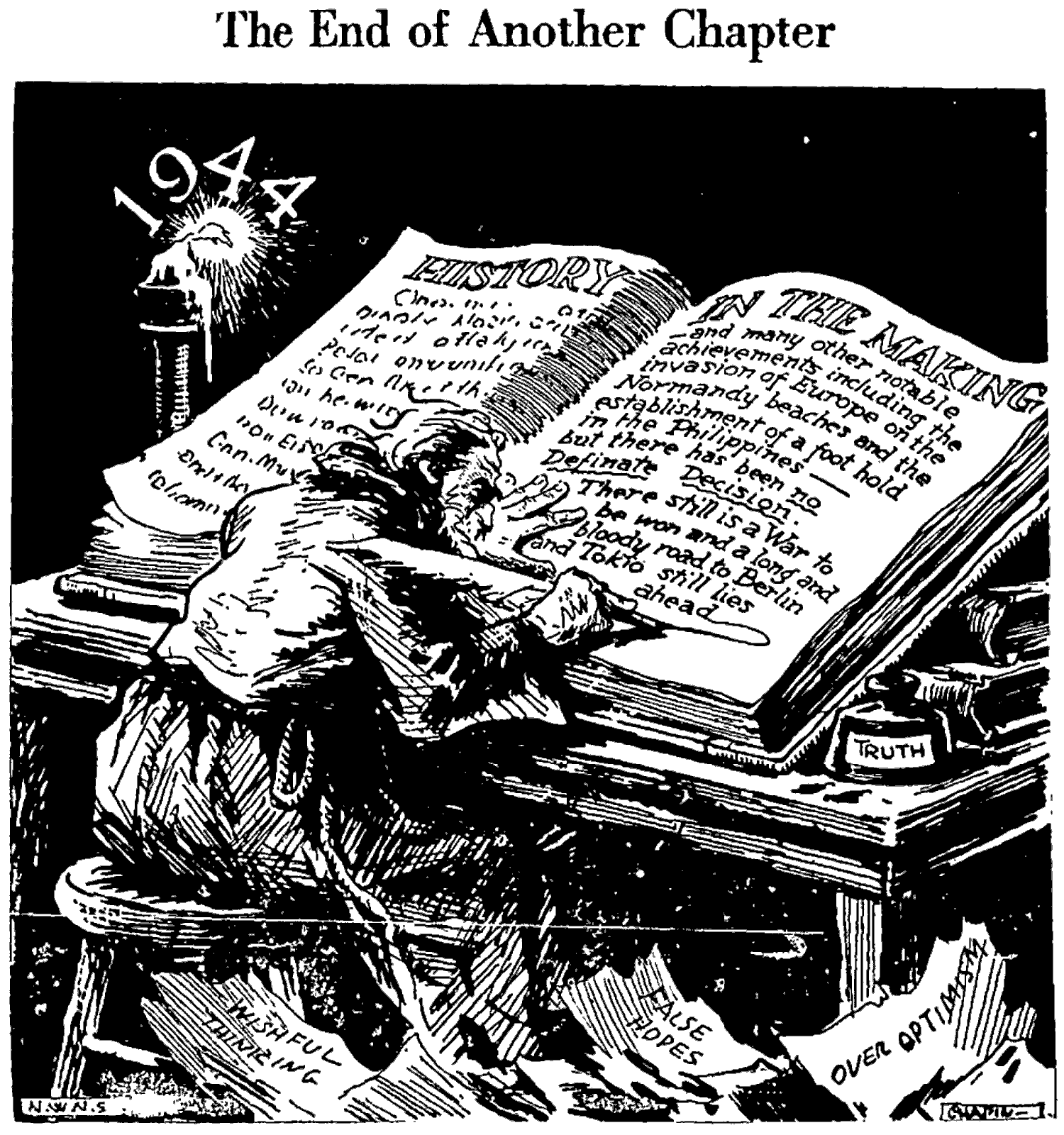
While doing other research, I found this cartoon from December 28, 1944.
On the opposite end of that, Robert Zimmerman’s Genesis: The Story of Apollo 8 puts our first trip to the moon into the context of those who made the trip, those who watched those who made the trip, and the era it happened.
Zimmerman perfectly captures that sense of an incredible journey by humanity from the ground to the skies to beyond, all in less than a century. And the sense of wonder and faith that drove it. Faith not just in God, but in a God Who makes scientific progress possible for Man.
Chaim Potok’s Old Men at Midnight puts an entirely different journey into the perspective of its times, but it’s still the same period as in Genesis, covering World War II and the Cold War that followed.
How tedious and commonplace, this business of mortality. Infrequently considered, and when considered, too quickly put aside. What returns it to remembrance is irony.
Stanislaw Lem’s Peace on Earth also takes on the Cold War, and the very absurd ways that the countries on various sides chose to maintain the peace. The title alludes to the fact that there is peace on Earth only because there is perpetual war on the Moon, guaranteed by treaty and with no human intervention at all. It’s all artificial intelligence and robots.
Which makes it a real problem when the Lunar Authority loses their eyes on the Moon, a Moon now filled with the greatest weapons of each nation and the most ruthless computers.
So of course they send noted explorer and semi-scientist Ijon Tichy to investigate, and hijinks ensue…
In heroic tales of space such things never happen.
I re-read two of the greatest comic books of the last century this year. Steve Gerber’s Howard the Duck remains the most influential comic of my comic reading career. I read his Deadline Doom when it came out, after thoroughly enjoying his 1976 Presidential campaign issues, and it changed my perspective on how comics, and in turn books, were created. I suddenly realized that they were written by people.
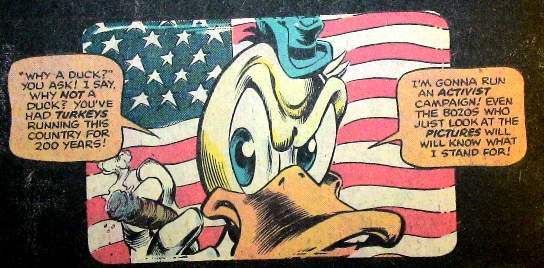
Plants are like people. Writers are like plants. Therefore, and this may come as a surprise, writers are like people.
What Gerber was doing in the seventies has not been matched since; the closest is probably Warren Ellis’s Transmetropolitan, which gets there only by recreating Hunter Thompson for science fiction. But Ellis’s work, wonderful as it is, never transcends Ellis’s politics. Gerber shared most of those politics, but understood human nature enough to write a work that went far deeper into the way human relationships really work rather than merely how one person would like them to work. And all with a duck for a protagonist!
Neil Gaiman’s Sandman is entirely different, a fantasy world based on the horror books that DC used to publish, House of Mystery, The Witching Hour, among many other once-popular anthology-style comics. Like Ellis, Gaiman inserts a great writer into his comic. But Gaiman’s great is G.K. Chesterton, and that makes all the difference.
What power have dreams in Hell?
Music was also on my mind this year. I began the musical year with Mark Steyn’s American Songbook and closed it out with the sheet music collection 100 Best Songs of the 20’s & 30’s, introed by Richard Rodgers.
It’s amazing how influential that period of music remains today. 100 Best Songs could be opened randomly and you’d likely hit something not just recognizable but influential. The Birth of the Blues. Embraceable You. Cole Porter, Rodgers and Hart, the Gershwins.
100 Best Songs doesn’t go into the legacy, it presents the sheet music and the lyrics for home musicians to use. Mark Steyn covers the legacy, in a book filled with wonderful anecdotes, from the funny, such as the origin of “That was no lady, that was my wife!” to the genius of writers like Dorothy Fields:
Lesser writers were wont to give serious love songs to the serious love interest and funny songs to the comedy couple and ne’er the twain shall meet. But most of us are serious and funny, romantic and hokey, sensuous and foolish all at the same time—and few songs walk that tightrope as adroitly as this one.
Read the book• to find out what Fields song that one was!
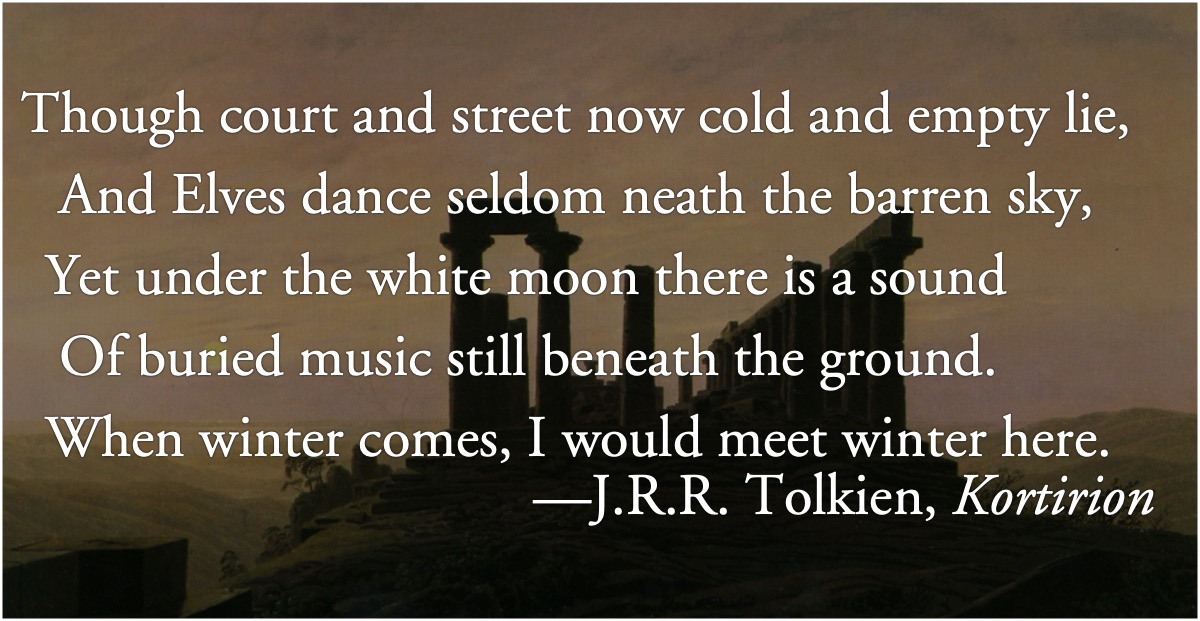
In between, I read Maria von Trapp’s autobiography My Own Story, about her own amazing life. My Own Story covers the parts of her life outside of Story of the Trapp Family Singers. So it covers growing up and joining a convent; it skips the years of The Sound of Music; and jumps to adjusting to not just America but Vermont, and then to being a celebrity after the movie’s popularity.
…we had believed that home could only be one spot on the globe—Austria. If you were so unlucky, so unhappy, to have lost your home, we thought you had to be homeless for the rest of your days. Now we discovered this was not so because home is where you belong, and having a little house on six hundred acres of Vermont soil made us belong again.
I bought von Trapp’s book while at LibertyCon, but not at LibertyCon. The Chattanooga library happened to be running a library book sale almost directly across the street. I picked up quite a few interesting books there, which I hope to get to in 2026. Hopefully not over a decade later…
The most popular book I read this year was The Fellowship of the Ring. I read a lot of Tolkien this year, re-reading the Lord of the Rings trilogy and re-reading Humphrey Carpenter’s fascinating biography, Tolkien. I first read it in high school, and quoted from it for a high school speech.
Before him stood the Tree, his Tree, finished. If you could say that of a Tree that was alive, its leaves opening, its branches growing and bending in the wind that Niggle had so often felt and guessed, and had so often failed to catch. He gazed at the Tree, and then slowly he lifted his arms and opened them wide.
“It’s a gift!” he said.
A Tolkien book that wasn’t a re-read was Christopher Tolkien’s collection of his father’s earlier stories, The Book of Lost Tales, another book I bought while in San Diego in February. It’s a fascinating collection of what could have been and of Christopher Tolkien’s observations of how his father worked.
A story must be told or there’ll be no story, yet it is the untold stories that are most moving.
The untold stories within the written word. They are a gift. Happy New Year!
In response to The Case for Books in 2015: In 2015, I read a lot of books… and bought a lot more. That’s not a sustainable market plan.
books
- Friends of the New Braunfels Public Library Annual Book Sale
- The annual New Braunfels Library sale is well worth a visit if you live nearby.
- Las Cruces, New Mexico: Coas Books
- Coas Books is a chain of two bookstores in Las Cruces, and well worth the visit.
- LibertyCon
- “A Tennessee Literary Science Fiction & Fantasy Convention.”
- University Heights Library at San Diego Public Library
- “As one of the oldest branch libraries in San Diego, the University Heights Library first opened in 1914 as a 20-foot by 30-foot wooden structure. In 1926, a permanent library was constructed, eventually replaced by the current two-story building, which opened in 1966.”
classics
- Out of Time: Mark Steyn at Steyn Online (audiobook)
- “While we start more or less as Wells did, you can probably guess where we’re headed.”
- Review: Out of the Deeps: Jerry Stratton at Jerry@Goodreads
- Wyndham writes a War of the Worlds where the aliens are truly alien, and the politicians are very, very real.
- Review: Peace on Earth: Jerry Stratton at Jerry@Goodreads
- Ijon Tichy takes on the autonomous weapons of the Lunar Authority, to maintain a very strange Peace on Earth.
- Review: Tarzan and the Jewels of Opar: Jerry Stratton at Jerry@Goodreads
- The fifth book in Burroughs’s Tarzan series, and among the best of the sequels. A weird world of hidden treasures, lost civilizations, and the prisons of the mind.
- Review: The Moon Pool: Jerry Stratton at Jerry@Goodreads
- This is pure gonzo D&D. Weird magic is mixed with weird science, and weird creatures share the stage with men and god-like ancients!
- Review: The People of the Mist: Jerry Stratton at Jerry@Goodreads
- This is such a strange story, not in how weird it is (it is, of course, weird) but in what drives it and how it ends.
- Review: The War of the Worlds: Jerry Stratton at Jerry@Goodreads
- An alien invasion of an Earth still bound by horse-drawn carriages and steam engines, but one thing never changes: our ability to pretend that there is no danger from obvious vectors.
- Review: Trader to the Stars: Jerry Stratton at Jerry@Goodreads
- This collection of three stories about different traders working for the same company and same (ultimate) boss looks a whole lot like a Traveller setup.
- Review: When the World Shook: Jerry Stratton at Jerry@Goodreads
- One might live ten lifetimes and never read a book as fantastic as the average H. Rider Haggard adventure!
- The Time Machine: H. G. Wells at Steyn Online (audiobook)
-
 “Mark reads The Time Machine, written by H G Wells… prefaced with an introduction by Mark in which he discusses the relevance of Wells’ vision of the world 800,000 years hence to our own age.”
comic books
- Get down, America!
- Steve Gerber, of Howard the Duck fame and much more, died on Sunday.
- Review: The Sandman: Preludes & Nocturnes: Jerry Stratton at Jerry@Goodreads
- Dream has been captured and stripped of his power, leaving a world haunted by dark nights.
- Review: The Sandman: The Doll’s House: Jerry Stratton at Jerry@Goodreads
- Dream has regained his power; now he must re-organize it. And so many of his creations have been loosed on Earth…
history
- Nikki Stratton—All the Gallant Men: Mike Rowe
- “Nikki Stratton didn’t realize what her grandfather had endured until her social studies teacher learned that he’d been aboard the Arizona when Pearl Harbor was attacked. The teacher had many questions, none of which his fourth-grade student was able to answer.”
- Review: All the Gallant Men: Jerry Stratton at Jerry@Goodreads
- “The Arizona wasn’t even supposed to be there that day…”
- Review: Genesis: The Story of Apollo 8: Jerry Stratton at Jerry@Goodreads
- “Before Apollo 8, no human had had ever seen the earth as a globe.” That’s the sense of wonder and revolution that Zimmerman captures throughout this book about our first trip to the moon.
- Review: Il Dolore: Jerry Stratton at Jerry@Goodreads
- “Il Dolore” is “the pain”, “the sorrow”, or “the grief” and these poems grow from sorrow at the loss of his son (in 1939) to sorrow at the loss of so many lives in World War II.
- Review: Old Men at Midnight: Jerry Stratton at Jerry@Goodreads
- The preservation of the wisdom of a culture is always difficult, under oppression, under war, and in the face of genocide.
J. R. R. Tolkien
- The Hobbit and The Lord of the Rings
- The best fantasy books I have ever read. “In a hole in the ground there lived a hobbit...” I found the animated movie to be marvelous as well. And the new movies by Peter Jackson are awesome! Great, great stuff.
- Review: The Book of Lost Tales: Jerry Stratton at Jerry@Goodreads
- Both the abandoned and superseded stories of the Book of Lost Tales and Christopher Tolkien’s essays on his father’s writing style and the evolution of Middle-Earth are fascinating.
- Review: The Fellowship of the Ring: Jerry Stratton at Jerry@Goodreads
- I still hear John Huston, not Ian McKellen, when Gandalf speaks. This book transitions between the humor of The Hobbit to the seriousness of The Two Towers.
- Review: Tolkien: The Authorized Biography: Jerry Stratton at Jerry@Goodreads
- This is a fascinating look at Tolkien’s life, from his youth to his retirement, such as it was.
music
- Mark Steyn’s American Songbook•: Mark Steyn (hardcover)
- “…here by popular demand is Steyn’s take on some of his favorite lyrics, some of his favorite music, and what happens when you put them together to create a classic song.”
- Review: 100 Best Songs of the 20’s & 30’s: Jerry Stratton at Jerry@Goodreads
- Open this at random and you’re likely to hit a century-old song still recognizable today. It’s amazing how influential the twenties and thirties were to popular culture.
- Review: Maria: My Own Story: Jerry Stratton at Jerry@Goodreads
- Maria von Trapp covers her life from growing up and entering the convent, to moving into Vermont and building a business.
- Review: Mark Steyn’s American Songbook: Jerry Stratton at Jerry@Goodreads
- This is a marvelous collection of anecdotes and history about some of the greatest songs of the American musical theater.
New Year
- Goodreads: Year in Books 2025 at Jerry@Goodreads
- From Tolkien to Teena, Stanislaw Lem to Giuseppe Ungaretti, it was a wonderful year of discovery.
- My Year in Food: 2025
- My year in food extended from 1776 to 2026, from San Diego to Barcelona, and from Texas to Michigan. I also made several vintage books available for you to download!
More 2025
- My Year in Food: 2025
- My year in food extended from 1776 to 2026, from San Diego to Barcelona, and from Texas to Michigan. I also made several vintage books available for you to download!
- Network and The Running Man in 2025
- One movie from the seventies and one from the eighties remain far more relevant than their contemporaries—and it’s the silliest that remains most relevant. We are living in Heinlein’s Crazy Years.
More books
- My Year in Books: 2024
- This has been a wonderful year in books, especially for revisiting old classics and visiting some old classics for the first time.
- My Year in Books: 2023
- It’s been a slower year in books than previous ones, but it was still a year of fantasy in the past, in the future, and across time, as well as an unplanned foray into people doing the impossible and changing the world.
- My Year in Books: 2022
- From Hoplites to Venice… California, this has been a year in books filled with war, evil, and the dehumanization of man. But it’s also been a year of high adventure, magic, and larger-than-life heroes.
- My Year in Books: 2021
- From Louis l’Amour to slavery to H. Rider Haggard, it’s been a very good year in books.
- The Year in Books: 2020
- What did 2020 have to offer in books?
- Three more pages with the topic books, and other related pages
More great books
- My Year in Books: 2024
- This has been a wonderful year in books, especially for revisiting old classics and visiting some old classics for the first time.