

Recent purchases:
- ANOTHER Movie Channel!—Monday, October 27th, 2025
-
It’s movie time! A friend of mine has started a new movie channel on YouTube, and it promises to be a standout.
David Vining: ANOTHER Movie Channel! at David Vining, Author (#)
- The Fiftieth Anniversary of Convoy—Wednesday, September 17th, 2025
-
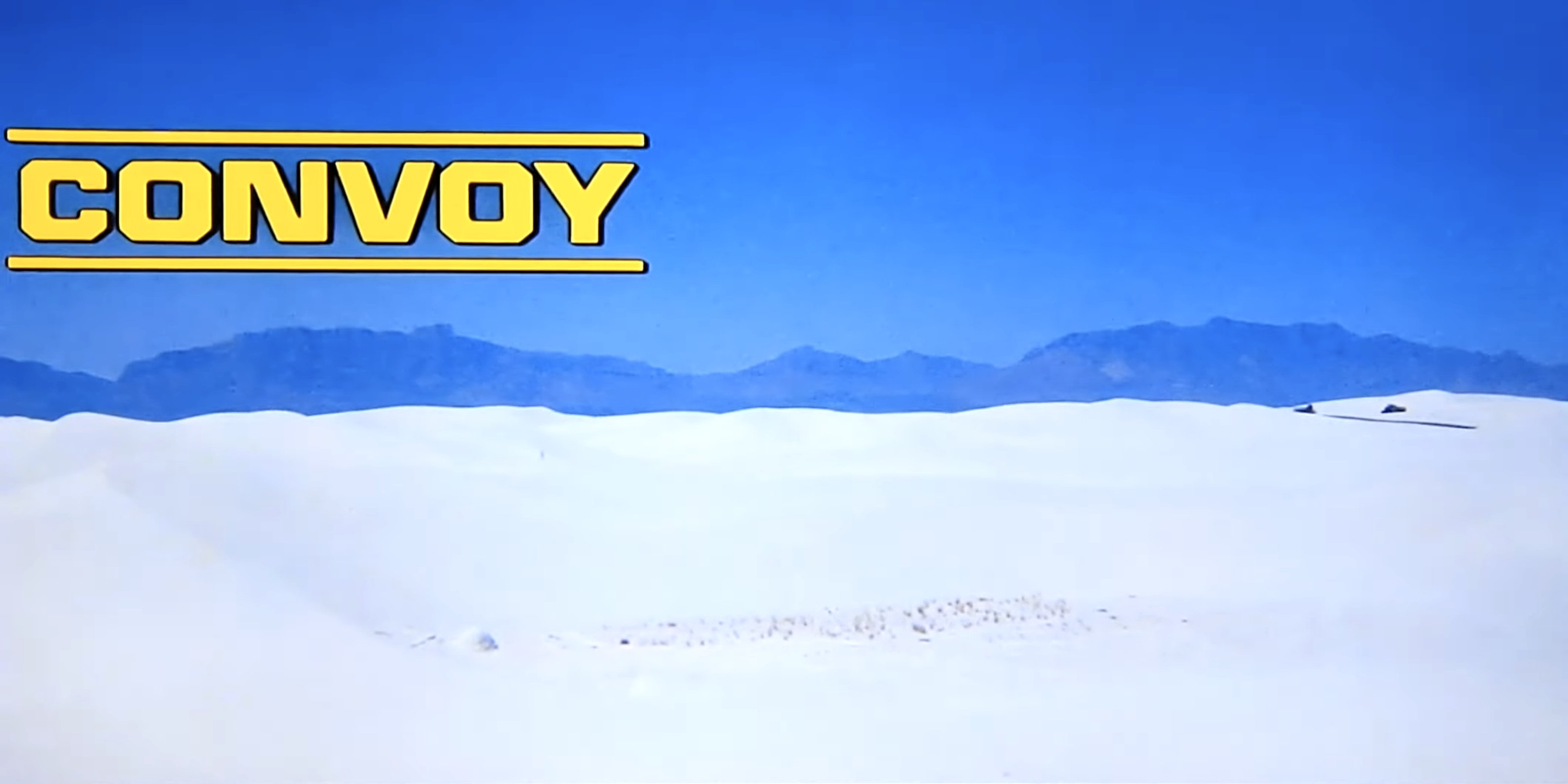
“Uh, breaker 1-9, this here’s the Rubber Duck. Anybody got a copy on me out there, come on.”
One of the strangest fads to flash through popular culture in the seventies was Citizens Band radio. As a ham radio operator I was only tangentially familiar with it: CB was that thing that people who couldn’t pass a license test used.
But one part of the fad I was very familiar with was C.W. McCall’s part in it, especially his 1975 hit song Convoy. The song was released as part of the Black Bear Road album on September 19, 1975. By January 10 it had reached number 1 on both the Billboard pop singles chart and the Billboard country singles chart.
Convoy was not the first CB-oriented song. Dave Dudley had already done a few, including “Me and Ol’ C.B.” for his own 1975 album Uncommonly Good Country. The trucker-as-cowboy theme was already well-trod territory, and Convoy accelerated the popularity of Citizens Band as a part of that myth. By 1977 there was enough demand for CB songs for an entire album of them, all ears, from, if I’m reading the label correctly, Radio Shack. The title of the album came from C.B. radio slang for an antenna.
C.W. McCall was the outlaw alter ego of Bill Fries and Chip Davis, the latter the founder of the very non-outlaw Mannheim Steamroller. I once, back in the eighties when both country and rap were very different, described C.W. McCall’s best music as a sort of country rap. It is nothing like rap, but it embodies a similar outlaw ethos, a tall-tale storyteller speaking directly to the listener as a real person.
If you’re interested in seventies country music, I’d strongly recommend searching out C.W. McCall’s albums. Besides Black Bear Road, which is a real classic, Wolf Creek Pass and Wilderness are also worth searching out.
- Network and The Running Man in 2025—Wednesday, January 1st, 2025
-
We have just entered the second quarter of the 2000s, well past the years that The Running Man was set in. Just before Thanksgiving I happened to watch both Network and Running Man back to back. The only reason for this juxtaposition was that they were both “movies my dad might enjoy”—which he did. But watching them together over two nights like that, one of the things that struck me is that The Running Man could literally be a sequel to Network. Both are about the entertainmentication of the modern world, both feature television executives obsessed with viewing shares, both use violent criminals to achieve winning shares and increase already-winning shares, both are very much about the merging of autocratic government and a compliant news industry. Both are about the merging of news and government with entertainment.
In Network Faye Dunaway’s up-and-coming television exec successfully develops a series about armed bank robbers and murderers acting under cover of political activism. We never do find out what her heiress-kidnapping Liberation Army show is called. Someone jokingly referred to it as “The Mao-Tse Tung Hour” early in development and that’s what the executives and development team keep calling it through the rest of the movie.
The Running Man was much less expertly filmed than Network, especially when it came to cutting it for theaters. We can still see bits remaining of subplots or subcurrents that were removed late in editing or so late during production that related scenes couldn’t be altered.
Maria Conchita Alonso’s Amber was clearly being set up for a tense scene at the end in which she would have trouble remembering the uplink code for the broadcast network, something that needed exact timing as the revolution’s strike team took over the broadcast control room. They cut the remembering scene but not the memorization scene—the latter was necessary to explain Harold Weiss’s disappearance.
Cutting that scene was a surprisingly smart choice for a B-level action movie like The Running Man. It’s such a cliched bit that it mostly only works in comedies today, Army of Darkness being the most iconic but still evident in the modern century in movies like Scoop.
A more interesting cut is possibly Captain Freedom’s awakening. His speech at the end about a “Code of the Gladiators” comes mostly out of nowhere. It looks a lot like the culmination of a character growth that never actually happened. When we first see Captain Freedom, he’s a joke, almost literally a white Bojangles prancing across the screen to promote his parodic exercise show.
Are you ready for pain? Are you ready for suffering? If the answer is yes, then you’re ready for Captain Freedom’s Workout.
- A revised timeline for Kolchak: The Night Stalker—Wednesday, November 13th, 2024
-
As part of integrating my annual Kolchak adventures with the movies and series, I’ve tried to put together a timeline of when relevant episodes actually took place. This allows me to, for example, give whoever is playing Dr. Leslie Dwyer the background that the events of “Mr. R.I.N.G.” took place four years ago, in 1972.
The timeline for the Kolchak movies is reasonable enough, if slightly confused—they happen a year or two apart. Add in the television series and things start to get very crowded very quickly, and occasionally even directly contradictory. If you go by the evidence in the television series, some of the Chicago episodes happened before the Seattle events in The Night Strangler! And while Kolchak had worked in Chicago before Las Vegas (at about 28 minutes in he and Gail Foster start listing the number of times he was fired in every major city in the United States) it wouldn’t likely have been for INS and it definitely would not have been for Vincenzo.
Because I’ve been running a game with Kolchak and his guest stars for four years now at the North Texas RPG Convention, I’ve had to make some assumptions about what experience they already have with the horrors Kolchak attracts, and when they had them. This has highlighted for me that Kolchak’s adventures are far too dense using the assumed timeline, that the movies happened in 1971 and either 1972 or 1973, and the series episodes in 1974 or 1975.
While none of the episodes mention a year, if you remember Kolchak’s iconic voiceovers from the movies, you probably remember that they took the form of “Weekday, Month Date”. That makes them relatively easy to place in a year. But much of it doesn’t make sense. When I looked at it closely, it turns out that there are timeline contradictions already in the second movie!
I wrote in The Wrong Goodbye,
- Everyone Is Gonzo: The Hunter S. Thompson Musical—Wednesday, February 28th, 2024
-
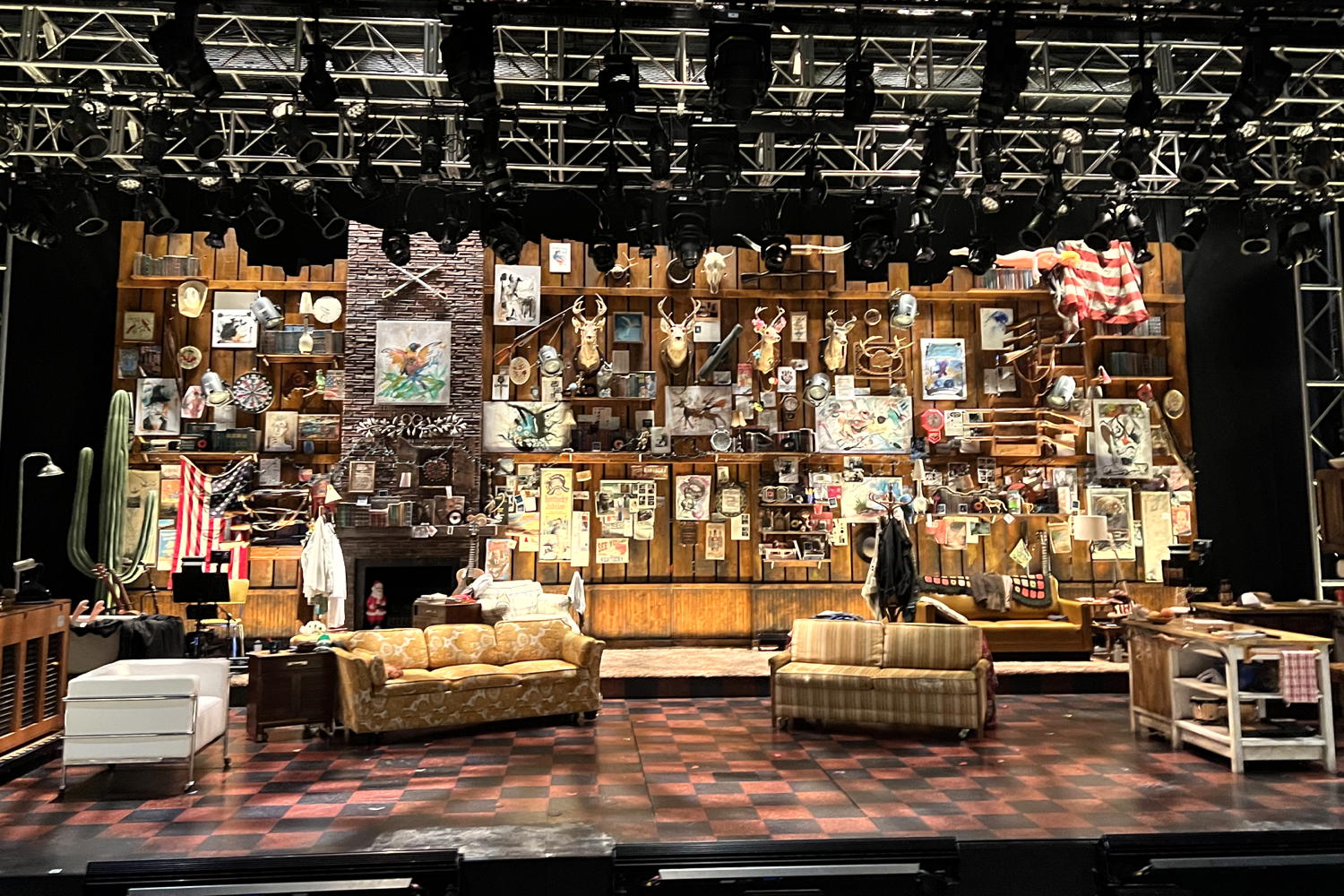
The only problem with this set is that it raises expectations that the play refuses to live up to.
On Tuesday, October 3, 2023, I was in San Diego and went to see the Hunter S. Thompson musical at the La Jolla Playhouse. I had no idea what to expect: greater musicals have been made on seemingly lesser musical-worthy material, but I’m also not really a fan of musicals. I’m a fan of specific musicals.
This turned out to be a great example of the kind I don’t like: the old-school, pre-Hammerstein musical where the music and the play are mostly separate. The show stops, songs are sung, the show restarts, without any help from the song. The songs could be sung at any point in this “musical”, and often by any of the characters.
The set, as you can see from the photograph, was amazing. While it didn’t all take place in Woody Creek, when the scene moved outside Woody Creek the lighting focused away the Woody Creek background.
The rest of the play was as if someone had read a matchbook biography of Thompson and decided, hey, I can write a musical about myself, and pretend it’s about Thompson, and that makes it gonzo!
Which is kind of true. On the one hand, it was the perfect Hunter S. Thompson musical: it gave Thompson the Thompson treatment, making him silly, ineffectual, and gay. Much as Thompson rewrote reality when covering his subjects, such as turning Ed Muskee into an exotic drug user the play turns Thompson into a prancing stereotype of a gay man.
The entire play was an over-the-top stereotype. It could have been dropped into any Parker & Stone musical as the bit that makes fun of modern musicals. It was almost literally Everyone Has Aids crossed with Hey, Mickey, let’s put on a play!. Everyone’s a freak. Everyone’s a WRITER—pronounced in all-caps. I have never heard anyone so clearly pronounce words in all caps. “I’m a WRITER.” “You’re a WRITER, Hunter.”
It’s a weird choice if you’re familiar with Thompson’s work. Thompson’s actual refrain, I’m a Doctor of Journalism or You’re dealing with a professional journalist! in the same tone as Bill Murray claiming to be a scientist in Ghostbusters, is worthy of caricature.
- OPPO DV-980H DVD player tray won’t open, won’t close—Wednesday, April 22nd, 2020
-
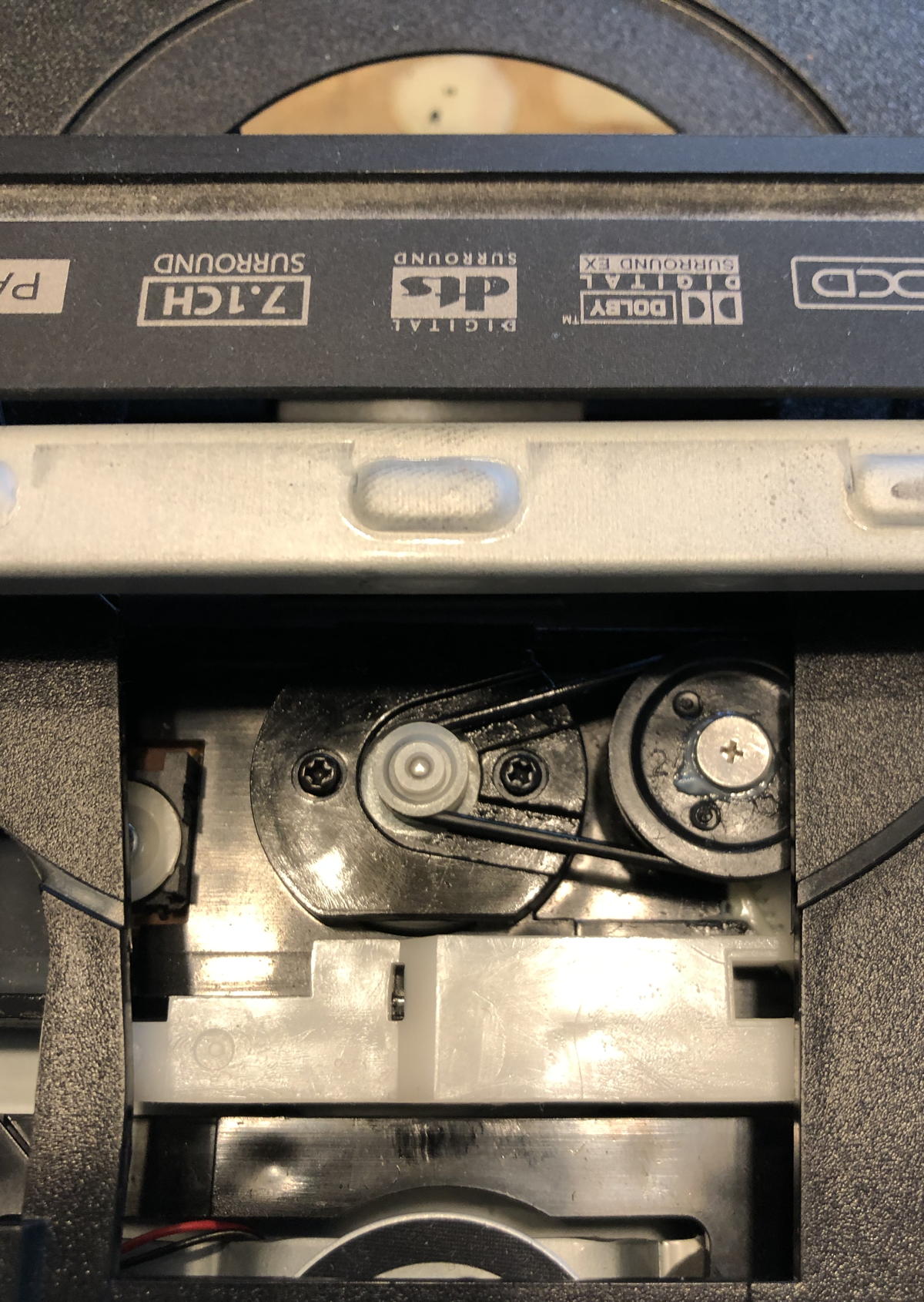
This is the belt you need to get to if the tray isn’t opening and closing. Notice that the tray is half open to see it.
In October of 2007 I replaced my 7-year-old Pioneer DVD player—I don’t remember what model, or what was wrong with it—with an OPPO DV-980H, which I’ve really liked. It worked great with my old Sony home theater system, and still plays great today over a new Marantz. Last year, however, the tray started having trouble closing. It needed a little help pushing in before the DVD would load. Soon after, the tray started having trouble opening as well, but it was still workable; all it needed was a little help with my fingernail.
I took a look inside, but there didn’t seem to be anything wrong. The symptoms clearly seemed to indicate a bad belt, but there was no belt. It was all gears. After taking it apart and putting it together, it started working again, so I thought perhaps something loose, perhaps the ribbon cable, had been tightened in the process.
Which may have been the case, but if so it was the belt that I couldn’t see. When the DVD tray again started having trouble, I took a more serious look inside, and discovered the belt I’d missed earlier. It was, in fact, loose, practically falling off of its wheels.
I thought it would be an easy fix, but it turns out to be very hard to find replacement belts. Nobody seems to sell belts anymore, at least not in the size needed for small electronics. What I eventually found was an o-ring gasket about the same size as the belt I needed. The size I ordered was 28mm x 25mm x 1.5mm•, and it is just about perfect. Because it’s an o-ring and not really a belt, it’s round, not flat like the belt it was replacing. That doesn’t seem to be a problem.
If you have similar troubles on your player, I wouldn’t recommend waiting. The only source for o-rings of the right size I could find was an overseas seller on Amazon, and it took well over a month to arrive. I ordered on January 26, and the package of belts arrived on March 6. In that period, the belt stopped working completely, which meant I had to forego watching any of my DVDs.
There are three steps to replacing the belt once you have it in hand: take the top off of the DVD player, remove the DVD spindle guide, and pull back the DVD player assembly to get at the belt. Here is the summary; photos follow at the end of the post.
- HDTV Antenna placement—Wednesday, March 28th, 2018
-
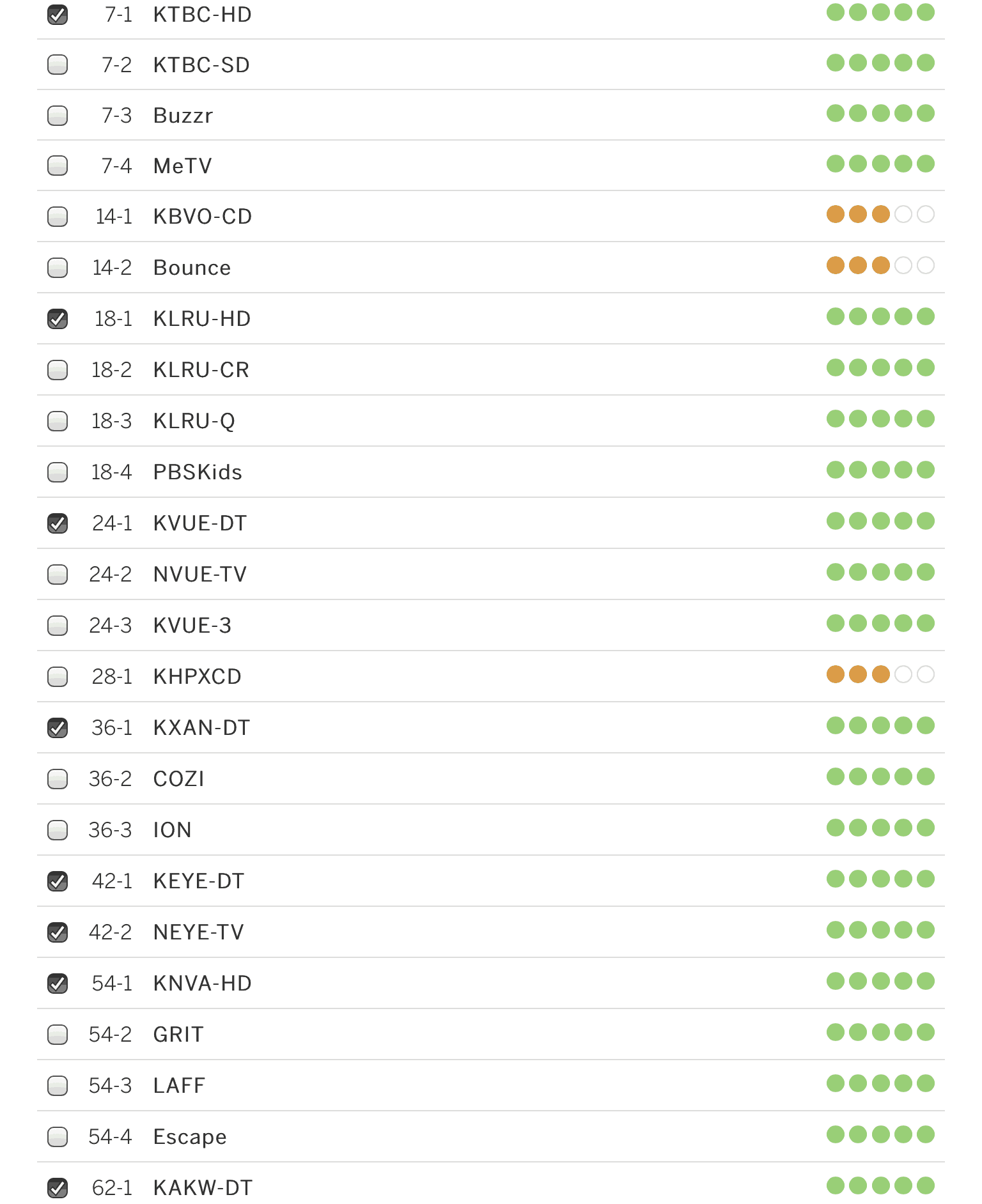
This is the signal strength report with an amplifier.
One of the greatest features of the Tablo TV box is that, if you have a smart phone or tablet, you can easily change the location of the antenna and re-run an antenna scan to check the signal strength of all available channels. And you can put the Tablo and its antenna anywhere, as long as it has power1 So the best place to put the television doesn’t have to be the best place to put an indoor antenna.
Before the Tablo, I had a Mohu Leaf 50• antenna downstairs plugged directly into the television set. Sometimes it worked better on the window; sometimes it worked better on top of a corner bookshelf at a weird angle. Sometimes it worked better after it fell on the floor, and then later it wouldn’t. When a car drove by, the signal often flickered.2
Moving the antenna upstairs improved reception for every station I watch but one. There’s a 24-hour weather channel that sometimes came in great downstairs, and sometimes didn’t come in at all; upstairs, it seems to come in all the time, but never comes in great. I suspect it’s direction-related, but I don’t know. In any case, I almost never watch that channel. It was mostly when channel flipping, which I’d stopped doing after I bought the Apple TV over a year ago.
Besides generally better reception, reception has also become more stable, which is also important. Time of day and weather seems to matter much less, if at all, now, except for one channel. And I was able to find a location that worked well for all of the stations I wanted to watch.
- Tablo TV without a subscription—Wednesday, March 7th, 2018
-
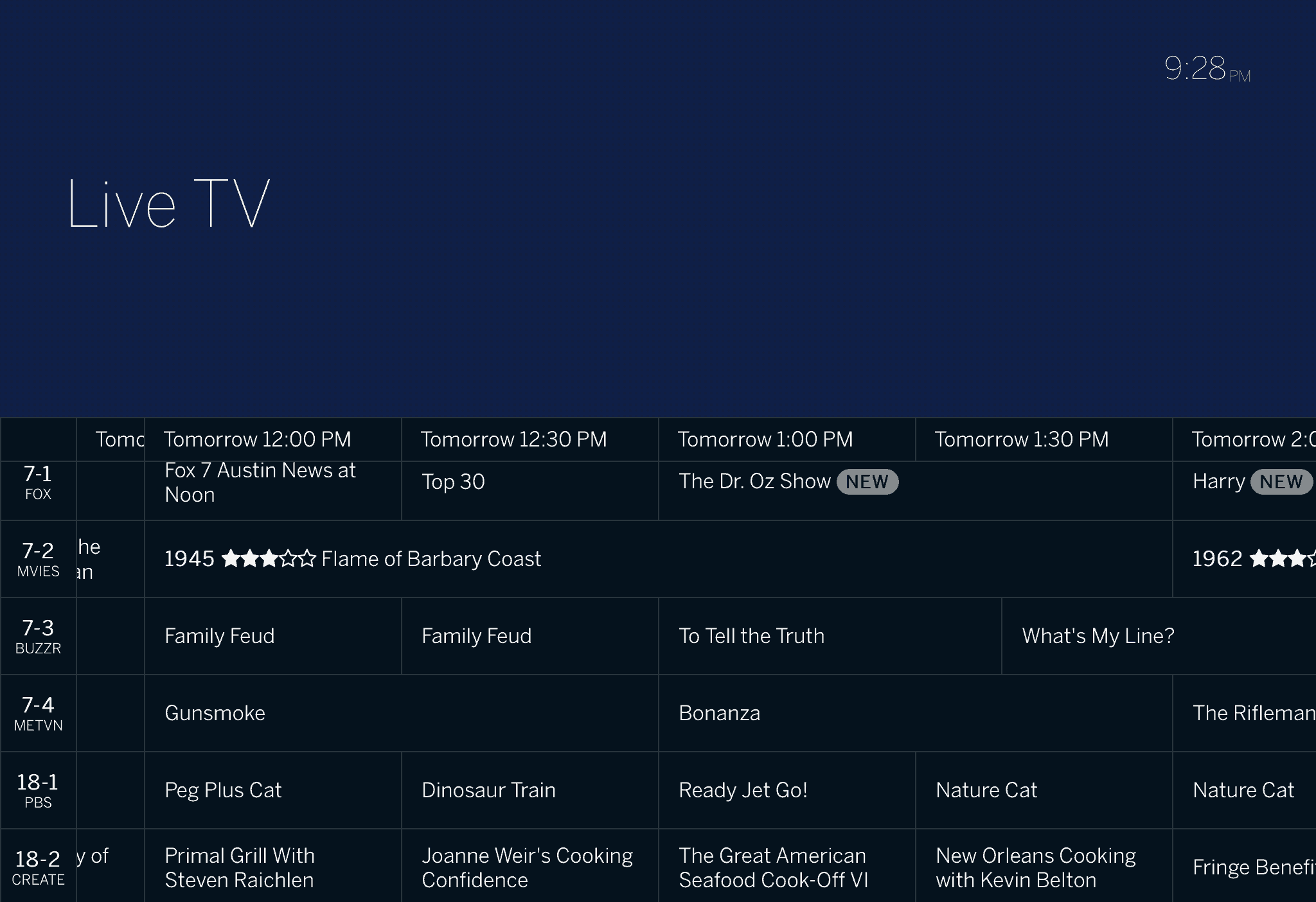
Flame of Barbary Coast is set to record, but you can’t tell it from the grid.
I’m not a fan of monthly fees. One of the reasons I use over-the-air instead of cable for television is to reduce the number of monthly fees I have (I use cable for Internet only). The Tablo TV comes with one month free of a subscription to their database that knows what is playing over the next 14 days. This is very useful. It also allows watching your recordings, or even live broadcasts, remotely; I subscribed for one month following the free month because that was over the holidays and I was traveling. As it turned out, I never used that feature, but the subscription certainly makes it easier to schedule recordings. Instead of going through channel by channel on a site such as TV Guide, you can just go through a genre-by-genre list of movie and television titles.
After returning from my travels, I let the subscription lapse. I use TV Guide to decide what to record, and manually set the recording times.
Without the subscription, Tablo is definitely harder to use. However, it’s still easier than the videocassette recorder I owned long ago. That said, some of the things that not having a subscription make harder are a bit annoying. They seem to be less a feature of a subscription than an artificial inducement to getting a subscription.
For example, when you have a subscription and schedule a show, it over-records by a small amount, so as to ensure that you don’t miss the beginning or end of a show. This does not cause any conflicts when recording shows back-to-back because the Tablo is smart enough to copy the end of an early show to the beginning of a following show. This feature appears to be disabled when manually recording: the Tablo marks overlapping times from the same channel as conflicts if there are not enough receivers to record them separately.
More importantly, if you don’t have Internet, you can’t use the Tablo. You need to have more than just a local network between the Tablo and your smart box or smart television. If the Tablo box cannot connect to Tablo’s servers, it’s pretty much worthless.