

Recent purchases:
- Everyone Is Gonzo: The Hunter S. Thompson Musical—Wednesday, February 28th, 2024
-

The only problem with this set is that it raises expectations that the play refuses to live up to.
On Tuesday, October 3, 2023, I was in San Diego and went to see the Hunter S. Thompson musical at the La Jolla Playhouse. I had no idea what to expect: greater musicals have been made on seemingly lesser musical-worthy material, but I’m also not really a fan of musicals. I’m a fan of specific musicals.
This turned out to be a great example of the kind I don’t like: the old-school, pre-Hammerstein musical where the music and the play are mostly separate. The show stops, songs are sung, the show restarts, without any help from the song. The songs could be sung at any point in this “musical”, and often by any of the characters.
The set, as you can see from the photograph, was amazing. While it didn’t all take place in Woody Creek, when the scene moved outside Woody Creek the lighting focused away the Woody Creek background.
The rest of the play was as if someone had read a matchbook biography of Thompson and decided, hey, I can write a musical about myself, and pretend it’s about Thompson, and that makes it gonzo!
Which is kind of true. On the one hand, it was the perfect Hunter S. Thompson musical: it gave Thompson the Thompson treatment, making him silly, ineffectual, and gay. Much as Thompson rewrote reality when covering his subjects, such as turning Ed Muskee into an exotic drug user the play turns Thompson into a prancing stereotype of a gay man.
The entire play was an over-the-top stereotype. It could have been dropped into any Parker & Stone musical as the bit that makes fun of modern musicals. It was almost literally Everyone Has Aids crossed with Hey, Mickey, let’s put on a play!. Everyone’s a freak. Everyone’s a WRITER—pronounced in all-caps. I have never heard anyone so clearly pronounce words in all caps. “I’m a WRITER.” “You’re a WRITER, Hunter.”
- OPPO DV-980H DVD player tray won’t open, won’t close—Wednesday, April 22nd, 2020
-
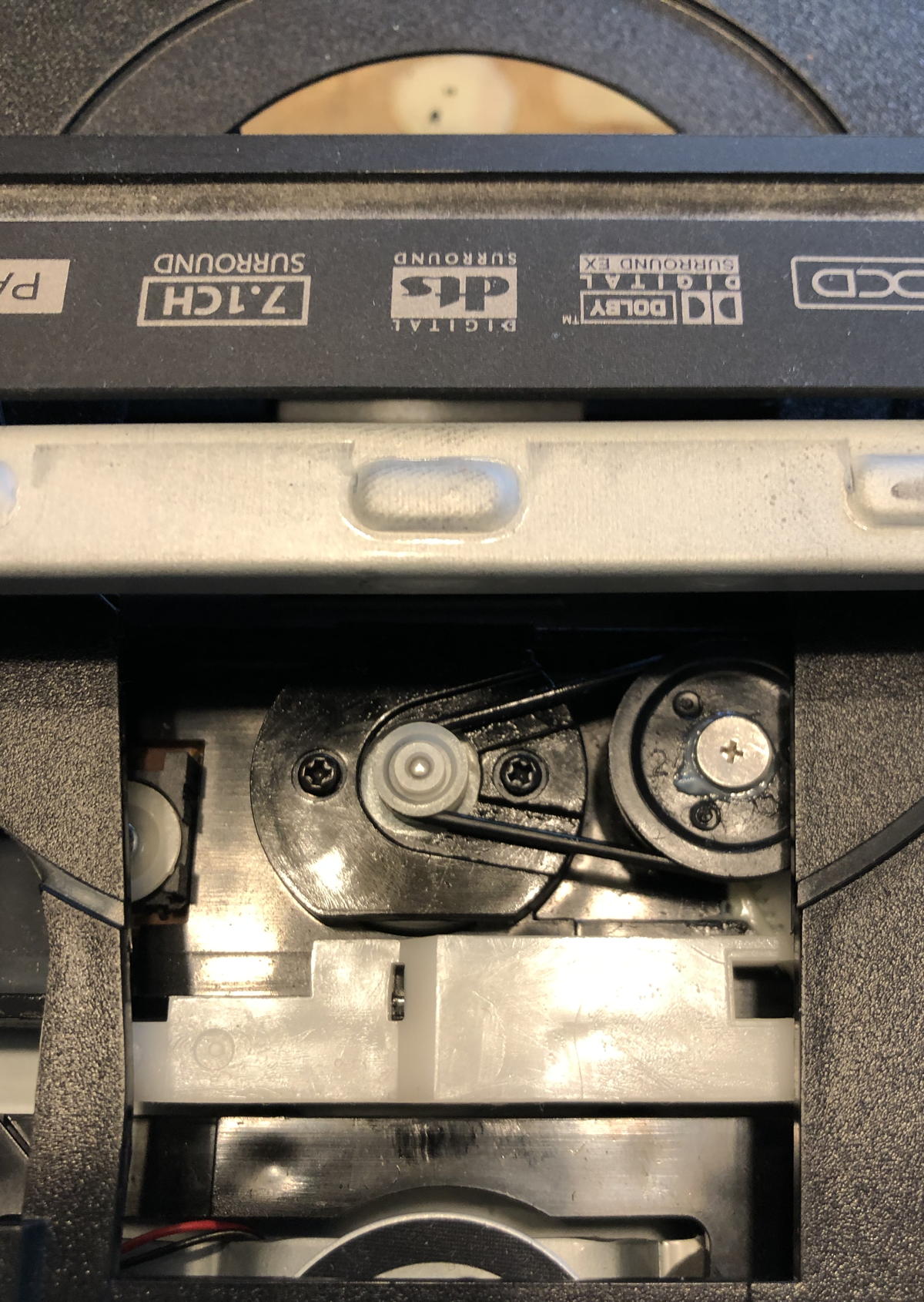
This is the belt you need to get to if the tray isn’t opening and closing. Notice that the tray is half open to see it.
In October of 2007 I replaced my 7-year-old Pioneer DVD player—I don’t remember what model, or what was wrong with it—with an OPPO DV-980H, which I’ve really liked. It worked great with my old Sony home theater system, and still plays great today over a new Marantz. Last year, however, the tray started having trouble closing. It needed a little help pushing in before the DVD would load. Soon after, the tray started having trouble opening as well, but it was still workable; all it needed was a little help with my fingernail.
I took a look inside, but there didn’t seem to be anything wrong. The symptoms clearly seemed to indicate a bad belt, but there was no belt. It was all gears. After taking it apart and putting it together, it started working again, so I thought perhaps something loose, perhaps the ribbon cable, had been tightened in the process.
Which may have been the case, but if so it was the belt that I couldn’t see. When the DVD tray again started having trouble, I took a more serious look inside, and discovered the belt I’d missed earlier. It was, in fact, loose, practically falling off of its wheels.
I thought it would be an easy fix, but it turns out to be very hard to find replacement belts. Nobody seems to sell belts anymore, at least not in the size needed for small electronics. What I eventually found was an o-ring gasket about the same size as the belt I needed. The size I ordered was 28mm x 25mm x 1.5mm•, and it is just about perfect. Because it’s an o-ring and not really a belt, it’s round, not flat like the belt it was replacing. That doesn’t seem to be a problem.
If you have similar troubles on your player, I wouldn’t recommend waiting. The only source for o-rings of the right size I could find was an overseas seller on Amazon, and it took well over a month to arrive. I ordered on January 26, and the package of belts arrived on March 6. In that period, the belt stopped working completely, which meant I had to forego watching any of my DVDs.
There are three steps to replacing the belt once you have it in hand: take the top off of the DVD player, remove the DVD spindle guide, and pull back the DVD player assembly to get at the belt. Here is the summary; photos follow at the end of the post.
- HDTV Antenna placement—Wednesday, March 28th, 2018
-
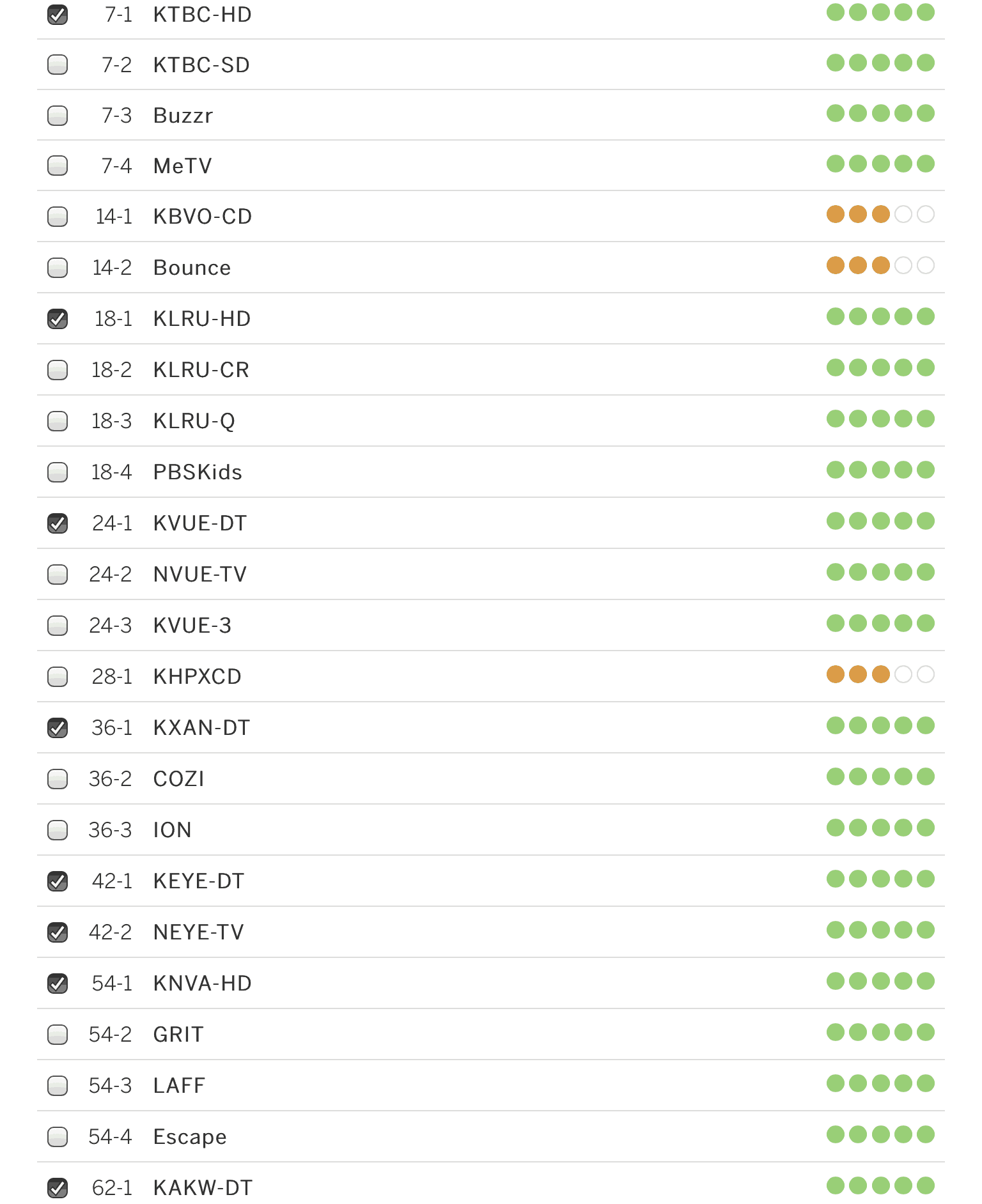
This is the signal strength report with an amplifier.
One of the greatest features of the Tablo TV box is that, if you have a smart phone or tablet, you can easily change the location of the antenna and re-run an antenna scan to check the signal strength of all available channels. And you can put the Tablo and its antenna anywhere, as long as it has power1 So the best place to put the television doesn’t have to be the best place to put an indoor antenna.
Before the Tablo, I had a Mohu Leaf 50• antenna downstairs plugged directly into the television set. Sometimes it worked better on the window; sometimes it worked better on top of a corner bookshelf at a weird angle. Sometimes it worked better after it fell on the floor, and then later it wouldn’t. When a car drove by, the signal often flickered.2
Moving the antenna upstairs improved reception for every station I watch but one. There’s a 24-hour weather channel that sometimes came in great downstairs, and sometimes didn’t come in at all; upstairs, it seems to come in all the time, but never comes in great. I suspect it’s direction-related, but I don’t know. In any case, I almost never watch that channel. It was mostly when channel flipping, which I’d stopped doing after I bought the Apple TV over a year ago.
Besides generally better reception, reception has also become more stable, which is also important. Time of day and weather seems to matter much less, if at all, now, except for one channel. And I was able to find a location that worked well for all of the stations I wanted to watch.
- Tablo TV without a subscription—Wednesday, March 7th, 2018
-
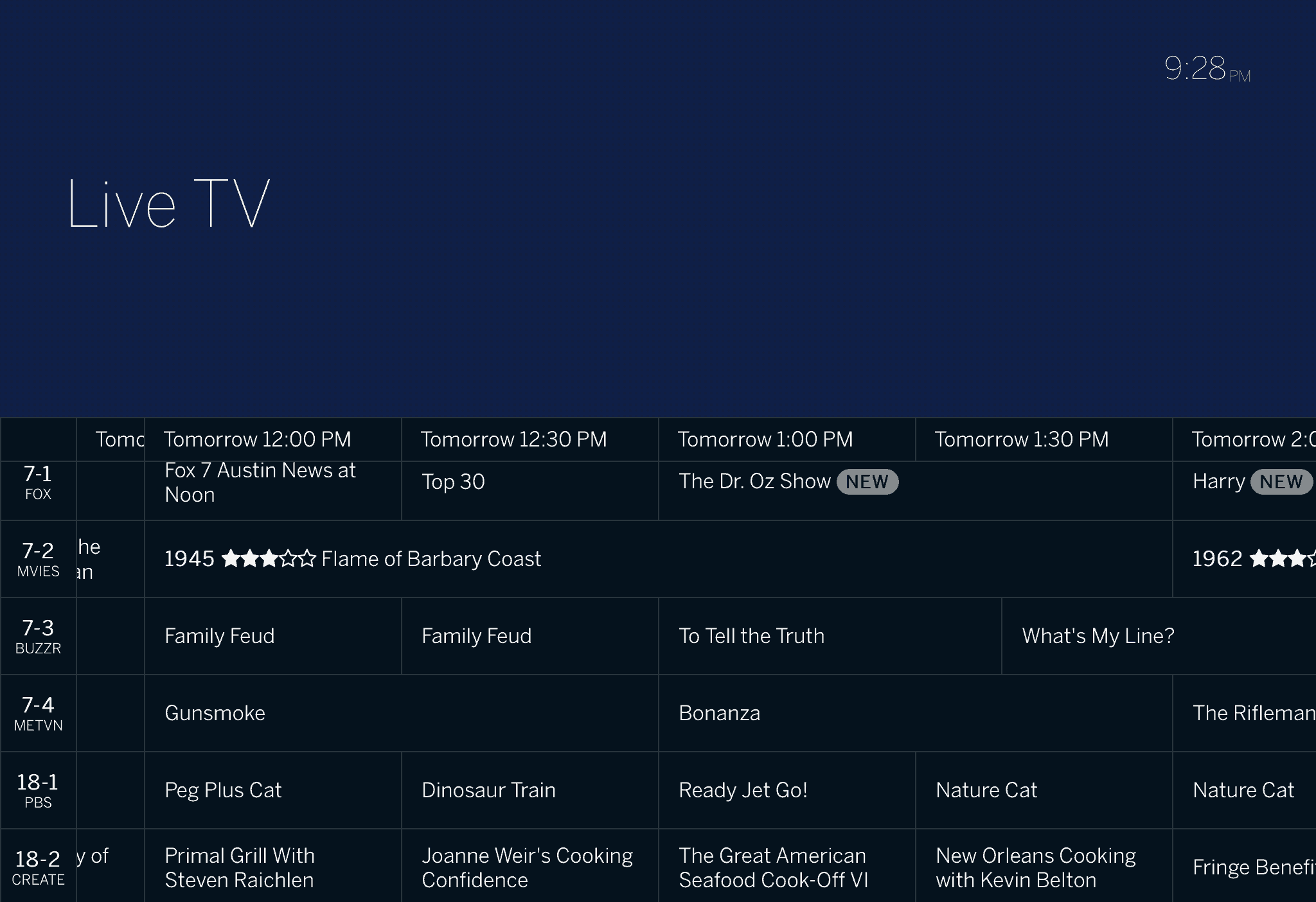
Flame of Barbary Coast is set to record, but you can’t tell it from the grid.
I’m not a fan of monthly fees. One of the reasons I use over-the-air instead of cable for television is to reduce the number of monthly fees I have (I use cable for Internet only). The Tablo TV comes with one month free of a subscription to their database that knows what is playing over the next 14 days. This is very useful. It also allows watching your recordings, or even live broadcasts, remotely; I subscribed for one month following the free month because that was over the holidays and I was traveling. As it turned out, I never used that feature, but the subscription certainly makes it easier to schedule recordings. Instead of going through channel by channel on a site such as TV Guide, you can just go through a genre-by-genre list of movie and television titles.
After returning from my travels, I let the subscription lapse. I use TV Guide to decide what to record, and manually set the recording times.
Without the subscription, Tablo is definitely harder to use. However, it’s still easier than the videocassette recorder I owned long ago. That said, some of the things that not having a subscription make harder are a bit annoying. They seem to be less a feature of a subscription than an artificial inducement to getting a subscription.
For example, when you have a subscription and schedule a show, it over-records by a small amount, so as to ensure that you don’t miss the beginning or end of a show. This does not cause any conflicts when recording shows back-to-back because the Tablo is smart enough to copy the end of an early show to the beginning of a following show. This feature appears to be disabled when manually recording: the Tablo marks overlapping times from the same channel as conflicts if there are not enough receivers to record them separately.
More importantly, if you don’t have Internet, you can’t use the Tablo. You need to have more than just a local network between the Tablo and your smart box or smart television. If the Tablo box cannot connect to Tablo’s servers, it’s pretty much worthless.
- Apple TV: Movie Streaming Overload—Wednesday, December 27th, 2017
-
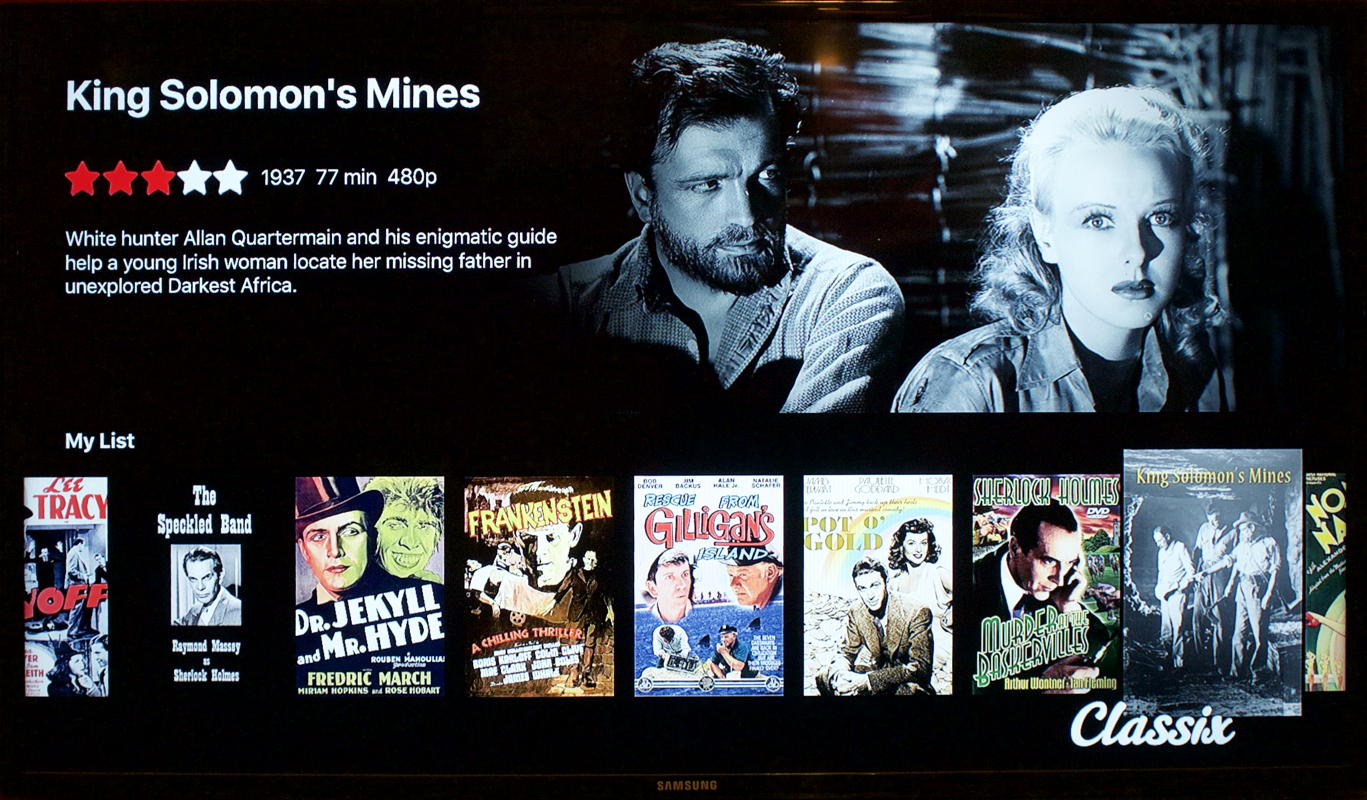
Classix is probably the best-curated and easiest to use of the public domain streaming services.
My original plan on buying the Apple TV, since I don’t have time to watch several streaming services, was to subscribe to one per month, switching back and forth between Netflix, Hulu, maybe even The Great Courses, and whatever else became available later.
With the addition of the Tablo 2-Tuner, I’m not sure I’ll be doing that; I seem to have reached a tipping point where I will never be able to watch what I have queued up, so why pay to queue up more?
The Tablo 2-Tuner provides access to over-the-air broadcasts almost as if they were a streaming service. I have to pay attention to the TV Guide and schedule a recording, but once recorded it’s just like any other streaming service on the Apple TV box.
Vudu even lets me watch a lot of my DVDs through the Apple TV instead of through the DVD player. But I’m not buying nearly as many DVDs as I used to, because the Apple Movie App has a $5.00 bargain bin just like the box stores where I used to buy DVDs. It also has a 99-cent rental bin, where I finally saw My Cousin Vinnie. And the Amazon Prime app isn’t just for Amazon Prime members: if you have purchased any streaming movies on Amazon (or acquired any through giveaways, as I did) you can watch those on the Prime app without joining Prime.
- Tablo TV: Pause and rewind live television—Thursday, December 21st, 2017
-
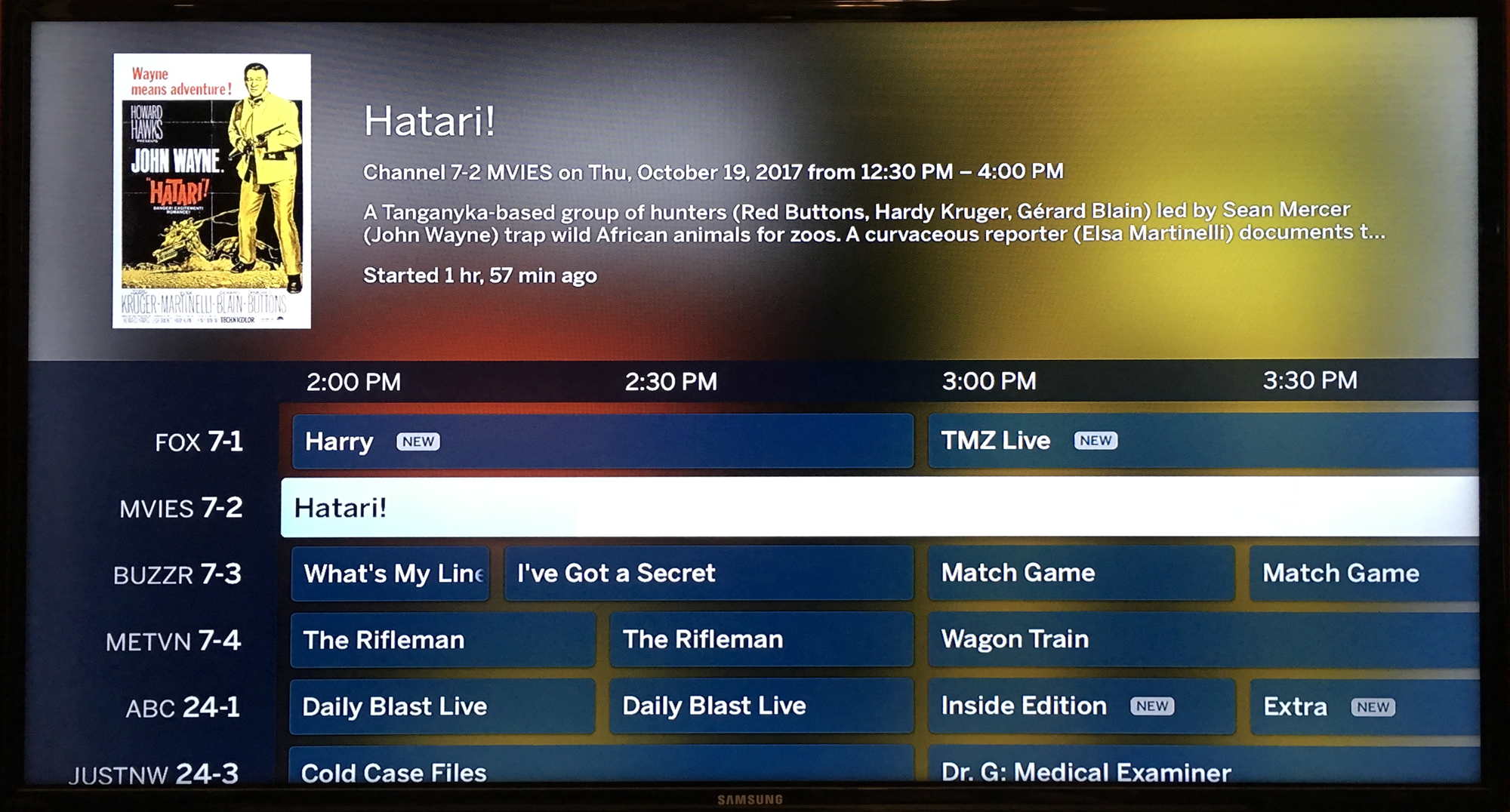
This is a photo of Tablo’s Apple TV app; this list of shows is might nicer to scroll through than the one built in to my Samsung television.
Back in the mid-seventies, when I was young and the recording industry thought it was old, I bought a cheap tape recorder at a yard sale. It was a portable cassette recorder, portable in the sense that it had a handle and was smaller than my dad’s breadbox-sized reel-to-reel. I used it to record songs off the radio, by putting its cheap plastic microphone on the carpet near the speakers on my parents’ console stereo.
It was an amazing experience and hooked me on listening to “my” music, when I wanted to and how I wanted to. It was a very short jump from there to the Columbia Record and Tape Club, where, of course, I bought cassette tapes at least once a month.
I listened to these tapes constantly, playing, pausing, fast-forwarding, and rewinding through my music collection. I distinctly remember a few months (or, given my frame of reference at the time, a few weeks) later, watching television, deciding I wanted to watch a scene over again, reaching my hand out to hit the rewind button on the television, immediately realizing how silly of a mistake it was.
So when I saw the Clearstream TV app show up for Apple TV and realized it was an app for pausing, rewinding, and occasionally even fast-forwarding through live television, I immediately wanted one. Even though I don’t even watch broadcast television anymore.
Turns out there were or were about to be several devices for watching live TV through an app. The Clearstream looked nice because of the price—only a hundred dollars. But the reviews were bad, and I preferred something that works over Ethernet. Mohu, whose Mohu Leaf antenna works reasonably well on my downstairs television, was about to come out with one that would connect to Ethernet. It was a hundred and fifty dollars, but I was toy-crazed and waited impatiently.
Unfortunately, the initial reviews for that were also bad.
- VidAngel: Here We Go Again—Friday, June 9th, 2017
-
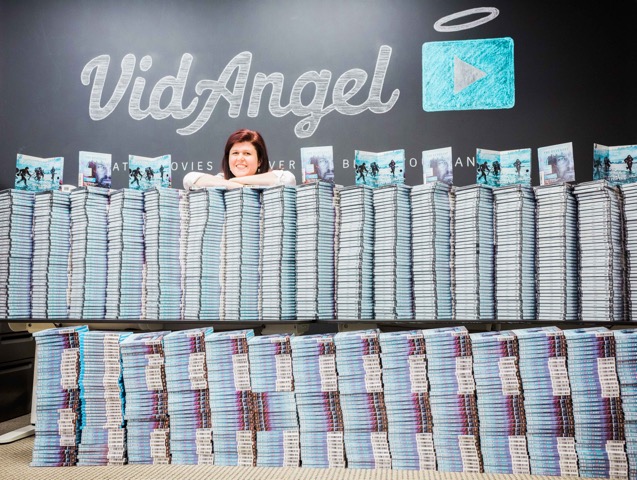
A thousand copies (or so) of Revenant in VidAngel’s DVD vault.
VidAngel just went to court on Thursday to appeal the injunction against their streaming movie filtering service. VidAngel is an interesting streaming service that allows you to buy a movie and then filter the movie according to your tastes at that moment; for example, you could change your filters depending on who is watching.
Or you could, if the courts would let them perform the service. Currently there’s an injunction against them.
VidAngel is a very neat idea. Their ads are very funny. Is VidAngel as useful as their ads say? Probably. Now, most movies are not as funny or as well-directed as VidAngel’s ads. But their ads are also a little misleading. Specifically, there are three things that are clearly explained on their web site but that are implied to be otherwise in their very funny and well-made ads:
- You can’t rent movies for $1. You aren’t renting movies at all, if they’re telling the truth: you’re buying movies for $20 and then getting $19 back. Except that if you have a widescreen television set, you probably want to buy the HD version, which also costs you $20, but you only get $18 when you sell it back. So for most people nowadays it’s going to be $2 per movie.
- You can’t wait any longer than RedBox to return the movie. Just like RedBox, you get charged what is basically a late fee for every day you don’t sell it back. The movie costs you $20; you buy it and you own it. You can (and probably will) sell it back to VidAngel to get some of your money back. If you sell it back within 24 hours, they’ll give you $18 or $19 for it. For every 24 hours after that, they’ll pay you less.
- Most importantly, you can’t actually watch it how you want to watch it, unless you always want to watch it filtered.
Now, all of these are clearly explained on the web site. I went in expecting to try out a movie-watching site where I could watch filtered or unfiltered for a buck as I wished, but by the time I got to the actual “give them money” step, I knew that wasn’t the case.
- Atlas Shrugged II: The Strike—Tuesday, February 14th, 2017
-
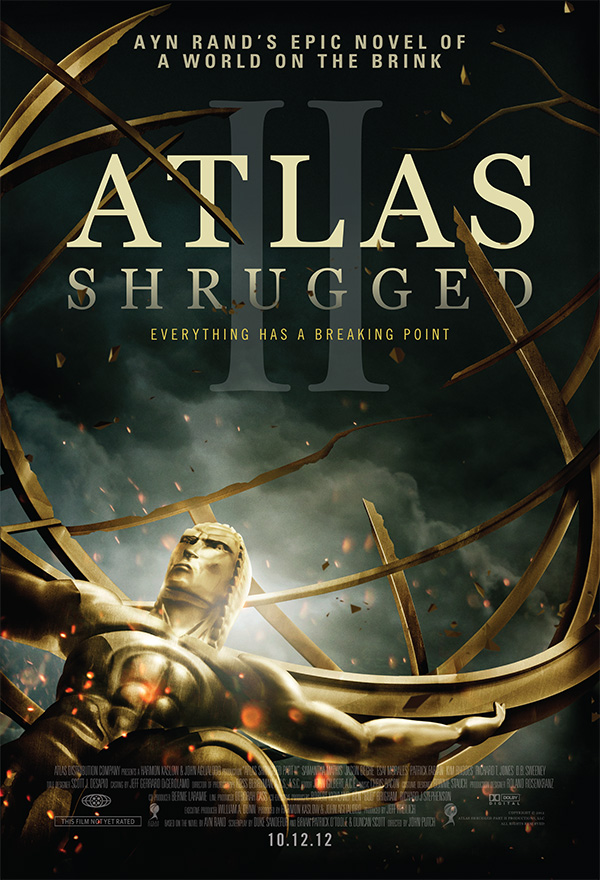
Well, I finally got around to seeing the second part of the Atlas Shrugged trilogy• last weekend. It has, in fact, overcome the few problems I noted from the first part. It was exciting, believable, and if it had any flaw it was that it was very much like a Hollywood movie. It vastly improved on the first movie, which I enjoyed, but mainly for memorable scenes (such as the train moving across the bridge) and the heart that the creators put into it.
Again, I still haven’t gotten around to reading the book (although I have read We the Living since then), so I can’t say how well it hews to the novel. But as a movie I highly recommend it.
If it has a flaw, it would be that it makes it look like the government’s actions are drastic and unprecedented; there’s no sense that some of them had already been put into place in the seventies by Nixon in collusion with a Democratic congress, and were maintained by Ford and Carter. We’ve already had wage freezes and price freezes in the United States; we know what a disaster it is—and how much the media will lie to maintain the resulting recession. While thrillers shouldn’t be history lessons, leaving that history out makes this movie more political than it really is.
Some demagogues on the left decry this movie as right-wing. But if, for example, the emphasis had been placed more on the cronyists like Dagny Taggart’s brother and less on the politicians that enable them, they’d be praising it. It’s all a matter of perspective: businessmen who use politicians are evil, and the movies that portray such evils are good; portraying politicians as complicit with the businessmen, even though the result is exactly the same and exactly as evil makes it right-wing from their perspective.
What it really is, is all too likely to happen again.
Atlas Shrugged III• is already in my Amazon cart. If it’s half as good as part two, this will be a great trilogy, and I’m not going to wait to find out like I did with part two.
Read the full post and comments | Buy Atlas Shrugged II: The Strike