


The Price of Prohibition
Heading into the downhill side of Tuesday’s terrorist attacks, I already hear news reporters and co-workers calling them “the price of freedom”, suggesting that we’ll need to give up some of our freedoms because of these attacks. But freedom did not fund these terrorist activities. Where these terrorists make their money is from prohibition. Prohibition provides a ready source of massive funding for organizations such as Osama bin Laden’s. He may have made his fortune in oil, but his Al-Qaeda organization maintains it with opium. And they can do so only because prohibition drives the price of opium up to hundreds of times what it would sell were we to end prohibition. The more successfully we enforce prohibition, the more money these terrorists make. According to Jane’s Transport aviation expert Chris Yates, such an effort “takes a logistics operation from the terror group involved that is second to none.” Whether we discover that these terrorists are foreigners or Americans, the chances are they funded their efforts through prohibition.
Freedom did not let these acts go undetected. Law enforcement follows the priorities we set, and we currently put a greater priority on catching drug users than on catching real criminals. Prohibition diverts law enforcement attention away from real crimes and towards pot smokers and heroin junkies. One of the questions being asked is “how could such a coordinated effort go completely undetected?” The answer, of course, is that law enforcement was focusing on pot smokers, inner-city junkies, and DWB’s. At least one third of all Americans have broken our prohibition laws at least once. The law enforcement effort that currently goes into trying to catch those Americans is effort that isn’t being used to catch murderers, thieves, and, yes, terrorists.
Those thousands injured and hundreds dead in New York and DC are not the price of freedom, they are the price of prohibition. We know that prohibition funds crime. We’ve known it ever since alcohol prohibition nurtured the expansion of the mafia. Today prohibition is funding and nurturing international criminal and terrorist organizations far more deadly than the mafia. How much more violence do we need to see before we realize how dangerous prohibition is?
End prohibition and we cut their funding. End prohibition and we can quickly bear massive law enforcement effort—effort that is currently bearing down on pot smokers and other recreational drug users—on finding and catching these real criminals. End prohibition and we’ll have more than enough jail space to place the criminals we catch.
Maintain prohibition, and we continue funding terrorism. Maintain prohibition, and we continue to let terrorists go in favor of jailing pot smokers. If we support prohibition, we support terrorism.
- May 4, 2015: Learning from alcohol prohibition
-
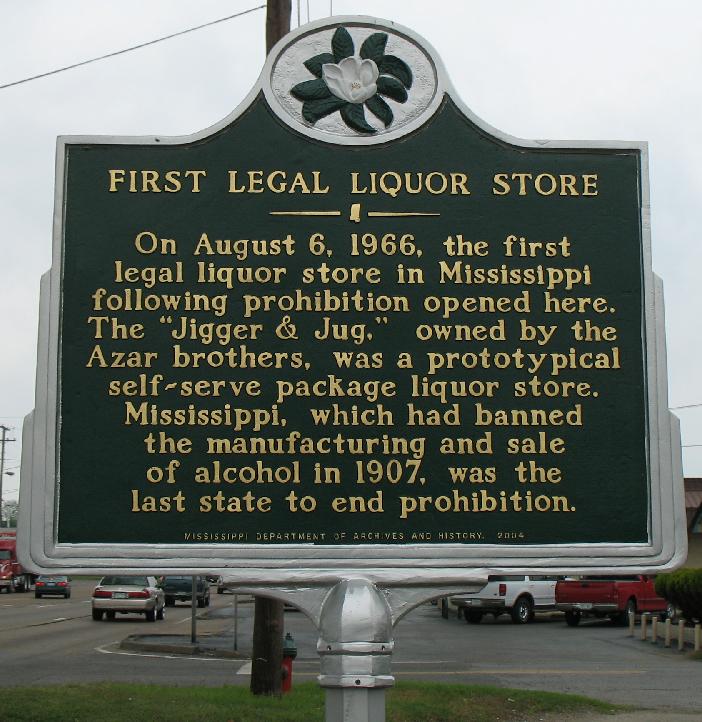
Mississippi waited until 1966 to end alcohol prohibition, learning the lessons of all other states.
Why does ending prohibition have to mean the government handing out cocaine, morphine, and heroin in the streets? When we ended alcohol prohibition we didn’t suddenly say, okay, you can now sell all the bathtub gin you want. We made it legal for states to start experimenting with legalizing alcohol, and for those that didn’t the federal government remained available to fight interstate traffic into those states.
Even today, sales of 95%-alcohol Everclear are banned in California, Florida, Hawaii, Iowa, Maine, Maryland, Michigan, Minnesota, Nevada, New Hampshire, North Carolina, Ohio, New York, Virginia, and Pennsylvania.
A tentative end to the violence of the drug trade could be tested in the United States simply by making it legal for states to experiment with various forms of legalization of marijuana, coca, and, if that didn’t increase violence, opium.
If we were to make tobacco illegal today, the preferred form of users would quickly become pure nicotine or something even more powerful (as heroin is even more powerful than pure morphine from the opium poppy). But the dangers of pure nicotine would be a poor reason to avoid relegalizing tobacco, just as the dangers of pure cocaine and pure morphine are a poor reason to avoid ending prohibition of coca and opium, and certainly of marijuana.
Following the lessons we learned from relegalizing alcohol, some states would choose to continue making coca and marijuana illegal, and transporting those drugs into those states would continue to be a federal crime. Other states would experiment with the same process that allow us to go to the bar today and drink a beer or cocktail instead of killing ourselves on bathtub gin.
Some states will be as cautious as Mississippi, which didn’t end prohibition until 1966. Others would move more quickly. Those that moved more quickly could themselves choose to move only on marijuana, or both marijuana and coca, or marijuana, coca, and opium, perhaps experimenting with medical vs. recreational use: experimenting with ways to end the violence and corruption costs associated with prohibition without seeing a worse rise in other costs.
- August 9, 2004: Use intelligence more intelligently to stop terrorism
-
I was recently re-reading Peter McWilliams’ wonderful “Ain’t Nobody’s Business If You Do” and ran across this prescient piece. McWilliams wrote this in 1996, five years before 9/11:
We don’t hear much about terrorism in this country because if we really knew what was going on, we'd all be, well, terrorized. The car bomb (or, more accurately, the mini-van bomb) explosion at the base of the World Trade Center in March 1993 was not only an act of terrorism--it was a warning....
Meanwhile, what are the FBI, CIA, and United States Customs--our only realistic defense against terrorism--up to? You guessed it: defending us against consensual crimes. Drugs, of course, head the list. Terrorism is a footnote.
...on September 28, 1992, the Office of the Attorney General and the Office of the Drug Enforcement Administration revealed “a truly unique joint effort involving the participation of law enforcement agencies on three continents.” Was this “truly unique” two-year international effort designed to track down and uncover terrorism? No. Known as Operation Green Ice, its purpose was to terrorize drug dealers. “Operation Green Ice has a message for drug dealers everywhere: the world is mobilized against you. U.S. law enforcement will continue with our colleagues around the world to defeat these purveyors of human misery.”
Couldn’t all of this intelligence be used more intelligently?
And today, eight years later and three years after September 11, not much has changed.
- September 20, 2001: Bush: We should live by our principles
-
President Bush’s address to the joint houses of congress tonight was eerily reminiscent of my own words above. He talked about how “Al Qaeda is to terrorism what the mafia is to crime” and that we must “cut the funding of terrorists at their source”. Strong words, but I doubt that he has the will, nor that we as a country have the desire, to end the divisive and profitable drug war. The prison industry is too powerful; law enforcement prefers the relatively easy job of busting pot smokers to the more dangerous job of tracking down terrorists; politicians will want to keep the easily-used election rhetoric of the drug war.
Bush said that “we are in a fight for our principles. We should live by them,” and that this is “the fight of all those who believe in plurality, tolerance, and freedom.” It would be strong symbolism and an important strike in the war against terrorism to show this tolerance and this plurality by ending prohibition of marijuana, coca, and opium in the same way that we ended the prohibition of alcohol and tobacco. At the same time that we show support for religious plurality (marijuana, for example, is used by practitioners of a mostly-Black religion, and marijuana prohibition is used to allow law enforcement to crack down on Blacks), for personal freedom, we would also end an easy source of terrorist funding.
“Al Qaeda is to terror what the mafia is to crime.” Like the mafia and alcohol prohibition, modern prohibition not only funds but nurtures and protects terror around the world. If we truly mean the rhetoric about tolerance, freedom, and living by our principles, if we truly want to cut funding to terror, if we truly want to divert our law enforcement might to terrorists, we will end prohibition once and for all.
More prohibition
- Learning from alcohol prohibition
- If the people against ending drug prohibition had been around in the thirties, we would never have ended the prohibition of beer and cocktails, because of the dangers of pure alcohol and bathtub gin. One of the lessons of the alcohol prohibition era is that we don’t have to go from banning everything to allowing everything. There is a middle ground.
- Progressives ruin a different kind of race in New Jersey
- As a potential triple-crown winner prepares for the third race of the Triple Crown, it’s almost impossible to place a bet in Atlantic City, NJ.
- U.S. homicide rate compared to gun control measures
- Extrano’s Alley lists the U.S. homicide rate from 1885 to 1940, and somebody else puts it into a chart.
- The Great Illusion: An Informal History of Prohibition
- Herbert Asbury’s book has to rank as one of the greatest arguments ever written against the drug war; this book about alcohol prohibition chronicles and forecasts all of the problems with modern prohibition that we see today.
- Cannabis Britannica
- Subtitled “Empire, Trade, and Prohibition”, this is an in-depth history of how prohibition came about in Britain, and ends up describing how marijuana prohibition came to the forefront of international attempts to ban opium.
- 26 more pages with the topic prohibition, and other related pages
More September 11
- Politico: Bush should have started war July 2001
- President George W. Bush ignored critical advice from intelligence advisor five months into presidency: “We need to go on a wartime footing now!”
- The graphs of destruction
- Imagine a graph with two lines charted against the years: the resources needed to cause mass destruction, and the resources available to those who want to cause mass destruction. Those lines are dangerously close today.