
Mimsy Review: The Tassajara Trilogy
Around the net
Review of The Tassajara Trilogy: Tassajara Cooking, Tassajara Recipe Book, and Tassajara Bread Book, with a recipe for Smoked Greens.
| Author | Edward Espe Brown |
|---|---|
| Publisher | Shambhala |
| Year | 1970 |
| Length | 693 pages |
| Book Rating | 7 |
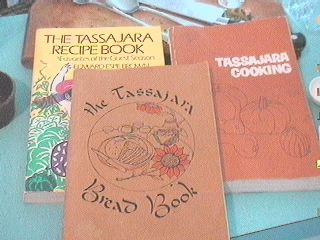
Edward Espe Brown• started at Tassajara as a dishwasher in 1966, when it was still a resort, not a zen monastery. A year later and he was cook at the Tassajara Zen Mountain Center. The bar became the meditation hall. (Wasn’t it always?) The first stage in the trilogy was two books: The Tassajara Bread Book•, completed in 1970, and Tassajara Cooking•, completed in 1973.
There was a twelve year gap between Tassajara Cooking and the final book, The Tassajara Recipe Book•. Along the way, the Zen Center of San Francisco became a corporation and a restaurant and Greens was started in San Francisco. Espe says that he wrote the third book, “not because I know something about cooking, but because I know something about writing cookbooks.” The third book is certainly more professionally put together; it has a glossy cover rather than the stiff cover of the previous two; the recipes are presented as recipes. Any commentary is separated to the beginning or the end.
In the first two books, recipes and comments on the recipes are intertwined; recipes can span entire chapters and be interspersed with other recipes. A friend of mine who is a professional cook doesn’t like the Bread Book because she finds it impossible to follow any specific recipe backwards and forwards.
The first chapter of the Bread Book is twenty pages of “general instructions for yeasted bread”. The actual yeasted bread recipes don’t start until the second chapter where you get variations such as rye bread with sour cream, summer Swedish rye bread, and banana sandwich bread. There are a few recipes in each of the first two books on turning leftovers into bread or soup, reflecting the “guerilla” nature of cooking at a remote mountain monastery.
Tassajara Cooking begins with “The way to be a cook is to cook. There is no secret. Play, don’t work.” It includes lots of notes on using and caring for knives, and chopping vegetables in various ways. The first half of the book covers vegetables and means of preparing them. The rest of the book is more standard recipes, or at least as standard as he could get in the seventies… beans, soups, sauces, and main dishes such as miso stew, a basic recipe for casseroles, bulgur-tahini casserole. Casseroles are excellent for leftovers, he writes. When you are days from the nearest grocer, you don’t waste your food.
The third book is set up more like a normal cookbook. The recipes are set off, there are nice photographs heading off each chapter, and the poetry gets pages on their own. The Zen Mountain Center seems to be a beautiful place.
You will find lots of tofu and rice in these recipes, but just as much egg and butter and cheese. While you will not find any meat, that is because the monks don’t eat meat, not because they leave meat out. These are not vegetarian cookbooks, nor are they health food cookbooks. The third book, for example, contains “Properly Cooked Brown Rice”, “Tassajara Granola”, “Tofu Cutlets”, and “Sour Cream Poppyseed Cake”. I would not like to see the fat content of “Shirred Eggs” or “Tassajara Smoked Cheese and Spinach Pie”. But I will eat them just the same!
Oh, yes, as I alluded to above, there is “zen cooking poetry” spread throughout each book. More so in the middle work, Tassajara Cooking. Here’s a sample from the chapter on vegetables:
- Whatever is done will not make a cucumber
- more of a cucumber or a radish more of a radish.
- Cucumber is cucumber, radish is radish.
- What is done may make a vegetable more suitable
- to some particular taste—that’s the usual way,
- to see what taste we want. But why not
- ask the cucumber, why not ask the radish?
- What is the taste it would like to express?
Yes, your taste may vary, I kind of like it. And stories about the monastery or how various recipes came about are also fun to read.
The Tassajara collections are among my favorite cookbooks to browse through, and they contain some of my favorite recipes. You will require respect for the sixties and early seventies, or for zen thinking, to truly enjoy these books; it will help if you don’t cook the food, but simply let it cook. Excuse me now, I’m off to try some tahini shortbread.
Smoked Greens
- greens,
- lemon butter,
- oil,
- salt.
- The greens were cooked in a wok, the concave Chinese frying pan, over a high flame.
- They were briefly forgotten about until—Oh no! They’re burning!
- Complete dismay in the kitchen—forty people waiting for supper—just have to make do.
- The blackened greens stuck to the bottom of the pan, and out came the rest, to be served with lemon-flavored butter.
- Everyone wondered, “How did the greens get this wonderful smoked flavor, as though they’d been cooked with some mighty fine ham?”
- C’est la vie.
- And then all of those blackened leaves had to be cleaned out of the pan.
The Tassajara Trilogy
Edward Espe Brown
My cost: $14.85
Recommendation: Quirky. You know you want it.•
If you enjoyed The Tassajara Trilogy…
For more about cookbooks, you might also be interested in A Concise Encyclopedia of Gastronomy, Bull Cook Historical Recipes, Cavalier Cooking, Classic Chinese Cuisine, Cooking the Bahamian Way, Country Commune Cooking, Life, Loves, and Meat Loaf, The Art of Korean Cooking, The Casserole Cookbook, The Complete Book of Oriental Cooking, The Complete Bread Cookbook, The Frugal Gourmet Celebrates Christmas, The Healthy Cuisine of India, The New Larousse Gastronomique, A Decade of Jell-O Joys: 1963-1973, Saucepans and the Single Girl, The Northwest Cartoon Cookery, Good Food From Mexico, Laurel’s Kitchen, The Cooking of Vienna’s Empire, James Beard’s Fireside Cook Book, French Bistro Cooking, A Fifteenth Century Cookry Boke, Crockery Cookery, Southern Cooking, The Frugal Gourmet Keeps the Feast, The Fannie Farmer Cookbook, French Cooking Simplified With a Food Processor, In Good Taste, Heritage of America Cookbook, Our Favorite Hometown Recipes Vol. II, The Indian Spice Kitchen, Japanese Country Cookbook, La Cuisine Française, Larousse Treasury of Country Cooking, The Natural Foods Cookbook, A Russian Jew Cooks in Peru, Soul Food Cook Book, Pains Spéciaux & Viennoiseries, Whole Earth Cookbook, The Wok: a chinese cook book, Southern Living Cookbook for Two, Lebanese Cuisine, The Art of Syrian Cookery, Popular Greek Recipes, In a Persian Kitchen, The Art of Pennsylvania Dutch Cooking, The Southern Living Cookbook Library, The Donna Rathmell German Bread Machine Cookbook collection, The missing indexes, St. Mary’s Altar Society Cookbooks, The Deplorable Index, My year in food: 2022, My Year in Food: 2023, My Year in Food: 2024, My Year in Food: 2025, Franklin Golden Syrup Recipes, Promotional cookbook archive, Finding vintage cookbook downloads, Chiquita Banana’s Recipe Book, A golden harvest of sunflower seeds, A 1950 recipe calendar for 2023, Hope Lutheran 1950 Lenten fish au gratin, Tempt Them with Tastier Foods: Second Printing, Mrs. Winslow’s Domestic Receipt Book for 1876, Stoy Soy Flour: Miracle Protein for World War II, A Traveling Man’s Cookery Book, Rumford Recipes Sliding Cookbooks, Using ingredients to guess cookbook years, Four New Ices and an Ice Cream Cookery, Ice Cream Cookery, Second Printing, A Bicentennial Meal for the Sestercentennial, Padgett Sunday Supper Club Sestercentennial Cookery, Refrigerator Revolution Revisited: 1928 Frigidaire, Refrigerator Revolution Revisited: 1942 Cold Cooking, Refrigerator Revolution Revisited: 1937 Kitchen-Proved, Padgett Sunday Supper Club, Club recipe archive, Promotional Cookbook Archive, Cookbook publication year estimates I have made, and Club Padgett Cookery Errata.
- The Tassajara Bread Book•: Edward Espe Brown (paperback)
- The best of the Tassajara books, with a nice variety of unique breads and baked goods.
- Tassajara Cooking•: Edward Espe Brown (paperback)
- “The way to be a cook is to cook.”
- The Tassajara Recipe Book•: Edward Espe Brown (paperback)
- More recipes from the Zen center corporation and restaurant.
“I don’t necessarily recommend that you try to duplicate this recipe, but maybe you will sometime without even trying.”