


Thomas Jefferson’s Pumpkin Soup
Celebrate this semiquincentennial Halloween in ghoulishly revolutionary fashion with this Founder-era pumpkin soup. Use your jack-o-lantern’s excised body parts to make it!
Servings: 8
Preparation Time: 1 hour, 30 minutes
Annette
Thomas Jefferson’s Cook Book (Internet Archive)
Ingredients
- 3 lbs pumpkin flesh
- 3 tbsp butter
- sugar
- salt
- pepper
- 4 cups hot milk
- three slices bread
- butter
Steps
- Steam the pumpkin until tender.
- Remove peel and mash.
- Stir in butter to melt.
- Add sugar, salt, and pepper to taste.
- Simmer fifteen minutes.
- Add milk, stirring well while pouring.
- Bring back to simmer.
- Meanwhile, chop the bread into cubes.
- Brown bread cubes crisp in butter.
- Distribute croutons in 6-8 bowls.
- Pour soup over croutons.
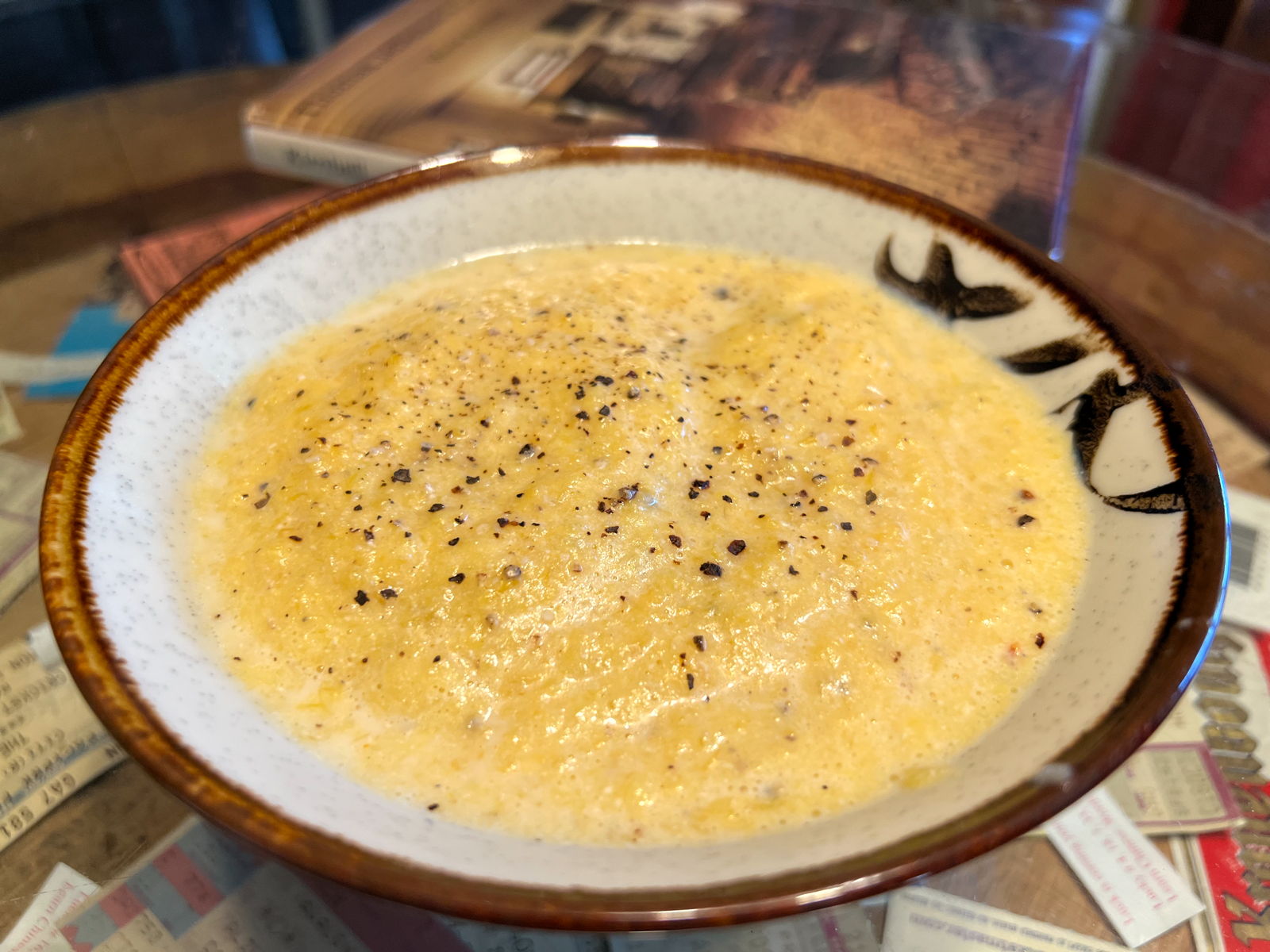
Thick enough that croutons did not immediately turn soggy.
One of the recipes I tried from Marie Kimball’s Thomas Jefferson’s Cook Book is the Pumpkin Soup attributed to “Annette”. I left this out of my Monticello Meal post because soups aren’t very good ideas for pot-lucks, especially Fourth of July pot-lucks with paper plates, drinks, and, nowadays, phones. You’d need four hands instead of the usual three if soup was involved, too!
This would be, however, a great soup for a Thanksgiving meal. It’s a fine example of how simple is often better. This soup includes none of the spices and other flavorings normally included in pumpkin soups. So often, pumpkin dishes are so spiced you could just as well use carrots or orange food coloring to get the same result and no one would know the difference.
Many pumpkin pies are so filled with cinnamon, cloves, allspice, nutmeg, brandy, and the rest of the holiday flavor profile that the pie appeals more to people who don’t like pumpkin than people who do.
Salt and pepper are it for this soup. It tastes like pumpkin. If you like pumpkin, you’ll like it. If you don’t, you won’t.
Pumpkin soup
Take half a small pumpkin, peel, cut in small pieces and put on the stove with half a glass of water. When the pumpkin is tender, drain, and pass through a colander. Add 3 tablespoonfuls of butter; sugar, salt, and pepper to taste. Let it simmer for fifteen minutes. Add 4 cups boiling milk, stirring well while pouring it in. When well mixed, pour over croutons, made by cutting three slices of bread in small cubes and browning well in butter.
Annette.
I chose to steam the pumpkin rather than simmer it in the water. I’ve found that steaming preserves and even enhances the color of vegetables, and for pumpkin that color is part of the appeal of the soup.
We know very little about the Annette who this soup is attributed to. Kimball implies that the “Annette” of the Pumpkin Soup is contemporaneous with “[Adrien] Petit, the old stand-by”. But while Petit is well known throughout his career as, variously, Jefferson’s valet de chambre and maître d’hôtel, we know pretty much nothing about Annette. She appears to have been the French governess hired for Jefferson’s daughters Martha (Randolph) and Mary (Eppes). However, I found this claim only in asides by people making some of these recipes. There is so little information about Annette that one of those asides is from my own review of Kimball’s book and is explicitly-labeled as speculation.
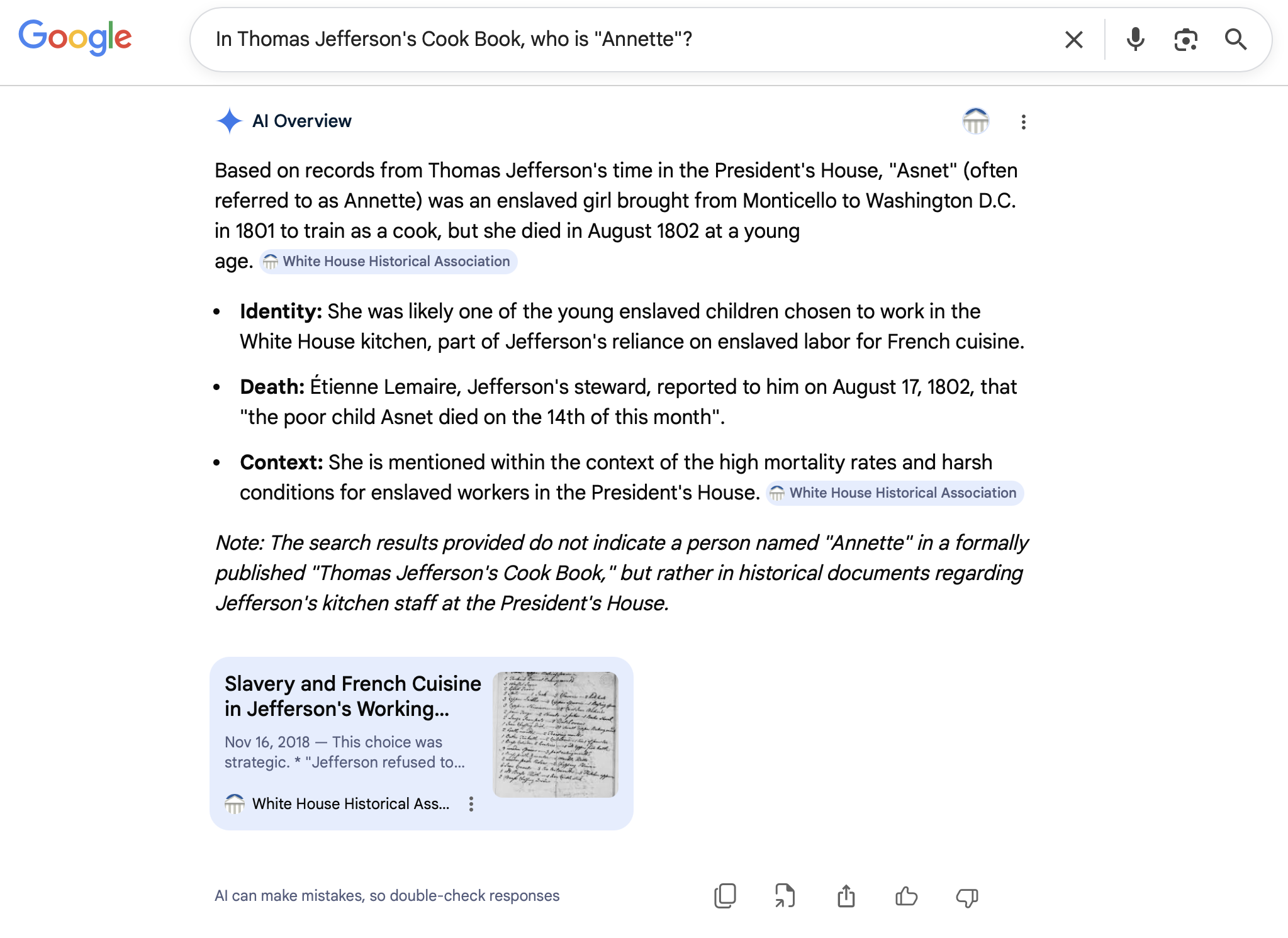
“AI can make mistakes, so double-check responses”. I’ll say. Asnet did die “at a young age”. The document referenced says: two months old. And that Asnet was a boy, not a girl.
I’ve found no historical work or reference that names the governess(es) of Jefferson’s daughters, nor any reference to an “Annette” in any of the works about his daughters. Kimball otherwise gives no information about Annette.
What’s worse is that at least two major Jefferson scholars are named Annette, making the original Annette difficult to track down by way of on-line searches. The closest I was able to get to identifying her was a parenthetical in a newspaper recipe, which makes this not just cookbook history—already unreliable—but newspaper column cookbook history, even worse.
The October 19, 1995, Tampa Bay Times, in Humble dish from aristocratic origin identified “Annette” as “French governess to Jefferson’s two daughters”.
That was it. And of course, being a newspaper, no sources either.
Dave DeWitt, in The Founding Foodies, attributed the recipe to “the slave cook Annette” but did so in a way which implied that information came from Marie Kimball and Thomas Jefferson’s Cook Book!
In her Thomas Jefferson Cookbook, Marie Kimball included a recipe attributed to the slave cook Annette for pumpkin soup, which I have used as a basis for the one here. I have taken the liberty of adding some chili pepper to it, as Jefferson grew bird peppers during his retirement.
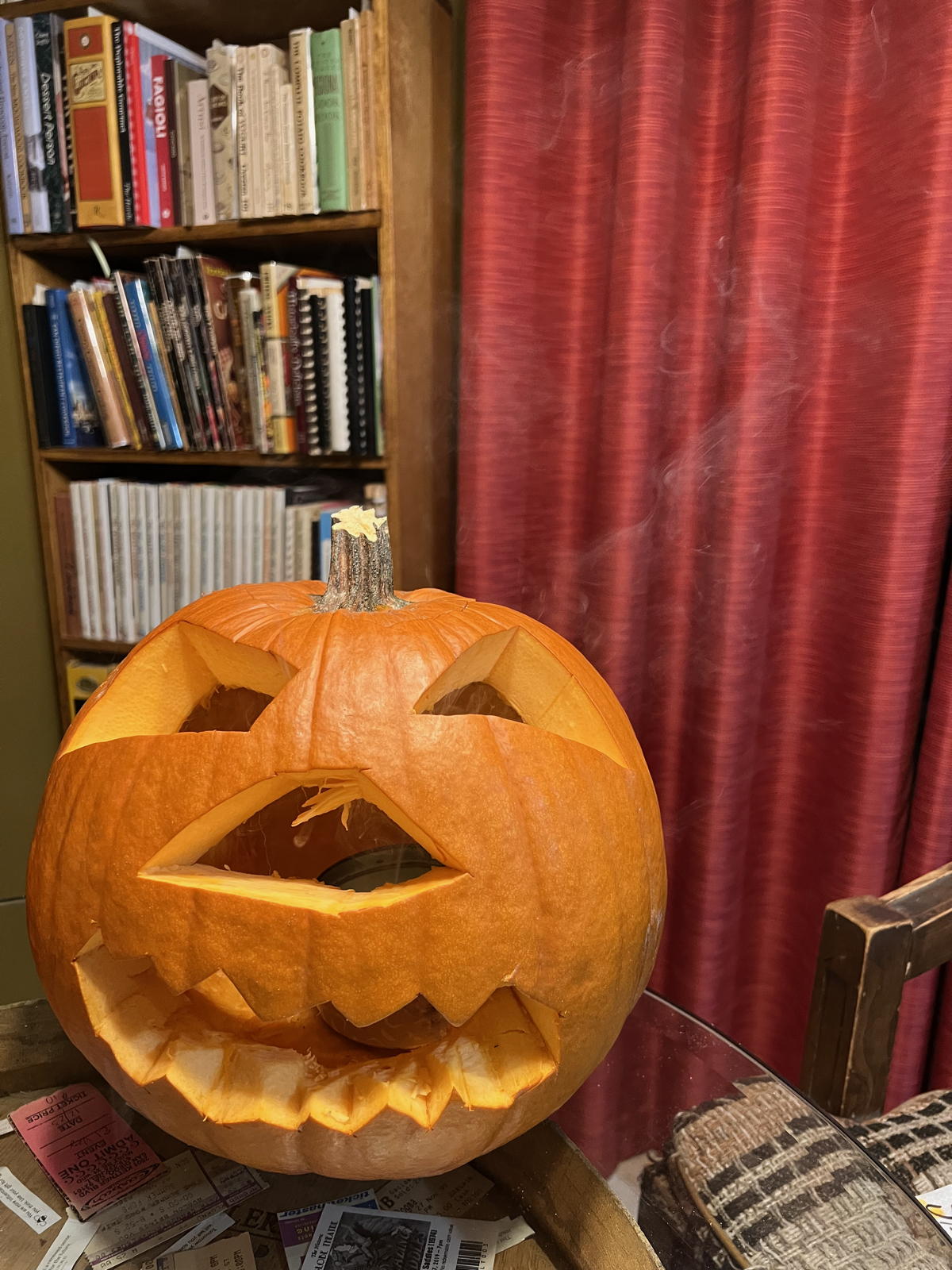
Jack is not happy with this dish…
There is nothing in Marie Kimball’s book to imply that Annette was a slave cook, and the only implication that she was a cook at all comes from her having supplied so many of the recipes. Many of the recipes are attributed to people who were definitely not slaves, and some not even cooks.
If the pop-culture title of Founding Foodies doesn’t inspire a lack of confidence in its historical accuracy, getting the title of Kimball’s book wrong should. That said, I’ll bet even money that roasted chili pepper would in fact be a great addition to this soup. If we discounted cookbooks with bad history in them we’d probably have to throw out half the great cookbooks of the world.
Kimball’s first mention of Annette is as a side remark to a side remark:
Each of the six granddaughters, as thoroughly schooled in the domestic arts as in French, Latin, or music, carefully copied, in the delicate hand writing they had learned from their mother, the favorite “rules” and “receipts” of the household, whether from Lemaire, the President’s steward, from Julien, the chef, Petit, the old stand-by, Annette, or some friend.
I initially read that as “the chef, Petit” and “the old stand-by, Annette”. But I’m nearly certain now that the correct reading begins with “Julien, the chef”. That’s because Etienne Lemaire was the President’s steward, making Petit, who was Jefferson’s valet de chambre and later maître d’hôtel the old stand by. The phrase becomes less a bit of colloquial praise and more a near literal description of what a valet de chambre actually does.
That remark by Kimball, however, is the first and only mention of an Annette outside of the recipe attributions. And a lot of the recipes are attributed to her. All of them are in the “Monticello Recipes” section of the book. They include a Soup à la Julienne, Pumpkin Soup, Potato Soup, Pea Soup, Pot au Feu, Fricassee of Chicken, Chicken with Rice, Capitolade of the Remains of Roast Fowl, Pigeons in Compote, Pigeons à la Compote, Civet of Hare, Croquettes of Roasted Veal, Braised Leg of Mutton, Hash of Braised or Roasted Leg of Mutton, Braised Mutton Chops, Fricandeau, Veal Cutlets in Paper, French Beefsteak, Larded Filet of Beef, Beef à la Mode, Gâteau au Riz (and sauce), Gâteau de Pomme de Terre, Grated Apple Pudding, and A Plain Pudding.
A lot of them have French names, which may bolster the Tampa Bay Times assertion.
For someone with as many recipes attributed to her as Annette has, she is surprisingly absent from online sources. Probably the second-most common result on searches for Jefferson are that he was our foodie President. But Annette is absent even from articles that reprint her recipes. Neither Martha Jefferson’s nor Mary Jefferson’s entries on Wikipedia mention her. Through implication it may be that—if the Tampa Bay Times claim that she was a governess can be taken seriously—Annette was one of the private tutors the sisters had while both were in Paris. She would then likely have disappeared into other employment in Paris after Jefferson and his family returned to the United States.
It’s not completely weird that a Frenchwoman would contribute pumpkin soup. Pumpkins had been brought to France in the mid 1500s and they were making soup out of it by 1651. Max Miller made a video about one of them on Tasting History. Miller’s translation of that soup makes it look very similar to Annette’s, although it does have some added flavoring that Annette’s does not:
Pumpkin Soup with Milk
Cut up a pumpkin and cook it as above [in water and salt], then pass it through a strainer with some milk and boil it with butter, seasoned with salt, pepper, and onion stuck [with cloves], and serve with yolks of eggs thinned [with some broth].
Annette’s Pumpkin Soup is the quickest pumpkin soup I’ve ever made. It required a lot of guessing; the amount of pumpkin required is “half a small pumpkin, peel, cut in small pieces”. I guessed at about three pounds of pumpkin flesh, and then, because I was making just enough for myself this time, I used a quarter of that, all leftover from my Halloween carvings.
Part of the reason I guessed at three pounds is that I wanted to make a quarter recipe—it makes the math easier—and I had about twelve ounces of pumpkin in the freezer.
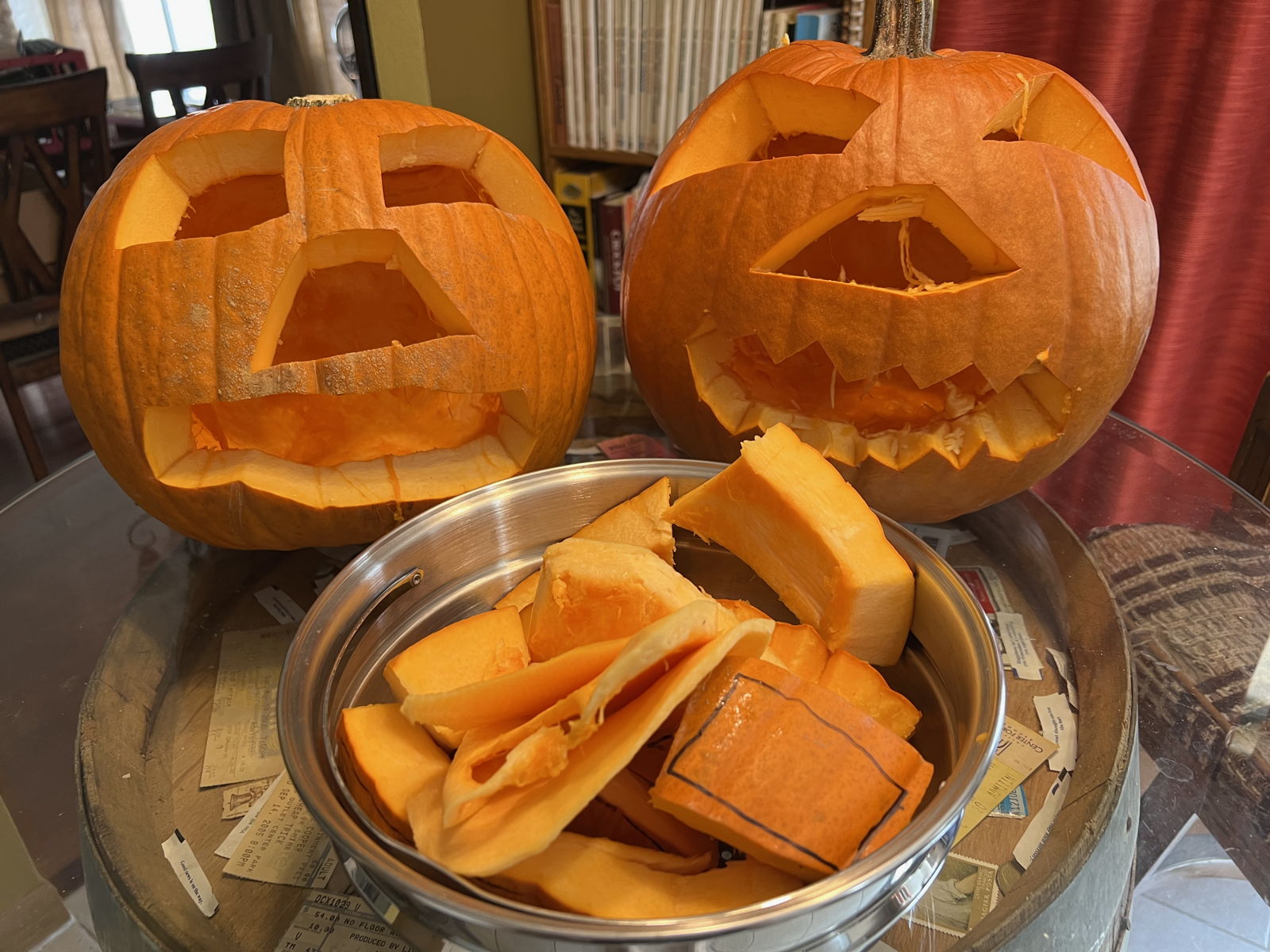
Always save your pumpkin parts! I’ve also found that steaming improves both the flavor and the color over boiling.
Because I used pre-steamed pumpkin flesh, this was a fast recipe: just simmer it with butter, “sugar, salt, and pepper to taste” for fifteen minutes, then add “boiling milk”, which I assumed to be scalded and very hot, but not quite boiling, and then pour over croutons “made by cutting three slices of bread in small cubes and browning well in butter”.
This was very good, right down to the croutons made from leftover Christmas/Easter bread. They were not as soggy as I originally expected, probably because the soup was thicker than I expected. How much of that was my very self-centered guess at the amount of pumpkin required, I don’t know.
It seemed basically about right: a cup to a cup and a half of pumpkin flesh to a cup of milk. And it’s likely that this is the amount I’ll use in the future, give or take based on whatever I have available.
This obviously would be a very different recipe “according to taste”, depending on how much sugar goes in vs. salt and pepper. If you put a lot of sugar in, do you also add the ubiquitous nutmeg even though it isn’t mentioned? I did not, although it likely would have been good even in the savory version I made.
And if you prefer a richer soup, you could replace some or all of the milk with half-and-half, cream, or evaporated milk. The soup was more than thick enough for me made as is. The use of milk rather than one of those richer options makes the pumpkin stand out more. This is and is meant to be a very pumpkin-forward pumpkin soup.
I was unable to find an original of this recipe from Jefferson’s era. Like DeWitt’s book did, all of the references to this recipe that I can find—and most references to Annette—refer back to Marie Kimball’s book if it provides a source at all. But if you’re still celebrating the Semiquincentennial and are making this to reproduce one of Jefferson’s dishes, evaporated milk wasn’t yet available in his time. Milk, or a rich milk, or potentially even a skimmed milk in which the cream has been removed for some other use, is likely to be the most historically accurate.
Any of those three will make a marvelous pumpkin soup.
In response to Holiday food: From Christmas to Easter to Independence Day and more, holidays are times for sharing great food.
bread
- Peppermint Dessert with stale Easter Bread
- This very simple whipped cream dessert is also a great way to use up stale Easter (or Christmas) bread.
pumpkins
- A 375 Year Old French Recipe for Pumpkin Soup: Max Miller at Tasting History with Max Miller
- “This is one of the first recipes for pumpkin soup where we can be sure that the pumpkin they’re referring to is a new world pumpkin. This cookbook was written by François Pierre de la Varenne, who’s credited with leading the shift away from highly spiced medieval and renaissance foods into what we would call French haute cuisine.”
- A Brief History of Pumpkins: Anna Fort
- “Pumpkin seeds have been found throughout Mexico, South America, and the Eastern United States, as early as 5,500 B.C., dating pumpkins well before the emergence of maize. Unlike the ones we are familiar with today, pre-Columbian pumpkins were smaller, harder, and more bitter, though native Americans eventually altered them to be sweeter.” “…around the mid-1500s, pumpkins were cultivated in England (pumpions), and France (pompons).”
- Pumpkin cornbread
- Pumpkin cornbread allows you to take your pumpkin leavings straight to the oven without any further preparation other than grating them.
- Pumpkin rarebit soup
- Pumpkin rarebit soup from Mollie Katzen’s Enchanted Broccoli Forest is a very nice way to use up those pumpkin parts after carving your pumpkin.
Thomas Jefferson
- The Founding Foodies: How Washington, Jefferson, and Franklin Revolutionized American Cuisine: Dave Dewitt at Internet Archive
- “Beyond their legacy as revolutionaries and politicians, the Founding Fathers of America were first and foremost a group of farmers. Passionate about the land and the bounty it produced, their love of food and the art of eating created what would ultimately become America’s diverse food culture.”
- Humble dish from aristocratic origin: Frances Price
- “Attributed to Annette, French governess to Jefferson’s two daughters, the original Capitolade was made with the Remains of Roast Fowl.”
- A Monticello Meal for Independence Day
- Marie Kimball’s Thomas Jefferson’s Cook Book provides several pot-luck friendly dishes for your Fourth of July celebration this Semiquincentennial.
- Review: Thomas Jefferson’s Cook Book: Jerry Stratton at Jerry@Goodreads
- “While the recipes lack as much historical context as I’d prefer, this is a fascinating book. Kimball’s essay’s focus on Jefferson’s status as a gourmet and a food and wine expert is an early and probably still most reliable and detailed example of the genre.”
- Thomas Jefferson’s Cook Book: Marie Kimball at Internet Archive
- This is a 2007 reprint of the 1938 edition, which doesn’t have the completely unnecessary Helen D. Bullock essay that prefaces the 1976 edition.
More Hallowe’en
- Pumpkin cornbread
- Pumpkin cornbread allows you to take your pumpkin leavings straight to the oven without any further preparation other than grating them.
- Salted, roasted, pumpkin seeds
- As we continue our quest to use all of Jack’s body parts, it is time to progress to his innards. Here is a simple, delicious use for your Hallowe’en pumpkin’s seeds. Jack’s got guts, I’ll say that for him!
- Pumpkin rarebit soup
- Pumpkin rarebit soup from Mollie Katzen’s Enchanted Broccoli Forest is a very nice way to use up those pumpkin parts after carving your pumpkin.
- Cream of coconut jack-o-lantern soup
- If last year’s jack-o-lantern soup wasn’t gruesome enough, try mixing your pumpkin’s disgouged facial parts with coconut and ginger.
- Cream of Jack-o-Lantern soup
- Use the body parts of your hallowe’en pumpkin to make a tasty, if disconcerting, pumpkin soup.
More pumpkins
- Pumpkin cornbread
- Pumpkin cornbread allows you to take your pumpkin leavings straight to the oven without any further preparation other than grating them.
- Salted, roasted, pumpkin seeds
- As we continue our quest to use all of Jack’s body parts, it is time to progress to his innards. Here is a simple, delicious use for your Hallowe’en pumpkin’s seeds. Jack’s got guts, I’ll say that for him!
- Pumpkin rarebit soup
- Pumpkin rarebit soup from Mollie Katzen’s Enchanted Broccoli Forest is a very nice way to use up those pumpkin parts after carving your pumpkin.
- Cream of coconut jack-o-lantern soup
- If last year’s jack-o-lantern soup wasn’t gruesome enough, try mixing your pumpkin’s disgouged facial parts with coconut and ginger.
- Cream of Jack-o-Lantern soup
- Use the body parts of your hallowe’en pumpkin to make a tasty, if disconcerting, pumpkin soup.
More soups and stews
- Pumpkin rarebit soup
- Pumpkin rarebit soup from Mollie Katzen’s Enchanted Broccoli Forest is a very nice way to use up those pumpkin parts after carving your pumpkin.
- Paprikás Burgonya (Potato Paprika Stew)
- Friday is National Potato Day. Why not try this very easy potato-sausage stew from Hungary? You can make it in an hour on the stovetop, or start it up in the morning in a crockpot.
- Cream of coconut jack-o-lantern soup
- If last year’s jack-o-lantern soup wasn’t gruesome enough, try mixing your pumpkin’s disgouged facial parts with coconut and ginger.
- Cream of Jack-o-Lantern soup
- Use the body parts of your hallowe’en pumpkin to make a tasty, if disconcerting, pumpkin soup.
- Corn and spinach tofu soup
- This is a very comforting light soup that makes good use of tofu’s texture and flavor.
- 15 more pages with the topic soups and stews, and other related pages
More Thomas Jefferson
- News on the Deaths of Adams and Jefferson
- “Such men need no trophies; they ask no splendid mausoleum. We are their Monument: their mausoleum is their Country.” John Adams and Thomas Jefferson’s death on the same day, 50 years to the day from the first July 4, was an inspiration to a young nation.
- No Common Spirits: Jefferson and Adams survive
- Adams and Jefferson both dying on the Jubilee was hailed as “a most singular coincidence… A more signal and impressive combination of circumstances is not to be found… Nothing so sublime could have been conceived by human thought… Who does not envy such a death after such a life?”
- Sources from the American Jubilee
- On July 4, 1826, as the country celebrated the 50th anniversary of the Declaration of Independence, John Adams and Thomas Jefferson died, sparking a long period of essays, orations, and exclamations about that “singular coincidence”.
- A Monticello Meal for Independence Day
- Marie Kimball’s Thomas Jefferson’s Cook Book provides several pot-luck friendly dishes for your Fourth of July celebration this Semiquincentennial.
- First, CNN came for InfoWars
- “When the speech condemns a free press, you are hearing the words of a tyrant.”
- Five more pages with the topic Thomas Jefferson, and other related pages